


SEO Title: Hygromanteia Explained: Byzantine Solomon Magic and the Origins of the Key of Solomon
Meta Description: Explore the Hygromanteia, the Byzantine Greek Magical Treatise of Solomon: Harley MS 5596, planetary magic, ritual tools, divination, spirits, and its relationship to the later Key of Solomon.
Suggested Permalink: hygromanteia-byzantine-key-of-solomon
Primary Category: Grimoires and Manuscripts
Tags: Hygromanteia, Solomon, Byzantine Magic, Key of Solomon, Grimoires, Ceremonial Magic
Primary Keyword: Hygromanteia
Hygromanteia Explained: The Byzantine Magical Treatise of Solomon Behind the Key of Solomon
 A fifteenth-century Greek magical diagram from British Library Harley MS 5596, one of the most important manuscript witnesses to the Magical Treatise of Solomon. Public-domain manuscript image via Wikimedia Commons.
The Hygromanteia, better described as the Magical Treatise of Solomon, occupies a crucial but often misunderstood place in the history of Western ceremonial magic. It is a Greek-language Byzantine magical compilation associated pseudepigraphically with King Solomon. Its manuscript tradition contains planetary timing, ritual implements, magical characters, spirit operations, divinatory procedures, prayers, astrological correspondences, and practical instructions that later reappear—sometimes transformed—in the European Clavicula Salomonis, the Key of Solomon.
For anyone interested in the genealogy of grimoires, this is a pivotal text. The famous Latin, Italian, French, and English forms of the Key of Solomon did not emerge from nowhere. They belong to a longer Mediterranean history in which late antique ritual techniques, Byzantine astrology, Christian prayer, Solomonic legend, manuscript copying, and translation moved across languages and regions. The Hygromanteia provides one of the clearest surviving bridges in that history.
Yet popular descriptions frequently make two mistakes. The first is to present the text as an ancient book written by the biblical Solomon. The second is to describe it as simply “a book of water divination” because the modern label Hygromanteia can suggest hydromancy. Neither claim adequately represents the surviving evidence. British Library Harley MS 5596, one of the most important witnesses, is a fifteenth-century Greek manuscript whose catalogue explicitly identifies folios 18v–39v as a “Magical treatise of Solomon.” The manuscript also contains arithmomancy, cleromancy, portions of the Testament of Solomon, astrological material, magical recipes, and other divinatory texts.
This article examines what can actually be established from manuscripts and scholarship, while separating historical evidence from traditional supernatural claims. When a grimoire says that a spirit can be compelled by a seal, that statement documents a historical ritual theory. It is not scientific proof that the spirit exists or that the operation produces the claimed result. That distinction allows the text to be studied seriously without either dismissing its practitioners or turning medieval ritual claims into modern facts.
What Is the Hygromanteia?
The name Hygromanteia has become a convenient modern label for a family of Greek Solomonic magical materials, but it can be misleading if taken too literally. The surviving tradition is broader than hydromancy. A more descriptive title is the Magical Treatise of Solomon, and one Greek heading preserved in Harley MS 5596 begins with the phrase Archē tēs apotelesmatikēs pragmateias, approximately “Beginning of the effective” or “astrological results” treatise.
The British Library catalogue does not describe Harley MS 5596 as one homogeneous grimoire. It identifies the codex broadly as “Divinations, magic, etc.” and lists fourteen component items. These include arithmomancy, cleromancy, a letter attributed to Pythagoras, magical recipes, parts of different recensions of the Testament of Solomon, the Magical Treatise itself, material on angels and demons assigned to days, horoscopic material, palmomancy, lunar passage through the zodiac, ink-making, planetary plants, and a zodiacal text.
That codicological context matters. A medieval or Byzantine magical manuscript is not always analogous to a modern printed book with one author, one title, and a stable table of contents. Manuscripts could function as working anthologies. Copyists assembled texts that belonged together in practice: astrology beside divination, spirit lore beside recipes, planetary correspondences beside ritual diagrams.
The Hygromanteia should therefore be studied both as a textual tradition and as part of a wider manuscript ecology of Byzantine practical knowledge.
Why King Solomon Became the Perfect Author of a Magical Book
The historical Solomon, if reconstructed from biblical and archaeological evidence, is difficult to separate from later literary tradition. The Solomon of postbiblical imagination, however, became far more than a wise king. Jewish, Christian, Greek, Arabic, and later European texts increasingly associated him with knowledge of hidden things, exorcism, spirits, medicines, divine names, and the structure of creation.
A key ancient witness is Flavius Josephus. In Jewish Antiquities 8.42–49, Josephus describes Solomon as possessing knowledge useful against demons and recounts an exorcistic performance by a man named Eleazar in the presence of the emperor Vespasian. Modern scholarship in the Harvard Theological Review has examined how this passage contributed to the development of Solomon’s reputation as an authority over demons.
The Testament of Solomon, composed and redacted over a long period in Greek, expands that reputation dramatically. Solomon receives power over demons, interrogates them, learns their functions and celestial associations, and forces them to work on the Temple. SecretMagic readers can compare this broader Solomonic environment with the site’s discussion of Sefer HaRazim, where Solomon likewise appears at the endpoint of a legendary chain of revealed magical knowledge.
By attributing a ritual book to Solomon, a copyist or compiler did more than choose a famous name. The attribution defined the type of authority the book claimed. Solomon was the king who supposedly knew the names, ranks, weaknesses, and constraints of invisible beings. A “Solomonic” book therefore announced access to a royal technology of hidden order.
The Manuscript Evidence: Harley MS 5596
Harley MS 5596 is one of the clearest institutional anchors for studying the text. The British Library dates the manuscript to the fifteenth century and identifies it as Greek. The codex contains 58 folios and was later owned by John Covel, an English clergyman and collector whose Greek manuscripts entered the Harleian Library in the early eighteenth century.
The Magical Treatise occupies folios 18v–39v. The same codex places it beside the Testament of Solomon and other divinatory materials, giving researchers an unusually direct view of how a fifteenth-century manuscript owner or copyist could understand the Solomonic corpus.
This evidence does not mean that the text itself was first composed in the fifteenth century. A manuscript can preserve older material. The correct historical formulation is more careful: important surviving witnesses are late medieval or Byzantine, while individual techniques and textual layers may preserve significantly earlier traditions.
That distinction between the date of a manuscript and the date of its contents is essential in the study of grimoires. Popular writing often collapses the two and then assigns a precise ancient date to a work whose surviving textual history is complex.
.jpg) Magical seals from Harley MS 5596, folio 31r. Their graphic complexity demonstrates the visual dimension of Byzantine Solomonic ritual texts. Public domain via Wikimedia Commons.
Magical seals from Harley MS 5596, folio 31r. Their graphic complexity demonstrates the visual dimension of Byzantine Solomonic ritual texts. Public domain via Wikimedia Commons.
Why the Text Is Sometimes Called the “Magical Treatise of Solomon”
Modern editor Ioannis Marathakis published an English translation based on multiple Greek manuscripts under the title The Magical Treatise of Solomon, or Hygromanteia. His edition is important because it treats the tradition comparatively rather than assuming that one surviving manuscript represents a perfect original.
The title “Magical Treatise of Solomon” is useful because it prevents the final or specialized hydromantic material from defining the entire work. The corpus includes far more than water divination: planetary correspondences, ritual preparations, tools, spirit names, directions, prayers, timing, and techniques for determining favorable conditions.
This broad content also explains why the work is so significant for the history of the Key of Solomon. The later Key is similarly not one technique but a ritual system: circles, tools, prayers, planetary hours, fasting, consecration, pentacles, and disciplined preparation form an integrated ceremonial technology.
Planetary Time as Ritual Technology
One of the most important continuities between Byzantine Solomonic material and later European grimoires is the use of celestial time. Premodern ritualists often assumed that terrestrial actions occurred within an active cosmos structured by planets, zodiacal signs, days, hours, and seasonal qualities.
In such a worldview, timing was not merely symbolic. A planet could be thought to govern particular plants, metals, colors, temperaments, spirits, or desired outcomes. Choosing the correct day or hour meant aligning the operation with a larger celestial condition.
Modern astronomy does not establish astrological causation in this traditional sense. Historically, however, astrology was intellectually integrated with medicine, agriculture, weather prediction, political forecasting, and ritual practice. A Byzantine magical handbook using planetary timing was participating in a broad learned culture, not simply inventing random correspondences.
A peer-reviewed study in Studia Ceranea on herbs as pharmaka specifically discusses the Hygromanteia Salomonis among sources that connect plants with planets and zodiacal signs. This overlap between medicine, astrology, natural knowledge, and magic is characteristic of premodern practical literature.
Plants, Stones, Metals, and the Material Cosmos
Solomonic magic is often remembered for demons and pentacles, but materials are equally important. Plants, stones, metals, inks, perfumes, animal products, waters, and crafted instruments create the physical world of ritual.
Correspondence theory turns material selection into cosmology. A plant associated with a planet is not merely an ingredient; it becomes a terrestrial expression of a celestial quality. A metal used for a talisman may be chosen because its traditional planetary ruler matches the intended operation. An incense can function through scent, symbolic association, ritual memory, and religious offering at the same time.
From a modern scientific perspective, some substances certainly have measurable chemical or pharmacological effects, while astrological correspondences are not scientifically established mechanisms. Historical practitioners did not necessarily separate these categories as sharply as modern readers do.
That is why the Hygromanteia belongs to the history of knowledge as well as the history of “the occult.” It preserves a world in which nature itself was read as a network of signatures, affinities, and timed relationships.
Ritual Tools: Why Implements Matter
The later Key of Solomon is famous for ritual knives, swords, wands, staffs, pentacles, inks, robes, circles, and consecrated objects. Greek Solomonic traditions already reveal the importance of crafted implements.
An implement is never only a practical tool. Ritual manufacture changes the status of an object. Special timing, inscriptions, prayers, purity requirements, or materials separate it from ordinary equipment. A knife bought for household use and a knife prepared for ceremonial use may be physically similar, yet the ritual system places them in different categories.
This transformation can be understood anthropologically without accepting supernatural claims. Consecration creates social and psychological boundaries around objects. It also disciplines the practitioner: a tool that requires careful preparation makes ritual slower, more deliberate, and more memorable.
Within traditional belief, however, consecration can be understood as objectively altering the tool’s spiritual suitability. Both perspectives should be distinguished rather than collapsed.
Circles and Controlled Sacred Space
Magical circles became one of the defining visual features of European ceremonial magic. Their function is often simplified to “protection from demons,” but ritual geometry performs several tasks.
A circle creates a boundary. Names, crosses, signs, directions, and sacred words can turn that boundary into a map of authority. The practitioner occupies a structured center rather than an undefined room or field.
From a symbolic perspective, the circle converts invisible cosmology into space. The ritualist knows where to stand, where a spirit is expected to appear, where tools belong, and which names define the perimeter.
From the grimoire’s traditional perspective, such boundaries may be described as spiritually effective protections. Historical documentation establishes that practitioners wrote and used these forms; it does not scientifically establish invisible barriers against supernatural entities.
Characters, Seals, and the Authority of Unfamiliar Writing
Harley MS 5596 contains striking magical characters and diagrams. Some resemble letters, while others appear as abstract sigils. Such characters occur throughout ancient and medieval ritual traditions.
Unfamiliar writing has special rhetorical power. Ordinary language communicates to anyone who knows the language. A secret sign suggests restricted knowledge. It can function as a signature, a divine or spirit mark, a condensed sacred name, an apotropaic symbol, or simply a conventional sign whose original meaning has been lost through transmission.
Copying also changes signs. A scribe reproducing a symbol may not know its source. Over generations, small differences accumulate until a once-readable letter becomes an abstract character.
This is why modern claims that every magical sign can be decoded into one ancient alphabet should be approached cautiously. Some symbols have traceable histories; others survive only as graphic tradition.
Divination in the Manuscript World
The British Library’s contents list for Harley MS 5596 is especially valuable because it shows multiple forms of divination coexisting. Arithmomancy uses number-based procedures. Cleromancy involves lots or randomized selection. Palmomancy interprets involuntary bodily movements rather than modern palmistry in the narrow sense. Horoscopic and zodiacal texts place divination inside celestial timing.
This diversity reveals a premodern appetite for procedures that transform uncertainty into interpretable signs.
Divination can be studied without deciding that its predictions are objectively supernatural. Its historical function is already substantial. It provides decision-making structures, psychological reassurance, ritual authority, and ways to interpret events that otherwise feel random.
The same manuscript can therefore serve someone seeking knowledge of future conditions, favorable timing, protection, spirit contact, or ritual success.
What “Hygromancy” Actually Contributed
Hydromancy—divination through water or watery media—has a long Mediterranean history. Reflective surfaces, bowls, lamps, liquids, and mirrors could all be used in visionary or divinatory practices.
The problem arises when the name Hygromanteia leads readers to imagine that the entire Solomonic compilation is a water-scrying manual. Modern editors have emphasized that this is too narrow.
Water divination belongs inside the tradition, but it is one component of a broader ritual system. The persistence of the label demonstrates how modern cataloguing can shape interpretation. A single title can make generations of readers look for the wrong organizing principle.
Angels and Demons Assigned to Time
Harley MS 5596 includes a magical treatise beginning with a phrase concerning the angels and demons of each day. This temporal organization is characteristic of a cosmos understood administratively.
Invisible beings are not simply chaotic presences. They can be classified by day, hour, planet, direction, office, or function. The resulting hierarchy resembles other late antique and medieval systems in which angels and spirits occupy stations and possess specific responsibilities.
SecretMagic’s Sefer HaRazim article examines a Jewish example of this classificatory impulse. The traditions are not identical, but comparison shows a wider Mediterranean habit of turning the invisible world into an ordered hierarchy.
Classification itself becomes a form of power. If one knows the correct name, time, and office, the unknowable appears manageable.
Prayer and Magic Were Not Always Opposites
Modern discussions often divide prayer and magic sharply: prayer supposedly asks humbly, while magic commands mechanically. Historical sources are messier.
Grimoires can contain explicitly Christian prayers, biblical names, invocations of God, ritual fasting, confession, and moral preparation beside spirit conjurations and talismanic procedures. Practitioners could understand their authority as dependent on God rather than as rebellion against religion.
Church authorities might still condemn such practices, especially spirit conjuration, divination, or unauthorized ritual. But condemnation proves contestation, not absence of religious language.
The Byzantine Solomonic world belongs to this ambiguous space. It uses sacred authority while pursuing specialized ritual aims. Calling it either “pure religion” or “pure anti-religious magic” erases the historical tension that made such texts controversial.
Christianity Inside a Solomonic Framework
The survival of Solomonic magic in Christian Byzantine manuscripts is itself significant. Solomon is a Hebrew biblical king, but Christian readers inherited the Hebrew Bible as scripture and could reinterpret his wisdom through Christian cosmology.
Crosses, Christian prayers, and divine names could coexist with older Solomonic legends and spirit lore. Rather than a pure pagan survival, the resulting tradition is layered.
This layering is typical of medieval ritual texts. A technique may preserve late antique structures while its surrounding prayers reflect later Christian transmission. Copyists do not merely preserve texts; they update them for new religious environments.
The Testament of Solomon and the Hygromanteia Are Related but Not the Same
Because Harley MS 5596 contains portions of the Testament of Solomon alongside the Magical Treatise, readers can easily confuse the two.
The Testament of Solomon is primarily a narrative demonological work. Solomon interrogates demons and learns their names, activities, celestial connections, and means of frustration. It explains his legendary mastery through a story.
The Hygromanteia is more procedural. It belongs to the world of practical ritual handbooks.
Their coexistence in one manuscript makes excellent historical sense. The Testament explains why Solomon is a master of spirits; the Magical Treatise gives later practitioners procedures attributed to that mastery.
From Greek Solomonic Texts to the Clavicula Salomonis
The most important question for modern grimoire history is how Greek Solomonic material relates to the Clavicula Salomonis, or Key of Solomon.
Modern comparative work argues for substantial continuity. The Greek tradition contains ritual technologies, structures, and motifs that reappear in later Latin and vernacular Keys. The transmission was not necessarily one moment in which a translator copied one perfect Greek book into Latin. It is more plausible to imagine stages of selection, abridgment, reorganization, and adaptation.
Stephen Skinner’s doctoral research at the University of Newcastle specifically examines continuity from the Graeco-Egyptian magical papyri through Byzantine Greek Solomonic manuscripts to later European grimoires. His work treats the Hygromanteia as a major bridge in the transmission of ritual techniques and implements.
Translation is therefore only one part of the story. Transformation is equally important.
Was the Key of Solomon Originally Hebrew?
Older occult literature sometimes presents the Key of Solomon as a translation from an ancient Hebrew original. This claim fits the aura of biblical authorship but is not securely supported by the manuscript history of the familiar European Key.
The Greek Solomonic tradition provides a more concrete textual context. Marathakis’s edition argues that the Magical Treatise is a major ancestor of the later Clavicula.
This does not mean Jewish magical traditions were irrelevant. Solomon’s magical reputation developed in Jewish as well as Christian and Greek environments, and Hebrew divine names entered European ritual magic through numerous channels. But “Jewish influence” is not the same as “the surviving Key was translated directly from a lost Hebrew book written by Solomon.”
Historical precision requires keeping those claims separate.
Byzantium as a Transmission Zone
Byzantium is sometimes imagined only as a guardian of classical literature or as the eastern Christian empire. Magical manuscripts reveal a more complicated intellectual world.
Greek-speaking scholars inherited ancient astrology, medicine, natural philosophy, mathematics, divination, Christian theology, and older ritual traditions. Some practices were condemned, some tolerated under different labels, and some copied privately.
The Byzantine manuscript environment therefore served as a transmission zone in which ancient ritual technologies could survive, change, and eventually enter western European textual networks.
The movement of Greek manuscripts into Italy accelerated in the late Byzantine period and around the fall of Constantinople in 1453, but historians should avoid turning 1453 into a magical single-date explanation for every Solomonic translation. Textual exchange between Greek and Latin worlds existed for centuries.
Renaissance Italy and the Reorganization of Magic
Once Greek magical and astrological material circulated in Renaissance Italy, it entered a culture already fascinated by ancient wisdom, astrology, natural magic, Kabbalah, Hermetic texts, and newly available Greek literature.
The resulting European grimoire tradition was not a simple continuation of Byzantine practice. Latin and vernacular copyists reorganized material according to local expectations. Diagrams changed. Prayers changed. Names changed. Christian theological framing could become stronger or weaker.
This is how textual traditions actually live. Stability in title can conceal instability in content.
The Key of Solomon as a Family of Texts
There is no single medieval autograph of the Key of Solomon from which every later edition descends unchanged. The Clavicula survives in many manuscripts and languages with significant variation.
Readers familiar only with S. L. MacGregor Mathers’s nineteenth-century English edition can easily mistake that editorial construction for the whole tradition. Mathers selected and synthesized manuscript material available to him.
Comparison with the Hygromanteia therefore changes how the Key should be read. Instead of asking “What is the one authentic Key of Solomon?” historians ask how Solomonic ritual modules circulated, combined, split, and changed.
That approach also helps explain later books already covered on SecretMagic, including the Heptameron, Grimorium Verum, and the Grand Grimoire. They belong to later branches of a broad European ritual culture rather than to one immutable secret manual.
The Pentacle Before Modern Occultism
Modern ceremonial magic often treats the pentacle as one of several elemental weapons or as a standardized disk bearing symbols. Historical Solomonic pentacles are more diverse.
A pentacle can be a drawn or inscribed figure containing names, verses, geometric forms, crosses, stars, characters, or planetary references. Its function depends on the textual tradition.
The importance of the Hygromanteia lies not in proving that every later pentacle comes from one Greek design but in documenting an earlier environment where written figures, sacred names, celestial correspondences, and ritual manufacture were already deeply integrated.
Byzantine Amulets and the Wider Culture of Protective Images
The Magical Treatise did not exist in a vacuum. Byzantine and late antique Mediterranean cultures produced amulets, inscribed pendants, gems, rings, bowls, and other protective objects.
A striking Byzantine amuletic pendant now associated with the Walters Art Museum tradition depicts the “much-suffering eye” attacked by animals and weapons, an image connected in scholarship with evil-eye protection and with demonological traditions known from the Testament of Solomon.
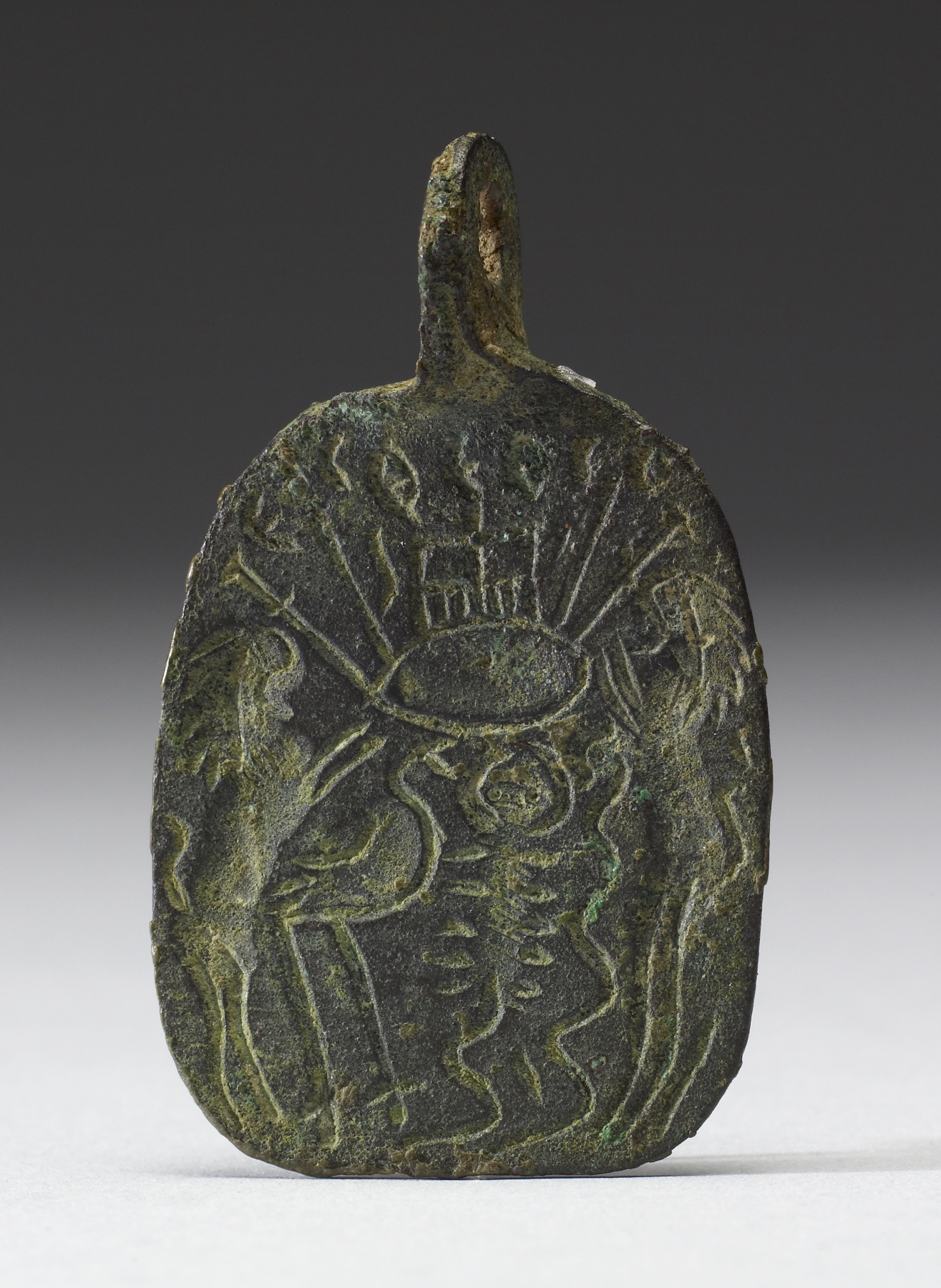 A Byzantine amuletic pendant depicting the “much-suffering eye” attacked by animals and weapons. It illustrates the wider material culture of protective ritual in which Solomonic demonology circulated. Wikimedia Commons; Walters Art Museum image record.
This object is not a page of the Hygromanteia, and it should not be presented as one. Its value is contextual. It shows that protective images and demonological symbolism could move between books and portable objects.
How Ritual Knowledge Became Portable
A ritual exists in time, but a diagram can survive it.
That simple fact helps explain the power of grimoires. Oral instructions disappear when practitioners die. Drawn circles, lists of names, recipes, and diagrams can travel through copying. They can be translated without translating every visual sign. They can be excerpted into new manuscripts.
The manuscript therefore makes ritual portable across generations.
At the same time, portability creates corruption. A copyist may misunderstand Greek. A translator may replace one prayer with another. A spirit name may be misspelled. A diagram may be rotated or simplified. The result is not merely decay; it is the creation of new versions.
Why Magical Names Are So Unstable
Ordinary sentences can be corrected by grammar and meaning. An unfamiliar divine or spirit name is harder to repair.
If a copyist sees a sequence of letters that has no obvious lexical meaning, one small mistake can create a new form. The next scribe faithfully copies the error. Transliteration from Greek to Latin can multiply variants further.
This is especially important in magical texts because practitioners may believe exact names possess power. The textual element that most needs precision is often the element most vulnerable to corruption.
Modern editors compare manuscripts precisely for this reason. Variants can reveal family relationships among texts and the routes through which material traveled.
Did Byzantine Magicians Really Perform These Operations?
A manuscript proves that someone copied the instructions. It does not automatically prove how often every instruction was performed.
Some books are practical manuals. Others are collections, intellectual curiosities, inherited family texts, or prestige objects. A ritual too expensive, dangerous, or elaborate may have been read more often than enacted.
Material evidence—amulets, inscribed objects, ritual spaces, residues, legal records, ecclesiastical condemnations—can strengthen arguments for practice. But historians should resist assuming that every recipe equals a documented event.
The safest conclusion is that Byzantine and later European communities preserved a robust culture of practical ritual knowledge, while the prevalence of specific operations varied.
What Supernatural Claims Can and Cannot Tell Us
The Hygromanteia belongs to a worldview in which spirits, planetary influences, sacred names, and ritual correspondences can have objective effects.
Historians can document that worldview. Anthropologists can study how ritual affects participants and communities. Psychologists can investigate attention, expectation, altered states, and symbolism. Scientists can test claims that produce measurable physical outcomes.
None of these approaches justifies quietly converting historical belief into scientific fact.
If a manuscript says that a particular operation reveals hidden information, the historically secure fact is that the manuscript makes the claim. Whether the operation does so supernaturally is a separate evidential question.
Common Misconception: Solomon Wrote the Hygromanteia
There is no historical evidence that the biblical King Solomon physically authored the surviving Greek Magical Treatise.
The attribution is pseudepigraphic: it assigns the work to an authoritative ancient figure. Pseudepigraphy is common in ancient and medieval esoteric literature and can express lineage, revelation, ideal authorship, or claims to legitimacy.
Calling the book “Solomonic” is historically appropriate if it describes the tradition of attribution. Calling it a manuscript personally written by Solomon is not.
Common Misconception: Hygromanteia Means the Whole Book Is Hydromancy
The label encourages this misunderstanding, but the surviving material is much broader.
Planetary magic, ritual implements, spirit classifications, divination, correspondences, prayers, and magical signs all belong to the tradition. Hydromantic material is part of the picture, not the organizing principle of every section.
Common Misconception: The Key of Solomon Appeared Fully Formed in Latin
The Clavicula Salomonis belongs to a history of transmission. Greek Solomonic texts provide important antecedents for techniques and structures later seen in Latin and vernacular Keys.
The transition involved selection and reorganization, not simply spontaneous invention.
Common Misconception: Every Magical Character Has One Universal Meaning
Some symbols can be traced. Others vary across manuscripts and may be corrupted, stylized, or context-specific.
Modern charts claiming to decode every sign through one “angelic alphabet” often impose order on evidence that is historically more complex.
Common Misconception: Byzantine Christianity Eliminated Magic
Christian authorities repeatedly condemned many magical and divinatory practices. Yet condemnation did not erase them.
Manuscripts such as Harley MS 5596 demonstrate survival and adaptation inside a Christian cultural world. The relationship between institutional religion and magic was contested, porous, and historically variable.
A Symbolic Reading of the Magical Circle
Even without assuming literal spirit manifestation, the circle offers a powerful philosophy of ritual.
Ordinary life is spatially unstructured. Attention moves from task to task. The circle creates a center and boundary. Words, names, directions, and signs define a temporary cosmos.
The practitioner’s first act of power is therefore not domination of a spirit but organization of space.
This is a modern symbolic interpretation, not proof that Byzantine ritualists understood the circle purely psychologically. Historical practitioners could believe the boundary possessed objective sacred efficacy.
A Symbolic Reading of Planetary Timing
Planetary timing can also be read as a philosophy of appropriateness.
Not every action belongs to every moment. Ritual timing insists that intention must encounter circumstance. The practitioner waits, observes, calculates, and acts under chosen conditions.
Modern readers need not accept astrological causation to appreciate the discipline this structure imposes.
A Symbolic Reading of Solomon
Solomon represents ordered intelligence confronting invisible complexity.
In biblical tradition he is wise. In later magical legend his wisdom becomes technical: he names spirits, classifies them, learns their limits, and assigns them tasks.
Symbolically, the Solomonic magician seeks power through knowledge of relationships rather than uncontrolled force.
This may help explain the longevity of the legend. The ideal magician is imagined not as someone who creates chaos but as someone who knows the hidden administration of the cosmos.
Why the Hygromanteia Matters More Than Its Fame Suggests
The Hygromanteia is far less famous among general readers than the Key of Solomon, but historically it may be more revealing.
The later Key shows what Solomonic magic became in western Europe. The Greek Magical Treatise shows an earlier stage in which astrology, divination, Christian ritual language, spirit lore, and practical technology were still visibly embedded in Byzantine manuscript culture.
It therefore helps historians avoid treating Renaissance ceremonial magic as a sudden European invention.
How to Study the Hygromanteia Responsibly
Begin with manuscripts and institutional catalogues. The British Library catalogue for Harley MS 5596 provides a reliable description of the codex and its contents. Its separate record for folios 18v–39v explicitly identifies the Magical Treatise of Solomon.
Next, use a comparative edition rather than assuming one manuscript is the complete original. Ioannis Marathakis’s The Magical Treatise of Solomon, or Hygromanteia translates and arranges material from multiple Greek witnesses and is a major reference point for the modern study of the text.
For transmission, Stephen Skinner’s doctoral research, available through the University of Newcastle record, examines techniques and implements from the Graeco-Egyptian magical papyri through Byzantine Solomonic manuscripts into European grimoires.
For natural materials and planetary correspondences, Giulia Freni’s peer-reviewed study in Studia Ceranea provides a useful scholarly discussion of the Hygromanteia Salomonis alongside medical, astrological, and magical sources.
Finally, compare the text with broader Solomonic traditions without assuming identity. The Testament of Solomon, Sefer HaRazim, the Key of Solomon, the Heptameron, and later grimoires form overlapping but distinct textual worlds.
Frequently Asked Questions
What is the Hygromanteia?
The Hygromanteia is the modern name commonly used for a Byzantine Greek Solomonic magical tradition also called the Magical Treatise of Solomon. It contains planetary, divinatory, ritual, and spirit-related material.
Did King Solomon write the Hygromanteia?
No historical evidence supports direct authorship by the biblical Solomon. The attribution is pseudepigraphic and reflects Solomon’s later reputation as a master of hidden wisdom and spirits.
How old is the Hygromanteia?
Important surviving manuscripts are late medieval or Byzantine. British Library Harley MS 5596 is dated to the fifteenth century. Some techniques and textual layers may preserve older material, but composition should not be confused with the date of a surviving copy.
Why is it called Hygromanteia?
The name is associated with hydromancy or water divination, but modern scholarship and editions emphasize that the larger Magical Treatise contains much more than water divination.
What is Harley MS 5596?
It is a fifteenth-century Greek manuscript in the British Library containing divination, magic, parts of the Testament of Solomon, the Magical Treatise of Solomon, planetary and astrological materials, and other practical texts.
Is the Hygromanteia the same book as the Testament of Solomon?
No. The Testament of Solomon is primarily a narrative demonological work, while the Magical Treatise is more procedural. Harley MS 5596 happens to preserve material from both traditions.
Is the Hygromanteia the same as the Key of Solomon?
Not exactly. The Greek Magical Treatise is an important antecedent of the later Key of Solomon tradition. The European Clavicula developed through translation, selection, and reorganization.
Was the Key of Solomon translated from Hebrew?
The common claim of a direct ancient Hebrew original is not securely established for the familiar European Key. Greek Solomonic manuscript traditions provide a major documented context for its development, while Jewish magical influence entered through multiple historical channels.
What kinds of practices appear in the Hygromanteia?
The tradition includes planetary timing, ritual implements, magical characters, prayers, divination, spirit classifications, natural correspondences, and practical magical procedures.
Are the magical seals scientifically proven to work?
No. Their existence and historical use can be documented, but claims that they compel spirits or produce supernatural effects are matters of traditional belief rather than established scientific fact.
Why is the Hygromanteia important to ceremonial magic?
It preserves an important Byzantine stage in the development of ritual technologies later associated with the Key of Solomon and European grimoire magic.
Conclusion: The Missing Middle of Solomonic Magic
The Hygromanteia matters because it occupies the historical space that popular histories often skip.
One version of the story jumps directly from the biblical Solomon to Renaissance grimoires. Another begins with the Key of Solomon as though ceremonial magic appeared fully formed in Latin manuscripts. The Byzantine Greek evidence reveals a far more interesting middle.
Solomon’s ancient reputation for wisdom expanded through Jewish and Greco-Roman traditions into a reputation for mastery over demons and hidden knowledge. Greek texts such as the Testament of Solomon turned that reputation into narrative. Byzantine practical manuscripts then placed Solomonic authority beside astrology, divination, planetary correspondences, ritual tools, Christian prayers, spirit classifications, and complex diagrams.
Harley MS 5596 makes that world tangible. Its contents show that a fifteenth-century Greek manuscript could hold arithmomancy, cleromancy, demonological narrative, a Magical Treatise of Solomon, angelic and demonic timing, palmomancy, lunar astrology, recipes, planetary plants, and zodiacal knowledge within one codex.
This is not evidence for one secret, unchanged order of magicians transmitting Solomon’s original book for two thousand years. It is evidence for something historically more plausible and more fascinating: a mobile ritual culture in which texts were copied, recombined, reinterpreted, translated, and adapted.
From that culture emerged materials that helped shape the Clavicula Salomonis. As Solomonic texts entered Latin and vernacular Europe, they changed again. Later occultists inherited the result without necessarily knowing how much of its structure belonged to Greek Byzantine predecessors.
The Hygromanteia therefore does not need legendary authorship to be extraordinary. Its importance lies in transmission. It shows how ritual knowledge crosses languages, how diagrams survive when explanations change, how astrology organizes ceremonial time, how sacred names gain authority, and how a biblical king can become the imagined patron of an entire magical technology.
For modern readers, the most responsible approach is neither credulity nor ridicule. We can recognize the supernatural claims as claims, the manuscript as material evidence, and the ritual system as a serious historical attempt to make the cosmos intelligible and actionable.
The deeper secret of the Hygromanteia is not a hidden spell. It is the manuscript history behind one of the most influential families of Western magic.
Sources and References
- British Library, Harley MS 5596, “Divinations, magic, etc.”, fifteenth-century Greek manuscript catalogue record.
- British Library, Harley MS 5596, ff. 18v–39v, “Magical treatise of Solomon.”
- Ioannis Marathakis, The Magical Treatise of Solomon, or Hygromanteia, Sourceworks of Ceremonial Magic.
- Stephen Skinner, Magical Techniques and Implements Present in Graeco-Egyptian Magical Papyri, Byzantine Greek Solomonic Manuscripts and European Grimoires, PhD thesis, University of Newcastle, 2014.
- Giulia Freni, “Herbs as pharmaka: between Medicine, Astrology and Magic,” Studia Ceranea 13.
- Pablo A. Torijano, study of Solomon’s magical wisdom and the Eleazar exorcism tradition in Harvard Theological Review.
- Wikimedia Commons, British Library Harley MS 5596 manuscript image and public-domain status.
- Wikimedia Commons / Walters Art Museum, Byzantine amuletic pendant image record.


