


SEO Title: Oedipus Aegyptiacus Explained: Athanasius Kircher, Hieroglyphs, Hermetic Egypt, and Kabbalah
Meta Description: Explore Athanasius Kircher’s Oedipus Aegyptiacus: his failed hieroglyphic decipherment, real Coptic breakthrough, Hermetic Egypt, Kabbalah, obelisks, symbolism, and influence on Western esotericism.
Suggested Permalink: oedipus-aegyptiacus-kircher-hieroglyphs
Primary Category: Hermeticism
Tags: Athanasius Kircher, Oedipus Aegyptiacus, Hieroglyphs, Hermeticism, Christian Kabbalah, Egyptosophy
Primary Keyword: Oedipus Aegyptiacus
Oedipus Aegyptiacus Explained: Athanasius Kircher, Hieroglyphs, Hermetic Egypt, and the Dream of Universal Wisdom
 Kircher’s symbolic “Egyptian cosmos” from Oedipus Aegyptiacus (1652). The image is a seventeenth-century reconstruction of supposed Egyptian wisdom, not a diagram copied from an ancient Egyptian source. Public domain via Wikimedia Commons.
Introduction: The Most Impressive Wrong Answer in Early Egyptology
Few books in the history of esotericism are as magnificent, ambitious, learned, and fundamentally mistaken as Athanasius Kircher’s Oedipus Aegyptiacus. Published in Rome in several enormous folio volumes between 1652 and 1655, the work attempted nothing less than the recovery of ancient Egypt’s hidden theology, hieroglyphic language, cosmology, priestly wisdom, magic, Kabbalah, astrology, mythology, and universal philosophy.
Kircher believed that Egyptian hieroglyphs were not primarily a normal writing system in which signs represented sounds and words. He treated them instead as compact symbolic images capable of containing entire chains of metaphysical meaning. A short Egyptian inscription might therefore expand, in his interpretation, into an elaborate statement about divine intellect, cosmic harmony, Isis, Osiris, elemental powers, providence, or the structure of creation.
Modern Egyptology demonstrated that these “translations” were overwhelmingly wrong. After the Rosetta Stone supplied a bilingual and trilingual key and Jean-François Champollion announced his decisive phonetic breakthrough in 1822, scholars could read Egyptian as language rather than as a limitless symbolic riddle. Yet dismissing Kircher as merely foolish produces a second historical error. His work was built from serious linguistic study, access to rare manuscripts and antiquities, deep engagement with Renaissance Hermeticism, Christian Kabbalah, classical scholarship, Jesuit global networks, and an early insight that proved genuinely important: Coptic preserved the latest historical stage of the ancient Egyptian language.
Oedipus Aegyptiacus therefore matters not because Kircher secretly solved hieroglyphs before Champollion, and not because his fantastic translations were accurate, but because the book captures a decisive moment when European scholars were moving from Renaissance symbolic antiquity toward modern historical criticism. It is a laboratory for understanding how Hermetic Egypt, comparative religion, antiquarian collecting, missionary linguistics, and early science could coexist in one seventeenth-century mind.
Who Was Athanasius Kircher?
Athanasius Kircher was born in 1602 in Geisa, in the German-speaking lands of the Holy Roman Empire, and entered the Society of Jesus. He became one of the seventeenth century’s most famous polymaths, publishing on magnetism, acoustics, optics, music, geology, volcanoes, languages, China, biblical history, combinatorial knowledge, subterranean phenomena, and ancient religion.
After arriving in Rome in 1635, Kircher became associated with the Collegio Romano, the Jesuits’ major intellectual center. Ingrid Rowland’s University of Chicago study emphasizes that his Roman career combined scholarship with patronage, court culture, printing, collecting, and spectacle. He built devices, organized knowledge visually, corresponded internationally, and cultivated a reputation as someone capable of connecting apparently unrelated domains.
That reputation helps explain the scale of Oedipus Aegyptiacus. Kircher did not view Egyptian hieroglyphs as a narrow philological puzzle. He believed Egypt stood near the beginning of human wisdom and that deciphering its signs would reveal relationships among religion, philosophy, number, language, nature, and sacred history.
Why Egypt Seemed to Contain Primordial Wisdom
Kircher inherited a powerful European myth of Egypt. Greek and Roman authors had long portrayed Egyptian religion as extraordinarily ancient. Renaissance scholars then read texts attributed to Hermes Trismegistus, Plutarch’s On Isis and Osiris, Horapollo’s Hieroglyphica, Neoplatonic philosophy, biblical narratives, and Christian authors together as witnesses to a primordial theology.
In this model, Egypt was not simply one civilization among many. It was a reservoir of ancient wisdom from which Moses, Pythagoras, Plato, and later philosophical traditions might have drawn. The Renaissance concept often called prisca theologia, or “ancient theology,” imagined that fragments of an original divine revelation survived in pagan antiquity and could ultimately be reconciled with Christianity.
SecretMagic’s Hermeticism archive provides broader context for this early modern fascination with ancient Egyptian wisdom. Kircher belonged to that intellectual inheritance, but he also transformed it through Jesuit scholarship, Oriental-language study, antiquarian evidence, and the enormous visual apparatus of Baroque print.
The Hermetic Problem: Ancient Wisdom Built on a Misdated Corpus
Renaissance Hermeticism depended heavily on the belief that writings attributed to Hermes Trismegistus were extremely ancient, perhaps older than Moses. That chronology gave Hermetic ideas enormous authority: if Hermes had anticipated philosophical or theological truths later associated with Christianity, then pagan Egypt could be interpreted as a witness to primordial revelation.
By Kircher’s lifetime, however, Isaac Casaubon had already argued in 1614 that the Greek Hermetic writings were products of the Roman imperial period rather than documents from remote pharaonic antiquity. Kircher did not simply surrender the larger idea of Egyptian primordial wisdom. He continued to build a universal history in which Egypt remained central.
This tension is crucial. Oedipus Aegyptiacus is not a naïve survival untouched by criticism. It is an effort to preserve a theological vision of antiquity in an age when philology was making that vision harder to sustain.
Kircher’s Real Breakthrough: Coptic and Ancient Egyptian
Kircher’s most important Egyptological achievement was not his decipherment of hieroglyphs. It was his recognition of the relationship between Coptic and the language of ancient Egypt.
In Rome he worked with Coptic material at a time when the language was poorly understood in western Europe. His Prodromus Coptus of 1636 and Lingua Aegyptiaca Restituta of 1643 made Coptic grammar and vocabulary far more accessible to European scholars. The University of Chicago account notes that Kircher used an Arabic manuscript containing Coptic grammatical material and regarded Coptic as the surviving descendant of the language once spoken in pharaonic Egypt.
That basic historical connection was correct. Coptic is the latest documented stage of the Egyptian language, written mainly with an alphabet derived from Greek plus additional signs. Champollion later relied heavily on Coptic knowledge when identifying the values and meanings of ancient Egyptian words.
Kircher therefore approached the right linguistic family while applying the wrong theory of how hieroglyphic writing worked.
Why the Hieroglyphs Were So Difficult
Knowledge of how to read formal Egyptian hieroglyphs disappeared in late antiquity. The final known hieroglyphic inscription dates to the fourth century CE, after which centuries passed without a living scribal tradition capable of teaching the system.
European scholars could see hieroglyphs on obelisks, statues, mummy cases, and imported antiquities, but they lacked the kind of controlled bilingual evidence needed to recover the script. They also inherited ancient and Renaissance theories that strongly encouraged symbolic readings.
The British Museum’s history of decipherment explains that scholars long treated hieroglyphs primarily as symbols for concepts rather than as a fully developed written language. That assumption made almost any sufficiently imaginative interpretation possible, because there was no reliable mechanism for testing one symbolic translation against another.
Horapollo and the Trap of Symbolic Reading
One of Kircher’s most influential sources was a Greek work known as the Hieroglyphica, attributed to Horapollo. Rediscovered in the Renaissance, it offered explanations of Egyptian signs in symbolic terms. Some observations may preserve genuine late antique traditions, but the work does not provide a functional guide to the Egyptian writing system.
If one begins with Horapollo’s model, an image of an animal or object invites allegorical interpretation. A beetle may become an entire theological statement; a hawk can open into a chain of solar or royal correspondences.
Kircher expanded this method on a monumental scale. Instead of asking first what sound or word a sign represented, he asked what hidden concept the image might encode. The result was intellectually creative but linguistically uncontrolled.
How Kircher Thought a Hieroglyph Worked
For Kircher, a hieroglyph could behave almost like a compressed emblem. Early modern emblem books paired images, mottos, and explanatory texts to generate layered moral or philosophical meanings. Kircher projected an even more ambitious form of this symbolic logic onto ancient Egyptian writing.
A short sequence of signs might, in his system, express a proposition involving divine spirit, cosmic generation, celestial forces, elemental harmony, and ritual order. Because each image could unfold into multiple analogies, the translation often became far longer than the original inscription.
Modern readers sometimes laugh at these expansions, but the method was coherent within Kircher’s theory of sacred language. He believed ordinary alphabetic writing fragmented thought into arbitrary sounds, whereas ancient hieroglyphs could communicate ideas more directly through symbolic forms.
The Sphinx and the Title “Oedipus Aegyptiacus”
The title announces Kircher’s self-image. In Greek myth, Oedipus solves the riddle of the Sphinx. Kircher presents himself as a new Oedipus confronting the Egyptian Sphinx: the apparently unreadable world of hieroglyphs.
The book’s famous frontispiece turns scholarship into sacred drama. Egypt is personified as a repository of mysteries waiting to be unveiled, while Kircher’s intellectual project promises to defeat obscurity through universal learning.
This imagery matters because Baroque scholarship was also performance. Large illustrated folios communicated patronage, authority, and magnificence. A reader did not merely receive an argument; the book staged the recovery of lost wisdom.
The Obelisks of Rome as an Open-Air Archive
Rome gave Kircher extraordinary access to Egyptian monuments. Ancient Roman emperors had transported obelisks from Egypt, and early modern popes re-erected several of them in prominent urban spaces.
For Kircher, these obelisks were gigantic documents written in a lost sacred language. He copied, analyzed, and interpreted their inscriptions, sometimes in works devoted to specific monuments.
The Yale Peabody Museum’s “Echoes of Egypt” project highlights both sides of his achievement. Kircher carefully documented Egyptian inscriptions and recognized important linguistic connections, yet his actual hieroglyphic translations were based on an incorrect symbolic method. Yale gives a striking example in which Kircher turns a brief funerary formula into an elaborate mythological exposition.
This contrast is central to understanding him: careful antiquarian observation could coexist with profoundly mistaken interpretation.
Obeliscus Pamphilius and the Fountain of the Four Rivers
Kircher’s Obeliscus Pamphilius, published in 1650, emerged from the project surrounding the obelisk erected above Gian Lorenzo Bernini’s Fountain of the Four Rivers in Piazza Navona.
The monument brought together papal patronage, ancient Egyptian material, Baroque sculpture, engineering, and global symbolism. Kircher’s interpretation treated the hieroglyphs as evidence of profound Egyptian theology and became a public demonstration of his expertise before the publication of Oedipus Aegyptiacus.
It is an excellent example of how knowledge, power, and spectacle intersected in seventeenth-century Rome. Deciphering Egypt was not only an academic exercise. It helped present the papal city as heir to ancient universal wisdom.
The Mensa Isiaca: A False Ancient Key That Looked Perfect
Another object that influenced Kircher was the Mensa Isiaca, or Table of Isis, a bronze tablet decorated with Egyptianizing figures and signs. Renaissance scholars treated it as an important artifact of Egyptian religion.
Modern scholarship identifies it as a Roman-era Egyptianizing object rather than an authentic pharaonic hieroglyphic document. The University of Chicago account stresses an even more damaging problem for Kircher’s project: many of its apparently hieroglyphic signs are decorative pseudo-writing.
In other words, Kircher was sometimes trying to decipher symbols that had never encoded Egyptian language in the first place.
The episode is a powerful lesson in source criticism. A beautiful old artifact can be genuinely ancient while still being the wrong kind of evidence for the question being asked.
Oedipus Aegyptiacus as an Encyclopedia of Comparative Religion
The book ranges far beyond Egypt. Kircher compares Hebrew, Chaldean, Greek, Roman, Persian, Indian, Chinese, Japanese, and American traditions. He investigates gods, alphabets, numbers, astrology, sacred names, Kabbalah, amulets, mythology, cosmology, ritual, and natural philosophy.
By modern standards, many comparisons are historically unreliable. Similar-looking symbols are sometimes treated as evidence of common origin without adequate proof. Indigenous traditions can be forced into biblical genealogies. Complex religions are interpreted through Christian categories.
Yet the encyclopedic impulse is historically significant. Kircher imagined humanity’s religions as a vast archive whose fragments could be compared in search of an original truth.
That comparative ambition would survive even after his particular theological conclusions fell out of favor.
Christian Kabbalah Inside an Egyptian Book
One of the striking features of Oedipus Aegyptiacus is the amount of Jewish and Kabbalistic material incorporated into a work ostensibly devoted to Egypt.
Kircher belonged to the Christian Kabbalistic tradition that had developed since the Renaissance through figures such as Giovanni Pico della Mirandola, Johannes Reuchlin, and later Christian Hebraists. Hebrew divine names, the sefirot, numerical correspondences, and letter symbolism could be interpreted as ancient witnesses compatible with Christian theology.
This was not the same thing as Jewish Kabbalah. Christian authors selected, translated, reorganized, and theologized Jewish mystical materials for Christian purposes.
SecretMagic’s article on Sefer Yetzirah offers useful background for the much older Jewish cosmological traditions that early modern Christian Kabbalists encountered and transformed.
Kircher’s Tree of Life
One of the most reproduced images associated with Kircher is his diagram of the Kabbalistic Tree of Life. It arranges ten sefirot and connecting paths within a Christian Kabbalistic interpretive framework.
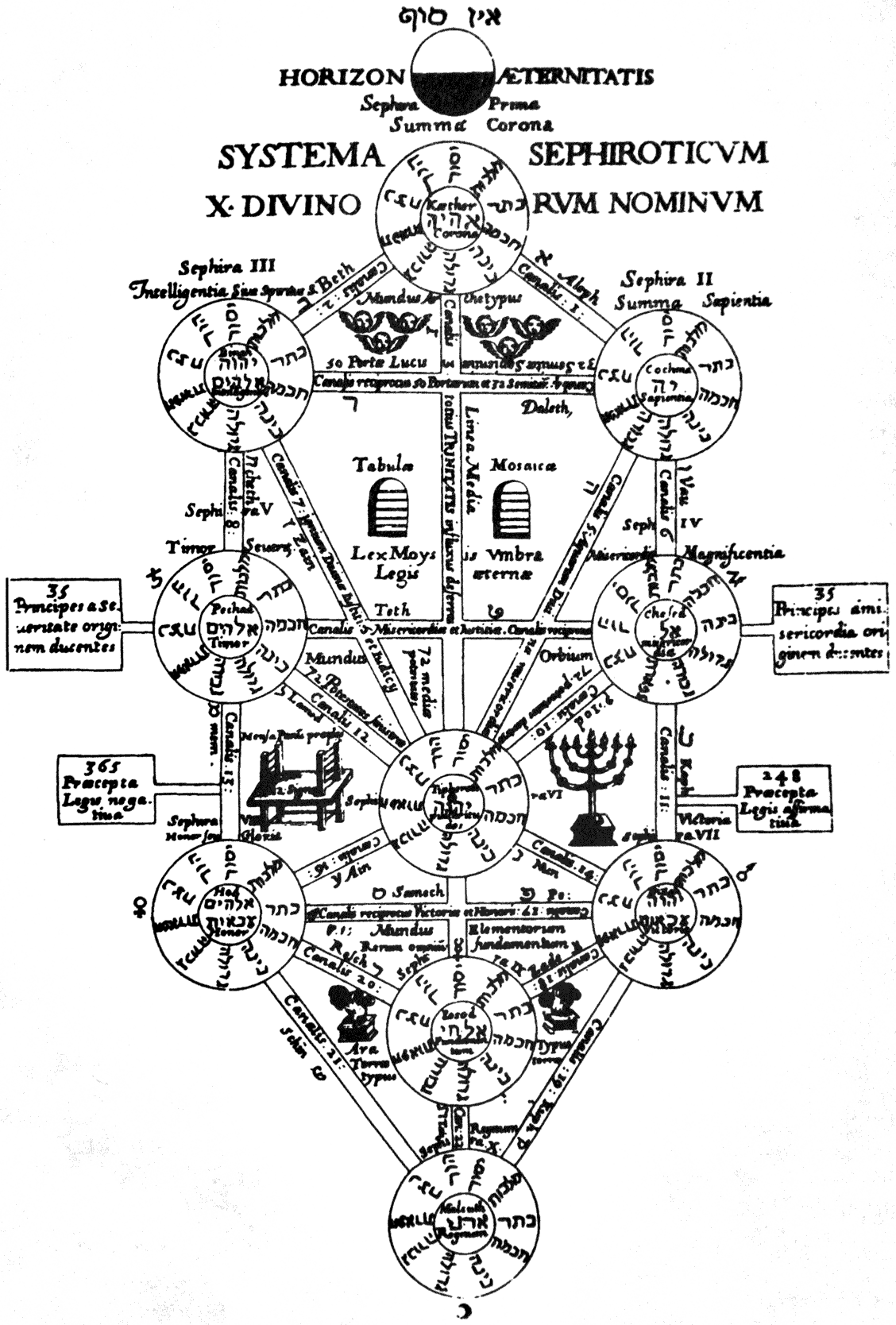 Kircher’s Tree of Life from Oedipus Aegyptiacus (1652). It is an early modern Christian Kabbalistic diagram, not a neutral reproduction of one timeless Jewish Kabbalistic scheme. Public domain.
The diagram later became highly influential in Western esoteric visual culture. But modern occultists should resist reading nineteenth-century Hermetic Qabalah backward into Kircher without qualification. The image belongs to a seventeenth-century Christian project that sought correspondences among Jewish tradition, Christianity, ancient theology, number, and universal symbolism.
The Seventy-Two Names and Universal Sacred Language
Kircher also explored traditions surrounding divine names and the seventy-twofold name of God, materials that had circulated through Jewish, Christian, magical, and Kabbalistic sources.
His visual diagrams arrange Hebrew names alongside other languages and sacred correspondences, turning philology into cosmography. For Kircher, languages were not isolated human inventions. They preserved traces of an ancient order and could be compared as parts of a universal history.
 Kircher’s 1653 diagram of divine names and languages, combining Hebrew, sacred-name traditions, and universalizing comparison. Public domain; digitized from the National Library of Poland.
The diagram illustrates both Kircher’s brilliance and his methodological danger: he could organize enormous quantities of material into a visually persuasive system even when the historical relationships among those materials were uncertain.
Egypt, Moses, and the Search for One Ancient Theology
Biblical history was fundamental to Kircher’s worldview. Egypt, Moses, Hebrew learning, pagan philosophy, and Hermetic traditions were not separate academic departments. They were episodes in one sacred history of humanity.
This encouraged him to search for traces of shared primordial knowledge across cultures. Egyptian symbols could therefore be interpreted through Hebrew theology, Greek philosophy, and Christian revelation.
The method made ancient religions commensurable, but it also risked erasing their differences. Modern history of religions generally begins from a different principle: apparent parallels must be demonstrated through chronology, transmission, language, and context rather than assumed because they fit a universal scheme.
Magic, Amulets, and the Problem of “Egyptian Wisdom”
Oedipus Aegyptiacus contains discussions and images related to amulets, astrology, sacred numbers, talismanic traditions, and ritual symbolism. These materials later made the book especially attractive to occult readers.
It is important to distinguish three levels. First, ancient Egyptians genuinely used amulets, ritual images, spoken formulas, divine names, and protective texts. Second, Greek, Roman, Jewish, Christian, and Islamic cultures developed their own forms of Egyptianizing magic over many centuries. Third, Kircher reconstructed “Egyptian wisdom” through seventeenth-century categories and sources.
The third layer is not a transparent window onto the first.
A Kircherian talisman may tell us much about early modern Egyptosophy even when it tells us little about how a priest in the New Kingdom actually understood a particular sign.
Kircher and Astrology
Astrology appears throughout Kircher’s vast comparative system. Oedipus Aegyptiacus includes representations of supposed Egyptian astrological structures and correspondences.
Seventeenth-century European intellectual culture had not yet separated astronomy, astrology, medicine, theology, and natural philosophy according to modern boundaries. Even thinkers skeptical of judicial astrology might still employ planetary correspondences or ancient astrological texts as historical evidence.
Kircher’s Egyptian astrology should therefore be read as part of a wider attempt to map celestial order onto religious history, not as a recovered pharaonic astrology manual.
Harpocrates and the Theology of Silence
Kircher was fascinated by Harpocrates, the Greco-Roman form of the Egyptian child-god Horus. In classical reception, the gesture of a finger to the mouth was widely interpreted as a sign of silence, even though its original Egyptian meaning concerned childhood.
For Kircher, Harpocrates became an ideal emblem of esoteric wisdom concealed beneath symbols. Truth was not always meant to be stated nakedly. Nature and divinity hid meaning in images, riddles, correspondences, and veiled forms.
This idea helps explain why he was predisposed to interpret hieroglyphs symbolically. A script that looked mysterious was assumed to have been designed to preserve mysteries.
The Baroque Love of the Emblem
Kircher’s method becomes more understandable when placed beside the emblem culture of the sixteenth and seventeenth centuries. Emblems combined pictures, mottos, and commentary to communicate layered moral or philosophical ideas.
A single image could therefore legitimately generate many sentences of interpretation. This was not considered a defect; it was the point.
Hieroglyphs appeared to Kircher as the perfect ancient version of the emblematic ideal: compact images containing more meaning than alphabetic prose.
The historical irony is that the very visual richness that made Egyptian writing look like pure symbolism helped obscure the fact that hieroglyphs also encoded sounds, grammatical structures, names, and ordinary language.
Why Kircher’s Translations Could Not Be Falsified Easily
A good decipherment system must make predictions. If a sign has a phonetic value in one inscription, it should behave consistently enough in other inscriptions to generate recognizable words and grammatical patterns.
Kircher’s symbolic method lacked this kind of constraint. Because one image could represent a network of concepts, an interpretation could expand or change according to theological context.
This gave the method extraordinary flexibility—and very weak falsifiability.
The lesson extends beyond Egyptology. Explanatory systems become dangerous when every possible result can be absorbed as confirmation. Historical and scientific methods gain strength from rules that allow evidence to prove an interpretation wrong.
The Rosetta Stone Changed the Kind of Question Scholars Could Ask
The Rosetta Stone, discovered in 1799, preserved a decree in hieroglyphic, Demotic, and Greek scripts. Because scholars could read Greek, they now possessed a controlled comparative text rather than isolated images.
Thomas Young and Jean-François Champollion made crucial advances by recognizing phonetic elements, especially in royal names. The British Museum dates the decisive public breakthrough to Champollion’s 1822 letter explaining phonetic hieroglyphs.
The transformation was methodological. Scholars no longer had to ask what an owl, sun disk, or seated figure might symbolize in the abstract. They could test whether signs represented sounds, words, grammatical elements, or semantic classifiers within an actual language.
What Champollion Saw That Kircher Did Not
Champollion recognized that Egyptian writing was mixed. Hieroglyphs could function phonographically, representing sounds; logographically, representing words; and determinatively, helping classify meanings.
This mixed system explains why purely pictorial interpretation fails. A drawing of an object does not necessarily mean that object in a given inscription.
Kircher’s knowledge of Coptic put him unexpectedly close to the right linguistic world, but his symbolic theory prevented him from exploiting that insight consistently.
He had part of the dictionary but the wrong theory of writing.
Was Kircher Completely Wrong About Hieroglyphs?
No—but the qualification must be stated carefully. His complete translations were not valid decipherments. Yet he occasionally made observations that later scholarship could recognize as partially correct.
Stanford’s Kircher gallery notes, for example, a case in which he associated the water sign with an m value. More broadly, his insistence on studying Coptic was genuinely productive.
He also documented inscriptions, assembled visual evidence, stimulated interest in Egyptian studies, and treated the material as worthy of sustained scholarly investigation.
The appropriate verdict is therefore neither “secret genius who solved Egypt” nor “total fraud.” Kircher was a serious scholar operating with an incorrect central theory.
Why Historians No Longer Treat Kircher as a Joke
Daniel Stolzenberg’s Egyptian Oedipus: Athanasius Kircher and the Secrets of Antiquity, published by the University of Chicago Press, is especially important for correcting the caricature.
Stolzenberg argues that Kircher should not be dismissed as an eccentric leftover from the Renaissance. His work embodied real tensions in seventeenth-century scholarship: between erudition and criticism, universal history and linguistic specialization, theological expectations and antiquarian evidence.
Kircher participated in emerging Oriental studies, sought manuscripts from the eastern Mediterranean, used Arabic and Coptic materials, and operated within sophisticated networks of scholars, missionaries, patrons, and collectors.
His mistakes were not random. They were the mistakes of a transitional intellectual world.
The Jesuit Global Network Behind the Book
Kircher’s scholarship depended on the extraordinary geographic reach of the Society of Jesus. Jesuit missionaries and correspondents supplied information, manuscripts, specimens, descriptions, maps, linguistic data, and reports from regions far beyond Rome.
This global network made Kircher’s books encyclopedic in a way that would have been nearly impossible for an isolated scholar.
It also introduced serious biases. Missionary reports were shaped by Christian theological assumptions, colonial encounters, translation problems, and the desire to fit unfamiliar cultures into biblical or classical frameworks.
Oedipus Aegyptiacus therefore belongs both to the history of global knowledge exchange and to the history of European appropriation and misclassification.
Censorship, Patronage, and What Could Be Printed
Seventeenth-century scholarship did not operate within a modern secular university system. Jesuit discipline, ecclesiastical review, princely patronage, and Roman politics shaped publication.
Kircher dedicated major works to powerful patrons and skillfully navigated the cultural world of papal Rome. The enormous expense of illustrated folio printing made patronage essential.
Stolzenberg’s research emphasizes that censorship and scholarly ambition were not separate topics. The boundaries of acceptable antiquarian speculation affected how pagan theology could be described and reconciled with Christianity.
The universal Christian framework of Oedipus Aegyptiacus was therefore theological conviction, intellectual method, and publishing condition at once.
The Images Are Part of the Argument
Kircher’s diagrams are not decorative extras. They do philosophical work.
Circles, trees, correspondences, cosmic figures, linguistic wheels, amulets, deities, and symbolic tables make relationships visible. A reader can perceive at a glance that Hebrew names, planetary structures, divine hierarchies, and ancient religions belong—according to Kircher—to one connected order.
This visual method is one reason the book remained influential even after its decipherments failed. Images can outlive arguments.
Modern occult diagrams descended from or influenced by Kircher can therefore preserve his universalizing imagination long after readers have forgotten the seventeenth-century theological context that produced it.
The Pan Illustration and Syncretic Interpretation
Kircher’s pages often transform classical gods into parts of a universal symbolic system. His illustration of Pan, for example, belongs to a tradition in which the god’s body can represent cosmic totality and natural correspondences.
 Kircher’s illustration of Pan from Oedipus Aegyptiacus. Wellcome Collection, CC BY 4.0.
Such imagery illustrates Kircher’s syncretic habit. Egyptian, Greek, biblical, Kabbalistic, and natural-philosophical traditions could be interpreted as partial expressions of one underlying truth.
Modern scholarship instead asks first how each symbol functioned within its own historical tradition before tracing demonstrated lines of borrowing or reinterpretation.
Egyptosophy Versus Egyptology
Yale’s “Echoes of Egypt” exhibition uses the useful term Egyptosophy for later cultural constructions of Egypt as a source of secret wisdom. Egyptology, by contrast, is the scholarly study of ancient Egypt through language, archaeology, material culture, history, and critical method.
Kircher sits precisely at the unstable boundary between them.
His work helped advance serious study of Coptic and Egyptian antiquities, yet his broader interpretive system turned Egypt into a symbolic mirror for Christian-Hermetic universalism.
The distinction remains useful today. A modern occult system inspired by Isis, Thoth, pyramids, or hieroglyphs can be culturally meaningful without being an accurate reconstruction of ancient Egyptian religion.
Common Misconception: Kircher Deciphered Hieroglyphs Before Champollion
He did not. Kircher produced elaborate interpretations of hieroglyphic inscriptions, but they do not constitute a correct decipherment of the script.
His genuine achievement was recognizing the importance of Coptic and preserving Egyptian materials for study. The phonetic and grammatical decipherment required evidence and methods developed later, especially through the Rosetta Stone, Thomas Young, and Champollion.
Common Misconception: Kircher Was Simply a Fraud
Kircher certainly promoted his authority energetically, and some contemporaries criticized his credulity. But describing him as merely a con artist ignores the depth of his scholarship, his linguistic work, his experimental interests, his manuscript research, and the historical assumptions he inherited.
A more useful interpretation is that he was often brilliant inside a framework that allowed persuasive but wrong conclusions.
Common Misconception: Oedipus Aegyptiacus Preserves Authentic Egyptian Kabbalah
The Kabbalistic material in the book belongs to early modern Christian Kabbalah and to Kircher’s comparative project. Kabbalah itself developed within Jewish religious history, not in pharaonic Egypt.
Kircher’s effort to connect Hebrew mystical structures with Egyptian antiquity is historically important as reception, not as evidence that ancient Egyptian priests used the sefirotic Tree of Life.
Common Misconception: Every Egyptian-Looking Image in the Book Is Ancient Egyptian
Many illustrations reproduce or adapt ancient material, but others are early modern reconstructions, comparative diagrams, Roman Egyptianizing objects, or images shaped by Kircher’s theories.
Provenance matters. A seventeenth-century engraving “of Egyptian cosmology” may tell us far more about Baroque Europe than about New Kingdom theology.
Common Misconception: Symbolic Meanings in Hieroglyphs Are Always False
Modern decipherment did not prove that ancient Egyptian writing lacked symbolism. Signs could carry visual associations, wordplay, religious meanings, and complex graphic relationships.
What failed was Kircher’s assumption that symbolic interpretation could replace linguistic decipherment.
Egyptian texts are language. Their symbolism becomes historically meaningful after, not instead of, reading the words and grammar.
A Symbolic Reading of Kircher’s Failure
Kircher’s failure is philosophically interesting because it demonstrates how intelligence can deepen error when the starting assumptions are wrong.
He possessed enormous learning. He gathered languages, antiquities, classical texts, theological traditions, and diagrams. Each new piece of evidence could be incorporated into his universal system.
The system became more impressive as it became less testable.
For modern students of esotericism, this is a useful warning. Complexity is not proof. A beautiful network of correspondences can be meaningful symbolically while remaining historically unsupported.
A Symbolic Reading of the Sphinx
Kircher chose the Sphinx because it represented hidden meaning waiting for a solver. But the history of decipherment produces a different symbolic lesson.
The Sphinx was not defeated by a more elaborate allegory. It was defeated by constraints: repeated names, comparative scripts, phonetic values, grammar, and evidence that could disconfirm a hypothesis.
Symbolically, the transition from Kircher to Champollion is a movement from the universe as riddle to the text as language.
Both approaches seek meaning. They differ in how meaning is disciplined.
A Symbolic Reading of Universal Wisdom
Kircher’s dream that all religions and sciences form one connected body of truth continues to attract modern readers.
At its best, the dream encourages intellectual curiosity across boundaries. It refuses to assume that language, astronomy, ritual, music, and philosophy are unrelated.
At its worst, it can erase cultural difference by forcing every tradition into one preselected scheme.
A responsible modern version of universal curiosity therefore needs historical humility: comparison should begin after each tradition has been studied on its own terms.
How Oedipus Aegyptiacus Influenced Western Esotericism
Even after Kircher’s hieroglyphic method lost credibility, his images and synthetic habits survived. Early modern and later occultists continued to imagine Egypt as a source of primordial mysteries. Masonic Egyptian rites, nineteenth-century occultism, Hermetic Qabalah, ceremonial magic, Theosophy, and modern esoteric art all inherited versions of the Egyptosophical imagination.
Kircher was not the sole source of those movements, but his books supplied a rich visual and conceptual archive.
His Tree of Life became particularly important in the history of Western esoteric diagrams. His treatment of sacred names, planetary correspondences, Egyptian gods, and universal symbolism helped normalize a style of synthesis in which multiple traditions could be arranged into one occult map.
Kircher, Agrippa, and the Renaissance System of Correspondences
Kircher’s universalism also belongs to the broader history of Renaissance and early modern correspondence thinking. Cornelius Agrippa’s Three Books of Occult Philosophy had systematized relationships among elemental, celestial, and intellectual worlds.
SecretMagic’s study of Agrippa’s three worlds of magic provides a useful comparison. Agrippa and Kircher differed in context and purpose, but both demonstrate how premodern scholars could treat symbols, stars, numbers, divine names, natural objects, and spiritual hierarchies as interlocking levels of one cosmos.
Kircher’s distinct contribution was to make Egypt one of the grand historical keys to that cosmos.
Kircher and the Emerald Tablet Tradition
The early modern fascination with Egypt also overlapped with the history of the Emerald Tablet, a short alchemical text attributed to Hermes Trismegistus whose actual textual history runs through Arabic and Latin traditions rather than directly to a surviving pharaonic inscription.
SecretMagic’s article on the Emerald Tablet’s Arabic origins illustrates the same methodological lesson: “Egyptian” or “Hermetic” authority in European esotericism can be historically powerful even when the text’s real transmission is later and more complicated than legend suggests.
Kircher’s Egypt belongs to that history of imagined antiquity.
What Modern Egyptology Reveals Instead
Once Egyptian texts became readable, ancient Egypt turned out to be both less like Kircher’s dream and more interesting than it.
Hieroglyphic and cursive texts preserve royal decrees, hymns, funerary compositions, letters, administrative records, wisdom literature, medical texts, ritual instructions, legal documents, jokes, accounts, biographies, and prayers.
The British Museum emphasizes that decipherment opened not a single secret theology but an enormous civilization of ordinary and extraordinary writing.
Ancient Egyptian religion was certainly symbolic, ritualized, magical in many historical senses, and deeply concerned with cosmic order. But those realities can now be studied from Egyptian-language sources instead of being reconstructed primarily through Greek and early modern fantasies.
Why Oedipus Aegyptiacus Still Deserves to Be Read
The book remains valuable for at least four reasons.
First, it is a masterpiece of Baroque visual scholarship. Second, it documents the prehistory of Egyptology and the importance of Coptic studies. Third, it is a major source for understanding Christian Hermeticism, Kabbalah, comparative religion, and Egyptosophy. Fourth, it teaches an unusually clear methodological lesson about the difference between persuasive symbolism and controlled decipherment.
Reading Kircher with modern Egyptology beside him creates a productive double vision. One sees both the actual ancient inscription and the enormous symbolic universe an early modern scholar projected onto it.
How to Study Kircher Responsibly
Start with institutional and academic sources rather than modern occult summaries. Ingrid Rowland’s University of Chicago essay gives an excellent overview of Kircher’s Roman context, Coptic work, sources, and hieroglyphic project. Daniel Stolzenberg’s Egyptian Oedipus is the major modern monograph for understanding his scholarship without caricature.
The Yale Peabody Museum’s Echoes of Egypt project provides a concise comparison between Kircher’s symbolic translations and modern readings. Stanford University’s Kircher image gallery makes many original diagrams accessible. For the actual decipherment of Egyptian, the British Museum’s hieroglyph resources and decipherment timeline provide authoritative context.
When encountering a Kircher image online, verify the volume, page, and subject before repeating a modern caption. Many diagrams circulate detached from their original argument.
Frequently Asked Questions
What is Oedipus Aegyptiacus?
Oedipus Aegyptiacus is Athanasius Kircher’s monumental seventeenth-century study of ancient Egypt, hieroglyphs, religion, languages, mythology, Kabbalah, astrology, and supposed universal wisdom, published in Rome in multiple volumes beginning in 1652.
Did Athanasius Kircher really decipher Egyptian hieroglyphs?
No. His elaborate symbolic “translations” were largely incorrect. The decisive decipherment came much later through the Rosetta Stone and the work of Thomas Young and Jean-François Champollion.
What did Kircher get right about ancient Egyptian?
Most importantly, he recognized that Coptic was historically related to ancient Egyptian and made Coptic linguistic material more accessible in Europe. That insight later became important for genuine decipherment.
Why did Kircher think hieroglyphs were symbolic?
He inherited ancient and Renaissance traditions, especially Horapollo and emblematic theories, that treated hieroglyphs as visual carriers of hidden concepts rather than primarily as a writing system representing language.
Was Kircher a Hermeticist?
Kircher worked within a Christian intellectual environment deeply influenced by Hermetic and prisca-theologia traditions. He integrated supposed Egyptian wisdom into a Christian universal history, though his exact relationship to “Hermeticism” differs from later occult usage of the term.
Why is Kabbalah in a book about Egypt?
Kircher believed Hebrew, Egyptian, Chaldean, Greek, and other wisdom traditions preserved connected fragments of primordial revelation. He therefore incorporated Christian interpretations of Jewish Kabbalah into his Egyptian synthesis.
Is Kircher’s Tree of Life authentically Jewish Kabbalah?
It uses Kabbalistic structures and Hebrew material but belongs to an early modern Christian Kabbalistic context. It should not be treated as a timeless or neutral diagram of all Jewish Kabbalah.
What is Egyptosophy?
Egyptosophy is a useful modern term for later cultural and esoteric constructions of Egypt as a source of secret wisdom. It differs from Egyptology, which studies ancient Egypt through critical historical, linguistic, archaeological, and material evidence.
Why is Oedipus Aegyptiacus still important if it was wrong?
Because it shaped European ideas about Egypt, preserved valuable antiquarian material, advanced Coptic studies, influenced Western esoteric imagery, and illustrates the transition from Renaissance symbolic scholarship toward modern historical method.
Are Kircher’s occult diagrams ancient Egyptian diagrams?
Generally no. They are early modern constructions, adaptations, or comparative diagrams created within Kircher’s seventeenth-century system, even when they incorporate ancient motifs or artifacts.
Did ancient Egyptian hieroglyphs have symbolic meaning at all?
Yes. Egyptian writing could exploit visual symbolism and wordplay. The error is to assume symbolism replaces language. Hieroglyphs form a real writing system with phonetic, lexical, and grammatical functions.
Is Oedipus Aegyptiacus useful for practicing ancient Egyptian magic?
It is more reliable as a source for seventeenth-century Christian-Hermetic Egyptosophy than as a practical reconstruction of pharaonic ritual. Ancient Egyptian ritual should be studied through Egyptian-language texts, archaeology, and modern Egyptological scholarship.
Conclusion: Kircher’s Egypt Was Wrong, but Historically Powerful
Athanasius Kircher failed to decipher Egyptian hieroglyphs, yet the magnitude of that failure is exactly what makes Oedipus Aegyptiacus so revealing.
He stood before genuine ancient monuments with an extraordinary library of languages, myths, theological systems, artifacts, manuscripts, and correspondences. He understood one crucial fact: Coptic was connected to ancient Egyptian. He knew that the hieroglyphs represented a lost intellectual world worth recovering. He gathered evidence on a scale few of his contemporaries could match.
But he asked the signs to be something they were not.
Instead of treating them first as language, he treated them as gateways into a universal symbolic theology. Once that assumption was accepted, every bird, serpent, star, deity, and geometric relation could open into an immense network of meaning. The resulting interpretations were elegant, encyclopedic, and impossible to control.
Champollion’s breakthrough two centuries later did not reveal a smaller Egypt. It revealed a larger one. Once hieroglyphs could be read as language, Egyptians themselves began to speak through prayers, biographies, tax records, hymns, funerary compositions, legal texts, jokes, royal inscriptions, medical writings, and ritual documents. The civilization no longer needed to be reduced to a single secret doctrine.
Kircher nevertheless left a powerful legacy. His images fed the Western esoteric imagination. His Christian Kabbalistic diagrams entered later occult visual culture. His fascination with sacred correspondences helped preserve the idea that religion, language, cosmos, and symbol could be studied together. His Coptic work genuinely advanced European knowledge.
Most importantly, his career demonstrates that historical error and intellectual seriousness can coexist.
Oedipus Aegyptiacus should therefore be read neither as authentic pharaonic revelation nor as a ridiculous curiosity. It is a monument to the early modern dream that the universe formed one readable symbolic book—and to the moment when philology began to teach Europe that ancient cultures had languages and histories more resistant to universal schemes than that dream allowed.
Kircher’s Sphinx was not finally solved by finding a deeper allegory. It was solved by learning how the Egyptians actually wrote.
That may be the most valuable esoteric lesson in the book: mystery deserves imagination, but knowledge also requires a method capable of telling us when our most beautiful interpretation is wrong.
Sources and References
- Ingrid D. Rowland, “Athanasius Kircher and the Egyptian Oedipus,” University of Chicago Library.
- Daniel Stolzenberg, Egyptian Oedipus: Athanasius Kircher and the Secrets of Antiquity, University of Chicago Press, 2013, via Oxford Academic.
- Yale Peabody Museum, “Obelisci Aegyptiaci,” Echoes of Egypt.
- Stanford University, “Image Gallery from the Works of Athanasius Kircher.”
- British Museum, “Hieroglyphs: Unlocking Ancient Egypt.”
- British Museum, “Hieroglyphs Resources.”
- British Museum, “How Egyptian Hieroglyphs Were Decoded: A Timeline to Decipherment.”
- Wikimedia Commons, Oedipus Aegyptiacus public-domain image archive.


