


SEO Title: Orphic Gold Tablets: Ancient Greek Afterlife Instructions, Orpheus, Dionysus, and Memory
Meta Description: Explore the Orphic gold tablets buried with ancient Greek initiates: their afterlife instructions, Lake of Memory, Persephone, Dionysus, reincarnation debates, Derveni context, and what scholars really mean by “Orphism.”
Suggested Permalink: orphic-gold-tablets-afterlife
Primary Category: Ancient Mystery Traditions
Tags: Orphic Gold Tablets, Orpheus, Dionysus, Ancient Greek Religion, Mystery Cults, Greek Afterlife
Primary Keyword: Orphic gold tablets
Orphic Gold Tablets: The Ancient Greek Afterlife Instructions Buried with the Dead
 A fourth-century BCE gold tablet from Thessaly, now in the J. Paul Getty Museum, bearing instructions for the deceased. Photograph by Remi Mathis, CC BY-SA 3.0, via Wikimedia Commons.
Introduction: Tiny Pieces of Gold and an Enormous Question About Death
Among the most extraordinary religious documents to survive from the ancient Greek world are pieces of gold so small that some could rest comfortably on a fingertip. They were folded, rolled, placed on the body, put inside a pendant, or deposited beside the dead. Scratched into their thin surfaces were instructions, declarations, names, passwords, warnings about springs in the Underworld, and statements of divine identity.
Modern scholars usually call them the “Orphic gold tablets,” “Orphic gold leaves,” or Bacchic-Orphic lamellae. The quotation marks that specialists often put around the word “Orphic” are important. The tablets have long been associated with Orpheus, Dionysian mysteries, purification, and beliefs about the soul, but there was no centralized Orphic church issuing identical burial texts across the Mediterranean. The surviving tablets vary in wording, date, region, and ritual context. Some mention Dionysus or Persephone more clearly than Orpheus. Others never name Orpheus at all.
What unites many of them is more concrete: they were intentionally buried with particular people who expected death to involve a journey requiring knowledge. The dead might need to avoid the wrong spring, approach the Lake of Memory, answer guardians correctly, declare themselves children of Earth and starry Heaven, identify themselves as pure, or announce that Bacchios had released them. These texts are therefore among the rare ancient Greek documents that speak from inside specialized expectations about the afterlife.
The tablets do not scientifically establish that an Underworld, reincarnation cycle, divine ancestry, or supernatural guardians objectively exist. They document what certain ancient people believed, hoped, performed, and paid to preserve at death. Precisely because the pieces are small, their historical implications are large: they force us to reconsider the idea that ancient Greek religion had one simple view of death.
Why Scholars Put “Orphic” in Quotation Marks
For more than a century, historians used “Orphism” as though it named a relatively coherent religious movement with a fixed theology: humanity was supposedly born from the ashes of Titans who killed Dionysus, the soul possessed a divine element imprisoned in a Titanic body, ritual purification released it from reincarnation, and Orpheus supplied the sacred revelation.
Parts of that reconstruction are based on genuine ancient evidence. The problem is chronology and combination. Not every component appears together in early sources. Radcliffe Edmonds and other modern scholars have shown that the once-popular doctrine of a specifically “Orphic original sin” was assembled by combining sources separated by centuries. The explicit story that humans arose from the remains of the Titans is securely articulated only in much later evidence.
The Cambridge volume The “Orphic” Gold Tablets and Greek Religion deliberately foregrounds the problem. One of its central questions is whether the gold leaves should be called Orphic at all. The term remains useful because the tablets belong to a religious environment in which poems attributed to Orpheus, Dionysian initiation, special knowledge, purity, and postmortem privilege overlap. It becomes misleading when treated as the name of a unified denomination.
A better model is to imagine networks of texts, ritual specialists, initiates, local traditions, and overlapping myths. Orpheus supplied authority. Dionysus could supply initiation and release. Persephone could rule access to the blessed dead. Individual communities adapted this symbolic vocabulary in different ways.
Who Was Orpheus to Ancient Greeks?
Orpheus was not a documented historical founder in the modern sense. He was a legendary singer, poet, ritual authority, and traveler to the Underworld. Greek myths describe the extraordinary power of his music over animals, trees, stones, and even the gods of death. His most famous later story tells how he descended to recover Eurydice and nearly brought her back to life.
The descent matters for esoteric history. A figure who entered Hades and returned could be imagined as possessing privileged knowledge about what happens after death. Poems attributed to Orpheus could therefore carry unusual authority even when their actual authors were anonymous or much later.
Ancient writers knew books circulating under Orpheus’s name. Plato complains about ritual specialists who arrived at wealthy households carrying books of Orpheus and Musaeus and offering rites capable of dealing with wrongdoing and the afterlife. Euripides likewise treats “Orphic” habits and books as recognizable enough to mock.
This literary evidence demonstrates that Orpheus was associated with specialized ritual and textual culture by the classical period. It does not prove that every gold tablet belonged to one institution founded by a historical Orpheus. Pseudonymous sacred authorship was itself part of the tradition.
The Tablets as Archaeological Objects
The gold tablets are not literary abstractions. They are grave goods. Their archaeological locations are central to interpretation.
Examples have been discovered in southern Italy and Sicily, mainland Greece, Thessaly, Macedonia, the Peloponnese, and Crete. The Cambridge scholarship on the corpus notes that tablets were deposited in tombs across the Greek world from roughly the late fifth century BCE into the Roman imperial period. The Getty’s exhibition on the ancient Underworld emphasizes their rarity: even where the relevant beliefs circulated, only a select minority of graves contain them.
Gold was an unusual material for writing. It is durable, resistant to corrosion, visually associated with value and divine splendor, and expensive enough to mark a deliberate choice. The inscriptions are often tiny, sometimes hurried, and not free from spelling or copying errors.
Their small size also shaped the text. A tablet could not contain a complete theology. It preserved what was needed at a critical moment: a route, phrase, identity claim, or ritual credential. Modern readers must therefore resist treating absence as proof. If a tablet does not explain why the deceased should approach Memory, that may be because the initiate was expected already to know.
The Thessalian Tablet at the Getty: Thirst, Cypress, and Starry Heaven
One of the clearest surviving examples is a fourth-century BCE gold tablet from Thessaly in the J. Paul Getty Museum. The tiny lamella instructs the deceased through a compact first-person declaration.
The speaker says, in effect, that they are dying of thirst, requests water from an ever-flowing spring, refers to a white cypress, and identifies themselves as a child of Earth and starry Heaven while also claiming a heavenly lineage.
The formula is striking because it combines physical need and metaphysical identity. Thirst makes the afterlife immediate and bodily. The soul is not presented as abstract philosophical intelligence floating outside experience; it reaches a landscape and needs to know where to drink. Yet at the same moment the deceased announces cosmic ancestry.
The declaration “child of Earth and starry Heaven” is sometimes turned into a generalized New Age slogan. Historically, it belongs to a specific set of funerary texts and must be read beside their ritual setting. It expresses a dual placement: the dead person comes from the mortal earth but also claims participation in a heavenly order.
Exactly how ancient initiates interpreted that claim remains debated. It need not imply the same theory of an immortal divine spark found in every later mystical system.
Two Springs in Hades: Why the Wrong Water Matters
Several tablets warn the deceased about water. On entering the realm of the dead, the soul encounters a spring that it must not use. Another source is connected with Mnemosyne, Memory, and is the correct destination.
The contrast is one of the most compelling pieces of esoteric geography in Greek religion. Death is not simply arrival in a place; it is a test of recognition. The deceased must remember prior instruction and choose correctly.
What does the forbidden spring represent? Later readers often identify it confidently with Lethe, Forgetfulness, but individual tablets do not always use exactly the same names. The opposition between memory and forgetting is nevertheless powerful and fits broader Greek ideas in which loss of identity accompanies death.
The ritual logic is circular in an elegant way: the initiate must remember, after death, instructions learned while alive in order to reach Memory itself. Initiation is therefore transformed into postmortem orientation.
This is one reason scholars describe some tablets as a kind of vademecum, a guide carried for a journey. The gold leaf is not merely a memorial inscription saying who the person was. It tells the dead what to do.
Memory as Salvation
Mnemosyne is more than ordinary recollection in Greek religious and poetic thought. She is the divine personification of Memory and, in myth, the mother of the Muses. Poets rely on memory to preserve truths beyond ordinary human reach. Mystery initiates could likewise imagine memory as protection against dissolution.
In later philosophical traditions, especially those involving reincarnation, forgetting explains why souls fail to remember previous lives or their divine origin. Plato’s myths use rivers and choices in the afterlife to dramatize memory, knowledge, and rebirth, although Plato should not be treated as a simple transcript of Orphic doctrine.
The gold tablets make memory practical. The deceased has words to say and places to recognize. Religious identity becomes a remembered script.
As a symbolic reading, Memory can represent continuity of self across radical change. Death threatens to erase biography, status, and bodily identity. The initiate answers by remembering a deeper affiliation.
That philosophical reading is consistent with the texts’ themes, but it should be labeled interpretation. The supernatural effectiveness attributed to postmortem passwords remains a religious claim rather than scientifically established knowledge.
Guardians, Passwords, and Initiatory Identity
Some tablets envision guardians stationed by the water or on the road. The deceased must speak correctly before receiving access.
Modern readers often compare such scenes with password systems in later esoteric initiation. The comparison is legitimate at the structural level: restricted knowledge marks membership. But historical continuity should not be assumed simply because two traditions both use passwords.
A password in a mystery context performs several functions simultaneously. It proves prior initiation, distinguishes insiders from outsiders, compresses doctrine into a memorable formula, and gives the individual confidence when approaching a dangerous threshold.
The gold tablet externalizes that knowledge. It is both reminder and credential.
This makes the object itself part of ritual identity. Someone had to prepare the gold, inscribe the words, know where to place it in the burial, and understand why those words mattered. The funeral therefore continued an initiatory relationship established during life.
“I Am a Child of Earth and Starry Heaven”
The famous self-identification found in several tablets is among the most quoted lines in ancient esotericism. It resonates because it captures a tension fundamental to many religious traditions: human beings are bodily and earthly yet capable of claiming affiliation with a higher realm.
Scholars have debated whether the line implies a specific anthropology. Older reconstructions often read it through the idea that humanity is made of Titanic and Dionysian components. Recent scholarship is more cautious because the tablets themselves do not spell out that entire myth.
The formula may instead be understood as a ritual claim to divine kinship. In Greek religion, genealogy establishes status. To tell supernatural guardians that one belongs not merely to Earth but also to starry Heaven is to assert that ordinary mortality does not exhaust one’s identity.
It is therefore safer to say that the tablets express privileged cosmic identity than to impose a single later theory of soul-body dualism upon them.
Persephone: Queen, Judge, and Gatekeeper of a Better Fate
Persephone appears repeatedly in the gold-tablet environment. This is not surprising. As queen of the Underworld, she is a natural divine authority for any tradition promising privileged treatment after death.
Some tablets present the deceased as approaching Persephone in a purified state. Others contain language in which Dionysus or Bacchios has released the initiate and Persephone is the one to whom this release must be announced.
This relationship is important because it prevents an overly Orpheus-centered reading. The afterlife scenario is deeply chthonic and Dionysian. Orpheus may supply revelatory authority, but Persephone controls the destination.
The goddess therefore occupies a role somewhat different from her appearance in the civic Eleusinian Mysteries. The two religious worlds overlap in concern with the Underworld and blessed expectation but should not be merged. SecretMagic’s existing study of the Eleusinian Mysteries shows how Eleusis had its own sanctuary, hereditary priesthoods, ritual calendar, and Athenian civic structure.
The gold-tablet traditions were far more decentralized.
Dionysus, Bacchios, and Release
Dionysus is one of the most important deities for understanding the tablets. Although popular culture primarily associates him with wine, theater, and ecstatic celebration, ancient Dionysian religion also possessed initiatory and funerary dimensions.
Certain gold leaves explicitly use the name Bacchios, a form connected with Dionysus. Tablets shaped like ivy leaves—a plant sacred to Dionysus—strengthen the association.
A particularly striking formula instructs the dead to tell Persephone that Bacchios himself has released them. The exact nature of the “release” is debated. It may involve release from punishment, ordinary mortality, a cycle of rebirth, or an initiatory condition that distinguishes the deceased from others.
The phrase shows why “Bacchic-Orphic” is often a more informative label than simply “Orphic.” The surviving evidence points toward overlapping Dionysian mysteries rather than a religious system focused solely on Orpheus.
The Titans and Dionysus: The Famous Myth That Requires Caution
One of the best-known modern summaries of Orphism tells the following story: Zeus fathered Dionysus with Persephone; the Titans lured the child, killed and dismembered him; Zeus destroyed the Titans with lightning; human beings arose from their ashes and therefore possess both a guilty Titanic nature and a divine Dionysian component. Salvation requires purification from Titanic inheritance.
Elements of this myth are ancient, but the complete anthropogony is not securely attested in early classical sources in the form often presented. Radcliffe Edmonds has famously challenged the idea that it can serve as the unquestioned foundation of all Orphic belief.
The sixth-century CE Neoplatonist Olympiodorus provides the clearest surviving statement connecting humanity’s origin to the Titans’ remains. That is many centuries later than the earliest gold tablets.
This does not prove that no earlier version existed. It means historians cannot use a late explicit source as though it were written on the fifth-century BCE leaves.
The tablets may fit traditions of purification and Dionysian privilege without requiring a universal doctrine of inherited “original sin.”
Reincarnation: Strong Possibility, Uneven Evidence
Reincarnation or metempsychosis is frequently associated with Orphism, Pythagoreanism, and Plato. Ancient sources certainly attest beliefs that souls could pass through multiple lives.
The gold tablets include phrases that scholars have interpreted in relation to cycles of birth and release. Some texts imply that the deceased has completed suffering or escaped a repeated condition. The wider intellectual environment makes reincarnation a serious context.
Yet not every tablet explicitly lays out a reincarnation doctrine. It is safer to speak of postmortem liberation and privileged destiny, noting that some associated traditions understood such liberation through rebirth cycles.
This distinction matters because modern spiritual writing tends to convert every funerary formula into a single doctrine. Ancient Greek esotericism was not standardized like a modern denominational catechism.
The Hipponion Tablet: A Map for the Soul
The tablet from Hipponion in southern Italy, dated around the late fifth or early fourth century BCE, is among the most important texts in the corpus. It gives unusually detailed instructions concerning the path in Hades, water, guardians, and the initiate’s response.
Its existence shows that a developed postmortem itinerary was circulating in Magna Graecia by the classical period. The text is not merely philosophical speculation about whether the soul survives. It assumes that the dead can navigate, speak, remember, and benefit from initiation.
Southern Italy is especially important because Greek settlers, local Italic populations, Pythagorean traditions, Dionysian cult, funerary art, and mystery religion interacted intensely there.
The tablets should nevertheless not be treated as straightforward Pythagorean documents. Similar concerns do not prove institutional identity.
Petelia and the British Museum Gold Tablet
A famous gold tablet acquired by the British Museum in the nineteenth century was reportedly found at Petelia in southern Italy. It was preserved with a pendant case.
The inscription warns the soul not to drink from one spring but to seek another associated with the Lake of Memory. The British Museum describes the text as guiding its owner through the Underworld.
The pendant case is historically important because it demonstrates another way the text could relate physically to the dead. It was not necessarily placed loose in a tomb. It could be protected and worn or deposited as a contained object.
Because the British Museum’s current photography is licensed for noncommercial reuse rather than unrestricted commercial publishing, this article does not reproduce that image. The object is nevertheless included in the references below as a directly relevant institutional source.
Image licensing is part of responsible digital scholarship. A historically perfect photograph is not automatically legally reusable for every website.
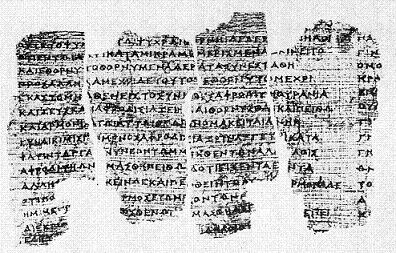 The Derveni Papyrus, a late fourth-century BCE manuscript preserving a commentary on an Orphic poem. Public-domain reproduction via Wikimedia Commons.
Crete: A Distinct Regional Corpus
Crete has produced a distinctive group of inscribed and uninscribed gold pieces sometimes called epistomia. Yannis Tzifopoulos’s Harvard Center for Hellenic Studies monograph studies these materials as a regional contribution to the larger Bacchic-Orphic corpus.
Their significance is methodological. The Cretan leaves show why scholars should not build one universal ritual from the best-known tablets. Local burial custom matters.
Some epistomia were placed over or near the mouth of the deceased, giving the object a physical relationship with speech. That position is especially suggestive for texts meant to equip the dead with words.
The material object therefore stages a paradox: a silent corpse is given a written voice.
Why Gold?
Gold’s durability is the simplest reason it made sense for funerary writing. Papyrus decays. Wax disappears. Gold survives soil, moisture, and time remarkably well.
But material symbolism likely mattered too. Gold was precious, luminous, resistant to tarnish, and associated in many ancient contexts with gods, wealth, permanence, and elite display.
The decision to inscribe sacred instructions on gold turned knowledge into durable matter. The initiate did not enter death with an ordinary note.
One should not assume that gold itself was believed to possess the same magical properties in every case. Material prestige and ritual efficacy can overlap without being identical.
Were the Tablets Amulets?
Scholars debate how closely the gold leaves should be compared with amulets. Christopher Faraone has explored the broader Greek tradition of inscribed leaf amulets, demonstrating that thin metal texts had uses beyond the Orphic corpus.
The comparison is helpful because it breaks the illusion that the tablets emerged from nowhere. Ancient Mediterranean cultures used written words, divine names, symbols, and materials as protective or efficacious objects in multiple settings.
At the same time, funerary instruction is unusually specific. A tablet telling the deceased which path to take functions differently from an amulet intended to cure fever or repel harm during life.
“Amulet” can therefore illuminate material practice without exhausting religious meaning.
The Derveni Papyrus: Orphic Poetry Meets Philosophy
The Derveni Papyrus is not a gold tablet, but it is essential for understanding the intellectual environment of Orphic literature. Discovered in 1962 near Thessaloniki in the remains of a funeral pyre, the papyrus dates to the late fourth century BCE and is often described as the oldest surviving book manuscript from Europe.
UNESCO’s Memory of the World program recognizes its exceptional importance. The surviving text contains a philosophical commentary on a theogonic poem attributed to Orpheus.
This is extraordinary evidence because it shows that Orphic poetry was not merely chanted in secret ritual. It could be subjected to sophisticated allegorical interpretation. The commentator treats apparently mythological language as concealing deeper cosmological meaning.
The Derveni text also discusses ritual specialists and religious practices, giving historians a rare bridge between poetry, philosophy, sacrifice, and esoteric interpretation.
It does not prove that the owner of every gold tablet had read the same poem. It demonstrates the diversity and intellectual seriousness of the wider Orphic textual world.
Orphic Books and the Problem of Secret Scripture
Plato’s complaint about wandering ritual specialists carrying books attributed to Orpheus is one of the most revealing ancient comments on esoteric religion.
The existence of such books means that Greek mystery practice was not purely oral. Text could authorize ritual. Written poems might explain gods, prescribe sacrifices, narrate cosmology, or provide formulas.
At the same time, possession of a book did not create a centralized scripture canon. Different specialists could circulate different works under prestigious names.
This resembles the manuscript cultures of later magic, where attribution to Solomon, Hermes, Moses, or other legendary sages provided authority without guaranteeing common authorship.
The gold tablets represent the smallest possible version of that textual religion: not a whole book, but a concentrated fragment designed to survive one final journey.
Orpheotelestai: The Itinerant Specialists Behind Some Mysteries?
Ancient sources refer to people called orpheotelestai, roughly ritual specialists or initiators associated with Orpheus.
They appear mostly through hostile or skeptical descriptions, so reconstructing their profession requires caution. Plato caricatures religious entrepreneurs who approach the wealthy with books and promises of ritual solutions for wrongdoing.
This evidence nevertheless suggests a market for private religious expertise outside state cult institutions. Clients could purchase initiation, purification, or ritual assistance.
If specialists of this kind transmitted the formulas represented on some gold tablets, that would help explain geographical variation. Different ritual experts could carry related texts between communities without maintaining one centralized organization.
The model resembles a network more than a church.
Purity: Moral, Ritual, or Both?
Some tablets contain declarations of purity. Modern readers immediately interpret purity as ethical goodness, but Greek ritual purity is broader.
Purity can involve preparation for sacred contact, avoidance of pollution, ritual cleansing, dietary restrictions, sexual rules, blood, childbirth, death, or other culturally defined conditions. Moral conduct and ritual status can overlap without being identical.
Orphic-associated traditions were famous in ancient literature for unusual dietary and behavioral restrictions, including references to abstaining from certain foods. Whether all tablet owners followed the same lifestyle cannot be demonstrated.
When a dead initiate presents themselves to Persephone as pure, the statement likely functions as a credential. Exactly what practices established that purity probably varied.
Vegetarianism and the Orphic Life
Ancient sources sometimes associate Orphic or Pythagorean ways of life with abstention from meat or blood sacrifice. Euripides and later authors refer to distinctive religious lifestyles linked with Orpheus.
Modern histories occasionally turn this into a universal rule that every Orphic initiate was a strict vegetarian. The evidence does not justify such certainty.
Diet could express purity, avoidance of blood, beliefs about reincarnation, or participation in a specialized identity. But Orphic-associated practices appear across long periods and diverse communities.
It is more accurate to say that vegetarian or restricted diets belonged to some traditions associated with Orpheus and related ascetic religious identities.
Women and the Gold Tablets
Women are well represented among known tablet burials. This is an important corrective to modern assumptions that ancient esoteric initiation was primarily male.
Greek civic religion often assigned different ritual roles according to gender, but mystery participation could cross boundaries unavailable in formal political life.
The presence of women does not mean the associated cults were socially egalitarian in a modern sense. It does demonstrate that privileged postmortem identity was not restricted to men.
This distinguishes the gold-tablet environment from the Roman mysteries of Mithras, whose archaeological evidence overwhelmingly points to male initiates. SecretMagic’s study of the Roman Mysteries of Mithras provides a useful comparison in how different mystery traditions constructed membership.
Orphism and Eleusis: Shared Underworld, Different Institutions
The Orphic gold tablets and Eleusinian Mysteries share striking themes: Persephone, the Underworld, initiation, secrecy, purity, and the hope of a better fate after death.
Those similarities encouraged ancient and modern interaction, but the institutions were fundamentally different.
Eleusis had a major sanctuary, hereditary priestly families, a fixed ritual calendar, state involvement, and a famous procession. The gold-tablet traditions appear decentralized and are often known only through private graves and scattered literary references.
There may have been people initiated into both kinds of mysteries. Greek religion did not demand exclusive membership in the modern denominational sense.
Shared themes therefore reveal a religious marketplace of afterlife hopes rather than one hidden master school.
Orphism and Pythagoreanism
Pythagorean traditions offer another important comparison. Ancient sources associate Pythagoras and his followers with reincarnation, ritual rules, special ways of life, and philosophical purification.
Southern Italy was a major center of Pythagorean activity and also produced important gold tablets. The geographical and thematic overlap is real.
Yet “Orphic-Pythagorean” can become a vague label that hides uncertainty. Similar doctrines may result from exchange, common cultural questions, later synthesis, or independent development.
Historically, it is more useful to ask which idea appears in which source than to assume every unconventional doctrine belonged to one combined sect.
Orphic Theogonies: Different Stories of the Gods
Ancient authors knew poems attributed to Orpheus that narrated the origins and genealogies of the gods. These theogonies did not always reproduce Hesiod’s famous Theogony.
Later Orphic cosmologies include figures such as primordial Time, cosmic eggs, Phanes or Protogonos, Night, Zeus, and Dionysus in elaborate sequences. The surviving evidence comes from fragments and later quotations, and different recensions existed.
This is another reason a single “Orphic Bible” is misleading. Orphic poetry developed over centuries.
The Derveni Papyrus proves that at least one theogonic Orphic poem circulated by the classical period and could be interpreted esoterically. Later Neoplatonists preserved additional material because they considered Orpheus an ancient theologian.
The Cosmic Egg and Phanes: Ancient but Not on the Gold Leaves
Modern illustrations of Orphism often center on the cosmic egg and the radiant deity Phanes. These are genuine features of later Orphic cosmological traditions.
They are not the central subject of the surviving gold tablets. The leaves focus overwhelmingly on death, identity, purity, routes, gods of the Underworld, and blessed destination.
This difference illustrates an important research principle: material associated with one broad tradition should not be imported into every artifact.
The gold tablets tell us about what certain initiates needed at death. They are not miniature copies of every Orphic cosmological poem.
 Orpheus playing the lyre among animals in a Roman mosaic from Mytilene. Photograph by KureCewlik81; crop distributed under CC BY-SA 4.0 via Wikimedia Commons.
A Better Afterlife Than Homer’s Hades
Homer’s Underworld is famously bleak. Most dead are diminished shades. Exceptional heroes may receive special treatment, but ordinary virtue does not automatically produce paradise.
By the classical period, Greek culture contained increasingly varied visions. Philosophers discussed judgment and reincarnation. Mystery initiations promised privileged fates. Funerary art in southern Italy depicted rich underworld scenes.
The Getty’s Underworld: Imagining the Afterlife exhibition emphasizes that Orphic and Dionysian devotion offered one path toward a better postmortem condition.
The gold tablets therefore participate in a religious transformation: death becomes negotiable through identity and initiation.
They do not necessarily promise “heaven” in the later Christian sense. Their destinations are described through Greek mythic geography and status.
Blessed Meadows, Heroic Status, and Becoming Divine
Some tablets describe the deceased moving toward the company of the blessed or attaining a transformed status. Others contain striking declarations suggesting that the initiate is no longer merely mortal.
Ancient Greek religion allowed boundaries between human and divine status to be more flexible in myth and hero cult than modern monotheistic categories might suggest. Heroes occupied a privileged postmortem category; exceptional mortals could receive cult.
When tablet language makes exalted claims, it should be read within that cultural spectrum.
The exact metaphysical mechanism remains uncertain. Did the soul literally become a god, regain an original divine nature, or simply join a blessed divine company? Different texts may imply different answers.
What is clear is that ordinary anonymous existence among the dead was not the desired outcome.
Why the Texts Contain Errors
Some gold inscriptions contain spelling mistakes, duplicated letters, odd word divisions, or corrupt phrases.
This is valuable evidence. It reminds us that sacred transmission involved ordinary human labor. Someone copied the text, perhaps from memory or an exemplar, onto difficult material with limited space.
A mistake does not necessarily mean the ritual was unserious. Manuscripts of prayers, magical formulas, and scripture across history contain copying errors.
The variations can help scholars reconstruct families of texts. Shared errors may indicate common exemplars; altered phrases may show local adaptation.
Esoteric traditions are often imagined as perfectly preserved secret chains. The tablets reveal something much more historical: knowledge survives through imperfect people.
Do the Tablets Prove Ancient Greek “Magic”?
The boundary between religion and magic is difficult in antiquity. The tablets use restricted knowledge to influence the deceased’s fate, which may sound magical to modern readers.
Yet they also address recognized gods, participate in burial practice, and belong to mystery initiation. Calling them simply “spells” would flatten their religious context.
A more useful question is what kind of ritual efficacy the object claims. The gold leaf assumes that words, knowledge, initiation, and divine relationships continue to matter after death.
Whether modern scholars label that magic, private religion, mystery religion, eschatological ritual, or a combination depends partly on analytical purpose.
Ancient participants did not organize their practices according to modern bookstore categories.
The Symbolic Meaning of the Journey
As a modern symbolic reading, the tablets present death as a problem of orientation rather than annihilation.
The soul encounters choices. Not every source of relief should be trusted. Memory matters. Identity must be spoken. Guardians must be faced. The traveler is told that origin is larger than ordinary biography.
This can be read philosophically as a model of transition in which knowledge becomes useful only when embodied under pressure. Memorizing a teaching while comfortable is easy; remembering it at the threshold is the real test.
That interpretation is modern. It does not establish what every ancient initiate consciously believed. Its value lies in showing why these tiny texts still feel psychologically powerful without requiring us to claim that their supernatural geography is scientifically verified.
Memory and Identity in Modern Psychological Reading
Modern psychology treats autobiographical memory as central to personal identity. Severe loss of memory can profoundly alter one’s continuity of self.
The Orphic emphasis on Memory therefore resonates strongly with contemporary readers, even though ancient and modern concepts are not identical.
A symbolic interpretation could say that the initiate survives transformation by remembering who they are at a level deeper than social role. The cosmic declaration becomes a defense against dissolution.
This should not be retrojected as an ancient psychological theory. It is a productive modern reception of a genuinely ancient motif.
Why Modern Occult Orders Loved Orpheus
Nineteenth- and twentieth-century esoteric movements were fascinated by ancient mystery religions because they provided prestigious models of initiation, secrecy, death, rebirth, and hidden wisdom.
Orpheus was especially attractive: musician, poet, traveler to the dead, revealer of mysteries, and alleged author of sacred books.
Modern occult writers often connected Orphic mysteries with Hermeticism, Kabbalah, Freemasonry, Rosicrucianism, the Golden Dawn, and universal “mystery schools.”
These comparisons shaped modern esotericism but do not prove an uninterrupted institutional chain from ancient Orphic initiators to modern orders.
Historical reception should be studied as reception. Modern orders created new syntheses from ancient fragments.
Common Misconception: There Was One Orphic Church
No evidence demonstrates a centralized ancient Orphic institution with universal doctrine, clergy, temples, and membership rules.
Ancient sources instead point to texts attributed to Orpheus, ritual specialists, private initiations, distinctive practices, and local religious networks.
The label Orphism remains useful as long as it does not hide diversity.
The quotation marks used by many scholars are therefore not pedantic decoration. They are a reminder that the category is modern and contested.
Common Misconception: Every Tablet Says the Same Thing
The corpus contains related but distinct texts. Some give detailed directions. Some provide short declarations. Some emphasize purity. Some name Persephone or Dionysus. Some were placed differently in graves.
Regional and chronological variation is real.
Modern websites often combine lines from several tablets into one seamless “Orphic prayer.” That can produce a beautiful composite text but should not be represented as one ancient inscription.
Each artifact has a provenance, date, wording, and archaeological history.
Common Misconception: The Tablets Prove Reincarnation as a Fact
The tablets are evidence that certain ancient people expected a special postmortem fate and that some associated traditions involved cycles of rebirth.
They are not empirical proof that reincarnation objectively occurs.
Historical evidence can establish that a belief existed, how it was expressed, where an artifact was buried, and how ideas developed. Supernatural truth claims require a different kind of evidence.
Maintaining that distinction allows ancient religion to be studied seriously without turning scholarship into either devotional assertion or dismissive ridicule.
Common Misconception: The Gold Leaves Are the Egyptian Book of the Dead in Greek
The tablets have occasionally been compared with Egyptian funerary literature because both equip the dead with knowledge for the afterlife. Cambridge scholarship even includes comparative work on Egyptian funerary texts.
Comparison can illuminate shared human concerns: routes, guardians, speech, judgment, and privileged knowledge.
But there is no basis for calling the Greek tablets simply a translated Egyptian Book of the Dead. Their form, gods, language, ritual institutions, and textual histories are different.
Cross-cultural influence in the Mediterranean is possible and sometimes demonstrable; superficial resemblance is not proof of direct copying.
Common Misconception: Orpheus Personally Wrote the Tablets
Orpheus is a mythic authority. There is no historical evidence that one individual named Orpheus authored the surviving gold leaves.
Texts could be called Orphic because they belonged to traditions attributed to him, used poems carrying his name, or participated in ritual environments associated with his authority.
Ancient pseudonymous authorship works differently from modern copyright.
The important historical question is not “where is Orpheus’s autograph?” but why his name could authorize knowledge about death.
What the Gold Tablets Can Tell Us with Confidence
Despite all the debates, several conclusions are strong.
First, specialized Greek-speaking communities buried selected dead with inscribed gold texts over many centuries and across a broad geography.
Second, many texts assume an afterlife journey in which knowledge changes outcomes.
Third, Memory, divine ancestry, purity, Persephone, Dionysian identity, and privileged destination recur sufficiently to show shared religious vocabulary.
Fourth, the texts were connected to initiation or ritual status rather than ordinary burial practice, because they are rare and explicitly distinguish their owners.
Finally, variation is as historically important as similarity. The corpus documents a religious network, not necessarily one church.
What We Still Do Not Know
We do not possess a complete initiation script explaining how a living person received the formulas. We do not know how much individual initiates understood the theology behind their tablets. We cannot identify the exact relationship among every local group.
We also do not know whether all tablet owners believed in reincarnation in the same way, whether all followed identical purity rules, or whether every formula came from a poem attributed to Orpheus.
These gaps are not failures. They are part of the historical object.
A responsible study of esotericism becomes stronger when uncertainty is stated clearly rather than filled with invented certainty.
Frequently Asked Questions
What are the Orphic gold tablets?
They are small inscribed gold leaves or lamellae buried with selected dead in the ancient Greek world. Many contain instructions or declarations intended to help the deceased obtain a privileged fate in the Underworld.
Why are they called Orphic?
They are associated by modern scholars with religious traditions involving Orpheus, Dionysian initiation, purity, and special afterlife knowledge. Because not every tablet names Orpheus and the category is debated, specialists often write “Orphic” in quotation marks.
How old are the tablets?
The corpus ranges broadly from the late Classical period into Roman times, with important examples dating from the late fifth and fourth centuries BCE.
What does “child of Earth and starry Heaven” mean?
It is a ritual declaration of cosmic ancestry found in several texts. It appears to assert that the deceased possesses a privileged heavenly identity in addition to earthly origin, but scholars debate its precise theology.
Why does the deceased need the Lake of Memory?
Some tablets contrast a forbidden spring with water associated with Memory. The initiate must remember the correct route and words. The exact metaphysics are uncertain, but memory clearly functions as a marker of privileged postmortem identity.
Did Orphics believe in reincarnation?
Reincarnation is associated with Orphic and Pythagorean traditions, and some tablet language fits liberation from repeated birth. However, not every surviving gold leaf explicitly describes a reincarnation system.
What does Dionysus have to do with the tablets?
Some tablets explicitly invoke Bacchios, a name of Dionysus, and tell the deceased to announce Dionysian release to Persephone. This is why many scholars prefer the term Bacchic-Orphic for parts of the corpus.
Are the tablets magical spells?
They claim ritual efficacy through sacred knowledge and can be compared with amuletic traditions, but they also belong to funerary religion and mystery initiation. Calling them simply spells loses important context.
Do the tablets prove an afterlife exists?
No. They provide direct archaeological evidence for ancient beliefs and ritual expectations about the afterlife, not scientific proof of supernatural geography.
Are Orphism and the Eleusinian Mysteries the same religion?
No. They share concerns with initiation, Persephone, secrecy, and postmortem hope, but Eleusis was a major civic sanctuary with hereditary priesthoods and a fixed festival, while the gold-tablet traditions appear decentralized.
Conclusion: Remember Who You Are
The Orphic gold tablets survive because ancient people chose the most durable possible material for some of the shortest possible religious texts. That contrast—fragile human life and incorruptible gold—is an appropriate symbol for their purpose.
They were created for a moment no living initiate could report afterward. Death was imagined as a journey in which ignorance carried risk and memory carried privilege. The initiate approached water, guardians, gods, and a choice of paths armed with a few lines learned or inscribed before burial.
Modern scholarship has made the tablets more interesting by making them less simple. There was probably no single Orphic church. The Titan-Dionysus anthropogony cannot be projected backward without qualification. Reincarnation is important but not uniformly stated. Orpheus, Dionysus, Persephone, local cult, poetry, private ritual, and funerary custom overlap in different proportions.
The surviving evidence therefore presents ancient esotericism as a network. Books circulated under sacred names. Ritual experts taught private initiations. Burial practices differed from region to region. Gold formulas condensed knowledge into portable identity.
The most haunting sentence remains the declaration of cosmic belonging: the dead person is a child of Earth and starry Heaven. Whether an ancient initiate understood this philosophically, ritually, genealogically, or all at once, the words refuse to let ordinary mortality have the final definition.
That is the central historical insight of the tablets. Their owners did not enter the grave believing that everyone arrived in the same condition. Initiation had changed who they were, and that identity was expected to matter beyond death.
For modern readers, no supernatural conclusion has to be assumed. The archaeological fact is already remarkable. More than two thousand years ago, someone placed a thin piece of gold beside a dead person because they believed memory, words, and sacred affiliation would still matter when everything else had been left behind.
The gold survives. The voices that explained it are gone. Yet the instruction embedded in the tradition remains unusually clear: when the greatest threshold arrives, remember the path—and remember who you are.
Sources and References
- Radcliffe G. Edmonds III, ed., The “Orphic” Gold Tablets and Greek Religion: Further Along the Path, Cambridge University Press, 2011.
- Cambridge University Press — scholarly introduction to the “Orphic question,” historiography, and interpretation of the tablets.
- J. Paul Getty Museum, Underworld: Imagining the Afterlife — gold tablets, Orpheus, Dionysus, Persephone, and ancient Greek expectations after death.
- Yannis Tzifopoulos, Paradise Earned: The Bacchic-Orphic Gold Lamellae of Crete, Center for Hellenic Studies, Harvard University, 2010.
- British Museum, gold tablet and pendant case with Greek instructions guiding the deceased through the Underworld.
- UNESCO Memory of the World — The Derveni Papyrus.
- “The Bacchic Gold Tablets and Poetic Tradition,” University of Chicago Press journal platform, 2024.
- Radcliffe G. Edmonds III, Myths of the Underworld Journey: Plato, Aristophanes, and the “Orphic” Gold Tablets, Cambridge University Press, 2004.
- Fritz Graf and Sarah Iles Johnston, Ritual Texts for the Afterlife: Orpheus and the Bacchic Gold Tablets, Routledge, 2nd ed.


