


SEO Title: Sefer Raziel HaMalakh Explained: Raziel, Jewish Magic, Amulets, and Manuscripts
Meta Description: A source-based guide to Sefer Raziel HaMalakh: the angel Raziel, medieval Ashkenazi origins, Eleazar of Worms, divine names, astrology, amulets, Sefer ha-Razim, the Latin Liber Razielis, and the influential Amsterdam 1701 edition.
Suggested Permalink: sefer-raziel-hamalakh-history-magic
Primary Category: Jewish Mysticism and Magic
Tags: Sefer Raziel HaMalakh, Raziel, Jewish Magic, Kabbalah, Amulets, Medieval Mysticism
Primary Keyword: Sefer Raziel HaMalakh
Sefer Raziel HaMalakh Explained: The Angel Raziel, Medieval Jewish Magic, Amulets, and the 1701 Printed Book
 The Amsterdam 1701 printing of Sefer Raziel HaMalakh, the edition that helped stabilize and popularize the book’s later printed form. Public-domain scan via Wikimedia Commons.
Introduction: The Book of Raziel Is Not One Ancient Book
Few Jewish magical books have acquired as much legendary prestige as Sefer Raziel HaMalakh, the “Book of Raziel the Angel.” In popular retellings, the story is simple: the angel Raziel revealed a book of heavenly secrets to Adam after the expulsion from Eden, jealous angels stole it, the book eventually returned to humanity, and its hidden wisdom passed through biblical patriarchs until it became a manual of astrology, divine names, amulets, angelology, and practical Kabbalah.
The historical picture is more complicated and more interesting. Sefer Raziel HaMalakh is not a single ancient manuscript written in Eden and preserved unchanged. It is a layered compilation that incorporates materials from several Jewish mystical and magical traditions, some of them much older than the printed book that became famous in early modern Europe. Scholars connect its medieval formation especially with Ashkenazi Jewish esoteric culture and with materials associated with Eleazar of Worms and the German Pietists, while the familiar printed version first appeared in Amsterdam in 1701.
That printed edition had enormous influence. It standardized diagrams, amulets, angelic names, cosmological passages, and practical instructions that continued to be copied in later Jewish books and amulets. It also acquired a remarkable reputation as a protective object: some owners believed that simply keeping the book in a house could guard against fire, robbery, harmful spirits, and other dangers.
This article distinguishes textual history from religious belief. Traditions describing Raziel as an angel who transmits divine secrets are genuine elements of Jewish religious and magical culture. Claims that an amulet prevents fire, that a divine name commands an angel, or that possession of the book creates supernatural protection are historically important beliefs, but they are not scientifically established facts. Understanding that distinction allows us to take the text seriously without turning its supernatural claims into modern evidence.
Who Is the Angel Raziel?
The name Raziel is usually interpreted as “Secret of God” or “Mystery of God,” from Hebrew raz, “secret,” and El, “God.” In later Jewish angelology, Raziel becomes an angel associated with revelation, hidden wisdom, celestial secrets, and the transmission of esoteric knowledge.
The name is not among the most prominent angelic names in the earliest layers of the Hebrew Bible. Raziel belongs to the expanding angelological worlds of post-biblical Jewish literature, where angels receive specialized offices, names, ranks, and functions.
The Jewish Encyclopedia notes traditions in which Raziel proclaims heavenly secrets and explains that his importance becomes especially connected with a “Book of Secrets.” That connection between messenger and book is crucial. Raziel is not merely another celestial being; he becomes the personification of esoteric transmission.
In religious narrative, this makes Raziel an ideal teacher for Adam. Humanity has lost Eden and now inhabits a difficult world. A divine messenger reveals knowledge that allows human beings to understand creation, time, the heavens, protection, and the hidden structure of sacred language.
Historically, we should distinguish the development of the angel Raziel from the later compilation called Sefer Raziel HaMalakh. The existence of traditions about Raziel does not prove that the familiar printed book existed in antiquity.
The Legend: Raziel Gives the Book to Adam
The most famous origin story places the book at the beginning of human history. After Adam and Eve leave Eden, Raziel gives Adam a book containing celestial wisdom. In some retellings, other angels object that a human should possess such knowledge and cast the book into the sea. It is later recovered and eventually passes through a chain of patriarchs.
The symbolism of this legend is powerful. The fall from Eden is followed by revelation. Human beings cannot regain paradise directly, but they can receive knowledge that helps them live in a world of mortality, danger, time, and uncertainty.
The story also legitimizes the book by making it older than almost every human institution. If Adam received it from an angel, its wisdom precedes Sinai, rabbinic academies, medieval Kabbalah, and Christian Europe.
From the standpoint of historical scholarship, however, the legend is not a provenance record. No ancient manuscript from the biblical period contains the familiar compilation. The narrative should be understood as sacred pseudepigraphic tradition: a way of expressing the perceived antiquity and divine authority of the material rather than a verifiable account of physical manuscript transmission.
A Medieval Compilation with Older Ingredients
The historical Sefer Raziel is best understood as a compilation. Different textual layers contain cosmology, angelology, magical names, astrology, amulets, instructions, and material related to earlier Jewish mystical works.
The Jewish Virtual Library describes the printed book as a collection of mystical, cosmological, and magical Hebrew works and portions of works rather than a single composition. It identifies several strata, including material connected to Hekhalot and Merkabah traditions and to older magical books.
This composite nature explains apparent differences in voice and subject matter. A modern reader may move from creation cosmology to angel names, from astrological correspondences to practical amulets, and from speculative mysticism to ritual instructions.
Such diversity is normal in premodern esoteric compilations. A copyist or compiler did not necessarily view “mysticism,” “magic,” “astrology,” and “cosmology” as separate disciplines. These fields could participate in one larger project: understanding the hidden structure of divine creation and acting within it.
The Ashkenazi Hasidim and Medieval Rhineland Esotericism
A major scholarly context for Sefer Raziel is the world of the Hasidei Ashkenaz, the German Pietists who flourished in the Rhineland during the twelfth and thirteenth centuries.
Their religious culture combined rigorous ethical discipline, prayer, theology, numerical interpretation, divine names, angelology, and esoteric speculation. Figures such as Judah the Pious and Eleazar of Worms became central to later memories of Ashkenazi mystical tradition.
Recent scholarship by Moshe Idel specifically describes Sefer Razi’el ha-Mal’akh as a conduit of medieval Ashkenazi culture. This is important because older popular accounts often describe the book simply as “ancient Kabbalah.” Its medieval Ashkenazi setting is much more specific.
The Rhineland Jewish communities that generated and transmitted this material lived in a Christian environment marked by crusading violence, theological pressure, local piety, manuscript culture, and intense communal life. Esoteric knowledge developed inside that historical reality, not in an abstract timeless mystical world.
Eleazar of Worms: Author, Compiler, or Source?
Eleazar of Worms, who died in the thirteenth century, is frequently associated with Sefer Raziel. Earlier scholarship sometimes treated him as the author of the work.
The evidence is less simple. The book in its later form contains multiple layers, and modern scholars generally avoid treating it as the product of a single author. Eleazar may have contributed material, transmitted related traditions, or influenced portions of the compilation.
The Center for Jewish Art notes that the likely compiler of a medieval form is connected with Eleazar and with works such as Sefer Galei Razia, but it also emphasizes that the surviving book includes writings representing different theological positions.
That difference between “author” and “compiler” matters. Esoteric books often accumulate authority through association with famous sages. A manuscript may preserve genuine material from a teacher without being wholly written by that teacher.
A careful formulation is therefore that Eleazar of Worms is central to the medieval Ashkenazi textual environment from which important parts of Sefer Raziel emerged, but the later book is a compilation rather than a single-authored treatise.
Sefer Yetzirah Inside the World of Raziel
One important intellectual ancestor is Sefer Yetzirah, the “Book of Formation.” SecretMagic has a dedicated study of Sefer Yetzirah and its thirty-two paths of wisdom.
Sefer Yetzirah describes creation through ten sefirot and twenty-two Hebrew letters. Its language helped establish a powerful connection between alphabet, number, cosmos, and divine creativity.
Sefer Raziel inherits a world in which Hebrew letters are not merely arbitrary signs used to record speech. Letters can be understood as structural elements of creation.
That idea has major consequences for practical magic. If letters participate in cosmic order, then divine names, permutations, written amulets, and numerical correspondences can be treated as more than symbolic reminders. They can be understood religiously as operations within the architecture of creation itself.
Modern linguistics does not treat Hebrew letters as physically causal forces in nature. Historically, however, the theological concept of creative language is essential for understanding why letter magic could make sense within medieval Jewish esotericism.
Sefer HaRazim: An Older Book of Jewish Magic
Another important source is Sefer HaRazim, the “Book of Secrets,” a Jewish magical work preserving material from late antiquity.
SecretMagic’s article on Sefer HaRazim and its seven heavens examines that text separately.
The relationship matters because later Sefer Raziel incorporates substantial earlier magical material. This is one reason the printed book can contain traditions older than its medieval compilation and early modern publication.
The distinction is crucial. Saying that some components are ancient does not mean the whole book is ancient. A modern anthology can contain ancient poems without being an ancient manuscript. The same principle applies here.
The layered nature of Sefer Raziel is therefore a strength for historical study: it became a vessel through which multiple earlier forms of Jewish esotericism continued to circulate.
The Book of the Garment and Mystical Cosmology
Among the strata associated with the Raziel compilation is material related to Sefer ha-Malbush, the “Book of the Garment.”
Garment symbolism appears frequently in mystical traditions because clothing can represent manifestation. A body is clothed; an invisible reality takes visible form; divine glory can be imagined through layers, coverings, or robes.
In Jewish mystical literature, such imagery can connect cosmology, angelology, divine names, and heavenly hierarchy.
The appearance of Sefer ha-Malbush material in Sefer Raziel shows that the compilation is not only a handbook of practical charms. It also preserves speculative models of the universe.
That combination of cosmology and practical ritual is characteristic of many magical traditions. Ritual action becomes intelligible because the practitioner possesses a model of how the cosmos is organized.
Divine Names: The Heart of Practical Jewish Magic
Sacred names are central to Jewish magical literature. The biblical names of God, expanded names, letter combinations, angelic names, and complex strings of sacred characters can all appear in amulets and ritual texts.
The logic is religious before it is mechanical. A divine name does not function merely because letters form a code. The name participates in divine authority.
This creates theological tension. Jewish tradition strongly prohibits misuse of God’s name, and magical texts can therefore inhabit a contested zone between pious invocation and forbidden manipulation.
Practitioners and critics may draw the boundary differently. One person may interpret an amulet as prayer in written form; another may see it as illicit practical Kabbalah.
The book’s historical significance lies partly in preserving this tension. It shows how sacred language could be approached as both devotional revelation and operative power.
Angels as a Structured Spiritual World
The angelology of Sefer Raziel is elaborate. Names multiply because the cosmos is imagined as administratively complex.
Angels may be associated with heavens, planets, directions, hours, months, zodiacal signs, natural phenomena, or particular tasks. Such systems reflect a broader premodern tendency to imagine the universe as spiritually populated.
Modern readers sometimes interpret long lists of angelic names as evidence of one ancient standardized hierarchy. The historical record is much less uniform. Angel names vary across manuscripts, languages, and traditions. Copying unfamiliar names also produces scribal corruption.
The presence of thousands of names therefore demonstrates both the richness and instability of angelological tradition.
Belief that these names refer to objectively existing beings belongs to religion and esotericism. Historical scholarship can trace the names and their functions without proving angelic existence.
Astrology in Sefer Raziel
Astrological material is another major feature of the Raziel tradition.
Medieval Jewish attitudes toward astrology were diverse. Some rabbis criticized deterministic interpretations; others accepted celestial influence while insisting that God remained sovereign and that Israel’s relationship to providence could not be reduced to planetary fate.
Sefer Raziel participates in the broader medieval world in which planets, zodiacal signs, lunar cycles, angels, and earthly events could be linked through systems of correspondence.
Astrology here is not the newspaper horoscope of modern popular culture. It belongs to a technical cosmology concerned with timing, celestial order, and correspondences.
No modern scientific consensus supports astrology as a predictive causal system. Historically, however, astrology was integrated into medicine, calendar calculation, philosophy, and magical practice across Jewish, Christian, and Islamic cultures.
Amulets: Writing Protection onto Material Objects
The amulet is one of the most visible meeting points between text and practice.
Jewish amulets can include biblical verses, divine names, angel names, geometric forms, abbreviations, protective formulas, and references to specific dangers such as illness, childbirth, demons, or the evil eye.
An amulet turns sacred language into a portable object. The words are not only read; they are carried, worn, hung, folded, or placed in a particular location.
This material dimension is essential. A magical book can be copied into smaller ritual objects, allowing its formulas to circulate even among people who never own the entire book.
The 1701 printed Sefer Raziel became influential partly because it standardized images that could then be reproduced elsewhere.
 Two protective amulet texts from the 1701 Sefer Raziel, including formulas identified with favor and protection from weapons. Public domain via Wikimedia Commons.
Protection in Childbirth and the Lilith Tradition
Childbirth was one of the most dangerous experiences in premodern life, and Jewish protective traditions developed around the vulnerability of mother and infant.
Lilith became a major figure in these traditions. In medieval Jewish folklore, she could be imagined as a harmful female demon threatening newborn children and women in childbirth.
Protective amulets frequently invoke the names Senoy, Sansenoy, and Semangelof in connection with legends about restraining Lilith.
A Wellcome Collection image derived from the 1701 Raziel tradition preserves a striking visual example of such protective culture.
Modern medicine explains childbirth risk biologically rather than demonologically. Historically, however, amulets offered families a way to act when medical options were limited. The ritual object could provide religious meaning, hope, communal continuity, and a sense of protection in a genuinely dangerous situation.
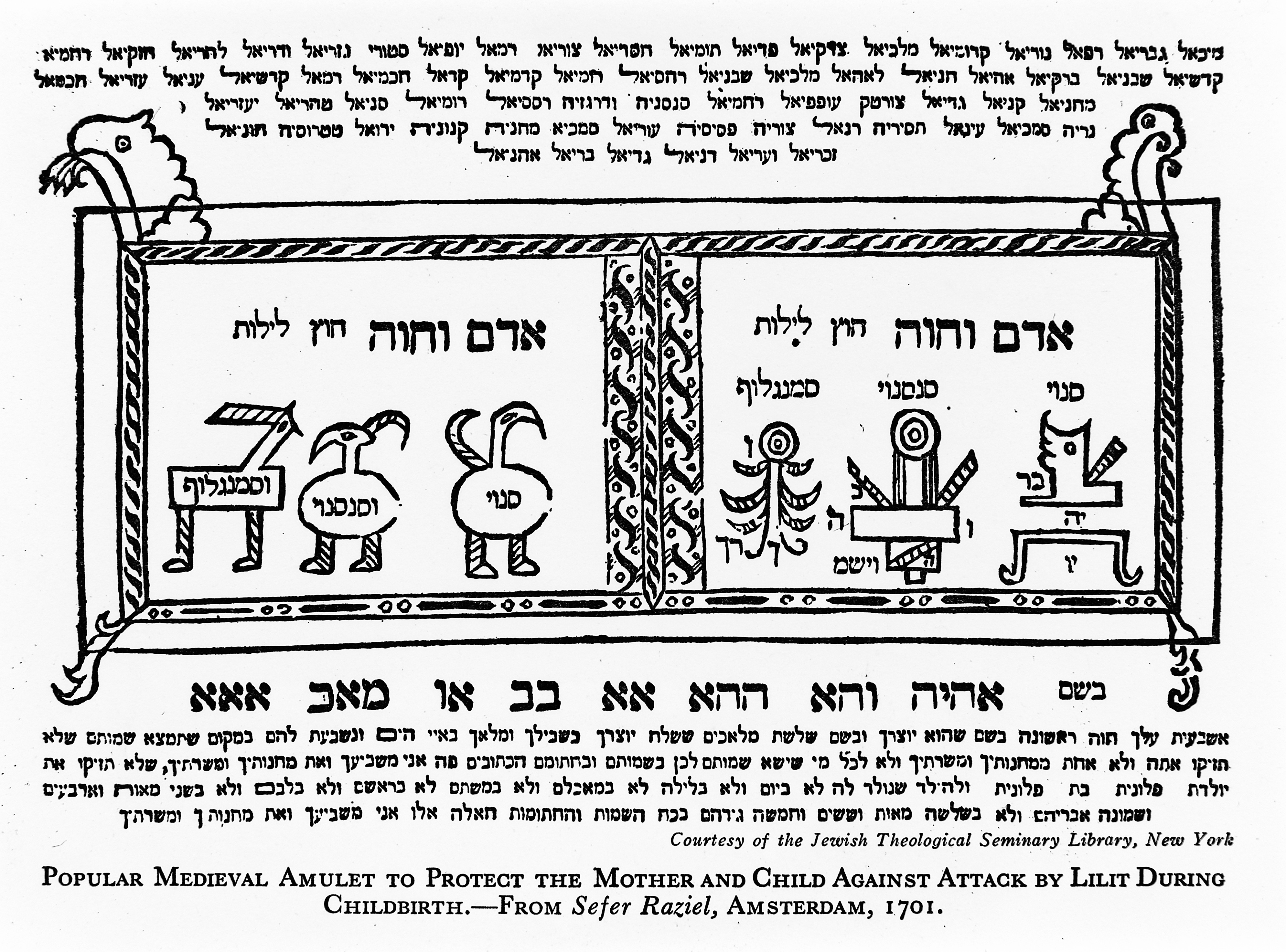 A protective Hebrew amulet associated with the Sefer Raziel tradition and childbirth protection. Wellcome Collection image, CC BY 4.0 via Wikimedia Commons.
The Famous Belief That the Book Protects a House from Fire
One of the most unusual aspects of Sefer Raziel is the belief that possession of the book itself can function as a segulah, a protective or auspicious object.
The Center for Jewish Art documents editions whose introductory material claims that keeping the book respectfully in the house can protect against fire, plunder, harmful spirits, and other dangers.
The Jewish Encyclopedia likewise notes the former belief that a house containing the book would be protected from fire.
This belief transformed the book from a source of knowledge into an amulet at architectural scale. A person did not necessarily need to understand or perform every ritual; ownership itself could carry protective meaning.
There is no scientific evidence that possession of a book prevents fire. Yet the practice is historically significant because it blurs the distinction between reading and ritual use. The physical book becomes a sacred object.
The Amsterdam 1701 Edition
The first printed edition appeared in Amsterdam in 1701 and became decisive for the book’s later history.
Amsterdam was a major center of Hebrew printing. Jewish printers there produced Bibles, rabbinic works, liturgy, Kabbalah, and other Hebrew literature for readers across Europe.
The 1701 edition gathered the Raziel material into a stable printed form with diagrams and amuletic images. The Center for Jewish Art states that this edition strongly influenced the later graphic representation of basic amulets, which were repeatedly copied afterward.
Print changes transmission. A manuscript diagram can vary substantially from copy to copy; a woodcut or printed plate can reproduce the same arrangement hundreds of times.
The history of Sefer Raziel therefore includes a technological transformation. Medieval esoteric traditions entered the age of mass reproduction.
Why the 1701 Printing Matters More Than a Mythical Original
Popular discussions often focus on locating “the original Book of Raziel.” Historically, that question can mislead.
The compilation grew through manuscripts and older source texts. There may never have been one moment when a single author produced the entire work in the form later readers knew.
The 1701 edition matters because it created a practical standard. Readers could cite it, reprint it, copy its diagrams, and preserve it as a segulah.
In cultural history, a printed edition can be more influential than an unattainable hypothetical original.
This is especially true for magical books, where diagrams and exact letter forms can become part of ritual authority.
The Latin Liber Razielis: A Related but Distinct Medieval Tradition
The name Raziel also became important in Latin medieval magic.
A Latin Liber Razielis circulated in Christian Europe and survives in manuscripts. Research from UCLouvain on Paris, BnF lat. 3666 describes a fifteenth-century Latin manuscript containing an angel-invocation treatise related to the Liber Razielis, which was one of the more widespread magical works of the later Middle Ages.
Cambridge scholarship on medieval ritual likewise describes the Latin Liber Razielis as a seven-part magical text and notes a tradition connecting it with the translation projects of Alfonso X of Castile.
The Latin and Hebrew Raziel traditions overlap in their attribution to the revelatory angel, but they should not be treated as identical books.
Translation across Hebrew, Latin, Arabic, and Romance intellectual environments produced new compilations and new interpretations. “Raziel” became a transreligious badge of ancient angelic wisdom.
Alfonso X and the Translation Culture of Medieval Spain
The court of Alfonso X of Castile became famous for translation projects involving astronomy, astrology, lapidaries, and other scientific or occult texts.
Medieval Spain was an environment in which Arabic, Hebrew, Latin, and Romance traditions interacted. Translators moved knowledge across languages while also changing its conceptual framework.
The Latin Liber Razielis tradition belongs to this larger world.
This does not mean Alfonso commissioned the Amsterdam 1701 Hebrew Sefer Raziel HaMalakh. Rather, the shared Raziel attribution demonstrates how angelic authority could travel across distinct textual families.
The same named angel could support Jewish practical Kabbalah and Latin Christian ritual magic without implying that the two traditions were identical.
Necromancy, the Dead, and the Latin Raziel
One striking feature of the Latin tradition is material concerning communication with the dead.
A Cambridge University Press study of hyssop in the Latin Middle Ages describes the seven-part Liber Razielis as providing a rare example of a medieval magical text with specific instructions for contacting the dead.
This evidence is important because modern popular summaries sometimes sanitize Raziel literature into harmless angelic spirituality.
Historically, the wider Raziel corpus could include techniques that medieval theologians classified as dangerous or illicit.
At the same time, those Latin materials should not automatically be projected back into every Hebrew version. The Raziel name became an umbrella under which different ritual traditions circulated.
Raziel, Metatron, and Different Models of Angelic Authority
Modern occult charts often place Raziel alongside Metatron, Michael, Gabriel, and other famous angels in a standardized hierarchy.
Historical Jewish texts do not always organize angels in the same way.
Metatron is particularly central to Hekhalot and Merkabah traditions, where he can appear as a supreme angelic figure associated with the heavenly palace, divine throne, or transformed Enoch.
Raziel’s identity is more closely tied to secrets and revelation.
The difference is useful because it shows that “angelology” is not one fixed system. Different texts elevate different beings according to their theological needs.
Modern systems that assign each angel a color, chakra, planet, crystal, or psychological archetype often combine medieval material with much later esoteric inventions.
Practical Kabbalah: A Useful but Complicated Label
Sefer Raziel is often described as a classic of practical Kabbalah.
The term is useful when referring to operative traditions involving divine names, angels, amulets, ritual formulas, or other techniques.
But “practical Kabbalah” should not imply that all Kabbalists practiced magic. Major Kabbalistic schools focused on theology, scripture, prayer, divine emanation, ethics, mystical intention, and communal ritual.
Jewish authorities also debated and sometimes condemned magical practices.
Sefer Raziel sits on this contested boundary. It became highly influential without representing every form of Kabbalah.
The book is therefore best understood as part of Jewish esoteric and magical culture rather than as a universal manual of “the Kabbalah.”
The Difference Between Sefer Raziel and Sefer HaRazim
The titles are easy to confuse.
Sefer HaRazim means “Book of Secrets.” It is an older Jewish magical work with a cosmology of seven heavens and extensive angelic lists.
Sefer Raziel HaMalakh means “Book of Raziel the Angel.” It is a later compilation that incorporates older materials, including material related to Sefer HaRazim.
The similarity is not accidental: Raziel is the angel of secrets, and raz is the Hebrew word for mystery or secret.
Yet they are historically distinct textual entities.
Keeping them separate prevents one of the most common errors in online occult writing, where quotations and diagrams from one book are attributed to the other.
The Difference Between Sefer Raziel and the Sword of Moses
Another frequently confused work is Harba de-Moshe, the Sword of Moses.
The Sword of Moses is an older Jewish magical text centered on a powerful sequence of sacred names called the “sword.”
Sefer Raziel belongs to a later compilation history, though the two participate in overlapping worlds of angelic names and operative sacred language.
The comparison demonstrates continuity without identity.
Jewish magic preserved techniques across centuries, but texts were recombined, renamed, and reinterpreted in changing environments.
Magic, Mysticism, and the False Choice Between Them
Modern readers often ask whether Sefer Raziel is “really magic” or “really mysticism.”
The historical answer is that the categories overlap.
Cosmology explains how the universe is structured. Mystical interpretation explains the divine significance of creation. Astrology maps celestial relationships. Angelology populates spiritual hierarchy. Amulets and sacred names apply that knowledge to practical needs.
Premodern compilers did not necessarily experience these subjects as contradictory.
A modern academic classification may separate them for analytical convenience, but the book itself shows how speculative and operative esotericism can coexist.
Common Misconception: Raziel Wrote the Book in Heaven
Traditional narratives attribute the book to the angel Raziel and describe its revelation to Adam.
Historical scholarship does not treat this as literal manuscript authorship.
The familiar work is a medieval and early modern compilation containing layers from different periods.
The legend should be respected as religious tradition while distinguished from bibliographic history.
Common Misconception: The Entire Book Comes from Ancient Kabbalah
Some materials are genuinely old, and the book preserves earlier Jewish magical traditions.
However, Kabbalah as a historical movement developed over time, and the printed Sefer Raziel combines materials from different periods.
Calling every page “ancient Kabbalah” hides the book’s medieval Ashkenazi formation and early modern print history.
Common Misconception: Owning Sefer Raziel Scientifically Prevents Fire
Historical editions promote the book as a segulah for protection, including protection from fire.
That is a documented religious belief, not an empirically demonstrated physical effect.
A modern home still requires ordinary fire prevention, alarms, safe wiring, and evidence-based safety practices.
Common Misconception: Every Raziel Sigil Online Is Authentic
The internet contains thousands of images labeled “Seal of Raziel.”
Many are modern inventions, New Age graphics, ceremonial-magic adaptations, or designs copied without provenance.
Historically responsible study asks for the edition, manuscript, page, and date.
The 1701 Amsterdam edition is especially valuable because its surviving scans make provenance possible.
Common Misconception: Raziel Is Simply an Archangel of Modern New Age Kabbalah
Contemporary spiritual systems often describe Raziel as an archangel of intuition, psychic development, rainbow colors, crystals, or manifestation.
Some of these associations are modern.
The historical Raziel is better grounded in Jewish traditions of divine secrets, angelic revelation, and esoteric knowledge.
Modern devotional interpretations may be meaningful to practitioners, but they should not be projected backward as medieval doctrine.
A Symbolic Reading of Raziel
Raziel is a powerful symbol because he personifies the idea that reality contains hidden layers.
A secret is not necessarily something deliberately concealed by an elite. It can also be something present but unreadable until one acquires the right language.
The angel of secrets therefore stands at the boundary between ignorance and interpretation.
Symbolically, Raziel represents the conviction that the visible world has depth: letters contain numbers, names contain power, stars correspond to time, and scripture contains meanings beyond its surface.
That symbolic reading helps explain why the angel remained compelling even as the textual forms attributed to him changed.
A Symbolic Reading of the Protective Book
The belief that a book itself protects a house reveals an unusual philosophy of knowledge.
In modern secular culture, information is valuable because someone reads and understands it. A protective Sefer Raziel suggests a different model: sacred text possesses presence.
The book does not merely describe holiness; it materially embodies holy names.
This logic resembles the use of mezuzot, amulets, relics, icons, and sacred scriptures in many religious traditions, though each tradition has its own theology.
Symbolically, the protected house becomes a miniature sanctuary organized around sacred language.
Why Sefer Raziel Matters to the History of Esotericism
Sefer Raziel HaMalakh matters because it connects several major histories at once.
It connects late antique Jewish magic with medieval Ashkenazi esotericism. It links mystical cosmology with practical amulets. It shows how Jewish material entered Latin ritual magic. It demonstrates how print technology stabilized magical diagrams. It reveals how a book can become both text and talisman.
It also challenges simplistic histories of Kabbalah. Jewish esotericism was not only abstract speculation about the sefirot, nor was Jewish magic merely marginal superstition. The two interacted in complex and contested ways.
The book’s history is therefore not one line from Adam to Amsterdam. It is a network of texts, legends, rituals, manuscripts, printers, and readers.
How to Study Sefer Raziel Responsibly
Start by distinguishing the 1701 printed edition from earlier manuscripts and source works.
Use institutional catalogues and scholarly research. The Center for Jewish Art documents multiple printed editions and their material features. The Hebrew University publication record for Moshe Idel’s 2024 study provides a current scholarly entry point into the book’s Ashkenazi cultural significance. UCLouvain research documents the Latin Liber Razielis tradition. Cambridge scholarship helps contextualize medieval ritual uses.
Then compare related texts separately: Sefer Yetzirah, Sefer HaRazim, the Sword of Moses, Hekhalot literature, and Latin Raziel manuscripts.
Finally, label modern reconstruction honestly. A contemporary ritual inspired by Raziel can be spiritually meaningful without being presented as an exact medieval ceremony.
Frequently Asked Questions
What is Sefer Raziel HaMalakh?
It is a Hebrew compilation of mystical, cosmological, angelological, astrological, and magical materials associated with the angel Raziel. The familiar printed edition appeared in Amsterdam in 1701.
Did the angel Raziel really give the book to Adam?
That is the traditional sacred narrative. Historical scholarship treats the surviving work as a medieval and early modern compilation rather than a physical book transmitted unchanged from Adam.
Who wrote Sefer Raziel?
No single author can securely be assigned to the whole compilation. Eleazar of Worms and the culture of the medieval Ashkenazi Pietists are important to its formation, but the book includes multiple older and later layers.
Is Sefer Raziel part of Kabbalah?
It belongs to Jewish esoteric culture and is often associated with practical Kabbalah, but it also contains material older than classical Kabbalah and should not be treated as a summary of all Kabbalistic teaching.
What kind of magic appears in the book?
It contains divine names, angelic names, astrology, amulets, protective formulas, cosmology, and instructions related to practical sacred knowledge.
What is the difference between Sefer Raziel and Sefer HaRazim?
Sefer HaRazim is an older Jewish magical book. Sefer Raziel is a later compilation that incorporates or adapts material from earlier works, including traditions connected with Sefer HaRazim.
Why was the book kept in houses?
Some editions promoted it as a protective segulah. Owners believed the physical presence of the book could protect against fire, theft, harmful spirits, and other dangers.
Does Sefer Raziel really prevent fire?
There is no scientific evidence that owning the book prevents fire. The protective claim is historically documented as a religious belief.
Is the Latin Liber Razielis the same book?
No. It is a related medieval Latin Raziel tradition with overlapping themes but a distinct textual history.
Are the sigils in modern Raziel books ancient?
Not necessarily. Some derive from documented historical editions, while many modern “Raziel seals” are later inventions or adaptations. Provenance should be checked against manuscripts or early printed editions.
Conclusion: A Book of Secrets with a History of Its Own
The historical Sefer Raziel HaMalakh is more compelling than the simplified legend of one angelic manuscript surviving unchanged from Eden.
Its real history is a history of accumulation.
Late antique Jewish magic contributed angelic hierarchies and operative names. Sefer Yetzirah contributed a cosmos shaped by letters and number. Medieval Ashkenazi pietists developed powerful traditions of sacred language, divine names, and esoteric interpretation. Compilers gathered material. Copyists transmitted it. Latin readers created related Raziel traditions. Hebrew printers in Amsterdam gave the book a stable and visually memorable form in 1701.
After printing, the book acquired a second kind of life. Its diagrams became models for later amulets. Its title became synonymous with practical Kabbalah. Its physical presence in a home could itself be treated as a segulah. The book was no longer only a container of secrets; it became a sacred object believed to act.
From a historical perspective, no supernatural claim needs to be proved in order for this story to matter. The book shows how religious communities materialize knowledge, how ancient authority is constructed, how manuscripts become print, and how a symbolic figure such as Raziel can gather centuries of esoteric tradition around one name.
For modern readers, the most useful distinction is simple. The angelic origin story belongs to tradition. The medieval Ashkenazi compilation belongs to textual history. The 1701 Amsterdam edition belongs to print culture. Claims of protection and ritual efficacy belong to religious belief and practitioner experience.
Keeping those levels distinct does not diminish the book. It reveals why Sefer Raziel HaMalakh is one of the most important surviving crossroads between Jewish mysticism, magic, angelology, and the history of the sacred book.
Sources and References
- Moshe Idel, “Sefer Razi’el ha-Mal’akh – A Conduit of Medieval Ashkenazi Culture,” Aschkenas 34.2 (2024), 225–250.
- Center for Jewish Art, Hebrew University of Jerusalem, record for Raziel ha-Malakh and its printed amuletic tradition.
- Jewish Virtual Library, “Book of Raziel,” overview of the compilation’s textual strata and print history.
- Odile Dapsens, research on the Latin Liber Razielis, Paris BnF lat. 3666, UCLouvain.
- “An Herb for Speaking to the Dead: The Liturgical and Magical Life of Hyssop in the Latin Middle Ages,” Church History, Cambridge University Press.
- Wikimedia Commons, public-domain scan of the Amsterdam 1701 Sefer Raziel HaMalakh.
- Wikimedia Commons, public-domain amulet texts from the 1701 edition.
- Wellcome Collection / Wikimedia Commons, protective childbirth amulet, CC BY 4.0.


