


SEO Title: Eleusinian Mysteries Explained: Demeter, Persephone, Kykeon, and Ancient Initiation
Meta Description: Explore the Eleusinian Mysteries through ancient texts and archaeology: Demeter and Persephone, the Sacred Way, Telesterion, kykeon, initiation, afterlife hopes, secrecy, and the debated psychedelic hypothesis.
Suggested Permalink: eleusinian-mysteries-demeter-persephone
Primary Category: Ancient Mystery Traditions
Tags: Eleusinian Mysteries, Demeter, Persephone, Ancient Greece, Mystery Cults, Greek Religion
Primary Keyword: Eleusinian Mysteries
The Eleusinian Mysteries Explained: Demeter, Persephone, Kykeon, and the Secret Rites of Ancient Greece
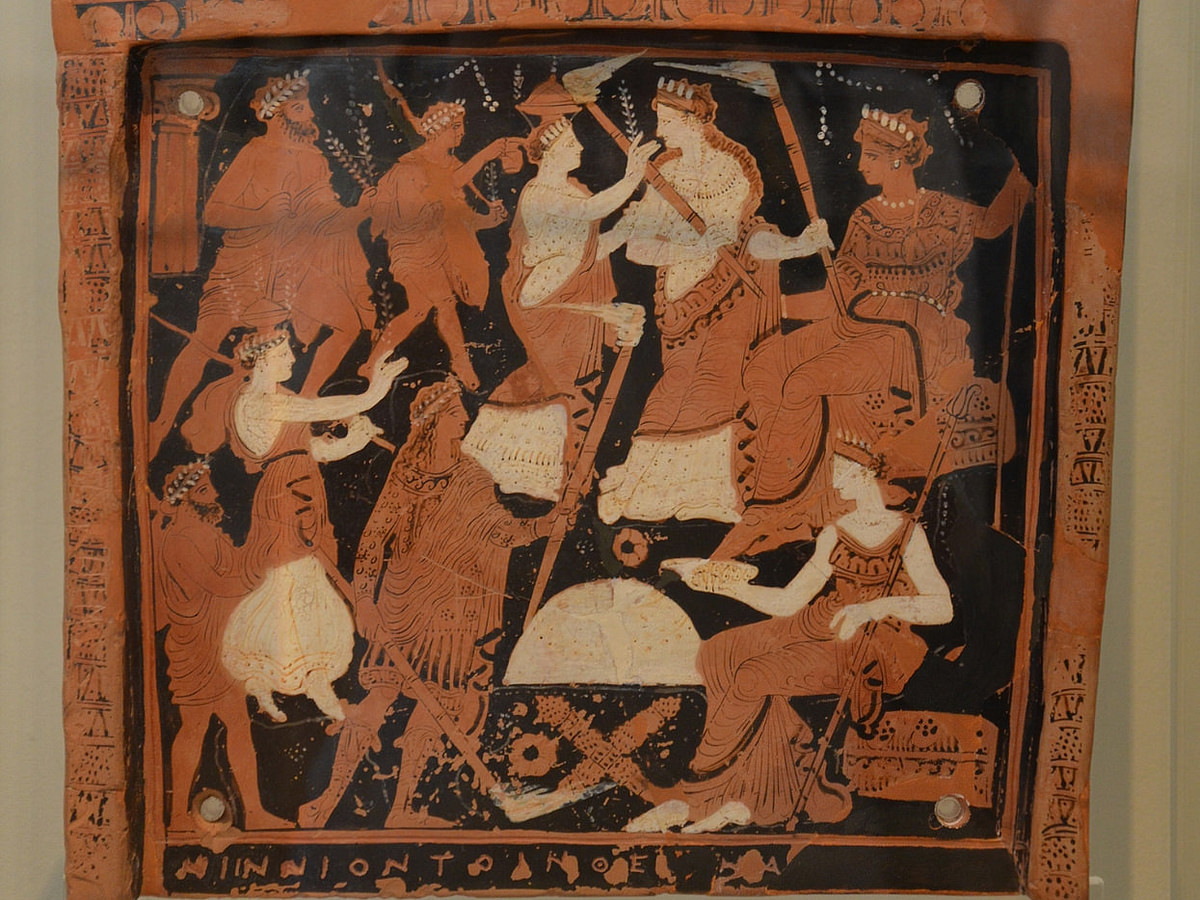 The Ninnion Tablet, a fourth-century BCE votive plaque from Eleusis, offers rare visual evidence for the cult of Demeter and Persephone. National Archaeological Museum, Athens.
What Were the Eleusinian Mysteries?
The Eleusinian Mysteries were the most celebrated initiation rites of ancient Greek religion. Centered at Eleusis, a settlement west of Athens, they honored Demeter, goddess of grain and agriculture, and her daughter Kore, better known as Persephone. Their documented history extends across many centuries, from archaic Greece through the Roman imperial period, and their prestige attracted ordinary people, political leaders, intellectuals, and emperors.
The word “mystery” did not originally mean an unsolved puzzle. Greek mystery cults were rites into which participants were initiated and whose central experiences were restricted from outsiders. The Eleusinian ceremonies were therefore mysterious because initiates were bound by secrecy, not because ancient Greeks knew nothing about them.
That distinction is crucial. Much of the public festival can be reconstructed from literature, inscriptions, archaeology, and art. We know about purification, sacrifice, fasting, a procession from Athens to Eleusis, ritual joking, the drinking of a beverage called kykeon, entry into the great initiation hall known as the Telesterion, and promises of a better condition after death. What happened at the climax inside the Telesterion remains less certain.
Oxford Classical Dictionary describes Eleusis as the most important Greek mystery cult and emphasizes its influence on ancient hopes concerning the afterlife. The cult was not a fringe magical society. It was woven into Athenian civic religion while simultaneously offering an intensely personal initiatory experience.
Demeter and Persephone: The Myth Behind Eleusis
The central myth is preserved most fully in the Homeric Hymn to Demeter, composed in the archaic period. Persephone is gathering flowers when Hades, ruler of the underworld, seizes her and carries her below. Her mother Demeter searches desperately for her, withdrawing from the company of the gods.
Disguised as an elderly woman, Demeter comes to Eleusis and enters the household of King Celeus. She attempts to make the child Demophon immortal, but the process is interrupted. The goddess then reveals herself and orders the Eleusinians to establish a sanctuary and rites in her honor.
Meanwhile the earth has become barren because Demeter refuses to allow crops to grow. Humanity faces famine, which would also deprive the Olympian gods of sacrifice. Zeus is forced to negotiate. Persephone returns to her mother, but because she has eaten pomegranate seed in the underworld she must spend part of the cycle with Hades and part above with Demeter.
The hymn links agricultural renewal, maternal grief, separation, return, divine revelation, and initiation. It explicitly praises the person who has seen the mysteries and contrasts the initiate’s fate after death with that of the uninitiated. This makes the hymn one of the most important primary sources for understanding Eleusinian religious meaning.
The Mysteries Were More Than a Seasonal Myth
Modern summaries often reduce Persephone’s story to a simple explanation of the seasons: she goes underground in winter and returns in spring. Agricultural symbolism is certainly central, but the Eleusinian system was richer than a children’s seasonal allegory.
Grain itself carries a powerful paradox. Seed is buried beneath the earth and appears dead before generating new life. The myth of Persephone similarly joins descent and return. For initiates, this agricultural cycle could provide a symbolic language for human mortality without requiring a simplistic belief that people literally reincarnated like plants.
Ancient testimony emphasizes hope after death. The mysteries appear to have promised not necessarily immortality in the modern sense but an improved postmortem condition for those who had undergone the sacred experience.
This combination helps explain Eleusis’s durability. It connected the most ordinary necessity of ancient life—grain—with the most difficult human question: what does death mean?
Who Could Be Initiated?
The Eleusinian Mysteries were unusually inclusive by the standards of ancient civic religion. Men and women could participate. Greeks from different cities could be admitted, and evidence indicates that some enslaved people also underwent initiation. The essential restrictions concerned ritual purity and the ability to understand the ritual language rather than membership in one narrow hereditary group.
This did not make Eleusis egalitarian in the modern political sense. Ancient Greek society remained deeply hierarchical. Priestly offices at Eleusis belonged to particular hereditary families, especially the Eumolpidai and Kerykes.
Nevertheless, the possibility that women, foreigners within the Greek-speaking world, and people of different social positions could share the status of initiate gave the cult an unusually broad reach. In the Roman period, emperors could undergo the same fundamental initiation tradition as less powerful worshippers.
The Lesser and Greater Mysteries
Initiation was not simply one evening at Eleusis. Ancient evidence distinguishes Lesser Mysteries and Greater Mysteries. The Lesser Mysteries were associated with preliminary preparation and purification, while the Greater Mysteries formed the major annual celebration.
The Greater Mysteries took place in the Attic month of Boedromion, roughly corresponding to September or early October in modern calendars. Their sequence extended over several days and linked Athens directly to Eleusis.
This staged structure matters. Mystery religion was a process. The initiate moved from ordinary civic space through purification, procession, fasting, and ritual transition before reaching the hidden climax.
The City Eleusinion in Athens
Eleusis was the sacred destination, but Athens played an essential role. The City Eleusinion, located near the Athenian Acropolis and Agora, functioned as the urban sanctuary of Demeter and Kore and as a key station in preparations for the mysteries.
Excavations by the American School of Classical Studies at Athens have revealed phases of the sanctuary from at least the seventh century BCE into late antiquity. Inscriptions preserve detailed regulations governing the mysteries, demonstrating how closely ritual secrecy coexisted with public administration.
The existence of laws and financial records is a useful corrective to romantic ideas about mystery cults. Eleusis was both transcendent religious experience and organized institution. Priests, civic officials, sacred property, roads, processions, and regulations made the mystery possible.
The Sacred Way: Initiation as a Journey
The procession from Athens to Eleusis followed the Sacred Way. The route itself transformed geography into ritual.
The Greek Ministry of Culture identifies the Sacred Gate in the Kerameikos as the starting point of the Eleusinian procession. From there participants moved westward toward Eleusis, passing sanctuaries and landmarks along the road.
Walking mattered. A pilgrimage is not only arrival at a destination; the movement reorganizes attention. Participants left the city, traveled together, crossed boundaries, encountered sacred places, and approached the sanctuary as a collective body.
The Acropolis Museum’s exhibition on Eleusis emphasized precisely this relationship among the City Eleusinion, Sacred Way, archaeological sanctuary, and Telesterion. The mysteries occupied a sacred landscape rather than a single hidden room.
Iacchos and the Procession
Ancient sources associate the procession with cries invoking Iacchos, a divine or personified figure linked with the Eleusinian journey. Later interpretations sometimes identify Iacchos with Dionysus, though the relationship is historically complicated.
Processional religion works through sound as well as sight. Repeated cries, music, movement, dust, torches, and the mass of participants could generate emotional intensity before the initiates reached Eleusis.
Modern attempts to reconstruct the mysteries sometimes focus almost exclusively on the secret climax. The procession reminds us that anticipation was itself ritual technology. The journey prepared the initiate psychologically and socially for what followed.
Ritual Joking at the Bridge
Ancient accounts preserve traditions of ritual mockery or joking associated with the Eleusinian procession. Participants crossing a bridge could be subjected to insulting humor known as gephyrismoi.
This apparently irreverent behavior belongs naturally beside the myth of Demeter. In the Homeric Hymn, the grieving goddess is finally made to smile by the servant Iambe’s joking.
Ritual laughter can interrupt grief, invert ordinary status, and mark transition. Eleusis was not solemn in only one emotional register. Mourning and joy, fasting and feasting, darkness and light, insult and sacred reverence could all coexist within the initiatory arc.
Fasting and the Example of Demeter
Fasting was another important preparatory act. In the hymn, Demeter refuses ordinary food and drink during her grief. The initiates’ fast ritually imitated the goddess.
Fasting changes bodily experience. Hunger sharpens awareness, alters mood, and creates a clear boundary between ordinary daily consumption and sacred time.
When the fast was eventually broken with kykeon, the drink carried mythic significance because Demeter herself accepts a similar mixture in the hymn.
This is one reason explanations that reduce kykeon to a hypothetical drug miss part of its meaning. Even if future evidence demonstrated psychoactive preparation in some period, the beverage was already embedded in a ritual narrative of fasting, divine grief, and return.
What Was Kykeon?
Kykeon means a mixed or stirred drink rather than one fixed chemical recipe. In the Homeric Hymn to Demeter, the goddess requests a mixture involving barley meal, water, and pennyroyal rather than wine.
At Eleusis, drinking kykeon became part of the ritual sequence. Ancient evidence establishes the beverage’s existence and sacred role. What remains disputed is whether the Eleusinian version contained an additional psychoactive ingredient.
The distinction between evidence and hypothesis is essential. Barley and pennyroyal are textually grounded. Claims about ergot-derived hallucinogens are modern scientific and historical hypotheses.
The Psychedelic Eleusis Hypothesis
In 1978, R. Gordon Wasson, Albert Hofmann, and Carl A. P. Ruck popularized the proposal that the Eleusinian kykeon contained psychoactive compounds related to ergot, the fungus that infects cereal grains. The theory became extraordinarily influential in modern psychedelic culture.
For decades, one major objection concerned toxicity. Ergot can cause severe poisoning, including convulsions and vascular damage. A stable religious institution initiating large numbers of people over centuries would seem unlikely to rely casually on a dangerously unpredictable contaminant.
A 2026 study in Scientific Reports renewed the debate experimentally. Researchers investigated whether ergot could be processed with techniques plausible in antiquity so that toxic components were reduced while psychoactive lysergic acid amide remained. Their laboratory results support chemical feasibility.
But feasibility is not historical proof. The experiment does not demonstrate that Eleusinian priestesses actually used that method, that ergot was intentionally added to kykeon, or that psychedelic pharmacology was necessary to produce initiatory experiences. The study itself belongs in the debate as new evidence about possibility, not as final discovery of the secret recipe.
Why Powerful Experience Does Not Require a Drug
Ancient initiates described Eleusis as profoundly transformative. Modern readers sometimes assume that intense altered experience must therefore have been pharmacological.
That assumption underestimates ritual. Fasting, exhaustion, expectation, sacred narrative, mass procession, music, darkness, torchlight, restricted access, emotional contagion, prayer, and sudden visual revelation can profoundly affect human consciousness without psychoactive substances.
Conversely, acknowledging ritual psychology does not prove that no psychoactive substance was used. The responsible position is agnostic where evidence is incomplete.
The psychedelic hypothesis is interesting precisely because it is testable in parts. It should not be turned into a new dogma replacing the ancient mystery with a modern one.
The Sanctuary at Eleusis
The archaeological sanctuary grew and changed over centuries. Its buildings included monumental gateways, sacred structures, storage and administrative spaces, and the extraordinary Telesterion.
The Acropolis Museum’s archaeological presentation highlights characteristic ritual vessels such as the kernos and plemochoe, images of major ritual officials including the Hierophant and Dadouchos, and artifacts connecting Athens with Eleusis.
Material evidence reveals a cult far more organized than modern fantasies of a hidden woodland ceremony. Eleusis was monumental, civic, expensive, and internationally famous.
The Telesterion: Architecture of Secrecy
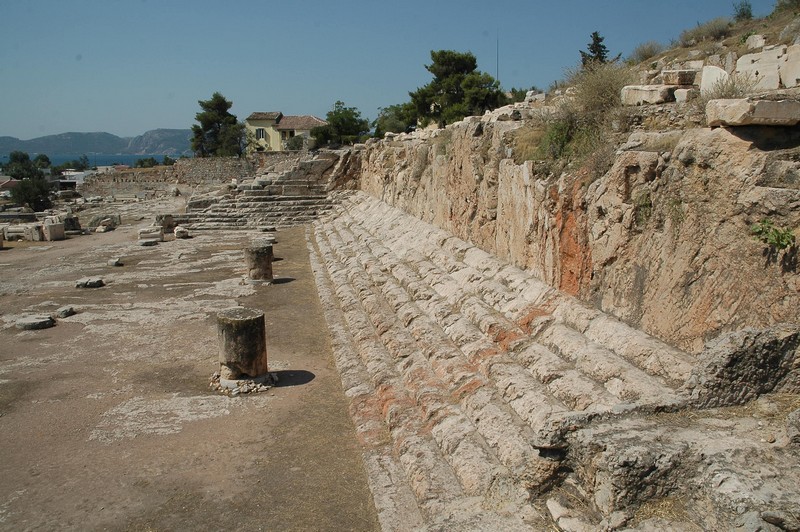 Surviving seating and foundations of the Telesterion at Eleusis, the monumental hall in which initiates experienced the climax of the Greater Mysteries.
The Telesterion was the great initiation hall and architectural heart of the mysteries. Unlike a conventional Greek temple designed primarily around an exterior altar and a deity’s inner chamber, the Telesterion was built to contain a large initiated audience.
Its form changed through successive building phases. In its classical monumental form, tiered seating surrounded a large interior space interrupted by columns. Within stood the Anaktoron, a particularly sacred inner structure associated with the mysteries’ holiest objects.
Thomas R. Martin’s historical overview for the Perseus Project emphasizes that thousands could be accommodated within the hall. The scale is remarkable: secrecy did not mean tiny numbers. A large population could share a secret if social and religious sanctions against disclosure were strong enough.
The Anaktoron and the Sacred Objects
The Anaktoron was the restricted sacred center within the Telesterion. Ancient sources associate the Hierophant with revealing holy things, but the precise identity of the central sacred objects remains uncertain.
Later Christian writers provide hostile descriptions of pagan mysteries, and modern scholars have proposed possibilities ranging from agricultural objects to symbolic representations. The famous idea that a cut ear of grain was displayed at the climax derives from late testimony and remains debated in interpretation.
The important methodological point is that we should not fill gaps with certainty. Something was shown. Something was said. Something was performed. Ancient terminology itself distinguishes things enacted, things shown, and things spoken, but reconstructing a universal exact script is difficult.
The Hierophant, Dadouchos, and Sacred Offices
The Hierophant, literally one who reveals sacred things, was the most famous Eleusinian priestly office. The role was hereditary within the Eumolpid family.
The Dadouchos, or torchbearer, was another major official, associated with the Kerykes family. Other sacred personnel contributed to the ritual system.
These hereditary offices gave continuity to a cult that initiated changing populations year after year. Priestly families preserved ritual authority while the civic state provided institutional support.
Eleusis therefore combined hereditary sacred expertise with broad initiatory access—a structure very different from both a private magical lodge and an ordinary open festival.
What Happened Inside the Telesterion?
This is the question that has fascinated readers for centuries, and it is also where responsible scholarship must resist overconfidence.
Ancient initiates largely kept the central secret. We possess hints from inscriptions, art, philosophical writers, later Christian polemicists, and descriptions of related rites. There may have been ritual drama involving the goddesses’ story, sacred speech, displays of objects, sudden light, and other sensory effects.
But no surviving neutral eyewitness gives us a complete program.
The mystery’s success at preserving its climax is historically extraordinary. For a cult practiced for centuries by enormous numbers of initiates, the absence of an undisputed ancient exposé demonstrates the strength of sacred obligation.
Seeing Rather Than Merely Learning
Greek mystery terminology repeatedly emphasizes experience. Initiation was not simply attending a lecture on secret theology.
The initiate saw, heard, moved, fasted, drank, and participated. Ancient language about the blessed person who has “seen” the rites suggests that revelation was experiential.
This distinction helps explain why a written summary could never fully reproduce the mysteries. Even if a modern historian correctly identified every sacred object, the emotional architecture of the event would remain absent.
Eleusis was knowledge embodied as ritual.
Torches, Darkness, and Revelation
Torches belong both to Demeter’s mythic search for Persephone and to Eleusinian imagery. Darkness and artificial light were therefore natural ritual media.
Inside a large enclosed hall, controlled illumination could create dramatic transitions. Sudden fire after darkness can feel revelatory even without elaborate technology.
Modern reconstructions sometimes turn this into a theatrical spectacle with precise lighting cues that are not securely documented. Yet the symbolic opposition itself is well grounded: Demeter searches in grief; Persephone returns; darkness yields to visibility.
The torch was not decorative. It materialized the act of seeking.
The Ninnion Tablet
The fourth-century BCE Ninnion Tablet is among the most important visual sources for Eleusinian religion. Dedicated by a woman named Ninnion, the red-figure plaque depicts worshippers approaching divine figures identified with the Eleusinian goddesses and associated sacred personnel.
Because it was found at Eleusis and belongs to the cult’s own visual environment, it offers evidence that later literary speculation cannot replace.
Yet even this image requires interpretation. Ancient religious art does not function like a photograph of one ritual moment. It condenses symbolic relationships, procession, divine presence, and ritual identity into a designed composition.
The Great Eleusinian Relief
Another major artifact, the Great Eleusinian Relief, dates to around 440–430 BCE and was found at Eleusis. The Greek National Archaeological Museum describes it as a large cult relief showing the central Eleusinian divine figures.
Demeter and Persephone flank the youthful Triptolemos, a figure associated with the transmission of agriculture. The composition connects divine gift, grain, civilization, and Eleusinian sacred authority.
Roman copies attest to the image’s continuing prestige. Eleusinian symbolism was not confined to one festival; it became part of the wider visual language of classical and Roman religion.
Triptolemos and the Gift of Agriculture
Triptolemos embodies another side of the Eleusinian story. While Persephone’s descent concerns mortality and return, Triptolemos represents the spread of cultivated grain and civilized life.
Greek art often depicts him receiving grain from Demeter before traveling in a winged vehicle to teach agriculture.
The mythology therefore moves outward from Eleusis. The sanctuary claims not only a secret about death but a civilizing gift necessary for human society.
Grain links private initiation with public survival.
What Did Initiates Hope to Gain?
Ancient evidence repeatedly connects initiation with a better fate after death. The Homeric Hymn to Demeter distinguishes the blessed initiate from the person who has no share in the rites.
Other Greek authors likewise speak positively of what initiates may expect beyond death.
This should not automatically be translated into later Christian concepts of heaven and hell. Greek ideas about the afterlife varied across periods and traditions.
Eleusis offered hope, privileged relationship with the goddesses, and perhaps knowledge that changed how mortality was understood. The exact doctrine may have mattered less than the conviction produced by the experience.
Eleusis and Orphic Traditions
Eleusinian and Orphic religion are frequently merged in modern occult literature, but they were not one organization.
Orphic texts and gold tablets preserve their own mythic, ritual, and afterlife traditions. Some themes overlap: Persephone, underworld journeys, purity, initiation, and improved postmortem destiny.
Ancient religious traditions could influence one another without becoming identical. An initiate might participate in more than one cult.
Comparison is therefore valuable, but calling the Eleusinian Mysteries simply “Orphic” erases important institutional and historical distinctions.
Eleusis and Dionysus
Dionysian associations also appear around Eleusinian tradition, especially through Iacchos and later religious interpretation.
Dionysus was himself a god of altered identity, ecstatic worship, theater, wine, death, and renewal. These themes naturally resonated with mystery religion.
Yet Demeter and Kore remained the defining goddesses of Eleusis. Dionysian parallels should enrich rather than replace the agricultural and maternal foundation of the cult.
Eleusis Was Not a Secret Society in the Modern Sense
The mysteries were secret, but the institution was public and famous. Athenians knew when the festival occurred. Processions crossed public roads. Sanctuaries were monumental. Officials regulated the rites.
This differs from a clandestine organization hiding its existence.
The secret concerned what initiates experienced and learned at particular ritual stages. Public visibility and restricted knowledge existed together.
This model helps explain many ancient mystery cults better than projecting modern ideas of underground occult orders onto them.
The Scandal of 415 BCE
The seriousness of Eleusinian secrecy is dramatically illustrated by the scandals surrounding the profanation of the mysteries in 415 BCE, at the beginning of Athens’ Sicilian expedition.
Individuals were accused of parodying or performing the mysteries outside their proper sacred context. The affair became entangled with political suspicion and accusations involving Alcibiades.
The episode demonstrates that revealing or imitating sacred rites could be treated as a grave civic and religious offense.
Secrecy was enforced not merely by personal preference but by social, legal, and theological consequences.
Roman Emperors at Eleusis
The mysteries remained prestigious after Greece came under Roman rule. Roman elites and emperors were initiated, integrating Eleusis into the religious geography of the empire.
This longevity demonstrates extraordinary institutional adaptability. A cult rooted in an archaic Greek hymn and local Attic sanctuary remained meaningful in a cosmopolitan imperial world centuries later.
Roman participation did not erase Greek identity. Instead, Eleusis became one of the places where Roman power sought access to venerable Greek sacred tradition.
Did Initiation Guarantee Salvation?
Modern descriptions sometimes present Eleusis as if it sold guaranteed salvation. Ancient evidence is more nuanced.
Initiation clearly promised religious benefit and improved hopes concerning death. But Greek religion generally lacked a single universal doctrine of salvation comparable to later systematic theologies.
The mysteries may have transformed the initiate’s relationship to death rather than providing a detailed map of the afterlife.
The power of Eleusis may have rested partly in experiential certainty: the initiate had seen something sacred that outsiders had not.
Was Eleusis a Fertility Cult?
Agriculture and fertility are fundamental, but the label “fertility cult” is too narrow if it suggests nothing more than crop magic.
Demeter governs grain, yet the myth moves through motherhood, grief, famine, divine-human relations, civilization, mortality, and afterlife hope.
Ancient agriculture itself was existential. Crop failure meant hunger and death. The regeneration of grain was therefore not a decorative metaphor; it was the material foundation of life.
Eleusis could connect cosmic, social, agricultural, and personal renewal precisely because these categories were not sharply separated.
Was There Sexual Ritual at Eleusis?
Modern occult speculation sometimes imagines secret sexual rites at the climax of the mysteries. The surviving evidence does not justify confident descriptions of ritual intercourse.
Fertility symbolism, divine marriage themes, and reproductive imagery occur widely in ancient religion without proving literal sexual ceremonies.
Claims about specific hidden sexual acts should therefore be labeled speculation unless supported by direct ancient evidence.
Was the Secret Simply an Ear of Grain?
A famous late source associates the Eleusinian climax with the display of a harvested ear of grain in silence. The image is powerful and may preserve genuine tradition.
But reducing centuries of initiation to one object is risky. Even if grain was displayed, its meaning depended on the entire ritual sequence: myth, fasting, procession, darkness, sacred speech, priestly authority, and the initiate’s expectations.
A symbol is not powerful because it is physically complicated. An ordinary grain head can carry extraordinary meaning inside the right ritual world.
Common Misconception: We Know Exactly What Happened
We do not. We know much about the festival framework and possess significant archaeological evidence, but the central revelation remains incompletely reconstructed.
Any modern author who provides a minute-by-minute definitive script should identify which parts come from ancient sources and which are reconstruction.
Common Misconception: Kykeon Was Definitely LSD
No. LSD is a modern semi-synthetic substance first prepared in the twentieth century.
The ergot hypothesis proposes that ancient processing might have yielded naturally occurring psychoactive lysergamides. The 2026 experimental study strengthens chemical plausibility but does not prove historical use at Eleusis.
Common Misconception: Persephone Simply Represents Spring
Seasonal return is important, but Persephone is also queen of the underworld, daughter, abducted bride, returned child, and divine guarantor within several Greek religious systems.
Reducing her to “spring” strips away the death-related and initiatory dimensions that made her especially important at Eleusis.
Common Misconception: Christianity Copied Eleusis
Christianity developed in the same Mediterranean world that contained mystery cults, and ancient Christians used language that could overlap with initiation traditions.
But similarity does not establish direct copying. Christianity emerged from Jewish scriptural and messianic traditions and developed its own historical institutions, while Eleusis was a Greek cult of Demeter and Persephone centered on a specific sanctuary.
Comparative study is valuable when it examines shared cultural environments rather than reducing one religion to plagiarism from another.
Why the Mysteries Ended
The decline of Eleusis belongs to the broader transformation of late antique religion. Imperial support increasingly favored Christianity during the fourth century CE, while traditional pagan institutions lost political and financial security.
The sanctuary also suffered amid the military disruptions of late antiquity. By the end of the fourth century, the ancient initiatory institution had effectively ceased.
Its disappearance did not erase its memory. Christian authors preserved hostile fragments; antiquarians studied ruins; archaeologists recovered the sanctuary; classicists reconstructed the festival; and modern esoteric movements reinvented Eleusinian symbolism.
Eleusis in Modern Psychology and Esotericism
Modern readers have interpreted Demeter and Persephone psychologically as images of mother-daughter separation, grief, maturation, descent into unconscious life, and return.
Such readings can be philosophically fruitful, but they are modern interpretations rather than documented doctrines taught by ancient Hierophants.
Contemporary Pagan and esoteric groups also create ceremonies inspired by Eleusis. Because the ancient secret ritual was not transmitted intact, modern practice necessarily involves reconstruction and invention.
Transparency is the key distinction: an Eleusinian-inspired ritual today may be meaningful without claiming an unbroken secret lineage from classical Athens.
A Symbolic Reading of Descent
Persephone’s descent is powerful because human life contains unavoidable descents: bereavement, separation, illness, uncertainty, aging, and confrontation with mortality.
Demeter’s response is equally important. She searches. She grieves. She refuses ordinary divine life. The world itself becomes barren.
The myth does not erase loss. Persephone does not return permanently; a cycle remains.
As a philosophical symbol, Eleusis therefore offers something subtler than simple resurrection. Human existence contains alternation, absence, return, and the knowledge that return is never absolute.
A Symbolic Reading of Grain
A grain seed disappears into darkness before growth becomes visible. Ancient farmers experienced this process not as metaphor but as survival.
Eleusinian symbolism could transform burial into a pattern that did not end with disappearance. That does not prove ancient initiates believed human bodies literally sprouted again.
Rather, agriculture supplied a vocabulary for hope: hiddenness is not always annihilation.
A Symbolic Reading of the Sacred Way
The journey from Athens to Eleusis can be read as a map of initiation itself.
The participant begins within ordinary civic identity, undergoes preparation, joins a collective procession, crosses boundaries, experiences fatigue and emotion, and reaches a place where ordinary access ends.
Initiation changes the meaning of return. The person who walks back toward ordinary life has traveled the same road but no longer occupies exactly the same religious status.
Why Eleusis Still Matters
Eleusis matters because it shows that ancient religion was not merely belief in myths. It was architecture, law, pilgrimage, food, fasting, family tradition, civic organization, sensory experience, and private hope.
It also teaches methodological humility. The cult left abundant evidence while successfully concealing its deepest ritual content. Historians must learn to distinguish what is documented from what is inferred.
Finally, Eleusis speaks to a recurring human desire: not simply to be told what death means, but to undergo an experience that changes one’s relationship to mortality.
Frequently Asked Questions
What were the Eleusinian Mysteries?
They were ancient Greek initiation rites honoring Demeter and Persephone at Eleusis, famous for promising initiates religious benefits and better hopes concerning the afterlife.
Where was Eleusis?
Eleusis, modern Elefsina, lies west of Athens in Attica, Greece.
Who could become an initiate?
Men and women could be initiated, and eligibility was broader than membership in the Athenian citizen body. Ritual purity and comprehension of the ritual language were important conditions.
What was the Telesterion?
The Telesterion was the monumental initiation hall at Eleusis where the climax of the Greater Mysteries occurred.
What was kykeon?
Kykeon was a mixed ritual beverage. The Homeric Hymn describes a drink involving water, barley meal, and pennyroyal. Whether the Eleusinian version also contained a psychoactive substance remains debated.
Did kykeon contain ergot?
It is possible but unproven. A 2026 Scientific Reports study demonstrated that ancient-compatible processing could theoretically reduce ergot toxicity while preserving a psychoactive compound, but chemical feasibility does not establish that Eleusinian priests actually did this.
What was the secret of the mysteries?
No complete reliable ancient account survives. Sacred objects, words, actions, and visual revelation were involved, but the exact climax remains uncertain.
Did initiates believe in life after death?
Ancient sources clearly associate initiation with a better fate or greater hope after death, although the exact theology should not be forced into later religious categories.
Were the mysteries a form of magic?
Ancient Greeks regarded them as sacred cult and initiation. Modern categories of “religion” and “magic” should not be imposed too rigidly.
Can the Eleusinian Mysteries be reconstructed today?
Parts of the public festival can be reconstructed from evidence, but the complete secret initiation cannot. Modern Eleusinian-inspired rites are therefore reconstructions, not demonstrably identical survivals.
Conclusion: The Secret Was an Experience, Not Just Information
The Eleusinian Mysteries survived for centuries because they joined several dimensions of human life that are often separated in modern discussion. Agriculture became theology. A mother’s grief became cosmic crisis. A daughter’s return became a language for hope. A road became pilgrimage. Fasting made myth bodily. A drink recalled the goddess’s own actions. Darkness and torchlight transformed architecture into revelation.
We know enough to reject many modern myths. The mysteries were not simply an underground drug cult. Kykeon was not “ancient LSD” as an established fact. Persephone was more than a symbol of spring. Eleusis was not a clandestine occult lodge detached from Greek civic religion.
At the same time, we do not know enough to write the final secret on a page. That limitation is historically meaningful. The initiates succeeded in preserving the restricted core of their experience to an extraordinary degree.
The most defensible reconstruction therefore begins outside the Telesterion. An initiate prepared, purified, fasted, walked from Athens, joined thousands of others, invoked sacred figures, crossed ritual boundaries, entered Demeter’s sanctuary, drank kykeon, and finally passed into a space unavailable to the uninitiated.
Inside, something was performed, something was spoken, and something was shown. Whatever the precise content, ancient testimony indicates that the experience changed how initiates imagined life and death.
That is why Eleusis remains important. Its enduring mystery is not merely that modern historians lack information. It is that ancient religion could create an experience considered so sacred that generations of participants accepted the obligation not to reduce it to public explanation.
For historians, the task is not to invent the missing secret. It is to understand the extraordinary religious world that made secrecy itself meaningful.
Sources and References
- Fritz Graf, “Mysteries, Eleusinian,” Oxford Classical Dictionary, Oxford University Press.
- Thomas R. Martin, An Overview of Classical Greek History, Perseus Digital Library, Tufts University.
- Acropolis Museum, “Eleusis. The Great Mysteries,” exhibition and archaeological overview.
- Margaret M. Miles, The City Eleusinion, Athenian Agora XXXI, American School of Classical Studies at Athens.
- Hellenic Ministry of Culture, Kerameikos and the Sacred Gate.
- National Archaeological Museum, Great Eleusinian Relief, ca. 440–430 BCE.
- “Investigating the psychedelic hypothesis of kykeon, the sacred elixir of the Eleusinian Mysteries,” Scientific Reports, 2026.
- Kevin Clinton, “A Law in the City Eleusinion Concerning the Mysteries,” Hesperia.


