


The Atharvaveda is often introduced with a deceptively simple label: the “Veda of spells.” That description captures something real, but it can also distort the text before we have begun to understand it. The collection includes charms for healing, protection, rivalry, love, household welfare, royal power, long life, and the neutralization of hostile forces. Yet it also contains cosmological speculation, reflections on speech and sacred knowledge, funeral material, marriage rites, royal liturgy, and hymns that belong to the wider intellectual world of Vedic religion. To call all of this “magic” as though the category were self-evident is to import a modern distinction between religion and magic into a society that organized sacred action differently.
For historians of esotericism, the Atharvaveda is valuable precisely because it complicates familiar boundaries. It shows ritual language functioning not only as praise offered to gods but as a technology of transformation: words are recited over herbs, knots, water, amulets, bodily conditions, domestic crises, and social relationships. The efficacy imagined by the texts lies in combinations of utterance, material object, inherited authority, analogy, bodily action, divine agency, and ritual timing. A charm is therefore not simply a sentence believed to have supernatural power. It is better understood as one component in a structured act that joins speech and world.
 Portrait of the Atharvaveda by a Mewar court artist, circa 1720. Public-domain reproduction via Wikimedia Commons.
This article approaches the Atharvaveda historically rather than as a handbook for modern occult practice. It asks what kinds of problems its rites addressed, how the text was transmitted, why the category of magic remains useful but dangerous, and what its ritual poetics reveal about early South Asian ideas of healing, protection, kingship, speech, and causality. The goal is not to flatten Vedic religion into “ancient sorcery,” nor to deny the genuinely coercive, protective, apotropaic, and aggressive rites preserved in the corpus. The more interesting task is to see how these elements coexist within one sacred tradition.
A Fourth Veda with a Different Ritual Horizon
The Atharvaveda belongs to the Vedic corpus, the body of Sanskrit sacred literature that became foundational for Brahmanical traditions. Modern reference works commonly describe it as the fourth Veda, distinguished in content from the Rigveda, Samaveda, and Yajurveda. Carlos Lopez, writing for Oxford Bibliographies, emphasizes that the Atharvaveda does not make the great public śrauta sacrifices its main subject. Instead, much of its material concerns healing, the removal of demons or hostile beings, love, domestic rites, initiation, death, and royal ceremonies. That difference in emphasis helps explain why readers have long perceived it as closer to everyday crisis and private ritual than the other major Vedic collections.
That difference should not be exaggerated into a simple opposition between “high religion” and “folk magic.” The Atharvan tradition was not outside Brahmanical culture. It developed its own specialists, ritual texts, recensions, scholastic traditions, and claims to Vedic authority. Later Atharvan materials include rites for kings and royal chaplains, and the tradition participates in the same broad universe of mantra, sacrifice, cosmic correspondences, sacred speech, and priestly expertise found elsewhere in Vedic religion. The fourth Veda is distinctive, but it is not a detached archive of popular superstition accidentally admitted into a priestly canon.
The collection survives principally in two major recensional traditions: the Śaunaka and the Paippalāda. The Śaunaka recension became the better-known form in modern printed scholarship, while the Paippalāda tradition has become increasingly important for philologists because its manuscript history preserves readings and materials not identical to the Śaunaka text. The existence of these recensions reminds us that “the Atharvaveda” is not a single immutable artifact descending unchanged from one moment. Like many ancient corpora, it is a layered textual tradition preserved through schools of transmission.
The chronology is likewise complex. Scholars locate Atharvavedic language and materials within the later phases of the Vedic period, but individual hymns, formulas, and ritual ideas may have different histories. It is safer to speak of composition, compilation, recensional formation, and manuscript preservation as separate questions. A hymn can preserve old linguistic or ritual elements even when the manuscript that physically transmits it is many centuries younger. The surviving manuscripts are not themselves “Vedic-age objects”; they are witnesses to a much older oral-textual tradition.
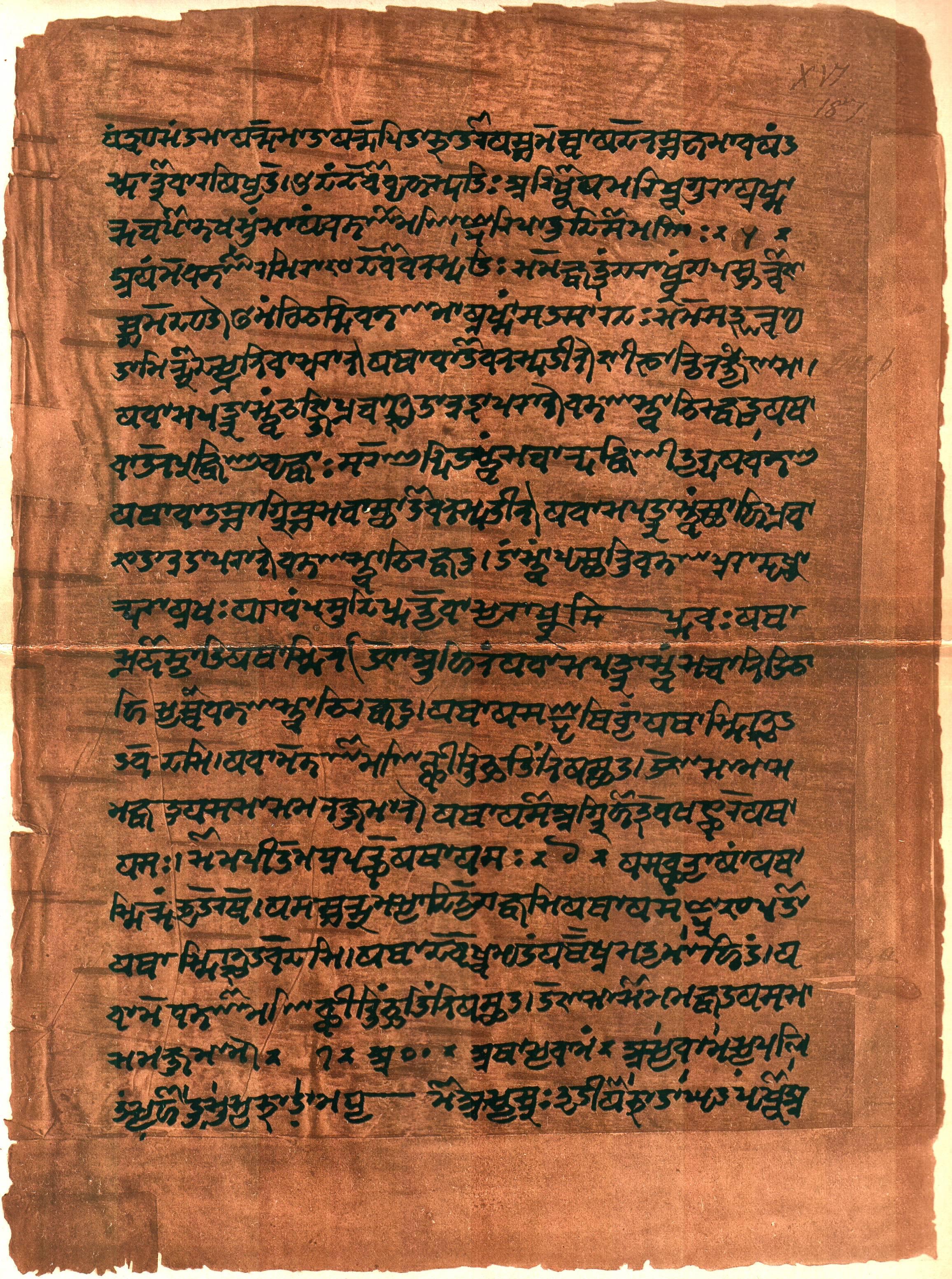 A manuscript page of the Atharva-Veda Saṁhitā reproduced by William Dwight Whitney and Charles Rockwell Lanman. Oxford Humanities credits the image as public domain.
This distinction between ancient composition and later manuscript witness is especially important for esoteric history. Occult literature is often romanticized through images of mysterious books carrying uninterrupted secret knowledge. Vedic transmission provides a different model. Oxford’s Humanities Division notes that the Vedas were famously preserved for long periods through highly disciplined systems of oral memorization and transmission, and that writing entered this history comparatively late. The authority of the Veda therefore did not originally depend on an old book sitting in a temple library. It depended on embodied recitation, teacher-student transmission, accent, sequence, memory, and the social institutions that maintained them.
Why Scholars Put “Magic” in Quotation Marks
The word “magic” is difficult because it is both illuminating and historically loaded. It is illuminating because many Atharvavedic rites unmistakably seek concrete effects through specialized words and actions: the curing of disease, protection from snakes or hostile beings, defeat of rivals, securing affection, restoration of bodily functions, acquisition of prosperity, or safeguarding of a household. Comparative historians recognize these as functions often described as magical in many cultures.
But the label becomes misleading when it silently carries assumptions inherited from European theological and intellectual history. Modern readers may imagine magic as the opposite of religion, as irrational technique opposed to prayer, or as clandestine manipulation outside legitimate priesthood. None of those oppositions can simply be projected onto Vedic India. A rite can call upon divine beings, use consecrated substances, rely on priestly expertise, and still be highly instrumental. Prayer and technique are not mutually exclusive categories.
This problem is central to recent scholarship. Carmen Sylvia Spiers’s 2025 critical edition and study of Book 3 of the Paippalāda Saṁhitā explicitly re-examines the use of the category “magic” in Atharvaveda studies. Her work places the so-called charms within a northwestern South Asian ritual tradition and treats performativity, poetry, violence, marginality, and ritual use as problems requiring historical analysis rather than as evidence for a ready-made category. The point is not that the Atharvaveda contains no magic. It is that “magic” is an interpretation, not a Sanskrit label that transparently explains the corpus.
Older scholarship frequently classified Atharvavedic hymns according to their apparent practical purposes: healing, securing harmony, harming enemies, protecting against demons, and so forth. Such classification remains useful, especially when navigating a large corpus. Yet it can encourage the reader to treat each hymn like an isolated recipe. In actual ritual life, a verse could be embedded within a larger procedure. Later ritual texts, above all the Kauśika Sūtra for the Śaunaka tradition, provide instructions that associate Atharvavedic verses with actions, substances, gestures, and ritual situations. The hymn and the rite illuminate each other, though scholars must be careful not to assume that every later ritual application perfectly reproduces the earliest context of the verse.
The category question matters beyond terminology. If we label a healing charm “magic” and a fire sacrifice “religion” solely because the first seems more instrumental, we may conceal the fact that Vedic sacrifice is also directed toward results: prosperity, offspring, victory, rain, status, heaven, and cosmic order. Conversely, if we avoid the word magic entirely, we risk losing a useful comparative vocabulary for coercive, protective, apotropaic, aggressive, and manipulative forms of ritual. The best approach is therefore explicit and limited: use “magic” as an analytical category while continually asking what exactly it describes in each context.
Speech as Action: What a Charm Is Trying to Do
Atharvavedic charms make sense only if we take seriously the ritual status of speech. In modern secular settings, words are often imagined as descriptions of reality. In ritual traditions, however, utterances may do things. A legal pronouncement can marry, condemn, release, authorize, or name; a vow can create an obligation; a blessing can publicly transform social status. Vedic mantra intensifies this performative dimension by locating correct speech within a sacred order transmitted through authoritative tradition.
The efficacy of a charm is rarely reducible to “believing hard enough.” Its logic is structured through identification, analogy, command, invocation, narration, praise, expulsion, binding, loosening, naming, or transfer. A disease may be addressed as an entity that can be driven away. A plant may be praised for a power understood to reside in its mythic origin or physical qualities. A hostile condition may be transferred to another place. A knot may embody a binding, while loosening can represent release. Water can cleanse, cool, carry away, or restore. Fire can transform. The rite works through a network of correspondences rather than through abstract doctrine alone.
This is one reason the material objects mentioned in ritual literature matter so much. Herbs are not decorative props added to verbal spells. Their color, growth pattern, habitat, medicinal property, name, or mythic association can participate in the argument of the ritual. The spoken formula interprets the object while the object gives material form to the formula. The result is a kind of enacted poetics.
Consider medical material. The Atharvaveda contains hymns directed toward fever, wounds, bodily dysfunctions, worms, and other afflictions. Some procedures combine medicinal substances with mantra; others personify illness or treat it through expulsion. A modern reader may be tempted to sort these elements immediately into “medicine” and “magic,” keeping the physically active substance on one side and the words on the other. That separation is historically crude. In the culture reflected by the texts, remedy, ritual authority, cosmology, and verbal action could belong to one therapeutic event.
This does not mean the texts should be treated as scientifically validated medical manuals. Historical importance is not the same as clinical efficacy. The Atharvaveda reveals how illness was conceptualized and treated within a specific ancient religious-medical world. Some plants used in early South Asian medicine may have pharmacological properties; some ritual actions may offer social or psychological forms of care; and some etiologies involve beings or forces that modern medicine does not recognize. These possibilities must be distinguished rather than collapsed into a single claim.
A 1981 study by V. V. Bhide on medical treatment and medicinal charms in Atharvanic literature emphasized the importance of reading Atharvavedic passages together with ritual texts such as the Kauśika Sūtra. Even though modern scholarship has advanced significantly since that article, the methodological point remains sound: the words are part of procedures. A mantra stripped from its ritual setting can easily be misunderstood.
Healing, Fever, and the Ritual Body
Healing is one of the Atharvaveda’s most accessible windows into its worldview because illness makes the intersection of body, environment, society, and invisible agency especially visible. Disease can be spoken of in ways that sound almost personal, as though an affliction could be confronted, persuaded, banished, or redirected. Such language should not be dismissed as primitive personification. It is a ritual strategy that turns suffering into a relationship that can be acted upon.
Fever is a famous example in Atharvavedic studies. Rather than treating fever solely as an impersonal symptom, ritual language can address it as something with direction and presence. Expulsion formulas send harmful conditions elsewhere, creating a verbal geography of illness. The patient is not only a biological body but a person located within a ritual cosmos in which speech can redraw boundaries between self and affliction.
Other charms use plants in highly specific ways. The plant may be addressed, praised, empowered through mythic association, or physically applied. This is not merely “sympathetic magic” in the narrow sense popularized by older anthropological theories. Similarity sometimes matters, but so do authority, lineage, deity, naming, and the perceived inherent potency of substances. A single theory cannot explain all Atharvavedic ritual logic.
The same caution applies to references to worms or other agents of disease. Some ancient descriptions may correspond broadly to observable parasites; others participate in a ritual taxonomy that does not map neatly onto modern biology. The historian’s job is not to force every ancient term into a modern diagnosis. It is to identify what the text claims, what actions it prescribes, and how the rite conceptualizes the relationship between visible symptoms and invisible causes.
Healing charms also reveal an important social dimension. Illness creates uncertainty. Ritual can provide a structured response: a specialist knows words, a sequence of actions, substances, and inherited precedents. Whether or not a modern observer accepts the supernatural assumptions of the rite, the procedure creates an intelligible framework for crisis. It names the threat, organizes care, and places the sufferer within a network of family, ritual experts, divine beings, and sacred tradition.
This helps explain why instrumental ritual persists in sophisticated religious cultures. People do not seek only metaphysical enlightenment or theological truth. They seek relief from pain, protection for children, reconciliation, long life, social stability, and a sense that misfortune can be addressed. The Atharvaveda preserves these ordinary pressures with unusual vividness.
Protection, Amulets, and the Materialization of Mantra
Protective ritual is another major Atharvavedic domain. Threat may come from disease, poison, hostile persons, dangerous beings, bad dreams, uncertain journeys, rivalries, or more diffuse forms of misfortune. Protection can involve recitation, tying, wearing, anointing, sprinkling, or manipulating substances whose ritual meaning is articulated through mantra.
An amulet is especially revealing because it turns sacred efficacy into something portable. The ritual does not end when the recitation stops. A consecrated object can continue to mark the body as protected. In this sense the amulet is a material extension of speech: the mantra interprets and activates the object, while the object prolongs the ritual relation in time.
The Atharvavedic world therefore challenges a modern tendency to treat text and object as separate media. A written modern spellbook may encourage the impression that magic primarily consists of verbal instructions. Vedic ritual suggests a more integrated ecology. Knowledge is embodied in memorized sound, performed gesture, social role, and material things. Even when modern scholars encounter the tradition in printed books, the ancient practice was not a literary exercise.
The importance of sound further complicates translation. A good English translation can communicate semantic meaning, but it cannot reproduce every feature of Vedic phonology, accent, meter, and inherited recitational practice. For historical study this means that a translated charm is not identical to the ritual utterance. The translation allows us to analyze imagery and meaning, but the original performance belonged to an oral discipline in which precise verbal form mattered.
This is one reason modern claims to extract isolated “power words” from the Atharvaveda should be treated cautiously. Without recensional context, grammatical understanding, ritual setting, and knowledge of the relevant tradition, a transliterated fragment on a website is not automatically the same practice preserved by Atharvan specialists. Historical reconstruction requires more than copying a line of Sanskrit.
 A photographed Atharvaveda volume. Image by Sudan Bhattarai Upadhaya, licensed CC BY-SA 4.0 via Wikimedia Commons.
Love, Attraction, and the Ethics of Coercive Ritual
The Atharvaveda also contains rites connected with attraction, affection, erotic desire, rivalry, and the securing of relationships. These texts are historically important because they reveal areas of life in which people sought ritual control over uncertainty. Desire is vulnerable: affection may be unreturned, marriage may be unstable, rivals may intervene, and social expectations may conflict with personal longing. Instrumental ritual offers imagined leverage over that uncertainty.
Yet such material raises ethical problems, especially when modern readers approach ancient texts looking for usable spells. Some attraction rites are not simply prayers for mutual affection; they can imagine compelling another person’s emotions or behavior. Historical description should therefore not become operational instruction. The existence of a rite tells us about ancient hopes, anxieties, gender relations, and ritual strategies. It does not make coercion ethically neutral.
One of the most important distinctions in responsible esoteric study is the difference between interpreting a ritual and reenacting its controlling intention. A scholarly account can examine the metaphors used to “heat,” “bind,” draw, or dominate desire while refusing to present coercive formulas as techniques for overriding another person’s autonomy. The historical value lies precisely in seeing how power is imagined.
Gender in these rites is complex. Some formulas reflect male attempts to obtain or secure women; others concern women’s concerns, household relationships, fertility, marriage, or rivalry. The corpus should not be reduced to one social voice. At the same time, it comes from a patriarchal historical setting and cannot be assumed to represent equal access to ritual authority. Careful reading asks who is speaking, whose desire is being centered, and what social structure the rite presupposes.
The language of attraction can also overlap with broader ritual themes of harmony and concord. Not every interpersonal charm is an erotic domination spell. Some rites seek agreement within a household or community. The same verbal technologies that can be used coercively may also be used to imagine social integration. This moral ambiguity is one reason the category “magic” by itself tells us too little; we also need to ask what the rite seeks and whose interests it serves.
Aggressive Rites, Rivalry, and Ritualized Violence
Alongside healing and protection, Atharvavedic literature preserves hostile and aggressive ritual. Enemies may be cursed, rivals weakened, threats bound, or harmful forces turned back. Such material makes it impossible to romanticize the corpus as a collection of benign spiritual affirmations. Ancient ritual systems, like ancient political systems, include conflict.
Aggressive rites are particularly useful for studying the relationship between symbolic and actual violence. A ritual may imagine crushing, binding, burning, piercing, expelling, or defeating an enemy without necessarily documenting a physical attack. Symbolic violence can be a substitute for direct confrontation, an accompaniment to it, or a way of representing social hostility in sacred language. The historical record rarely allows us to determine how often a given rite was performed or what practical consequences followed.
The verbal form of such rites often creates certainty in situations where outcomes are uncertain. A speaker proclaims the enemy already defeated, excluded, or deprived of power. Linguistically, the rite collapses desire and result. That performative confidence is common in many magical traditions: the formula does not merely ask that something might happen; it speaks as though ritual authority has made it so.
Modern readers should resist two opposite errors. The first is sensationalism, treating every hostile verse as evidence of a secret world of lethal sorcerers. The second is sanitization, translating aggressive ritual into harmless psychology. The texts can be genuinely hostile. They belong to societies where competition, warfare, disease, legal conflict, status anxiety, and household rivalry were real. Ritual language provided one culturally available means of acting within those pressures.
Spiers’s recent study is especially valuable because it places violence and marginality among the problems that must be analyzed when discussing Atharvavedic “magic.” The concept of magic has often been used historically to marginalize practices considered illegitimate, irrational, or socially suspect. Yet the Atharvan tradition itself eventually occupies authoritative Brahmanical space. A rite can be aggressive without being socially marginal, and a tradition can preserve coercive techniques while also serving kings and domestic religion.
Royal Power and the Atharvan Priest
The association of the Atharvaveda with household crises does not exhaust its social range. Royal ritual became an important domain of Atharvan expertise. The tradition includes material concerning consecration, protection of kingship, victory, omens, appeasement, and the maintenance of political order. This dimension disrupts the stereotype of the Atharvaveda as a marginal collection of village spells.
Marko Geslani’s study of śānti, or rites of appeasement, shows how Atharvan ritual manuals became deeply involved in kingship and divination. In the Atharvavedic appendices for the royal chaplain, ritual response expands to cover omens and threats affecting the ruler and realm. Appeasement becomes not merely private protection but part of governance: dangers in the cosmos, body politic, and environment require ritual management.
This development illustrates a broader pattern in the history of esotericism. Techniques initially associated with specialized or liminal expertise can become instruments of institutions. Astrology, divination, omen interpretation, and apotropaic rites have repeatedly moved between private practitioners and courts. When royal authority adopts such techniques, the distinction between “official religion” and “magic” becomes even harder to sustain.
The Atharvan priest’s value lies partly in dealing with what cannot be fully controlled through ordinary administration. A king can command soldiers and collect taxes, but eclipses, disease, ominous births, dreams, weather, and unexplained misfortune occupy another register. Ritual specialists convert uncertainty into interpretable signs and prescribed responses. In political terms, this offers a technology of reassurance and order.
We should not assume that rulers or priests understood such rites as mere theater. The available evidence suggests a cosmology in which ritual action was genuinely connected to the maintenance of auspicious order. But from a historical perspective, the rites also perform social functions: they define expertise, authorize specialists, organize responses to danger, and connect political power to sacred knowledge.
The Paippalāda Tradition and What Manuscripts Changed
Modern knowledge of the Atharvaveda has been transformed by work on the Paippalāda recension. Earlier Western scholarship often depended heavily on the Śaunaka text because it was more accessible in printed editions. The Paippalāda tradition, preserved in different regional manuscript histories, has allowed scholars to recover variant readings and additional material that complicate any assumption that the better-known printed text represents the whole Atharvavedic tradition.
The University of Tübingen preserves a striking sixteenth-century Kashmir birch-bark manuscript of the Atharvaveda Paippalādaśākhā written in Śāradā script. Its significance is not that the physical leaves date to the Vedic age; they do not. Rather, the manuscript is a witness to the long survival of a recensional tradition. Its birch bark, script, and regional provenance make visible the historical journey by which orally grounded sacred material entered manuscript culture.
The Asiatic Society of Mumbai likewise preserves important Atharvavedic manuscripts, including Paippalāda materials that have been digitized. These witnesses matter because textual criticism depends on comparing evidence. A modern critical edition is not simply a translation of one old book. It is the result of reconstructive work across manuscripts, recensions, citations, ritual texts, linguistic patterns, and the history of transmission.
This philological labor has direct consequences for the study of magic. If a charm exists in different forms, or if a ritual application varies between traditions, then the historian cannot assume a single fixed “spell.” Variation may reveal adaptation, reinterpretation, regional practice, or the ordinary instability of long transmission. The history of a magical text is therefore also a history of editing, memory, and institutional continuity.
Spiers’s 2025 work on Book 3 of the Paippalāda Saṁhitā exemplifies this newer phase of scholarship. It combines critical edition, translation, and commentary with theoretical reflection on ritual performance. That combination is important. Philology without ritual interpretation can produce accurate words but thin historical understanding; ritual theory without secure text can build interpretations on unstable foundations.
The Kauśika Sūtra: When Hymns Become Procedures
One of the recurring problems in reading the Atharvaveda is that a hymn does not always tell us everything about how it was used. The Kauśika Sūtra, associated with the Śaunaka tradition, helps fill that gap by prescribing ritual applications for Atharvavedic verses. It links recitation to actions involving substances, objects, bodily gestures, domestic events, healing procedures, rites of protection, and hostile operations.
For students of ceremonial magic, this relationship between mantra collection and ritual manual is familiar in structure even if the cultural content is very different. A liturgical text supplies authoritative words; a procedural tradition specifies how, when, and with what they are deployed. But one must avoid importing later Western grimoire categories. The Kauśika Sūtra belongs to Vedic ritual scholarship, with its own language of authority and practice.
The relationship between text and procedure also warns against extracting Atharvavedic verses from context. A line that sounds like a powerful command may have been part of a highly specific rite. The object manipulated, the social role of the performer, and the ritual purpose can change its meaning. A modern quotation site that presents such a line as a universal mantra may erase exactly the information historians need most.
At the same time, later ritual application should not automatically be treated as the original meaning of every hymn. Traditions reuse authoritative texts. A verse can acquire new settings over time. The Kauśika Sūtra is evidence for how Atharvavedic material was understood and ritualized within its tradition, not a time machine providing direct access to the first performance of every stanza.
This layered method—text, recension, ritual manual, manuscript history, linguistic analysis, and comparative study—is what distinguishes serious historical work from modern occult reconstruction. The latter often seeks a single usable procedure. The historian is more interested in how procedures changed and why.
Cosmology, Sacred Speech, and the Atharvaveda Beyond Charms
If we focus only on practical spells, we miss some of the Atharvaveda’s most ambitious intellectual material. The collection includes speculative hymns on cosmic principles, sacred speech, the Vedic student, sacrificial remnants, time, and the structure of reality. These passages demonstrate that Atharvavedic tradition was not confined to crisis management. It participated in the same movement toward cosmological and theological reflection that would shape later Vedic thought.
This matters because practical ritual and speculation are not separate universes. A charm works within assumptions about what kinds of things exist, how words relate to them, and how human beings can participate in cosmic order. The more speculative hymns make some of those assumptions explicit. Sacred language is powerful because speech is not merely a human convention; it is tied to knowledge, order, and creative potency.
Esoteric traditions often join cosmology to technique. Renaissance astral magic connects talismanic operations to a hierarchical cosmos. Kabbalistic practices connect letters and divine names to structures of creation. Daoist ritual connects registers, talismans, gods, and bureaucracy. The Atharvaveda belongs to a very different cultural world, but it offers a comparable lesson: practical rites become intelligible when placed within their cosmological environment.
That comparison should not be turned into claims of hidden historical influence where evidence is absent. Similar ritual patterns can arise independently. Comparative study is strongest when it identifies structural similarities while preserving cultural difference. The Atharvaveda does not become a “Vedic grimoire” merely because it contains effect-oriented rites. Its place within Vedic revelation, oral transmission, Sanskrit poetics, and Brahmanical ritual makes it historically distinctive.
Magic, Religion, and Science: Three Categories That Do Not Line Up Neatly
Modern discussions of ancient ritual often fall into a triangle: was this magic, religion, or early science? The Atharvaveda shows why this framing is inadequate. A healing rite can invoke divine power, use a medicinal plant, employ observed bodily knowledge, and include an expulsion formula. Which category should own it?
From a modern institutional perspective, medicine belongs to science, prayer belongs to religion, and a command addressed to fever might be classified as magic. In an ancient ritual event these components could function together. Sorting them may help modern analysis, but the sorting should not be mistaken for the historical experience of the practitioner.
This does not require abandoning distinctions altogether. Scholars can ask whether a substance had plausible pharmacological effects, whether a rite involved worship, whether language was coercive rather than petitionary, or whether a practice was socially authorized. The mistake is assuming that one answer excludes the others. Ancient systems regularly combine empirical observation with cosmological assumptions that modern science rejects.
The same caution applies to claims that the Atharvaveda “anticipated” modern medicine, psychology, physics, or neuroscience. Such arguments usually depend on vague resemblance and anachronistic translation. The text deserves study on its own terms. Inflating it into a repository of lost modern science does not honor the tradition; it replaces historical understanding with projection.
Conversely, dismissing the entire corpus as superstition produces the opposite distortion. Atharvavedic material preserves linguistic, medical, social, ritual, botanical, political, and religious evidence of enormous historical value. A practice can be based on supernatural assumptions and still reveal sophisticated forms of classification, poetic construction, observation, and cultural reasoning.
What the Atharvaveda Teaches Us About Esotericism
The Atharvaveda is not “esoteric” in exactly the same sense as a modern initiatory order or a Renaissance occult handbook, yet it belongs naturally in the comparative history of specialized sacred knowledge. Its rites depend on controlled transmission, authorized speech, ritual expertise, and techniques that address uncertain or hidden causes. It demonstrates that esoteric power can reside as much in disciplined oral knowledge as in secret books.
It also shows how porous the boundary between ordinary life and sacred technique can be. Birth, marriage, illness, love, rivalry, kingship, death, cattle, crops, bodily functions, and household peace all become ritual subjects. The sacred is not confined to temples or metaphysical contemplation. It enters the vulnerable places where human beings most strongly want outcomes.
A second lesson concerns classification. Traditions do not arrive pre-sorted into the boxes scholars later use. “Magic,” “religion,” “medicine,” and “politics” are analytical lenses. Each can reveal something, but none should erase the others. The Atharvaveda is especially useful because it refuses to behave like a pure example of any one category.
A third lesson concerns the relationship between language and matter. In many modern discussions of magic, language is treated as symbolic and objects as physical. Atharvavedic ritual demonstrates a more integrated model: speech interprets matter, matter carries speech, gesture gives form to intention, inherited authority stabilizes the procedure, and cosmology explains why the combination should work. This is ritual as a total technology of meaning.
Finally, the tradition teaches caution about romantic claims of antiquity. The physical manuscripts we can photograph are much younger than the Vedic compositions they preserve. Printed editions are younger still. Yet the oral discipline behind them may carry very old textual material. The history is neither “an ancient book unchanged for thousands of years” nor “a late fabrication.” It is a layered chain of transmission whose complexity is more interesting than either myth.
Common Misconceptions About the Atharvaveda
“It is simply a black-magic Veda.”
No. The corpus contains aggressive and coercive rites, but also healing, protection, household ritual, marriage, funerary material, royal liturgy, and philosophical or cosmological hymns. Describing it as a book of black magic sensationalizes one part of a much broader tradition.
“Every Atharvavedic hymn was originally a spell.”
No. The collection is diverse, and even effect-oriented hymns can belong to ritual contexts that are more complex than the modern idea of a spell. Some materials are speculative, liturgical, domestic, royal, or funerary.
“The surviving manuscripts are thousands of years old.”
The textual tradition is ancient, but surviving manuscripts are much later material witnesses. The Vedas were transmitted orally for long periods. Composition date, recensional history, manuscript date, printed edition, and modern translation must be kept distinct.
“Magic and religion were completely separate.”
The Atharvavedic evidence makes that separation difficult to sustain. Instrumental rites can invoke deities and operate within recognized priestly traditions. Modern categories should be used carefully rather than projected backward as rigid native distinctions.
“A translation gives the complete ritual.”
Not necessarily. Ritual manuals such as the Kauśika Sūtra can associate verses with actions and substances not obvious from the hymn alone. Sound, accent, recensional form, and performance context also matter.
“Because a hymn is ancient, its medical claims are scientifically proven.”
Historical age does not establish clinical efficacy. Atharvavedic healing material is important for the history of medicine and religion, but supernatural etiologies and ritual claims should not be presented as modern medical evidence.
Frequently Asked Questions
What does the name Atharvaveda mean?
The name is connected with Atharvan traditions and priestly associations preserved in Vedic literature. Older designations also connect Atharvans with Aṅgirases. The history of these names is complex, and they should not be reduced to a modern translation such as “magician.”
Is the Atharvaveda part of Hindu scripture?
Yes. It is recognized as one of the four Vedas within the Brahmanical scriptural tradition. Its status developed historically, and ancient texts do not all refer to the four collections in exactly the same way, but it became canonical as the fourth Veda.
Why is it associated with magic more than the Rigveda?
Because a large portion of its content directly addresses healing, protection, hostile forces, love, household welfare, and other concrete aims through charms and ritual procedures. The Rigveda has its own effect-oriented and protective material, but its dominant liturgical profile is different.
What are the Śaunaka and Paippalāda recensions?
They are major textual traditions of the Atharvaveda. Their differences matter for philology and ritual history. The better-known printed Śaunaka text does not exhaust the evidence preserved by Paippalāda manuscripts and scholarship.
Can the Atharvaveda be read without the Kauśika Sūtra?
Yes, but some ritual applications become clearer when the two are studied together. The Kauśika Sūtra is especially important for understanding how Atharvavedic verses were deployed in later Śaunaka ritual practice. It should be used as contextual evidence rather than assumed to preserve the first context of every hymn.
Did Atharvavedic practitioners use amulets?
Protective objects and substances are an important part of Atharvan ritual culture. Their efficacy is often articulated through mantra, consecration, tying, wearing, or related acts. This combination of words and objects is one of the tradition’s most important features for comparative ritual studies.
Does the Atharvaveda contain harmful rites?
Yes. Alongside healing and protection, it preserves hostile, coercive, and aggressive material. Historically responsible study should acknowledge this directly while avoiding instructions that facilitate coercion or harm.
Conclusion: A Sacred Technology of Uncertain Life
The Atharvaveda survives from a world in which sacred speech was expected to enter the practical crises of life. Illness, desire, rivalry, political danger, household instability, and fear of unseen harm were not peripheral to religion. They were precisely the situations in which specialized knowledge mattered most.
Calling that knowledge “magic” can be useful if the term is handled with care. The collection unquestionably preserves rites that are protective, coercive, apotropaic, aggressive, and result-oriented. But the label becomes misleading when it implies that such practices stood outside religion, priesthood, cosmology, or intellectual culture. Atharvan ritual is deeply entangled with all of them.
The most revealing feature of the tradition may be its refusal to separate word from world. A hymn is not merely read; it is performed. A plant is not merely medicinal or symbolic; it can be both substance and participant in sacred analogy. An amulet is not merely an object; it can extend the life of a spoken rite. A king’s misfortune is not merely political; it can become a problem of cosmic appeasement. A fever is not merely described; it is addressed, relocated, and ritually opposed.
For the comparative history of magic, this is a powerful corrective. The history of ritual cannot be reduced to collections of exotic spells. What matters is the larger system that makes a spell plausible: who is authorized to speak, what objects are meaningful, how texts are transmitted, what kinds of causality are imagined, how society classifies legitimate and dangerous practices, and how ritual responds when ordinary control fails.
The Atharvaveda is therefore best approached neither as a primitive grimoire nor as a text that must be purified of the word magic. It is a sophisticated, layered archive of Vedic attempts to act upon an uncertain world. Its charms become historically intelligible when we see them as poetry, ritual, social technology, sacred speech, embodied knowledge, and inherited tradition at once.
Sources and References
- Carlos Lopez, “Atharva Veda,” Oxford Bibliographies in Hinduism.
- Carmen Sylvia Spiers, Charmes védiques, École française d’Extrême-Orient / Institut français de Pondichéry, 2025.
- Institut Français de Pondichéry, publication information for Spiers, Charmes védiques.
- University of Oxford Humanities Division, “The Vedas: the Once and Future Scriptless Texts”.
- Marko Geslani, “The Ritual Culture of Appeasement,” in Rites of the God-King, Oxford University Press.
- V. V. Bhide, “Medical Treatment and Medicinal Charms Mentioned in the Atharvanic Literature,” Ancient Science of Life.
- Shilpa Sumant, “A Note on the Charm for the Cure of Urine Retention: Atharvaveda Śaunakasaṃhitā 1.3 and Paippalādasaṃhitā 1.4”.
- Museum of the University of Tübingen, University Library collections: Atharvaveda Paippalādaśākhā manuscript, Kashmir, 16th century.
- Wikimedia Commons, public-domain Mewar portrait of the Atharvaveda.
- Wikimedia Commons, Atharva-Veda Saṁhitā manuscript page reproduced by Whitney and Lanman.


