


Manichaeism is often remembered through a single adjective: “dualistic.” That description is not wrong, but it is radically incomplete. The religion founded by Mani in third-century Mesopotamia was also one of antiquity’s most ambitious experiments in multimedia revelation. Mani wrote books, organized a missionary church, composed or inspired hymnic traditions, and—most unusually for a founder of a major scriptural religion—became famous as a painter. Later Persian and Arabic memory could still call him Mani the painter long after Manichaean communities had disappeared from much of western Asia.
The visual dimension was not ornamental. According to Manichaean and later sources, Mani produced a canonical set of images usually known through Greek as the Eikōn, “Picture,” and through Iranian traditions by names associated with the Ārdhang or Arzhang. The original work has not survived. What survives instead is a remarkable trail of testimony and material evidence: references in Coptic, Syriac, Middle Persian, Parthian, Arabic, Persian, Uygur, and Chinese sources; illuminated manuscript fragments from the Turfan oasis; wall paintings and textiles; and later memories of Mani as an artist whose pictures made an extraordinarily complicated cosmology visible.
This matters for the history of esotericism because Manichaeism did something that later occult traditions would repeatedly attempt in different forms: it turned cosmology into an image system. The invisible architecture of salvation—Light and Darkness, divine beings, imprisoned luminous particles, prophets, the church, cosmic mechanisms, death, judgment, and liberation—could be taught not only through abstract doctrine but through organized visual forms.
Yet modern readers should resist a seductive mistake. The surviving Central Asian paintings are not pages torn directly from Mani’s own third-century hand. Most are many centuries later, produced in very different cultural settings. The historical task is therefore to distinguish Mani’s lost canonical pictures from the later Manichaean visual tradition they inspired.
 Fragment of an illuminated Manichaean book from the Turfan region, traditionally catalogued as MIK III 4979. The surviving Central Asian material is centuries later than Mani but preserves the religion’s exceptional commitment to painted books. Public-domain reproduction.
Mani Was a Prophet Who Worried About Transmission
Mani was born in 216 CE in Mesopotamia, then within the Arsacid and soon Sasanian Iranian world. Modern scholarship reconstructs his biography from sources of very different kinds: Manichaean texts, the Greek Cologne Mani Codex, Iranian fragments, Coptic literature, Islamic historical reports, and hostile Christian and Zoroastrian traditions. These witnesses do not always agree, and polemical sources often distort his life. Even so, a broad picture is secure. Mani emerged from a baptizing religious environment, began proclaiming his own revelation in the third century, gained temporary access to the Sasanian court, organized missionaries, and died in royal custody under Wahrām I, probably in 274 or 277.
What distinguishes Mani from many earlier religious founders is the extraordinary emphasis he placed on preserving revelation in controlled textual form. Werner Sundermann’s account in Encyclopaedia Iranica’s study of Mani stresses his activity as a prolific writer who regarded written preservation as protection against later falsification and misunderstanding. The contrast with traditions whose founders left no writings of their own was part of Manichaean self-understanding.
Mani’s canonical works are known by titles and fragments rather than complete original copies. Lists include the Living Gospel, Treasure of Life, Pragmateia, Book of Mysteries, Book of Giants, letters, prayers and psalms, and the Middle Persian Šābuhragān prepared for Šābuhr I. Different sources organize the canon somewhat differently, and the exact original forms of several works remain debated.
The crucial point is that Mani thought like a founder concerned with media. Revelation needed language, authorized texts, scribal reproduction, missionary translation, and images. He was not content for disciples to preserve his message through uncontrolled memory alone.
The Lost Book of Pictures
The work modern scholarship commonly calls Mani’s Book of Pictures is known through several linguistic traditions. Greek sources use Eikōn, “image” or “picture.” Iranian traditions preserve names related to Ārdhang, while later Persian usage popularized Arzhang. Terminology varies, and scholars must be careful not to assume that every later reference describes one physically identical codex.
According to Sundermann, Mani created a picture book to clarify the difficult cosmological statements of his teaching. Zsuzsanna Gulácsi’s extensive work on Manichaean art has developed this point further: the images were not merely illustrations added by later decorators but belonged to a deliberate didactic strategy associated with Mani himself. Her reconstruction follows textual testimony across many languages and compares it with surviving artistic remains from Central Asia and China.
No authenticated third-century copy survives. That fact must govern everything said about the work. We do not know its original dimensions, binding, complete sequence, pigment palette, or precise relationship between text and image. Later descriptions and later copies can preserve genuine traditions while also reflecting centuries of artistic development.
The absence of the original has encouraged fantasy. Modern occult literature sometimes describes the Arzhang as if a complete secret manuscript survives somewhere containing diagrams of cosmic machinery. There is no evidence for such a surviving complete book. Islamic writers knew stories about Mani’s paintings and occasionally claimed that copies or famous examples had survived in royal treasuries, but these reports are part of reception history, not a chain of securely preserved manuscripts reaching us today.
Why a Religion of Invisible Light Needed Pictures
Manichaean cosmology is difficult to summarize because it is populated by many divine beings, cosmic stages, mythic battles, structures, and processes. At the most basic level, it begins with a radical opposition between realms conventionally described as Light and Darkness. Through a primordial crisis, elements of Light become entangled with the material cosmos. Salvation involves the recognition, purification, and liberation of this imprisoned luminous substance.
That brief summary hides enormous complexity. Manichaean texts describe divine emanations, cosmic combat, the formation of the world from defeated powers, mechanisms associated with sun and moon, the role of the Living Spirit and other beings, Adam and Eve, Jesus in several forms, prophetic history, the work of the Elect, and the eventual separation of Light from Darkness.
A picture could organize these relationships spatially. Above and below, center and margin, luminous and dark, enthroned and subordinate, pure and mixed—visual distinctions can communicate hierarchy before a viewer understands every doctrinal term.
This does not mean Manichaean images were a simple “comic-book Bible.” Gulácsi’s research suggests a disciplined iconographic system in which compositions, colors, gestures, costumes, and spatial arrangements could identify doctrinal categories. A trained viewer might recognize theological information that a modern observer sees only as decorative beauty.
Pictures as Oral Teaching Tools
One of the most important insights in recent scholarship is that Mani’s pictures should be understood in relation to oral instruction. A religious teacher could display an image while explaining its figures and relationships. The picture stabilizes the structure; the teacher supplies the discourse.
This model solves an apparent puzzle. Why would a founder so committed to writing also need pictures? Because text and image perform different tasks. Writing preserves verbal formulation. Images preserve relational structure. Oral explanation can connect both to the immediate audience.
In a missionary religion crossing languages, this combination was especially powerful. A text must be translated. A picture can cross linguistic boundaries more easily, although its symbols still require cultural interpretation. Manichaean missionaries operated across a vast territory stretching eventually from the Roman world and Egypt through Iran and Central Asia into China. Their communities used Syriac, Coptic, Middle Persian, Parthian, Sogdian, Uygur, Chinese, and other languages.
Visual teaching did not eliminate translation, but it gave the church another medium for maintaining identity across linguistic change.
Manichaeism Was a Religion of the Book Before It Became a Religion of Fragments
Today Manichaeism is reconstructed from fragments because persecution, climate, religious change, and the disappearance of communities destroyed or scattered most of its literature. This fragmentary survival can create the false impression that the religion itself was textually chaotic.
The historical situation was nearly the reverse. Mani sought a canon. Manichaean communities cultivated scribal culture. The religion valued calligraphy, book production, hymnody, and visual presentation. Encyclopaedia Iranica’s survey of Manichaeism notes both the fixed scriptural ambition of Mani and the exceptional physical character of surviving books: some Coptic codices from Egypt are unusually large, while the Greek Cologne Mani Codex is famously tiny.
Format was therefore flexible even when authority was not. A sacred tradition could be monumental or miniature. It could travel as a missionary book, be copied for liturgy, or become an illuminated object.
The modern archive reverses the ancient hierarchy. Canonical works often survive only in quotations and scraps, while archaeological accidents preserve pieces of manuscripts never intended to become museum treasures.
Turfan: Where the Painted Books Reappeared
The greatest surviving body of Manichaean visual material comes from the Turfan oasis in present-day Xinjiang, northwestern China. German expeditions in the early twentieth century recovered thousands of Manichaean fragments from the region. The discoveries transformed the study of the religion.
Encyclopaedia Iranica’s survey of Manichaean art reports roughly five thousand Manichaean items from the Turfan discoveries, overwhelmingly manuscript fragments. Around one hundred artistic items were identified, including fragments from dozens of illuminated manuscripts, painted or embroidered textiles, wall paintings, and architectural records.
The numbers matter because they show that illumination was not a rare eccentricity. The surviving sample is small compared with what once existed, yet even this damaged archive reveals sustained investment in visual culture.
The Turfan material belongs especially to the period when Uygur rulers and elites supported Manichaeism. The Uygur steppe empire adopted Manichaeism in the eighth century, and communities later flourished in oasis centers. The resulting art emerged from a multicultural environment shaped by Iranian, Turkic, Chinese, and Buddhist artistic traditions.
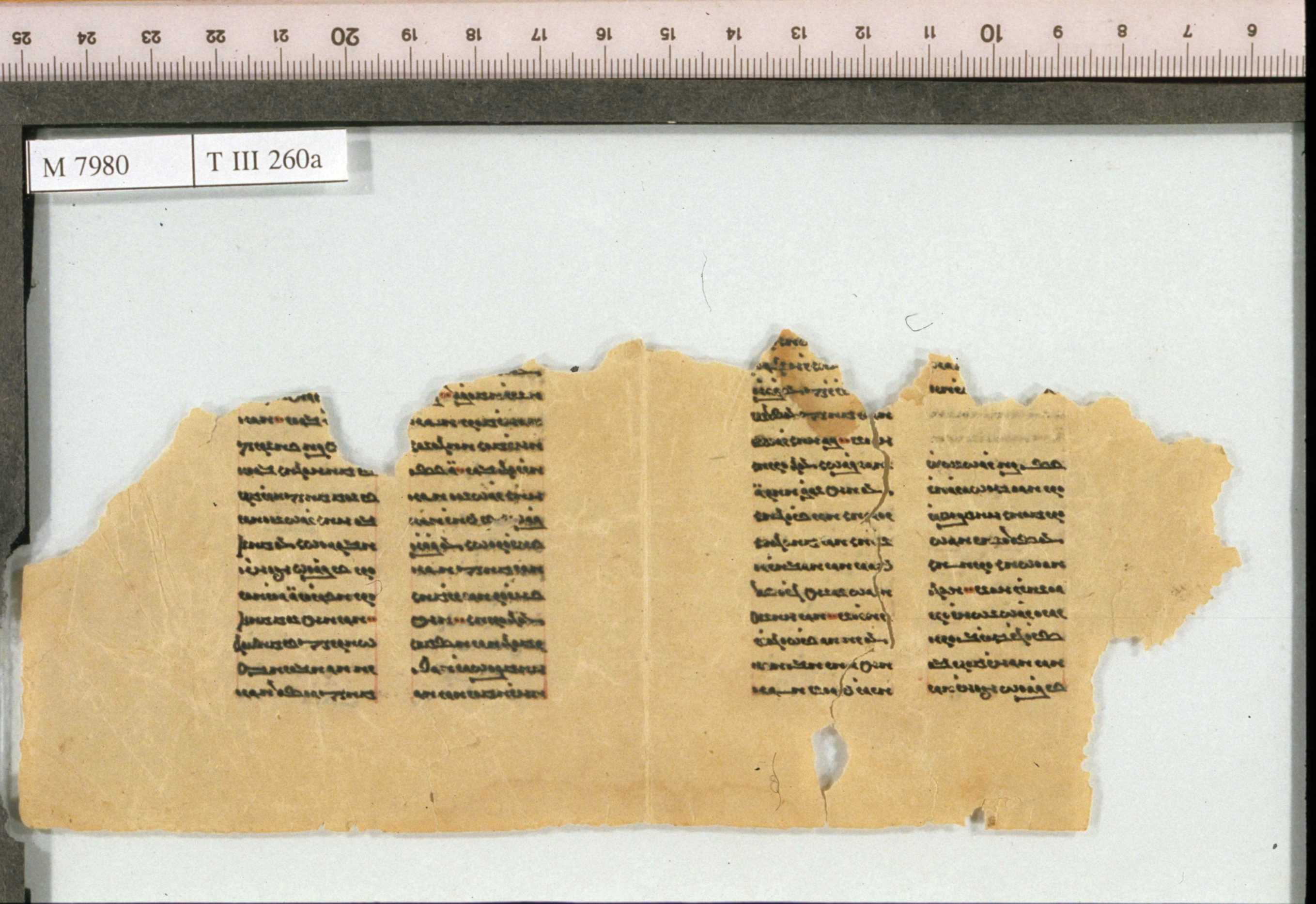 A Manichaean manuscript fragment from the Turfan collection. The survival of thousands of textual fragments allows scholars to reconstruct the multilingual book culture in which painted pages circulated.
Why the Turfan Paintings Are Not “Persian Miniatures”
Later Persian literary tradition celebrated Mani as a painter, and modern viewers often associate any Iranian religious painting with Persian miniature art. The Turfan fragments require a more precise vocabulary.
They were produced in Central Asia centuries after Mani, often under Uygur patronage, and their styles reflect multiple artistic environments. Some features can be related to Iranian traditions; others show Chinese or Central Asian conventions. Buddhist book and mural culture was especially important in the region.
Calling the works “Persian miniatures” collapses geography and chronology. Classical Persian manuscript painting as most readers know it belongs largely to later Islamic-period courts and workshops. Manichaean illuminated books represent a different history.
The more interesting question is how a missionary religion adapted local visual languages while preserving recognizable doctrinal identities. The answer seems to be that Manichaean art could change style without surrendering its iconographic grammar.
What Surviving Illuminations Show
Fragmentary Manichaean paintings depict religious figures, members of the Elect, lay supporters, ritual gatherings, deities, cosmological scenes, plants, architecture, and richly patterned textiles. Because many fragments are tiny, interpretation depends on reconstruction.
A head with a halo, a sleeve, a flower, a section of throne, or a line of script may be all that survives. Scholars compare pigments, page dimensions, handwriting, margins, iconographic details, and joins between fragments to determine whether pieces belonged to the same codex.
This is where art history becomes codicology. A painting is not isolated from the book. Its location on a page, relationship to text columns, orientation, scale, and sequence can reveal function.
Gulácsi’s Medieval Manichaean Book Art is especially important because it treats illuminated fragments as parts of books rather than as free-standing paintings. That methodological shift makes it possible to ask how readers actually encountered the images.
The Elect and Hearers: Social Structure Made Visible
Manichaean communities distinguished especially between the Elect, who followed demanding religious disciplines, and the larger body of Hearers, who supported them. This was not merely an administrative distinction. It was tied to the religion’s theory of salvation.
The Elect followed dietary and behavioral restrictions intended to minimize harm to living Light and to participate in its liberation. Hearers provided food and material support, performed religious duties appropriate to their status, and hoped for progress through the salvific system.
Art could make hierarchy visible through clothing, posture, scale, halo, seating, and proximity to sacred figures. A viewer did not need a written label saying “this person has higher ritual status” if the visual code already communicated it.
This is a reminder that religious art often teaches social organization along with theology. Images show not only gods but who stands where before them.
Food, Light, and the Strange Sacrament of Eating
One of the most distinctive aspects of Manichaean religious practice concerns food. The Elect’s diet and ritual consumption were connected with the belief that particles of Light were trapped within living matter and could be released through proper religious processes.
Jason BeDuhn’s study The Manichaean Body has shown how central bodily discipline was to Manichaean religious logic. Salvation was not an abstract escape from matter achieved by thinking the right idea. It was enacted through eating, fasting, sexual renunciation, work, prayer, and community structure.
This makes illuminated scenes of offerings or communal religious life more than decorative records of ceremony. They belong to a theology in which bodies participate in cosmic repair.
Modern readers should not convert this into nutritional science. There is no scientific evidence that food contains supernatural particles of divine Light released by ritual digestion. Historically, however, the belief organized real behavior and gave everyday acts a cosmic meaning.
The Bēma: An Empty Throne for an Absent Prophet
The Bēma festival was the high point of the Manichaean liturgical year. A raised structure or throne represented Mani’s presence within the community after his death. Sources describe confession, commemoration, hymns, and the symbolic centrality of the founder.
Sundermann notes the possibility that an image associated with Mani’s pictorial tradition may have been displayed in connection with the Bēma. Even where the details remain uncertain, the festival demonstrates how representation could overcome absence.
Mani was dead, yet a throne could mark his authority. A picture could make him visible. Books could preserve his voice. Hymns could reactivate communal memory.
This combination of empty seat, image, text, and ritual is philosophically striking. Religious presence is created through media precisely because the historical person is absent.
Did Mani Paint the Surviving Pictures?
No surviving painting can securely be identified as an original work made by Mani’s hand. This point is simple but essential.
Sources close enough to the tradition support his reputation as an artist and the existence of canonical pictures. Later Islamic and Persian literature magnified that reputation, sometimes turning Mani into an almost legendary master painter. The surviving Turfan fragments prove that Manichaean communities maintained a sophisticated visual tradition centuries later.
But those facts do not allow a museum fragment from the ninth or tenth century to be signed mentally “Mani, ca. 250.” Between founder and fragment lie centuries of copying, translation, artistic adaptation, patronage, migration, and cultural contact.
The proper historical claim is more interesting: later Manichaean artists worked inside a religion whose founder had already made visual teaching part of revelation.
How the Religion Traveled Across the Silk Roads
Manichaeism became one of the most geographically expansive religions of late antiquity and the early medieval world. Missionaries moved west toward the Roman Empire and Egypt and east through Iran and Central Asia toward China.
This expansion required translation on an extraordinary scale. A doctrine first articulated in Syriac could be recast in Middle Persian, Parthian, Sogdian, Uygur, Chinese, and other languages. Names of divine beings could be translated, transliterated, or equated with familiar religious vocabulary.
Visual culture faced the same challenge. A sacred figure painted in Mesopotamia could not simply be copied unchanged forever if local artistic workshops, materials, costumes, and viewer expectations differed. Manichaean art therefore became a laboratory of controlled adaptation.
This is one reason the religion is so important for comparative esotericism. It demonstrates that a symbolic system can remain recognizably itself while changing language and style.
Buddhist Visual Culture and Manichaean Adaptation
Central Asian Manichaean communities lived beside powerful Buddhist traditions with highly developed mural, manuscript, and devotional art. The two religions were not identical, but Manichaean artists could work in environments where Buddhist visual conventions were familiar.
Halos, enthroned teachers, donor figures, sacred books, symmetrical compositions, and richly colored wall paintings were not exclusive to one religion. Shared visual forms could be resemanticized.
This process resembles linguistic translation. A Manichaean text in Chinese might use Buddhist-sounding terminology while assigning it a distinct Manichaean meaning. An image could likewise look familiar to a Buddhist viewer while communicating a different cosmology.
Borrowing therefore does not prove theological identity. It shows that missionary religions speak through available cultural languages.
China and the Transformation of Mani’s Image
Manichaeism entered China during the Tang period and survived in changing forms despite periods of suppression. Chinese sources knew Mani through titles that framed him as a luminous religious figure, and later communities sometimes adapted Manichaean identity to local religious landscapes.
One of the most remarkable survivals is the statue traditionally identified with Mani at Cao’an in Fujian. The site belongs to a much later Chinese phase and should not be used as evidence for Mani’s actual appearance. Its importance lies in reception: a Mesopotamian prophet had become visually naturalized within Chinese sacred art.
The transformation is a perfect example of what happens when an image tradition travels farther than the culture that created it. Identity persists through reinterpretation.
Mani the Painter in Islamic Memory
Manichaeism declined dramatically in the Islamic world, and Muslim heresiographers often treated its dualism as a major theological error. Yet Mani’s artistic reputation survived with surprising strength.
Persian literature could remember Māni-ye naqqāš, Mani the painter, as a standard of artistic excellence. The prophet’s theological message might be rejected while his visual genius was admired.
This split reception is historically important. Cultural memory can preserve one attribute after abandoning the system that gave it meaning. Mani becomes an artist detached from Manichaeism.
Later stories about the Arzhang sometimes turn the lost picture book into an almost magical masterpiece whose beauty itself demonstrates Mani’s extraordinary skill. These stories are valuable evidence for medieval imagination, but they should not be confused with direct descriptions of a surviving third-century artifact.
Was the Arzhang a “Grimoire”?
No. Calling Mani’s picture book a grimoire imports a later European category into a different religious world.
A grimoire is usually understood as a manual of ritual magic containing procedures, conjurations, talismans, spirit lists, or related operations. Mani’s images, as reconstructed by scholarship, were didactic representations of doctrine: cosmology, soteriology, prophetology, and sacred history.
Manichaeism certainly belongs within the wider history of esotericism. It taught hidden structures of the cosmos, salvation through revealed knowledge, elaborate supernatural hierarchies, and ritual disciplines. But “esoteric” does not automatically mean “magical manual.”
Readers interested in how ritual books differ from cosmological texts can compare SecretMagic’s study of the Greek Magical Papyri as a corpus of ritual handbooks rather than one unified grimoire. The contrast helps clarify genre.
Was Manichaeism Simply Gnosticism with Better Art?
Manichaeism shares major features with traditions commonly called Gnostic: radical cosmic dualism, revelatory knowledge, a divine element trapped in the lower world, saving messengers, and complex myths of origin and return. Mani also inherited Christian and other late antique religious traditions.
But reducing Manichaeism to “Gnosticism plus paintings” misses its institutional distinctiveness. Mani created an organized missionary church, canonized writings, established hierarchy, cultivated liturgy, and deliberately translated his religion across cultures.
The label Gnosticism is itself contested because it can make very different ancient movements appear to be branches of one religion. SecretMagic’s article on Pistis Sophia and the Askew Codex shows a very different esoteric Christian textual world. Similarity should invite comparison, not collapse.
The Book of Giants and the Problem of Shared Myth
Mani’s Book of Giants drew on traditions ultimately connected with the Jewish Enochic story of Watchers and giants. Fragments survive in several Manichaean languages, demonstrating how inherited mythology could be incorporated into Mani’s universal history.
This is important for visual culture because Manichaean images did not emerge from a closed doctrinal vacuum. The religion consciously presented itself as the fulfillment of earlier revelations associated with figures such as Buddha, Zoroaster, and Jesus.
Mani’s universalism was selective. Earlier religions contained truth, but Mani claimed to provide its final and complete clarification. Images could therefore visualize a history in which previous prophets were honored while subordinated to the final revelation.
Religious art here becomes an argument about succession.
Cosmology as Diagram Before the Modern Occult Diagram
Western esoteric readers are familiar with cosmological diagrams: the Kabbalistic Tree of Life, astrological wheels, alchemical emblems, Rosicrucian engravings, Enochian tables, and Theosophical planes. Mani’s visual program belongs to a much earlier and independent history.
The comparison is useful at the level of function. Complex metaphysical systems generate pressure toward visualization. Once a doctrine contains multiple worlds, beings, levels, movements, and correspondences, prose becomes difficult to hold in memory. Images externalize structure.
But direct genealogical claims should be avoided. There is no evidence that the Golden Dawn Tree of Life, for example, descends secretly from the Arzhang. Similar problems can produce similar visual solutions without direct transmission.
The deeper continuity is cognitive rather than institutional: humans draw the invisible when language becomes crowded.
Why Color Matters
Surviving Manichaean art from Central Asia is famous for saturated color, patterned clothing, gold-like visual effects, and carefully differentiated figures. Color can mark status, sacredness, and cosmological distinction.
Yet modern reproductions create problems. Pigments fade. Photography changes hue. Digital compression flattens texture. A fragment seen online may look very different from the original object under museum lighting.
Scholars therefore combine iconographic interpretation with technical and codicological evidence. A color should not be assigned a universal occult correspondence merely because a modern esoteric system uses the same color symbolically.
Red in a Manichaean manuscript is not automatically “Mars,” blue is not automatically “Jupiter,” and gold is not automatically “solar consciousness.” Historical symbolism must be demonstrated from the tradition itself.
Calligraphy Was Part of Sacred Beauty
Manichaean visual culture did not divide painting sharply from writing. Beautiful script, decorated initials, margins, page design, and illumination could form one aesthetic system.
This integration reflects Mani’s concern with authorized transmission. If revelation must be copied, the copied page becomes a sacred interface. Accuracy matters, but so does visual dignity.
In Central Asia, Manichaean scribes used scripts adapted to different languages. The famous Manichaean script itself developed from Syriac traditions and became a marker of community identity even when used for Iranian languages.
A page could therefore communicate belonging before its words were read. Script is visual identity.
What Archaeology Destroyed and Preserved
The Turfan expeditions recovered material that might otherwise have disappeared, but early twentieth-century archaeology also operated under standards very different from those expected today. Objects were removed from sites and distributed to distant institutions. Context could be incompletely recorded. War later destroyed some materials in Berlin.
This history complicates the celebratory language of “discovery.” Museum collections preserve fragments because imperial-era expeditions extracted them. Scholarship benefits from those collections while also needing to acknowledge the conditions under which they were formed.
The surviving art is therefore doubly fragmentary: physically broken by time and historically separated from its original ritual environment.
Why Manuscript Reconstruction Is So Difficult
Imagine finding a painted corner of a page with three lines of text and part of a robe. To reconstruct the original book, a scholar must ask about paper, fibers, dimensions, ruling, script, language, pigment, hand, margins, page sequence, and iconography.
Two fragments in different museum drawers may once have touched. Conversely, two pieces with similar colors may come from entirely different books.
Codicological reconstruction is therefore probabilistic. Scholars can make strong joins when physical edges match or textual sequences align. Other associations remain hypotheses.
This uncertainty should remain visible in public writing. “Probably from the same manuscript” is not a weakness. It is an accurate description of evidence.
The Difference Between Composition Date and Surviving Object Date
Manichaean studies repeatedly require chronological discipline. Mani lived in the third century. A doctrine attributed to him may survive in a fifth-century Coptic manuscript, a ninth-century Middle Iranian fragment, a tenth-century Uygur painting, or a later Chinese text.
These dates answer different questions.
- Composition date asks when a teaching or work was first created.
- Redaction date asks when a surviving textual form was organized.
- Manuscript date asks when the physical copy was produced.
- Discovery date asks when modern researchers recovered it.
- Publication date asks when scholars edited or translated it.
Confusing these categories creates false antiquity. A tenth-century manuscript can preserve a third-century tradition without itself being third-century.
Did Mani Invent Religious Illustration?
No. Ancient religions had used images for millennia. Egyptian temples, Mesopotamian reliefs, Greek cult statues, Roman painting, Buddhist narrative art, and many other traditions long predate Mani.
What is unusual is the explicit integration of a founder’s own didactic picture cycle with a canonical written revelation. Mani’s artistic identity became part of the religion’s self-conception.
His innovation lies less in “inventing sacred art” than in making controlled visual explanation central to a missionary scriptural project.
Why Manichaean Art Was Vulnerable
Portable books are easier to destroy than stone temples. Communities persecuted as heretical can lose libraries rapidly. Organic materials decay. Paintings can be scraped from walls. Political changes can convert religious centers to other uses.
Manichaeism suffered suppression under multiple regimes at different times. In the Roman Empire, Christian authorities attacked it. In Iran, Zoroastrian institutions opposed it. In China, state policies periodically restricted foreign religions. Islamic heresiography often used “Manichaean” language polemically against alleged dualists or freethinkers.
The religion’s disappearance from many regions therefore changed its archive. Much of what survives comes from unusually favorable accidents: dry Central Asian conditions, buried manuscript deposits, Egyptian codices, quotations preserved by opponents, and archaeological recovery.
What Hostile Sources Can and Cannot Tell Us
Because so much Manichaean literature vanished, historians once depended heavily on anti-Manichaean writers such as Augustine and Christian heresiologists. Augustine is especially important because he spent years as a Manichaean Hearer before becoming one of Christianity’s most influential theologians.
Hostile testimony can preserve genuine information, but it must be read critically. Polemic selects what is useful for refutation. It exaggerates contradictions, moral danger, or absurdity. It may quote accurately in one passage and caricature in another.
The twentieth-century discovery and publication of Manichaean texts allowed scholars to compare opponents’ claims with believers’ own voices. The result was not that every hostile source became worthless. Instead, historians gained the ability to triangulate.
Art as Evidence for a Religion’s Self-Image
A polemicist may describe Manichaeans as dangerous heretics. A Manichaean painting shows how the community wanted sacred order to look.
This difference is profound. Art preserves ideals of beauty, hierarchy, purity, ritual comportment, and communal identity that doctrinal summaries often miss.
Figures are not only theological symbols. Their clothing, posture, and grouping encode an imagined society. The religion represents itself as ordered, luminous, disciplined, and beautiful.
That aesthetic self-presentation is part of theology. A cosmos whose goal is the liberation of Light naturally values visual luminosity.
Modern Occult Appropriations of Mani
Modern esoteric movements have occasionally adopted Mani as a hidden master, Gnostic initiate, proto-occultist, or custodian of an ancient secret doctrine. Rudolf Steiner, for example, gave Mani a positive place within Anthroposophical interpretations of spiritual history.
Such receptions belong to the modern history of esotericism. They should not be confused with ancient Manichaean doctrine.
A twentieth-century occult reading may reveal what Mani came to symbolize after the recovery of Gnostic materials, but it cannot be used as evidence for what a third-century Manichaean believed.
Reception history is most useful when kept in its own chronological layer.
A Symbolic Reading: The Image as a Map of Captive Light
A modern symbolic interpretation can ask why Manichaean visual culture remains compelling even for readers who do not accept its cosmology literally.
The central myth of Light mixed with Darkness can be read as an image of divided consciousness: something experienced as valuable, lucid, or compassionate finds itself entangled in systems of appetite, violence, confusion, and mortality. Salvation then becomes the work of discrimination—learning what belongs to what.
Pictures are uniquely suited to this task because they discriminate visually. They place figures in relation, separate colors, create borders, and reveal patterns.
This is a modern philosophical reading, not a claim that Mani secretly taught contemporary psychology. Historical Manichaeans understood Light and Darkness cosmologically and religiously, not merely as metaphors for mood.
A Philosophical Reading: Why Invisible Systems Become Visible
Every complex metaphysics faces a communication problem. If ultimate reality is invisible, how can it be taught?
One answer is negative theology: refuse images and emphasize what cannot be said. Another is symbolic abundance: generate names, stories, diagrams, colors, beings, and maps.
Manichaeism chose abundance. Its cosmos is narratively crowded because invisible processes are personified and dramatized.
Mani’s picture tradition pushes that strategy to its logical conclusion. If the cosmos already behaves like a story, it can become an image.
What the Book of Pictures Does Not Prove
- It does not prove that Mani possessed supernatural artistic powers.
- It does not survive as a complete third-century manuscript.
- Later Turfan paintings are not originals painted by Mani.
- The Arzhang was not a European-style grimoire.
- Manichaean art does not prove that later occult diagrams descended from Mani.
- Similarity to Buddhist or Christian imagery does not make Manichaeism a branch of either religion.
- Later Persian praise of Mani’s painting is evidence of reception, not direct documentation of the lost original.
These limits do not make the subject less extraordinary. They make the real historical achievement easier to see.
Frequently Asked Questions
Who was Mani?
Mani was a third-century religious founder from Mesopotamia who established Manichaeism, a missionary religion that spread from the Roman world to China. He presented himself as the final messenger in a sequence of earlier revelations and organized a church with scriptures, hierarchy, ritual, and missionary activity.
Did Mani really paint?
Multiple traditions remember Mani as an artist, and scholarly consensus accepts that visual teaching was genuinely associated with him. However, no surviving painting can be securely identified as an original work by Mani’s own hand.
What was the Arzhang?
Arzhang is a later Persian form of the name associated with Mani’s canonical picture tradition. Greek sources refer to an Eikōn, or “Picture.” The work appears to have illustrated Manichaean doctrine and cosmology. The original is lost.
Are the Turfan paintings copies of the Arzhang?
Some surviving Central Asian materials may preserve themes or iconographic traditions ultimately related to Mani’s canonical pictures, but they are later works. Scholars reconstruct relationships cautiously rather than treating every illuminated fragment as a direct copy.
Why are Manichaean manuscripts found in China?
Manichaeism spread eastward through Iran and Central Asia and gained important Uygur patronage. Communities in the Turfan region produced manuscripts in several languages and developed a rich illuminated-book tradition.
Was Manichaeism a form of Christianity?
No. Mani drew heavily on Christian traditions and called himself an apostle of Jesus Christ in a distinctive Manichaean sense, but his religion developed its own cosmology, canon, church, ritual system, and understanding of Jesus. It also incorporated Iranian, Mesopotamian, and eventually Buddhist cultural elements.
Was Manichaeism “black magic”?
No. Historical Manichaeism was a full religious tradition centered on salvation, ethics, ritual discipline, cosmology, scripture, and missionary teaching. Calling it black magic is both historically inaccurate and derived from later polemical stereotypes.
Why did Manichaeans use so many images?
Images helped explain a highly complex cosmology, supported oral teaching, reinforced community identity, and communicated hierarchy across linguistic boundaries. Mani’s own artistic reputation gave visual media unusual authority within the religion.
Did Manichaean art influence Persian painting?
Mani’s reputation as a painter remained important in Persian cultural memory, but direct lines of artistic influence are difficult to prove. Later Persian miniature painting belongs to different historical institutions and styles. Claims of simple descent should be treated cautiously.
Do any complete Manichaean scriptures survive?
No complete copy of Mani’s original canonical library survives. Scholars reconstruct Manichaean literature from Coptic codices, the Cologne Mani Codex, Middle Iranian and Turkic fragments, Chinese texts, quotations, and other witnesses.
Conclusion: The Prophet Who Refused to Leave Revelation Invisible
Mani’s lost Book of Pictures occupies an unusual place in the history of religion because it sits between absence and abundance. The original object is gone. No page can be placed under glass and labeled “painted by Mani.” Yet the evidence for a canonical visual tradition is abundant enough to transform how we understand Manichaeism.
Mani did not treat images as an afterthought to doctrine. He confronted a problem every universalizing religion faces: how can a complex revelation survive the death of its founder, cross languages, and remain intelligible to people who did not witness its first proclamation?
His answer was multimedia before that word existed. Write the revelation. Organize scribes. Send missionaries. Translate. Sing. Preach. Paint.
Centuries later, Uygur Manichaeans in Central Asia were still producing books whose beauty makes that strategy visible. Their fragments show that religious art could carry doctrine through radical cultural change. Iranian and Turkic languages replaced Syriac. Chinese artistic environments replaced Mesopotamian ones. Political patrons changed. Styles changed. The church itself moved across continents. Yet the idea that sacred truth should be made visually ordered endured.
The fragments also teach historical humility. What survives is not the original system frozen in time. It is transmission made material. Every damaged page contains at least two histories: the doctrine it communicates and the journey by which that doctrine acquired a new language, a new hand, a new pigment, and a new audience.
That is why Mani’s pictures matter beyond Manichaeism. They reveal a fundamental mechanism of esoteric culture. Invisible worlds become durable when communities give them form. A cosmology becomes a diagram. A revelation becomes a book. A hierarchy becomes posture and color. A prophet who is no longer physically present becomes an image before an empty throne.
Manichaeism ultimately disappeared from most of the regions where it once flourished, but the attempt to preserve revelation through both word and image left a long afterlife. Mani survived in hostile theology as the arch-heretic, in Persian literature as the incomparable painter, in Central Asian archaeology as the absent source behind exquisite fragments, and in modern scholarship as the founder of one of history’s most self-conscious religions of transmission.
The original Book of Pictures is lost. Its central idea is not: some truths, communities have believed, are too complex to be left only to words.
Sources and References
- Werner Sundermann, “Mani,” Encyclopaedia Iranica.
- Zsuzsanna Gulácsi, “Manichean Art,” Encyclopaedia Iranica.
- Werner Sundermann, “Manicheism i. General Survey,” Encyclopaedia Iranica.
- Desmond Durkin-Meisterernst and Philip G. Kreyenbroek, “Manicheism,” Encyclopaedia Iranica.
- Zsuzsanna Gulácsi, Manichaean Art in Berlin Collections, Brepols, 2001.
- Zsuzsanna Gulácsi, Medieval Manichaean Book Art, Brill, 2005.
- Zsuzsanna Gulácsi, Mani’s Pictures, Brill, 2015.
- Iain Gardner and Samuel N. C. Lieu, eds., Manichaean Texts from the Roman Empire, Cambridge University Press, 2004.
- Jason BeDuhn, The Manichaean Body, Johns Hopkins University Press, 2000.
- Hans-Joachim Klimkeit, Gnosis on the Silk Road, HarperSanFrancisco, 1993.


