


The Rasāʾil Ikhwān al-Ṣafāʾ, the Epistles of the Brethren of Purity, are easy to describe badly. They are sometimes reduced to a medieval encyclopedia, sometimes treated as a secret Ismaili manifesto, and sometimes mined as a storehouse of astrology, numerology, talismans, and magic. Each description catches something real, but each becomes misleading when allowed to stand alone. The Brethren were not compiling disconnected curiosities. Their fifty-two epistles were arranged as an intellectual ascent in which mathematics, natural philosophy, psychology, metaphysics, religion, politics, and the occult sciences were made to illuminate one another.
That architecture is essential for understanding their treatment of magic. Magic does not enter as an isolated handbook placed outside respectable knowledge. It arrives at the end of a long educational sequence. By the time the reader reaches the final epistle, the Brethren have already taught number, geometry, astronomy, music, natural bodies, the soul, cosmic hierarchy, prophecy, government, and religious disagreement. The occult sciences therefore become intelligible only inside a larger theory of how the cosmos is ordered and how the human being learns to perceive that order.
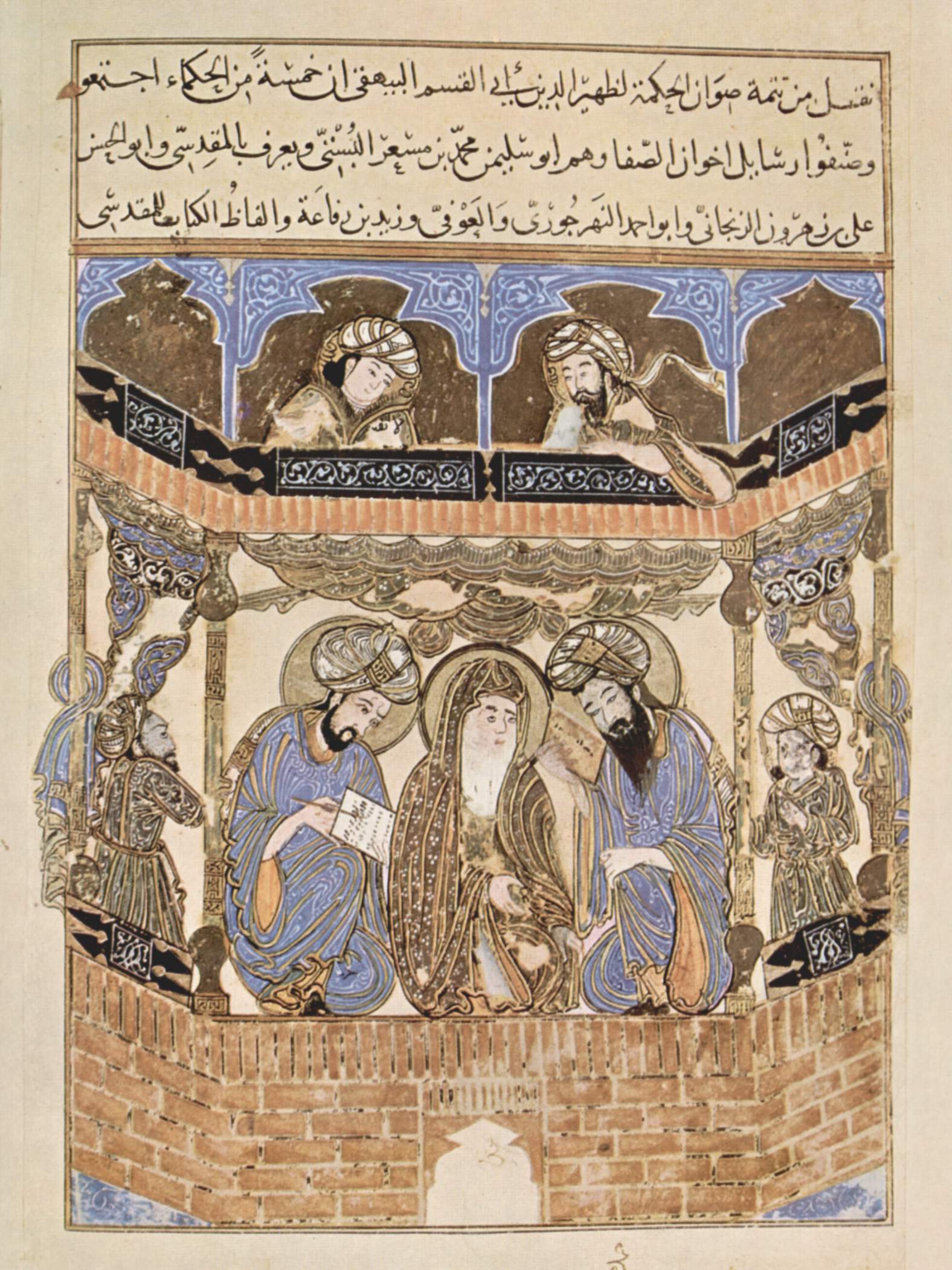 Illumination from a 1287 manuscript of the Epistles of the Brethren of Purity, preserved in the Süleymaniye Library manuscript tradition. Public domain image via Wikimedia Commons.
This is why the Ikhwān al-Ṣafāʾ occupy such an important place in the history of esotericism. Their work shows a medieval Islamicate intellectual culture in which what modern readers separate into “science,” “philosophy,” “religion,” and “magic” could still be organized as neighboring regions of one cosmos. They inherited Greek mathematical and philosophical traditions, Islamic scripture and theology, astrological learning, stories about ancient sages, ideas associated with the Ṣābiʾans of Ḥarrān, and a broad late antique heritage of correspondences between heaven and earth. They did not merely preserve these materials. They rearranged them into an educational program concerned with purification, knowledge, and the proper ordering of the soul and community.
The result is not a simple defense of superstition, nor is it a disguised anticipation of modern science. It is a different intellectual world. To read the Brethren well, we have to reconstruct their categories before judging them by ours.
Who Were the Brethren of Purity?
The identity of the Ikhwān al-Ṣafāʾ remains one of the enduring problems of medieval Islamic intellectual history. The name is conventionally translated as “Brethren of Purity,” although “Brethren of Sincerity” also appears. The authors present themselves as a brotherhood of sages and sincere friends, but they do not sign their encyclopedia as ordinary individual authors. Medieval testimony and modern scholarship have proposed names and affiliations, yet the precise composition of the group, the stages in which the corpus developed, and its confessional identity remain debated.
The most influential reconstruction places the brotherhood in the intellectual world of Basra and Baghdad around the tenth century. Abū Ḥayyān al-Tawḥīdī, writing near the end of that century and the beginning of the next, preserves a report naming several men associated with a learned circle in Basra. Modern historians have repeatedly examined these names, but the question is complicated by manuscript history, by the possibility that the epistles were assembled over time, and by evidence connecting parts of the corpus with al-Andalus. The Stanford Encyclopedia of Philosophy, in its substantially revised account of the Ikhwān, emphasizes that authorship and dating remain unresolved rather than presenting a single theory as settled fact.
Their relationship to Ismailism is similarly complex. Generations of scholars have identified strong Ismaili themes in the Rasāʾil, and the Institute of Ismaili Studies describes the group as having strong connections with the Shiʿi and Ismaili tradition. Yet that does not mean every passage can simply be read as a coded statement of one fixed denominational program. The corpus is unusually inclusive in the range of religions and philosophical schools it discusses. It draws on Qurʾanic material, Biblical traditions, Greek philosophy, Persian and Indian learning, and accounts of communities such as the Ṣābiʾans. Liana Saif has argued that the Brethren’s project of reform cannot be reduced to the older question of whether they were “really” Ismaili. In her reading, their theory of magic is connected to a broader attempt to reconcile philosophical knowledge and revelation while imagining an ethically reformed community.
This matters because modern occult readers sometimes picture the Ikhwān as if they were a hidden lodge in the later European sense: initiates guarding a secret magical curriculum. Their anonymity and fraternity make the comparison tempting, but it can easily become anachronistic. The medieval brotherhood existed in a world of scholarly circles, theological factions, missionary networks, philosophical education, manuscript circulation, and political insecurity. Their secrecy cannot automatically be equated with the organizational secrecy of nineteenth-century occult orders.
An Encyclopedia Designed as an Ascent
The Rasāʾil are usually described as fifty-two epistles grouped into four broad divisions. The first treats mathematical sciences, including arithmetic, geometry, astronomy, geography, music, and logical disciplines. The second examines natural bodies and the physical world. The third turns to the soul and intellect. The fourth addresses theological, political, spiritual, and esoteric themes, culminating in the epistle on magic.
This arrangement is not accidental. The Brethren believed that education could transform the soul. Knowledge was valuable not only because it supplied information, but because properly ordered knowledge trained the human being to perceive relationships linking the many levels of reality. Mathematics was therefore spiritual preparation. Astronomy could become ethical instruction. Music could reveal proportion. Natural philosophy showed structure and causation in the bodily world. Psychology directed attention inward. Theology placed all of these within a hierarchy extending ultimately to God.
The Institute of Ismaili Studies describes the first two mathematical epistles as combining technical analysis with metaphysical interpretation. Their arithmetic depends heavily on traditions associated with Nicomachus of Gerasa, while geometry draws on Euclidean learning. Yet the Brethren place those mathematical sciences inside a monotheistic and Pythagorean vision. Number is not merely a calculating instrument. It becomes a way of thinking about unity, multiplicity, order, and dependence.
That choice is fundamental for their later esotericism. A magical cosmos requires relations. Planets must correspond with earthly conditions, times with qualities, sounds with states of soul, numbers with structures, and spiritual beings with cosmic functions. The Brethren’s mathematics supplies a language for imagining those relations. This does not mean that arithmetic itself was “magic” in their hands. Rather, mathematical order made the occult sciences philosophically conceivable.
The final position of magic is therefore significant. A reader who skips directly to the last epistle misses the intellectual scaffolding that makes it possible. In the Brethren’s curriculum, magic is not introduced before cosmology but after it. One first learns why the universe has levels, motions, proportions, causes, and spiritual realities. Only then can one discuss extraordinary effects within that universe.
Number: The Grammar of an Ordered Cosmos
Pythagorean number symbolism has often attracted modern occultism, but the Brethren’s use of number should not be confused with arbitrary numerology. Their mathematical writings belong to the learned curriculum of their period. They discuss properties of numbers, ratios, geometry, and related disciplines through sources that include Nicomachus and Euclid. At the same time, they interpret these sciences philosophically.
One of their central habits of thought is analogy. The sequence of numbers becomes a model for hierarchy. Unity precedes multiplicity; later numbers depend on earlier principles; structured series help the mind imagine how many beings can arise within an ordered whole without abolishing ultimate unity. The same habit appears in discussions of cosmology and metaphysics. Epistle 51, according to the modern critical edition of the late theological epistles, returns once again to Pythagorean number theory immediately before the final discussion of magic.
This return creates a circular architecture. The encyclopedia begins with arithmetic and approaches its conclusion by revisiting numerical order. Magic then stands not as a rejection of reason but as an application, extension, or culmination of a worldview in which hidden relations are expected because the cosmos itself is patterned.
For historians, this is an important distinction. When modern people hear “numerology,” they may think of assigning personal destinies to birth dates or reducing names to digits. The Ikhwān’s number philosophy is much broader. Number belongs to cosmology, metaphysics, music, astronomy, ethics, and education. It offers a grammar of proportion. Occult correspondences become plausible within that grammar because the world is understood as a coherent structure rather than a heap of unrelated objects.
The spiritual significance of arithmetic also explains why mathematical study could be a discipline of purification. To contemplate stable relations is to train the intellect away from the confusion of sense experience toward intelligible order. The ascent is philosophical rather than merely computational. Number becomes a ladder by which the mind learns how unity can express itself in multiplicity without ceasing to be unity.
 Detail from a manuscript of the Brethren’s encyclopedia dated 1287. The historical work and reproduction are identified as public domain on Wikimedia Commons.
Astronomy and Astrology Were Not Yet Separate Worlds
Epistle 3, commonly translated in the modern edition as On Astronomia, is particularly revealing because it combines elementary astronomy with astrology. Modern readers are accustomed to separating the two sharply: astronomy is a physical science, while astrology is classified as a divinatory or occult practice. The Brethren lived before that boundary took its modern form.
The modern critical edition prepared by F. Jamil Ragep and Taro Mimura stresses that the epistle is not simply a beginner’s astronomical manual. Its scientific material is directed toward moral, spiritual, and soteriological purposes. The order visible in the heavens becomes evidence of a creator and a pattern for ethical, political, and economic order. Astronomy is therefore simultaneously descriptive and exemplary.
Astrology enters this picture because celestial motions were widely believed to correlate with changes in the sublunary world. Planets did not merely occupy positions; they possessed qualities and influences. The heavens and earth were joined by causation and sympathy. Within such a model, astrology could be treated as a rational discipline even when particular practices or claims were disputed.
The Brethren’s occult thought depends heavily on this layered cosmos. Astral magic assumes that celestial configurations matter. A talisman is meaningful only if material form, celestial timing, intention, and spiritual causation can be related. The final epistle therefore does not invent a magical universe from nothing. It inherits the heavens already described earlier in the encyclopedia.
Yet it would be a mistake to conclude that the Ikhwān endorse every form of astrological determinism. Their religious commitments require moral responsibility and divine sovereignty. Medieval astrology often had to negotiate precisely this problem: how can celestial influence be real without turning human beings into helpless machines? The Brethren work within a tradition that distinguishes influence, disposition, and cosmic order from an absolute fatalism that would empty ethical life of meaning.
This tension is one reason their writings remain intellectually interesting. They do not inhabit a simple opposition between “faith” and “astrology.” Instead, they attempt to fit cosmic influence into a theological universe. The heavens reveal order; they can influence bodies and circumstances; but they do not erase the hierarchy of causes or the spiritual vocation of the soul.
Music as a Science of Correspondence
Few parts of the Rasāʾil demonstrate the Brethren’s worldview more elegantly than the epistle on music. In the mathematical curriculum inherited from Greek philosophy, music was not merely performance. It was a science of measured relationships. Intervals, rhythms, strings, and modes could be analyzed through proportion, making sound a sensory manifestation of number.
The Brethren draw on Greek, Arab, and Persian traditions. Their treatment has affinities with al-Kindī and al-Fārābī, but the epistle also discusses Arab instruments and prosody. Owen Wright’s critical edition emphasizes that their music theory includes both technical concepts and psychological applications. Musical effects are discussed in relation to the four humours and to changing states of body and soul.
This is where music touches the larger esoteric system. If harmony is numerical and the cosmos is proportionally ordered, then musical harmony becomes more than entertainment. It becomes a small-scale image of universal harmony. The human being, as microcosm, can be affected through patterned sound because body, soul, number, and cosmic order are not treated as sealed compartments.
Modern readers should be careful here. Historical claims that music affects humours or participates in cosmic sympathy are not scientific facts in the modern medical sense. They belong to a premodern physiology and cosmology. But dismissing them as random superstition would miss their conceptual coherence. For the Brethren, music’s power is intelligible because ratio connects mathematics, physical vibration, emotion, and the architecture of the cosmos.
Later occult traditions would repeatedly make similar moves, especially when associating planetary forces with musical tones or ritual chant. The Brethren are important not because every later magical musician read them directly, but because their encyclopedia preserves a sophisticated medieval model in which number, music, astronomy, and spiritual transformation could be integrated.
Spiritual Beings and the Hierarchy of Causes
Before the final epistle on magic, the Brethren devote sustained attention to spiritual beings and the hierarchy of existence. Epistle 49, as presented in the modern volume On God and the World, probes levels of reality from God through spiritual and cosmic orders to the material elements. This is crucial background for their occult sciences because magic, in their conceptual universe, cannot be reduced to manipulation of inert matter.
The Brethren inhabit a Neoplatonizing cosmos. Reality descends through ordered levels, and the human soul can ascend intellectually and spiritually by understanding them. Angels or spiritual beings are associated with cosmic governance, celestial motion, and the mediation of divine order. This makes extraordinary causation philosophically possible without requiring every unusual event to be attributed to a capricious demon.
That hierarchy also imposes limits. The magician is not sovereign over the universe. Human action takes place within a larger structure of causes. Even when the Brethren discuss techniques that sound operative, their ideal practitioner is supposed to possess philosophical and spiritual discipline. The occult sciences belong to knowledge of creation, not to fantasies of unlimited personal power.
This is one reason the final epistle should not be read as a medieval equivalent of a modern “spell book.” The text contains discussions of magic, incantations, the evil eye, astrology, spiritual beings, ancient authorities, and the Ṣābiʾans. But its deepest question is not “Which spell should I use?” It is “What kinds of hidden causation are possible in an ordered, ensouled cosmos, and under what intellectual and ethical conditions may a learned person understand or employ them?”
Epistle 52 and the Problem of the Two Versions
The textual history of the epistle on magic is itself a warning against oversimplification. Modern scholarship distinguishes shorter and longer forms conventionally labeled 52a and 52b. The shorter version has received a critical Arabic edition and English translation by Godefroid de Callataÿ and Bruno Halflants. Scholars have debated the authenticity, relationship, and chronology of these versions, and older printed editions do not always reflect the same manuscript configuration.
The shorter form is especially important because de Callataÿ’s work argues that it belongs authentically to the Ikhwānian corpus. The Institute of Ismaili Studies summarizes its significance clearly: in this version, magic and the occult sciences are treated as the culmination of the Brethren’s philosophical teaching, with particular attention to astral magic. The text appeals to authorities ranging from Plato and Abū Maʿshar to Qurʾanic material and stories presented as deriving from Jewish tradition.
That diversity of authorities is characteristic of the Rasāʾil as a whole. The Brethren are less interested in policing modern categories of “orthodox” and “foreign” knowledge than in placing inherited traditions inside a universal intellectual history. Ancient sages, prophets, philosophers, and religious communities can all become witnesses to aspects of cosmic truth, though they are not treated as equally correct in every respect.
One of the most striking parts of the shorter epistle is its extended treatment of the Ṣābiʾans of Ḥarrān. Medieval Islamic literature frequently associates the Harranians with astral religion, planetary cults, and ancient wisdom. Modern historians know that “Ṣābiʾan” was a complex label used in multiple contexts, and descriptions of Harranian religion are filtered through Muslim authors with their own agendas. The Brethren’s sympathetic treatment is therefore especially valuable as evidence for medieval perceptions of astral religion, but it should not be mistaken for a transparent ethnographic record.
The existence of multiple forms of Epistle 52 also affects claims about influence on later magical literature. Scholars have noted connections between the Brethren’s occult thought and the Ghāyat al-Ḥakīm, known in Latin as the Picatrix. But influence must be handled carefully because textual layers, dating, and authorship questions remain complicated. Similar ideas can reflect shared intellectual environments as well as direct borrowing.
What Did “Magic” Mean to the Ikhwān?
There is no single modern English word that perfectly reproduces the range of medieval Arabic categories translated as magic, occult science, talismanic art, incantation, or astral operation. The Brethren discuss several kinds of unusual causation and practice. Their final epistle includes magic, incantations, the evil eye, astral operations, and stories about spiritual beings and ancient peoples. The category is therefore wider than modern stage magic but also more structured than a generic belief in the supernatural.
Liana Saif’s research is important here because she argues that magic is not marginal to the Brethren’s political and religious project. In her interpretation, it becomes a conceptual and practical pivot connecting philosophy, revelation, knowledge of nature, and legitimate spiritual leadership. This does not mean that the Rasāʾil are secretly only about magic. It means that the final occult science crystallizes themes that have been developing throughout the encyclopedia.
The logic can be reconstructed in stages. First, nature is intelligible and ordered. Second, visible things participate in wider networks of cause and correspondence. Third, the human being occupies a special position because the soul can understand these relations. Fourth, spiritual purification and intellectual discipline determine whether knowledge is used rightly. Fifth, extraordinary arts become legitimate only when they remain subordinated to the ethical and metaphysical order of the whole.
That hierarchy distinguishes the Brethren’s ideal of occult knowledge from simple coercive sorcery. They are not naïve about deceptive uses. Premodern texts that praise occult sciences can also warn against fraud, harmful manipulation, or morally corrupted practice. Knowledge is powerful precisely because it can be misused.
This ethical emphasis is also why it is misleading to extract a recipe from a medieval text and present it as though context were irrelevant. Historical rites may assume cosmologies, substances, religious commitments, and social conditions that no longer exist. Some premodern magical literature can also involve unsafe materials or coercive aims. Responsible historical study explains such practices without turning them into promises of guaranteed supernatural results.
Talismans: Where Matter, Image, and Heaven Meet
Talismanic magic is one of the clearest expressions of the Brethren’s worldview because a talisman exists at the meeting point of several sciences. It has material substance and therefore belongs to natural philosophy. It may contain geometric figures, letters, or numbers and therefore draws on mathematical order. It can be made for a particular celestial configuration and therefore depends on astronomy and astrology. It may invoke spiritual beings and therefore belongs to cosmology and theology. It is created for an effect and therefore raises questions of causation, intention, and ethics.
A talisman in this intellectual environment is not merely an object that has been labeled “magical.” It is a constructed node of correspondences. Its efficacy is explained through the belief that the cosmos is layered yet continuous: celestial, spiritual, psychological, and material realities can meet in carefully organized forms.
The later Picatrix famously develops elaborate forms of astral talismanic magic, but the Ikhwān help us understand the philosophy that can make such practices appear reasonable. If the heavens impress qualities on the lower world, if materials differ in their receptivity, if images can embody celestial forms, and if timing places an operation under a particular configuration, then a talisman becomes a technology of cosmic sympathy.
From a modern scientific perspective, there is no established evidence that planetary configurations empower talismanic images through occult radiation or spiritual sympathy. The historical value of the theory lies elsewhere. It reveals how medieval thinkers created explanations for relations between time, matter, symbol, and human intention. Talismans are therefore useful objects for studying the borderlands between religion, science, art, and magic.
The Microcosm and the Human Task
The Brethren repeatedly use the analogy between macrocosm and microcosm. The universe is a great ordered whole, while the human being reflects its structures in miniature. This is not simply decorative symbolism. It is an educational and ethical principle.
If the human being mirrors the cosmos, then self-knowledge can become a path toward knowledge of the world. Conversely, knowledge of cosmic order can teach the soul how to order itself. The same pattern appears at different scales: numerical harmony, bodily balance, social cooperation, celestial hierarchy, and spiritual ascent all become analogous.
This helps explain why the Brethren’s occult sciences are inseparable from moral formation. A disordered soul cannot safely claim mastery of cosmic order. Philosophical education is supposed to refine judgment, moderate passions, and loosen attachment to merely material concerns. The highest knowledge is therefore not accumulation of secret techniques but transformation of the knower.
That point marks a major difference between the Rasāʾil and much modern commercial occultism. Contemporary magical marketing often promises rapid results: money, attraction, dominance, luck, or control. The Brethren’s intellectual architecture moves in the opposite direction. It begins with disciplined study and ends with a theory of extraordinary knowledge. The occult is the summit, not the shortcut.
 A teaching scene from the 1287 manuscript tradition associated with the Epistles of the Brethren of Purity. Public domain image via Wikimedia Commons.
The Brotherhood as a Social and Political Ideal
The word “Brethren” is not incidental. The encyclopedia imagines knowledge as communal. Epistles dealing with friendship, cooperation, religious difference, politics, and leadership indicate that philosophical purification is not only private. The properly ordered community mirrors the properly ordered cosmos. Just as numbers relate according to proportion and celestial bodies move within a hierarchy, human beings are expected to discover forms of cooperation that harmonize individual capacities with a larger purpose.
This social dimension is central to Saif’s interpretation of their magic. If extraordinary knowledge culminates philosophy and revelation, then the qualified possessor of such knowledge is also implicated in the problem of legitimate authority. The question becomes political: who is fit to guide a community, and what does true guardianship look like? Magic, in this interpretation, is not valuable simply because it promises unusual effects. It symbolizes a perfected knowledge in which nature, revelation, and philosophy have been reconciled.
The Brethren’s answer does not map neatly onto modern liberal, sectarian, or occult categories. Their ideal remains hierarchical, spiritual, and philosophical. Yet the breadth of sources they are willing to consider is remarkable. They can speak about truths distributed among prophets, philosophers, religious communities, and ancient peoples. The intellectual task is to discern order within plurality. This cosmopolitan tendency does not mean that they regarded every doctrine as equally true. Rather, it allowed them to imagine that wisdom could appear in many historical languages while still pointing toward one reality.
That inclusive strategy also explains why their occult sciences are connected to religious comparison. The final epistle’s treatment of the Ṣābiʾans, stories attributed to Jewish tradition, references to Qurʾanic material, and appeals to ancient philosophers are not random ornaments. They support an argument that hidden knowledge has appeared among different peoples. The Brethren’s own role is to gather, classify, and interpret that dispersed inheritance.
The Ṣābiʾans of Ḥarrān and the Memory of Astral Religion
The Ṣābiʾans of Ḥarrān occupy a special place in medieval histories of magic. Muslim authors often described the city’s learned pagan or astral traditions through the language of planetary worship, ancient wisdom, statues, temples, and rites directed toward celestial powers. These reports became enormously influential in later Arabic magical literature and, through works such as the Picatrix, in European ideas about ancient planetary religion.
The Brethren’s account is valuable because the shorter form of Epistle 52 treats the Harranians with unusual sympathy. But the historical situation requires caution. “Ṣābiʾan” was not a simple ethnic label. The term had scriptural, legal, and polemical uses in Islamic literature, and different communities could be identified with it. Medieval descriptions of Ḥarrān were written by outsiders as well as insiders, and they often served arguments about prophecy, philosophy, pagan antiquity, or the legitimacy of particular sciences.
For the Ikhwān, Harranian material functions as part of a genealogy of astral wisdom. The heavens are not merely astronomical mechanisms. They are signs of divine order, inhabited or governed within a hierarchy of spiritual realities, and linked to earthly change. A community reputed to have organized religious life around celestial powers therefore becomes relevant to the history of occult knowledge.
Modern readers sometimes turn such passages into a fantasy of an intact “Hermetic pagan cult” surviving unchanged from remote antiquity. The evidence does not support such a simple picture. Harranian religion changed over time, medieval Muslim reports disagree, and learned authors could project ancient philosophical categories onto the community. The Brethren’s text is best read as evidence for how tenth-century intellectuals imagined the relationship among pagan antiquity, astrology, philosophy, and revelation.
That distinction does not diminish the passage’s importance. On the contrary, it makes the epistle more useful. It shows how religious memory itself becomes part of magical theory. Ancient communities are transformed into authorities, cautionary examples, or witnesses within later intellectual systems. Esotericism is therefore not only a set of practices; it is also a way of narrating the past.
From the Brethren to the Picatrix
One of the most important reasons historians of Western esotericism study the Ikhwān is the transmission of Islamicate occult and philosophical ideas into later traditions. The relationship between the Rasāʾil and the Ghāyat al-Ḥakīm is particularly significant. The latter became the Latin Picatrix, one of the most influential works of astral magic in medieval and Renaissance Europe.
The short version of Epistle 52 has been studied for its apparent impact on the Ghāya. Both works inhabit a world where astral magic can be philosophically justified, ancient authorities carry prestige, and the Ṣābiʾans of Ḥarrān appear as custodians of planetary wisdom. But the relationship should not be simplified into “the Brethren wrote the Picatrix.” They did not. The texts are distinct, their authorship and chronology are separate problems, and the Ghāya develops extensive materials of its own.
What the comparison reveals is an intellectual ecology. Arabic occult sciences grew within networks that included philosophy, astrology, medicine, mathematics, religious debate, translations from Greek, and the appropriation of Persian and Indian materials. The Picatrix later carried some of that ecology into Latin Europe, where it encountered Christian theology, scholastic natural philosophy, Renaissance Platonism, courtly astrology, and eventually new forms of learned magic.
The Brethren are therefore part of a much larger story of transmission. Their importance is not confined to Islamic philosophy, just as their work should not be appropriated as if it were secretly European Hermeticism in Arabic clothing. They belong to the Islamicate world, but the intellectual currents they organized crossed linguistic and religious boundaries.
Were the Brethren “Hermetic”?
The adjective “Hermetic” is often used loosely in modern occult writing. The Brethren certainly share features with traditions modern scholars associate with Hermetic and late antique esoteric culture: cosmic sympathy, astrology, spiritual ascent, ancient sages, and a universe structured by correspondences. Their wider intellectual environment also preserved and transformed works attributed to Hermes and other legendary authorities.
Yet calling the entire Rasāʾil “Hermetic” risks flattening its diversity. The Brethren are equally indebted to Aristotelian natural philosophy, Neoplatonic metaphysics, Pythagorean mathematics, Islamic scripture and theology, Arabic scientific traditions, and a cosmopolitan body of inherited learning. Hermetic material is one current in the stream, not the whole river.
This distinction matters especially for readers coming from modern Western occult orders. Later Hermetic systems often organize planets, elements, Hebrew letters, tarot, divine names, and ritual grades into elaborate correspondence tables. The Brethren also love correspondences, but their conceptual language, religious horizon, and textual genealogy are different. Similarity should invite comparison, not erase historical difference.
Magic, Religion, and Science Before Modern Boundaries
The most valuable lesson of the Ikhwān may be methodological. Their work demonstrates why historians hesitate to impose modern categories too quickly on premodern knowledge. The Rasāʾil can contain astronomy and astrology in one educational project, music theory and spiritual psychology in another, metaphysics and politics in another, and magic as the concluding science of the whole.
Modern science developed through institutions, methods, instruments, mathematical practices, and debates that eventually separated astronomy from astrology, chemistry from alchemy, and empirical medicine from humoral cosmology. Those distinctions are crucial to contemporary knowledge. But they cannot simply be projected backward as though medieval thinkers already inhabited them.
For the Brethren, a science was often defined by its subject, causes, and place in a hierarchy of knowledge rather than by whether a modern laboratory could verify its claims. Astrology could therefore be intellectually serious because the heavens were believed to possess causal influence. Music could be medical because humoral physiology connected sound and bodily states. Talismanic art could be rationalized because celestial and material causation were continuous.
Recognizing that coherence does not require us to accept the claims as scientifically true. Historical empathy is not credulity. We can understand why a system made sense without pretending that planetary spirits or talismanic sympathies have been experimentally demonstrated.
What the Brethren Did Not Mean by Magic
Modern discussions often collapse all premodern occult activity into a single imagined category. The Brethren’s system resists that simplification. Their “magic” is not identical with folk healing, stage illusion, demonic conjuration, astrology, talisman-making, or prayer, even though boundaries among those practices could overlap. The final epistle is an attempt to classify and explain hidden forms of action within a comprehensive philosophy.
Nor is their magic simply “technology before technology.” That phrase can be suggestive because talismans are deliberately made objects intended to produce effects, but it can also distort. Modern technology is grounded in repeatable physical mechanisms that can be publicly tested. The Brethren’s occult arts depend on cosmological assumptions about celestial and spiritual causation that modern science does not confirm.
At the same time, calling the material irrational is equally unsatisfactory. The Brethren reason from premises that were intellectually respectable in parts of their world: the cosmos is ordered; celestial bodies influence terrestrial processes; form and matter interact; soul can affect body; symbols can participate in realities beyond themselves; and ancient sciences preserve fragments of wisdom. Their conclusions follow from an interconnected metaphysics, even where those premises are no longer accepted.
Common Misconceptions
“The Brethren were simply a secret magical order.”
No. They were an anonymous learned fraternity associated with a vast philosophical encyclopedia. Magic is important, but the corpus devotes enormous attention to mathematics, natural philosophy, logic, psychology, theology, ethics, and politics.
“The fifty-two epistles were written by one known master.”
The authorship problem is unresolved. Medieval reports name figures associated with a Basran circle, but modern scholarship continues to debate composition, dating, and the relation of different textual layers.
“Their astrology was just fortune-telling.”
Their astral thought belongs to cosmology. It includes ideas about celestial influence, moral and spiritual order, and the relation between heaven and the sublunary world. Divinatory questions are only one possible use of astrology.
“Their magic was opposed to religion.”
The final epistle attempts the opposite: to place legitimate occult knowledge inside a religious and philosophical universe. Whether other Muslim scholars accepted that synthesis is a separate question; many theologians and jurists drew boundaries very differently.
“Because the Brethren discussed magic, they endorsed every magical practice.”
No. Their thought contains ethical distinctions and recognizes deceptive or wrongful uses. The occult sciences are subordinated to philosophical discipline and spiritual purpose.
“Their work proves ancient magic worked scientifically.”
Historical sources prove that people developed sophisticated theories and practices. They do not by themselves demonstrate supernatural efficacy under modern scientific standards.
Why the Brethren Still Matter
The Ikhwān al-Ṣafāʾ are worth studying because they force us to reconsider what an “occult science” can mean. In their encyclopedia, the occult is not the irrational remainder left behind after rational knowledge ends. It emerges from a particular model of rationality: a cosmos in which number, form, spirit, matter, time, sound, and soul participate in one graded order.
That model is historically distant from modern science, but it is intellectually rich. It helps explain why astrology could be studied alongside astronomy, why music could be treated as mathematical and therapeutic, why talismans could appear technological rather than merely superstitious, and why magic could be presented as the culmination of a philosophical curriculum.
The Brethren also complicate simple stories about civilizations passing knowledge from one to another. Their work is not a warehouse preserving Greek philosophy for Europe. It is an active synthesis created in the medieval Islamicate world. Greek, Islamic, Persian, Indian, Biblical, and late antique materials are translated into a new intellectual architecture with its own religious and political ambitions.
For readers interested in esotericism, the most useful approach is therefore neither romanticization nor dismissal. The Rasāʾil should be read as a historical experiment in total knowledge. Its authors asked what the world would look like if mathematics, nature, soul, revelation, philosophy, and occult causation were parts of one curriculum. Their answer is strange to modern eyes precisely because our intellectual map is different.
And that difference is the point. The Brethren of Purity show us a time when the boundaries around magic had not yet hardened into the categories we now take for granted. Their final epistle on magic is meaningful only because the preceding curriculum has already taught the reader to see an ordered universe filled with causes, symbols, proportions, and levels of life. The deepest “secret” is not a hidden spell. It is the architecture of the whole.
 A later Safavid manuscript of the Epistles of the Brethren of Purity, circa seventeenth century. Public domain reproduction via Wikimedia Commons.
Frequently Asked Questions
How many Epistles of the Brethren of Purity are there?
The standard corpus contains fifty-two epistles, traditionally divided into four major sections, along with additional comprehensive works associated with the tradition. Manuscript evidence shows that particular epistles can circulate in different versions, so the textual history is more complicated than a simple fixed list suggests.
When were the Epistles written?
They are generally associated with the tenth-century intellectual world of Basra and Baghdad, although dating remains debated and some scholarship has proposed different chronologies for portions of the corpus. It is safer to speak of a complex tenth-century context than to assign the entire work to a single exact year.
Were the Brethren Ismaili?
Strong connections with Ismaili and broader Shiʿi intellectual traditions are widely recognized, but the precise confessional identity of the authors and the political purpose of the encyclopedia remain debated. Recent scholarship warns against reducing the entire project to one sectarian label.
What is the most important magical text in the corpus?
Epistle 52, commonly titled On Magic, Incantations, and the Evil Eye, is the major occult treatise. Scholars distinguish shorter and longer versions, often labeled 52a and 52b. The shorter version has been critically edited and translated by Godefroid de Callataÿ and Bruno Halflants.
Did the Brethren influence the Picatrix?
Modern scholarship has identified important connections between the Ikhwānian epistle on magic and the Ghāyat al-Ḥakīm, later translated into Latin as the Picatrix. The relationship is significant, but it should not be described as simple authorship or identity between the works.
Why is music important to their esotericism?
Music demonstrates numerical proportion in audible form. The Brethren combine technical music theory with ideas about psychology, bodily humours, and cosmic harmony. That makes music a bridge between mathematics, embodied experience, and spiritual interpretation.
Are their magical claims scientifically proven?
No. The Rasāʾil are invaluable evidence for medieval theories of nature, astrology, spirituality, and occult causation. They do not provide modern experimental proof of supernatural effects. Historical understanding should distinguish documented beliefs and practices from scientifically established claims.
Sources and References
- Stanford Encyclopedia of Philosophy, “Ikhwān al-Safāʾ”.
- Institute of Ismaili Studies, On Magic, Part I: critical edition and English translation of Epistle 52a, edited and translated by Godefroid de Callataÿ and Bruno Halflants.
- Institute of Ismaili Studies, On Arithmetic & Geometry: Epistles 1–2, edited and translated by Nader El-Bizri.
- Institute of Ismaili Studies, On Astronomia: Epistle 3, edited and translated by F. Jamil Ragep and Taro Mimura.
- Institute of Ismaili Studies, On Music: Epistle 5, edited and translated by Owen Wright.
- Institute of Ismaili Studies, On God and the World: Epistles 49–51.
- Liana Saif, “Ikhwān al-Ṣafāʾ’s Religious Reform and Magic: Beyond the Ismaʿili Hypothesis,” Journal of Islamic Studies 30.1 (2019): 34–68.
- Nader El-Bizri, ed., The Ikhwān al-Ṣafāʾ and their Rasāʾil.
- Wikimedia Commons, 1287 manuscript illumination, public domain.
- Wikimedia Commons, 1287 manuscript detail, public domain.
- Wikimedia Commons, Safavid manuscript of the Rasāʾil, public domain reproduction.


