


A small sheet of papyrus can preserve a world that official histories barely mention. In late antique and early Islamic Egypt, people did not experience religion only in churches, monasteries, sermons, and theological disputes. They also faced fevers that would not break, frightening dreams, damaged relationships, uncertainty about childbirth, legal conflicts, theft, jealousy, hostile neighbors, and the fear that invisible forces might be involved in ordinary misfortune. Hundreds of Coptic-language ritual manuscripts survive from this environment. They are often called the Coptic magical papyri, but the label is more useful when treated as a historical category rather than as a judgment about what their users believed they were doing.
These manuscripts are among the most intimate witnesses to lived religion in Egypt after the spread of Christianity. They invoke Jesus, Mary, archangels, saints, biblical episodes, divine names, mysterious strings of letters, inherited Egyptian and Greek religious vocabulary, and figures drawn in ink. Some are handbooks containing multiple ritual recipes. Others are applied texts made for a particular person or purpose. Some combine prayers with medical ingredients or bodily treatment. Others ask for protection, healing, favor, information, reconciliation, or aggressive action against an adversary. Their value lies not in proving supernatural effects, which historical evidence cannot do, but in showing how people understood crisis, agency, sacred power, and the porous boundary between authorized devotion and private ritual.
 P.Mich.inv. 593, a Coptic magical manuscript dated around 600 CE. University of Michigan Library Digital Collections; public domain.
What Scholars Mean by “Coptic Magical Papyri”
The phrase sounds more precise than it really is. “Coptic” refers primarily to the final written stage of the Egyptian language, usually written with an alphabet derived from Greek and supplemented with signs adapted from Demotic. “Papyri” is convenient shorthand, but not all surviving examples are made of papyrus. The corpus includes parchment, paper, ostraca, leather, and other writing materials. “Magic” is the most difficult word of all, because ancient and medieval communities rarely divided religion, medicine, ritual, and magic according to modern categories.
The current Corpus of Coptic Magical Formularies project at the University of Würzburg describes these manuscripts as evidence for non-institutional ritual practices and emphasizes what they reveal about the hopes, fears, and beliefs of people living in late antique and early Islamic Egypt. The earlier Coptic Magical Papyri project estimated that roughly six hundred Coptic magical texts survive, broadly dating from the third through the twelfth centuries. That chronological range matters. These manuscripts are not the remains of a single sect, secret order, or moment of “pagan survival.” They belong to many centuries during which Egyptian society changed dramatically under Roman, Byzantine, and then Islamic rule.
The manuscripts therefore resist a simple story of replacement. Christianity did not arrive, erase Egyptian ritual culture, and produce a completely new religious landscape overnight. Nor did old Egyptian religion merely survive unchanged beneath Christian language. The evidence is more interesting. Ritual forms, divine names, textual habits, healing practices, scribal conventions, biblical traditions, saint cults, angelologies, and older ideas about efficacious speech were continually recombined. What we see is cultural transformation.
For this reason, many scholars use the concept of vernacular religion or lived religion. The point is to study what people actually did, requested, copied, wore, buried, spoke, or carried, rather than reconstructing religious life only from normative texts written by bishops, theologians, and monastic authorities. A sermon that condemns magic tells us that an authority disapproved of certain practices. A worn amulet naming a specific client tells us that someone paid for, made, or used an object in the middle of a real problem. The two kinds of evidence answer different questions.
This distinction is essential because the word “magic” can accidentally reproduce the judgments of ancient polemicists. Christian writers sometimes accused rivals, heretics, healers, diviners, or ritual specialists of demonic practice. Yet a manuscript that invokes Christ, Michael, Gabriel, the Trinity, and episodes from scripture might have been understood by its maker as deeply Christian. The historical task is not to decide whether it was “really religion” or “really magic,” but to describe the ritual logic and social location as carefully as possible.
From Demotic and Greek Ritual Texts to Coptic
Coptic magical manuscripts did not emerge from a vacuum. Egypt had a very long tradition of ritual writing. Pharaonic texts treated words, images, names, gestures, and materials as active components of religious and protective practice. In the Ptolemaic and Roman periods, Egyptian, Greek, and mixed-language ritual handbooks circulated among specialists. The so-called Greek Magical Papyri preserve only one portion of this larger environment. They show practitioners drawing on Egyptian gods, Greek divine names, Jewish sacred names, astrology, hymnic language, voces magicae, medical ingredients, and elaborate procedures for divination, protection, attraction, and other goals.
The transition from these older traditions to Coptic is visible linguistically as well as religiously. One famous bridge is the group of late Demotic magical manuscripts that use what scholars call Old Coptic: Egyptian written with largely Greek letters, sometimes to clarify pronunciation. The London-Leiden Magical Papyrus, for example, is primarily Demotic but contains Old Coptic glosses and Greek recitations. Such evidence shows that the movement toward alphabetic Egyptian writing was already entangled with ritual practice before Coptic became the dominant written form of Egyptian Christianity.
Yet continuity should not be mistaken for identity. By the centuries in which most Coptic magical material was produced, the religious environment had changed profoundly. The central divine figures are very often Christian. Biblical narratives become reservoirs of ritual precedent. The Virgin Mary can appear as an intercessor and healer. Archangels are called as powerful protectors. Christ’s miracles, the cross, psalms, apostles, martyrs, and saints supply language of authority. Older ritual strategies survive, but they are frequently embedded in new theological worlds.
A good example is the persistence of the logic of analogy. In many ancient rituals, an event in myth or sacred history provides a model for what should happen now. If a god once defeated poison, a present sufferer can identify with the rescued figure. In Christian Coptic texts, the same basic logic can be reframed through biblical episodes: as Christ healed, released, crossed, defeated, or protected, so may the client be healed, released, or protected. The mechanism is not crude imitation. Sacred history becomes a precedent through which the present crisis is placed inside a larger divine order.
Another continuity is the importance of the divine name. Egyptian ritual culture had long treated the accurate knowledge of names as a form of access to power. Greek and Demotic ritual texts likewise contain long sequences of special names and sounds. Coptic texts continue this fascination, but the names now coexist with explicitly Christian invocations and angelic hierarchies. Some names are recognizable biblical or Greek forms; others are obscure, transformed, invented, or inherited from earlier ritual vocabularies. Scholars must be cautious about assuming that every strange name conceals a single recoverable origin.
Christianity Inside the Manuscripts
One of the most important corrections to older popular accounts is that Coptic magic cannot be described simply as “pagan magic with Christian names added.” Christianity is often structural, not decorative. The ritual universe in many manuscripts assumes Christian cosmology. Jesus is not merely one powerful name among others. Mary, angels, apostles, saints, biblical narratives, crosses, and liturgical echoes can organize the entire text.
This does not mean that every manuscript reflects official church teaching. It means that Christianity was the cultural language through which many practitioners and clients understood sacred power. A village healer or ritual specialist did not need to be a theologian to inhabit a Christian world. People could attend church, venerate saints, use amulets, consult healers, and fear hostile ritual action without seeing those acts as mutually exclusive.
The Prayer of the Virgin Mary at Bartos, preserved in several witnesses, illustrates how prayer, narrative, protection, and healing could merge. One tenth-century manuscript, P. Heid. Inv. Kopt. 685, includes an image of the Virgin Mary and a long protective text associated with disease and demonic danger. The Würzburg Coptic Magical Papyri project highlights this manuscript precisely because it complicates rigid categories. It uses forms that modern scholars place in the magical corpus while drawing heavily on Christian sacred authority.
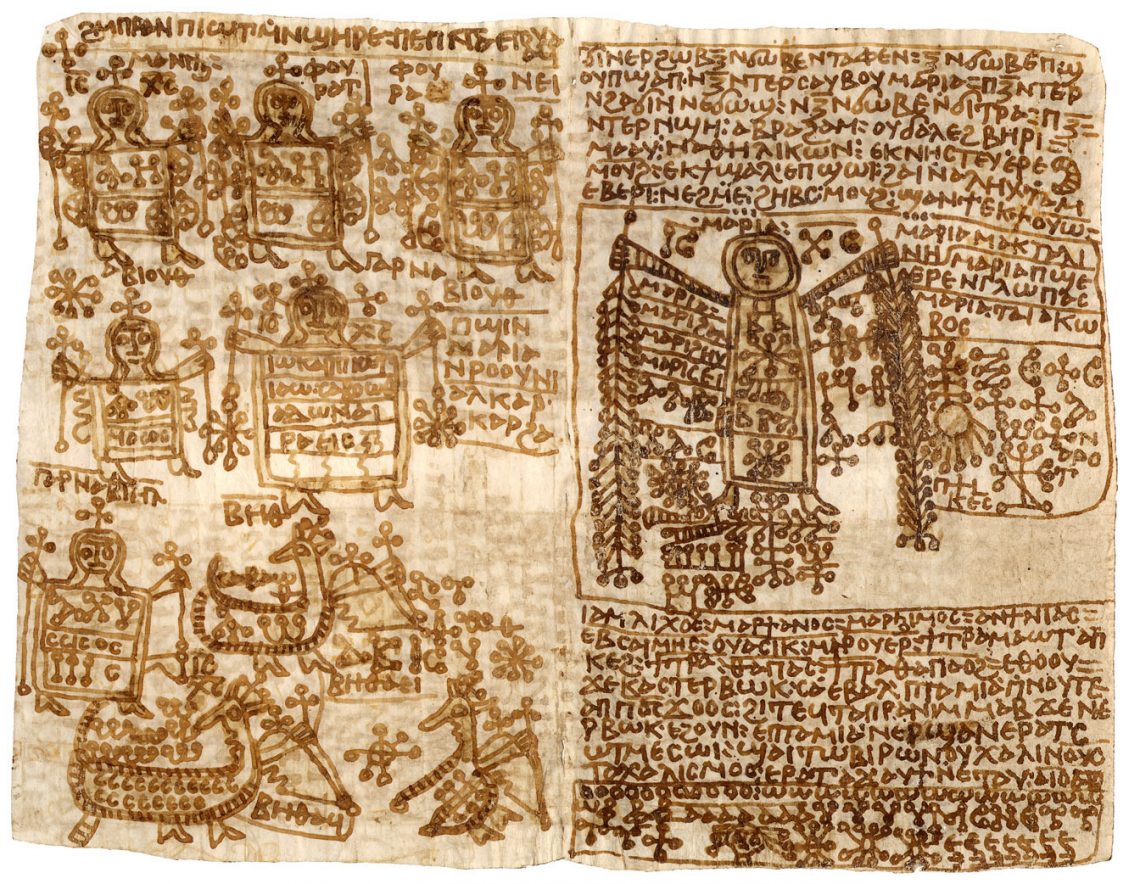 Pages from P. Heid. Inv. Kopt. 685, tenth century, including an image of the Virgin Mary associated with a healing and protective prayer. Image reproduced by the Coptic Magical Papyri project, University of Würzburg.
Angels are especially important. Michael frequently appears as a celestial protector, warrior, healer, or intermediary. Gabriel, Raphael, and other named or numbered angelic beings may be invoked alongside more obscure powers. This is not surprising when we remember that angelology was already richly developed in Jewish and Christian literature. The magical manuscripts draw that cosmic population into personal emergencies.
The result is a religion experienced at human scale. Grand theological claims about divine providence become practical questions: Will this fever stop? Will a hostile person leave me alone? Will a pregnancy be protected? Can I obtain favor from an official? Can I sleep without terrifying dreams? Can a family conflict be repaired? The manuscripts turn cosmology into a technology of hope, although historians cannot verify whether users obtained the results they expected.
Formularies and Applied Texts: Two Different Kinds of Object
A key distinction in modern research is between formularies and applied texts. A formulary is essentially a ritual handbook. It contains recipes or models that could be adapted to different clients. Instructions might specify that a practitioner write certain words, speak a prayer, prepare an object, or insert a person’s name. The client may be represented by a generic formula such as “so-and-so.” Formularies could preserve many procedures on a single sheet, roll, or codex.
An applied text is different. It is the product of a ritual prepared for a concrete case. Names have been inserted. The object may have been folded, tied, worn, deposited, hidden, or otherwise activated through use. An amulet written for a named person is not simply a text; its physical history is part of the ritual.
This distinction changes how scholars read the evidence. A handbook tells us what a practitioner knew or wanted to preserve. An applied object shows that at least one ritual was actually commissioned or carried out. A formulary listing a love spell does not prove that every recipe was performed. A folded amulet naming a client offers stronger evidence of use, although it still does not reveal whether the user believed it succeeded.
Material details can also expose the economics of ritual knowledge. Some manuscripts are carefully written; others use rough hands and reused surfaces. Texts may be copied on scraps. Corrections, repetitions, damaged passages, and uneven spelling show that ritual expertise was not confined to highly trained literary scribes. At the same time, the existence of large formularies implies specialists who collected, copied, adapted, and transmitted technical knowledge.
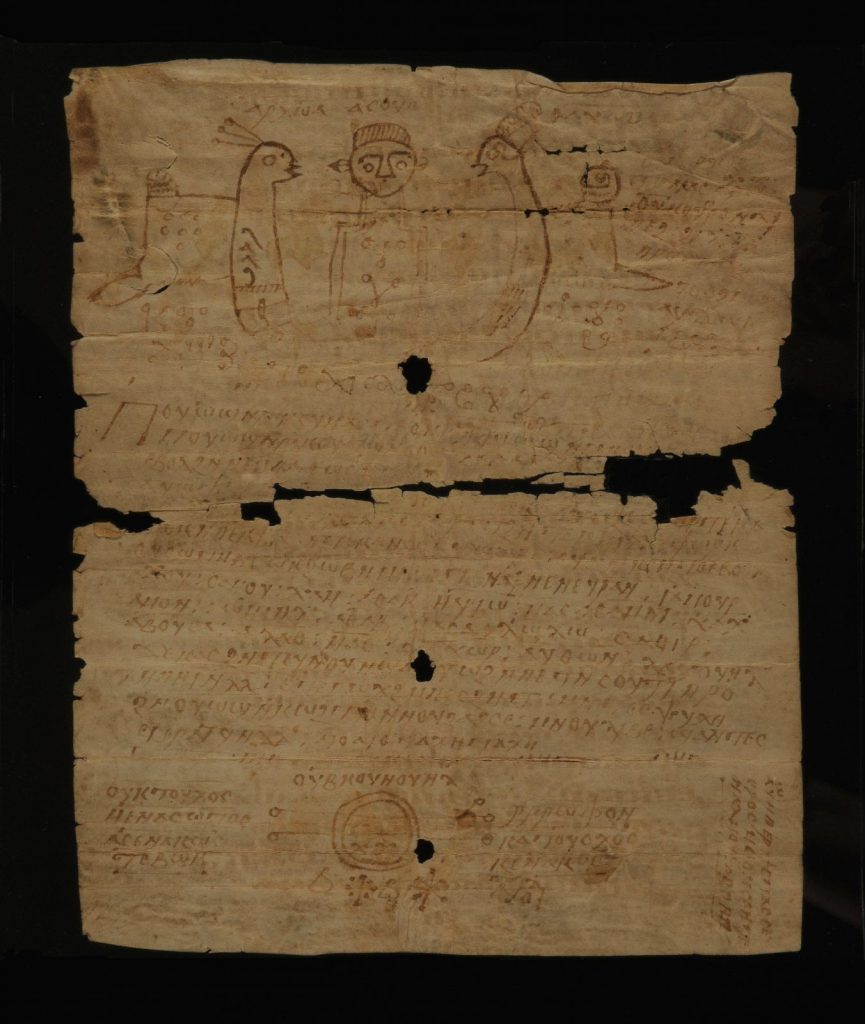
P.Duk.inv. 460, a Coptic magical handbook held by Duke University, preserves numbered recipes in a sequence, strongly suggesting a larger professional collection. Recipes 42–47 survive on the fragment. The manuscript is valuable because its organization makes the handbook function unmistakable: it was not designed as a one-time amulet but as a reusable storehouse of procedures.
Another striking example is Leiden F 1964/4.14, an eleventh-century Coptic formulary discussed by the Würzburg project. It preserves multiple recipes and includes drawings and signs. The page shows how text and image worked together and how a ritual handbook could be visually dense without being a luxury manuscript.
 Leiden F 1964/4.14, an eleventh-century Coptic ritual formulary with multiple recipes, drawings, and magical signs. Image reproduced by the Coptic Magical Papyri project, University of Würzburg.
Healing, the Body, and Invisible Causes
Healing is one of the most important themes in the Coptic magical corpus. This alone should make us wary of imagining a sharp wall between medicine and magic. Premodern healing systems often combined empirical observation, inherited pharmacology, prayer, sacred narrative, ritual action, and assumptions about invisible agents. A fever might be treated with a substance, a prayer, an amulet, or several of these at once.
The University of Michigan preserves manuscripts in which catalogers explicitly describe the content as both medical and magical. P.Mich.inv. 593, for example, belongs to material associated with a group once called the “Wizard’s Hoard.” One portion is classified as a collection of magic and medicine. Such archival labels reflect modern cataloging, but the mixed content itself is ancient.
Why combine medicine and ritual? Because the body was not conceptualized as an isolated biological machine. Illness could be understood through many overlapping explanations: environmental conditions, bodily imbalance, injury, divine testing, demonic attack, envy, hostile ritual, or other invisible influences. A practical healer could address more than one causal level at the same time.
Modern readers sometimes treat such texts as evidence of irrationality. That response is historically shallow. People everywhere develop explanatory systems using the intellectual and religious resources available to them. A Coptic healing text is valuable not because its supernatural assumptions can be scientifically validated, but because it reveals how suffering was interpreted and managed. It also reminds us that the history of medicine includes prayer, ritual, household expertise, and spiritual care alongside technical pharmacology.
Some healing formulas draw on biblical episodes in which physical contact, divine speech, or sacred presence restores health. Others invoke angelic beings or command disease to leave. Still others prescribe substances. The ritual can move between symbolic and material registers without perceiving a contradiction. Words are things done to bodies; objects are carriers of words; sacred narratives are models for biological recovery.
The current research of Markéta Preininger and colleagues has emphasized precisely this intersection of health and invisible forces. Such work helps shift the study of Coptic magic away from sensational lists of spells and toward questions of embodiment, emotion, fear, and therapeutic practice.
Protection, Amulets, and the Material Life of Sacred Words
Amulets are among the clearest examples of religion becoming material. The written surface could be folded, rolled, pierced, tied, placed in a container, worn against the body, or hidden in a location. The words mattered, but so did their physical form.
In Christian Egypt, protective texts might invoke the Trinity, Christ, Mary, angels, saints, psalms, or biblical events. Crosses and other signs could be drawn alongside writing. Some objects include elaborate character sequences that cannot be reduced to ordinary language. Their power, from the user’s perspective, may have depended partly on being special, secret, or visually authoritative.
The body and the text could become physically linked. An amulet worn on the neck or arm created a continuous proximity between the client and the sacred names it carried. A text folded into a tiny packet changed from readable document into protective object. Once folded, its efficacy may not have depended on anyone reading it again.
This is an important point for the history of literacy. Not every ritual text was produced in order to communicate information in the ordinary sense. Writing could function as presence. A divine name written correctly could be understood as active even when hidden. A drawn figure could embody a relationship. A sequence of signs could mark access to specialized knowledge.
Material analysis has become increasingly important in recent scholarship. Researchers examine fibers, ink, leather, folding patterns, joins, damage, scribal hands, and radiocarbon dates. British Museum work on the Hay archive of Coptic spells on leather, for example, has helped reconstruct objects that earlier catalogues treated mainly as textual witnesses. This material turn changes the questions we ask. Instead of only “What does the spell say?” we can ask “How was the object made, handled, folded, joined, stored, or worn?”
That shift brings us closer to practice. Ritual is not just language. It is language situated in bodies, materials, places, gestures, and relationships.
Figures, Signs, and the Visual Grammar of Ritual
Coptic magical manuscripts can be visually extraordinary. Human figures, angelic or divine beings, birds, snakes, geometric shapes, crosses, rings, characteres, and diagram-like forms appear beside or inside written instructions. These drawings should not automatically be treated as illustrations in the modern sense. They could be ritual components.
A figure may represent the target of a rite, the divine being invoked, a protective presence, or an abstract cosmological structure. Rings and enclosed names can imply containment. Repeated signs may create a visual rhythm. Some images are accompanied by labels that identify beings or explain how the drawing functions.
The difficulty is interpretation. Modern viewers are tempted to recognize familiar symbols too quickly. A rough drawing may resemble an Egyptian deity, a saint, an angel, or a demon, but resemblance alone is not proof. Specialists compare parallel manuscripts, captions, textual context, and iconographic traditions before making identifications.
The same caution applies to “magical alphabets” and characteres. Some signs may descend from older Greek or Egyptian ritual notation; others may be stylized letters; still others function as graphic symbols whose meaning is difficult to recover. Their opacity may itself have been valuable. A sign that looks unlike ordinary writing marks the manuscript as technical and potentially authoritative.
Visual complexity also complicates the assumption that literacy is simply binary. A practitioner might recognize certain names, formulaic patterns, crosses, or signs without being a highly trained literary reader. Another might copy a model whose language was only partially understood. Ritual manuscripts could therefore move through different levels of textual competence.
Love, Favor, Conflict, and the Ethics of Reading the Corpus
Not all Coptic rituals are protective or healing. The corpus also includes requests for favor, attraction, reconciliation, separation, domination, curses, and other forms of social intervention. These texts are historically important because they expose conflicts often missing from elite literature. They show individuals trying to alter relationships when ordinary social power felt insufficient.
Modern presentation can easily become irresponsible here. A coercive attraction spell should not be romanticized as an exotic “love ritual.” Its goal may involve overriding another person’s autonomy. Aggressive curses may seek illness, humiliation, separation, or submission. Historians can describe these practices without turning them into operational instructions.
The ethical tension is part of the evidence. A manuscript may invoke Christian sacred authority for a goal that modern readers, and perhaps some ancient clergy, would judge morally troubling. That contradiction tells us something important: religious language does not guarantee ethical consensus. People can mobilize the sacred in disputes, desire, jealousy, and competition just as readily as in healing.
Favor spells are especially revealing. They may seek acceptance before officials, employers, powerful patrons, or communities. In societies structured by hierarchy, legal vulnerability, taxation, and patronage, “favor” was not trivial. A person’s access to justice or livelihood could depend on how authorities received them. Ritual offered one imagined way to influence that uncertainty.
Separation and curse texts likewise reveal the fragility of social bonds. They remind us that the users of magical texts were not abstract believers; they were people embedded in households, workplaces, marriages, neighborhoods, and legal systems. Their ritual requests preserve emotional histories: fear of rivals, anxiety about abandonment, anger over theft, longing for recognition, and desperation in illness.
Reading these texts well requires resisting two distortions. The first is romanticization, which turns every manuscript into spiritual wisdom. The second is ridicule, which treats every ritual as primitive superstition. The sources deserve the same seriousness we give legal petitions, medical recipes, sermons, or letters. They are evidence for human attempts to act under uncertainty.
Who Made and Used These Texts?
The manuscripts rarely give us a full biography of the practitioner. Older scholarship often used labels such as “magician” or “sorcerer,” but these can imply a fixed profession that the evidence does not always support. Some ritual specialists may have been healers. Others may have had monastic, clerical, scribal, or temple-connected backgrounds. Some could have learned through apprenticeships or family transmission. The corpus probably represents multiple social types rather than a single class of magician.
Literacy itself was specialized. Producing a long formulary required writing materials, models, and enough training to copy complex texts. Yet the irregular hands in some manuscripts suggest that highly polished book culture was not necessary. A specialist might occupy a middle zone between formal scribe and orally trained practitioner.
Clients could come from many levels of society. Applied texts preserve personal names, and some prayers reveal gender, family relationships, or particular concerns. But the survival of a manuscript is accidental. Papyrus decays; amulets were worn to destruction; many objects were discarded or deliberately buried. The surviving corpus cannot be treated as a statistical census of Egyptian ritual life.
Geography is another challenge. Many objects reached European and American collections through the antiquities market, often with vague or lost provenance. This weakens our ability to map practices to particular villages or regions. When archaeological context survives, it is therefore especially valuable.
Despite these limits, clusters of related manuscripts can reveal workshops or archives. The University of Michigan “Wizard’s Hoard” is a good example of material that appears connected through textual parallels and physical features. Copies of the same or related formulas show that ritual knowledge was reproduced rather than improvised from scratch every time.
This copying culture also explains textual variation. A formula could be shortened, expanded, mistranscribed, Christianized further, or combined with another text. Names changed through copying errors. Instructions migrated. The manuscript tradition behaved like a living repertoire.
The Problem of “Syncretism”
Coptic magical texts are often called syncretistic because they combine elements associated with Egyptian religion, Christianity, Judaism, Greek ritual culture, and later Islamic environments. The term can be useful, but it can also obscure more than it explains.
Calling a text “syncretistic” may imply that there once existed pure religious systems that were later mixed together. Historical religions are rarely that tidy. Christianity itself developed in a multilingual Mediterranean world shaped by Jewish scripture, Greek philosophy, Roman institutions, local cults, and competing interpretations. Egyptian Christianity was Egyptian from the beginning: it was lived by people whose language, landscape, family customs, and inherited concepts came from Egypt.
A better question is not “Which religion does this element belong to?” but “How is this element functioning here?” An old divine name may survive because it was copied as powerful technical vocabulary, not because the practitioner secretly worshipped the old deity. A Jewish divine name may circulate through Greek ritual books without implying Jewish identity. A Christian prayer may be adapted for a private coercive goal without representing official liturgy.
Roxanne Bélanger Sarrazin’s work on Greek and Egyptian deities in Coptic magical texts has stressed processes of appropriation and transformation. The survival of a name such as Isis or Horus in a Christian-era manuscript does not prove an unchanged cult. Names can become ritual fossils, reinterpreted beings, or specialized formulaic components.
The same is true of mysterious divine names that move across languages. Greek spelling may preserve an Egyptian sound; Coptic spelling may preserve a Greek form; Hebrew names may be filtered through Greek pronunciation. A magical manuscript is therefore also a linguistic archive of cultural contact.
Why the Coptic Evidence Changes the History of Christianity
If we studied Egyptian Christianity only through councils, theology, monastic rules, and hagiography, we would see an incomplete society. The magical manuscripts reveal forms of Christian practice that ecclesiastical authors often ignored or condemned. They show Christianity not only as doctrine but as a practical sacred system used to negotiate danger.
This matters for debates about conversion. Conversion is sometimes imagined as a switch: one religion disappears and another replaces it. The manuscripts show a slower and messier process. New sacred authorities were integrated into existing expectations about how divine power should work. Older forms of ritual expertise could be translated into Christian idioms. Biblical stories could take the role once held by older myths. Angels could fill spaces once occupied by other protective beings.
At the same time, Christianity generated genuinely new ritual resources. The cross was not merely an old symbol with a new name. Christological narratives, Marian devotion, saints, relic-like logic, and biblical authority reshaped the repertoire. The transformation worked in both directions: inherited ritual habits influenced Christian practice, while Christianity reorganized the meaning of those habits.
The manuscripts also complicate the line between orthodoxy and heterodoxy. A text may contain perfectly conventional Christian names alongside unusual cosmology. Another may preserve apocryphal stories that never became canonical scripture but circulated widely. Yet another may invoke figures associated by modern scholars with “Gnostic” traditions. The categories used by church historians do not always map neatly onto private ritual manuscripts.
In this sense, the Coptic magical corpus is not a marginal curiosity. It is evidence for Christianity as lived by ordinary people in conditions of uncertainty. It belongs beside archaeology, letters, tax documents, monastic texts, and liturgy in any serious reconstruction of Egyptian religious history.
Manuscripts as Evidence for Emotion and Everyday Life
Perhaps the greatest value of these texts is emotional. Official inscriptions celebrate rulers. Theological treatises defend doctrines. Monastic literature praises ascetic ideals. Magical manuscripts preserve fear.
Fear of fever. Fear of miscarriage. Fear of demons. Fear of a rival. Fear of being rejected by an authority. Fear that a lover will leave. Fear that a child will not recover. Fear of theft, animals, nightmares, and enemies.
But they preserve hope as well. A ritual only makes sense if someone believes action is still possible. Writing a name, commissioning an amulet, calling on Michael, invoking Mary, or carrying sacred words converts helplessness into procedure. The person may not control the world, but the ritual creates a structured response.
This is why “superstition” is such a poor analytical category. It tells us what a modern observer thinks of the belief but very little about the person who held it. Historical interpretation asks instead: What problem was being solved? What authority was trusted? Why this material? Why this divine figure? What other options did the client have?
The answers are rarely complete, but the manuscripts bring us unusually close to people who otherwise left no autobiography.
What the Modern Coptic Magical Papyri Project Has Changed
For much of the twentieth century, Coptic magical texts were difficult to study as a corpus. Editions were scattered across many books and journals. Some manuscripts had never been published. Others had old editions that needed correction. Photographs could be difficult to access. As a result, scholars often generalized from a relatively small sample.
The University of Würzburg’s Coptic Magical Papyri project, active from 2018 to 2023, transformed this situation by cataloguing manuscripts, publishing new studies, and developing the Kyprianos database. Its successor, the Corpus of Coptic Magical Formularies project, funded for 2024–2027, continues this work with a focus on Coptic ritual handbooks and systematic analysis of language and ritual.
The first volume of Papyri Copticae Magicae appeared in 2023, dedicated to formularies. The importance of this publication is methodological as much as philological. A coherent corpus allows scholars to compare vocabulary, ritual structure, recurring names, manuscript relationships, and geographic or chronological patterns across many texts rather than relying on famous isolated examples.
Kyprianos is particularly valuable because it treats manuscripts, individual rituals, images, hands, materials, and textual relationships as connected data. Digital tools make it easier to ask whether a rare name appears elsewhere, whether a drawing has parallels, or whether two recipes share a distinctive sequence.
This new research environment also encourages collaboration among Coptologists, papyrologists, historians of religion, Egyptologists, manuscript specialists, and digital humanists. The field is moving away from the old model in which a single exotic spell was translated and displayed as a curiosity.
Common Misconceptions
“Coptic magic is just ancient Egyptian magic after Christianity.”
There are continuities, but the claim is too simple. Coptic ritual texts belong to a transformed religious environment. Christian cosmology, scripture, saints, angels, and liturgical language are often central. Older Egyptian and Greco-Roman elements survive through adaptation rather than untouched preservation.
“The texts prove that Coptic Christians secretly remained pagan.”
No. The presence of old divine names or inherited ritual forms does not establish secret pagan identity. A name can survive as technical vocabulary long after its original cultic context changes. Many manuscripts are explicitly Christian in structure.
“Magic was the opposite of religion.”
That modern binary is historically unstable. Ancient authorities certainly distinguished licit from illicit practices, and Christian writers condemned forms of magic. But users of protective prayers and amulets may have understood their actions as religious. The boundary was contested, not self-evident.
“Every recipe in a handbook was actually performed.”
A formulary records available knowledge, not necessarily completed actions. Applied texts with inserted names and evidence of folding or wearing provide stronger evidence for performance.
“Strange names are meaningless gibberish.”
Some sequences may be intentionally opaque, but many have linguistic histories. They can preserve transformed Egyptian, Greek, Hebrew, or other names. Others are graphic or sonic technologies whose meaning cannot be reconstructed confidently.
“These texts show that ancient people had no medicine.”
False. Magical and medical approaches could coexist. Some manuscripts combine pharmacological treatment with ritual language. The categories are not mutually exclusive in the historical sources.
Frequently Asked Questions
How many Coptic magical texts survive?
The Würzburg research project has described a corpus of roughly six hundred surviving texts, although the exact count changes as manuscripts are reclassified, joined, newly published, or distinguished as separate ritual units. They are distributed across museums, libraries, and collections around the world.
When were they written?
The broader corpus spans approximately the third to the twelfth centuries CE, with much of the material belonging to late antique and early Islamic Egypt. Individual manuscripts must be dated separately through palaeography, codicology, archaeological context, or in some cases radiocarbon analysis.
Are they all written on papyrus?
No. Papyrus is common, but examples also survive on parchment, paper, leather, ostraca, and other media. The traditional phrase “magical papyri” is therefore a convenient umbrella term rather than a literal description of every object.
Are the rituals specifically Coptic Christian?
Many are strongly Christian, invoking Jesus, Mary, angels, saints, scripture, and the cross. But the corpus also preserves older Egyptian, Greek, Jewish, and other ritual elements. The combination varies from manuscript to manuscript.
Did the Coptic Church approve these practices?
There is no single answer. Ecclesiastical authorities frequently condemned magic, divination, and unauthorized ritual. Yet some practices found in the manuscripts use prayers, psalms, crosses, and saints that also belonged to accepted Christian devotion. Historical practice did not always follow institutional boundaries cleanly.
Can historians know whether the spells “worked”?
Not in the supernatural sense. Historical evidence can establish that texts were copied, commissioned, worn, folded, deposited, or reused, and it can reconstruct what users expected them to do. It cannot scientifically verify supernatural efficacy.
Why are these manuscripts important today?
They preserve voices and problems often missing from elite sources. They illuminate ordinary religion, healing, emotion, gender, social conflict, language contact, manuscript culture, and the transformation of Egyptian society across Christianization and early Islamic rule.
A Better Way to Read Coptic Magic
The most useful way to approach the Coptic magical papyri is neither as occult instruction manuals nor as embarrassing debris left outside “real” religion. They are archives of religious creativity under pressure.
A person suffering from illness could turn to medicine and prayer together. A parent could carry an amulet for a child. A ritual specialist could preserve dozens of procedures in a handbook. A client could seek divine favor in a dispute. A scribe could copy mysterious names inherited from a tradition whose origins were already partly forgotten. Christian sacred history, Egyptian habits of efficacious writing, Greek technical vocabulary, Jewish divine names, and local social problems could meet on a single piece of papyrus.
This does not mean that all traditions blended harmoniously. There were conflicts, condemnations, coercive rites, and competing claims to authority. But the manuscripts show that lived religion is rarely as clean as institutional categories suggest.
They also reveal the power of writing itself. A sacred name could be spoken, drawn, enclosed, folded, carried, or placed against the body. A page could move from reference manual to ritual object. Images were not decoration but part of the logic of action. The manuscript was a technology connecting language, body, material, and divine presence.
Seen this way, Coptic magical texts belong to several histories at once. They are part of the history of Christianity because they show Christians acting outside formal liturgy. They are part of the history of medicine because they record ways of treating illness. They are part of the history of writing because they use scripts, signs, and objects in unconventional ways. They are part of the history of Egypt because they preserve continuity and transformation across one of the country’s greatest religious transitions.
Most of all, they are part of the history of ordinary human uncertainty. Their users lived in a world where illness, bureaucracy, violence, childbirth, poverty, and social dependence could become existential dangers. Ritual gave those dangers names, structures, and possible responses. Whether or not the expected supernatural effects occurred, the act of commissioning or carrying a text created a sense that the crisis could be addressed.
That is why the Coptic magical papyri deserve more than fascination with strange symbols. They are not merely exotic spells from a vanished world. They are documents of people trying to make sacred power present in the most vulnerable parts of life.
Sources and References
- Corpus of Coptic Magical Formularies, Julius Maximilian University of Würzburg.
- Coptic Magical Papyri: Vernacular Religion in Late Antique and Early Islamic Egypt, University of Würzburg.
- Kyprianos Magical Text Database overview, University of Würzburg.
- Korshi Dosoo, Edward O. D. Love, and Markéta Preininger, “The Coptic Magical Papyri Project: Progress Report,” Journal of Coptic Studies 24 (2022), 43–100.
- P.Mich.inv. 593, Advanced Papyrological Information System, University of Michigan Library Digital Collections.
- P.Duk.inv. 460, Coptic magical handbook, Duke Papyrus Archive.
- Coptic magical manuscript EA10414a, British Museum.
- Coptic magical manuscript EA10376, British Museum.


