


The Cyranides is one of the strangest survivors of the ancient Hermetic world. Unlike the philosophical dialogues of the Corpus Hermeticum, it does not ask the reader to contemplate the nature of God, mind, or cosmic rebirth. Instead, it catalogs plants, birds, fish, stones, animals, and bodily substances, then links them through hidden sympathies that were believed to produce medicinal or magical effects. A stone might protect a pregnancy. A bird, plant, and fish beginning with the same Greek letter might be combined into a talisman. An animal part could be assigned a curative force. A gemstone engraved with a specific figure could become, within the logic of the text, a concentrated instrument of natural power.
That practical character makes the Cyranides indispensable for understanding what scholars call the technical Hermetica: ancient and late antique writings attributed to Hermes Trismegistus that deal not primarily with philosophical revelation but with astrology, alchemy, medicine, talismans, stones, plants, and occult properties. The work is especially valuable because it preserves a world in which medicine, magic, natural history, folklore, and religious cosmology were not cleanly separated.
It is also textually difficult. There is no single pristine authorial manuscript. The Cyranides developed through compilation, rearrangement, translation, and supplementation. Its own prologues attribute material to legendary figures such as Kyranos, a supposed Persian king, Harpocration of Alexandria, and Hermes Trismegistus. Modern scholarship treats those names as part of the work’s literary strategy rather than as straightforward proof of authorship. The date is likewise complex: some underlying material may be early imperial, while the form in which the collection circulated was shaped across late antiquity and Byzantium.
This article reconstructs that world carefully. It explains the structure of the books, the role of the Greek alphabet, the idea of sympathy and antipathy, the relationship between medicine and magic, the Hermetic claim to authority, the Arabic and Latin transmission, the importance of Paschalis Romanus’s twelfth-century translation, and the ways the text influenced later ideas about occult virtues. It also separates historical belief from modern evidence. Ancient and medieval readers could regard these materials as real therapies and protective technologies; modern historical study can document those claims without presenting them as scientifically proven medical treatments.
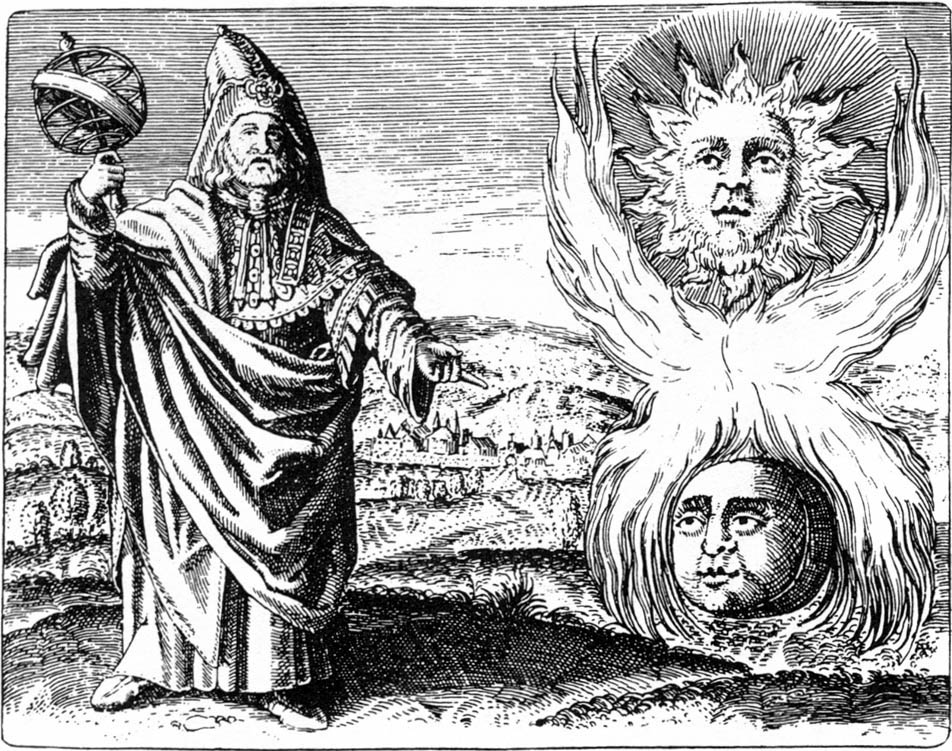 Hermes Trismegistus in Daniel Stolcius von Stolzenberg’s Viridarium chymicum (1624). The image is much later than the Cyranides, but it reflects the enduring identification of Hermes with occult knowledge, astrology, medicine, and alchemy. Public-domain image via Wikimedia Commons.
What the Cyranides Is—and What It Is Not
The Cyranides is a Greek collection concerned with the hidden and therapeutic properties of natural things. Oxford Classical Dictionary describes it as a tract listing the magical and curative powers of stones, plants, and animals, while manuscript databases such as Bibliotheca Philosophica Virtualis classify it among the Hermetica. Its surviving form is composite rather than unitary.
It is not a philosophical Hermetic dialogue comparable to the Poimandres. It is not a single Roman medical handbook in the Hippocratic or Galenic tradition. It is not a medieval European grimoire in the later Solomonic sense. And it is not merely a bestiary, even though several books organize animal lore in bestiary-like form.
The work belongs to a broader category of practical knowledge in which natural substances were thought to possess hidden forces. Those forces could be mobilized through contact, ingestion, engraving, binding, wearing, fumigation, or carefully constructed combinations.
The most useful modern description is therefore a Hermetic compendium of occult natural virtues, medicine, and amuletic practice.
A Text That Calls Itself Secret Wisdom
The work’s prologues frame its contents as privileged revelation. One tradition presents the material as knowledge associated with Kyranos, a Persian king, and Harpocration of Alexandria; Hermes then appears as the authority who unites or transmits the wisdom. This pseudonymous genealogy is typical of ancient esoteric literature.
Attributing a work to a remote king, Egyptian sage, or divine Hermes does not necessarily mean the compilers intended a modern-style fraud. Ancient literary cultures regularly used prestigious names to place teachings within an authoritative chain. The important historical question is not simply “Did Hermes write it?” but “Why did a technical handbook need Hermes?”
The answer lies in the kind of knowledge being claimed. Hidden virtues are not obvious to ordinary perception. If a plant and a stone are secretly connected, or if a carved gem can redirect an invisible influence, the teaching requires an origin deeper than common experience. Hermes supplies that origin.
The language of secrecy also regulates readership. The prologue warns that such knowledge should not be disclosed casually. This turns a catalogue of natural substances into an esoteric inheritance.
The Problem of Date and Authorship
Dating the Cyranides is difficult because the collection is layered. Oxford Classical Dictionary notes uncertainty over authorship, date, and title, while recognizing affinities with writings attributed to Hermes Trismegistus and possible Egyptian or Coptic origins for some material. Other scholarly resources place important stages of compilation in late antiquity or early Byzantium.
The work itself invokes Kyranos and Harpocration. Neither attribution can be treated as a secure historical author signature. “Harpocration” may refer to a learned Alexandrian persona rather than a figure we can identify with certainty, and the Persian king Kyranos belongs to the text’s legendary architecture.
Modern scholarship often describes the Cyranides as a texte vivant, a living text. That phrase is unusually appropriate. Passages were abridged, expanded, reordered, and transmitted in different languages. Books that now appear together may have had separate earlier histories.
Composition date, compilation date, translation date, and manuscript date must therefore remain separate. A medieval Latin copy can preserve much older Greek material; a late manuscript does not make the ideas late.
Book One: The Alphabet Becomes a Machine of Correspondence
Book One is the most distinctive part of the collection. It is arranged according to the twenty-four letters of the Greek alphabet. Under each letter, the text associates a plant, a bird, a stone, and a fish or sea creature whose Greek names begin with that letter.
This is not merely an index. The alphabet itself becomes an organizing principle for occult sympathy. Items that share an initial letter are treated as if language reveals a hidden natural kinship.
From a modern scientific perspective, there is no reason to assume that two substances acquire causal powers because their Greek names begin with the same letter. Historically, however, the procedure reflects a world in which language could disclose structure rather than arbitrarily label it.
The method is especially important for the history of esotericism because it joins philology and nature. A letter links mineral, plant, bird, and fish into a fourfold unit. The reader learns to see vocabulary as cosmology.
Why the Alphabet Matters
Ancient alphabets were not only writing systems. Letters could carry numerical values, divine names, sounds, and symbolic associations. Greek magical papyri, amulets, and later mystical systems frequently treat letters as powerful objects.
The Cyranides applies that symbolic potential to natural history. The initial letter creates a formal bridge among substances that would otherwise appear unrelated.
This strategy has an important cognitive effect. It makes a huge body of lore memorable. Alphabetical organization converts chaotic lists into a navigable system.
The system is therefore simultaneously mnemonic, literary, and magical.
Plants, Birds, Stones, and Fish as a Composite Talisman
A recurring feature of Book One is the construction of composite amulets. A stone may be engraved with a figure associated with the corresponding bird or fish. Plant material or animal substances may be incorporated. The finished object is supposed to gather the virtues of all components.
The logic is cumulative. Each ingredient contributes an invisible quality. The engraved image fixes identity. The letter provides formal correspondence. The body of the wearer becomes the final point where the network acts.
This model anticipates later magical tables of correspondence, but the relationship should not be overstated. Nineteenth-century occultists systematized planets, colors, perfumes, metals, gods, and tarot cards in very different intellectual environments. The Cyranides belongs to an older natural-magical ecology.
What connects them is the assumption that power can be intensified by assembling things believed to belong to the same hidden chain.
Books Two to Four: A Magical Bestiary
The later books move more strongly into animal lore. Different creatures are described along with the virtues attributed to parts of their bodies, behaviors, secretions, stones, or other substances.
This material belongs to the long history of ancient zoological and medical writing. Animals were sources of food, medicine, poison, omen, metaphor, and ritual power. A single creature could appear in Aristotle, Pliny, Dioscorides, folklore, temple religion, and magical texts with very different meanings.
The Cyranides preserves this overlap. A biological observation can sit beside a fantastic claim. A therapeutic recommendation may be followed by an amuletic use. The modern distinction between natural history and superstition does not map neatly onto the text’s categories.
This is one reason the work is valuable to historians of medicine: it shows what ordinary or semi-learned therapeutic culture looked like outside the most prestigious Galenic tradition.
Sympathy and Antipathy: The Hidden Physics of the Text
The concept of sympatheia—sympathy—is central to the intellectual world of the Cyranides. Sympathy means that distant or different things can be linked by hidden affinities. Antipathy describes the reverse: natural opposition, repulsion, or hostility.
Such ideas were widespread in Greco-Roman natural philosophy and later occult thought. Magnets, medicinal plants, animal behaviors, poisons, and astronomical influences could all be interpreted through invisible relations.
Sympathy allowed magical practice to present itself as an extension of nature rather than a violation of nature. The practitioner did not necessarily imagine commanding reality arbitrarily. Instead, the goal was to discover which things already belonged together.
That theory would remain extremely influential through medieval and Renaissance natural magic.
Occult Virtues: Properties That Cannot Be Explained by Ordinary Qualities
Premodern medicine often classified substances through qualities such as hot, cold, moist, and dry. Yet many effects seemed too specific to explain through those general categories. A stone said to prevent miscarriage, for example, could not easily be reduced to temperature or moisture.
Writers therefore spoke of hidden or “occult” properties. The word occult originally means hidden, not necessarily demonic.
The Cyranides is one of the major ancient witnesses to this style of thinking. Its world is full of substances whose effects are assumed to arise from specific, concealed virtues.
Later medieval philosophers would debate whether such virtues could be natural even when their mechanism was unknown. That debate helped create the intellectual space in which talismans, stones, and astrological medicine could sometimes be defended without openly invoking demons.
Medicine and Magic Were Not Separate Departments
Modern readers often ask whether a particular recipe is “medical” or “magical.” The Cyranides shows why the question can be misleading.
A remedy might involve a plant with a pharmacological effect, an animal part with no demonstrated benefit, and a gemstone worn as an amulet. To the compiler, these were not necessarily contradictory.
Ancient therapy could combine diet, drugs, prayer, charms, dream interpretation, ritual purity, and amulets. Patients sought relief in plural medical markets.
Historical explanation should therefore resist the temptation to divide the text into a rational medical layer and an irrational magical layer as if ancient users themselves always recognized that boundary.
The Cyranides and Dioscorides
Dioscorides’ De materia medica, written in the first century CE, became one of the most influential pharmacological works of antiquity and the Middle Ages. The Cyranides shares some plant and animal lore with traditions also reflected in Dioscorides.
Oxford Classical Dictionary notes parallel passages in later parts of the Cyranides, suggesting that both traditions could draw on older reservoirs of natural knowledge.
The comparison is useful precisely because the works differ. Dioscorides is organized around materia medica and therapeutic use. The Cyranides is more willing to incorporate amulets, secret correspondences, and occult effects.
Their overlap demonstrates that “scientific” and “magical” textual traditions could draw from the same inherited observations while organizing them according to different explanatory models.
 Ivy in the sixth-century Vienna Dioscorides. The image is not from the Cyranides itself, but it illustrates the late antique manuscript culture in which plants were catalogued as carriers of medicinal properties. Public-domain image via Wikimedia Commons.
Why This Is Hermetic Literature
The Cyranides belongs to what scholars often call the technical Hermetica. That category includes texts attributed to Hermes dealing with astrology, alchemy, stones, medicine, and ritual knowledge.
This practical Hermeticism differs in genre from the theological dialogues of the Corpus Hermeticum, yet both claim access to a cosmos structured by divine intelligence and meaningful correspondences.
SecretMagic’s study of the Demotic Book of Thoth shows another side of Egyptian and Graeco-Egyptian learned tradition: scribal knowledge, sacred writing, animals, and priestly intellectual identity. The Cyranides belongs to a later and more overtly technical branch of the broad Hermetic environment.
Hermes functions here not as a single historical author but as the imagined patron of total knowledge: language, nature, stars, medicine, and hidden causes.
Hermes Trismegistus as a Guarantee of Total Knowledge
The authority of Hermes is especially effective in a book that crosses disciplinary boundaries. A normal physician might know drugs; a naturalist might know animals; an astrologer might know stars. Hermes, as constructed by late antique tradition, could know all of them.
That universal competence is part of the literary theology of the Hermetic sage. The more diverse the material, the more useful an all-knowing legendary author becomes.
The attribution also places the text within an Egyptianizing prestige tradition. Greek and later Latin readers associated Hermes Trismegistus with ancient Egyptian wisdom through the identification of Hermes with Thoth.
Modern historians do not treat this as evidence that the surviving compilation was literally written by the Egyptian god Thoth or a single prehistoric sage. It is evidence of how ancient knowledge claimed legitimacy.
Amulets as Portable Natural Philosophy
An amulet is often treated as a superstition detached from theory. In the Cyranides, it can be the opposite: a condensed philosophical object.
A gem may embody mineral virtue; an engraved animal may represent a natural power; a plant may contribute another property; the letter or name can establish a formal relation; the wearer becomes the target of the combined effect.
The amulet is therefore a theory of nature made portable.
This is one of the most important ways to understand ancient magic materially. Belief is not only spoken. It is carved, worn, tied, buried, swallowed, burned, and carried.
Magical Gems and the Wider Graeco-Egyptian World
The Cyranides belongs to the same broad cultural environment in which engraved gemstones were used for healing, protection, divination, and religious purposes.
Surviving gems from the Roman imperial period carry images of deities, serpents, scarabs, divine names, voces magicae, and protective symbols. Some objects were specifically connected with bodily complaints.
The famous lion-headed serpent Chnoubis appears on many gems, often in medical or protective contexts. It should not be assumed that every Chnoubis gem came directly from the Cyranides, but the objects illuminate the material world in which claims about stones, images, and hidden virtues made sense.
The museum object is therefore not an illustration of a fantasy text; it is independent archaeological evidence that engraved stones really functioned as ritual technologies.
 A chalcedony intaglio showing Chnoubis, the radiate lion-headed serpent, from the eastern Mediterranean, first to third centuries CE. Such engraved gems belong to the broader medical-magical culture that helps contextualize the Cyranides. Image from the Musée de la BnF via Wikimedia Commons.
Pregnancy, Childbirth, and the Eagle-Stone
One of the most persistent ancient and medieval amuletic traditions concerns the aetites, or eagle-stone. The object was believed to contain another stone inside itself and was compared to a pregnant body.
Because the stone appeared to “give birth,” it became associated with fertility and childbirth. Texts attributed protective properties to it during pregnancy.
The logic is a textbook example of sympathetic reasoning: resemblance produces efficacy. A stone that seems pregnant is used to protect pregnancy.
Modern obstetrics provides no scientific basis for relying on such an amulet to prevent miscarriage or complications. Historically, however, the belief reveals the emotional and medical vulnerability surrounding childbirth in premodern societies.
Animal Bodies as Pharmacies
The Cyranides repeatedly assigns powers to teeth, hair, fat, blood, organs, bones, and secretions. Such uses can appear shocking to modern readers.
The material reflects a broader ancient assumption that a living creature’s qualities remain concentrated in its body parts. Courage, fertility, aggression, nocturnal activity, or resistance to poison could be imagined as transferable.
This is related to but not identical with modern pharmacology. Some animal-derived substances can contain biologically active compounds; that fact does not validate every ancient magical claim.
Historical discussion should therefore avoid two mistakes: treating all animal remedies as absurd without investigation, or treating traditional use as proof of medical effectiveness.
The Ethics of Reconstructing Ancient Recipes
Some Cyranides procedures involve animal harm, unsafe ingestion, toxic substances, or unhygienic preparations. A responsible modern article should not reproduce them as operational instructions.
The scholarly value lies in understanding classification, symbolism, and social use.
Where a recipe contains a potentially dangerous substance, historians can describe the category of material without encouraging experimentation.
This is especially important online, where a translated ancient recipe can be copied into wellness culture and stripped of the uncertainty surrounding both its identity and safety.
From Greek into Arabic
The Cyranides did not remain confined to Greek. Biblissima records an Arabic translation of Book One produced by the later ninth century, and the Bodleian Library preserves an Arabic manuscript containing a translation or adaptation of part of that book.
Arabic transmission matters because Hermetic literature became deeply important in medieval Islamicate intellectual culture. Hermes was linked with Idris in some traditions and was imagined as an ancient sage of astronomy, medicine, alchemy, and philosophy.
Translation also changes texts. Greek alphabetical wordplay is difficult to reproduce in Arabic because the initial letters and names no longer align in the same way. Translators therefore had to adapt, preserve, or reinterpret the system.
This is a powerful reminder that an occult correspondence can depend on language. If a magical relation rests on Greek spelling, translation exposes the cultural construction of the system.
The Bodleian Arabic Cyranides
Oxford’s Bodleian Library MS. Arab. d. 221 is especially important for modern readers because it demonstrates the text’s movement into Arabic Hermetic culture.
The catalog description identifies the manuscript as an Arabic translation or adaptation of part of Book One and explicitly notes the system of twenty-four Greek alphabetic chapters.
The physical manuscript is later than the ancient composition it transmits. This distinction between text date and manuscript date is essential.
The object is evidence for transmission, not proof that the exact surviving leaf reproduces the earliest Greek text without change.
Paschalis Romanus and the Latin Translation of 1169
The Cyranides entered medieval Latin culture through a translation associated with Paschalis Romanus, a cleric and learned translator connected with Constantinople. Bibliotheca Philosophica Virtualis dates the translation to 1169.
This moment is historically significant. The twelfth century saw an enormous Latin appetite for Greek and Arabic medicine, astronomy, astrology, and philosophy.
The translation gave Western readers access to a text in which medicine and occult natural properties were tightly intertwined.
Once translated, however, the work entered new debates about legitimate natural knowledge, magical practice, and the boundary between medicine and superstition.
Why Constantinople Matters
Constantinople was not simply a container preserving ancient books. Byzantine scholars copied, excerpted, judged, and reclassified occult materials.
The survival of the Cyranides depended on this intellectual ecosystem.
Byzantine medicine itself could include amulets and ritual techniques alongside learned Galenic practice. Isabel Grimm-Stadelmann’s research on Byzantine medical literature emphasizes continuities between Egyptian motifs, late antique ritual texts, and later iatromagical therapies.
The Byzantine world therefore challenges the modern habit of imagining a clean break between classical magic and medieval Christianity.
The Cyranides and Byzantine Suspicion
Occult texts could also attract danger. Byzantine authorities did not treat every form of hidden knowledge as harmless.
Manuscript traditions and legal-religious conflicts show that astrology, divination, and magic could be condemned, especially when associated with forbidden ritual or demonological practices.
The Cyranides survived inside this ambiguity: useful enough to copy, suspicious enough to require caution.
That tension may help explain why practical texts often circulate in composite manuscripts rather than as openly celebrated canonical works.
From Natural Magic to Renaissance Correspondence
By the Renaissance, learned Europeans had inherited multiple traditions describing hidden virtues: Pliny, Dioscorides, Arabic medicine, astrology, lapidaries, Hermetic texts, and medieval natural magic.
The Cyranides contributed to that archive even when later writers encountered its material indirectly.
Renaissance philosophers such as Marsilio Ficino and Heinrich Cornelius Agrippa developed elaborate theories of celestial and occult correspondences. Their systems are later and more philosophically synthetic than the Cyranides, but they share the conviction that nature contains invisible relationships discoverable by the learned practitioner.
This is one route by which ancient technical Hermetica helped feed the history of Western esotericism.
The Cyranides and the Greek Magical Papyri
The Greek Magical Papyri preserve another major body of ritual material from Graeco-Roman Egypt. They include invocations, protective operations, divination, erotic magic, healing, and divine names.
The Cyranides differs in form. It is more encyclopedic and natural-historical, while the papyri frequently preserve individual procedures or ritual handbooks.
Yet the cultural overlap is substantial. Both corpora inhabit a world in which stones, plants, animals, spoken names, images, gods, and bodily effects could be combined.
Studying them together reveals the diversity of technical religion in late antiquity.
The Cyranides and the Chaldean Oracles
SecretMagic’s article on the Chaldean Oracles highlights a very different type of late antique esotericism. The Oracles became authoritative for Neoplatonic theurgy and metaphysics; the Cyranides is far more concrete and materially focused.
One is dominated by divine hierarchy, cosmic fire, and the soul’s ascent; the other by stones, animals, plants, bodily remedies, and amulets.
Both, however, assume that the cosmos is structured by relations invisible to ordinary perception.
This shared premise helps explain why later Hermetic and magical traditions could combine philosophical theurgy with material correspondences.
Why the Text Looks Irrational to Modern Medicine
Modern evidence-based medicine asks whether a treatment produces measurable benefits under controlled conditions and whether risks are understood.
The Cyranides operates through a different epistemology. Tradition, analogy, observed coincidence, inherited authority, and occult sympathy can all count as evidence.
A remedy is plausible because the animal behaves a certain way, because a stone resembles an organ, because names share a letter, or because Hermes transmitted the teaching.
These are historically meaningful forms of reasoning, but they are not substitutes for modern clinical evidence.
Why Dismissing It as Superstition Is Also Too Easy
Calling the entire work “superstition” ends the investigation before it begins.
The text preserves vocabulary, natural observations, pharmacological traditions, mineral lore, social anxieties, religious symbols, and evidence about ancient medical markets.
Some plant knowledge may reflect empirically useful traditions; some claims are symbolic or magical; others are impossible to assess because the substances are uncertain.
The historian’s task is not to certify the remedies but to understand how such heterogeneous knowledge became authoritative.
Common Misconception: The Cyranides Is a Single Book by Hermes
The surviving collection is composite and layered. Hermes is a traditional authority, not a historically verified sole author.
The text invokes other figures, including Kyranos and Harpocration, and modern scholarship recognizes a complex transmission history.
Common Misconception: It Is Just an Ancient Herbal
Plants are only one component. Stones, birds, fish, land animals, amulets, engravings, bodily substances, and magical-medical operations are equally important.
Common Misconception: Its Remedies Were Standard Ancient Medicine
The Cyranides did not represent the whole medical establishment. Learned Galenic medicine had different theoretical priorities, and ancient therapeutic culture was plural.
Common Misconception: Every Amulet Was Purely Religious
Amulets could operate through religious names, natural sympathy, astrology, medicine, or combinations of these.
The modern distinction between religious and natural causation is often too rigid for ancient material.
Common Misconception: Occult Means Demonic
In premodern natural philosophy, “occult” often meant simply hidden from ordinary explanation.
A hidden property could be defended as natural even when its mechanism was unknown.
Common Misconception: Ancient Use Proves Effectiveness
Historical popularity is not clinical evidence.
The fact that people trusted a stone, plant, or animal remedy tells us about culture and experience, not necessarily about objective efficacy.
A Symbolic Reading: The Alphabet as a Map of Nature
For a modern symbolic reader, the most fascinating idea in Book One is that the alphabet can organize the natural world.
A letter becomes more than a sign for sound. It becomes a gate through which plant, bird, stone, and fish enter one family.
This can be read philosophically as a dream of perfect language: the hope that names are not arbitrary but reveal how reality is constructed.
That is a modern interpretation, but it helps explain why technical Hermeticism repeatedly joins language and nature.
A Philosophical Reading: The World as Relation Rather Than Object
Modern science often succeeds by isolating variables. The Cyranides imagines knowledge in the opposite direction: things become intelligible through relationships.
The stone matters because of the bird, the plant, the letter, the body, the disease, and the engraved image.
Its specific causal claims are not scientifically established, but the relational instinct is intellectually interesting.
The text asks a question still relevant today: do we understand a thing by studying it alone, or by mapping the systems in which it participates?
A Material Reading: Why Esoteric Knowledge Needs Objects
Esoteric traditions are often discussed as beliefs or ideas. The Cyranides reminds us that hidden knowledge is frequently material.
A practitioner needed stones, plants, animals, engravings, containers, threads, and bodies.
This materiality changes interpretation. Magic is not only a theory of invisible forces; it is a craft of arranging visible things.
The history of esotericism is therefore also the history of objects, workshops, trade, collecting, and bodily risk.
Modern Cultural Impact
The Cyranides is less famous today than the Corpus Hermeticum, the Picatrix, or later grimoires, but interest in technical Hermetica has grown strongly in academic and practitioner circles.
Modern astrologers and talismanic magicians sometimes revisit its recipes. Historians of medicine use it as evidence for non-Galenic therapeutic culture. Scholars of magic compare its amulets with archaeological gems. Historians of Hermeticism use it to challenge the idea that Hermetic literature was only philosophical.
This renewed attention is valuable when it remains source-conscious.
The danger is that ancient recipes are easily detached from their medical uncertainty, animal ethics, and hazardous materials and marketed as “authentic Hermetic healing.”
How to Study the Cyranides Responsibly
Start with the textual history. Ask which book, language, edition, and manuscript tradition a passage belongs to.
Distinguish traditional attribution from historical authorship. “Hermes says” is a statement about the text’s authority, not proof of composition by a historical Hermes.
Compare natural-magical claims with contemporary medical sources such as Dioscorides and with archaeological evidence from amulets and gems.
Do not translate recipes directly into self-treatment. Species identification, dosage, toxicity, contamination, and historical terminology can all be uncertain.
Finally, treat cultural transmission as part of the subject. Greek, Arabic, Byzantine, and Latin versions are not secondary noise; they are the history of the work.
Frequently Asked Questions
What is the Cyranides? It is a late antique Greek collection of Hermetic natural magic and medicine describing hidden properties of plants, stones, birds, fish, animals, and amulets.
Who wrote it? The work is anonymous and composite. It attributes material to legendary or pseudonymous figures including Kyranos, Harpocration, and Hermes Trismegistus.
When was it written? The underlying material may include early imperial traditions, while compilation and redaction continued through late antiquity and Byzantium. Scholars disagree on a single date.
Why is Book One arranged alphabetically? Each Greek letter organizes a plant, bird, stone, and fish whose names begin with that letter. The shared initial becomes part of the occult correspondence.
Is the Cyranides part of Hermeticism? Yes. It is usually classified among the technical Hermetica, distinct from but related to the philosophical Hermetic writings.
Was it translated into Arabic? Yes. Arabic transmission of Book One is documented, and the Bodleian Library preserves an Arabic adaptation or translation.
When did it enter Latin Europe? A Latin translation is associated with Paschalis Romanus in Constantinople in 1169.
Are its medical claims scientifically proven? No. Some materials may preserve pharmacological knowledge, but many claims depend on magical sympathy, amulets, or substances not validated by modern evidence.
Why are animals so important? Ancient natural magic often assumed that an animal’s qualities could persist in its body parts or be transferred through amulets and remedies.
Why does the Cyranides matter? It is one of the best sources for understanding how late antique and medieval people connected natural history, medicine, language, Hermetic authority, and magic.
Conclusion: The Hidden Virtues of a Connected World
The Cyranides survives from a world that did not divide knowledge the way modern institutions do. Medicine, zoology, mineral lore, language, religion, and magic could occupy the same page without requiring the reader to choose one category.
Its most distinctive contribution is a theory of connection. Plants, birds, stones, fish, letters, images, diseases, and human bodies belong to networks of sympathy. The practitioner’s task is to discover and assemble those networks.
Modern science does not confirm the supernatural or amuletic mechanisms claimed by the text. A gemstone does not become an evidence-based treatment because an ancient author attributed healing power to it. An animal part does not become safe because it appears in a Hermetic recipe.
Yet the historical importance of the work remains enormous. It documents how medicine functioned beyond elite theory, how occult properties could be understood as natural, how alphabets could become cosmological tools, and how objects were designed to carry invisible power.
Its transmission is equally revealing. Greek material moved through Byzantine scholarship, entered Arabic Hermetic culture, and reached Latin readers through a twelfth-century translation. Every stage transformed the work while preserving its central intuition: nature contains more relations than ordinary perception reveals.
For historians of esotericism, the Cyranides therefore fills a crucial gap between philosophical Hermetism and later ceremonial magic. It shows Hermes not only as a revealer of cosmic theology but as the imagined master of stones, plants, animals, medicine, and practical secrets.
The work’s real legacy is not a single talismanic recipe. It is the idea that knowledge can be hidden inside relationships—and that the world itself can be read as a coded network of correspondences.
Sources and References
- John Scarborough, “Cyranides,” Oxford Classical Dictionary, Oxford University Press.
- Bibliotheca Philosophica Virtualis, “Kyranides,” manuscript and transmission overview.
- Biblissima, authority record for the Cyranides, including Greek, Arabic, and Latin transmission.
- Bodleian Library MS. Arab. d. 221, Arabic adaptation of Book One of the Cyranides, via Biblissima and Digital Bodleian.
- M. David Litwa, ed. and trans., “First Prologue to the Cyranides,” in Hermetica II, Cambridge University Press, 2018.
- Maryse Waegeman, Amulet and Alphabet: Magical Amulets in the First Book of Cyranides, Brill.
- Isabel Grimm-Stadelmann, “Healing in the Context of Regeneration and Sympathy: The Reception of Egyptian Motifs in Byzantine Medical Literature,” Medicina nei Secoli.
- Spyros Piperakis, “Plants Full of Signs: Herbal Lore in the Sacred Book of Hermes to Asclepius I,” Classical Philology 117.1 (2022).
- Maryse Waegeman, Amulet and Alphabet: Magical Amulets in the First Book of Cyranides. J. C. Gieben, 1987.
- Garth Fowden, The Egyptian Hermes: A Historical Approach to the Late Pagan Mind. Cambridge University Press, 1986.

