


SEO Title: Daoist Thunder Rites Explained: Five Thunders, Leifa, Talismans, Celestial Generals, and Song Ritual Magic
Meta Description: Explore Daoist Thunder Rites, or leifa: their Song-dynasty rise, Five Thunders, celestial generals, talismans, petitions, inner cultivation, exorcism, rainmaking, and the Daoist ritual bureaucracy.
Suggested Permalink: daoist-thunder-rites-leifa-five-thunders
Primary Category: Asian Esoteric Traditions
Tags: Daoism, Thunder Rites, Leifa, Five Thunders, Chinese Ritual, Talismans
Primary Keyword: Daoist Thunder Rites
 Master Thunder (Lei Gong), dated 1542, a Ming-dynasty hanging scroll in The Metropolitan Museum of Art. The work is public domain and shows the martial, bureaucratic visual world in which thunder deities were imagined.
Introduction: Thunder as a Ritual Technology
Daoist Thunder Rites, usually called leifa (雷法), are one of the most technically sophisticated ritual traditions to emerge from medieval Chinese Daoism. They became especially prominent from the Song dynasty onward, when new exorcistic lineages, divine registers, ritual manuals, talismanic systems, meditative techniques, and martial deities were reorganized into powerful technologies of protection, healing, rainmaking, spirit pacification, and communal ritual.
The English phrase “thunder magic” is common in scholarship, but it can mislead modern readers into imagining a magician throwing lightning bolts. Historical Daoist Thunder Rites were far more complex. They were built around a religious universe in which Heaven functioned through ranks, offices, registers, petitions, seals, warrants, generals, and cosmic ministries. A properly initiated priest did not simply “summon thunder.” He acted within a ritual bureaucracy.
Thunder was both a natural phenomenon and a sacred model of sudden, righteous force. Storms could terrify communities, nourish crops, destroy buildings, break droughts, and dramatize the authority of Heaven. Daoist ritual specialists transformed this tremendous natural image into a language of spiritual governance. Thunder gods became officers. Talismans became warrants. Seals authenticated ritual authority. Petitions communicated with celestial departments. Martial generals executed commands.
Academic research places the major consolidation of these rites in the Song and Yuan periods, especially from the eleventh through thirteenth centuries. Cambridge scholarship describes the Five Thunders as an innovation codified in the early twelfth century, while Florian C. Reiter’s studies show that “Thunder Magic” became an umbrella term for many exorcistic ritual systems constitutive of religious Daoism.
This article distinguishes historical evidence from religious claims. Daoist texts may describe priests controlling weather, expelling demons, healing affliction, or activating thunder through internal alchemical processes. These claims are historically genuine components of Daoist religion. They are not scientifically established demonstrations that ritual speech or talismans can cause meteorological events or compel objectively existing supernatural beings.
What Does Leifa Mean?
The Chinese term leifa combines lei, “thunder,” with fa, a word whose meanings can include method, ritual technique, law, or authorized procedure. Translating fa simply as “magic” captures only part of the idea.
In medieval Daoist culture, fa often implied a ritually transmitted method backed by lineage and celestial authority. This distinction is essential. A thunder rite was not supposed to work because an isolated practitioner possessed private psychic power. Its authority derived from initiation, registers, deities, ritual documents, inherited procedures, and the practitioner’s relationship to an ordered Daoist cosmos.
This is why “Thunder Methods” or “Thunder Rites” can sometimes translate leifa more accurately than the sensational phrase “thunder sorcery.” The rites certainly belong to the comparative history of magic, but they were also orthodox religious technologies within important Daoist institutions.
Why the Song Dynasty Changed Daoist Ritual
The Song dynasty, 960–1279, was a period of enormous religious innovation. Daoism received significant imperial patronage during particular reigns, new local cults entered larger pantheons, printing expanded the circulation of texts, and ritual specialists competed for recognition from courts and communities.
Cambridge’s Companion to Song China emphasizes the vibrancy of the period: therapeutic and exorcistic systems expanded, new deities gained prominence, and the state alternately sponsored, regulated, or ignored local religious movements. Thunder Rites emerged within this environment.
They did not appear from nothing. Earlier Daoism already possessed exorcism, petitions, talismans, registers, protective gods, star rituals, meditative visualizations, and bureaucratic models of Heaven. The Song period reorganized these older elements around new revelations and martial thunder pantheons.
By the twelfth century, thunder rites had become sufficiently integrated into mainstream Daoism that later canonical compendia preserved enormous collections of them.
The Five Thunders
One of the best-known expressions is Wulei fa, the “Methods of the Five Thunders.” The number five naturally resonated with classical Chinese cosmological systems built around the Five Phases, directions, colors, organs, seasons, and other correspondences.
Yet the Five Thunders should not be reduced to one universal list that remained unchanged across all lineages. Different ritual traditions organized thunder powers differently. “Five Thunders” could function as a cosmological structure, a ritual category, or a way of describing multiple departments of celestial force.
Modern websites often provide confident charts assigning one thunder to each organ, direction, planet, and emotion. Some such correspondences may derive from real texts, but lineages and manuals differ. Historical study requires identifying the exact source rather than assuming one timeless Daoist table.
Lei Gong: The Thunder Duke
Lei Gong, the Thunder Duke or Thunder Lord, is one of the most recognizable Chinese thunder deities. He is often depicted as a fierce, nonhuman or bird-like figure equipped with drums, mallets, wedges, or other implements associated with thunder and lightning.
Lei Gong existed in Chinese religious imagination before the full development of Song Thunder Rites. Leifa traditions therefore did not invent thunder divinity; they absorbed older gods into increasingly formalized celestial administrations.
The visual evolution is important. A mythic thunder god can become an officer in a larger bureaucratic system. The same deity who appears in folklore may occupy a ritual rank, receive petitions, command subordinates, and participate in highly technical exorcistic procedures.
 An early twentieth-century illustration of the Chinese God of Thunder from Donald A. Mackenzie’s Myths of China and Japan (1923). The image is public domain in the United States.
Thunder Gods Were a Bureaucracy, Not a Single Deity
Daoist Thunder Rites employ many gods, marshals, generals, messengers, officers, and spirit armies. This is one reason the common phrase “the thunder god” can be misleading.
The unseen world was imagined in terms familiar from Chinese administration. Divine offices issued orders. Marshals executed commands. Registers recorded authority. Seals authenticated documents. Priests submitted petitions. Spirits could be investigated, arrested, punished, pacified, or incorporated into legitimate service.
Cambridge and Brill scholarship on Daoist exorcism describes this collaboration between priests and martial gods as central to the daofa traditions that grew from around the tenth century and became integrated into mainstream Daoism by the twelfth.
This celestial administration should not be dismissed as a crude projection of government onto religion. Bureaucratic imagery solved a profound ritual problem: how can a human priest claim authority over dangerous unseen beings? The answer was delegation. The priest acts because a higher order authorizes him.
Marshal Gods and the Militarization of the Sacred
Thunder ritual is filled with martial imagery: armor, weapons, banners, prisons, fire, commands, patrols, and spirit armies. Gods with local or popular origins could be incorporated into Daoist pantheons as marshals serving a higher celestial order.
This process has been described by scholars as the “civilizing” or bureaucratizing of demons and local spirits. A frightening local power did not always need to be destroyed. It could be transformed into an officer.
The strategy resembles political incorporation: potentially dangerous forces become useful when assigned rank, duty, and superior command.
For communities seeking protection, this cosmology made religious sense. The same terrifying power that threatened human life could, under correct authority, defend it.
Wang Wenqing and the Song Thunder Tradition
Wang Wenqing (1093–1153) is an important historical figure in the development of Song Thunder Rites. Later Daoist sources connect him with highly influential ritual methods involving the Five Thunders, celestial generals, internal visualization, and weather rites.
Florian Reiter’s research on Wang reconstructs ritual systems concerned with rain, clear weather, exorcism, and the powers of the Jade Pivot. Wang became associated with the Divine Empyrean, or Shenxiao, ritual world.
As with many religious founders, later tradition may magnify biography. The historical Wang and the ritual patriarch constructed by later texts should therefore be distinguished.
Shenxiao: The Divine Empyrean
The Shenxiao, or Divine Empyrean, traditions became closely associated with Thunder Rites during the Northern Song. They gained extraordinary visibility under Emperor Huizong, whose reign is famous for intense Daoist patronage.
Shenxiao teachings developed a celestial geography and a pantheon of powerful thunder officers. Imperial patronage helped ritual lineages gain prestige, but it also tied them to politics.
This relationship between state and ritual is important. Thunder priests did not serve only private clients. Reiter notes that thunder rites could be performed for individuals, local communities, and state administration.
Weather control was especially politically significant in an agrarian empire. Drought or flood could threaten harvests, taxation, social stability, and the moral legitimacy of rulers.
Rainmaking and the Politics of Weather
Rainmaking is one of the most dramatic claims associated with Thunder Rites. Medieval religious professionals could be summoned when drought threatened crops. Ritual success might enhance the prestige of a priest or temple; failure could produce skepticism.
Historical anecdotes preserve both belief and doubt. Song sources sometimes describe disputes over whether a ritual specialist genuinely produced rain or merely took credit for changing weather.
This tension is valuable evidence because it shows that medieval people were not universally credulous. Claims of supernatural efficacy could be contested within the culture that produced them.
Modern meteorology does not provide evidence that Daoist ritual commands thunderstorms. Historically, however, rain rites mattered because communities faced real ecological danger and ritual offered a structured response to uncertainty.
Exorcism: Thunder as Righteous Violence
Exorcism was central to leifa. Illness, haunting, disruptive spirits, polluted spaces, or unexplained calamity could be interpreted through religious models involving demonic interference or disordered spiritual forces.
Thunder represented rapid divine enforcement. Ritual texts invoke gods capable of striking, imprisoning, burning, or expelling harmful beings.
Such imagery can look violent, but from the practitioner’s perspective it served protective goals. The celestial army protects the community because legitimate authority defeats illegitimate disturbance.
The history of these rites belongs to the history of healing as well as religion. Before modern biomedical explanations became available, communities used multiple frameworks—herbal medicine, physicians, family ritual, temples, spirit mediums, Buddhist liturgy, and Daoist exorcism—to interpret suffering.
Healing and the Ritual Diagnosis of Affliction
Thunder Rites could be used in therapeutic contexts. A client’s illness might be interpreted as physical, spiritual, karmic, environmental, or some combination of these categories.
Modern scholarship should not convert such explanations into biomedical facts. There is no scientific evidence that demons are established causes of infectious, neurological, or psychiatric disease.
But dismissing ritual healing as meaningless would also be historically shallow. Ritual gives suffering a narrative, mobilizes family and community support, creates specialist care, and can produce strong psychological and social effects even when its supernatural explanation remains unverified.
Talismans: Written Authority in Compressed Form
Daoist talismans, or fu, are among the most recognizable objects associated with Chinese ritual. Their writing can combine ordinary Chinese characters with highly stylized sacred graphs, divine names, diagrams, seals, and strokes that do not function like normal prose.
A thunder talisman may be understood as authorization, command, divine presence, protective device, or ritual instrument depending on the rite.
Its strange appearance is not evidence that the priest was writing meaningless symbols. Esoteric scripts distinguish sacred communication from ordinary literacy. They may also encode lineage knowledge not obvious to outsiders.
In the bureaucratic model, the talisman resembles a warrant. Its authority comes from the office behind it.
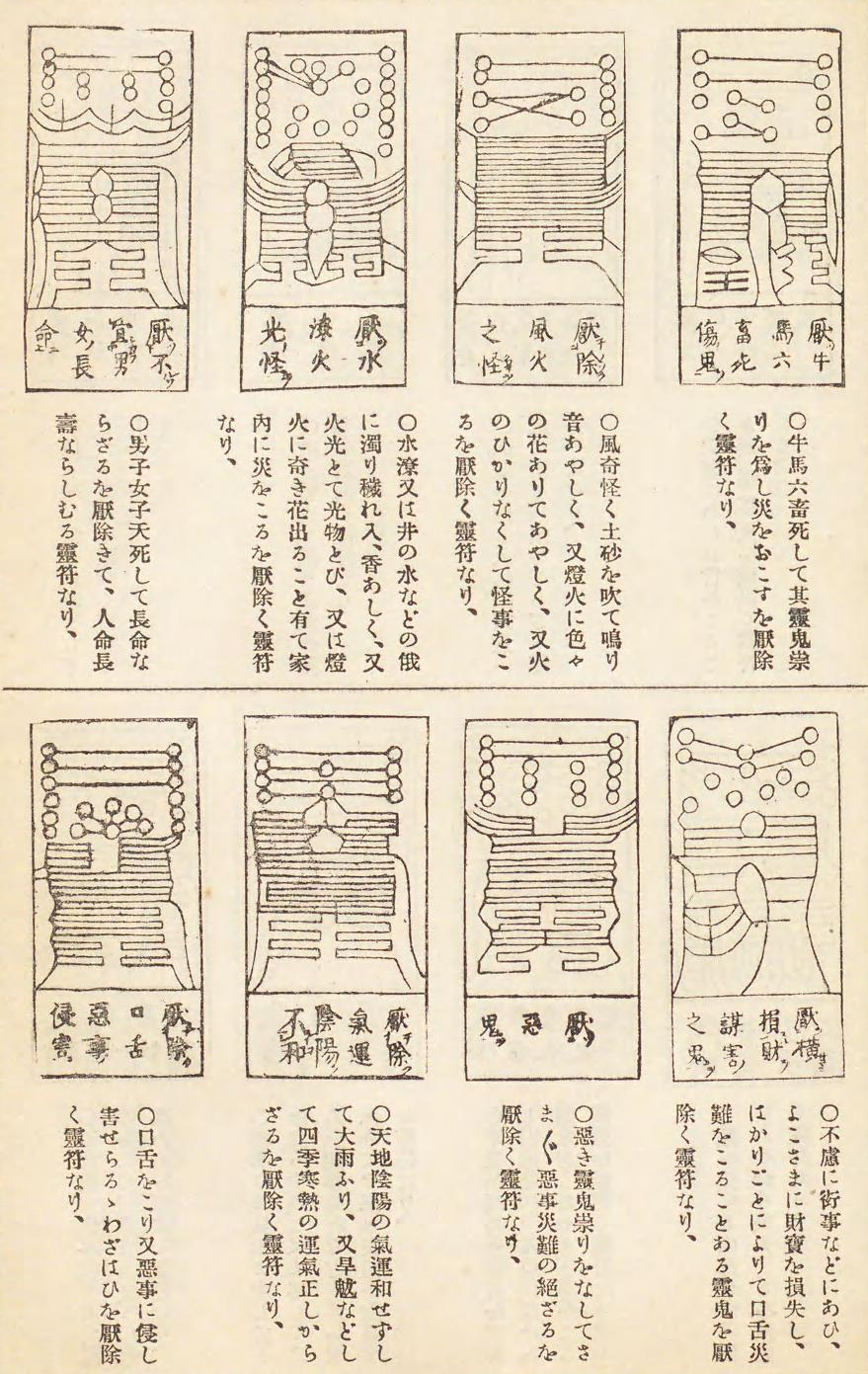 Protective talismans from a 1915 Japanese publication. Wikimedia Commons identifies the series as originally Daoist in origin and transmitted to Japan during the Middle Ages. The image is public domain.
Talismans Were Used, Not Merely Displayed
A talisman could be worn, posted, burned, dissolved into water, stamped onto ritual documents, or used within a more complex sequence. Its physical handling mattered.
This helps distinguish talismanic writing from ordinary calligraphy. The object participates in an action. Burning may transfer the written command into smoke or ash. Drinking water containing talismanic ash may symbolically internalize the sacred order. Posting a talisman marks a boundary.
Modern readers should not assume that ingesting ash or ink is medically safe. Historical description is not health advice.
Seals: Authentication Between Worlds
Imperial China relied heavily on seals to authenticate documents. Daoist ritual adopted analogous technologies.
A sacred seal could mark a petition or talisman as valid. The ritual world thus mirrored administrative practice: a document without proper authority could be ignored, while a correctly authenticated document carried delegated power.
From a symbolic perspective, the seal solves the problem of identity. It says: this command is not private improvisation; it belongs to a recognized office.
Petitions and Memorials to Heaven
One of the most distinctive features of institutional Daoism is the use of written petitions to divine authorities. Priests could present documents describing the client, the problem, the requested intervention, and the relevant divine offices.
Academic studies of Song Thunder Rites preserve examples of memorials concerning ritual procedure and divine administration. This documentary culture makes Daoist magic look strikingly different from the stereotype of spontaneous shamanic trance.
The priest is part liturgist, part ritual official, part scribe.
Registers and Ordination
Daoist religious authority has long been connected with registers listing deities and powers available to properly ordained specialists. Thunder ritual became deeply woven into ordination systems.
This means that knowing the words of a ritual was not traditionally considered sufficient. Authority had to be transmitted.
For modern readers accustomed to downloadable manuals, this point is essential. Possessing a scanned page of the Daozang does not reproduce the social and religious institution that made the page operative for historical priests.
The Daofa Huiyuan: A Vast Ritual Compendium
The most important textual treasury for later Thunder Rites is the Daofa huiyuan, often translated as the Corpus or Compendium of Daoist Ritual Methods. It survives in the Ming Daoist Canon and contains hundreds of fascicles of ritual material.
Brill scholarship describes it as a massive compilation combining thunder rites, exorcistic systems, internal cultivation, talismans, deity visualizations, petitions, and related ritual techniques inherited from Song, Yuan, and early Ming traditions.
It is not one book written by a single author at one moment. It is an archive of lineages and methods.
This makes it invaluable but difficult. Contradictory instructions may represent different schools rather than scribal mistakes. Modern attempts to reduce the entire compendium to one “system” risk erasing its historical plurality.
Internal Cultivation Inside an External Ritual
One of the most surprising features of Thunder Rites is the integration of inner cultivation. A priest may visualize deities within the body, circulate breath or qi according to inherited models, generate inner thunder, or identify temporarily with a divine general.
Brill’s studies of thunder processes explicitly connect thunder rites with internal bodily maps and cultivation. A passage from the Daofa huiyuan describes thunder arising through transformations of breath within the cinnabar field.
This is why the distinction between “internal alchemy” and “external ritual” is sometimes too rigid. In leifa, inner transformation can authorize outer command.
The Priest Becomes the Divine Officer
Some ritual descriptions involve identification between the priest and a thunder deity. Through visualization, breath, mudra-like gestures, talismanic signs, or incantation, the practitioner assumes a divine role.
This does not mean historical priests believed they permanently became gods in ordinary social life. Ritual identity is situational.
The mechanism is comparable to other religious traditions in which officiants speak in the voice of a deity, embody a sacred role, or become a temporary vessel of higher authority.
Traditional practitioners may understand this transformation metaphysically. Scholars can describe the ritual process without claiming scientific proof of literal divine possession.
Thunder in the Body
Daoist ritual thought frequently treats the human body as a microcosm. The organs, breath, directions, stars, deities, and cosmic forces can be mapped within the practitioner.
Thunder is therefore not only outside in the storm. It can be generated symbolically and ritually inside.
This is one of the deepest philosophical moves of leifa. The priest does not stand outside nature commanding it like an engineer. The body is already a condensed cosmos. Ritual becomes possible because inner and outer orders correspond.
Five Phases and Cosmic Correspondence
The Five Phases—wood, fire, earth, metal, and water—provided Chinese thinkers with a flexible framework for cycles, transformations, directions, seasons, and processes.
Thunder rites could use Five-Phase correspondences to organize divine offices and ritual timing. But the details vary greatly across texts.
Modern “element charts” often oversimplify this tradition by treating phases as fixed substances comparable to the four classical elements of Greek philosophy. In Chinese thought, the term wuxing refers more accurately to dynamic phases or modes of transformation.
Steps of Yu and Ritual Movement
Daoist ritual may include patterned steps known as the Steps of Yu, associated by legend with Yu the Great. These movements can map stars, the Big Dipper, or ritual space under the practitioner’s feet.
In Thunder Rites, embodied movement can accompany visualization and divine identification. The ritual ground becomes cosmological space.
Again, the priest does not merely recite a text. He walks a map.
Incantations and Sacred Sound
Thunder rites use incantations, divine names, commands, and formulaic speech. Some texts even include syllables that scholars describe as pseudo-Sanskrit or influenced by Buddhist esoteric ritual.
Christine Mollier and other scholars have demonstrated substantial exchange between medieval Daoism and Buddhism. Esoteric Buddhist ritual technologies, including mantras and mudra-like gestures, could be adapted into Daoist contexts.
This is especially interesting when compared with SecretMagic’s broader coverage of East Asian esoteric practice: similar ritual technologies can migrate across religious boundaries while acquiring new theological meanings.
Daoism and Esoteric Buddhism
Medieval China was not divided into isolated religious boxes. Buddhists and Daoists competed, borrowed, translated, criticized, and imitated one another.
Brill scholarship specifically identifies esoteric Buddhist elements in Daoist thunder ritual. The influence should not be exaggerated into the claim that Thunder Rites are “really Buddhist.” Daoist priests integrated borrowed technologies into a deeply Daoist cosmology of registers, celestial administration, talismans, inner gods, and lineage.
Religious borrowing is creative. A ritual gesture can cross a boundary while its meaning changes.
Thunder Rites and the Heavenly Masters
The Celestial Masters tradition, one of the oldest organized Daoist movements, developed strong liturgical and exorcistic structures long before the Song. Later Heavenly Master lineages incorporated Thunder Rites into their ritual repertoire.
Reiter’s work emphasizes that Song and Yuan thunder methods became part of professional Daoist culture associated with communal and private service.
This institutional continuity explains why leifa should not be portrayed as an underground anti-religious sorcery. It became part of recognized Daoist ritual professionalism.
Qingwei and Later Ritual Synthesis
The Qingwei, or Pure Tenuity, tradition became important from the thirteenth century onward. It inherited and reorganized earlier ritual streams, including thunder methods.
JSTOR and Brill scholarship describe Qingwei as a major form of Daoist ritual professionalism that continued the legacy of Shenxiao and other exorcistic systems.
By the Ming period, canonical compilations preserved these lineages side by side, making later Daoist ritual a product of synthesis as much as isolated sectarian purity.
Was Thunder Magic “Black Magic”?
The modern label “black magic” does not map cleanly onto Daoist categories. Thunder rites contain violent commands, demon prisons, spirit punishments, and aggressive imagery, but practitioners interpreted these as legitimate enforcement of cosmic order.
The key distinction was often not gentle versus violent but orthodox versus deviant, authorized versus unauthorized, ordered versus chaotic.
A thunder marshal could be terrifying and still serve a protective function.
What About Curses?
Historical magical cultures rarely fit modern ethical categories perfectly. Some rites seek to punish enemies, suppress hostile spirits, or destroy perceived sources of harm.
Scholars document such material without needing to endorse it. The existence of aggressive ritual reminds us that religion can contain coercive dimensions alongside healing and protection.
It is also important not to transform historical ritual manuals into instructions for harming living people.
Thunder Rites and Moral Order
Thunder was frequently associated with Heaven’s judgment. Popular religious stories portray thunder gods punishing hidden wrongdoing, oath-breaking, or moral transgression.
This connection gave storms ethical meaning. Lightning was not merely random atmospheric electricity in the traditional worldview; it could be interpreted as evidence that the cosmos responded to conduct.
Modern science explains lightning through physical atmospheric processes. Historical religion explains why humans attached moral significance to those processes.
Why Thunder Was Such a Powerful Symbol
Thunder has several ritual advantages. It is invisible until heard. It arrives suddenly. It frightens. It accompanies lightning. It transforms peaceful sky into overwhelming force.
For a ritual system concerned with expelling disruptive powers, few natural images could be more appropriate.
The symbolic message is immediate: lawful celestial force can arrive faster than disorder can escape.
Common Misconception: Leifa Means Throwing Lightning from the Hands
Historical sources describe control of thunder and weather in religious terms, but popular fantasy imagery should not be mistaken for documented physical technique.
There is no scientific evidence that Daoist practitioners can emit electrical lightning from their bodies.
Common Misconception: Every Thunder Rite Is the Same
Leifa is a family of methods, not one universal ceremony. Shenxiao, Tianxin, Qingwei, Heavenly Master, and regional traditions preserved distinct procedures and pantheons.
The Daofa huiyuan itself demonstrates this diversity.
Common Misconception: Talismans Are Random Scribbles
Fu writing belongs to ritual systems with internal conventions, divine names, diagrams, seals, and lineage-specific knowledge. Outsiders may not be able to read them like ordinary Chinese prose, but that does not make them arbitrary.
Common Misconception: Thunder Rites Were Purely Folk Magic
Popular religion influenced Daoist ritual, but thunder methods were also preserved by learned priests, incorporated into canonical collections, connected with imperial patronage, and debated by educated elites.
The boundary between “folk” and “elite” religion was porous.
Common Misconception: Internal Alchemy and Thunder Ritual Are Unrelated
Some Thunder Rites explicitly integrate internal breath, cinnabar fields, visualization, and divine embodiment. Inner cultivation can provide the basis for outer ritual command.
Common Misconception: Historical Claims Are Scientific Proof
Texts describing rainmaking, exorcism, healing, and supernatural punishment establish that people believed these rites worked. They do not establish the claimed supernatural mechanisms as scientific fact.
A Symbolic Reading of the Celestial Bureaucracy
For a modern philosophical reader, the celestial bureaucracy can symbolize disciplined authority. Power is not supposed to arise from impulse. It requires authorization, procedure, accountability, and correct communication.
That is an unusual message for a magical tradition. The strongest practitioner is not necessarily the person with the most aggressive will. It is the person who occupies the correct relationship within a larger order.
This is a modern interpretive reading, not a replacement for the religious reality of celestial offices in historical Daoist belief.
A Symbolic Reading of the Talisman
A talisman compresses an institution into a small object. Like a passport, court seal, military order, or signed decree, it represents authority greater than the material on which it is written.
Its power, symbolically, comes from relationship. Ink is ordinary; authorized ink is not.
This makes the fu one of the clearest material expressions of Daoist ritual theory.
A Symbolic Reading of Inner Thunder
Inner thunder can be read as the transformation of scattered vitality into decisive action. Ordinary consciousness hesitates, fragments, and disperses. Thunder concentrates.
The ritual ideal is not uncontrolled anger. Thunder is dangerous precisely because it must belong to lawful order.
For modern readers, this offers a useful distinction between force and chaos: spiritual power becomes legitimate when disciplined by structure.
Thunder Rites in Modern Daoism
Elements of thunder ritual survive in contemporary Daoist and Chinese ritual communities, especially in Zhengyi and regional traditions in China, Taiwan, and the Chinese diaspora.
Modern practice is not identical to medieval manuals. Lineages change, ritual repertoires contract or expand, political regimes affect temple life, and local communities adapt rites to current needs.
Claims of unbroken transmission should therefore be evaluated individually. A living tradition can be authentic while still changing historically.
Why Modern Internet “Thunder Magic” Needs Care
Online material often extracts one talisman, one mantra, or one visualization and presents it as a complete method. This removes the rite from ordination, registers, purification, liturgy, teacher guidance, and institutional context.
It also encourages false certainty. A medieval page may preserve part of a rite whose oral instructions are lost.
Historical research is therefore safer than pretending to reconstruct operative practice from fragments.
How to Study Daoist Thunder Rites Responsibly
Start with scholarship rather than social-media spell lists. Florian C. Reiter’s articles on Thunder Magic remain fundamental for the ritual structure, deities, and canonical sources. Cambridge’s work on Song religion provides the political and institutional context. Brill studies of the Daofa huiyuan, Daoist ritual, Buddhist-Daoist exchange, and body maps help explain why thunder rites combine external command with internal cultivation.
For art and material culture, The Metropolitan Museum of Art’s Daoist collections demonstrate the martial gods and ritual imagery that surrounded later Daoist practice.
When reading translations, preserve technical terms where useful. Fa, fu, lu, qi, and lei carry historical meanings that no single English word captures perfectly.
Finally, distinguish three levels of claim: what a manuscript says; what a historical community believed; and what can be demonstrated independently today. Mixing these levels creates bad history and bad religious studies.
Frequently Asked Questions
What are Daoist Thunder Rites?
They are a family of Daoist ritual methods, especially prominent from the Song dynasty onward, involving thunder deities, celestial generals, talismans, petitions, seals, internal cultivation, and exorcistic or protective rites.
What does leifa mean?
Leifa means Thunder Methods or Thunder Rites. The word fa can imply an authorized ritual method rather than merely “magic.”
What are the Five Thunders?
The Five Thunders are a major organizational concept in several leifa traditions. Their precise cosmological and ritual meanings vary by lineage and text.
Who is Lei Gong?
Lei Gong is a major Chinese thunder deity. Daoist ritual systems incorporated thunder gods like Lei Gong into broader celestial bureaucracies of officers, marshals, and generals.
What is the Daofa huiyuan?
It is a large Daoist ritual compendium preserved in the Ming Daoist Canon. It contains extensive material on thunder rites, exorcism, talismans, divine generals, internal cultivation, and related ritual systems.
Did Daoist priests really perform rainmaking rituals?
Yes. Historical sources document priests performing rites intended to produce rain or clear weather. Whether ritual itself caused meteorological change is a religious claim, not a scientifically established fact.
What are Daoist talismans?
Talismans, or fu, are ritual writings that may combine sacred graphs, deity names, seals, diagrams, and commands. They can function as protective devices, warrants, or ritual instruments.
Were Thunder Rites only for exorcism?
No. They could be used for exorcism, healing, protection, weather rites, communal services, and other purposes depending on the lineage.
Are Thunder Rites related to internal alchemy?
Some systems integrate internal cultivation, breath, visualization, cinnabar-field imagery, and divine identification into external ritual action.
Are they related to Buddhism?
Medieval Daoist ritual interacted substantially with esoteric Buddhist techniques, but Thunder Rites developed within Daoist lineages and cosmologies. Borrowing does not make the traditions identical.
Can a person learn authentic Thunder Rites from an old manuscript alone?
Historically, these rites depended on initiation, lineage, registers, and ritual instruction. A surviving text can document a method without preserving every performative detail required by the original tradition.
Are supernatural claims about Thunder Rites scientifically proven?
No. Their historical existence and religious meaning are well documented, but supernatural effects such as spirit command or ritual control of weather are not scientifically established.
Conclusion: The Sound of Authority
Daoist Thunder Rites reveal a form of esotericism radically different from the modern stereotype of the solitary magician.
The leifa priest stands inside a network. Behind the talisman lies a seal. Behind the seal lies an office. Behind the office lies a lineage. Behind the lineage lies a celestial hierarchy. Ritual power is imagined as delegated power.
This structure helps explain why Song and Yuan Daoists could transform thunder into such a comprehensive religious technology. Thunder was already one of nature’s most dramatic forces, but ritual gave it administration. Lei Gong and martial generals became celestial officers. Demons could be arrested. Petitions could be filed. Spirits could be investigated. Weather could be addressed through formal rites. Communities could seek healing and protection through a cosmos organized like an enormous government.
The system was not purely external. Thunder also entered the body. Breath, cinnabar fields, visualization, inner deities, and ritual identification allowed the priest to mirror the celestial administration internally. The microcosm of the body and the macrocosm of Heaven became mutually responsive.
This is why the Daofa huiyuan is so important. Its hundreds of fascicles do not preserve one magical recipe but a civilization of ritual knowledge: competing lineages, divine bureaucracies, internal practices, talismanic scripts, martial gods, and techniques developed across centuries.
Modern readers should resist both credulity and reductionism. There is no scientific evidence that a talisman commands storms or that an initiated priest can literally release lightning from the body. But reducing Thunder Rites to primitive superstition would miss their philosophical sophistication and historical role.
Leifa answers a recurring human problem: how can dangerous force become legitimate force?
Its answer is order. Thunder must have rank. Violence must have mandate. Spiritual power must be authenticated. Even the most terrifying divine generals serve a higher administration.
In that sense, the deepest symbol of Daoist Thunder Rites is not lightning itself. It is the seal that authorizes lightning.
Sources and References
- Patricia Buckley Ebrey and Paul Jakov Smith, eds., The Cambridge Companion to Song China, chapter “Serving the Gods.”
- Florian C. Reiter, “Taoist Thunder Magic (五雷法), Illustrated with the Example of the Martial Thunder Divinity Chao Kung-ming,” Zeitschrift der Deutschen Morgenländischen Gesellschaft.
- Florian C. Reiter, “Taoist Transcendence and Thunder Magic,” Zeitschrift der Deutschen Morgenländischen Gesellschaft.
- Florian C. Reiter, “The Amulet in Thunder Magic Rituals as Prism of Taoist Culture,” Zeitschrift der Deutschen Morgenländischen Gesellschaft.
- Lowell Skar, “A Thirteenth-Century Memorial Deliberating the Thunder Rites,” Cahiers d’Extrême-Asie.
- Brill, “Thunder Processes Illustrated by the Chart for the Cultivation of Perfection.”
- Brill, “Esoteric Buddhist Elements in Daoist Ritual.”
- The Metropolitan Museum of Art, Marshal Wang, dated 1542, Daoist guardian deity painting.
- The Metropolitan Museum of Art, “Daoism and Daoist Art.”


