


SEO Title: Shingon Buddhism Explained: Kūkai, Mahāvairocana, Mandalas, Mantra, Mudra, and Enlightenment in This Body
Meta Description: Explore Shingon Buddhism through Kūkai, Mahāvairocana, the Womb and Diamond Realm mandalas, mantra, mudra, the Three Mysteries, goma fire ritual, Mount Kōya, and the doctrine of enlightenment in this very body.
Suggested Permalink: shingon-buddhism-kukai-mahavairocana
Primary Category: Asian Esoteric Traditions
Tags: Shingon Buddhism, Kūkai, Mahāvairocana, Japanese Esoteric Buddhism, Mandala, Mantra
Primary Keyword: Shingon Buddhism
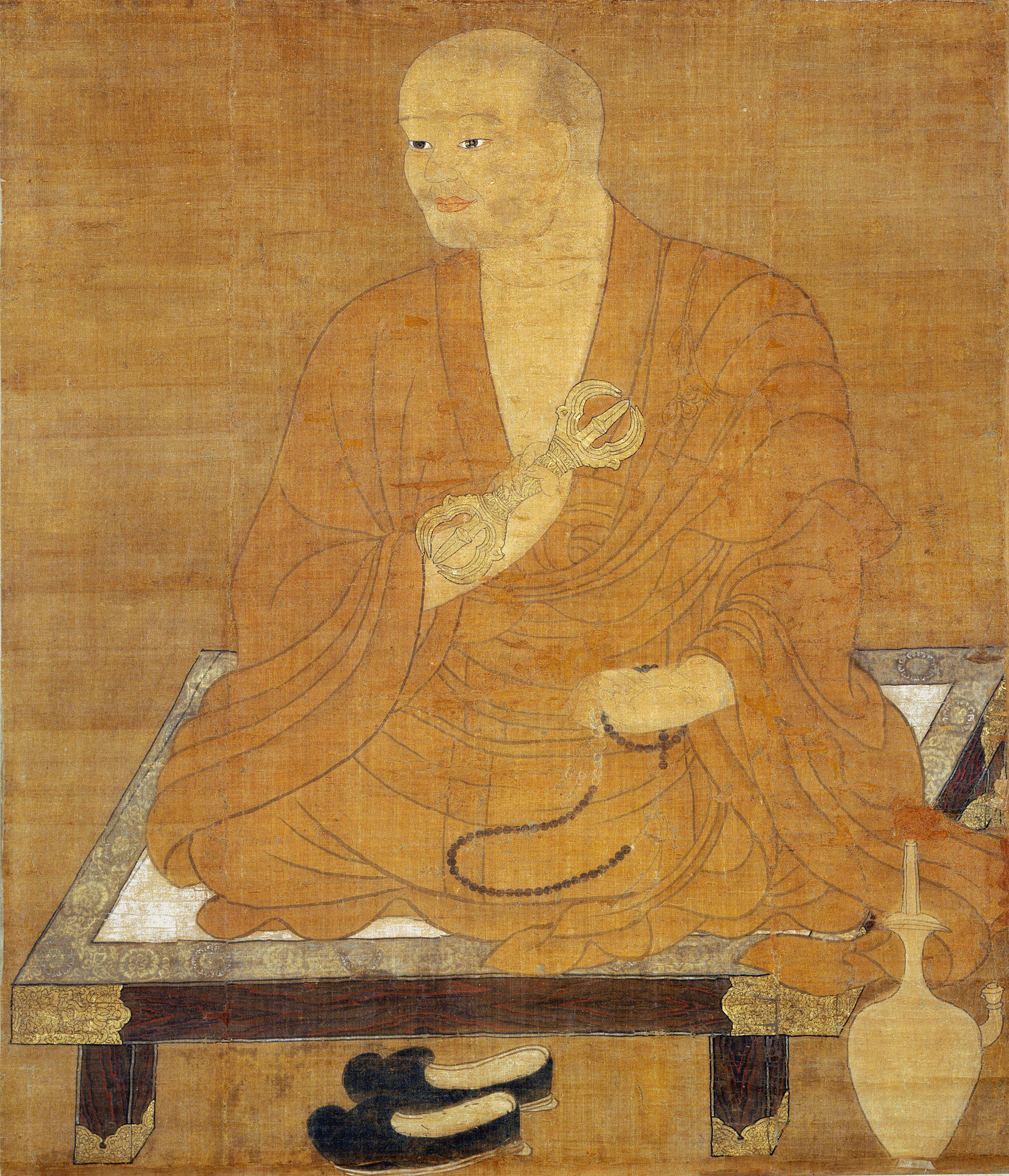 Kūkai in a thirteenth- to fourteenth-century painting from the Nara National Museum’s series of the Eight Patriarchs of Shingon. The image is reusable under terms compatible with CC BY 4.0.
Introduction: Japanese Esoteric Buddhism Is More Than a Collection of Secret Rituals
Shingon Buddhism is one of the major surviving traditions of East Asian Esoteric Buddhism. Founded in Japan through the work of the monk Kūkai (774–835), later known by the honorific Kōbō Daishi, it developed a religious world in which mantra, mudra, mandala, ritual initiation, sacred images, visualization, fire offerings, philosophical study, and monastic discipline all belong to one program of awakening.
The name Shingon means “True Word” or “Word of Truth.” It is the Japanese reading of Chinese zhenyan, itself used to translate the Sanskrit idea of mantra. Yet mantra alone does not define the tradition. In Kūkai’s system, body, speech, and mind are all capable of becoming expressions of buddhahood. Ritual therefore works through three coordinated dimensions: physical gesture, sacred sound, and contemplative awareness. Together these are called the Three Mysteries.
At the center of Shingon stands Mahāvairocana Buddha, called Dainichi Nyorai in Japanese. Mahāvairocana is not simply one historical teacher among others. In Shingon interpretation, Mahāvairocana represents the dharmakāya, the Buddha-body that is ultimate reality itself. The cosmos, sacred sound, the mandalas, ritual action, and the practitioner’s own body can all be interpreted as expressions of this awakened reality.
This creates a doctrine for which Shingon is especially famous: sokushin jōbutsu, “attaining buddhahood in this very body.” The phrase is sometimes advertised online as a promise of instant enlightenment through a secret technique. That is misleading. Kūkai’s claim belongs to an elaborate Buddhist theory of embodiment, mind, ritual correspondence, initiation, and practice. It is neither a scientifically demonstrated supernatural transformation nor a shortcut that eliminates ethical and religious training.
This article approaches Shingon historically and philosophically. It distinguishes verifiable history from sacred tradition, ritual claims from scientific claims, and modern popular interpretations from what Kūkai and later Shingon institutions actually taught.
Who Was Kūkai?
Kūkai was born in 774 on the island of Shikoku into a family with connections to regional administration. He received an education suitable for a young man expected to enter government service, including training in Chinese classics. At some point in his early life, however, he turned increasingly toward Buddhist practice and eventually abandoned the conventional bureaucratic career.
His early spiritual development is difficult to reconstruct in complete detail because later biographies surround him with miracles and sacred legends. What is clear is that he pursued Buddhist learning intensely and became interested in esoteric teachings associated with mantra practice. He also gained remarkable proficiency in Chinese literary culture and calligraphy, skills that would later be crucial during his journey to Tang China.
In 804, Kūkai joined an official Japanese mission to China. The voyage was dangerous; Japanese embassies crossed rough seas in ships that could be lost to storms. Kūkai reached Tang territory and eventually traveled to the imperial capital Chang’an, one of the great cosmopolitan cities of the medieval world.
There, in 805, he met Huiguo (746–805), an eminent Chinese master of systematized Esoteric Buddhism at Qinglong Monastery. The Tokyo National Museum describes Kūkai as having founded Shingon in Japan after studying these esoteric teachings under Huiguo. The meeting became the decisive event in Kūkai’s religious biography.
Huiguo and the Transmission from Tang China
Huiguo stood within a transmission lineage that drew upon Indian Buddhist tantric texts and ritual systems translated into Chinese during the Tang dynasty. According to later Shingon lineage models, he united important streams associated with the Mahāvairocana and Vajraśekhara traditions.
Kūkai’s period with Huiguo was surprisingly short. Sources describe him receiving initiations and ritual instruction rapidly before Huiguo’s death later in 805. From a historical perspective, the speed is striking. It may reflect Kūkai’s preparation, Huiguo’s age and urgency, or the retrospective way lineage history organized the transmission.
Religious tradition interprets the meeting providentially: the Japanese monk arrives just before the Chinese master dies and receives a teaching destined to flourish elsewhere. Historians can establish the broad historical relationship between Kūkai, Huiguo, Chang’an, and esoteric Buddhist transmission. Claims that the meeting was cosmically predestined belong to sacred interpretation.
Kūkai returned to Japan in 806 carrying texts, mandalas, ritual implements, images, and knowledge that would reshape Japanese Buddhism. His imported materials were not random curiosities. They represented an integrated ritual-philosophical system that he would spend the rest of his life interpreting and institutionalizing.
Shingon Means “True Word”
The name Shingon points toward a theory of language. Ordinary language communicates by convention: a word refers to something because a community agrees to use it that way. Mantra, in the esoteric Buddhist understanding Kūkai inherited and transformed, functions differently. Sacred syllables are not merely descriptive labels. They participate in the reality they express.
This helps explain why Sanskrit sounds and Siddhaṃ letters became so important in Japanese esoteric Buddhism even when practitioners did not speak Sanskrit conversationally. The form of a syllable, the sound of a mantra, and the deity or principle it embodies can form one ritual complex.
Modern readers sometimes call this “vibration” and then explain mantra through speculative physics. That is unnecessary and historically misleading. Shingon already has its own theory: sacred speech is an expression of the Buddha’s enlightened activity. Its significance does not depend on claims about frequencies unknown to medieval Buddhists.
The Mahāvairocana Sūtra
One of the two most important scriptural foundations of Shingon is the Mahāvairocana Sūtra, also known in scholarship as the Vairocanābhisaṃbodhi Sūtra. It developed in the Indian Buddhist tantric environment and was translated into Chinese in the early eighth century by the Indian monk Śubhākarasiṃha with the Chinese monk and scholar Yixing.
Modern research on the Chinese translation emphasizes that Yixing also created an extensive commentary based upon Śubhākarasiṃha’s instruction. This commentary became enormously important for East Asian interpretation.
The scripture presents Mahāvairocana as the central Buddha of a ritual and cosmological system involving mandala construction, initiation, mantras, mudras, visualization, and the transformation of perception. The surviving Chinese tradition preserves Sanskrit mantras in Siddhaṃ script, providing a vivid example of the way language moved across India, China, Korea, and Japan.
The term “sūtra” can make the work sound like an ordinary sermon collection, while the modern term “tantra” can make readers expect Tibetan-style ritual systems. Both expectations require caution. The text belongs to an early phase of Buddhist esotericism with its own ritual structure and East Asian transmission history.
The Vajraśekhara Tradition and the Diamond Realm
The second major scriptural current is associated with the Vajraśekhara or “Vajra Pinnacle” tradition. In Japanese Shingon it became especially connected with the Diamond Realm Mandala.
The Sanskrit vajra can evoke diamond-like indestructibility and the thunderbolt. In esoteric Buddhism it becomes a ritual object and a powerful symbol of awakened wisdom. Kūkai is frequently portrayed holding a vajra, visually identifying him with the ritual world he transmitted.
The Mahāvairocana and Vajraśekhara streams were not simply two competing religions. Shingon treated their mandalic systems as complementary presentations of awakened reality.
Mahāvairocana: The Cosmic Buddha
Mahāvairocana, Dainichi Nyorai, is the doctrinal center of Kūkai’s system. The name is often rendered “Great Illuminator” or “Great Sun Buddha.” The solar metaphor is helpful: the sun illuminates without selecting only one person to receive its light. But Shingon interpretation goes beyond a physical sun deity.
Mahāvairocana represents the dharmakāya, ultimate buddhahood or the Dharma-body. In many Buddhist systems, the dharmakāya can sound highly abstract. Kūkai makes it dynamically expressive. The Dharma-body teaches continuously through the structures of reality itself.
Nature, sound, form, consciousness, and symbolic pattern can therefore be interpreted as the Buddha’s activity. This does not mean every accidental noise is a coded verbal sermon. Rather, the entire cosmos participates in the awakened body, speech, and mind of Mahāvairocana.
The Six Great Elements
Kūkai describes reality through six great elements: earth, water, fire, wind, space, and consciousness. These are not chemical elements in the modern scientific sense. They belong to a Buddhist cosmological and phenomenological framework.
The first five describe basic modes of material existence; consciousness completes the sixfold model. Kūkai argues that these elements interpenetrate without obstruction. The body of the practitioner and the body of Mahāvairocana are therefore not absolutely separate substances.
This is fundamental to the doctrine of enlightenment in this body. If ordinary embodiment were entirely cut off from buddhahood, ritual union would be impossible. Because the same six elements participate throughout reality, the practitioner can awaken to a relationship that is already structurally present.
The Three Mysteries: Body, Speech, and Mind
The practical heart of Shingon is the cultivation of the Three Mysteries, Japanese sanmitsu: body, speech, and mind.
- Body is cultivated through mudras, ritual posture, offerings, and embodied action.
- Speech is cultivated through mantra, dhāraṇī, liturgical recitation, and sacred syllables.
- Mind is cultivated through visualization, contemplation, mandala awareness, and meditative identification.
These are called “mysteries” not merely because outsiders are forbidden to know them, but because awakened activity cannot be exhausted by ordinary conceptual language. Ritual creates a correspondence between the practitioner’s three activities and the body, speech, and mind of the Buddha.
In traditional interpretation, empowerment or kaji allows the practitioner to participate in Mahāvairocana’s awakened activity. This is a religious claim about ritual transformation. Scholars can document its meaning and practice but cannot scientifically measure “buddhahood” as a physical substance entering the body.
Mudra: Why the Hands Matter
A mudra is a ritual gesture or configuration of the hands and fingers. Buddhist iconography already uses gestures to identify actions such as teaching, meditation, fearlessness, and generosity. Esoteric Buddhism develops far more specialized mudras connected with particular deities and ritual states.
In Shingon, mudra makes doctrine bodily. The practitioner does not merely think about a Buddha. The hands take a form associated with the Buddha’s activity.
This physical dimension matters because it challenges the assumption that religion is primarily belief inside the head. Shingon ritual synchronizes thought, sound, breath, attention, posture, and gesture. The practitioner becomes an enacted icon.
Mantra: Sacred Speech Rather Than Magic Words
Mantras are central to Shingon, but describing them as “magic words” creates more confusion than clarity. They are sacred utterances embedded in Buddhist ritual, cosmology, and initiation.
Correct pronunciation is valued, but efficacy in the religious system does not come from sound as an isolated mechanical trick. Mantra belongs together with intention, visualization, lineage, ritual context, and the deity or Buddha with which it is associated.
Some mantras remain restricted to initiated contexts; others are publicly recited in Japanese Buddhist life. The fact that a mantra can be found online does not erase the traditional distinction between public devotion and authorized esoteric transmission.
Mandala: A Cosmos You Can Enter
The modern word “mandala” is often reduced to a decorative circular pattern. In Shingon, a mandala is far more specific. It presents the enlightened cosmos in visual and ritual form.
The deities are not placed randomly. Position communicates relationship, function, hierarchy, and doctrinal structure. The practitioner does not simply admire a picture but learns to perceive an ordered field of awakened activity.
The Tokyo National Museum describes the Lecture Hall at Tō-ji as containing Kūkai’s “sculpture mandala,” a three-dimensional arrangement of Buddhist deities. This is important: a mandala does not have to remain flat. Architecture, sculpture, body, sound, and ritual space can all become mandalic.
The Womb Realm Mandala
 The Womb Realm Mandala from Tō-ji, Kyoto, a ninth-century National Treasure of Japan. The mandala organizes hundreds of deities around Mahāvairocana within a ritual map of compassion, awakening, and cosmic order. Public-domain historical artwork via Wikimedia Commons.
The Womb Realm Mandala, Japanese Taizōkai, is associated especially with the Mahāvairocana Sūtra. Its imagery emphasizes the unfolding or manifestation of awakened qualities.
At its symbolic center is Mahāvairocana, surrounded by buddhas, bodhisattvas, fierce protectors, and other beings organized into courts. One of the most recognizable central structures is an eight-petaled lotus.
The word “womb” can mislead if understood narrowly as biological anatomy. The imagery suggests generation, nurturing, compassionate manifestation, and the capacity in which awakening unfolds. It is one half of a larger paired system.
The Diamond Realm Mandala
 The Diamond Realm Mandala at Tō-ji, Kyoto, the second half of the Mandala of the Two Realms. Its nine-part organization expresses dimensions of indestructible awakened wisdom. The historical artwork is public domain.
The Diamond Realm Mandala, Japanese Kongōkai, is associated with the Vajraśekhara ritual tradition. Its familiar form is divided into nine major assemblies.
Where the Womb Realm can emphasize compassionate manifestation and generative potential, the Diamond Realm emphasizes awakened wisdom, stability, and indestructibility. These summaries are useful but should not become rigid oppositions. Shingon tradition treats the two realms as inseparably related.
The paired mandalas became among the most important visual technologies of Japanese Buddhism. They trained monks to understand the cosmos not as empty space populated by unrelated gods but as an ordered manifestation of enlightenment.
The Two Mandalas Are Not Two Universes
A common beginner’s error is to imagine the Womb Realm and Diamond Realm as two separate supernatural dimensions, like parallel fantasy worlds. Their relationship is more philosophical.
They are complementary visualizations of one awakened reality. One emphasizes aspects that the other presents differently. Their unity resembles the broader Shingon insistence that wisdom and compassion, principle and manifestation, Buddha and practitioner are distinguishable without being absolutely separated.
The paired mandalas therefore teach through difference. Two maps can reveal one landscape because each makes visible relationships the other emphasizes less strongly.
The Four Mandalas
Kūkai also teaches a doctrine of four mandalas, broadening the word beyond painted diagrams. These can be summarized as the great mandala of divine forms, the samaya mandala of symbolic attributes, the dharma mandala of seed syllables and sacred language, and the karma mandala of activity.
The doctrine makes an important philosophical point: enlightened reality can be expressed through body, symbol, language, and action. A Buddha image, a vajra, a Sanskrit syllable, and a ritual performance do not belong to four unrelated religions. They are four modes through which the same awakened order becomes manifest.
Siddhaṃ Script: When Writing Becomes Sacred Form
Shingon preserves the Siddhaṃ script, called shittan in Japan, which transmitted Sanskrit syllables through East Asia. Its survival is one of the most fascinating consequences of Buddhist movement across Asia.
A seed syllable, or bīja, can represent a deity or enlightened quality in condensed written form. In ritual, practitioners may visualize such a character and its transformation into a deity or mandalic world.
Writing here is not merely a way to record spoken language. The graphic form itself becomes contemplative and ritual. This helps explain why calligraphy, manuscript transmission, and precise copying acquired extraordinary importance.
Ajikan: Contemplating the Letter A
One of the best-known Shingon contemplative practices is commonly called Ajikan, contemplation of the Sanskrit letter A. The syllable is associated with the unborn or unarisen nature of phenomena.
Public descriptions often show a Siddhaṃ A on a lunar disc and lotus. In formal practice, however, visualization is embedded in doctrinal interpretation and often in teacher-guided training.
It would be misleading to claim that staring at the letter mechanically causes supernatural enlightenment. The symbol works within a Buddhist philosophy of emptiness, non-arising, embodiment, and the Three Mysteries.
Sokushin Jōbutsu: Becoming Buddha in This Very Body
Kūkai’s doctrine of sokushin jōbutsu—attaining buddhahood in this very body—is perhaps the most celebrated claim of Shingon.
Some Buddhist paths describe awakening across immense stretches of rebirth and cultivation. Esoteric Buddhism emphasizes the possibility of realizing buddhahood within the present embodied condition through correctly transmitted practice.
Kūkai’s argument rests partly on non-separation. The body consists of the same six elements that constitute the cosmic body of Mahāvairocana. The practitioner’s body, speech, and mind can correspond to the Buddha’s Three Mysteries. Enlightenment is therefore not the manufacture of an alien substance but the realization and enactment of a deeper identity.
This doctrine should not be confused with a medical promise of immortality or an experimentally measurable change in human biology. “Buddhahood” is a Buddhist soteriological category.
Initiation and Abhiṣeka
Esoteric Buddhism depends heavily on initiation, usually called abhiṣeka in Sanskrit and kanjō in Japanese. Historically, initiation authorizes entry into specific ritual knowledge and establishes a relationship between teacher, disciple, mandala, and lineage.
One reason initiation matters is that ritual diagrams and mantras are not treated as self-explanatory. A book may preserve words while leaving out embodied details, interpretive keys, timing, visualization, and lineage-specific procedures.
Modern readers accustomed to downloading every text instantly may find this restrictive. From the tradition’s perspective, however, secrecy also functions as pedagogy. Complex practices are staged according to preparation and responsibility.
Goma: The Esoteric Fire Ritual
The goma fire ritual is among the most recognizable Shingon ceremonies. The British Museum preserves a nineteenth-century set of altar implements acquired from a Shingon temple in Tokyo, providing material evidence for the complexity of the rite.
Goma derives historically from Indian fire-offering traditions transformed within Buddhism. During the ceremony, a priest performs precise gestures, recitations, offerings, and visualizations around a consecrated fire.
Fire can symbolize the wisdom that burns ignorance and obstruction. Wooden sticks or other offerings may carry petitions or symbolic significance. Different rites can be performed for purification, protection, memorial purposes, worldly benefits, or broader religious aims.
Traditional participants may believe the rite has objective spiritual efficacy. Historical study can document that belief and the ritual procedure. It cannot demonstrate supernatural causation scientifically.
Fudō Myōō: The Immovable Wisdom King
Goma practice in Japan is often associated with Fudō Myōō, the “Immovable Wisdom King,” a fierce figure whose sword, rope, flames, and threatening expression surprise people who expect every Buddhist icon to appear peaceful.
Fudō’s wrath is not simply anger in the ordinary psychological sense. His frightening form represents uncompromising awakened power directed against ignorance and obstacles.
This is a broader feature of esoteric Buddhist iconography: compassion is not always represented as softness. Protective or transformative activity can appear fierce because the imagery dramatizes the destruction of delusion.
Tō-ji: Esoteric Buddhism in the Imperial Capital
Tō-ji in Kyoto became one of the great institutional centers associated with Kūkai. Its Lecture Hall preserves the famous three-dimensional sculptural mandala highlighted by the Tokyo National Museum.
The arrangement shows how Kūkai’s Buddhism entered architecture and political space. Esoteric rites could be conducted not only for individual awakening but also for protection of the state, imperial welfare, rain, health, and public religious purposes.
This matters because modern spirituality often imagines esotericism as private and anti-institutional. Shingon history shows the opposite: sophisticated esoteric ritual could operate within major temples and in close relationship with government.
Mount Kōya: A Mountain Made into a Mandala
 Kongōbu-ji at Mount Kōya, one of the principal centers of the Shingon tradition. Photograph by 663highland, available under CC BY-SA 3.0 and CC BY 2.5 via Wikimedia Commons.
In 816 Emperor Saga granted Kūkai permission to establish a monastic center at Mount Kōya in the mountains of the Kii Peninsula. The site became one of the most important sacred landscapes in Japanese Buddhism.
Mount Kōya demonstrates how mandalic thinking can shape geography. Temples, peaks, paths, forests, cemeteries, and ritual spaces together create a religious landscape rather than one isolated building.
The relationship between esoteric Buddhism and sacred mountains also provides a natural internal connection with SecretMagic’s article on Shugendō and Japanese mountain asceticism. Shugendō developed in close interaction with Shingon and Tendai esoteric traditions but became its own layered system of mountain pilgrimage, austerity, local deities, and ritual authority.
Did Kūkai “Found” Shingon from Nothing?
No. Kūkai was a founder in the Japanese institutional and doctrinal sense, but the religious materials he organized had older Indian and Chinese histories.
Mahāvairocana texts developed in Indian esoteric Buddhism. Translators and ritual masters transmitted them in China. Huiguo taught Kūkai within Tang Buddhist institutions. Kūkai then interpreted, classified, taught, and institutionalized those materials in Japan.
Calling him founder should therefore not erase the trans-Asian network behind Shingon. The tradition is an example of cultural transmission through adaptation rather than simple copying.
The Eight Patriarchs
Shingon lineage traditionally honors eight major patriarchs connecting Indian and Chinese transmission to Kūkai. Portrait cycles of these patriarchs became important visual statements of lineage legitimacy.
The portraits function almost like a genealogy of authorization. A teaching is not represented as the private invention of one Japanese monk but as something transmitted through a sequence of masters.
Historical scholarship may evaluate the exact relationships differently from sacred lineage tradition. Religious genealogies often express doctrinal legitimacy as much as modern documentary chronology.
Shingon and Tendai Esoteric Buddhism
Shingon was not the only Japanese tradition to adopt esoteric Buddhism. Tendai, associated with Saichō and Mount Hiei, developed its own powerful esoteric ritual systems, often called Taimitsu in contrast with Shingon’s Tōmitsu.
The traditions competed, borrowed, debated, and influenced Japanese religious culture together. This makes it inaccurate to speak as if “Japanese esoteric Buddhism” and “Shingon” were always identical categories.
Both traditions contributed mantras, fire rites, mandalas, consecrations, and complex pantheons to the wider religious landscape of medieval Japan.
Shingon and Shugendō
Mountain ascetic traditions borrowed heavily from esoteric Buddhism. Mantras, mudras, fierce deities, fire rituals, and mandalic interpretations of geography became deeply important to Shugendō.
Yet a yamabushi performing mountain austerities is not automatically a Shingon monk. Shugendō developed networks associated with both Shingon and Tendai institutions as well as local mountain traditions.
The comparison shows how ritual technologies move between religious communities without erasing institutional difference.
Shingon and Tibetan Vajrayāna: Related, Not Identical
Shingon and Tibetan Vajrayāna share Indian tantric Buddhist ancestry, which explains major parallels: mantra, mudra, mandala, initiation, deity visualization, ritual implements, and claims that esoteric practice can accelerate awakening.
But they developed through different transmission histories. Shingon’s core system passed through Tang China and became established in Japan during the ninth century. Tibetan Buddhist traditions continued receiving later Indian tantric developments that did not necessarily enter Shingon in the same form.
It is therefore inaccurate to call Shingon “Japanese Tibetan Buddhism.” They are related branches of broader Buddhist esotericism, not regional copies of one another.
Shingon and Zen
Outside Japan, Japanese Buddhism is often imagined primarily through Zen. Shingon reveals how incomplete that picture is.
Zen traditions typically emphasize meditation, direct insight, lineage, and distinctive monastic disciplines. Shingon emphasizes a dense ritual-symbolic cosmos where sacred speech, visualization, hand gestures, images, initiation, and offerings are central.
The contrast should not become caricature. Zen has ritual, images, liturgy, and esoteric historical interactions; Shingon also values meditation and direct realization. Japanese Buddhist traditions have never existed in airtight compartments.
What “Esoteric” Means in Shingon
The Japanese term mikkyo means “secret” or “esoteric teaching.” The opposite category, kengyo, refers to exoteric teaching.
Kūkai’s distinction is not merely that one set of doctrines is hidden from the public. Esoteric teaching is considered the direct expression of the Dharma-body itself, communicated through symbols, sound, mandala, and ritual that cannot be reduced entirely to discursive explanation.
This is why a perfectly accurate prose summary still would not constitute full Shingon practice. The tradition claims that embodied participation conveys a dimension that description cannot replace.
Is Shingon Magic?
The answer depends on how the modern word “magic” is defined.
Shingon rites have historically been performed for concrete outcomes such as protection, healing, rain, averting calamity, memorial benefit, and state welfare. From the perspective of the comparative history of magic, such ritual efficacy belongs within a broad study of operative religion.
But calling Shingon a “magic system” as though it were a grimoire tradition is misleading. Its central goal is buddhahood, and its rites operate inside Buddhist ethics, cosmology, monastic institutions, lineage, and soteriology.
Historical categories should therefore remain flexible. A practice can look magical to an outsider while functioning as orthodox liturgy to practitioners.
Can Mantra or Goma Be Scientifically Proven to Cause Supernatural Effects?
No controlled scientific evidence establishes that a specific Shingon mantra compels invisible beings, changes external events through supernatural force, or that a goma fire literally burns metaphysical karma as a measurable physical substance.
That does not make the rituals historically unimportant. Ritual can affect attention, memory, emotion, group identity, perceived meaning, breathing, posture, and social relationships. Practitioners may also report experiences they interpret as spiritual.
A responsible account distinguishes the existence and effects of the ritual as human practice from unverified metaphysical claims about causation.
Common Misconception: Shingon Is a Secret Japanese Sorcery School
Shingon contains esoteric ritual, but its identity is Buddhist. The central subjects are awakening, compassion, wisdom, the Dharma-body, lineage, initiation, and the transformation of body, speech, and mind.
Popular fascination with secret mantras can obscure the ethical, philosophical, devotional, artistic, and institutional dimensions of the tradition.
Common Misconception: Kūkai Invented All Japanese Mantras
Kūkai inherited a vast trans-Asian Buddhist mantra tradition. His achievement was transmission, interpretation, organization, and institutional development, not invention from nothing.
He became enormously influential because he connected imported texts and rites with Japanese religious, artistic, linguistic, and political life.
Common Misconception: Mahāvairocana Is a Creator God
Comparisons with monotheistic creator theology can be misleading. Mahāvairocana represents dharmakāya buddhahood and the awakened reality expressed through the cosmos. The doctrine emerges from Buddhist categories rather than from a theory of a personal creator producing the universe from nothing.
Common Misconception: Mandalas Are Relaxation Art
Shingon mandalas are ritual and doctrinal objects. Their geometry, deities, positions, gestures, colors, and symbols encode specific relationships.
They can certainly be aesthetically beautiful, but treating them only as decorative stress-reduction patterns erases the religious system that gives them meaning.
Common Misconception: Enlightenment in This Body Means Instant Superpowers
Sokushin jōbutsu is a doctrine of buddhahood, not a guarantee of paranormal ability. Hagiographies may attribute miracles to Kūkai or other masters, but those stories should be separated from the philosophical meaning of awakening.
The teaching concerns realization of the relationship between the practitioner’s embodied activity and Mahāvairocana’s awakened reality.
Common Misconception: Kūkai Is Historically Proven to Be Physically Alive on Mount Kōya
A powerful devotional tradition holds that Kūkai did not simply die in the ordinary sense but entered deep meditation and remains spiritually present at his mausoleum on Mount Kōya.
This belief shapes ritual practice and pilgrimage. It is religious tradition, not a scientifically verified claim of ordinary biological survival since 835.
A Symbolic Reading of the Two Mandalas
For a modern philosophical reader, the paired mandalas can symbolize two ways of understanding transformation: the capacity to awaken and the structure of awakened wisdom.
The Womb Realm evokes unfolding, nourishment, and manifestation. The Diamond Realm evokes clarity, stability, and indestructibility. Their pairing suggests that transformation requires both openness and form.
This is a modern interpretive reading. Historical practitioners operate within richer doctrinal systems and should not be reduced to contemporary psychology.
A Symbolic Reading of the Three Mysteries
The Three Mysteries offer an unusually integrated model of practice. Body, language, and mind are often treated in modern life as separate: the body performs habits, speech communicates externally, and mind privately thinks.
Shingon practice brings them into deliberate alignment. Gesture, sound, and visualization all express one religious intention.
Even outside supernatural claims, this provides a useful philosophical insight: transformation becomes deeper when what a person does, says, and attends to no longer point in contradictory directions.
A Symbolic Reading of Goma Fire
Fire makes transformation visible. Wood does not remain unchanged after entering flame. Smoke rises; heat spreads; shape becomes ash.
This physical transformation makes fire a compelling ritual language for impermanence, purification, offering, and wisdom. The visible event supplies a sensory model for an invisible aspiration: ignorance is to be transformed as decisively as fuel.
The symbolic interpretation is meaningful without requiring a claim that ritual fire literally alters supernatural substances detectable by physics.
Shingon Art as Religious Technology
The beauty of Shingon art is not secondary decoration added to doctrine. Images help perform doctrine.
Mandalas organize the cosmos. Statues embody the presence and attributes of deities. Seed syllables compress divine identity into writing. Ritual implements materialize philosophical symbols. Temple architecture turns spatial movement into religious instruction.
The Kyoto National Museum’s exhibitions of Esoteric Buddhist painting and the Tokyo National Museum’s presentation of Tō-ji treasures make this point especially clear: visual culture is one of the principal ways Esoteric Buddhism became tangible in Japan.
Why Shingon Matters to the Comparative Study of Esotericism
Shingon complicates a Western-centered picture of esotericism dominated by grimoires, Hermeticism, Kabbalah, and occult orders. It developed from Indian and Chinese Buddhist sources and built a different model of secrecy and ritual power.
There is no Solomonic magician standing inside a protective circle commanding spirits. Instead there is an initiated Buddhist practitioner aligning body, speech, and mind with a cosmic Buddha through inherited ritual.
Yet comparative themes remain visible: sacred language, initiatory authorization, cosmological diagrams, correspondences, special gestures, visualized divine forms, consecrated objects, and theories that ritual participation can transform the practitioner.
Comparison is most useful when similarities reveal questions rather than erase differences.
How to Study Shingon Responsibly
Begin with Kūkai in context. The Stanford Encyclopedia of Philosophy’s entry on Kūkai provides an accessible scholarly introduction to his philosophy, language theory, cosmology, and doctrine of the Three Mysteries.
For art and material culture, consult the Tokyo National Museum’s Kūkai and the Treasures of Shingon Buddhism materials and its documentation of the Tō-ji sculpture mandala. The Metropolitan Museum of Art also preserves important Japanese esoteric Buddhist objects and contextual cataloguing.
For living practice, seek established Shingon temples and teachers rather than anonymous lists of “secret mantras.” Public scholarship can explain doctrine and history, but restricted ritual instructions belong to living communities that make their own decisions about transmission.
Finally, avoid forcing Shingon into modern categories such as “energy work,” “manifestation,” or “Japanese witchcraft.” Such translations may create contemporary practices, but they should be labeled as modern reinterpretation rather than presented as Kūkai’s own teaching.
Frequently Asked Questions
What is Shingon Buddhism?
Shingon is a Japanese school of Esoteric Buddhism established through Kūkai in the early ninth century. It combines mantra, mudra, mandala, initiation, visualization, ritual offerings, philosophical doctrine, and monastic practice.
Who founded Shingon Buddhism?
Kūkai (774–835), later honored as Kōbō Daishi, established Shingon in Japan after studying systematized Esoteric Buddhism under Huiguo in Tang-dynasty Chang’an.
What does Shingon mean?
Shingon means “True Word” or “Word of Truth” and is connected with the Sanskrit concept of mantra.
Who is Mahāvairocana?
Mahāvairocana, Dainichi Nyorai in Japanese, is the central cosmic Buddha of Shingon and represents the dharmakāya, ultimate awakened reality.
What are the Three Mysteries?
They are body, speech, and mind. Shingon practice aligns them through mudra and embodied ritual, mantra and sacred speech, and visualization or contemplative awareness.
What are the Two Realm Mandalas?
The Womb Realm and Diamond Realm mandalas are complementary visual systems central to Shingon. They organize Mahāvairocana and large assemblies of esoteric Buddhist deities into ritual maps of awakening.
What is sokushin jōbutsu?
It is Kūkai’s doctrine that buddhahood can be realized “in this very body.” It depends on Shingon theories of the six elements, Mahāvairocana, the Three Mysteries, initiation, and practice.
What is goma?
Goma is an esoteric Buddhist fire ritual involving consecrated fire, offerings, recitations, gestures, and visualization. In Japan it is especially prominent in Shingon and Tendai traditions.
Is Shingon the same as Tibetan Buddhism?
No. They share Indian tantric Buddhist ancestry and important ritual features, but they developed through different historical transmissions and doctrinal traditions.
Is Shingon a form of magic?
Shingon contains rites historically intended for protection, healing, state welfare, and other effects, making it relevant to the comparative study of ritual efficacy. But it is fundamentally a Buddhist religious tradition whose highest goal is awakening, not a standalone magical system.
Can anyone perform Shingon esoteric rituals?
Public devotional practices exist, but many formal esoteric practices traditionally require initiation, instruction, and lineage authorization. Reading a mantra online is not equivalent to receiving a complete ritual transmission.
Did Kūkai really remain alive in meditation after 835?
Shingon devotional tradition regards Kūkai as continuing in profound meditation at Mount Kōya. This is a religious belief central to pilgrimage and devotion, not a scientifically verified claim of ordinary biological survival.
Conclusion: A Universe That Speaks in Body, Sound, and Image
Shingon Buddhism is difficult to understand if religion is imagined as a set of propositions that believers merely accept. Kūkai’s system is embodied, visual, sonic, architectural, and initiatory.
The Womb and Diamond Realm mandalas do not simply illustrate a doctrine explained elsewhere. They are part of the doctrine’s operation. A mudra is not merely a reminder of an idea; the body becomes the sign. A mantra is not merely a sentence about the Buddha; sacred speech participates in the Buddha’s speech. Visualization does not merely entertain the mind; it trains perception according to a mandalic cosmos.
This integration explains why the Three Mysteries are so central. Human action normally feels fragmented. The body does one thing, speech another, and thought wanders elsewhere. Esoteric practice brings them together and aligns them with Mahāvairocana’s awakened activity.
Kūkai’s most daring doctrine follows from that alignment. If body, speech, and mind can participate in the Buddha’s body, speech, and mind, and if the six elements composing the human body already belong to the cosmic body of Mahāvairocana, then buddhahood need not be imagined only as escape from embodiment. The body itself can become the site of realization.
That claim has inspired more than twelve centuries of Japanese religious life. It shaped temples, paintings, sculptures, Sanskrit calligraphy, pilgrimage landscapes, fire rituals, monastic institutions, and devotional traditions. Mount Kōya transformed a mountain plateau into sacred geography. Tō-ji transformed a lecture hall into a three-dimensional mandala. Manuscripts and portraits preserved a lineage stretching symbolically from India and China to Japan.
Historical study also makes the tradition more interesting by removing false mysteries. Shingon was not invented suddenly by one isolated genius. It emerged from long-distance transmission among Indian, Chinese, and Japanese Buddhist communities. It is not simply Japanese “spell magic,” though it contains rituals of practical efficacy. It is not Tibetan Buddhism transplanted to Japan, though both descend from wider tantric Buddhist developments. And its doctrine of enlightenment in this body is not a scientific claim about paranormal biology.
What remains after those corrections is a sophisticated vision of reality as communication. Mahāvairocana teaches not only through ordinary speech but through sound, form, gesture, symbol, consciousness, and the patterned cosmos itself.
In that vision, the world is not spiritually silent. Mountains, letters, ritual implements, images, bodies, and voices can all become media of awakening. The purpose of esoteric practice is to learn how to participate consciously in that language.
That may be the most distinctive Shingon idea of all: enlightenment is not somewhere beyond the world waiting to be reached after the world has been discarded. The world, the body, and the act of perception can themselves become the mandala in which buddhahood is recognized.
Sources and References
- Stanford Encyclopedia of Philosophy, “Kūkai.”
- Tokyo National Museum, “Kūkai and the Treasures of Shingon Buddhism.”
- Tokyo National Museum, “Kūkai and the Sculpture Mandala.”
- Tokyo National Museum, “The World of Esoteric Buddhist Sculpture.”
- The Metropolitan Museum of Art, “Mandala in Sanskrit with Buddhas, Bodhisattvas, and Eight Guardian Kings.”
- The Metropolitan Museum of Art, “Scroll of Deities of the Diamond World Mandala.”
- British Museum, Shingon goma fire ritual altar equipment, collection record As1892,0523.6.30.
- “Translating the Esoteric: On the Chinese Translation and Commentary of the Mahāvairocana Sūtra,” academic research record.
- Rolf W. Giebel, trans., The Vairocanābhisaṃbodhi Sūtra, Numata Center for Buddhist Translation and Research.
- Yoshito S. Hakeda, Kūkai: Major Works, Columbia University Press.


