


Meta description: Explore the medieval Hermetic De Quindecim Stellis, the Book of the Fifteen Fixed Stars: its manuscript history, Arabic and Latin transmission, stellar talismans, stones, herbs, Agrippa, Ficino, and the difference between historical astrological belief and modern astronomy.
Suggested permalink: de-quindecim-stellis-fifteen-fixed-stars-hermetic-magic
Primary category: Hermeticism
Tags: De Quindecim Stellis, Behenian Stars, Hermes Trismegistus, Astrological Magic, Medieval Magic, Agrippa
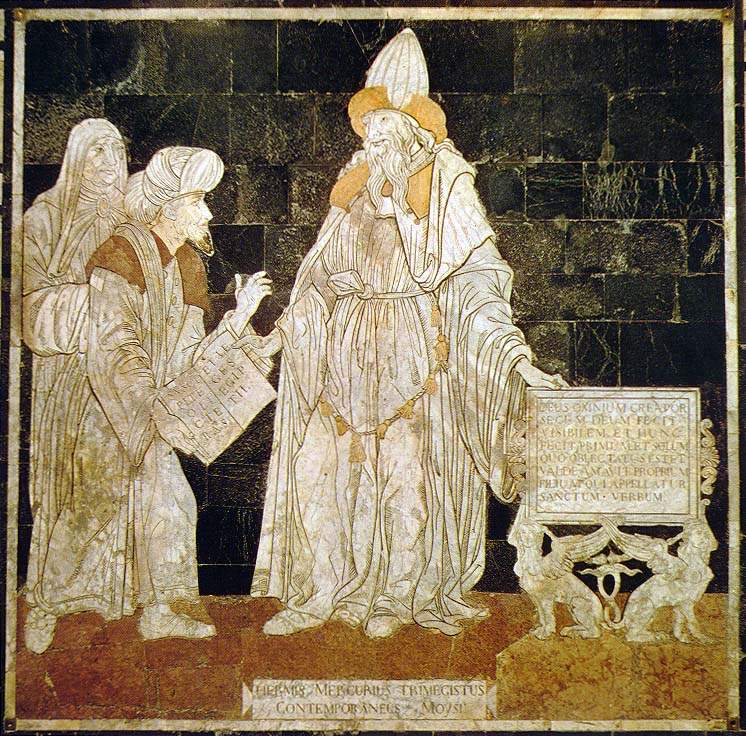 Hermes Trismegistus in the floor inlay of Siena Cathedral, created in the late fifteenth century. The image captures the Renaissance tendency to imagine Hermes as an ancient sage whose authority could encompass theology, astrology, alchemy, and magic. Public-domain image via Wikimedia Commons.
A medieval reader opening a short work known as De Quindecim Stellis—the Book of the Fifteen Stars—would not encounter a philosophical dialogue about the divine mind, nor an astronomical catalogue in the modern sense. Instead, the text offered a compact map of relationships: a bright fixed star, a stone, a plant, a figure or image, and a claimed celestial virtue. Fifteen stars were treated as especially potent nodes in the heavens. Their powers could, according to the logic of the work, be received or concentrated through carefully chosen earthly materials.
The work is one of the clearest examples of what historians call astral or astrological magic: practices built on the belief that celestial bodies exerted specific influences upon terrestrial things and that those influences could be directed through correspondences, images, timing, and material substances. It also sits at the crossroads of several intellectual worlds. Its authority is attributed to Hermes Trismegistus, the legendary sage associated with the Greek Hermes and Egyptian Thoth; some versions connect the material with Enoch, others with the astrologer Māshāʾallāh, and later medieval readers encountered related recensions under different names. Modern scholarship, however, treats these attributions as part of the text’s transmission and authority rather than as straightforward statements of authorship.
This distinction is essential. De Quindecim Stellis is historically important because it shows how medieval readers linked astronomy, astrology, natural philosophy, stones, plants, images, and Hermetic authority. It does not provide scientific evidence that the stars emit occult virtues that can be captured in talismans. Modern astronomy understands fixed stars as distant suns with measurable physical properties, while the “fixed stars” of premodern astrology belong to a different explanatory framework. To study the book responsibly is therefore to hold two perspectives at once: the historical reality of the belief system and the absence of modern scientific validation for its supernatural claims.
What Is De Quindecim Stellis?
The Latin title De quindecim stellis means “On the Fifteen Stars.” A fuller form found in the tradition describes fifteen stars, fifteen stones, fifteen herbs, and fifteen images. Some witnesses organize the material into four corresponding sections, which explains the title Quadripartitum Hermetis, or “Four-Part Work of Hermes,” used in parts of the manuscript tradition. The basic structure is easy to understand: each selected star is associated with terrestrial substances and a particular image through which its influence was believed to operate.
Bibliotheca Philosophica Virtualis, a research resource devoted to medieval philosophical and magical literature, dates the Latin tradition broadly to the twelfth or thirteenth century and identifies the attributed author as “Hermes Abhaidimon.” The form of the name varies in manuscripts. It is not a recoverable historical author in the modern sense; rather, it belongs to the vast medieval habit of attaching technical works to Hermes or to other legendary bearers of primordial wisdom.
The work survives not as a single pristine original but through a family of manuscripts and related recensions. That matters because popular presentations often speak of “the fifteen Behenian stars” as though a standardized chart descended unchanged from antiquity. In reality, manuscripts disagree over names, spellings, figures, plant identifications, stones, and sometimes the wording of the supposed effects. The tradition is stable enough that a recognizable fifteen-star system can be traced, but fluid enough that the idea of one perfect canonical list is historically misleading.
Some manuscript versions also include glosses or comments attributed to Māshāʾallāh ibn Atharī, the influential eighth-century Jewish-Persian astrologer who worked in the early Abbasid world. The exact relationship between these glosses and the textual history is complex, and it would be unsafe to say simply that Māshāʾallāh “wrote” the book. What can be said more cautiously is that the Latin tradition preserves material presented under his authority, which shows how Arabic astrological prestige became woven into a text framed as Hermetic.
The Fifteen “Behenian” Stars
Modern occult literature commonly calls these stars the Behenian fixed stars. The term became especially familiar through early modern authors such as Heinrich Cornelius Agrippa. The list generally includes well-known bright stars or stellar groups such as Algol, the Pleiades, Aldebaran, Capella, Sirius, Procyon, Regulus, Spica, Arcturus, Antares, Vega, and several others. Names and identifications vary in older sources because medieval Latin star names were often transliterations from Arabic, and those transliterations could shift dramatically from one copyist to another.
“Fixed star” does not mean that medieval observers literally believed the star had no motion whatsoever. In classical and medieval astronomy, the term distinguished the stars that maintain roughly constant positions relative to one another from the seven “wandering” planets visible to the naked eye: Saturn, Jupiter, Mars, the Sun, Venus, Mercury, and the Moon. The whole stellar sphere was understood to move, but the stars formed the comparatively stable background against which the planets wandered.
For astrology, however, some fixed stars had individual significance beyond the zodiac signs. Classical authors had already assigned stellar natures and effects. Ptolemy, for example, compared the qualities of certain stars or constellations with combinations of planetary qualities. Medieval astrologers inherited, translated, and elaborated this material. De Quindecim Stellis goes further by joining selected stars to an explicitly magical network of stones, plants, and images.
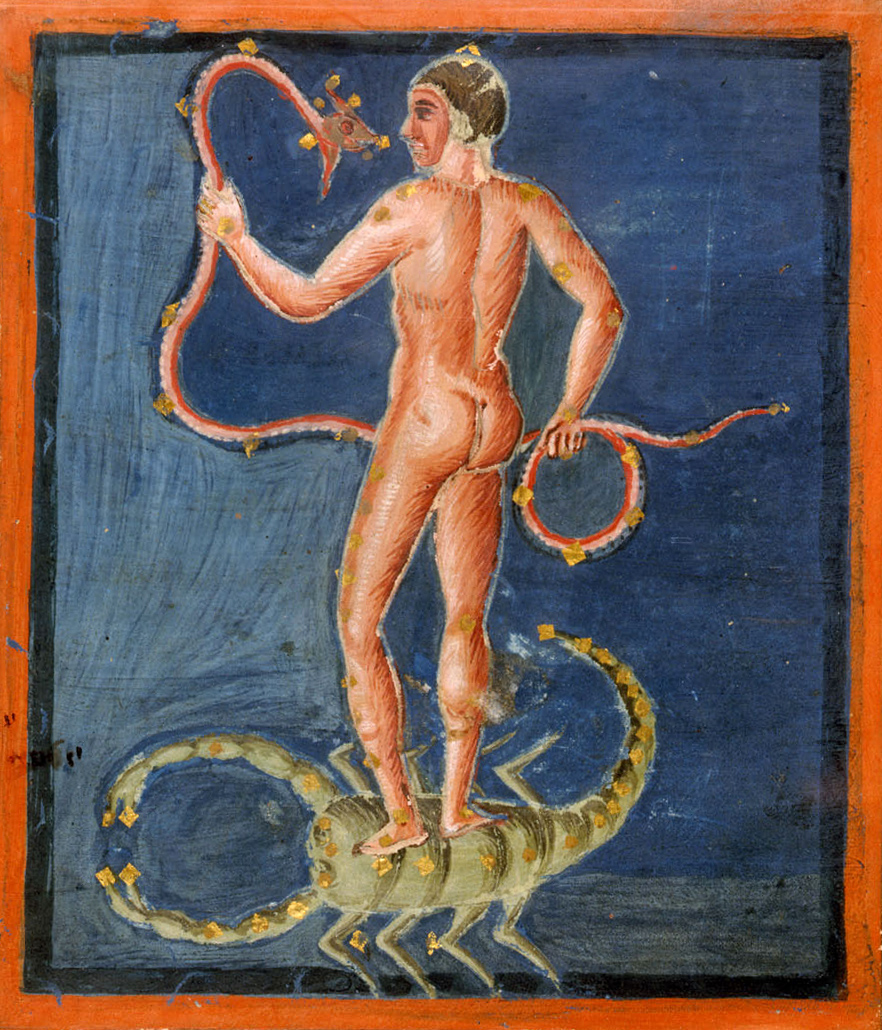 Ophiuchus, Serpens, and Scorpius in the ninth-century Leiden Aratea. This is not a page of De Quindecim Stellis, but it illustrates the rich manuscript culture through which classical constellation knowledge was preserved in medieval Europe. Public domain via Wikimedia Commons.
Why Fifteen?
The number fifteen invites speculation, but certainty is difficult. Later writers have sometimes proposed that the selection derives from a set of especially bright stars known to ancient astronomical authors. Scholars have noted that Ptolemaic star catalogues and later Arabic astronomical traditions provided obvious pools of conspicuous stars from which such a magical selection could develop. What we should resist is the temptation to invent a single esoteric numerological explanation and present it as fact.
The important historical point is that the system is selective. The sky contains thousands of visible stars, yet this work chooses a small elite group and gives each a terrestrial correspondence. Selectivity turns astronomy into a usable magical technology. A practitioner cannot work with every star; a list of fifteen produces a manageable repertoire. Each star becomes almost like a chapter in a celestial pharmacopoeia.
That comparison is not accidental. Medieval natural philosophy often imagined creation as a network of specific virtues. A certain plant might heal a certain condition, a gemstone might possess a protective property, and a star might imprint a quality upon things generated under its influence. The magical text organizes these claims into practical correspondences. In that sense, the fifteen-star tradition stands halfway between a star catalogue, a lapidary, an herbal, and a book of images.
Hermes Trismegistus as an Author Who Was Never One Author
To understand why the book is attributed to Hermes, we need to abandon a modern assumption about authorship. Hermes Trismegistus was not a single identifiable writer who sat down and composed all the works carrying his name. He is a legendary authority formed through the cultural fusion of Hermes and Thoth. Texts attributed to Hermes range from philosophical dialogues to astrology, alchemy, magic, medicine, and technical lore, composed by different authors across different centuries and languages.
In late antiquity, philosophical Hermetica such as the dialogues later collected as the Corpus Hermeticum explored theology, mind, creation, rebirth, and salvation. Other works attributed to Hermes were technical: astrological manuals, alchemical texts, medical and magical instructions. Modern scholarship therefore often distinguishes the “philosophical Hermetica” from the “technical Hermetica,” while recognizing that ancient and medieval readers did not always police that boundary as sharply as modern disciplines do.
By the Middle Ages, Hermes could function as a universal ancient sage. To say “Hermes said” did more than supply a name. It placed a work in a legendary genealogy of wisdom that seemed older than ordinary human scholarship. In Christian Europe, Hermes could even be reimagined as a pagan prophet who dimly anticipated Christian truths. In Islamic intellectual culture, Hermes was sometimes connected with Idrīs or with ancient sages who transmitted astronomy and other sciences. These identifications were historically layered and often contradictory, but that flexibility made Hermes unusually useful.
The fifteen-star book benefits directly from this authority. Its terrestrial correspondences would appear more credible if they were not recent inventions but fragments of primordial science. Pseudonymous attribution therefore does cultural work: it gives the text age, dignity, and a place inside a sacred history of knowledge.
Arabic Transmission and the Problem of Lost Originals
One of the most important features of medieval occult literature is the role of translation. Latin Europe did not develop its astrological and magical traditions in isolation. From the twelfth century onward, translators working especially in Iberia and southern Italy rendered large bodies of Arabic astronomy, astrology, medicine, philosophy, mathematics, and magic into Latin. Arabic texts themselves often preserved and transformed Greek, Persian, Indian, and other materials.
De Quindecim Stellis belongs to this multilingual environment. Scholars generally understand the Latin work as deriving, directly or indirectly, from Arabic material that in turn may preserve or rework older Greek-Hermetic traditions. The precise genealogy is difficult because the hypothetical earlier forms have not survived in a simple chain. We do not possess an autograph by “Hermes,” nor a complete Greek archetype waiting to be compared line by line with a Latin translation.
This is why confident claims that the book is “an ancient Egyptian manual translated intact into Arabic and then Latin” should be rejected. The Hermetic attribution is historically meaningful, but it is not documentary proof of pharaonic authorship. A safer description is that the work represents a medieval Latin form of a technical Hermetic and astrological tradition shaped through Arabic transmission.
The broader context can be seen in related works. SecretMagic’s study of the Picatrix shows how an Arabic work of astral magic entered Castilian and Latin culture. Our article on the Arabic transmission of the Emerald Tablet demonstrates a similar problem: “Hermetic” does not mean “textually preserved from pharaonic Egypt.” Hermetic authority and documentary history are two different questions.
Stars, Stones, Herbs, and Images: The Logic of Correspondence
The most distinctive feature of the fifteen-star system is its fourfold pattern. A star is associated with a stone, a plant or herb, and an image. In some recensions, additional instructions or claimed effects appear. The underlying theory is one of celestial sympathy: things below were believed to receive and embody qualities from things above.
This does not mean medieval authors imagined starlight as a magical laser that could be trapped in a gemstone. Their theories were subtler and varied. Aristotelian natural philosophy, Neoplatonic causation, Arabic astrology, theories of occult properties, and magical image traditions supplied different ways to explain how celestial influence might operate. Some authors emphasized natural causation. Others added spirits, prayers, divine names, or ritual actions. The same object—a gemstone engraved under a star—could therefore be interpreted differently by different readers.
A stone was especially suitable because gemstones already occupied an ambiguous intellectual territory. Lapidaries described physical appearance and supposed medicinal or protective powers. Some claims were empirical in a loose premodern sense; others were legendary or magical. A plant likewise belonged to medicine, agriculture, and occult natural philosophy simultaneously. By pairing star, stone, and herb, the text draws upon accepted genres of natural knowledge and then extends them into talismanic image-making.
The image is the decisive step. A figure carved or engraved in a suitable material under a suitable celestial condition was believed to reproduce the quality of the star. Image magic depended on resemblance, timing, material fitness, and celestial causation. The object was not merely a symbol of the star in the modern psychological sense. Within the historical theory, it was intended to become an operative receiver of celestial virtue.
Natural Magic or Spirit Magic?
This question troubled medieval intellectuals and continues to shape modern scholarship. If a talisman works because a star naturally influences a stone, then perhaps the operation belongs to “natural magic,” an extension of hidden properties in nature. If it works because a spirit is invoked or compelled, then theologians were much more likely to classify it as illicit demonic magic.
The boundary, however, was never perfectly clean. A scholastic thinker could accept celestial influence while rejecting rituals that appeared to address invisible beings. A magician could claim that a prayer merely disposed the operator to receive a natural influence. Another reader could interpret the same voces, names, or suffumigations as evidence of spirit communication.
The fifteen-star material is especially valuable because it exists near this contested border. Its core correspondences can look “natural”: star, stone, herb, figure. Yet later manuscripts and commentaries may add more explicitly spiritual elements. A study of the text therefore shows how a technique could migrate from one category to another depending on framing.
This matters because the modern word “magic” can flatten medieval distinctions. To a twenty-first-century reader, a star talisman is obviously magical. To a thirteenth-century author, the decisive question might be whether the effect was produced through legitimate celestial nature or through illicit spirit agency. Historians must reconstruct those categories before judging them.
The Star as a Celestial Signature
One way to read the system symbolically is to treat each star as a celestial signature. The world below is imagined as marked by the sky above. Stones, colors, scents, plants, animals, bodily states, social events, and human temperaments can all become signatures of a larger cosmic pattern.
This worldview is radically different from modern scientific specialization. Astronomy today studies celestial objects through physics. Botany studies plants. Mineralogy studies stones. Psychology studies human cognition and behavior. Premodern correspondence systems instead ask how these domains mirror one another. The same quality might appear in the brilliance of a star, the hardness of a gemstone, the scent of a plant, and the imagined effect of a talisman.
Such thinking is not unique to magic. Medieval medicine used correspondences among qualities, elements, seasons, organs, and humors. Liturgical symbolism connected colors, times, directions, saints, and biblical events. The magical correspondence table intensifies a general cultural habit of relational thinking.
For the historian, this is more important than whether any particular list is “correct.” The real intellectual achievement is the construction of a universe in which nothing is isolated. Every earthly object can become a clue to celestial order.
Algol: A Case Study in Stellar Reputation
No star better illustrates the mixture of observation, naming, myth, and magical reputation than Algol, Beta Persei. Astronomically, Algol is an eclipsing multiple-star system whose brightness visibly varies because one component passes in front of another from our perspective. Premodern observers did not possess the modern astrophysical explanation, but the star’s place in the head of Medusa within the constellation Perseus gave it a particularly ominous symbolic identity in many astrological traditions.
The Arabic name raʾs al-ghūl, “head of the ghoul,” contributed to the Latin and European form Algol. Medieval and Renaissance astrology often treated it as dangerous, violent, or intense. In fixed-star magic, however, “malefic” does not always mean useless. A feared celestial power might be directed toward protection, victory, intimidation, or the reversal of harm. The moral interpretation of a star’s virtue depended on what the operator intended to do with it.
This is a useful reminder that magical catalogues are not simple lists of “good” and “bad” energies. They imagine powers that can be hazardous, medicinal, defensive, coercive, or transformative depending on context. Modern social-media astrology often reduces Algol to a dramatic personality label. The medieval textual world was more materially specific: stars were connected with images, substances, bodily effects, and concrete operations.
The Pleiades: One Star or Many?
The Pleiades create an immediate conceptual puzzle because they are a star cluster rather than a single star. Yet premodern catalogues often treat prominent asterisms as coherent celestial agents. This demonstrates that the magical category “star” does not map perfectly onto modern astronomical taxonomy.
The cluster has been culturally important across the world. Its visibility, seasonal appearances, and compact form made it useful for calendars, navigation, myth, and agriculture. In a magical correspondence system, its fame and recognizability made it an obvious candidate for special virtue.
The inclusion of the Pleiades also reminds us that De Quindecim Stellis is not a scientific star list in the modern sense. It is a selection of astrologically meaningful celestial loci. Some are individual bright stars; some are culturally constructed points within constellations or clusters. Their unity is ritual and astrological rather than astrophysical.
Sirius and the Deep History of a Brilliant Star
Sirius, the brightest star in the night sky, carried enormous cultural importance long before the medieval Latin tradition. In ancient Egypt, its heliacal rising was associated with calendrical and Nile-related cycles. In Greek and Roman literature, Sirius was linked with the heat of the “dog days.” Arabic astronomers carefully catalogued it. Medieval Europe inherited several layers of this history.
It is tempting, therefore, to claim that a medieval Sirius talisman directly preserves ancient Egyptian ritual. That is precisely the kind of shortcut responsible scholarship must avoid. Cultural continuity can exist without a continuous ritual text. The Sirius of De Quindecim Stellis belongs to a medieval correspondence system transmitted through technical literature, not to a securely documented pharaonic talismanic rite.
Still, the star’s cross-cultural prestige matters. Brightness gives a celestial object visibility; visibility encourages naming; naming generates myth and interpretation; those interpretations can then be absorbed into astrology and magic. Sirius shows how an astronomical fact—exceptional apparent brightness—can become the seed around which many cultural meanings accumulate.
Regulus and the Political Imagination of the Sky
Regulus, in Leo, has long carried royal associations. Its Latin name means “little king” or “prince,” while Arabic and earlier traditions also connected the region with royal symbolism. Such names mattered because astrological interpretation frequently translated celestial hierarchy into political language.
A star identified with kingship could be sought for honor, status, authority, or favor. Again, these are historical claims about what users hoped a stellar talisman could achieve; they are not evidence that possession of such an object objectively changes political outcomes.
The broader pattern is fascinating. Astrological magic turns social categories into cosmic categories. Kingship is not merely a human institution; it appears mirrored in the heavens. Violence, eloquence, healing, fertility, wealth, and protection can likewise be mapped onto particular stars. The sky becomes a symbolic constitution of earthly life.
Spica, Agriculture, and the Image of Abundance
Spica is the brightest star in Virgo. Its name means “ear of grain,” referring to the wheat ear traditionally held by the constellation figure. The agricultural symbolism is obvious. A culture dependent on grain would naturally perceive fertility, harvest, and abundance in such imagery.
Within astral magic, this symbolic inheritance could be integrated with material correspondences. A stellar image associated with prosperity might be carved into a particular stone or combined with a plant considered harmonious with the star. The resulting object would be understood as concentrating abundance.
From a modern historical perspective, this is a perfect example of how image, economy, and cosmology converge. Grain is not an abstract symbol; it is survival, taxation, trade, food security, and seasonal labor. A star called “the ear of grain” therefore carries far more cultural weight than a dictionary definition suggests.
Antares and the Language of Rivalry
Antares, the bright reddish star in Scorpius, takes its Greek-derived name from its resemblance or rivalry with Ares/Mars. Its red color encouraged martial associations. Premodern astrology repeatedly interpreted color, brightness, and constellation position through planetary analogies.
Modern astronomy explains Antares as a red supergiant whose color results from its surface temperature. That explanation does not erase the older symbolism; it places it in a different epistemic system. For a premodern observer, visible redness could legitimately function as evidence of martial nature because celestial qualities were interpreted analogically.
The comparison is useful because it shows how the same observation can support different theories. Both medieval astrologer and modern astronomer see a reddish star. They disagree about what redness means. One reads qualitative sympathy with Mars; the other reads stellar temperature and spectral properties.
Vega, Arcturus, and the Problem of Changing Names
Star names are miniature histories of translation. Many names used in European astronomy derive from Arabic forms that were Latinized, miscopied, shortened, or reinterpreted. Vega ultimately reflects Arabic terminology connected with the “falling eagle” or vulture imagery of the constellation tradition. Arcturus derives from Greek language associated with the bear constellations.
When magical manuscripts transmit these names, the philological problem becomes serious. A scribe unfamiliar with Arabic can distort a transliteration. Another scribe copies the distortion. A later occult compiler then treats the corrupted form as an esoteric name. Modern readers may encounter several spellings and assume they designate different stars.
This is why manuscript scholarship matters to occult history. Philology is not a dry accessory. Correctly identifying a star may depend on reconstructing a chain of copying across languages. The “secret name” can sometimes be nothing more mysterious than a medieval spelling problem.
Māshāʾallāh and the Prestige of Arabic Astrology
Māshāʾallāh ibn Atharī was one of the most influential astrologers of the early Abbasid period. Works circulating under his name entered Latin Europe and shaped medieval astrology. As with many premodern authorities, the corpus attributed to him contains both authentic and uncertain material.
His appearance in connection with De Quindecim Stellis should therefore be understood as part of a wider prestige system. Hermes supplies primordial wisdom; Māshāʾallāh supplies the authority of Arabic mathematical and astrological learning. A Latin reader receives a text whose credibility is reinforced from two directions: legendary antiquity and respected recent science.
This combination is historically powerful. Medieval translation culture often presented Arabic scholars as indispensable transmitters and interpreters of ancient knowledge. Even when Christian writers disagreed with Islamic theology, they could deeply respect Arabic astronomy, medicine, and philosophy. Magical literature participated in the same transfer.
Ficino: How Far Did Renaissance Natural Magic Go?
Marsilio Ficino is central to the Renaissance revival of Platonism and Hermeticism. His Three Books on Life, especially the third book, discusses celestial influences, music, scents, images, and ways of harmonizing the human spirit with the heavens. Ficino’s relationship to magic was cautious because accusations of illicit magic could be dangerous.
Modern scholarship has shown that Ficino knew traditions related to the fifteen fixed stars. This does not mean he simply copied De Quindecim Stellis as a ritual manual. Rather, the work belonged to the intellectual environment from which Renaissance discussions of astral images and celestial virtue drew.
Ficino is valuable because he dramatizes the boundary problem. How can one benefit from celestial powers without invoking demons? His answer tended toward natural and spiritualized explanations: music, light, odors, images, and the human spirit could be harmonized with the world soul and celestial order. Critics could still suspect magic, but Ficino repeatedly sought a philosophically and theologically defensible framework.
The fifteen-star tradition therefore did not merely survive as a secret grimoire. It fed into serious Renaissance debates about medicine, cosmology, causation, and the limits of legitimate natural philosophy.
Agrippa and the Canonization of the Fifteen Stars
Heinrich Cornelius Agrippa’s Three Books of Occult Philosophy, published in its mature form in 1533, became one of the most influential syntheses of Renaissance magic. Agrippa gathered material from classical philosophy, Christianity, Jewish sources, astrology, number symbolism, natural magic, angelology, and ritual traditions. His treatment helped standardize many correspondences for later occultists.
Agrippa discusses fixed stars, their images, and their terrestrial correspondences, and the later label “Behenian stars” is strongly associated with his reception. For many modern practitioners, Agrippa is the immediate source through which the fifteen-star system became known, even when the underlying material is older.
This is a classic example of textual compression. A complicated medieval manuscript tradition becomes a neat printed table. Printing encourages standardization: one version can circulate widely, later authors quote it, and deviations begin to look like errors rather than alternative witnesses.
 A double-page view of Agrippa’s Three Books of Occult Philosophy, an early modern synthesis that transmitted fixed-star and talismanic traditions to generations of readers. Wellcome Collection image, CC BY 4.0, via Wikimedia Commons.
From Manuscript Variation to Modern Tables
Contemporary websites often present the fifteen stars in a table with four columns: star, gemstone, herb, sigil. The format is convenient, but it can conceal the history. A table looks authoritative. It implies that each row has always been fixed.
Manuscripts tell a messier story. A plant name may be uncertain. A stone may be translated differently. A sigil may be rotated, simplified, or corrupted. The star itself may carry a transliterated Arabic name that a later copyist fails to recognize. Even the number and shape of strokes in a character can change.
These differences are not merely mistakes to be corrected. They are evidence of use. A copied magical figure passes through hands, eyes, inks, and local conventions. Its instability reveals the social life of the text.
For historians, a modern reconstruction should therefore identify its manuscript or printed source. “The sigil of Spica” is less precise than “the form of the Spica character printed by Agrippa” or “the figure preserved in manuscript X.” Such specificity protects us from inventing a timeless occult canon.
Are the Behenian Sigils Ancient?
Claims that every fixed-star sigil comes directly from ancient Egypt, Babylon, or prehistoric star worship are not supported by the surviving evidence. Some symbols may preserve old iconographic ideas; others may be medieval graphic inventions or transformations of earlier signs. The surviving forms we can document belong to manuscripts and printed books from the medieval and early modern periods.
The problem is methodological. Similarity is not genealogy. A modern viewer may see a shape in a Renaissance sigil that resembles an Egyptian hieroglyph or a Mesopotamian sign, but resemblance alone does not prove direct descent. To demonstrate transmission, historians look for intermediate texts, shared names, sequences, copying errors, or other evidence that links one corpus to another.
This does not make the sigils less interesting. In fact, their medieval history is more revealing than a vague claim of extreme antiquity. They show how European and Arabic technical cultures created new visual languages from inherited astronomy, astrology, and image magic.
What Did “Image” Mean in Astrological Magic?
The Latin imago could mean a picture, figure, likeness, or constructed talismanic image. In astrological magic, an image was often made to embody the intended effect of a celestial configuration. The image might depict a human, animal, symbolic scene, or geometric character.
The logic could operate on several levels. Resemblance connected the figure to an intended outcome. Material connected it to a star or planet. Timing aligned fabrication with the heavens. Words, prayers, or fumigations—when present—added further layers. The final object condensed an entire cosmology into portable form.
This is why it is misleading to call such an object merely a “symbol.” A symbol can represent something without being expected to cause anything. A talismanic image was designed as an instrument. Its maker believed that form and celestial timing could make it efficacious.
Modern museums often display magical gems and engraved stones primarily as art objects. Their beauty is real, but their historical users may have understood them more like technologies: objects intended to do something.
Stones as Receivers of Celestial Virtue
Gemstones occupy a special place in magical literature because they combine durability, color, rarity, and apparent purity. Their physical stability made them plausible containers for stable celestial qualities. A translucent or brilliantly colored stone could seem naturally related to a luminous heavenly body.
Premodern lapidaries attributed extraordinary properties to gems: protection from poison, enhancement of eloquence, victory, reconciliation, healing, prophetic dreams, and many other effects. Some claims entered from classical natural history; others came through Arabic or vernacular traditions.
The fifteen-star book integrates this genre with astrology. The stone is not powerful only because of its species; it becomes part of a relationship with a star. This relational logic is central. A material is valuable because it corresponds.
Modern mineralogy explains gemstones through crystal structure, chemistry, geological formation, and optical properties. No scientific evidence demonstrates that a gemstone can store the occult influence of Regulus or Sirius. The historical belief should therefore be studied as a cultural theory of matter, not presented as experimentally verified physics.
Herbs, Odors, and the Atmosphere of Ritual
Plants entered astral magic through medicine, dietetics, agriculture, incense, and symbolic association. An herb might be assigned to a star because of color, shape, medicinal property, planetary rulership, name, or inherited textual authority.
When burned as incense, plants also altered the sensory environment. Smoke, scent, darkness, lamp light, and recitation can transform attention and emotion. Modern psychology can explain some effects of ritual atmosphere without accepting the historical celestial theory. This does not reduce ritual to “mere psychology”; it simply separates observable sensory effects from supernatural claims.
The historical practitioner, however, would not necessarily make that separation. Scent could be materially sympathetic to a celestial force. An odor rising upward could also symbolize communication between earthly and heavenly realms. Ritual sensation and cosmic causation occupied the same conceptual field.
Why Timing Matters
Astrological magic depends on the idea that celestial configurations change the quality of moments. A talisman made at the wrong time might be ineffective or even harmful. Electional astrology therefore sought moments when a desired star or planet was strong and unafflicted.
Different texts give different rules, and reconstructing medieval elections can become technically complex. But the basic philosophical point is simple: time is qualitative. One hour is not metaphysically identical to another. The heavens give each moment a distinct pattern.
Modern physics does not validate such astrological qualities of time. Yet the cultural significance of election is profound. It turns action into synchronization. The practitioner does not merely decide what to do; he or she waits for the cosmos to become suitable.
This makes astral magic a discipline of patience. The heavens cannot be hurried. Even in a system aimed at control, the operator remains subordinate to cosmic timing.
Common Misconception: “As Above, So Below” Explains Everything
Modern Hermetic discussions often invoke “as above, so below” as a universal explanation for correspondence. The phrase is associated with the Emerald Tablet, but using it as a shortcut can erase important distinctions.
De Quindecim Stellis is not simply an illustration of one aphorism. Its theory emerges from specific astrological, lapidary, herbal, and image-magical traditions. Different authors explain correspondence differently. Some appeal to celestial rays; some to forms; some to spiritual intermediaries; some simply inherit lists without explaining causation.
The Emerald Tablet is relevant to Hermetic reception, but a slogan should not replace textual history. Correspondence is a family of theories, not one sentence.
Common Misconception: The Stars Were Worshipped as Gods
Astrological magic does not necessarily equal star worship. Some practitioners may have addressed stars in devotional language, while others understood them as created instruments of divine order. Christian and Islamic astrologers could affirm that celestial bodies have effects while insisting that God alone is sovereign.
This distinction was theologically important. A Christian magician who claimed merely to use natural celestial influences could present his art as compatible with monotheism. If he sacrificed to a star as a deity, the practice would be much harder to defend.
Texts, of course, do not always stay on the safe side of the line. Astral magic includes invocations and rites that theologians condemned. The historical field contains negotiation, not one uniform doctrine.
Common Misconception: Medieval People Could Not Tell Astronomy from Astrology
Premodern astronomy and astrology were closely connected, but that does not mean observers lacked technical sophistication. Predicting planetary positions, calculating rising signs, making astronomical tables, and using instruments required serious mathematical knowledge.
The key difference is that astrology added a theory of terrestrial significance to astronomical calculation. A learned astrologer could be highly accurate about a planet’s position while holding causal beliefs that modern science rejects.
It is therefore unfair to describe astrological magic simply as ignorance of the sky. Its practitioners often knew the sky through the best technical resources available to them. Their error, from a modern scientific perspective, lay in the explanatory framework attached to those observations.
Common Misconception: Every Modern Fixed-Star Correspondence Is Medieval
Modern occult books frequently expand the fifteen-star system with chakras, crystals unknown to medieval Europe, psychological archetypes, modern essential oils, tarot cards, or newly invented angel names. Such systems may be meaningful within contemporary practice, but they should not be backdated.
A historically responsible presentation labels layers. Agrippa belongs to the sixteenth century. A nineteenth-century occult order belongs to another context. A twenty-first-century crystal correspondence is modern. Mixing them without attribution creates an imaginary tradition that never existed in any one period.
The Relationship to Picatrix
Picatrix and De Quindecim Stellis are often grouped together because both belong to astral magic, but they are not versions of the same book. Picatrix is a large Arabic compilation known as Ghāyat al-Ḥakīm, translated into Castilian and Latin in the thirteenth century. It includes extensive philosophical, astrological, talismanic, and ritual material.
The fifteen-star text is much shorter and more tightly organized around fixed-star correspondences. Comparing them reveals two scales of magical literature: the encyclopedic compilation and the portable technical list.
They also illuminate different modes of transmission. Picatrix has a relatively traceable Arabic textual identity despite its own complexities. De Quindecim Stellis survives in a more fragmentary family of Latin forms connected with Hermetic and Arabic authority. Together, they show why “medieval European magic” is impossible to understand without the Arabic intellectual world.
The Relationship to the Cyranides
Another useful comparison is the Cyranides, a Hermetic natural-magical collection linking stones, plants, animals, and therapeutic or magical effects. Both traditions imagine nature as a web of hidden virtues. But the organizing principles differ.
The Cyranides works through natural correspondences among creatures, substances, letters, and engraved gems. De Quindecim Stellis makes the star itself the primary organizing point. The comparison demonstrates how Hermetic natural magic could be catalogued in multiple ways: by alphabet, animal, stone, planet, or fixed star.
In both cases, the physical object matters. Magic is not only speech. It is stone, plant, image, scent, metal, and timing. The intellectual system becomes tangible.
Symbolic Reading Without Pretending It Is the Original Meaning
Modern readers may find psychological or philosophical value in the fifteen stars. A star can symbolize orientation, distance, permanence, destiny, or aspiration. A stone can symbolize embodiment; a plant, growth; an engraved image, intention. The fourfold system can therefore be read as a meditation on how an abstract ideal becomes material.
That is a legitimate modern interpretation as long as it is labeled as interpretation. It should not be presented as what every medieval copyist “really meant.” Historical actors often believed in objective celestial causation. Turning the entire system into Jungian symbolism would erase their worldview just as surely as treating it as modern astrophysics.
A responsible symbolic reading therefore works in two stages. First reconstruct the historical meaning as closely as evidence allows. Then ask what the structure can mean for a modern reader. Interpretation becomes richer when it does not pretend to be archaeology.
The Modern Revival of Fixed-Star Magic
Traditional astrology and occult publishing have revived interest in fixed-star talismans. Modern editions compare manuscript variants, reconstruct sigils, and offer practical instructions. Online communities track elections for Regulus, Spica, Algol, Sirius, and other stars.
This revival has a double effect. On one hand, it has encouraged serious engagement with neglected medieval texts. Manuscripts that once interested only specialists now have broader audiences. On the other hand, commercial practice can blur scholarship and belief. A historically accurate description of what a manuscript promises is not evidence that the promise works.
Readers should therefore distinguish four questions: What does the manuscript say? What did historical users believe? How did the tradition change? Does the claimed effect withstand modern scientific testing? These questions are related but not interchangeable.
What Modern Astronomy Changes
Modern astronomy has transformed every physical assumption surrounding these stars. Algol is an eclipsing multiple system. Sirius is a binary system including a white dwarf. Antares is a red supergiant. Vega is a rapidly rotating main-sequence star. The Pleiades are an open cluster of young stars. Their distances from Earth differ enormously even when they appear close together on the celestial sphere.
This knowledge reveals that the visible sky is a perspective effect. Constellations are not physical groups in most cases; stars that look adjacent can be separated by vast distances. The “sphere of fixed stars” is not a literal shell.
Does that make the medieval system meaningless? Scientifically, it undermines the cosmology that supported astrological causation. Historically and symbolically, however, the system remains meaningful because it tells us how humans transformed visual patterns into structures of knowledge.
The difference is crucial. Cultural meaning survives scientific correction. We can study medieval celestial symbolism without pretending that astrophysics confirms it.
How to Study De Quindecim Stellis Responsibly
Begin with manuscript and edition history rather than a modern correspondence chart. Identify which recension you are reading. Note whether the work is attributed to Hermes, Enoch, Māshāʾallāh, or another authority. Compare star names and material correspondences across witnesses.
Next, separate astronomy from astrology. Identify the modern star and its astronomical properties, then examine the traditional astrological qualities as historical beliefs. This prevents confusion when medieval terms do not map cleanly onto modern classifications.
Then study the material culture. What stones and plants were actually available? How were names translated? Could a medieval lapidary have identified the same mineral species that a modern jeweler names today? Botanical and mineral identities are often less certain than occult tables imply.
Finally, read across genres. Compare the fifteen-star work with Agrippa, Ficino, Picatrix, lapidaries, herbals, astronomical catalogues, and theological critiques of image magic. The text becomes more intelligible when returned to its intellectual ecosystem.
Frequently Asked Questions
What is De Quindecim Stellis?
It is a medieval Latin Hermetic-astrological work describing fifteen important fixed stars and their associated stones, plants, and magical images. It belongs to the tradition of astral or astrological magic.
Who wrote it?
The surviving tradition attributes it to forms of the name Hermes, often “Hermes Abhaidimon,” and includes material associated with Māshāʾallāh. Modern scholarship does not treat these attributions as proof of a single historical author. The text is better understood as a transmitted technical Hermetic corpus.
Is it ancient Egyptian?
No surviving evidence allows us to call the medieval Latin work an intact pharaonic Egyptian book. Its Hermetic attribution evokes Egyptian wisdom through Hermes-Trismegistus traditions, but the documentary history belongs to late antique, Arabic, medieval, and Renaissance transmission.
What are the Behenian fixed stars?
The term is commonly used for the fifteen stars or stellar groups associated with this magical tradition, including famous objects such as Algol, the Pleiades, Aldebaran, Sirius, Regulus, Spica, Antares, and Vega. Lists and spellings vary between sources.
Why are stones and herbs assigned to stars?
Premodern astral magic assumed that celestial bodies impressed qualities upon terrestrial substances. A stone or herb considered sympathetic to a star could therefore be used as a material receiver of that influence. This is a historical belief, not a scientifically demonstrated mechanism.
Did Agrippa invent the system?
No. Agrippa transmitted and systematized older material in the sixteenth century. His printed synthesis made the fixed-star correspondences especially influential for later Western occultism.
Did Marsilio Ficino use the fifteen-star tradition?
Scholarship shows that Ficino knew related fixed-star magical material. His approach to celestial influence, however, was embedded in a broader Neoplatonic and medical project and cannot be reduced to simply copying a talisman manual.
Do fixed-star talismans work?
Historical texts claim that they do, and modern practitioners may hold spiritual beliefs about them. There is no accepted scientific evidence demonstrating that an engraved object captures a star’s occult influence or produces the promised external effects.
Are the sigils all ancient?
No. The forms we can document survive in medieval and early modern manuscript and print traditions, and they vary. Claims that every sigil is directly Egyptian or Babylonian require evidence that is generally absent.
Is this the same tradition as Picatrix?
No. Both concern astral magic, but Picatrix is a large Arabic-derived magical-philosophical compilation, while De Quindecim Stellis is a shorter fixed-star correspondence tradition.
Conclusion: A Small Book with a Very Large Cosmos
De Quindecim Stellis is small compared with encyclopedic grimoires and philosophical Hermetica, yet its structure condenses an entire premodern cosmos. Fifteen points of light become fifteen terrestrial networks. A star is joined to a stone; the stone to a plant; the plant to an image; the image to a desired human outcome. The heavens are not distant scenery. They are causal participants in earthly life.
The text also demonstrates that Western esotericism was never purely “Western” in the narrow geographic sense. Its medieval Latin form depends on a history of translation in which Arabic astrology, Greek-Hermetic authority, Christian intellectual categories, and later Renaissance synthesis meet. Hermes and Māshāʾallāh can stand in the same textual genealogy because medieval knowledge was built through accumulation rather than modern disciplinary borders.
At the same time, the book offers a lesson in historical restraint. We do not need to claim that its sigils came unchanged from ancient Egypt, that every manuscript agrees, or that stellar talismans have scientifically verified powers. The documented history is already extraordinary. A technical text crossed languages and centuries, entered manuscripts, was reorganized by scribes, absorbed into Renaissance occult philosophy, and eventually reappeared in modern occult revival.
Its deepest value may therefore lie in the question it asks about knowledge itself: what happens when a culture believes that the universe is woven together by hidden affinities? The answer is a world in which astronomy becomes medicine, gemstones become celestial instruments, plants become signatures, and images become technologies of correspondence. Whether or not we accept its causal claims, De Quindecim Stellis remains a remarkable archive of the human desire to turn the night sky into a readable—and usable—map of meaning.
Sources and Further Reading
- Bibliotheca Philosophica Virtualis, “Liber de quindecim stellis.”
- Bibliotheca Philosophica Virtualis, “Tractatus de quindecim stellis.”
- Renaissance Quarterly, “Ficino on Force, Magic, and Prayers: Neoplatonic and Hermetic Influences in Ficino’s Three Books on Life.”
- David Porreca and Antonella Sannino, studies on the Hermes Latinus and medieval technical Hermetica.
- Nicolas Weill-Parot, research on astrological images and medieval theories of magical causation.
- Charles Burnett, studies of Arabic-to-Latin translation, medieval astrology, and the transmission of astral sciences.
- Brian P. Copenhaver, Hermetica, Cambridge University Press, for the wider philosophical Hermetic tradition and its historical framing.
- Heinrich Cornelius Agrippa, De occulta philosophia libri tres (1533), especially Book II for celestial images and fixed-star correspondences.
- Marsilio Ficino, De vita libri tres (Three Books on Life), especially Book III for Renaissance discussions of celestial influence.
- Wikimedia Commons: Hermes Trismegistus, Siena Cathedral, public domain.
- Wikimedia Commons: Leiden Aratea, fol. 10v, public domain.
- Wikimedia Commons / Wellcome Collection: Agrippa, Book of Occult Philosophy, CC BY 4.0.


