


 The London portion of the Demotic Magical Papyrus of London and Leiden, British Museum EA10070. The roll preserves ritual recipes, divination procedures, healing texts, and Old Coptic glosses. British Museum collection image.
The Demotic Magical Papyrus of London and Leiden is one of the most revealing documents ever recovered for the study of ritual practice in Roman Egypt. It is not a philosophical manifesto, a temple inscription composed for public display, or a literary fantasy about magicians. It is a working handbook: a long papyrus roll filled with recipes, invocations, medical treatments, erotic operations, protective procedures, and above all elaborate methods for obtaining knowledge from divine powers. Its surviving pieces are now divided between the British Museum in London and the Rijksmuseum van Oudheden in Leiden, but they originally belonged to a single roll roughly five metres long. The manuscript is generally dated to the third century CE, although many of the traditions it preserves are older. Its language is principally Demotic Egyptian, supplemented by Greek, Old Coptic glosses, special signs, and a remarkable cipher script. In its pages, the religious worlds of pharaonic Egypt, Hellenistic culture, Roman-period temple learning, and multilingual late antiquity meet without becoming indistinguishable.
For readers interested in the history of magic, the papyrus is especially important because it lets us move beyond modern stereotypes. Ancient divination here is not simply a matter of predicting tomorrow. It is a disciplined attempt to establish controlled communication with a divine or superhuman source of information. A practitioner prepares a lamp, bowl, vessel, child medium, or other ritual setting; purifies bodies and materials; speaks invocations; manipulates substances; and waits for a god to arrive, appear, speak, or disclose hidden knowledge. The desired answer may concern theft, illness, love, danger, identity, or an uncertain future. What makes the manuscript extraordinary is the density of practical detail. The British Museum catalogues its opening columns as vessel divination and later sections as an “Inquiry of the Lamp,” a “God’s Arrival,” and inquiries associated with Khonsu and the solar bark. The handbook therefore gives historians unusually close access to the mechanics of divinatory ritual.
A Manuscript Torn in Two
The modern history of the papyrus is itself a lesson in how ancient magical literature reached European collections. The roll came from the antiquities trade connected with Thebes in Upper Egypt and passed through the hands of Giovanni d’Anastasi, the collector and diplomatic figure whose purchases supplied several major European museums with papyri. By the nineteenth century the manuscript had already been separated. The Leiden portion entered the Dutch collection in 1828, while the London portion was acquired later, in 1857. Scholars eventually recognized that the two pieces joined physically and textually. Francis Llewellyn Griffith and Herbert Thompson published the reunited text in the early twentieth century under the title The Demotic Magical Papyrus of London and Leiden.
The reconstruction matters because the manuscript was never a neat modern “book of spells” organized by topic. Griffith and Thompson observed that it was a compilation of heterogeneous material rather than a composition following a single logical plan. On the recto, twenty-nine columns preserve substantial ritual texts; the verso contains shorter notes, prescriptions, memoranda, and invocations. The roll is incomplete at its end and perhaps at its beginning. Its surviving structure suggests accumulation: material was copied, adapted, juxtaposed, and preserved because it was useful or authoritative to the people who transmitted it.
This is one reason the papyrus should be read as a handbook rather than as evidence for a single coherent “religion of magic.” Its contents do not present a creed. They preserve techniques. Egyptian gods appear beside divine names that circulated in Greek and Jewish environments. Some recipes are elaborate and ceremonial; others are strikingly brief. Medical and ritual knowledge occupy the same physical object. The boundaries that modern readers often draw between religion, medicine, divination, and magic are therefore less obvious in the manuscript itself.
The papyrus is also a linguistic monument. Demotic was the late cursive stage of the ancient Egyptian writing tradition, but the manuscript includes glosses that write Egyptian sounds with Greek letters supplemented by signs needed for Egyptian phonology. These Old Coptic glosses helped early scholars understand Demotic pronunciation and contributed to the decipherment of the script. Recent research has also drawn attention to the manuscript’s special cipher writing. Rather than being a decorative curiosity, the cipher belongs to the intellectual environment of the handbook, where scripts themselves could carry cultural identity, secrecy, expertise, and ritual authority.
Divination as a Technology of Presence
To understand the divination recipes, it is useful to abandon the modern image of fortune-telling as a detached prediction. The central problem in many ancient ritual texts is presence: how can a human operator make a god, spirit, or divine image become perceptible enough to answer a question? The London-Leiden papyrus repeatedly addresses that problem through carefully staged procedures. Light, water, oil, incense, purity, spoken names, written signs, and human vision are coordinated so that an ordinary object can become a threshold for revelation.
The term “vessel divination” describes rituals in which a bowl or similar container serves as the focal medium. A liquid surface can reflect light and images, but the ritual meaning goes beyond simple optics. The vessel is prepared as a sacred field. The practitioner may invoke a deity, consecrate the medium, and arrange the conditions under which a vision is expected. The result can be described as seeing a god, seeing divine figures, or receiving answers through a medium. Such procedures have deep Egyptian precedents, but the Roman-period texts show them operating in a cosmopolitan environment in which Greek terminology and foreign divine names could be incorporated without erasing the Egyptian framework.
Lamp divination works with a related logic. A flame is both material and unstable: visible, luminous, mobile, and capable of transforming a dark room. In ritual, these qualities make the lamp an ideal device for staging epiphany. The British Museum identifies one section of EA10070 as an “Inquiry of the Lamp.” Another is explicitly called a “God’s Arrival.” The language is significant. The operation is not merely about interpreting the shape of a flame. It aims to create a situation in which divine presence is ritually summoned and made available for questioning.
An Egyptian pottery lamp from the Middle Kingdom. Lamps in Roman-period divination were later objects, but the long material history of Egyptian lighting helps us remember that ritual technologies were built from familiar things. The Metropolitan Museum of Art, Open Access.
Dream divination belongs to the same broader family of controlled revelation. Dreams were widely treated in antiquity as potential channels of divine communication, but magical handbooks attempt to make that communication deliberate. Instead of waiting passively for a significant dream, the practitioner prepares for one. A ritual may include prayer, purification, a written or spoken formula, a divine image, or instructions about sleeping. The Berlin Papyrus Database describes PGM II, a late second- or early third-century Greek magical papyrus probably from Thebes, as preserving a magical dream oracle in which ritual instructions and hymnic material are used to obtain an oracle. Christopher Faraone’s research on dream-divination recipes has likewise emphasized the role of divine images in these procedures. The underlying principle is active incubation: ritual creates the conditions in which a dream becomes an answer.
The Child Medium and the Problem of Vision
Some divinatory traditions in Roman Egypt employ a child as the visionary medium. This practice can seem strange to modern readers, but it belongs to a much wider ancient assumption that certain persons could serve as especially suitable channels for divine perception. The child’s role was not necessarily to invent an interpretation. Rather, the ritual could position the child as the person who sees what the adult operator has summoned. The adult manages the procedure; the medium reports the vision.
Why a child? Ancient sources do not provide a single universal explanation. Purity is one likely factor. Children could be imagined as less ritually compromised by adult social and sexual life. Their social position also made them available within households and temple communities. In some contexts, their lack of specialized ritual knowledge may have enhanced their credibility: a child who reports an unexpected figure or answer can appear less likely to be consciously manipulating the outcome. Yet historians should resist turning these possibilities into a single rule. Different rituals may have used young mediums for different reasons.
The important point is that vision in these texts is socially organized. Divination is not always the private mystical experience of a solitary magician. It can be a small ritual system involving operator, medium, deity, objects, words, and questioner. Knowledge is produced through relationships. This helps explain why instructions can be so precise. If several people participate, the procedure must specify who speaks, who looks, what is prepared, and when an answer counts as valid.
The same observation complicates the popular notion that ancient magic was purely “occult” in the modern sense of secret individual practice. Certainly secrecy and specialist knowledge mattered. But a diviner might work for clients. A household could seek information about theft or illness. A ritual specialist could provide a service comparable, in social function if not in theology, to other forms of consultation. The handbook’s practical range strongly suggests a world in which uncertainty generated demand for expertise.
Khonsu, the Sun, and Egyptian Divine Authority
The London-Leiden papyrus is deeply Egyptian even when it participates in a multilingual ritual culture. This is especially clear in the prominence of Egyptian gods. One vessel inquiry is associated with Khonsu, the Theban lunar deity whose cult was centered at Karnak. Another seeks a vision connected with the bark of Re, the solar god. The presence of these deities is not antiquarian decoration. Their traditional identities contribute directly to the logic of divination.
Khonsu’s lunar associations make him particularly appropriate in a ritual world attentive to night, changing light, time, and celestial movement. The sun, meanwhile, is the great revealer. Sunrise defeats darkness, exposes what is hidden, and renews cosmic order. Egyptian religious texts had long imagined the solar journey as a fundamental structure of divine power. In late antique ritual, solar imagery could be translated into practical epistemology: the god who illuminates the cosmos can illuminate a hidden matter.
That continuity does not mean the papyrus is simply “pharaonic magic surviving unchanged.” Centuries of Persian, Greek, Ptolemaic, and Roman rule transformed Egyptian intellectual life. Temple scholars worked in environments where Greek was a major language of administration and learning. Names and formulas traveled between communities. The manuscript therefore represents continuity through adaptation. Its Egyptian gods remain recognizable, but they inhabit a ritual vocabulary shaped by late antique exchange.
This is precisely why the old model of “pure Egyptian religion corrupted by foreign magic” is misleading. Syncretism was not necessarily experienced by practitioners as confusion. A divine name from another tradition could be treated as an additional key to power. Transliteration, equivalence, and accumulation allowed specialists to enlarge a ritual repertoire. The result is not a random mixture but a learned strategy: different names and scripts could be coordinated because the cosmos itself was imagined as containing multiple levels, powers, languages, and manifestations.
Words That Do Things
Modern readers often approach an ancient spell as though it were a poem whose meaning can be extracted by translation. Ritual language does not work so simply. In the London-Leiden papyrus, words are actions. Names identify and address powers; commands establish hierarchy; praise creates a relationship; narrative can provide mythic precedent; repeated sounds intensify performance; and difficult or foreign-looking sequences can mark speech as more-than-ordinary.
The distinction between semantic meaning and ritual efficacy is therefore crucial. Some expressions can be translated straightforwardly. Others resist translation because their force may depend partly on sound, script, antiquity, or perceived divine origin. The Greek magical papyri famously preserve voces magicae, strings of powerful syllables and names. The Demotic handbook participates in the same late antique environment but retains a much stronger Egyptian linguistic and mythological texture. Its Old Coptic glosses sometimes help the reader pronounce Egyptian words that the Demotic script does not transparently vocalize.
Pronunciation mattered because ritual speech was embodied. A spell existed not only as ink but as breath, rhythm, volume, timing, and memory. Writing stabilized the procedure, yet performance activated it. This relationship between written and spoken knowledge helps explain why magical handbooks can contain phonetic aids. A scribe copying a ritual for future use needed to preserve not just an abstract idea but a reproducible sequence of sounds.
The cipher script adds another layer. Recent linguistic research argues that its signs reflect a complex interaction between Greek and Demotic graphic forms. Whatever precise motives governed its use, the script demonstrates that writing itself could become an object of specialized manipulation. A hidden or transformed script does more than conceal information from casual readers. It marks the text as belonging to a restricted domain of expertise. In ritual culture, legibility can be graduated: what is opaque to an outsider may be meaningful to an initiate.
Material Ingredients and the Ritual Laboratory
The handbook is intensely material. Ancient ritual specialists did not imagine words floating free of bodies and substances. Oils, plants, minerals, incense, liquids, lamps, vessels, writing materials, and prepared objects form part of the operation. A divination procedure may depend on the quality of a surface, the purity of a substance, the direction of light, or the sequence in which ingredients are handled. The ritual space becomes a small laboratory in the broad premodern sense: a place where matter is arranged so that hidden properties can become active.
This materiality is one reason the manuscript also contains medical recipes. The modern division between “medicine” and “magic” can obscure how ancient people understood causation. Illness might have bodily, environmental, divine, demonic, or social dimensions at once. A treatment could therefore combine an ingredient with an invocation without appearing internally contradictory. The remedy acts materially; the words act ritually. Both belong to a single therapeutic strategy.
The same principle applies to divination. Water is not merely symbolic; it physically reflects. Oil changes the reflective quality of a surface. Flame produces light and movement. Incense alters the sensory environment and marks sacred action. Darkness isolates the luminous focus. The practitioner exploits ordinary physical properties while placing them inside a theological framework. Calling such procedures “superstition” tells us little about why they were persuasive. Their credibility was partly produced by the way sensory experience and religious expectation reinforced one another.
This does not require us to accept ancient claims about supernatural causation. Historical understanding is different from endorsement. We can recognize that a lamp ritual was designed to produce altered attention, expectation, visual ambiguity, and social authority while also taking seriously the practitioners’ own conviction that a god could become present. A responsible history of magic avoids two opposite errors: treating every ancient claim as literally verified, and dismissing the entire ritual system as meaningless because its cosmology differs from modern scientific models.
The Handbook and the Temple
Who wrote and used the London-Leiden papyrus? Absolute certainty is impossible, but the manuscript strongly points toward a learned Egyptian environment connected with the traditions of temple specialists. Demotic literacy itself was specialized by the Roman period. The complexity of the recipes, familiarity with Egyptian mythology, multilingual glossing, and technical ritual knowledge suggest trained scribes rather than casual household writers.
This fits a broader transformation in late antique Egypt. Traditional temples were not simply static institutions preserving an unchanged past. Priests were scholars, scribes, ritual experts, astronomers, healers, and interpreters of inherited knowledge. As temple institutions faced political and economic pressure under Roman rule and later Christianization, bodies of expertise could move into new contexts. David Frankfurter and other scholars have argued that some of the magical papyri are best understood against this changing priestly world rather than as the literature of an entirely separate criminal “underground.”
The distinction matters. Roman law could condemn certain forms of magic, especially harmful operations, but ritual expertise existed on a continuum with socially accepted religious practices. Divination itself could be politically sensitive because hidden knowledge threatened authority. Yet temples had long provided oracular functions. The same culture could honor one mode of divine consultation and stigmatize another depending on setting, patronage, target, and legal classification.
The handbook preserves this ambiguity. Some operations seek healing or knowledge; others concern erotic control or hostile action. A single practitioner’s repertoire could cross moral categories that modern readers would prefer to separate. That does not prove every scribe personally performed every recipe. Handbooks can preserve possibilities, inherited texts, and professional knowledge beyond an individual’s actual practice. Still, the coexistence of these operations shows that ancient ritual expertise was defined more by technique and authority than by a modern ethical category called “magic.”
From Pharaonic Heka to Late Antique Ritual
The London-Leiden papyrus belongs to a much longer Egyptian history of efficacious ritual speech. Earlier Egyptian culture used the concept commonly rendered as heka for a power embedded in the created order and available to gods and humans. Protective texts, healing rites, funerary compositions, amulets, and mythic recitations had flourished for millennia before the Roman period. The late antique handbook inherits this confidence that correctly structured speech and action can alter dangerous circumstances.
Yet historical continuity must be demonstrated rather than assumed. A third-century CE Demotic ritual is not automatically identical to a New Kingdom spell because both come from Egypt. The languages, institutions, gods’ cults, political structures, and intellectual networks had changed dramatically. The most useful approach is to trace recurring techniques alongside transformation: appeal to mythic precedent, identification with divine powers, manipulation of sacred names, protection through written words, and divination through controlled ritual settings all have earlier Egyptian analogues, but their Roman-period forms respond to new cultural conditions.
The manuscript’s multilingualism is perhaps the clearest sign of that transformation. Greek had been present in Egypt for centuries. Jewish communities contributed names and traditions that circulated far beyond synagogue settings. Egyptian priests themselves could be bilingual. The magical papyri reveal specialists who were not passively “influenced” by foreign cultures but actively selected, translated, and reorganized material. Their work is intellectual bricolage in the strongest sense: a deliberate construction from authoritative pieces.
The comparison with earlier Egyptian heka makes the historical change visible. Earlier traditions provide the deep grammar; the Roman-period papyri show that grammar operating in a new multilingual world.
Relationship to the Greek Magical Papyri
The London-Leiden manuscript is often discussed alongside the Greek Magical Papyri, or PGM, but the relationship needs precision. “The Greek Magical Papyri” is a modern scholarly corpus assembled from multiple manuscripts, not a single ancient book. The Demotic Magical Papyrus of London and Leiden is one specific manuscript, conventionally cited as PDM xiv in the older publication system and more recently classified within broader corpora of Greek and Egyptian magical formularies. It shares techniques, names, and ritual forms with Greek-language handbooks, but its Egyptian character is unusually strong.
Griffith and Thompson already noticed that Egyptian mythology dominates the Demotic manuscript more thoroughly than in many Greek magical texts. The handbook invokes gods and mythic relationships that presuppose substantial knowledge of Egyptian tradition. At the same time, Greek and other non-Egyptian elements are unmistakable. This makes the papyrus especially valuable for studying translation not merely between languages but between ritual systems.
Recent scholarship on bilingual scribes has strengthened this picture. Studies of PGM/PDM XII and XIV examine scribal hands, scripts, and shared features among manuscripts associated with the so-called Theban Magical Library or Anastasi handbooks. Rather than imagining separate Greek and Egyptian magical communities exchanging occasional borrowings, this evidence points toward specialists capable of operating across linguistic boundaries. A scribe could know that one formula should remain in Egyptian, another could be written in Greek, and a third required phonetic annotation.
This multilingual competence changes how we understand “syncretism.” The term can imply that originally pure traditions were blended into a confused mixture. The manuscripts instead suggest technical multilingualism. The practitioner selects a language because a particular divine name, sound, script, or inherited formula is authoritative in that form. Translation is strategic. Not everything is translated because ritual power may be attached to the perceived original sound.
The same world produced curse tablets and binding practices. Curse tablets and divinatory handbooks differ in material and purpose, but both show that late antique ritual was embedded in ordinary anxieties: love, rivalry, theft, litigation, illness, and uncertainty.
Dreams, Lamps, and the Management of Uncertainty
Why did people seek these rituals? The simplest answer is uncertainty. Ancient life contained many situations in which reliable information was difficult or impossible to obtain. A stolen object might never be recovered through formal institutions. Disease could have an unclear cause. Marriage and erotic desire were unstable. Travel was dangerous. Legal outcomes depended on powerful patrons. The future was opaque. Divination offered not merely prediction but a procedure for acting when ordinary knowledge failed.
This social function helps explain why divination survives across cultures even when its theology changes. The ritual provides structure. A question is formulated. Preparations impose order. A specialist claims competence. Sensory attention is focused. An answer emerges through dream, vision, medium, sign, or speech. Even before considering whether participants believed a deity had objectively appeared, the process transforms uncertainty into a narrative that can guide action.
Ancient practitioners, however, did not reduce this to psychology. The ritual worked because the cosmos was populated by intelligences capable of knowing more than humans. Gods see what mortals cannot. Celestial powers move through ordered cycles. The dead may know hidden matters. A successful divination therefore depends on reaching the right source and compelling, persuading, or inviting it to communicate.
This is where ritual authority becomes crucial. Not every dream is an oracle. Not every reflection in water is a god. The handbook distinguishes ordinary perception from ritually authorized perception by surrounding the event with procedures. Purification, invocation, sacred names, timing, offerings, and technical instructions create a chain of validation. The vision counts because it occurred inside a recognized ritual frame.
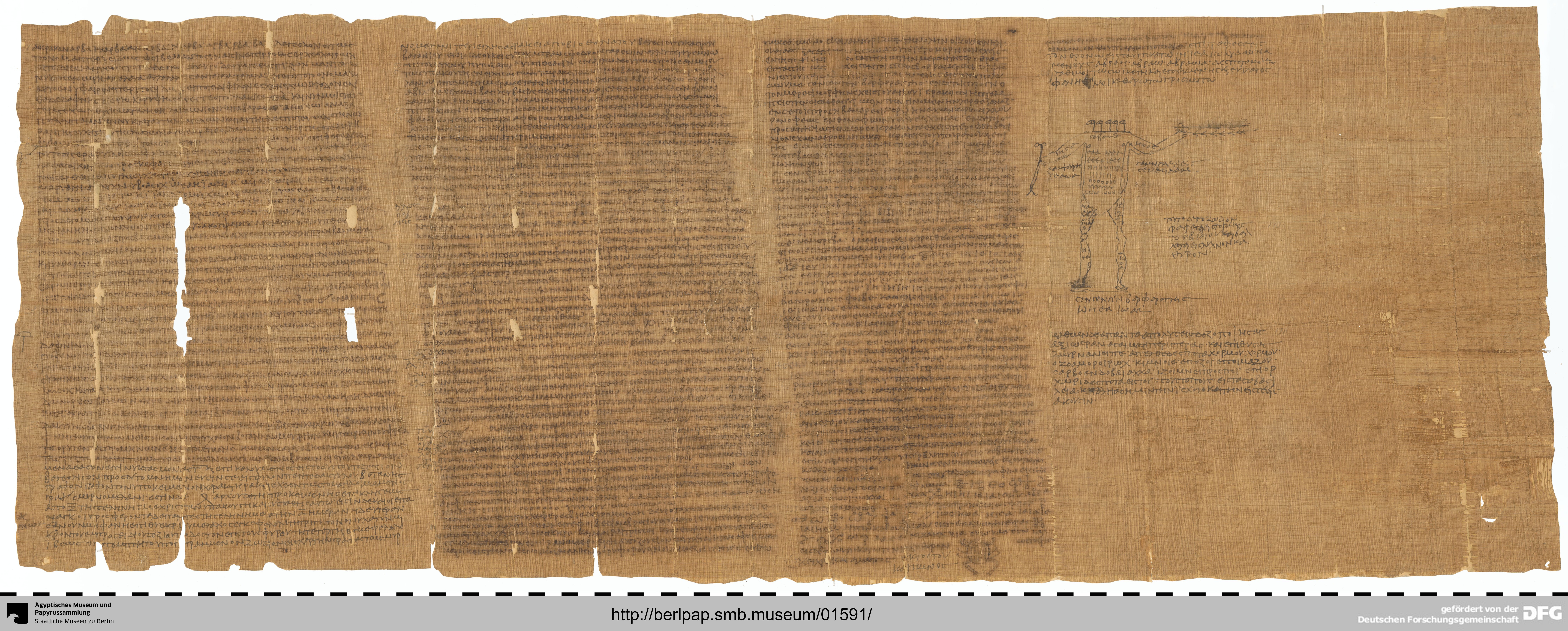 Berlin P. 5026, a Greek magical handbook from late Roman Egypt containing oracular and prophetic material. Berlin Papyrus Database, Ägyptisches Museum und Papyrussammlung.
The Berlin dream-oracle papyrus offers a useful parallel. Its surviving instructions show that dream revelation could be prepared through ritual rather than left to chance. The same principle runs through lamp and vessel inquiries: divine knowledge must be made accessible through an engineered encounter. The operator is therefore less a passive fortune-teller than a technician of revelation.
Magic, Religion, and the Limits of Our Categories
Calling the manuscript “magical” is convenient because that is how the scholarly tradition has classified it, but the label can distort as much as it clarifies. Modern Western culture often contrasts magic with religion: religion petitions a god humbly, while magic compels supernatural forces mechanically. The papyrus refuses to stay inside that binary. Its rituals can include praise, prayer, command, offering, purification, identification, and technical manipulation in the same operation.
Nor is “magic” simply failed science. Some recipes contain empirical observations; others rely on cosmological assumptions that modern science rejects. But the manuscript’s organizing question is not whether a practice belongs to a modern discipline. It asks what works within a ritual world. The practitioner’s expertise joins materials, words, divine names, timing, and inherited authority.
Historians therefore increasingly study ancient magic as a category produced by social boundaries. Who calls a practice magic? Is the label applied by an outsider, a legal authority, a rival priesthood, or a modern scholar? Does the practitioner use an equivalent term? In Roman Egypt, the answer varies. Some operations were clearly stigmatized, especially harmful or coercive acts. Others overlap heavily with temple ritual, healing, and private devotion.
The London-Leiden papyrus is valuable precisely because it keeps those boundaries unstable. Its scribe does not stop to explain that a medical prescription belongs to one discipline and a vessel inquiry to another. Both are useful knowledge. The manuscript’s practical unity is more historically important than our taxonomic discomfort.
What the Papyrus Does Not Prove
Because ancient magical texts are evocative, they attract exaggerated claims. The London-Leiden papyrus does not prove that its rituals objectively produced supernatural visions. It does not prove the existence of a single secret Egyptian priesthood controlling all Greco-Roman magic. It does not provide evidence for modern occult orders claiming direct institutional descent from pharaonic temples. And it should not be treated as a timeless manual detached from its third-century cultural setting.
It also does not justify collapsing every late antique divine name into “the same god.” Syncretic ritual often works through equivalence, but equivalence is contextual. A practitioner may identify or coordinate deities for a particular operation without asserting that their cults, myths, and communities are universally identical. Historical comparison must preserve difference even while tracing exchange.
Similarly, the manuscript’s use of Greek and Jewish-derived names should not be turned into a story of one tradition secretly originating all others. Late antique Egypt was a contact zone. Names traveled because people traveled, texts circulated, languages overlapped, and specialists borrowed. Cultural exchange is more plausible—and more interesting—than a single hidden source.
Finally, the papyrus should not be mined for isolated “spells” while ignoring the manuscript that preserves them. A recipe has a scribal context. Its placement, glosses, corrections, script, and neighboring texts reveal how knowledge was transmitted. Papyrology turns magic from a collection of sensational instructions into a history of books, readers, languages, and institutions.
Why the London-Leiden Papyrus Still Matters
The manuscript matters because it preserves a form of expertise that was usually ephemeral. Ritual performance disappears when the lamp goes out, the water is poured away, the incense burns, and the spoken words fall silent. A handbook freezes part of that performance into writing. It cannot give us the practitioner’s voice or the client’s expression, but it preserves the architecture of the act.
That architecture reveals a sophisticated understanding of mediation. Gods are not assumed to be automatically available. Contact must be built. The ritual constructs a pathway using language, material, sensory focus, purity, and authority. A vessel becomes a seeing device. A lamp becomes a theater of divine arrival. Sleep becomes an oracular chamber. A child becomes a visionary intermediary. Writing becomes both memory and power.
The papyrus also demonstrates that Egyptian religion did not simply vanish when political eras changed. It transformed. Egyptian myth and ritual remained productive inside Roman-period intellectual networks, even as Greek language, foreign divine names, and new scribal practices became part of the repertoire. The manuscript is therefore evidence not of a frozen survival but of creative continuity.
For the history of Western esotericism, this distinction is fundamental. Later magical traditions often inherited late antique techniques indirectly: divine names, planetary correspondences, ritual purification, image magic, dream incubation, spirit consultation, and the idea of a written handbook of operations. Yet transmission was rarely a straight line. Texts were translated, forgotten, rediscovered, reorganized, and interpreted through new religious frameworks. Understanding the London-Leiden papyrus on its own terms prevents us from projecting medieval grimoires or modern ceremonial magic backward onto Roman Egypt.
It also gives a more human picture of ancient ritual. Behind the spectacular divine names are ordinary questions. Someone has lost something. Someone is sick. Someone wants to know whether a relationship will succeed. Someone fears an enemy. Someone needs an answer that normal channels cannot provide. The handbook exists because uncertainty is universal, while the techniques used to manage it are historical.
Reading Ancient Divination Responsibly
A responsible modern reading begins with context. The papyrus should be approached as a historical artifact, not as an instruction sheet guaranteed to reproduce ancient results. Many recipes involve substances, coercive aims, or practices that would be unsafe, unethical, or impossible to reconstruct accurately today. The scholarly value lies in understanding how ritual knowledge was organized and why practitioners found it meaningful.
Second, translations should be compared with manuscript scholarship. Griffith and Thompson’s edition remains foundational and is freely digitized by Heidelberg University, but a century of papyrological research has refined readings, classifications, and historical interpretation. Museum catalogues provide object-level data; recent scholarship on bilingual scribes and cipher writing adds dimensions unavailable to the first editors.
Third, images should be read as evidence. The physical roll shows column layout, ink, damage, corrections, and scribal habits. A photograph reminds us that “a spell” is not an abstract paragraph. It occupied fibers of papyrus, had dimensions and edges, was rolled and handled, and eventually broke. Material survival determines intellectual survival.
Finally, comparison should be controlled. The London-Leiden papyrus can illuminate the Greek Magical Papyri, earlier Egyptian ritual, Coptic magical texts, and later traditions, but similarity does not automatically prove direct transmission. Coptic magical papyri provide a useful later comparison: the language and religious vocabulary change substantially, yet the manuscript culture of healing, protection, sacred names, and practical ritual remains recognizable.
A Handbook at the Edge of Worlds
The Demotic Magical Papyrus of London and Leiden survives at a historical threshold. Its script belongs to the last centuries of a writing tradition stretching back to pharaonic Egypt. Its rituals preserve ancient Egyptian gods while speaking to a Roman imperial world. Its glosses anticipate the Coptic writing system that would become central to Egyptian Christianity. Its recipes sit beside Greek magical traditions and share a cultural landscape with Jewish, Hermetic, astrological, and emerging Christian forms of ritual knowledge.
That position makes the manuscript more than a curiosity. It is a record of intellectual adaptation under conditions of enormous change. The people behind it did not experience themselves as museum custodians preserving a dead religion. They were working with living techniques. They copied what they believed could heal, reveal, protect, attract, repel, and explain. They translated when translation helped and preserved strange sounds when strangeness itself mattered. They wrote old gods into new scripts and new names into old ritual structures.
The divination texts are especially revealing because they expose the central ambition of the handbook: to cross the boundary between visible uncertainty and invisible knowledge. A lamp, bowl, dream, or medium is valuable because it can become a controlled interface between those domains. The ritual specialist’s task is to prepare that interface correctly.
Whether we call that practice magic, divination, ritual technology, or priestly expertise, the manuscript demands historical precision. Its world was neither irrational chaos nor a hidden version of modern science. It was a coherent late antique attempt to understand and influence a cosmos imagined as alive with gods, powers, names, correspondences, and signs. The London-Leiden papyrus lets us see that attempt unusually close to the level of practice.
More than seventeen centuries after the roll was copied, its most important lesson may be methodological. Ancient magic becomes clearer when we stop asking whether it resembles modern occultism and start asking what problems it solved for ancient people, what institutions trained its specialists, what materials made its rituals possible, and what ideas made those rituals credible. In the answers, a damaged papyrus becomes a map of an entire intellectual world.
Sources and References
- British Museum, EA10070,1, Series: The London Magical Papyrus.
- British Museum, EA10070,3, including the Inquiry of the Lamp and vessel inquiries.
- F. Ll. Griffith and Herbert Thompson, The Demotic Magical Papyrus of London and Leiden, vol. 1 (1904), Heidelberg University Library digital edition.
- Berlin Papyrus Database, “A Magical Dream Oracle,” GEMF 30/PGM II, P. 5026.
- Christopher A. Faraone, “The Use of Divine Images in the Dream-divination Recipes of the Greek Magical Papyri,” in Ancient Magic: Then and Now (2020).
- “Bilingual Scribes in Magical Formularies: The Cases of PGM/PDM XII and XIV,” recent study of bilingual magical handbooks.
- Paolo Milizia, “On the cipher script of the London-Leiden Demotic magical papyrus,” Ricerche Linguistiche 2 (2025; published 2026).


