


Giordano Bruno is usually introduced through his cosmology, his conflicts with religious authority, or the dramatic fact of his execution in Rome in 1600. That familiar story can make one of the most important parts of his intellectual life almost disappear: Bruno spent years constructing increasingly ambitious arts of memory. For him, remembering was not merely a practical trick for storing speeches or lists. It could become a method for ordering knowledge, combining images, training attention, and placing the human mind in a meaningful relation to the structure of nature.
His first major Paris publication, De umbris idearum of 1582, made that ambition visible in an unusual form. Philosophical reflections on “the shadows of ideas” lead into an Ars memoriae built from striking images, alphabetic combinations, rotating wheels, and carefully organized associations. Later works continued to alter the system. The result was neither a modern psychological science nor a single timeless occult technique. It was a Renaissance experiment at the border of classical mnemonics, Ramon Llull’s combinatorial methods, Neoplatonic metaphysics, Hermetic ideas, rhetoric, visual thinking, and what Bruno himself understood as an active philosophy of nature.
 Portrait of Giordano Bruno reproduced in an edition of his works. Wellcome Collection image, licensed CC BY 4.0 via Wikimedia Commons.
Why Memory Was a Serious Intellectual Art in the Renaissance
Modern readers often treat memory as a private mental capacity: some people remember names easily, others need notes, and digital devices now store much of what earlier generations had to retain internally. In antiquity and the Renaissance, however, memory could be taught as an art. Classical rhetorical education developed techniques for remembering long speeches by associating vivid images with ordered places. A speaker imagined a familiar building, street, theater, or sequence of architectural locations and mentally deposited memorable images in those places. During recall, the speaker moved through the imagined route and recovered the material in order.
The basic logic was simple but powerful. Abstract language is difficult to hold in the mind, while a bizarre, dramatic, emotionally charged, or visually precise image is easier to retrieve. Order is equally important. Memory becomes more reliable when information is distributed through a stable structure. Classical authors such as Cicero and Quintilian discussed such methods in rhetorical contexts, and medieval teachers adapted mnemonic principles to preaching, devotion, moral instruction, and the organization of knowledge.
By Bruno’s century, the art had accumulated more than one intellectual history. It remained a practical technique, but it had also become entangled with philosophical questions about imagination, signs, knowledge, and the relationship between mental images and the world. Some Renaissance thinkers asked whether an artificial memory could do more than preserve information. Could it arrange the contents of knowledge so well that the structure itself produced insight? Could a memory system become an instrument for discovery rather than only storage?
That question is central to Bruno. His art is difficult because it does not merely ask, “How can I remember a hundred items?” It asks how images, concepts, words, relations, and operations might be combined within one dynamic mental architecture. In this sense, memory becomes a model of thought itself.
Bruno Before the Memory Wheels
Bruno was born at Nola near Naples in 1548 and entered the Dominican order as a young man. He received a demanding education in logic, philosophy, theology, and the techniques of scholastic disputation. He later left the convent and began the long sequence of travels that took him through Italian, French, English, German, and Central European cities. Those movements mattered intellectually. Bruno lived in environments where universities, courts, confessional conflicts, printing houses, humanist scholarship, natural philosophy, and religious controversy constantly intersected.
The Stanford Encyclopedia of Philosophy emphasizes that Bruno’s work eventually joined metaphysics, natural philosophy, psychology, ethics, cosmology, religion, and the arts of memory into an unusually original project. His interest in mnemonics was therefore not a detached hobby. It belonged to the same mind that would defend an infinite universe, criticize contemporary Aristotelianism, explore the relation between unity and multiplicity, and describe nature as dynamic and living.
Bruno’s reputation for memory also had practical value. Memory arts could be demonstrated, taught, dedicated to patrons, and presented as intellectual technologies. In Paris he entered the orbit of the French court and published De umbris idearum in 1582. The work was associated with King Henry III, and its appearance placed Bruno before a learned audience as both philosopher and master of an extraordinary mnemonic art.
It is important not to convert that reputation into legend. Renaissance biographies and later occult literature sometimes magnify mnemonic skill into almost supernatural photographic memory. The documented achievement is already impressive enough: Bruno wrote technically elaborate systems designed to train artificial memory and connected them to his philosophy. There is no need to invent paranormal abilities in order to explain why contemporaries found the subject remarkable.
De umbris idearum: A Book with Two Faces
The 1582 De umbris idearum is frequently described as a memory book, but the title announces a philosophical problem before a practical one. “The shadows of ideas” suggests that human cognition does not simply grasp ultimate reality in a direct, transparent manner. We work through images, reflections, signs, species, and mediated forms. Knowledge is therefore connected to the art of handling representations.
The surviving 1582 edition, digitized from the Bavarian State Library and available through Google Books, shows that the work is not a modern handbook separated neatly into theory and exercises. Its Latin presentation is dense, technical, and full of diagrams and lists. The physical book itself makes the conceptual ambition visible: the reader encounters text and geometry together.
This matters because Bruno’s mnemonics cannot be reduced to “picture something strange and you will remember it.” Classical vivid imagery remains important, but Bruno is constructing a generative system. The images are organized, classified, and placed into structures that can be manipulated. One can think of the difference between a box of index cards and a machine for recombining the cards according to rules. Bruno is interested in the machine.
Alessandro Farinella’s study in Renaissance Quarterly argues that Bruno’s memory wheel reflects an attempt to integrate Neoplatonic metaphysical principles with a broader organization of knowledge. That interpretation helps explain why the work can feel simultaneously practical and philosophical. The method is not only about retention; it expresses a theory of how multiplicity can be ordered without losing the possibility of movement and recombination.
The Ancient Method of Places and Images
To understand what Bruno changes, it helps to begin with the classical art of memory. The traditional method depends on two elements: loci, or places, and imagines, or images. Places provide sequence. Images carry content. If a person wanted to remember a structured argument, the person could imagine a series of familiar locations and place one striking image at each position.
The method works because recall is rarely a neutral retrieval of disconnected data. Memory is cued by context. A place gives the mind a stable address; an image creates an unusual signal; order allows the sequence to unfold. Ancient rhetorical teachers recommended images that were vivid enough to resist confusion. A merely ordinary image could fade into the background of imagination, while something exaggerated, beautiful, comic, violent, emotionally charged, or otherwise distinctive could remain mentally available.
Bruno accepted the power of visual association but was not satisfied with a fixed corridor of mental rooms. His ambitions demanded far more flexibility. If every possible subject required a separately memorized palace, the art would remain useful but limited. He wanted a system that could support variation, composition, and the rapid formation of new relations.
That desire pushed him toward combinatorial structures. Instead of treating memory as a static gallery, he increasingly treated it as a set of movable relations. This is where the influence of Ramon Llull becomes essential.
Ramon Llull and the Idea of Thinking with Wheels
Ramon Llull, the medieval Majorcan thinker, developed diagrams that arranged letters and concepts on rotating or combinable figures. Llull’s goals were theological and logical rather than identical to Bruno’s, but the visual principle was enormously suggestive: a finite set of basic terms could be recombined to produce many relations.
A wheel changes the character of a system. A written list gives one sequence. A rotating set of concentric circles can generate multiple alignments. With each movement, new combinations appear. The device therefore represents not merely memory but possibility.
Bruno took combinatorial thinking in a distinctive direction. He did not simply reproduce Llull’s art. He mixed alphabetic structures with mnemonic images, actions, objects, and philosophical classifications. In the process, the wheel became part of a visual language for organizing both words and concepts.
The Stanford account of Bruno notes that his memory art and his engagement with Llull served larger philosophical aims. The ideal memory structure could mirror intelligible order and train the soul to move between multiplicity and unity. This is a much more ambitious goal than ordinary recollection. It turns mnemonic organization into a way of exercising the intellect.
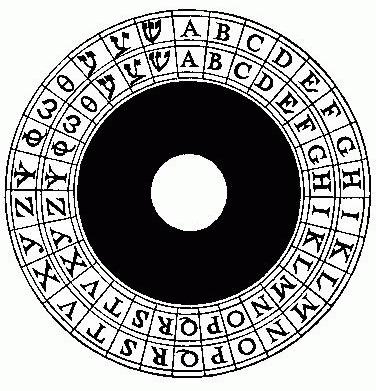 Two combinatorial alphabetic wheels from Bruno’s 1582 De umbris idearum. Public domain via Wikimedia Commons.
What the Wheels Actually Do
The circular figures are among the most recognizable images associated with Bruno, but they are also easy to romanticize. They are sometimes reproduced online as mysterious occult seals without explanation. In context, their importance is combinatorial. Concentric bands carry letters or other symbolic units, and rotation changes which elements align with one another.
The wheel therefore creates a controlled field of substitutions. A mnemonic practitioner can attach categories of images, agents, actions, objects, sounds, syllables, or concepts to different positions and then generate compound associations. The exact organization varies across Bruno’s works, and no single diagram should be treated as a universal key to every part of his memory system.
The practical advantage is compression. A relatively small set of well-learned elements can produce a much larger number of combinations. Instead of memorizing each possible compound separately, the practitioner learns the components and the rules by which they can be joined. This is one reason Bruno’s art has fascinated readers interested in symbolic logic, computation, coding, and information systems. The resemblance is suggestive, but historical caution is needed: his wheels are not mechanical computers and should not be described as forgotten digital technology.
The deeper significance is epistemic. A movable wheel trains the user to think relationally. An element is not defined only by its isolated identity; it takes on new functions through alignment. Knowledge becomes a pattern of transformations.
Agents, Actions, and Images as a Mental Vocabulary
Bruno’s mnemonic systems repeatedly depend on building a repertoire of images rich enough to encode varied material. One common strategy is to associate letters or conceptual units with memorable figures and actions. The human mind is better at retrieving a scene than an abstraction, especially when the scene contains movement.
Imagine the difference between remembering the bare sequence of two letters and remembering a recognizable person performing an exaggerated action with a strange object. The second construction contains multiple retrieval cues: identity, movement, object, emotion, color, and spatial relation. A mnemonic art can exploit these layers systematically.
Bruno’s lists are not random decoration. They aim to create an internal visual language. Once a practitioner learns the repertoire, combinations can stand for words, arguments, categories, or new material. The art depends on familiarity: an elaborate image is useful only if the person can retrieve it quickly and consistently.
This feature also shows why learning the system would require discipline. A memory wheel printed on a page does not automatically improve memory. The user must internalize the components, practice transitions, stabilize associations, and develop speed. The visible diagram is only the external skeleton of an internal habit.
Internal Writing: Memory as a Script Inside the Mind
One of the most productive ways to understand Bruno’s project is through the metaphor of internal writing. Ordinary writing stores language outside the body. Artificial memory attempts to create a comparable system within imagination. Images become signs, places become addresses, and ordered structures become something like pages.
The comparison does not mean the mental script is identical to alphabetic writing. In fact, mnemonic imagery can be denser. A single imagined scene can carry several elements at once. It can encode sound, meaning, order, emotion, and relation simultaneously.
This helps explain why De umbris idearum uses the language of shadows and representation. Human thought operates through mediating forms. The task is to make those forms disciplined enough that they do not collapse into chaos. Memory art is therefore an art of managing images.
A 2018 study by Fabrizio Rusconi and Clara Salvador in Cadernos de Letras da UFF places Bruno’s work in a longer philosophical conversation about writing and memory. That perspective is valuable because it moves the discussion away from the simplistic question “Was this magic?” and toward a broader question: what happens when the mind is trained to become its own writing surface?
The Role of Imagination
Imagination is the engine of any image-based mnemonic art. Yet Renaissance theories of imagination were broader than contemporary casual usage. Imagination could mediate between sensation and intellect, preserve sensory forms after the external object disappeared, combine images, and influence attention and emotion.
For Bruno, a trained imagination was not mere fantasy. It was an operative faculty. If thought depends on images, then improving the order and mobility of those images can transform intellectual work. The art of memory becomes a discipline of perception, attention, and association.
This does not validate supernatural interpretations of imagination. Modern cognitive science studies mental imagery, attention, memory cues, and associative learning using very different theories and methods. Bruno’s cosmological and metaphysical assumptions belong to his historical world. Nevertheless, the practical recognition that vivid imagery and structured retrieval cues can strengthen memory remains psychologically intelligible.
The important distinction is between historical efficacy and metaphysical explanation. A mnemonic technique can be effective as memory training even if the Renaissance theory used to explain it is no longer accepted. Conversely, a beautiful symbolic theory does not prove extraordinary powers of mind.
Hermeticism, Ficino, and the Problem of Cosmic Memory
Bruno inherited a Renaissance environment already transformed by the revival of Platonic and Hermetic literature. Marsilio Ficino’s translations and philosophical writings had helped make the idea of ancient wisdom intellectually powerful. Ficino also developed a universe rich in correspondences, spirit, music, planetary qualities, and mediated relations between soul and cosmos.
SecretMagic.space has examined that world in Marsilio Ficino’s Three Books on Life. Ficino’s project differs from Bruno’s, but the comparison is useful. Ficino asks how a scholar’s life might be harmonized with nature and celestial order. Bruno pushes much further toward an active theory of mind in which memory, images, combinations, and philosophy become tools for intellectual transformation.
The Hermetic revival also matters because Hermes Trismegistus represented an ideal of ancient Egyptian wisdom for Renaissance readers. Bruno inherited that prestige even though modern scholarship dates the philosophical Hermetica to late antiquity rather than the remote pharaonic age Renaissance thinkers often imagined. For the historical background, see SecretMagic.space’s study of the Corpus Hermeticum.
Older twentieth-century scholarship, especially work influenced by Frances Yates, strongly emphasized the magical and Hermetic dimensions of Bruno’s memory art. That interpretation remains enormously influential because it explains why the system contains far more than neutral mnemonic efficiency. The memory structure can be read as an attempt to interiorize a meaningful cosmos.
Why the “Hermetic Memory Magician” Interpretation Is Debated
Influential interpretations are not final verdicts. More recent scholarship has challenged the idea that Hermetic or magical influence should be treated as the single determining key to De umbris idearum.
Julián Barenstein’s study in the Art Research Journal explicitly proposes a less esoteric reading of the work, emphasizing the regulation and cognitive function of memory rather than treating natural magic as the decisive explanatory framework. The point is not that Bruno had no interest in magic; his broader corpus makes such a denial impossible. The question is whether every technical feature of the memory art should be interpreted primarily as magical.
This debate improves our understanding because it prevents two opposite simplifications. One simplification turns the wheels into neutral study aids and ignores Bruno’s metaphysics. The other turns every mnemonic procedure into ritual magic and ignores the technical problem of organizing memory.
The strongest reading holds both levels together. Bruno was a philosopher who took images, correspondences, and the powers of mind very seriously. He was also designing a practical art with internal rules. Historical interpretation should show how those dimensions interact rather than forcing one to erase the other.
Shadows: Why the Title Matters
The metaphor of the shadow is central because it describes a relationship between presence and absence. A shadow depends on something more substantial than itself, yet it is not identical to that source. Human cognition, in Bruno’s framework, operates through mediated representations rather than through possession of divine ideas in their pure form.
That situation gives memory a philosophical dignity. If knowledge arrives through images, signs, and sensible forms, then the organization of those forms matters. A confused imagination produces confused thought. A disciplined imagination can become a ladder toward greater intellectual order.
Bruno’s language should not be flattened into a modern “law of manifestation” or a promise that thinking an image causes reality to obey. Such claims are common in contemporary occult popularization but do not responsibly summarize the historical work. His shadows belong to a sophisticated Renaissance problem about the relationship among ideas, images, intellect, and sensible experience.
The metaphor also explains why the art is endless in principle. No finite image is the idea itself. Images can be recombined, refined, and reorganized. The mind works through a moving field of approximations.
Cantus Circaeus: Circe, Transformation, and a More Accessible Memory Art
Bruno published another memory-related work in Paris in 1582, the Cantus Circaeus, often translated as “The Incantation of Circe” or “Circe’s Song.” A digitized early copy is available through Google Books. The work combines a dramatic mythological dialogue involving Circe with a second part that presents mnemonic instruction.
Tommaso Ghezzani’s recent study, summarized by the Scuola Normale Superiore research portal, emphasizes the unity of these parts. The dialogue is not merely decorative myth placed before a separate technical manual. The imaginative and philosophical material can itself become material for mnemonic practice.
This is a revealing feature of Bruno’s method. Mythological images are valuable because they are already dense with attributes, actions, relationships, and emotional charge. A figure such as Circe is not one neutral symbol. She carries transformation, speech, animality, power, deception, knowledge, and the instability of human identity. Such richness makes myth highly usable in an image-based mental art.
The same feature explains both the attraction and danger of reading Bruno through modern occult symbolism. His use of myth is real, but symbols do not possess one universal meaning independent of context. Their mnemonic function depends on how the practitioner organizes them.
 A mnemonic device from Bruno’s 1582 Cantus Circaeus. The sixteenth-century design is in the public domain; reproduction via Wikimedia Commons.
From Memory to Invention
A conventional memory art is retrospective: it preserves something already known. Bruno’s ambition is more expansive because the organization of images can also support inventio, the discovery or production of new combinations.
This is one reason the rotating wheel matters so much. Rotation does not merely recover a fixed answer. It generates arrangements. If the elements stand for categories of thought, moving them can expose relations that were not previously visible in one sequence.
Renaissance rhetoric used the word inventio for finding the material of an argument. Bruno’s systems intensify that idea. A well-built internal structure can help the mind move among possibilities, compare terms, and assemble new configurations.
It would be misleading to call this a scientific discovery engine in the modern sense. A combinatorial device can generate nonsense as easily as insight. The value depends on the quality of the elements and the judgment of the user. Bruno’s art does not eliminate interpretation; it increases the field through which interpretation moves.
The Difference Between a Memory Palace and Bruno’s Machine
The popular “memory palace” remains the most familiar mnemonic image today. It usually means placing information along a known route. Bruno’s system can use spatial organization, but it goes beyond the palace metaphor in several ways.
First, the elements are not only located; they are categorized. Second, they can be combined. Third, the system can encode language or conceptual relations rather than merely a sequence of topics. Fourth, its philosophical framework gives the architecture a claim about cognition itself.
A palace is stable. Bruno’s wheel is mobile. The difference is revealing. Stability helps recall, while mobility helps transformation. Bruno wants both: enough fixed order to prevent confusion and enough movement to support combination.
This tension remains relevant to any serious system of knowledge. If everything is fixed, new relationships become difficult to see. If everything is movable, order disappears. Bruno’s mnemonic art is one historical attempt to solve that problem visually.
Images Are Not Decorations
Many reproductions of Bruno’s diagrams circulate as aesthetic objects. Their circles, letters, geometries, and strange associations fit easily into modern occult design. Yet the diagrams were not created merely to look mysterious.
Each image participates in an operation. A mnemonic figure can organize positions, classify elements, provide transformation rules, or serve as a stable object of contemplation. Its meaning lies partly in what the practitioner does with it.
This is why a photograph of a wheel is not equivalent to mastering the art. Looking at the diagram from outside is like looking at a musical score without knowing how to read music. The structure is visible, but the practiced movement is absent.
The same principle applies to later ceremonial diagrams. Historical images should be studied as tools embedded in systems rather than as free-floating occult logos.
The Thirty Seals and the Expansion of the Project
Bruno did not abandon the memory problem after 1582. In London he published the Explicatio triginta sigillorum in 1583 together with the Sigillus sigillorum. The Bibliothèque nationale de France catalogues the work and its sixteen woodcut diagrams, confirming the 1583 London publication by John Charlewood.
The title announces a broad ambition: the thirty “seals” concern invention, arrangement, and memory across sciences and arts. This vocabulary shows how far Bruno had moved beyond a narrow technique for memorizing speeches. A seal is a patterned instrument. Each figure offers a different way of ordering mental operations.
The BnF record is especially useful because modern occult reproductions sometimes circulate individual seals without bibliographic context. Returning the figures to the 1583 book restores their historical function. They belonged to a printed philosophical-mnemonic project, not to an anonymous collection of magical emblems.
Bruno’s systems also changed from work to work. There is no reason to assume that one diagram represents a final definitive method. His repeated revisions suggest experimental thinking. Memory was a laboratory in which he tested visual organizations of intellect.
 Three mnemonic seals associated with Bruno’s 1588 Articuli centum et sexaginta: Numerator seu Combinator, Speculum Magorum, and Annulus Gygis. Public domain via Wikimedia Commons.
Why Bruno Calls Some Figures “Seals”
The word “seal” has religious, legal, material, and symbolic associations. A seal stamps a pattern into another surface. It authenticates, closes, marks, and reproduces form. That makes it an unusually fitting metaphor for a theory of memory.
A mnemonic structure also stamps form onto otherwise unstable material. The mind receives a flood of sensations and words; art imposes a repeatable order. A seal transforms loose material into a recognizable pattern.
The metaphor can also carry esoteric resonance. Renaissance texts often use seals, signatures, characters, and images as signs of hidden relations. But here again the technical and symbolic meanings do not need to be separated absolutely. Bruno repeatedly chooses language that can operate at more than one level.
For modern readers, this layered vocabulary is a reminder that historical terms should be allowed to remain complex. Translating every “seal” into either “magic symbol” or “diagram” loses part of the intellectual texture.
Figura Intellectus: Drawing the Operations of Mind
One of the most striking later diagrams associated with Bruno is the Figura intellectus, a geometric figure published in 1588. It belongs to a period when he continued to experiment with formal images for intellectual operations.
The figure should not be treated as a literal anatomical map of the brain. It is a conceptual diagram. Its value lies in representing relations visually, allowing abstract operations to be grasped as structured form.
This technique belongs to a much larger history of diagrams in philosophy. Trees, ladders, circles, squares, correspondences, genealogies, and logical figures all convert abstract relations into spatial ones. Once an idea has a position, direction, or connection, the eye can participate in reasoning.
Bruno intensifies this visual philosophy. His diagrams are neither illustrations added after the argument nor purely mathematical figures. They are part of the thinking process.
 Bruno’s Figura intellectus, dated 1588. Public-domain historical diagram via Wikimedia Commons.
Memory, Logic, and the Organization of Knowledge
Bruno’s work emerged in a culture deeply concerned with how knowledge should be divided and taught. Medieval and Renaissance education organized disciplines into hierarchies, branches, questions, distinctions, and commentaries. Logic trained students to separate terms and relations. Rhetoric trained them to find and arrange arguments. Memory trained them to preserve and retrieve material.
Bruno refuses to keep these activities completely separate. A memory art that organizes categories becomes close to logic. A system that helps find combinations approaches invention. A visual structure that orders sciences becomes a theory of knowledge.
This is why his mnemonic writing can be frustrating to anyone searching for one practical method. It is doing too many things at once. The same complexity, however, makes it historically important. Bruno reveals a moment before modern specialization separated cognitive psychology, logic, visual design, information organization, and esotericism into different fields.
His work should therefore be read alongside broader Renaissance encyclopedic projects, not only occult manuals. The dream is comprehensive order.
Bruno and Agrippa: Two Different Kinds of Occult System
Bruno is often placed in the same large history as Heinrich Cornelius Agrippa, whose Three Books of Occult Philosophy had already offered a major Renaissance synthesis of natural, celestial, and intellectual worlds. SecretMagic.space’s article on Agrippa’s three worlds explains how correspondences, astrology, mathematics, divine names, and spiritual hierarchy were organized into an enormous cosmological system.
Bruno learned in a world shaped by such synthesis, but his memory project has a different center of gravity. Agrippa classifies the cosmos for the learned magician. Bruno asks how the mind itself can become dynamically organized enough to move through multiplicity.
The distinction is not absolute. Both writers are interested in correspondences, signs, and intellectual ascent. Yet treating Bruno as merely “another ceremonial magician” misses the cognitive originality of the memory works.
His most characteristic question is not simply which planet rules a stone or which name belongs to an angelic hierarchy. It is how a finite human intellect can use signs and images to navigate an effectively inexhaustible universe of relations.
Bruno and Trithemius: Memory Versus Secret Writing
Another illuminating comparison is Johannes Trithemius. SecretMagic.space has examined Trithemius’s Steganographia, a work in which secret writing was wrapped in the language of angelic and spiritual communication.
Trithemius and Bruno both show how Renaissance techniques of information could inhabit an esoteric environment without being reducible to superstition. Trithemius transforms writing through concealment. Bruno transforms memory through internal symbolic structure. One hides messages outside the mind; the other builds a writing system within imagination.
The comparison also reveals the importance of learned secrecy. Complex arts create specialized communities of readers. To understand the system, one must possess the key, whether the key is cryptographic or mnemonic.
Neither author should be turned into a prophet of digital technology. Their works are historically specific. But both demonstrate that the organization of information has a much older and stranger history than modern computing.
Was Bruno’s Memory Art Supposed to Be Magic?
The answer depends on what “magic” means. If the term means stage illusion or supernatural entertainment, it is misleading. If it means Renaissance magia as a learned theory of hidden relations, active imagination, correspondences, and human participation in nature, then parts of Bruno’s project clearly belong to that world.
The difficulty is that Bruno’s memory art also works at a technical level that does not require a supernatural interpretation. Associating vivid images with structured positions is a real mnemonic strategy. Organizing information into categories is a real cognitive aid. Combining learned units can support recall and invention.
The metaphysical claim is stronger: that the properly organized mind can mirror deeper structures of nature and rise toward intellectual unity. That claim belongs to Bruno’s philosophy and cannot be verified simply by showing that mnemonic techniques improve recall.
A responsible historical account therefore separates levels. The techniques exist. Some mechanisms are psychologically plausible. Bruno’s cosmology and magical philosophy explain what he thought the art ultimately meant. None of that requires presenting extraordinary supernatural effects as established fact.
The Myth of the Perfect Universal Memory
Popular summaries sometimes imply that Bruno discovered a system capable of remembering literally everything. The historical sources do not support such a simplistic promise.
An artificial memory always has costs. The user must learn the system itself. Images can interfere with one another. Large repertoires require maintenance. Encoded information must be translated back into ordinary meaning. Complexity can become a burden.
Bruno knew that memory required art, not a miracle button. His dense systems testify to the amount of structure he believed necessary. The sophistication of the method is evidence against effortless perfection.
This is also why modern readers who want practical mnemonics may find simpler methods more efficient. Bruno’s goal was not merely to win memory competitions. His art carried philosophical and intellectual ambitions that exceed everyday utility.
The Myth That the Wheels Were Magical Machines
Another misunderstanding treats the printed wheels as talismans that supposedly work by being displayed. There is no historical basis for reducing the mnemonic wheel to an automatically operative charm.
The wheel is a tool of organization. It becomes useful through learned correspondences and mental operations. The physical diagram helps the user understand or manipulate a system, but the system ultimately has to be internalized.
The distinction is crucial for reading Renaissance diagrams generally. An image can be sacred, philosophical, mnemonic, mathematical, astrological, magical, or several of these at once. Its function is determined by context and use rather than visual strangeness alone.
Reproducing Bruno’s wheels as posters can be aesthetically interesting, but it is not the same as practicing his art.
The Myth That Bruno Was Executed for His Memory System
Bruno’s death is so famous that later narratives often connect every unusual idea he held directly to his execution. That is historically careless.
His long Roman trial concerned a complex set of theological and philosophical propositions. His cosmology, religious ideas, and criticisms of doctrine became entangled with questions of authority and recantation. The memory works formed part of his intellectual identity, but there is no serious basis for claiming that the Church executed him simply because he knew a secret mnemonic technology.
This matters because martyr narratives can distort scholarship. Bruno’s courage and tragic end do not need invented charges. His surviving writings provide more than enough material for understanding why his philosophy was controversial.
Separating the memory art from sensational trial mythology also allows us to study it on its own terms.
What Modern Memory Science Can and Cannot Take from Bruno
Contemporary research recognizes several principles that make traditional mnemonic methods effective: structured retrieval cues, elaborative encoding, distinctive imagery, spatial organization, and repeated practice. These ideas can help explain why classical memory techniques work without adopting Renaissance cosmology.
Bruno’s systems also anticipate a general principle familiar in information design: compression through reusable components. A small vocabulary of stable elements can represent many combinations. This is not unique to Bruno, but his wheels make the principle visible.
What modern science should not take from him uncritically are astrological causation, universal cosmic correspondences, or claims that symbolic images provide direct access to metaphysical structures. Those belong to philosophical and religious history, not established cognitive neuroscience.
The most productive encounter is comparative. Modern science can explain some mechanisms differently while historians preserve the meanings Bruno assigned to them.
A Symbolic Reading: Memory as a Model of the Renaissance Self
Bruno’s art offers a compelling symbolic image of the human person. The self is not a passive container waiting to be filled with facts. It is an active organizer. It selects images, assigns positions, creates relations, and moves through patterns.
In this sense, memory becomes a model of intellectual responsibility. What we remember depends partly on how we arrange attention. A disordered inner world produces fragmented retrieval; a disciplined inner world can sustain complex thought.
The wheel adds another symbolic dimension. Identity itself is not one frozen list. The mind changes relations without losing continuity. New combinations emerge from familiar elements.
Such a reading does not claim that Bruno secretly anticipated modern psychology. It simply recognizes that his visual structures make philosophical claims about human agency. The mind is capable of being cultivated.
Why the System Feels Modern Even When It Is Not
Readers familiar with databases, coding, interfaces, and visual knowledge systems often feel an immediate attraction to Bruno’s diagrams. The resemblance comes from shared problems: how do we encode information, reduce complexity, retrieve items, generate combinations, and move among categories?
Those problems are transhistorical, but the answers are not. A software database depends on formal machine operations. Bruno’s art depends on a trained biological memory embedded in Renaissance theories of imagination and cosmos.
Calling the wheel an “algorithm” can therefore be useful only as analogy. It follows rules and transforms inputs, but it does not execute itself. The human practitioner supplies interpretation, memory, judgment, and movement.
The better historical lesson is that information architecture did not begin with computers. People have long created material and mental technologies to extend cognition.
How to Study Bruno’s Memory Art Responsibly Today
The first step is to distinguish historical reconstruction from modern adaptation. A person can learn the classical method of loci today without pretending to recreate Bruno’s complete system. Likewise, one can experiment with rotating categories or image coding as a creative exercise while clearly labeling the method as modern.
The second step is to work from primary texts and scholarly editions whenever possible. De umbris idearum survives in early printed copies, and digital facsimiles allow readers to inspect the diagrams instead of relying only on modern redrawings. The same applies to the Cantus Circaeus and the Thirty Seals.
The third step is to compare interpretations. Farinella’s Neoplatonic reading, the cognitive emphasis of Barenstein, studies of Bruno’s Llullism, and work on his broader philosophy do not all produce the same Bruno. That disagreement is valuable. A complex historical thinker should not be forced into one modern identity.
Finally, keep practical claims proportionate. Mnemonic training can improve recall. There is no reliable evidence that Bruno’s diagrams confer supernatural knowledge, perfect memory, or direct control of cosmic forces.
What Searchers Often Mean by “Giordano Bruno Memory Method”
People searching for Bruno’s method are often looking for one of three things. Some want a practical mnemonic technique. Others want the history of Western esotericism. A third group wants to understand the mysterious diagrams reproduced online.
For practical memory, begin with the classical principles: stable locations, vivid images, strong associations, and repeated retrieval. These are easier to learn than Bruno’s full system. Once those foundations are understood, his combinatorial structures become easier to appreciate.
For esoteric history, place Bruno between Ficino, Llull, Renaissance Hermeticism, natural magic, and the later development of learned occult philosophy. His memory art belongs to a much larger debate over whether symbols merely represent reality or participate in its hidden order.
For the diagrams, always identify the work and date. A wheel from De umbris idearum, a figure from the Thirty Seals, and an image from an 1588 publication do not automatically perform the same function.
Frequently Asked Questions
What is De umbris idearum?
De umbris idearum is a 1582 Latin work by Giordano Bruno published in Paris. It combines philosophical discussion with an elaborate art of memory. Its title refers to “shadows of ideas,” and its mnemonic sections use images, alphabetic structures, and combinatorial wheels to organize and manipulate remembered material.
Did Giordano Bruno invent the memory palace?
No. The method of places and images is ancient and appears in classical rhetorical traditions many centuries before Bruno. His importance lies in transforming inherited mnemonic techniques through combinatorial structures, Llullian influences, philosophical ambitions, and a much more dynamic system of images and relations.
What were Bruno’s memory wheels?
They were circular combinatorial diagrams with movable or conceptually rotatable bands. Elements positioned on the rings could be aligned in multiple ways, allowing a limited set of symbols or mnemonic units to generate many combinations. Their purpose was organizational and intellectual; they were not automatic magical devices.
Was Bruno’s art of memory Hermetic?
Hermetic and Neoplatonic ideas strongly influenced Bruno’s intellectual environment, and influential scholarship has interpreted the memory art within that framework. However, researchers disagree about how decisive that influence is for the technical structure of De umbris idearum. The safest conclusion is that the art has both mnemonic and philosophical dimensions and should not be reduced to one label.
Did Bruno believe memory could reveal the structure of the universe?
His philosophical writings give memory a role far beyond ordinary recall. He sought systems through which the mind could organize multiplicity and move toward deeper intellectual unity. That aspiration can be described as cosmological or metaphysical, but it should not be confused with scientifically demonstrated access to hidden cosmic information.
Can Bruno’s method be used today?
Parts of it can be studied and adapted, especially vivid imagery, ordered locations, reusable visual codes, and combinatorial organization. Reconstructing his full historical system is far more difficult and requires substantial study of the Latin texts, their diagrams, and their philosophical context. Modern users should distinguish adaptation from historical replication.
Is the art of memory the same as magic?
No. Artificial memory has a long rhetorical and educational history independent of magic. In Bruno’s work, however, mnemonic technique intersects with Renaissance theories of imagination, correspondences, Neoplatonism, Hermeticism, and active philosophy. The overlap is historically real without making every mnemonic operation a supernatural ritual.
Why Bruno’s Memory Art Still Matters
The most important thing about Bruno’s memory art is not that it offers one strange trick from the past. It reveals a different conception of the mind. Memory, imagination, classification, invention, philosophy, and visual form are treated as parts of one activity.
That unity is difficult for modern readers because our institutions separate these subjects. We send memory to psychology, diagrams to design, logic to philosophy, magic to religious studies, and information systems to computer science. Bruno’s books come from a world in which those boundaries were still porous.
His solution was extraordinarily ambitious. Learn a disciplined vocabulary of images. Arrange it within stable structures. Make the structures movable. Use movement to create relations. Treat relations not merely as reminders but as instruments of thought. Then place the entire system inside a philosophy in which nature itself is dynamic, connected, and intelligible.
We do not have to accept Bruno’s metaphysics to understand the force of that idea. The memory wheel survives as a historical image of cognition under construction: a human mind attempting to become more ordered without becoming static, more capacious without becoming chaotic, and more inventive without losing structure.
Sources and Further Reading
- Stanford Encyclopedia of Philosophy, “Giordano Bruno.” Updated scholarly overview of Bruno’s life, philosophy, cosmology, memory art, Llullism, and intellectual development.
- Alessandro G. Farinella, “Giordano Bruno: Neoplatonism and the Wheel of Memory in the De Umbris Idearum,” Renaissance Quarterly.
- Julián Barenstein, “Memoria regulata: hacia una interpretación no esotérica del De umbris idearum de Giordano Bruno,” Art Research Journal.
- Fabrizio Rusconi and Clara Salvador, “Escrita e memória: do mito de Thot ao De umbris idearum de Giordano Bruno,” Cadernos de Letras da UFF.
- Giordano Bruno, De umbris idearum, Paris, 1582, digitized from the Bavarian State Library.
- Giordano Bruno, Cantus Circaeus, 1582, digitized early edition.
- Bibliothèque nationale de France catalogue record for Bruno’s Explicatio triginta sigillorum, London, 1583.
- Tommaso Ghezzani, “The Enchantment of Memory: Observations on Giordano Bruno’s Cantus Circaeus,” Scuola Normale Superiore research record.

