


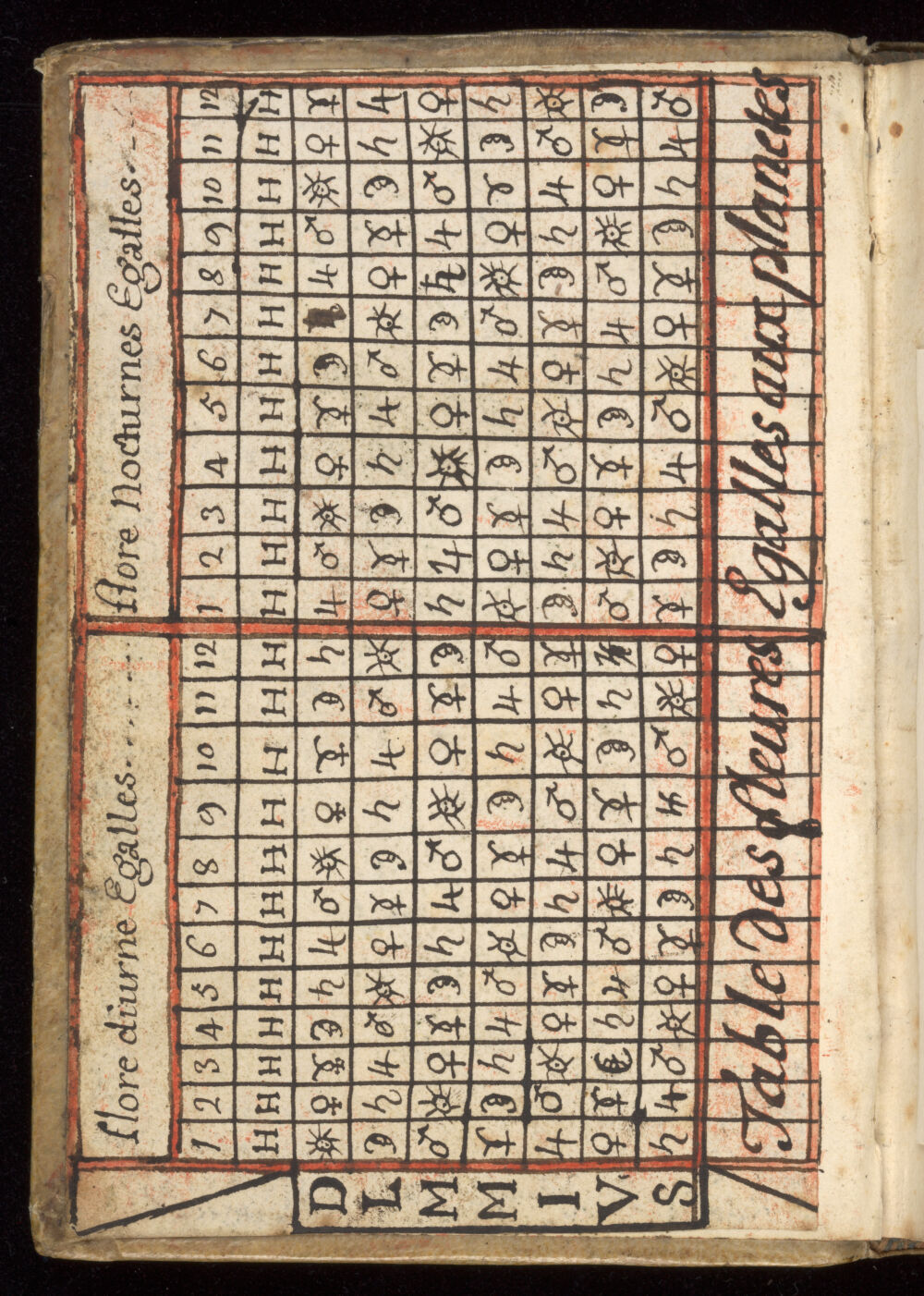
 Tables from L’art Magique, Wellcome MS 983, dated c. 1709. The manuscript is one of the most important early witnesses for material that later appears in the Grimorium Verum. Public Domain Mark, Wellcome Collection.
The Grimorium Verum announces itself with the confidence of an ancient revelation. Its title page claims a translation from Hebrew by a Dominican Jesuit named Plaingière, published at Memphis by “Alibeck the Egyptian” in 1517. The book then presents a compact system of spirit hierarchies, characters, prayers, ritual objects, pacts, and practical secrets under the immense authority of Solomon. Read literally, it sounds like a surviving Renaissance doorway into an older Hebrew magical tradition.
Almost every part of that first impression is historically unstable.
The famous date is not a secure date of composition. “Alibeck the Egyptian” is not a verified historical publisher. The claim of Hebrew translation belongs to the same long pseudepigraphic culture that placed magical books under the names of Solomon, Moses, Honorius, Albertus Magnus, Cyprian, and other figures whose authority could make a small manual seem ancient, dangerous, and privileged. Yet the book is not therefore historically unimportant. Quite the opposite: once the false antiquity is stripped away, the Grimorium Verum becomes a remarkably revealing document of European grimoire culture.
Its real story is about manuscripts and print, the traffic between learned ceremonial magic and popular occult publishing, the use of Christian language inside explicitly demonic operations, the visual authority of seals, and the transformation of the Solomonic tradition for readers who wanted a more direct and portable system than the sprawling ritual architectures of other grimoires.
This article treats the Grimorium Verum as a historical and cultural object. It distinguishes documented manuscript evidence from legendary claims, explains the structure and symbolism of the text without presenting its supernatural promises as established fact, and asks a question that is more interesting than whether the book is “really ancient”: why did a relatively small and unstable grimoire become one of the most recognizable names in modern occult literature?
A Title Page Designed to Manufacture Antiquity
The title page of the French Grimorium Verum is a lesson in how occult authority could be constructed. It does not merely name a book. It creates a world around the book. The alleged Hebrew source reaches toward biblical antiquity. Solomon supplies the royal-magical lineage. Plaingière provides a learned clerical translator. Memphis supplies an Egyptian aura. The date 1517 pushes the publication backward toward the early age of European print.
These elements should not be read as neutral bibliography. They operate rhetorically. A reader encountering an obscure magical manual is asked to believe that the text descends from a tradition older and more authoritative than the immediate act of printing. The title page turns a commercial object into recovered secret knowledge.
This strategy was common in grimoire publishing. Magical books often claimed older authors, older languages, distant cities, or prestigious religious lineages. Such claims did more than deceive. They also told readers what kind of authority the book wanted to possess. A “Solomonic” manual claimed command through sacred wisdom. A “Mosaic” text claimed proximity to divine revelation. A book attributed to a pope could dramatize forbidden clerical power. An Egyptian location evoked the long European imagination of Egypt as a homeland of arcane science.
The correct historical response is not to accept these claims uncritically, but neither is it enough to dismiss them as cheap fraud. Pseudonymous title pages are evidence. They show what publishers and readers considered persuasive. The false 1517 date tells us that antiquity had commercial and ritual value. The name Solomon tells us that biblical authority still mattered inside demonological magic. “Memphis” tells us that Egypt functioned as a symbolic geography of hidden wisdom.
The Earliest Evidence Is Manuscript, Not the Famous Printed Date
The strongest challenge to the 1517 claim comes from the surviving textual record. Joseph H. Peterson’s ongoing work on the Grimorium Verum identifies an important early manuscript witness in the Wellcome Collection: MS 983, titled L’art Magique, ou la Science Angélique. The Wellcome catalogue dates the volume to approximately 1709. Its first substantial work is a pseudo-Solomonic grimoire whose wording corresponds closely to material later known through the Grimorium Verum.
This matters because it moves the historical discussion away from a legendary printed title page and toward a recoverable manuscript tradition. MS 983 is not “the original Grimorium Verum” in the simple modern sense. It is evidence of a textual family. The manuscript contains several magical works gathered into one volume, including a Solomonic grimoire, material attributed to Peter of Abano, and a text on invocation of the angel Uriel. The book therefore belongs to a culture in which ritual texts traveled together, borrowed from one another, and were copied as practical or intellectual dossiers rather than as stable modern publications.
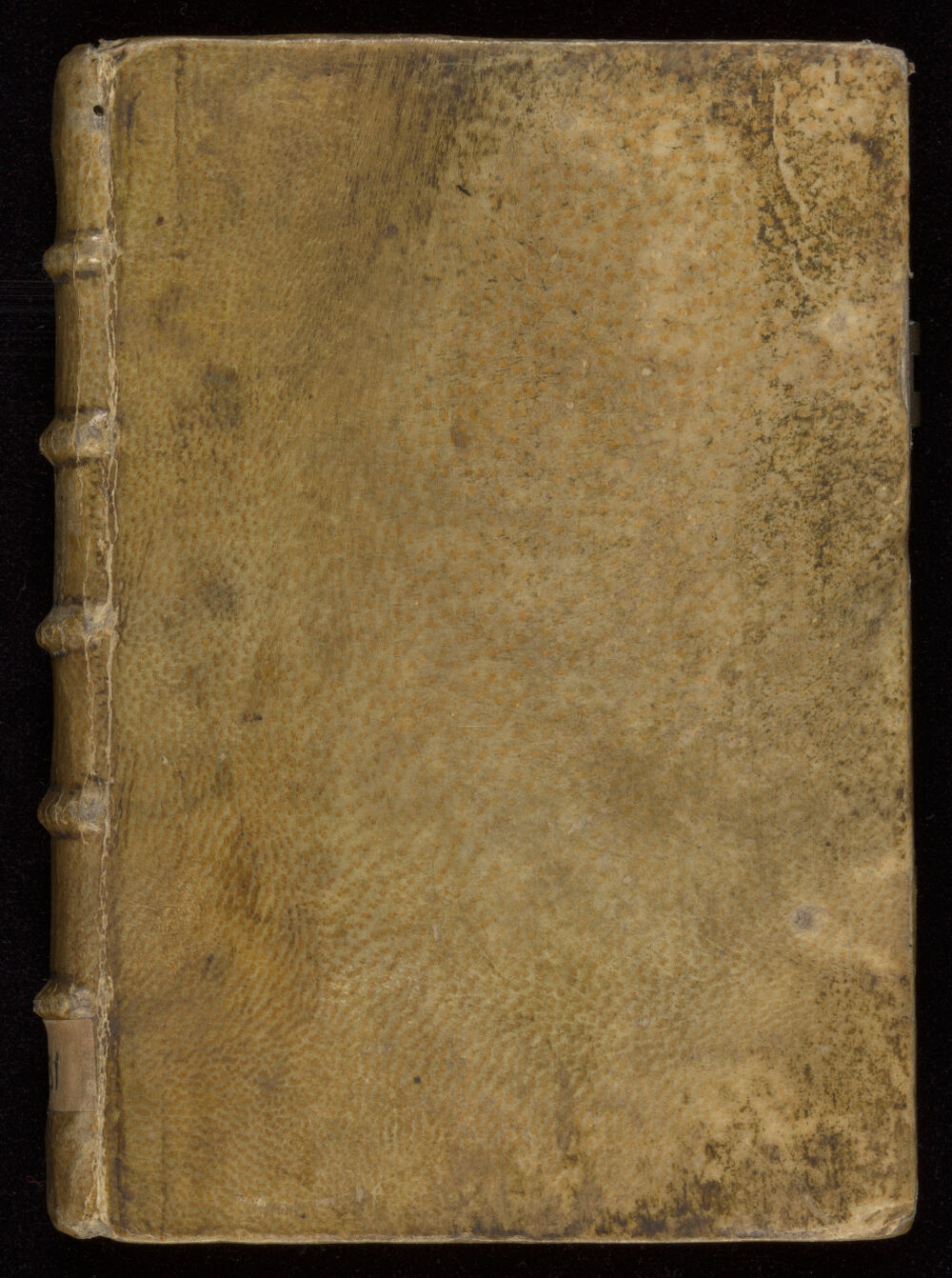 The vellum binding of Wellcome MS 983. Its physical survival reminds us that the history of grimoires is a history of books as objects: copied, bound, handled, collected, corrected, and transmitted. Public Domain Mark, Wellcome Collection.
A second crucial witness is Wellcome MS 4667, a mid-eighteenth-century French pseudo-Solomonic manuscript titled Les Secret misterieux que Dieu a Revellez au sage et sauvent Salomon fils de David. Peterson describes it as an important bridge between older Latin material and later forms of the Grimorium Verum. It contains hundreds of pages and numerous magical drawings. The Wellcome catalogue dates it to the middle of the eighteenth century.
Another relevant witness is BnF Arsenal MS 2795, an eighteenth-century French magical manuscript that includes a “Grimoire pour faire paroitre Lucifer et ses Princes.” The existence of these manuscripts does not produce a perfectly linear family tree, but it makes one point clear: the Grimorium Verum belongs to a living early modern manuscript environment before or alongside the printed editions by which most modern readers know it.
This is precisely why dating grimoires is difficult. A title page may be false. A surviving manuscript may be later than the text it copies. A printed edition may contain older material but rearrange it. Names and diagrams may migrate independently. A later scribe can preserve an early reading, while an earlier witness can already contain corruptions. Historians therefore compare multiple witnesses rather than asking one copy to reveal a single moment of origin.
Why “1517” Is Better Understood as a Claim Than a Date
Modern discussions often repeat one of two statements: either the Grimorium Verum was published in 1517, or it was simply invented in the nineteenth century. The evidence supports a more nuanced position.
The 1517 date on the title page is widely regarded as fictitious. At the same time, manuscript witnesses show that related textual material was circulating before the best-known nineteenth-century printed versions. The Wellcome MS 983 witness, catalogued to around 1709, is particularly significant. Peterson also points to other seventeenth- and eighteenth-century evidence relevant to the textual family.
The book is therefore best approached as a layered early modern grimoire tradition that later acquired famous printed forms. Its “ancient” date belongs to the mythology of the book, not to secure bibliography.
That distinction is essential because the false date itself became part of the book’s afterlife. Occult publishers repeated it. Later readers treated it as proof of Renaissance origin. Modern internet summaries copied it from one another. In this way, a bibliographic fiction became a cultural fact: not true as publication history, but highly influential as part of the identity of the Grimorium Verum.
From Manuscript Dossier to Printed Grimoire
The printed history of the Grimorium Verum is complicated by variant editions and uncertain dating. Peterson identifies French printed exemplars associated with the “Alibeck” title page and with the printer-publisher Simon Blocquel, whose occult publishing activity belonged to the nineteenth-century French world of inexpensive magical literature. Italian versions followed, and the text circulated through an expanding marketplace for grimoires, dream books, fortune-telling manuals, collections of “secrets,” and books of popular occult knowledge.
Earlier occult commentators sometimes assumed that the Italian versions preserved a superior or more complete independent tradition. Peterson’s comparative work argues instead that the Italian printed editions depend on the French textual stream. This is an important example of why textual criticism matters. A later edition can look fuller and more coherent because an editor repaired omissions, borrowed figures, or reorganized material. Completeness does not automatically prove independence.
Print changed the grimoire in several ways. First, it stabilized one arrangement long enough to create a recognizable “book.” Manuscripts could vary dramatically; printed copies multiplied the same errors and the same sequence. Second, print widened the audience. A magical manual no longer had to pass from teacher to pupil or circulate in a small scribal network. It could enter shops, private libraries, police records, clerical denunciations, and eventually the international antiquarian market.
Third, print created a new form of secrecy. A printed grimoire is public in the sense that copies can be bought, but it can remain esoteric through opacity. Strange names, damaged sigils, abbreviated prayers, unexplained Latin, and inconsistent instructions make possession different from comprehension. The book can be materially accessible while remaining interpretively difficult.
This tension—mass reproduction of supposedly secret knowledge—is one of the defining paradoxes of modern grimoire culture.
What Does “Grimorium Verum” Mean?
The Latin title can be translated as “True Grimoire.” That adjective is not modest. It distinguishes the book from false, incomplete, or ineffective rivals. In a crowded occult marketplace, “true” promises authenticity and results. The same rhetorical strategy appears across the history of magical publishing: “true key,” “veritable secret,” “grand grimoire,” “complete art,” “genuine clavicle.”
The word grimoire itself came to designate books of magical knowledge, especially manuals containing conjurations, characters, talismans, prayers, spirit catalogues, astrological correspondences, or practical operations. Its cultural meaning is broader than “spell book.” A grimoire can function simultaneously as a ritual manual, a prestige object, a repository of names, a collection of inherited fragments, and a performance of learned authority.
The Grimorium Verum fits that definition extremely well. Its identity lies not in a single doctrine but in the way it brings several technologies of authority together: biblical attribution, sacred language, hierarchy, written seals, ritual timing, consecrated objects, command formulas, and transactional promises.
Solomon as the Book’s Invisible Author
The historical King Solomon did not write the surviving Grimorium Verum. Yet the book makes little sense without Solomon.
By late antiquity and the medieval period, Solomon had developed far beyond the biblical portrait of a wise king and temple builder. Jewish, Christian, Islamic, Greek, and later European traditions remembered him as a master of spirits, exorcist, possessor of a powerful seal, knower of hidden names, and ruler whose authority extended into the invisible world.
Solomonic grimoires convert that legendary authority into textual form. The operator does not claim power as an isolated individual. The operator inherits a chain. Divine names authorize Solomon; Solomon authorizes the book; the book authorizes the reader who performs the prescribed acts correctly.
That structure can be seen in other materials already explored on SecretMagic, especially the Hygromanteia or Magical Treatise of Solomon. The Byzantine and post-Byzantine Greek tradition is not identical to the Grimorium Verum, but it shows the older development of Solomon as a portable ritual authority. The later French grimoire inherits the prestige of this larger Solomonic world even as it reshapes it for a different cultural environment.
The Book’s Three-Part Architecture
The French text presents itself as a work in three parts. This organization is one reason the grimoire can feel surprisingly compact compared with larger compilations.
The first part: characters, powers, and hierarchy
The opening material introduces the spiritual powers, their characters or seals, and the general logic by which they are said to be invoked and dismissed. The text identifies three superior powers: Lucifer, Beelzebuth, and Astaroth. Beneath them appear intermediary figures and a larger body of subordinate spirits.
The important historical point is not whether this hierarchy corresponds to an objectively existing supernatural bureaucracy. The hierarchy is a literary and ritual technology. It makes the invisible world administrable. Instead of confronting an undifferentiated realm of spirits, the reader receives names, ranks, offices, and chains of command.
The second part: powers and “secrets”
The second part assigns functions to numerous spirits. The promised powers range widely: wealth, hidden treasure, information, weather, transport, invisibility, languages, medicine, alchemy, sleep, locks, social influence, and other forms of practical advantage. Some entries involve coercive, sexual, violent, or medically unsafe claims that should be treated as evidence of historical belief, not as responsible modern instructions.
This catalogue gives the grimoire much of its reputation for directness. Unlike philosophical occult works that spend hundreds of pages explaining cosmic correspondences, the Grimorium Verum often appears to tell the reader which named power corresponds to which desired result.
The third part: ritual procedure
The third part turns toward invocations, prayers, objects, preparation, and the mechanics of ritual performance. The surviving printed texts include Christian prayers, sacred names, consecrations, planetary timing, ritual tools, and instructions that modern readers may find ethically disturbing.
For historians, the third part is especially revealing because it destroys the simplistic idea that “Christian” and “demonic” are separate textual worlds. The grimoire can invoke God, angels, biblical names, and Christian formulae while simultaneously organizing contact with spirits classified as infernal or demonic. Premodern and early modern ritual culture often combined categories that modern readers expect to remain separate.
Lucifer, Beelzebuth, and Astaroth: A Government of the Invisible
At the top of the Grimorium Verum hierarchy stand Lucifer, Beelzebuth, and Astaroth. The text assigns them geographical and administrative relationships and places subordinate powers beneath them. These arrangements vary across magical and demonological literature. There is no single universal “official” demon hierarchy shared by all grimoires.
That variation is itself historically important. Demonologies are systems of classification. They absorb names from scripture, apocrypha, folklore, earlier magical books, theological polemic, misread languages, and scribal invention. A name can change spelling and rank as it passes from one manuscript to another. A spirit who is a duke in one catalogue may be placed differently in another. Copyists can split one name into two or fuse two names together.
The Grimorium Verum therefore should not be treated as a census of an objectively fixed otherworld. It is better understood as one textual attempt to make spiritual power legible through hierarchy.
The structure resembles political administration. Superior powers command deputies; deputies command lesser agents; lesser agents possess specialized offices. The reader is taught not merely whom to name but where each name sits in a chain of authority.
Symbolically, this is a powerful model. It translates the uncertain and invisible into something resembling a court, army, or bureaucracy. The unknown becomes governable when it is given ranks.
Syrach and the Eighteen Spirits
One of the most famous sections of the Grimorium Verum lists eighteen spirits under Syrach. Their names appear in variant spellings across manuscripts and editions: Claunech or Clauneck, Musisin, Bechaud or Bechard, Frimost, Klepoth, Khil, Merfilde, Clisthert, Sirchade, Segal, Hiepacth, Humots, Frucissière, Guland, Surgat, Morail, Frutimière, and Huictiigaras, among others depending on the witness.
Modern occult websites often present such lists as if each spelling were eternally fixed. Manuscript evidence shows otherwise. Unfamiliar names are among the most fragile elements in handwritten transmission. A scribe copying an ordinary French word can rely on grammar and context; a scribe copying an unknown spirit name has fewer safeguards. One ambiguous letter can generate a new spelling that later publishers treat as authoritative.
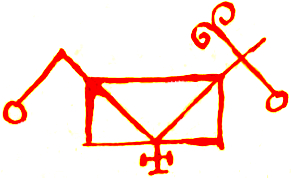 A manuscript character associated with Claunech from Wellcome MS 983, reproduced in Joseph H. Peterson’s digital edition. The comparison of manuscript and printed characters is essential because later editions often omit, distort, or redraw the figures.
The same problem affects the spirits’ seals. A sigil is visually complex, and tiny copying errors can transform it. When a printed edition lacks a figure, later editors may borrow from another manuscript or reconstruct it from parallel texts. The modern reader can therefore encounter several “authentic” seals for the same spirit, each descended from a different chain of copying.
This does not make the images meaningless. It makes them historical artifacts. A damaged seal records transmission. A variant line is evidence of a scribe, engraver, publisher, or editor making a decision.
Why the Seals Matter More Than Decoration
The visual language of the Grimorium Verum is central to its identity. Characters, circles, marks, and seals do not merely illustrate a text that could exist unchanged without them. In the ritual logic of the book, visual form helps identify, authorize, bind, or address powers.
Readers familiar with modern branding may understand one aspect of this intuitively. A seal compresses identity. A signature, coat of arms, corporate logo, notarial stamp, or royal seal can stand for a person or institution even when the person is absent. Premodern magical characters intensify that logic. The sign is treated not just as a representation of authority but as a functional part of the relationship between operator and named power.
The opacity of a magical character can increase its authority. Ordinary writing is meant to be read; an esoteric sign can advertise that it belongs to a specialized system. Its difficulty makes expertise visible.
This is why corrupted figures create a serious historical problem. If the magical text claims that the exact sign matters, but the manuscript tradition shows constant variation, the gap between ritual ideal and book history becomes impossible to ignore. The Grimorium Verum promises precision while surviving through imprecision.
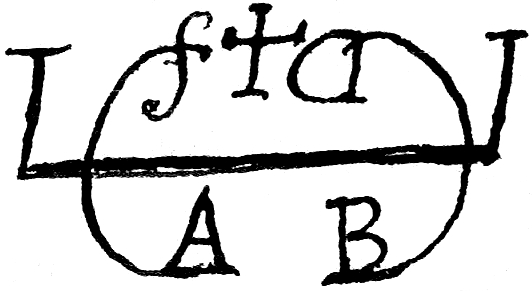 A lamen from Wellcome MS 4667 as reproduced in the Esoteric Archives edition. MS 4667 is a mid-eighteenth-century pseudo-Solomonic manuscript that helps bridge manuscript and later printed forms of the tradition.
The Magic Circle as Architecture, Not Just Protection
Popular culture usually reduces the magic circle to one function: a protective barrier that keeps dangerous spirits outside. Grimoire circles can certainly carry protective meaning, but their symbolic work is broader.
A circle creates a center and a boundary. It distinguishes ritual space from ordinary space. It can organize divine names, directions, planetary relationships, or the identity of the operator. By physically placing the body inside a marked geometry, ritual thought becomes spatial.
The Grimorium Verum tradition includes forms of the circle that vary across witnesses. Peterson notes corruption and distortion in printed figures and compares them with manuscript versions. Again, the historian encounters the same tension: the text implies that the correct figure matters, while transmission repeatedly alters the figure.
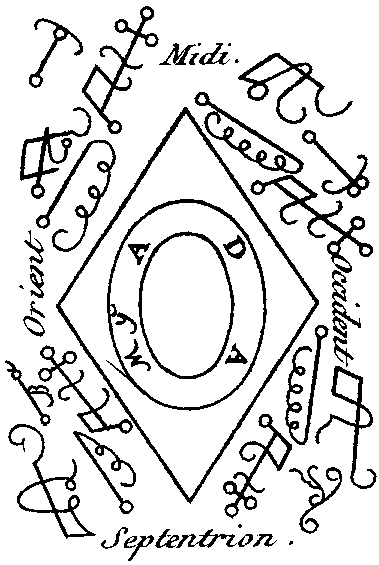 A form of the magic circle reproduced in Joseph H. Peterson’s Grimorium Verum edition. Variant manuscript witnesses help reveal where printed forms became distorted.
Symbolically, the circle can be read as a model of controlled relation. The operator does not simply “enter a magic space.” The operator stages a hierarchy: sacred authority above, bounded human intention at the center, and addressed powers around or beyond that center. Geometry makes the claimed order visible.
Pacts: The Most Disturbing Idea in the Book
The Grimorium Verum is famous for its language of pacts. It distinguishes forms of agreement and repeatedly describes spiritual relationships as exchanges. The spirits do not act “for nothing”; the operator must give, promise, prepare, or enter a defined relationship.
This transactional language is one reason later occult writers classified the work as unusually dark or dangerous. Yet the pact is also historically intelligible within a broader early modern culture of contracts, oaths, service, patronage, obligation, and hierarchy.
A pact creates legibility. Instead of unpredictable spirit contact, it imagines a negotiated relationship with terms. The supernatural world is modeled through social forms familiar to human institutions.
Christian demonology had long represented the demonic pact as a sign of apostasy or illicit exchange, especially in theological and witch-trial literature. Grimoires could invert that accusation by making contractual logic part of an operator’s supposed technique. The same cultural image—the pact—could therefore function differently in an inquisitorial confession, a literary legend such as Faust, and a magical handbook.
It is important not to collapse those genres. A trial record describing an alleged pact is not automatically evidence that an accused person used the Grimorium Verum. A grimoire describing a pact is not proof that readers enacted it. A literary story about selling one’s soul is not a documentary transcript of magical practice. Historians compare these materials while respecting their different purposes.
The Paradox of Christian Prayer Inside Demonic Magic
Readers expecting a purely anti-Christian “book of Satanism” are often surprised by the Grimorium Verum. The text includes prayers to God, divine names, angelic invocations, biblical language, exorcistic forms, and Christian sacred formulas.
This mixture is not an accidental contradiction. It belongs to the structure of many European grimoires. The operator often claims authority over spirits not by rejecting God but by invoking a higher sacred power. The demonic being is compelled through names and hierarchies that ultimately place divine authority above it.
This is one reason the category “black magic” can be historically misleading if used without explanation. A text may be condemned as illicit or demonic by church authorities while still operating inside a Christian cosmology. The practitioner does not necessarily imagine entering a separate religion. The ritual may be parasitic on Christian language, heterodox in application, or explicitly sinful according to orthodox theology, yet still fundamentally dependent on Christian concepts of God, angels, demons, scripture, and sacred names.
The same entanglement appears throughout European ritual magic. Books attributed to Solomon, Honorius, or other religious authorities frequently borrow the language of liturgy while redirecting it toward private goals. The boundary between prayer and conjuration is therefore a historical dispute, not a simple difference in vocabulary.
Ritual Tools and the Material Imagination
The Grimorium Verum devotes attention to tools and materials: blades, writing surfaces, rods, inks, perfumes, metals, stones, and other ritual objects. Some historical instructions involve animal harm, blood, or substances that a responsible modern reader should not reproduce.
Historically, the important question is why these materials mattered.
Ritual objects turn abstract correspondences into physical form. A planetary time becomes a moment for manufacturing. A sacred name becomes an inscription. A prayer becomes attached to an object. A piece of metal becomes associated with a celestial or spiritual hierarchy. A tool becomes different from an ordinary tool because it has been separated from everyday use through timing, blessing, inscription, or restriction.
This logic is not unique to magic. Religious cultures consecrate vessels, vestments, relics, icons, buildings, water, oil, and written texts. Courts authenticate documents with seals. Craftspeople distinguish specialized tools. The grimoire draws on this broader human tendency to materialize authority.
What makes the magical object distinctive is the function assigned to it inside an operative system. It is not only holy, beautiful, or official; it is supposed to help produce a specific result.
Planetary Time and the Search for the Correct Moment
The manuscript environment surrounding the Grimorium Verum preserves planetary tables and related astrological material. This reflects a wider premodern belief that time has quality, not merely quantity. Tuesday and Friday are not only positions in a calendar; planetary hours, lunar phases, and celestial correspondences can make one moment more suitable than another for a particular act.
The same principle appears in learned astrology, medical elections, agriculture, talismanic traditions, the Picatrix, and many Solomonic manuals. Ritual timing translates cosmology into scheduling.
Modern scientific evidence does not establish that planetary hours cause the supernatural effects claimed by grimoires. Historically, however, electional timing provided a disciplined structure for action. The practitioner did not act whenever desire arose; desire had to be fitted into a larger perceived order.
That structure may also produce psychological effects. Waiting for a selected hour intensifies preparation. Repetition of a calendar can create expectation. Celestial timing turns an ordinary evening into a designated event. These observations can help explain ritual experience without reducing every historical belief to psychology or treating supernatural claims as scientifically proven.
From Learned Magic to Popular Print
The Grimorium Verum sits at an important crossroads between learned ceremonial traditions and the popular print culture of magic.
Medieval ritual magic could require Latin literacy, clerical education, astronomical calculation, expensive materials, and access to manuscripts. By the eighteenth and nineteenth centuries, print expanded the circulation of magical knowledge. Cheap books, chapbooks, collections of secrets, dream manuals, fortune-telling texts, and grimoires reached audiences far beyond elite manuscript circles.
Owen Davies’s work on grimoires places magical books inside this broader history of literacy and print. A grimoire was not only a set of ideas. It was a commodity. Printers selected titles, reused woodcuts, copied older editions, altered language, and sold danger as a form of value. Readers bought books for different reasons: curiosity, collection, prestige, divination, practical experiment, or simply because prohibited knowledge is attractive.
The Grimorium Verum was well suited to this market. It was comparatively compact. Its title promised authenticity. Its hierarchy was memorable. Its seals gave it visual authority. Its alleged antiquity made a newly printed object feel old.
In that sense, the book’s success belongs as much to media history as to occult history.
Comparison with the Key of Solomon
The Grimorium Verum belongs to the broad Solomonic universe, but it should not be confused with the Key of Solomon or treated as a simple abridgment of one fixed original.
The Key of Solomon survives in a large, multilingual, highly variable manuscript tradition. Its many forms emphasize ritual preparation, planetary timing, prayers, pentacles, consecrated tools, and experiments. The Grimorium Verum shares several of these features but reorganizes them around a more explicit demonological hierarchy and pact logic.
The difference is partly one of textual personality. The Key often appears as a ceremonial technology of divine names and pentacles applied to many aims. The Grimorium Verum feels more like a compact chain of command. It tells the reader who the powers are, who stands beneath whom, what offices are attributed to them, and how the book imagines access to their services.
Readers who want the earlier Greek background of Solomonic ritual literature can compare the SecretMagic study of the Hygromanteia, which demonstrates how complex the prehistory of the later Clavicula traditions really is.
Comparison with the Grand Grimoire
The Grand Grimoire, sometimes associated with the title Red Dragon, shares the sensational aura of demonic pacts, treasure, and infernal power. Both books were absorbed into the nineteenth-century popular imagination of forbidden magical literature.
They should nevertheless remain distinct. Different manuscript witnesses, printed editions, spirit names, ritual structures, and literary histories belong to each textual family. Later publishers and occult anthologies frequently cross-contaminated grimoires by borrowing seals or passages, which can make the boundaries look less clear than they originally were.
The comparison is useful because it reveals a recurring commercial formula: ancient authority, named spirits, a promise of direct results, and a book presented as dangerously effective. These features helped turn small occult manuals into legendary objects.
Comparison with the Grimoire of Pope Honorius
The Grimoire of Pope Honorius derives its authority from a different kind of scandal. Instead of Solomon, it exploits the imagined power of the papacy and Christian priesthood. It famously combines clerical and liturgical forms with illicit magical aims.
The Grimorium Verum and Honorius traditions overlap in the larger culture of Christianized ceremonial magic, but they dramatize authority differently. Honorius suggests forbidden access to ecclesiastical power. The Grimorium Verum foregrounds Solomonic command, demonic hierarchy, and pact.
Both show why “religious” and “magical” cannot simply be separated by vocabulary. The very prayers and names that make a ritual look Christian can be the features that made religious authorities judge it more dangerous.
Comparison with the Greek Magical Papyri
The Grimorium Verum is separated from the Greek Magical Papyri by many centuries, languages, and cultural transformations. They should not be collapsed into one continuous system. Yet comparison reveals recurring ritual strategies: powerful names, voces magicae, written characters, material preparations, timing, invocation, and the attempt to create specialized relationships with superhuman agents.
The SecretMagic guide to the Greek Magical Papyri shows how late antique ritual texts already combined Egyptian, Greek, Jewish, and other religious elements. The Grimorium Verum belongs to a later Christian European world, but it likewise demonstrates that ritual traditions often thrive through combination rather than purity.
Continuity should therefore be discussed at the level of strategies and textual habits, not by claiming that a specific Grimorium Verum rite descends unchanged from ancient Egypt.
The Problem of “Black Magic”
No discussion of the Grimorium Verum can avoid the phrase “black magic.” The book openly addresses spirits classified as demonic, includes coercive goals, and has long been marketed as a dangerous infernal manual. The label is therefore historically relevant.
But it is also unstable.
“Black magic” can mean harmful magic, demonic magic, forbidden magic, selfish magic, necromancy, anti-Christian practice, or simply magic disapproved by the speaker. Those definitions do not always coincide. A healing operation invoking a demon might be “black” by theological classification but beneficial in intended outcome. A love operation might avoid demons yet still be coercive. A protective curse could be interpreted as defensive by one community and harmful by another.
It is more precise to describe the actual features: demonological hierarchy, pact language, coercive aims, Christian ritual borrowing, spirit conjuration, and popular grimoire transmission. The moral evaluation can then be discussed rather than smuggled into a single color word.
Common Misconception 1: “It Was Printed in Memphis in 1517”
The title page says so. Historical evidence does not securely support it.
The claim should be presented as part of the book’s self-mythology. Early manuscript witnesses such as Wellcome MS 983, dated c. 1709, are far more important for reconstructing the textual history. Later French and Italian printed forms belong to a print culture that repeatedly used false places and dates to manufacture antiquity.
Common Misconception 2: “It Is a Direct Translation from Ancient Hebrew”
The surviving evidence does not establish an ancient Hebrew original from which the printed French book was directly translated. Hebrew attribution is part of the Solomonic prestige system. Biblical and pseudo-Hebrew elements may occur within the tradition, but that is different from proving the title page’s translation claim.
This distinction matters because “translated from Hebrew” was itself a mark of authority. It told readers that the book had crossed a sacred linguistic boundary from the biblical world into Europe.
Common Misconception 3: “Every Edition Has the Same Seals”
They do not. Figures are omitted, distorted, supplied from parallel manuscripts, or redrawn. Peterson’s edition repeatedly compares printed images with Wellcome manuscript witnesses in order to reconstruct missing or damaged material.
When modern occult charts present one clean set of seals without provenance, they conceal the most interesting historical fact: the visual tradition is unstable.
Common Misconception 4: “The Spirit Names Have One Correct Spelling”
Variant spellings are normal. Manuscripts and printed books disagree. Some differences come from handwriting, typesetting, language, or attempts to regularize unfamiliar names. A historically responsible edition records variants instead of pretending that one modern spelling descended unchanged from antiquity.
Common Misconception 5: “Owning the Book Reveals What People Actually Practiced”
A grimoire is evidence of available instructions and imagined possibilities. It is not automatically a diary of practice.
People can own books they never use. They can copy rituals they never perform. They can perform practices learned orally rather than from books. They can modify instructions beyond recognition. Police confiscation records, trial documents, marginal notes, wear patterns, personal notebooks, letters, and ethnographic evidence are needed when historians want to move from text to behavior.
The existence of the Grimorium Verum proves that a particular ritual system circulated. It does not prove how many readers enacted it or what they experienced.
A Symbolic Reading: The Grimoire as a Machine for Turning Desire into Order
Even without accepting the supernatural claims of the book, the Grimorium Verum can be read as a highly structured symbolic technology.
Human desire is usually vague: wealth, knowledge, love, safety, revenge, mobility, influence. The grimoire decomposes desire into categories. Each category receives a name. Each name receives a character. Each character sits in a hierarchy. Each hierarchy requires a procedure. Procedure requires time, space, material, and speech.
The result is a transformation of uncertainty into order.
From a psychological perspective, this can create intense focus. From an anthropological perspective, it converts private desire into culturally meaningful action. From a religious perspective, it places action inside a cosmology. From a literary perspective, it gives the reader a role inside a drama of authority.
None of these explanations proves that the spirits exist as independent beings. Nor do they invalidate the personal spiritual interpretations of practitioners. They simply identify layers of meaning that can be studied without requiring agreement about metaphysics.
Names, Seals, and the Dream of Perfect Address
A recurring fantasy in magical literature is that the invisible can be reached if one possesses the exact name, sign, hour, and formula. This is the dream of perfect address.
Ordinary communication is uncertain. People misunderstand. Letters go unanswered. Power is inaccessible. Bureaucracies lose requests. The grimoire imagines a universe in which correct address overcomes distance: name the right power, display the right sign, use the right authority, and a response becomes possible.
The tragedy of manuscript transmission is that exactness is constantly lost. Spellings mutate. figures blur. pages disappear. printers misplace characters. editors repair what they think is damaged. The material history of the book therefore undermines its own fantasy of perfect precision.
This tension is one of the deepest reasons grimoires fascinate historians. They are texts that promise control while physically demonstrating the instability of knowledge.
The Ethics of Reading Historical Grimoires Today
A responsible modern edition or article should neither sensationalize nor sanitize the Grimorium Verum. The text includes material that many readers will find violent, coercive, exploitative, or unsafe. Hiding those features creates a false history. Reproducing them as a practical recipe creates a different problem.
The better approach is contextual description.
When a ritual uses animal harm, the historian can explain what the instruction reveals about sacrifice, purity, material correspondence, and early modern assumptions without encouraging reenactment. When a spirit is assigned coercive sexual power, the article can identify the gender and consent problems embedded in the text. When a medical claim appears, it should not be presented as evidence-based treatment. When the book promises treasure or wealth, the promise should be classified as a historical claim rather than a guaranteed method.
This approach respects both the source and the reader. Historical magic does not become more authentic when modern writers abandon ethical judgment.
How the Nineteenth-Century Occult Revival Changed the Book
By the nineteenth and early twentieth centuries, grimoires entered a new interpretive environment. Occultists, ceremonial magicians, spiritualists, folklorists, collectors, bibliographers, and anti-occult writers all encountered them through different agendas.
A. E. Waite discussed the Grimorium Verum in his studies of ceremonial magic, but his treatment was shaped by his own theological and occult framework. He often judged grimoires morally while also preserving information about editions that later researchers would revisit.
Twentieth-century popular writers further transformed the text. Some treated it as a practical manual. Others mined it for demon names and seals. Occult publishers produced translations of varying quality. In the process, the book became less tied to specific French and Italian print histories and more like a floating global occult brand.
The internet accelerated the process. Isolated sigils circulate without manuscript references. Spirit lists are copied into databases. False dates are repeated because they appear on old title pages. Modern practitioners compare experiences while historians compare witnesses. The same book now exists simultaneously as archive, commodity, ritual text, folklore, digital image set, and cultural myth.
Why Joseph H. Peterson’s Textual Work Matters
Modern study of the Grimorium Verum has benefited enormously from Joseph H. Peterson’s comparison of French and Italian editions with manuscript witnesses. His digital Esoteric Archives edition is especially useful because it does not hide textual problems. Missing figures, variant names, manuscript parallels, and editorial choices are identified rather than silently repaired.
This approach changes how a reader understands the book. Instead of seeing one eternal grimoire, we see a transmission network.
The difference resembles the study of medieval scripture, classical literature, or folk songs. No single surviving witness necessarily contains the original form. Editors reconstruct relationships by comparing errors, additions, omissions, and shared readings. A grimoire deserves the same philological seriousness.
Peterson’s work also makes a broader point: occult texts are part of book history. They can be studied with the same tools used for sermons, medical recipes, legal documents, and literary manuscripts.
What Wellcome MS 983 Changes About the Story
Wellcome MS 983 is important not because it solves every mystery but because it anchors the tradition in a dated physical object. The Wellcome catalogue describes L’art Magique as a small vellum-bound manuscript, approximately 13.5 by 9.5 centimeters, with headings and diagrams in red, green, and black. Its first work is a pseudo-Solomonic grimoire involving secrets said to operate through demonic powers.
That description immediately changes the mental image of the Grimorium Verum. Before it became a downloadable PDF or mass-market occult paperback, related material existed in a tiny handwritten book. Someone prepared colored diagrams. Someone copied unfamiliar names. Someone bound the leaves. Someone owned and preserved the volume.
The manuscript sits beside works attributed to Peter of Abano and a Uriel invocation. That context suggests compilation rather than isolation. Magical knowledge was assembled from authorities and techniques that a compiler considered mutually useful.
It is also a reminder that “book” is not synonymous with “text.” Binding, size, color, page order, corrections, and visual layout all participate in meaning.
What Wellcome MS 4667 Adds
MS 4667 is a much larger mid-eighteenth-century French manuscript containing pseudo-Solomonic material, talismans, sigils, and other magical works. Peterson uses it to recover or compare figures missing from printed forms of the Grimorium Verum.
This witness is especially valuable because it demonstrates how graphic content could migrate. A later printed edition may present a blank or damaged place where a character should be. A manuscript can preserve a related form. By comparing them, an editor can reconstruct not an absolute original but a more plausible stage in transmission.
The process also reveals editorial responsibility. When a modern edition inserts a figure from another manuscript, that figure should be labeled as supplied rather than allowed to masquerade as if it appeared in the printed source. Transparent editing preserves history.
Grimoires as Archives of Error
Modern readers are often frustrated by errors in magical books. From a historical perspective, errors are among the most useful features.
A repeated misspelling can reveal that two editions share an ancestor. A misplaced image can show how a page was assembled. A meaningless Latin phrase may preserve a damaged line from an earlier source. A strange spirit name may be the fossil of a copying mistake. An omitted diagram can reveal that a printer worked from an incomplete exemplar.
In other words, corruption has genealogy.
The Grimorium Verum is particularly instructive because its authority depends on exact characters and names, yet the textual tradition is visibly unstable. That contradiction forces us to distinguish two forms of authenticity: ritual authenticity, which claims that exact forms matter, and historical authenticity, which accepts that surviving books are products of transmission.
The Modern Question: “Does It Work?”
Searches for the Grimorium Verum frequently lead to one practical question: does it work?
Historical research cannot answer that question in the same way a practitioner might. Manuscripts and editions can show what people claimed, copied, believed, feared, or attempted. They cannot establish supernatural causation under modern scientific standards.
Personal testimonies also require careful classification. A practitioner may report dreams, coincidences, visions, emotional shifts, or perceived material results after ritual. Those experiences can be meaningful to the person and relevant to the study of contemporary religion or esotericism. They are not the same kind of evidence as a controlled demonstration that a named spirit caused an external event.
The most productive scholarly questions are therefore different: How was efficacy imagined? What counted as success for historical readers? How did books tell operators to interpret signs? How did repetition, expectation, fear, secrecy, and ritual structure shape experience?
These questions allow serious study without ridiculing practitioners or converting belief into scientific fact.
Why the Grimorium Verum Still Matters
The Grimorium Verum matters for at least five reasons.
First, it documents the afterlife of Solomonic authority. The legendary king remained powerful enough to authorize magical literature many centuries after biblical antiquity.
Second, it exposes the relationship between manuscript and print. The book is not a clean transition from ancient original to modern edition. It is a web of handwritten witnesses, printed rearrangements, missing figures, and editorial repair.
Third, it shows the entanglement of Christianity and illicit magic. Divine names and prayers do not disappear when demons enter the text. The grimoire depends on the religious cosmology it appears to violate.
Fourth, it illustrates the power of visual knowledge. Seals and circles are not decorative extras; they are central to how magical authority is represented.
Fifth, its false antiquity became culturally productive. The fictional 1517 Memphis publication helped create the aura that allowed the book to survive in occult memory.
How to Study the Grimorium Verum as a Historical Source
Readers who want to move beyond internet summaries can follow a simple research discipline.
- Separate the title-page claim from the catalogue record. Treat “Memphis 1517” as evidence of self-presentation, not as confirmed publication history.
- Compare manuscript and printed witnesses. Wellcome MS 983 and MS 4667 are particularly important reference points.
- Track variant spellings. Do not assume the cleanest modern name is the oldest.
- Record the provenance of images. A seal supplied from a manuscript is different from a seal actually present in a printed exemplar.
- Distinguish description from instruction. Historical reconstruction can explain a ritual without recommending reenactment.
- Read the book beside other grimoires. The Key of Solomon, Honorius traditions, the Grand Grimoire, and related Solomonic materials reveal shared structures and meaningful differences.
- Use book history. Ask who copied, printed, collected, translated, and sold the text.
- Keep belief categories explicit. “The text claims,” “practitioners believed,” and “historians can document” are not interchangeable statements.
Frequently Asked Questions
Is the Grimorium Verum really from 1517?
The date appears on the famous title page, but modern textual evidence does not support treating it as a secure publication date. Related material survives in early eighteenth-century and later manuscript witnesses, including Wellcome MS 983, dated c. 1709. The 1517 date is best understood as part of the grimoire’s claim to antiquity.
Who wrote the Grimorium Verum?
No securely identified historical author is known. The title page’s names belong to the book’s pseudonymous presentation. The text developed through a tradition of manuscripts and print rather than through a single documented authorial publication.
Was it translated from Hebrew?
The title page claims a Hebrew source, but surviving evidence does not establish a direct ancient Hebrew original corresponding to the French printed text. The claim participates in a wider Solomonic strategy of biblical authorization.
Is the Grimorium Verum a Solomonic grimoire?
Yes, in the historical sense that it presents itself within the broad magical tradition attributed to Solomon. That does not mean the historical Solomon wrote it. “Solomonic” describes the book’s claimed lineage, authority structure, and relationship to a large family of pseudo-Solomonic magical texts.
Why are there different spellings of the demon names?
Because manuscripts and printed editions transmit unfamiliar names imperfectly. Handwriting, typesetting, language, copying errors, and editorial correction all create variants. A responsible edition records those differences.
Why do different editions show different seals?
Some printed editions omit figures or preserve corrupted versions. Modern editors may supply missing images from manuscript witnesses such as Wellcome MS 983 or MS 4667. This is why provenance matters when comparing seals.
Is the book purely anti-Christian?
No. Although it deals with spirits classified as demonic and contains material historically condemned by Christian authorities, it also uses Christian prayers, divine names, biblical authority, and angelic language. It is better described as illicit ritual magic operating inside a Christian cosmological framework than as a text completely outside Christianity.
Did people actually perform its rituals?
Some readers and practitioners almost certainly used grimoires operationally, and modern practitioners continue to report doing so. But the existence of a text alone cannot tell us how often a specific ritual was performed. Historical claims about practice require additional evidence such as annotations, legal records, correspondence, ownership history, or ethnographic testimony.
Are the supernatural claims scientifically proven?
No. The text’s claims about spirits, treasure, invisibility, magical healing, alchemy, and other supernatural effects belong to historical belief and occult practice. They should not be presented as established scientific facts.
What is the best way to read the Grimorium Verum today?
For historical study, use a critical edition that identifies manuscripts, printed exemplars, missing figures, and variant readings. Compare the text with catalogued manuscript holdings and with broader scholarship on grimoires and Solomonic magic. Treat operationally dangerous or coercive material as historical evidence rather than as a recommendation.
Conclusion: The “True Grimoire” Is Most Valuable When We Stop Taking Its Legend Literally
The greatest irony of the Grimorium Verum is that a book calling itself the “True Grimoire” became famous through a title page crowded with claims historians cannot verify. Yet exposing those claims does not destroy the book’s significance. It reveals it.
The false Memphis setting shows how Egypt functioned as an imagined homeland of esoteric authority. The false or at least unverified 1517 date shows the commercial power of antiquity. The Solomonic attribution places the book inside a centuries-long transformation of the biblical king into a master of spirits. The manuscript witnesses reveal an active culture of compilation. The printed editions reveal how secret knowledge entered mass circulation. The variant seals and names expose the physical instability of texts that promise exact ritual precision.
Most importantly, the Grimorium Verum demonstrates that grimoires are not merely lists of bizarre spells. They are machines for organizing authority. They translate desire into hierarchy, hierarchy into names, names into signs, signs into procedures, and procedures into a story about how human beings might negotiate with an invisible universe.
Whether one approaches that universe as religious belief, ritual psychology, folklore, literary imagination, or living spiritual practice, the historical book remains concrete. A small vellum manuscript survives. Colored diagrams survive. Printed copies survive. Errors survive. Corrections survive. The survival of those objects allows us to replace sensational legend with a more complex form of wonder: the history of how people made, copied, feared, sold, interpreted, and continually reinvented books of magic.
Sources and Further Reading
- Wellcome Collection, MS 983: L’art Magique. Catalogued c. 1709; includes a pseudo-Solomonic grimoire closely related to the textual history of the Grimorium Verum. Digitized and released under the Public Domain Mark.
- Wellcome Collection, MS 4667: Pseudo-Solomon. Mid-eighteenth-century French magical manuscript with numerous sigils, talismans, and pseudo-Solomonic material. Public Domain Mark.
- Joseph H. Peterson, digital edition of the Grimorium Verum. Includes manuscript comparisons, editorial notes, variant figures, and bibliography; digital text licensed CC BY 4.0.
- Joseph H. Peterson, Grimorium Verum: A Handbook of Black Magic. Critical edition and translation drawing on major French and Italian sources.
- Owen Davies, Grimoires: A History of Magic Books. Oxford University Press; a major study of magical books as cultural and material history.
- Owen Davies, Art of the Grimoire: An Illustrated History of Magic Books and Spells. Yale University Press, 2023; a global history emphasizing the visual and material dimensions of magical books.


