


 A circular diagram in British Library Harley MS 5596, a fifteenth-century Greek miscellany that preserves a version of the Magical Treatise of Solomon. Public-domain manuscript image via Wikimedia Commons.
On folio 3v of British Library Harley MS 5596, a circle opens like a mechanical heaven. Concentric bands are divided into compartments, each occupied by a compact character that resembles neither ordinary Greek writing nor casual decoration. Beneath the diagram, lines of Greek text continue the work of explanation. The page is not merely an illustration of “medieval superstition.” It is evidence of a learned attempt to organize invisible powers through writing, number, time, prayer, image, and inherited authority.
The manuscript is one of the most important witnesses to a Greek ritual tradition now commonly called the Hygromanteia, or the Magical Treatise of Solomon. It belongs to the broad family of texts that placed magical knowledge under the name of the biblical King Solomon. Yet it differs sharply from the popular image of a single, fixed “Solomon grimoire” copied unchanged from antiquity. The Hygromanteia survives through multiple Greek manuscripts, variant titles, rearranged chapters, added materials, and scribal adaptations. It is better understood as a living textual tradition than as one perfectly stable book.
This distinction matters. The Hygromanteia is frequently introduced online as either a manual of water divination or the direct original of the Key of Solomon. Both descriptions contain fragments of truth, but neither is sufficient. Its contents extend far beyond hydromancy, and its relationship to the later Clavicula Salomonis is historically significant without being a simple one-to-one genealogy. Studying the text carefully reveals something more valuable: how Byzantine and post-Byzantine readers assembled a portable cosmos in manuscript form, and how that cosmos traveled into later European ritual magic.
This article examines the Hygromanteia as a historical, religious, material, and symbolic object. It separates documented manuscript evidence from later claims, explains the practices without presenting supernatural outcomes as scientifically established, and shows why this Greek tradition deserves a place beside the better-known Testament of Solomon, the Key of Solomon, and the Latin grimoires of early modern Europe.
A Book with Several Names—and No Single Final Form
The name Hygromanteia is the label most English-language readers recognize today. It suggests hydromancy: divination by water, moisture, or liquid surfaces. Some manuscripts and related traditions do include divinatory operations, but the surviving text is not primarily a narrow handbook devoted to gazing into water. Modern reliance on this title can therefore mislead readers before they encounter the work itself.
Other names illuminate different aspects of the tradition. Catalogues and editions refer to it as the Magical Treatise of Solomon, the Apotelesmatike Pragmateia—roughly, a treatise concerned with effects or results—the Epistle to Rehoboam, and the Solomonike. The “epistle” framing places the work within a familiar pseudepigraphic pattern: Solomon transmits secret wisdom to his son Rehoboam. This literary device does not establish that the historical Solomon wrote the text. It creates a chain of authority, transforming instructions into a royal inheritance.
The multiplicity of names reflects the multiplicity of manuscripts. Ioannis Marathakis’s modern English translation draws on a group of Greek witnesses, including manuscripts associated with London, Bologna, Athens, Paris, Munich, and the Gennadius Library. Pablo A. Torijano’s academic study of Solomon’s development from biblical king to esoteric sage includes both a translation and a Greek synopsis of the Hygromanteia. These scholarly projects do not uncover a pristine original hidden behind all later copies. Instead, they compare witnesses whose structures and readings differ.
That variation is not corruption in the simple sense. Manuscript books were copied by human agents who selected, omitted, corrected, expanded, translated, and recombined materials. A ritual text was especially vulnerable—and especially open—to this process. A scribe might preserve an old prayer while modernizing a recipe, add a planetary table from another source, or place a fragment of the Testament of Solomon beside instructions attributed to the same king. The result is a textual ecosystem.
The most accurate question is not “What is the one authentic Hygromanteia?” but “How did different manuscripts construct Solomonic magical knowledge for different readers?”
Harley MS 5596: A Manuscript Dossier, Not an Isolated Grimoire
Harley MS 5596 is especially useful because its catalogue record reveals the company that the Magical Treatise kept. The British Library describes the codex broadly as a collection of divinations, magic, and related material. The specific text identified as the Magical Treatise of Solomon occupies folios 18v–39v. Elsewhere in the manuscript are forms of arithmomancy and cleromancy, magical recipes, astrological and divinatory matter, part of Recension A of the Testament of Solomon, and a fragment of Recension C.
This arrangement prevents us from treating the codex as a modern single-author book. A manuscript miscellany functions more like a curated archive. Its neighboring texts shape how each item is read. In Harley MS 5596, the Magical Treatise does not stand alone; it participates in a Solomonic and divinatory dossier. The king’s authority is distributed across narrative, demonological, astrological, and operative texts.
The placement beside multiple recensions of the Testament of Solomon is particularly revealing. The Testament presents Solomon as a ruler who interrogates and constrains demons, learns their functions and vulnerabilities, and directs supernatural labor toward the construction of the Temple. The Hygromanteia is not simply another copy of that story. It translates the prestige of the Solomonic ruler into a more manual-like body of knowledge. One text narrates mastery; the other organizes techniques under the master’s name.
Harley MS 5596 is generally dated to the fifteenth century, but the age of this particular copy should not be confused with the date when every component originated. Manuscripts can preserve older textual layers in later handwriting. Conversely, claims of ancient origin inside a text do not prove an ancient date. Historical dating requires comparison of language, manuscript evidence, textual parallels, codicology, and transmission—not acceptance of a legendary attribution.
The manuscript also demonstrates why images are not secondary ornaments. Diagrams, seals, characters, and circular arrangements carry information that ordinary prose cannot replace. A copyist reproducing such a page was not merely transcribing sentences. The scribe was maintaining a relationship among spatial position, written name, line, boundary, and sequence. In ritual manuscripts, layout can be part of meaning.
What Kind of “Magic” Did Byzantine Readers Recognize?
It is tempting to divide Byzantine culture into two sealed compartments: official Christianity on one side and forbidden magic on the other. Legal and ecclesiastical sources did condemn practices identified as sorcery, illicit divination, harmful ritual, and invocation of suspect powers. Saints’ lives often contrast the holy person’s legitimate miracles with the fraudulent or demonic acts of magicians. Those distinctions were real and socially consequential.
Yet the surviving material record is less tidy. Amulets combine crosses, biblical language, angelic names, inherited pagan motifs, medical intentions, and protective images. Prayers can resemble liturgy while serving highly personal goals. Astrological calculation can stand near devotional formulas. A practitioner might understand an operation as Christian protection even when a clerical authority classified it as illicit magic.
Modern scholarship therefore treats “magic” not as a substance with a universally stable definition but as a contested category. Who labels an act magical? A lawgiver, theologian, rival healer, client, modern historian, or practitioner may answer differently. The same object can appear as medicine, prayer, superstition, ritual technology, fraud, or popular religion depending on the observer.
The Hygromanteia occupies precisely this unstable territory. Its world is deeply religious. Divine names, angelic hierarchies, prayers, purification, and Solomonic authority are not decorative additions to a secular technology. They are part of the theory by which the operations make sense. At the same time, the text’s instrumental organization—its concern with selecting times, preparing materials, forming boundaries, and directing powers—distinguishes it from ordinary public worship.
 A sixth-century Byzantine amuletic armband from the Walters Art Museum. Its Christian, Jewish, and inherited protective imagery illustrates the blended visual environment in which late antique and Byzantine ritual objects operated. Image available under the license stated by the Walters Art Museum and Wikimedia Commons.
Solomon’s Transformation from Wise King to Ritual Authority
The biblical Solomon is famous for wisdom, judgment, wealth, temple building, diplomacy, and knowledge of the natural world. Later Jewish, Christian, Islamic, and Mediterranean traditions expanded that portrait. Solomon became an exorcist, astrologer, master of spirits, possessor of a seal, knower of hidden languages, and ruler whose authority extended beyond human subjects.
This transformation did not occur in one moment. It developed through interpretation, legend, pseudepigraphy, material culture, and ritual practice. The Testament of Solomon is one major witness. Protective amulets portraying a mounted holy figure overcoming a female demon form another. Arabic and Islamic stories of Sulayman’s command over the jinn contribute yet another rich branch, with their own theological and literary histories. Medieval and early modern grimoires then attached Solomon’s name to prayers, pentacles, spirit catalogues, experiments, and ritual protocols.
Pablo Torijano describes this long development as the making of “Solomon the esoteric king.” The phrase is useful because it preserves both parts of the identity. Solomon is not imagined as an eccentric village sorcerer. His magical power derives from kingship ordered by wisdom. He judges, classifies, names, confines, assigns, and governs. Ritual authority becomes a supernatural extension of royal administration.
That model explains why Solomonic books repeatedly emphasize correct hierarchy. Divine authority stands above angelic or spiritual powers; the operator seeks legitimacy through sacred names, purity, inherited instruction, and proper command. Whatever later practitioners believed about literal spirits, the textual structure represents power as lawful when it descends through an authorized chain.
The attribution also solves a literary problem. A manual containing unusual characters, specialized preparations, and secret names needs an explanation for its knowledge. Solomon supplies one. His legendary wisdom links biblical antiquity to the manuscript’s present, while the father-to-son transmission explains secrecy: the knowledge was not absent from history; it was reserved for worthy heirs.
The Operational World of the Hygromanteia
The exact order and contents vary across manuscripts, so any summary must avoid pretending that every witness contains the same chapters. Nevertheless, the tradition repeatedly organizes ritual knowledge around several interacting domains. These domains are more historically illuminating than a sensational list of “spells,” because they reveal the text’s underlying model of causation.
1. Celestial Time Is an Active Condition
In the Hygromanteia’s world, time is qualitative. An hour is not an empty container in which an action happens; it has celestial character. Planets, zodiacal relationships, lunar conditions, days, and hours can support or obstruct particular aims. The ritual worker is therefore partly a scheduler of correspondences.
This temporal logic is not unique to the Hygromanteia. Astrological medicine, agricultural calendars, electional astrology, talismanic traditions, and works such as the Arabic Ghāyat al-Ḥakīm, known in Latin as the Picatrix, also treat celestial configurations as meaningful conditions. What distinguishes a given manual is how it selects, simplifies, and ritualizes that wider science.
Modern readers often reduce this to “perform the ritual on the correct day.” The manuscript logic is more complex. Correct timing joins the operator’s intention to a perceived cosmic order. It is an act of participation rather than mere superstition about a date. Symbolically, the practitioner does not force a neutral universe; the practitioner seeks an opening in a universe already alive with differentiated qualities.
2. Materials Carry Correspondence and Memory
Inks, plants, metals, stones, animal substances, perfumes, writing surfaces, lamps, and vessels appear throughout premodern ritual traditions. Their selection is rarely random. A material may be linked to a planet, a medical property, a biblical association, a color, a sensory effect, or an inherited recipe.
For historians, the important point is not whether these correspondences produce the supernatural effects claimed by practitioners. The important point is that material choice makes a cosmology tangible. A metal associated with a planet is celestial theory made portable. A fragrance is not only symbolic; it changes the atmosphere, marks ritual time, and acts on memory and attention. An ink fixes spoken authority into durable form.
Some historical recipes include substances that are toxic, irritant, unethical, or unsafe. A responsible modern study should never assume that “traditional” means harmless. The value of these recipes lies in what they reveal about historical classifications of nature, not in uncritical reproduction.
3. Writing Is an Operation, Not Merely a Record
The Hygromanteia’s characters, names, seals, and diagrams belong to a culture in which writing could be performative. A written sign might identify, petition, constrain, protect, commemorate, or embody a relationship. This differs from everyday writing, but it is not incomprehensible. Legal signatures, royal seals, liturgical inscriptions, boundary markers, and sacred calligraphy also make authority visible through form.
Magical characters often resist ordinary reading. Their opacity can signal secrecy, antiquity, nonhuman origin, or technical specialization. To a modern eye they may look like arbitrary marks, yet their arrangement can be as significant as their shape. A character placed inside a circle, near a divine name, or in a planetary compartment participates in a visual grammar.
 Seals in Harley MS 5596, folio 31r, from the Greek Magical Treatise of Solomon. The folio shows how image and script form a single technical page. Public-domain image via Wikimedia Commons.
4. Ritual Space Is a Model of Ordered Authority
Circles, directional arrangements, marked tools, and prescribed positions create a bounded ritual environment. Popular culture imagines the circle only as a defensive barrier against demons. Protection is certainly one function in many grimoires, but a circle can do more. It can map hierarchy, distinguish the consecrated center from ordinary space, orient the body toward cosmic directions, and make an abstract order visible on the ground.
From an anthropological perspective, boundary making changes behavior. Entering a marked space creates a threshold between ordinary and ritual identity. Speech becomes formulaic; movement becomes deliberate; objects acquire assigned roles. Even without accepting a supernatural explanation, the psychological and social effects of formalized space are real. That observation does not prove or disprove spiritual claims; it explains one layer of ritual efficacy.
5. Names Establish Relationship and Rank
Premodern ritual texts often treat names as more than labels. A divine or angelic name can invoke presence, authority, memory, and scriptural association. Names of spirits can classify powers and make them addressable. Long strings of unusual words may preserve foreign-language fragments, altered sacred names, scribal errors, deliberate voces magicae, or combinations whose histories are difficult to reconstruct.
The temptation is to translate every unfamiliar word as a precise “secret name.” Philology demands more caution. Copying across languages can deform a term beyond recognition. Greek, Hebrew, Latin, Arabic, and invented or ritualized syllables may coexist in later manuscripts. Scholars compare variants to determine whether a sequence is stable, corrupted, meaningful in another language, or intentionally nonsemantic.
6. Divination Seeks Information Before Action
The manuscript context includes several methods of divination. This matters because ritual magic is not represented only as causing events. It is also a system for diagnosing hidden conditions: whether an undertaking is favorable, what force is involved, when to act, or how to interpret uncertainty.
Divination can therefore function as an epistemology—a culturally specific theory of how knowledge becomes available. Lots, numbers, celestial signs, dreams, and symbolic figures translate uncertainty into a structured answer. Their historical users did not necessarily experience these techniques as random entertainment. They could regard them as disciplined consultations with a meaningful cosmos.
From a modern scientific standpoint, claims that such techniques reliably reveal hidden facts require evidence and should not be assumed. From a historical standpoint, however, the procedures tell us how communities managed risk, responsibility, and ambiguity. Divination is often most revealing when studied as a decision-making practice.
Purification: Moral Preparation, Technical Cleanliness, and Altered Attention
Purification in ritual manuals can involve prayer, fasting, abstinence, washing, clean clothing, confession-like preparation, or avoidance of specified activities. It would be a mistake to interpret all of these requirements as primitive hygiene or arbitrary inconvenience. They operate on several levels at once.
First, purification authorizes the practitioner morally. The operator claims not to approach sacred power casually or from an impure motive. Second, it creates technical consistency: objects, spaces, and bodies are separated from ordinary use. Third, it alters attention. Fasting, repeated prayer, solitude, reduced stimulation, and anticipation can intensify concentration and expectation.
These effects help explain why purification becomes a cross-cultural feature of ritual without proving that every metaphysical claim attached to it is true. The same practice can be theological for the believer, disciplinary for the practitioner, and psychologically consequential for the observer.
There is also an ethical tension. A manuscript may demand purity while including operations for domination, coercion, retaliation, or private advantage. Historical texts do not always share modern ethical assumptions. Responsible interpretation should not romanticize them. Instead, it should ask how practitioners justified conflicting aims and how ideas of purity could legitimize power.
The Holy Rider, the Bound Demon, and the Protective Seal
Material culture helps reconstruct the imaginative world surrounding Solomonic texts. Late antique and Byzantine amulets often depict a mounted figure spearing a female demon or threatening force. Some inscriptions identify or invoke Solomon; related objects associate the rider with saints such as Sisinnios or with a generalized holy warrior. The reverse may show the “much-suffering eye” attacked by animals and weapons, a visual formula against the evil eye.
These objects do not prove that the Hygromanteia directly caused every rider image. They demonstrate a broader tradition in which protection was visualized as authorized mastery over a personified affliction. The mounted ruler occupies the superior position; the demon is named, exposed, and overcome. The image turns invisible danger into a scene with a victor.
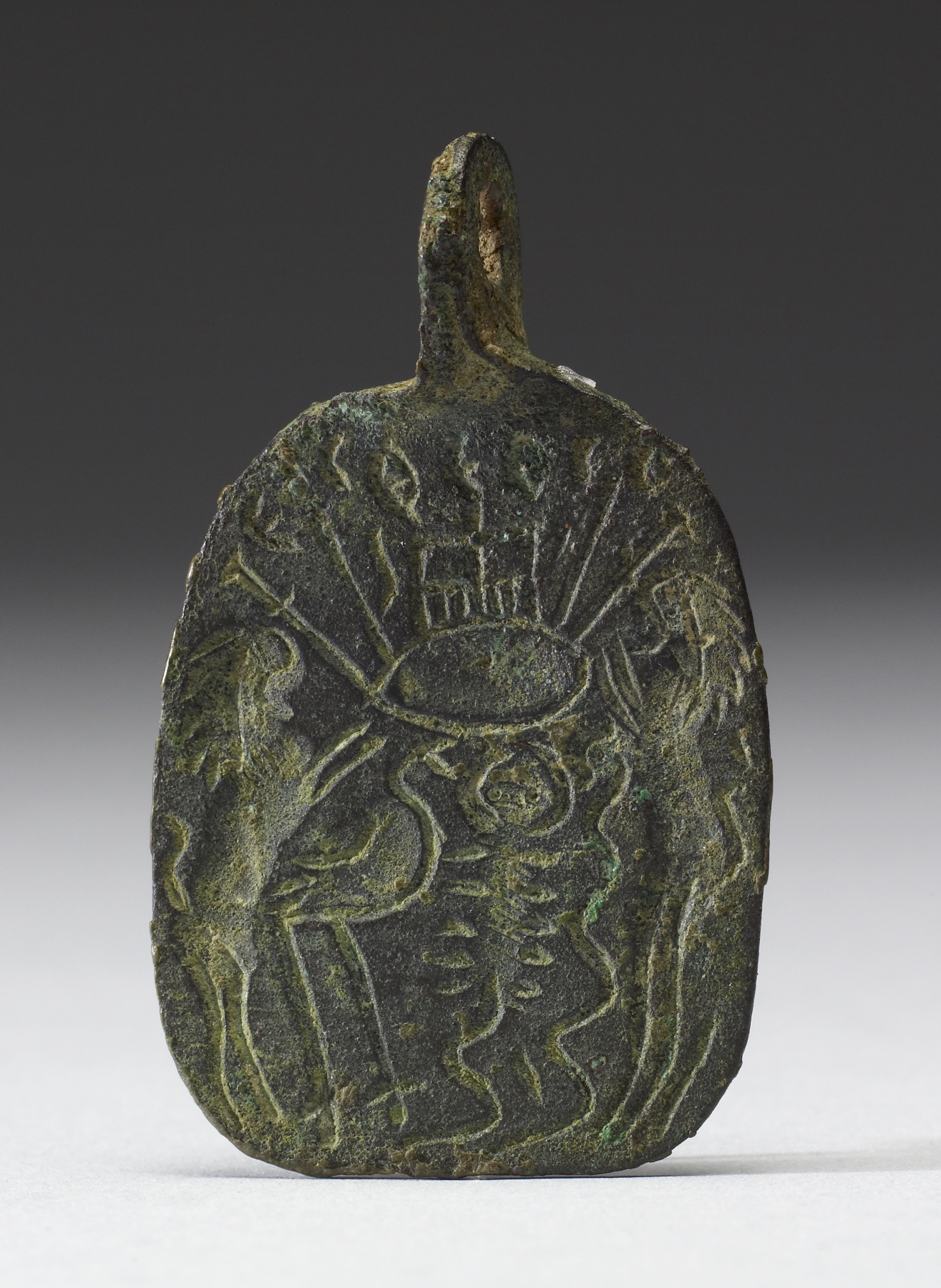 A fifth-century Byzantine amuletic pendant from the Walters Art Museum. One face presents the “much-suffering eye”; the other associates Solomon as holy rider with the defeat of a threatening female figure. Image available under the license stated by the Walters Art Museum and Wikimedia Commons.
The seal works through a related logic. A seal authenticates authority, closes access, marks ownership, and preserves a command. In Solomonic legend, the seal is both sign and instrument of kingship. Later grimoires multiply “seals of Solomon,” but there is no single universal design that remained unchanged from the biblical period. Different communities produced different forms while claiming the same prestigious source.
This is one of the clearest examples of tradition operating by attribution rather than exact graphic continuity. A later diagram can be “Solomonic” because it participates in the king’s mythology of wisdom and command, not because archaeologists can trace its lines to an object worn by the historical monarch.
Hygromanteia and the Testament of Solomon: Related but Not Identical
Because Harley MS 5596 contains both the Magical Treatise and portions of the Testament of Solomon, readers often blur the two. They share a central authority figure and belong to overlapping Solomonic traditions, but their genres and emphases differ.
The Testament of Solomon is largely narrative and interrogatory. Solomon receives power over demons, questions them about their names and activities, discovers which angels thwart them, and compels their labor. The story creates a demonological catalogue through dialogue. It also dramatizes the danger of compromised wisdom: Solomon’s mastery does not prevent his eventual moral failure.
The Hygromanteia is more recognizably procedural and compilatory. Rather than telling one continuous story, it arranges knowledge useful to an imagined operator. Its emphasis on timing, materials, figures, prayers, and practical classifications gives it the character of a technical handbook, though no surviving witness should be assumed to represent a single original author’s complete plan.
The two traditions reinforce each other. The narrative explains why Solomon possesses authority; the manual makes that authority transmissible. When copied in the same codex, they offer a reader both mythic precedent and technical application.
Was the Hygromanteia the Original Key of Solomon?
The relationship between the Hygromanteia and the Key of Solomon is the subject that attracts the greatest modern interest—and the greatest oversimplification. The Clavicula Salomonis, or Key of Solomon, survives in a very large and diverse manuscript tradition across several languages. A recent study in the Harvard Theological Review emphasizes that there is no single uniform Clavicula: hundreds of manuscripts and printed books display substantial variation.
Greek Solomonic materials, including the Hygromanteia, clearly belong to the prehistory and transmission environment of later Key traditions. Scholars and editors identify parallels in ritual architecture, celestial timing, consecrated tools, prayers, characters, and Solomonic framing. It is reasonable to describe the Greek treatise as an important precursor and source tradition.
It is less responsible to imagine a neat family tree in which one complete Greek book was translated once and became every later Key of Solomon. Texts traveled through excerpts, translations, rearrangements, oral explanation, auxiliary manuals, and contact with other ritual literature. Latin, Italian, French, English, Hebrew, and other witnesses developed local forms. Chapters could migrate independently. Diagrams could be redrawn. Christian formulas could be expanded or altered. Astrological materials could enter from parallel sources.
The distinction between “ancestor” and “identical original” is therefore crucial. The Hygromanteia helps explain how a Greek Solomonic manual tradition could feed later European grimoires. It does not erase the complex editorial history of those grimoires.
 A page dated 1572 from The Clavicle of Solomon, revealed by Ptolomy the Grecian. It represents a later Key of Solomon tradition rather than the Byzantine Hygromanteia itself. Public-domain image via Wikimedia Commons.
A Practical Comparison
- Hygromanteia: a family of Greek Solomonic magical treatises preserved in variant manuscripts, with strong Byzantine and post-Byzantine context.
- Testament of Solomon: a pseudepigraphic narrative centered on Solomon’s interrogation and command of demons.
- Key of Solomon: a diverse early modern and later manuscript family emphasizing ritual preparation, tools, pentacles, prayers, timing, and experiments.
- Lesser Key of Solomon or Lemegeton: a different composite grimoire tradition, best known for its Goetia section and catalogues of spirits; it should not be treated as another title for the Hygromanteia.
- Greek Magical Papyri: much earlier Greco-Egyptian ritual documents from antiquity, containing a different mixture of Egyptian, Greek, Jewish, and other elements. They provide valuable background but are not versions of the Hygromanteia.
For a deeper look at the older Egyptian concept of ritual power, SecretMagic’s article on Heka and ancient Egyptian magic offers an important contrast. The comparison shows that “magic” is not one universal system moving unchanged from Egypt to Byzantium. Each culture organizes ritual authority through its own languages, institutions, gods, scriptures, and material practices.
Why Manuscript Variants Matter More Than Secret “Authenticity”
Occult publishing often markets a text by promising the oldest, truest, or complete version. Historical manuscripts rarely cooperate with that promise. A diagram may be missing from one copy and elaborated in another. A prayer may use different divine names. A chapter sequence may shift. A scribe may correct a word accurately—or replace an unfamiliar word with a familiar but wrong one.
Textual criticism compares these differences. The goal is not always to create a single final text that cancels every manuscript. Variants can preserve the history of use. An added prayer may show adaptation to a Christian environment. A modified planetary list may reveal contact with another astrological source. A redrawn seal may expose the practical difficulties of copying images.
This is especially important for “barbarous names” or nonstandard characters. A copyist cannot easily reproduce what the copyist does not understand. Small visual changes accumulate. Later practitioners may then interpret a copying error as an intentional mystery. Philology does not destroy the sacred or symbolic interest of a text; it prevents modern imagination from being mistaken for historical evidence.
Readers researching such works online can use the method described in SecretMagic’s guide to verifying occult history and manuscript claims. Catalogue shelfmarks, folio numbers, edition histories, and institutional records are more reliable than unattributed images reposted without context.
The Manuscript as a Portable Cosmos
The Hygromanteia can be read symbolically without reducing it to fantasy. Its pages construct a miniature ordered universe. Celestial hours establish time. Directions and circles establish space. Names establish hierarchy. Materials establish sympathy between levels of nature. Purification establishes the operator’s condition. The seal establishes authority. The manuscript gathers these relationships into an object that can cross generations.
This “portable cosmos” is not a metaphor imposed from nowhere. Medieval diagrams frequently compress large systems into visible forms. A circular figure can join astronomy, theology, memory, and ritual movement. Its power for the reader lies partly in simultaneity: relationships that prose describes one after another appear together on the page.
The book also disciplines the imagination. It tells the operator where attention should move, which names should be remembered, what sequence should be observed, and what boundaries should not be crossed. The manuscript is therefore both archive and instructor. It stores a tradition while training a particular kind of reader.
Symbolically, Solomon represents the intellect that orders multiplicity. The many spirits, times, materials, and signs threaten chaos until they are named and assigned a place. This reading helps explain the enduring attraction of Solomonic magic even among modern readers who do not accept its supernatural claims literally. The system offers an image of consciousness confronting disorder through knowledge, ethics, language, and form.
Ritual Efficacy: Four Different Questions Often Confused
Discussions of old magical texts frequently collapse several questions into one: “Does it work?” A more precise analysis separates at least four meanings of efficacy.
- Historical efficacy: Did people copy, purchase, conceal, condemn, or use the text? The manuscript record shows that Solomonic ritual knowledge mattered enough to transmit.
- Social efficacy: Did possession of the book confer status, fear, authority, or suspicion? A learned-looking diagram or rare name could shape relationships even before any ritual was attempted.
- Psychological and performative efficacy: Could fasting, repetition, sensory control, expectation, and formal space alter attention and experience? Such effects are plausible and observable without proving spirits exist.
- Supernatural efficacy: Did the rites objectively command nonhuman beings or reveal hidden facts? Historical documents record belief and testimony, but they do not by themselves provide scientific confirmation.
Keeping these questions separate allows respect without credulity and skepticism without ridicule. A ritual may be historically and psychologically powerful even when its metaphysical claims remain unverified. Conversely, a vivid personal experience should not automatically be generalized into a universal scientific fact.
Common Misconceptions About the Hygromanteia
“It Is Only a Book of Water Scrying”
The modern title encourages this assumption, but the manuscript tradition encompasses a much broader range of astrological, ritual, protective, divinatory, and material knowledge. Water-related divination belongs to a wider technical environment rather than exhausting the text’s identity.
“Solomon Personally Wrote the Surviving Manuscripts”
No credible historical evidence establishes that the biblical king authored Harley MS 5596 or the medieval Greek textual family. The attribution is pseudepigraphic: it gives the work ancient authority and places it within a legendary transmission from Solomon to Rehoboam.
“There Is One Exact Seal of Solomon”
Different periods and communities used hexagrams, pentagrams, complex characters, rings, mounted-rider images, and other designs under Solomonic names. The tradition is unified by authority and story more than by one unchanged graphic emblem.
“The Hygromanteia and the Lesser Key Are the Same Book”
They are distinct textual traditions. The later Lemegeton is a composite work whose sections have their own manuscript histories. Shared Solomonic attribution does not make all grimoires identical.
“Byzantine Christianity Eliminated Every Older Magical Element”
Ecclesiastical authorities condemned many practices, but texts and amulets show continued blending, reinterpretation, and competition. Christian names and images could coexist with inherited astrological and protective forms. This coexistence did not mean the Church officially approved them.
“A Modern Translation Reproduces One Perfect Ancient Original”
Modern translations are scholarly or editorial constructions based on selected manuscripts. A responsible edition explains its witnesses and variants. Translation also requires decisions about technical terms, damaged passages, names, and diagrams.
“Public-Domain Means Context-Free”
A manuscript image may be legally reusable while still being easy to misidentify. The shelfmark, folio, date, institution, and relationship to the text should accompany the image. A mysterious diagram detached from its catalogue becomes visual misinformation.
Ethics: Studying a Ritual Manual Without Reproducing Its Harms
Historical grimoires may contain operations aimed at coercion, sexual control, revenge, theft detection, spirit constraint, or manipulation of another person’s will. Recording that such material exists is not the same as endorsing it. Modern educational treatment should describe the historical categories while refusing to present harmful or coercive procedures as responsible solutions.
Several further cautions are necessary. Premodern recipes can involve toxic substances, unsafe smoke, blood, animal harm, fire hazards, sleep deprivation, or prolonged fasting. Manuscripts were not written under modern medical, legal, or ethical standards. No reader should ingest, burn, or apply an unidentified historical ingredient because a translation labels it sacred.
Mental health also matters. Intensive isolation, fasting, repetitive invocation, and sleep disruption can produce distressing experiences. People who are vulnerable to paranoia, mania, psychosis, or severe anxiety should not treat a historical grimoire as a substitute for professional care. A cultural history article can explain ritual structure without encouraging dangerous experimentation.
Finally, respect for living traditions requires precision. “Solomonic magic” intersects with Jewish, Christian, Islamic, Greek, Arabic, and European histories, but these communities are not interchangeable. The presence of Hebrew names in a Christian manuscript does not make the whole work an authentic expression of rabbinic Judaism. The legend of Sulayman in Islamic culture should not be flattened into a European demon-conjuring manual. Comparison is valuable when it preserves difference.
From Forbidden Knowledge to Museum and Digital Object
The modern life of the Hygromanteia differs radically from its manuscript life. A text once accessible to a small literate network can now circulate through scans, translations, social media, videos, and online occult communities. This democratization has real benefits. Researchers can compare catalogue data, locate editions, and view images that previously required travel and institutional permission.
Digital circulation also creates new distortions. Cropped folios lose shelfmarks. AI-generated illustrations are mislabeled as medieval originals. A modern redrawing is presented as an “ancient seal.” Publisher language is repeated as scholarly consensus. Search engines reward confident simplification over careful uncertainty.
The solution is not to retreat from digital research but to practice source transparency. A reliable article distinguishes the manuscript from the modern edition, the image from its caption, the catalogue description from a practitioner’s interpretation, and the evidence of belief from evidence of objective supernatural effect.
The Hygromanteia is particularly suited to this method because it resists easy certainty. Its history is distributed across manuscripts. Its title is unstable. Its Solomonic attribution is legendary. Its relationship to the Key of Solomon is important but complex. Every one of these complications makes the text more interesting, not less.
Why the Hygromanteia Still Matters
The Hygromanteia matters first because it corrects a Western-European bias in the popular history of grimoires. Ritual magic did not suddenly appear in Latin and English books. Greek-speaking Byzantine and post-Byzantine environments preserved, reshaped, and transmitted bodies of astrological, religious, and operative knowledge that contributed to later traditions.
Second, it demonstrates that a grimoire is not simply a container of instructions. It is a material artifact produced by scribes, owned by readers, classified by libraries, and transformed by translation. Its diagrams and errors are historical evidence. The physical page tells a story that a list of spells cannot.
Third, it reveals the extraordinary adaptability of Solomon. The biblical king became a shared figure through whom different cultures thought about wisdom, demons, stars, medicine, protection, and legitimate command. That adaptability explains both the breadth of the tradition and the danger of treating every Solomonic text as the same.
Finally, the Hygromanteia offers a disciplined way to think about symbolic practice. Its universe is ordered through correspondences, boundaries, names, and timing. Whether read religiously, psychologically, artistically, or historically, that structure asks a persistent question: how does a human being imagine a lawful relationship with powers larger than the self?
Frequently Asked Questions
What does “Hygromanteia” mean?
The term is commonly connected with hydromancy or divination involving water or moisture. However, the surviving Magical Treatise of Solomon covers far more than water divination, so the modern title can create an overly narrow impression.
When was the Hygromanteia written?
There is no single uncontested composition date for every textual layer. Important surviving Greek witnesses are medieval or post-medieval; Harley MS 5596 is generally dated to the fifteenth century. Some materials may preserve older traditions, but legendary claims of Solomonic antiquity are not historical dating evidence.
Who wrote it?
The historical author or compilers are not securely identified. The attribution to Solomon is pseudepigraphic. Multiple manuscripts show that the work developed through copying, compilation, and adaptation rather than remaining the product of one demonstrable author.
Is Harley MS 5596 the only copy?
No. Modern editions compare several Greek manuscripts from different collections. Harley MS 5596 is a major and visually striking witness, not the entire tradition.
Does the manuscript contain the Testament of Solomon?
Harley MS 5596 contains parts associated with more than one recension of the Testament of Solomon as well as the Magical Treatise. They are related Solomonic works but should not be collapsed into one text.
Is it older than the Key of Solomon?
The Greek tradition represented by the Hygromanteia is an important precursor to later Key of Solomon traditions. However, the transmission involved multiple manuscripts, languages, and editorial changes. “Older source tradition” is more accurate than “the one unchanged original of every Key.”
Is the Hygromanteia a Christian text?
Its surviving forms operate in a strongly Christianized Byzantine environment and use Christian sacred language, yet they also preserve and recombine astrological, Jewish, late antique, and broader Mediterranean ritual elements. It is better described through its layered context than forced into a single pure category.
Did the Byzantine Church approve it?
No general approval should be assumed. Byzantine legal and ecclesiastical authorities condemned many forms of magic and illicit divination. The survival of Christianized magical texts and amulets shows practice and belief, not official endorsement.
Can its supernatural claims be scientifically verified?
The manuscripts document what authors and users believed, prescribed, or transmitted. They do not by themselves provide scientific proof that spirits were objectively commanded or hidden facts supernaturally revealed. Historical evidence and scientific confirmation are different kinds of claim.
What is the safest way to study it?
Begin with institutional manuscript catalogues, critical scholarship, and transparent translations. Track shelfmarks and folio numbers, compare variant descriptions, and avoid physically reproducing recipes involving unknown substances, fire, coercion, fasting, or health risks.
Conclusion: A Tradition Preserved in Variants
The Hygromanteia is not valuable because it offers a shortcut to guaranteed supernatural power. It is valuable because it preserves a complicated meeting of manuscript culture, Byzantine religion, astrology, material symbolism, Solomonic legend, and later European grimoire traditions.
Harley MS 5596 makes that meeting visible. The Magical Treatise sits beside divinations and portions of the Testament of Solomon; diagrams share the page with Greek instructions; royal authority becomes ritual structure. Other manuscripts modify the inheritance, proving that the tradition lived through variation.
Read carefully, the Hygromanteia changes the question we ask of grimoires. Instead of searching for a single secret book outside history, we encounter generations of scribes and readers building ordered worlds from inherited fragments. Their claims should be evaluated critically, their cultures treated respectfully, and their pages understood as evidence—not only of what people hoped to command, but of how they imagined knowledge itself could be made powerful.
Sources and Further Reading
- British Library Archives and Manuscripts Catalogue: Harley MS 5596, Divinations, Magic, etc.
- British Library: Harley MS 5596, fols. 18v–39v, Magical Treatise of Solomon
- British Library: Harley MS 5596, fols. 8–18, part of Recension A of the Testament of Solomon
- British Library: Harley MS 5596, fols. 39v–41, fragment of Recension C
- Pablo A. Torijano, Solomon the Esoteric King: From King to Magus, Development of a Tradition, Brill
- Ioannis Marathakis, The Magical Treatise of Solomon or Hygromanteia, WorldCat record
- Alicia Walker, “Magic in Medieval Byzantium,” in The Cambridge History of Magic and Witchcraft in the West
- “Upon the Magician’s Escritoire: A Recently Discovered Hebrew Clavicula Salomonis,” Harvard Theological Review
- Armand Delatte, Anecdota Atheniensia, Open Library record


