


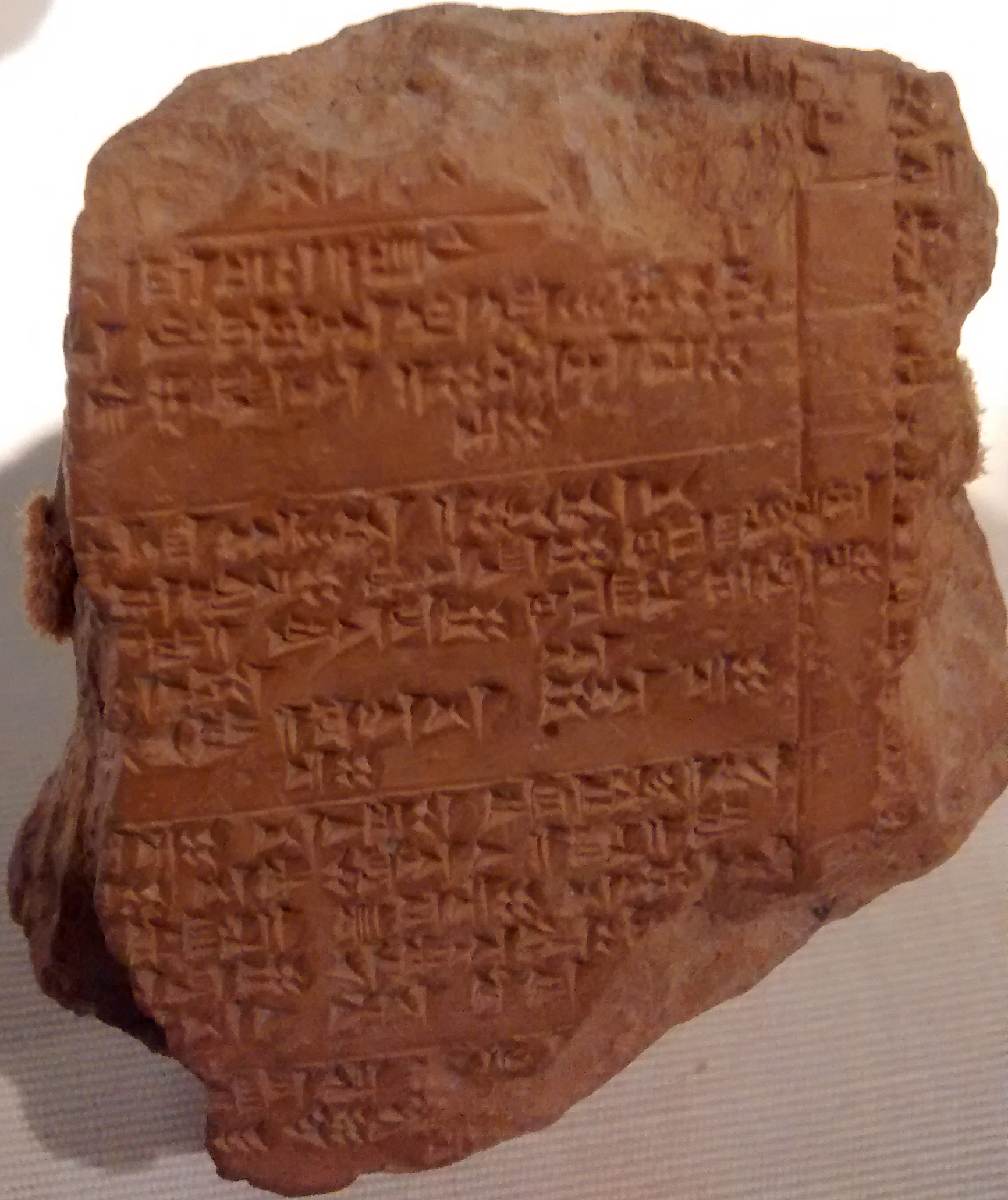
 A Hittite cuneiform tablet from Hattusa, probably fourteenth century BCE, preserving a cultic festival text for the goddess Tetešḫapi. Photograph by Mx. Granger, CC0, via Wikimedia Commons.
When modern readers hear the phrase “Hittite magic,” they may imagine secret spells performed at the margins of Bronze Age religion. The surviving evidence from ancient Anatolia tells a more complicated story. Ritual techniques that we might classify as magical were not necessarily marginal, illicit, or opposed to religion. They could be written down by palace scribes, preserved in royal archives, performed by recognized specialists, used to protect kings and queens, and integrated into a religious world crowded with gods, ancestral powers, dangerous impurities, oaths, omens, curses, illnesses, and invisible forms of contamination.
The Hittite kingdom and empire flourished in Anatolia during the second millennium BCE, with its political center at Hattusa in what is now central Turkey. Thousands of cuneiform tablets recovered there preserve treaties, laws, myths, prayers, festivals, omen texts, medical prescriptions, and an unusually rich body of ritual instructions. Those ritual tablets allow us to watch ancient experts diagnose misfortune not simply as a physical or psychological problem but as a disturbance in relationships among people, gods, places, words, objects, and forms of pollution. The solution was often practical and material: wash, burn, bury, break, transfer, carry away, sacrifice, speak, bind, untie, cross a boundary, or send a dangerous burden somewhere it could no longer harm the patient.
This article examines that ritual world without pretending that the English word “magic” maps neatly onto Hittite categories. It focuses on purification, substitution, scapegoat rites, incantation speech, ritual specialists, nighttime ceremonies, dangerous places, and the remarkable logic by which evil could be moved from one body or household into another object and then expelled. The goal is not to reconstruct a modern occult system from fragmentary Bronze Age texts. It is to understand how the Hittites themselves used ritual technologies to make misfortune manageable.
Why “Hittite Magic” Is a Useful but Imperfect Label
Ancient Anatolian ritual texts do not divide neatly into our modern boxes of religion, medicine, magic, psychology, and law. A single ceremony may contain prayer to deities, sacrifice, manipulation of symbolic objects, verbal analogies, purification by water, disposal of contaminated materials, and instructions that look to modern eyes like sympathetic or contagious magic. Calling the whole thing “magic” can be convenient, but it can also hide the fact that the rite belonged to an accepted institutional world.
The problem is especially obvious when the client is the king. Hittite ritual texts include procedures intended to purify the royal couple, avert ominous consequences, remove hostile sorcery, treat pollution, repair damaged relations with the gods, or substitute another being for a threatened ruler. These were not necessarily private acts performed against the state. They could be state-supported responses to danger. The same archives that preserve diplomatic treaties and royal prayers also preserve ritual knowledge.
Scholars therefore often speak more precisely about purification rites, anti-witchcraft rituals, substitution rituals, birth rituals, healing rituals, funerary rituals, festival rites, omen rituals, and many other genres. The word “magic” is most useful when it draws attention to particular mechanisms: the transfer of an unwanted condition, the use of analogy, the manipulation of miniature figures, the performative power of spoken formulas, and the controlled disposal of pollution. It becomes misleading when it suggests a universal underground religion separate from official cult.
This distinction matters because Hittite texts repeatedly show ritual expertise operating inside ordinary structures of authority. The palace collected foreign specialists and foreign ritual traditions. Hurrian, Luwian, Hattian, Mesopotamian, and Anatolian elements could coexist in the same cultural sphere. Hittite ritual culture was not a sealed national tradition. It was a multilingual archive of techniques.
Hattusa as an Archive of Ritual Technologies
Hattusa was not only an imperial capital; it was also a place where ritual memory was written, copied, classified, and stored. The cuneiform tablets recovered from the city reveal a scribal culture deeply interested in preserving instructions. Some compositions name the ritual practitioner from whom a rite was known. Others exist in multiple copies or versions. This is important because a ritual tablet is not simply a theological essay. It is closer to a record of actions: what must be prepared, what must be said, what must be touched, where the participants must go, which deity must receive an offering, and what must happen to the dangerous materials when the operation ends.
The written form also reminds us that ritual traditions can be both oral and scribal. An incantation could be spoken aloud while its authorized wording circulated in cuneiform. A practitioner’s expertise was embodied in performance, yet the palace archive could preserve the sequence and speech for future use. Recent work on Hittite incantation prayers emphasizes exactly this interplay between speech acts, ritual setting, and scribal craftsmanship.
The resulting corpus is exceptionally valuable for the history of magic because it shows that ritual action was not improvised chaos. Procedures were structured. Materials had roles. Spoken formulas often explained what an action meant. If a thread was cut, a knot untied, wax melted, water poured, or an object sent away, the accompanying words could explicitly identify the analogy: just as this thing changes, so should the patient’s dangerous condition change.
That logic is familiar from many ritual traditions, but the Hittite documentation allows us to observe it in unusually concrete detail. The ritual is a technology of transformation. It changes the status of persons and places by moving substances, names, symbols, and obligations through a controlled sequence.
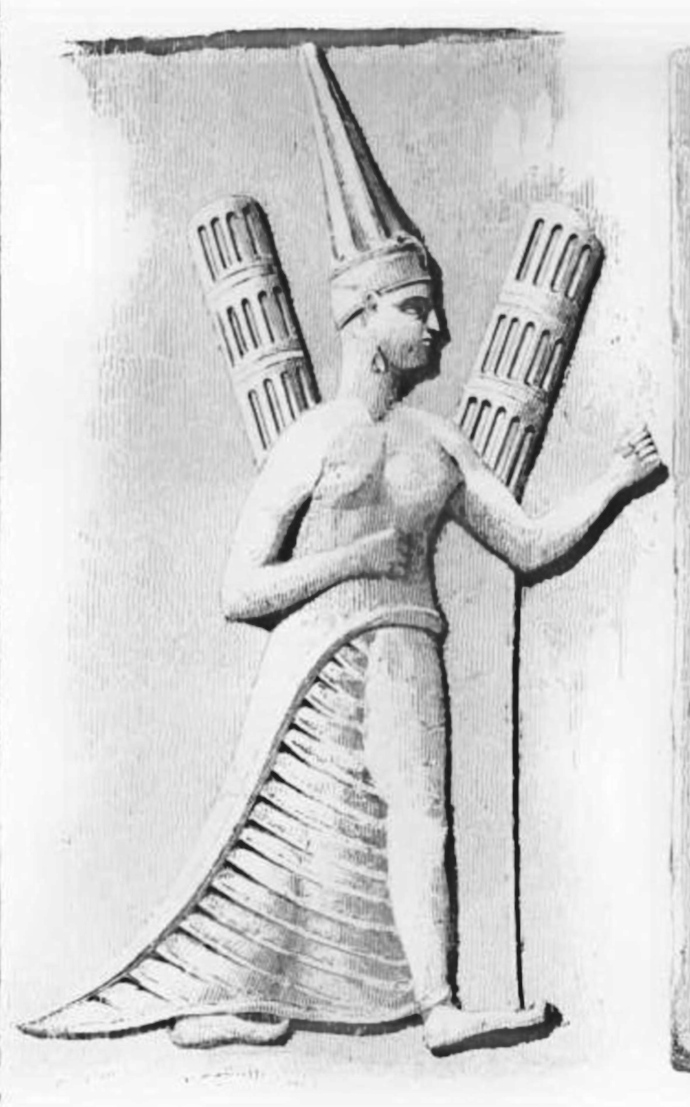 Šauška at the rock sanctuary of Yazılıkaya near Hattusa, in a nineteenth-century drawing by Charles Texier. The sanctuary reflects the strong Hurrian presence within late Hittite religion. Public domain via Wikimedia Commons.
Purity Was Not Simply Cleanliness
Purification stands at the center of many Hittite rituals, but “purity” should not be reduced to modern hygiene. Ancient Anatolian ideas of cleanliness certainly included bodily and environmental dimensions, yet ritual purity concerned a broader condition in which a person, object, house, temple, or royal body was properly ordered and free from dangerous contamination. Pollution could have physical causes, moral associations, ritual causes, supernatural causes, or combinations that our modern categories would separate.
The language used in Hittite texts distinguishes states of purity and consecration, and modern scholarship has emphasized that purity can be understood as a condition of ritual neutrality: the absence of an impurity that interferes with normal relations. A sacred object may require a more elevated status than something that is merely cleansed. This helps explain why purification rituals could be elaborate even when no ordinary dirt was involved.
Water naturally played an important role, but it was not the only cleansing medium. Rituals could involve fire, wool, bread, clay, figurines, plants, animals, metals, threads, stones, and specially prepared substances. What matters is not a universal property inherent in one material but the role assigned to it within the rite. Some substances absorb danger. Some carry it away. Some mark boundaries. Some represent the patient. Some are offered to supernatural beings. Some are destroyed so that the harmful condition they bear is destroyed with them.
Recent research on Hittite concepts of hygiene has also warned against assuming that ritual purity and everyday cleanliness are entirely separate. Societies organize the body through overlapping ideas of health, order, disgust, social status, sacredness, and danger. Hittite evidence belongs to that larger human pattern, even though its particular rules must be reconstructed from Bronze Age sources rather than projected from modern habits.
The Ritual of Tunnawi: Cleansing a Polluted Body
One of the best entry points into Hittite purification is the ritual associated with a woman named Tunnawi. The surviving text is generally dated to the Middle Hittite period and has long attracted attention because of its detailed sequence of cleansing actions. The ritual addresses a person afflicted by impurity and seeks to purify the body in a comprehensive way. A teaching edition of the Hittite text maintained by the University of Texas highlights the rite’s concern with purifying the “twelve parts” of the patient’s body and restoring bodily and generative well-being.
The importance of the Tunnawi ritual is not that every action can be reduced to one theory. It combines several strategies. Materials are manipulated around the client. Polluting forces are separated from the body. Symbolic actions are accompanied by words that identify what is being removed. The patient is treated as a body whose boundaries have become compromised and must be restored.
In such rituals, the body is never merely anatomical. It is social and ritual. A person can carry the effects of hostile speech, taboo, curse, sorcery, illness, or divine displeasure. Purification therefore does more than wash skin. It changes the person’s relationship to the forces believed to have entered or surrounded them.
The ritual’s detailed attention to body parts also illustrates a broader feature of ancient ritual medicine: precision does not require modern physiology. A ceremony can be highly systematic while operating with a different model of causation. The text identifies components of the person, addresses them through repeated actions, and seeks to produce total restoration. The ritual expert is working with a map of the body as culturally understood.
For historians of esotericism, Tunnawi is valuable because it complicates the stereotype of ancient magic as a collection of dramatic spells. Much of the work is procedural and therapeutic. The rite constructs a safe passage from pollution back to ordinary life.
When a House Could Become Polluted
Hittite purification was not limited to bodies. A house itself could require ritual treatment. The composition catalogued as CTH 446, recently studied in detail under the title Purifying a House from Blood, prescribes a two-day procedure for a building contaminated by impurity. “Blood” is a central concern, though the ritual can address other causes as well.
The idea that a place can become polluted is fundamental to understanding Hittite ritual space. Misfortune does not remain abstract. It adheres. A violent death, forbidden act, dangerous substance, curse, or supernatural event can alter the status of a location. Ordinary occupation cannot simply continue as though nothing happened. The building must be ritually reset.
The purification of a house reveals how ritual boundaries operate. The contaminated space must be distinguished from the clean world around it. Materials associated with the impurity may need to be removed. Offerings and incantations address deities whose cooperation is necessary. The ritual transforms the house from a dangerous zone back into a viable human environment.
This logic has parallels throughout the ancient Mediterranean and Near East, but the Hittite sources deserve to be understood on their own terms. Rather than imagining “haunted houses” in a modern sense, we should think of pollution as a condition with legal, religious, bodily, and cosmological dimensions. A house was embedded in a network of obligations. Purification restored that network.
The Power of Transfer
One of the most striking mechanisms in Hittite ritual is transfer. An unwanted condition can be moved from a person onto another medium. The logic is simple enough to summarize but sophisticated in practice: identify the harmful force, provide a receiver for it, establish contact or equivalence, move the force, and then dispose of the receiver so that the danger leaves the patient’s world.
This is sometimes described using the comparative language of contagious magic. The term can be helpful when the ritual depends on contact: an object touches the patient, absorbs impurity, and is then carried away. Yet Hittite texts show that different kinds of transfer must not be collapsed into one category. A substitute is not always the same thing as a scapegoat, and a purifying material is not always treated as a full symbolic double of the client.
Recent analysis of Hittite and Luwian rites distinguishes substitution from scapegoat mechanisms by asking whether equivalence is explicitly established between patient and substitute. In a substitution rite, the substitute can be identified with the threatened person through words or gestures; the dangerous fate is transferred; then the substitute is removed or destroyed. In a scapegoat-type rite, by contrast, an animal or object may carry away evil without first becoming a complete equivalent of the patient.
This distinction is more than terminology. It shows that ancient ritualists thought carefully about how causation worked. Transfer could operate through identity, contact, representation, expulsion, or gift. The same outward act—sending away an animal, for example—can mean different things depending on the ritual explanation.
Nakkušši: The “Sent-Away” Carrier
A particularly important Hittite term in discussions of expulsion is nakkušši, commonly associated with something “sent away” or released as a carrier of evil. Animals can function in this way. A ritual may load danger onto a living carrier and then drive or release it away from the center of human life.
These practices are often compared with the biblical scapegoat of Leviticus 16, and the comparison is historically useful because elimination rites are widely attested in the ancient Near East. But similarity does not prove direct identity. Hittite, Hurrian, Syrian, Mesopotamian, and Israelite traditions each developed their own ritual grammars. The broader pattern is the belief that impurity or evil can be materially relocated and expelled beyond a meaningful boundary.
In some Hittite examples, the target is not merely an individual. A whole land can be threatened by plague or collective misfortune. The ritual then works on a political scale. The kingdom is imagined almost as a body requiring purification, and the carrier removes danger from that body.
The boundary matters. To “send away” is not simply to move something a few meters. The harmful force must be displaced from the social center into a location where it can no longer circulate among the people. Roads, wilderness zones, rivers, pits, mountains, and uncultivated places can become ritual destinations because they lie outside the ordinary domestic order.
Substitution and the Problem of Fate
Substitution rituals address an even more dramatic question: what if a predicted disaster is attached to a person, especially a king? In ancient Near Eastern divinatory cultures, omens could announce danger before it occurred. Ritual action offered a way to negotiate that future.
Hittite royal substitution texts belong to a wider Near Eastern family of rites in which the threatened ruler may be symbolically replaced. The substitute receives the dangerous destiny so that the king can survive. This is not identical to ordinary purification. The problem is not only pollution already present but a fate expected to arrive.
The ritual logic assumes that identity can be constructed ceremonially. A substitute becomes effective because the rite creates a meaningful equivalence. Names, garments, gestures, objects, food, or verbal statements can establish the connection. Once the dangerous outcome has been redirected, the relationship must be closed so that the threat does not return.
Such practices reveal a worldview in which prophecy and ritual are not necessarily opposites. An omen may be true in the sense that it accurately identifies danger, yet ritual can still respond to it. Prediction is therefore not always fatalism. The future is structured, but structured futures can sometimes be diverted through authorized action.
Wax, Clay, Bread, Wool, and the Material Intelligence of Ritual
Hittite rituals often use humble materials. This is one of their most revealing features. The power of the ceremony does not depend on rare jewels or exotic substances alone. Bread, wool, clay, water, wax, thread, plants, and ordinary animals become effective because they are placed within a system of analogies and divine relationships.
Wax and clay are particularly well suited to representation. They can be shaped into figures, manipulated, broken, burned, buried, or melted. A miniature body can stand for a person or hostile force. Its physical transformation makes an invisible change visible. When the figure is destroyed, the rite dramatizes the desired destruction or removal of what it represents.
Bread and other food substances can act as offerings, carriers, or analogical materials. Wool can bind, wipe, encircle, or absorb. Threads can be knotted and untied. The actions are intelligible because their physical properties participate in the ritual argument. Something that binds can represent binding; something that can be severed can represent separation; something absorbent can receive contamination.
This is why it is misleading to imagine ancient ritual as “irrational” simply because its causal model differs from laboratory science. The procedures show acute attention to material properties. The practitioner selects objects because they can perform a metaphor physically.
Incantations as Actions, Not Decorations
The spoken component of Hittite ritual is not merely commentary added to a physical ceremony. Words themselves are actions. An incantation can identify a threat, command a force, appeal to a deity, establish equivalence, declare separation, or explain the analogy that makes a material gesture effective.
Recent scholarship on Hittite incantation prayers emphasizes their character as speech acts. This concept is useful because it avoids treating ritual language as either meaningless poetry or primitive science. A legal oath changes a social relationship because authorized words are spoken under defined conditions. Ritual speech can function similarly within a sacred framework.
The power of the formula therefore depends on context. Who speaks? In whose presence? Over which objects? At what stage of the ceremony? To which deity or dangerous force? Repeating the same words outside that sequence may not reproduce the same act, because the act is constituted by the entire ritual situation.
Hittite rituals also preserve the multilingual complexity of Anatolia. Some formulas belong to traditions identified with Luwian, Hurrian, Hattian, or other cultural backgrounds. The Hittite scribal archive did not erase these differences. Instead, it sometimes preserved foreign-language ritual speech as part of authoritative practice.
This is a major lesson for the history of magic. Sacred language does not always work because every participant understands it in ordinary conversational terms. Antiquity repeatedly shows specialists preserving old, foreign, technical, or formulaic speech because its ritual identity matters.
Women as Ritual Experts
The surviving corpus complicates simplistic assumptions about gender and religious authority. A number of Hittite ritual compositions are associated with female practitioners. Some are identified by personal names and places of origin; others belong to specialist categories often translated approximately as “Old Woman” or ritual woman, depending on context.
These practitioners were not necessarily outsiders accused of forbidden witchcraft. They could be recognized experts whose knowledge was written down and employed for clients of high status. Their authority came from mastery of procedures: how to diagnose ritual danger, which substances to prepare, how to speak the formulas, and how to move the patient through the sequence.
The presence of women in these texts is especially important because later European histories of magic often make the “witch” the default female ritual figure. Hittite evidence does not support such a simple equivalence. A woman could be a professional agent of purification rather than the source of pollution.
At the same time, Hittite texts certainly knew fears of hostile sorcery. Ritual experts could be called to remove the consequences of malicious acts. The same culture therefore accommodated both legitimate ritual specialists and the category of dangerous magical aggression. The boundary was social and legal, not simply technological: similar ideas about transfer or incantation could be judged differently depending on intention, authorization, and target.
Anti-Witchcraft Without a European Witch Hunt
The term “witchcraft” appears frequently in modern discussions of Hittite ritual, but it should not import the assumptions of early modern European witch trials. Hittite anti-witchcraft texts concern harmful ritual action, evil words, curses, pollution, and the need to reverse supernatural aggression. They do not describe a single organized satanic conspiracy or a medieval demonological system.
A threatened client might believe that another person had acted against them through hostile rites, speech, or objects. The counter-ritual seeks to identify and neutralize the harm, sometimes sending it back toward its source or removing it to a place where it can no longer operate.
The king and queen could themselves require protection from “evil words.” This phrase points to a world in which speech has consequence. Slander, curse, oath violation, and ritual utterance overlap as forms of socially dangerous language. Words can damage relationships among humans and gods.
For modern readers, this is a useful corrective. Ancient magic was not always about commanding spirits to obtain extraordinary power. Much of it was defensive. People sought ways to survive uncertain causation: unexplained illness, reproductive failure, political danger, plague, ominous dreams, broken relationships, and accusations that another person had deliberately caused harm.
Night as a Ritual Environment
Some Hittite ceremonies take place at night. Alice Mouton’s study of Hittite night rituals asks a crucial question: what did night itself contribute to ritual effectiveness? Darkness is not merely an inconvenient time of day. It can be a distinct religious environment associated with transitions, dreams, chthonic forces, secrecy, and the movement between ordinary and extraordinary states.
Nighttime rites may address powers that are best approached outside daylight order. Fires, lamps, pits, stars, silence, and darkness change the sensory world of the ritual. The participant enters a temporally bounded space in which dangerous forces can be confronted and then released before the return of day.
We should avoid assuming that every nocturnal rite was secret or illicit. Official rituals can occur at night. The significance lies instead in cosmological timing. A ritual can use the rhythm of sunset and sunrise as part of its transformation. What begins under danger may end with restored order in the morning.
This temporal logic appears elsewhere in ancient magic as well. For readers interested in comparative ritual technologies, SecretMagic’s study of Buddhist dhāraṇī shows a very different tradition in which timing, repetition, sacred speech, material texts, and protective aims also interact without fitting a simple modern division between religion and magic.
Pits, Roads, Rivers, and “Untouched” Places
Space in Hittite ritual is functional. Different places are selected because they can receive, separate, or communicate. A ritual performed in a house addresses domestic order. A rite outside the city can remove danger from inhabited space. A pit can open a controlled connection with underworld powers. A road can carry something away. Water can transport impurity. An “untouched” location can serve because it lies outside normal human use.
Studies of Hittite invocation and purification rituals note ceremonies conducted beyond settled space, including locations characterized as uncultivated or untouched. The movement from center to margin is itself an act. The practitioner takes pollution from the patient and relocates it into a different geography.
This gives Hittite magic a strongly spatial quality. Evil is not only defeated; it is positioned. The ritual asks where a dangerous thing belongs. If it does not belong in the king, house, city, or country, it must be given another destination.
The act of disposal also prevents recirculation. A contaminated object left in the household would remain a problem. Destruction, burial, release, or removal completes the ritual circuit. Modern summaries sometimes focus on the dramatic middle of a rite—the figurine, spell, or sacrifice—but ancient instructions often care just as much about cleanup. The ending secures the boundary.
Hurrian and Luwian Knowledge Inside Hittite Ritual Culture
Hittite ritual religion was never culturally pure. The empire incorporated peoples and traditions across Anatolia and northern Syria, and its archives preserve a dense mixture of Hittite, Luwian, Hurrian, Hattian, and Mesopotamian elements. Some ritual experts are explicitly identified by regional origin. Gods travel across languages. Techniques are adopted, translated, and reorganized.
This multicultural character is essential when discussing “Hittite magic.” The label describes texts preserved in the Hittite imperial sphere more than a single homogeneous ethnic tradition. Kizzuwatna, a region in southeastern Anatolia with strong Hurrian and Luwian connections, was particularly important in the transmission of purification practices.
The rock sanctuary of Yazılıkaya near Hattusa provides a visual counterpart to this textual hybridity. Its divine processions include Hurrian deities integrated into the late Hittite royal religious landscape. The goddess Šauška, for example, belongs to a Hurrian tradition and is related to the wider Near Eastern family of goddesses associated with love and war.
Ritual archives therefore document cultural exchange at a technical level. Empires do not merely conquer territory; they collect expertise. A foreign ritual may be valuable precisely because it is believed to solve a problem for which local resources are insufficient.
The Gods Were Participants, Not Symbols Alone
Modern esoteric interpretation often treats ancient gods as symbols or psychological archetypes. That can be meaningful within modern spirituality, but it should not be projected backward as the only explanation of Hittite practice. The ritual texts address gods as agents with preferences, jurisdictions, anger, generosity, and the capacity to intervene.
Offerings are not merely props. They maintain relationships. Prayers attempt persuasion. Oaths invoke divine witnesses. Pollution can block proper interaction with the sacred world, while purification makes restored communication possible.
The famous bronze treaty tablet from Hattusa, though not a magical text, vividly illustrates this divine social universe. The treaty between Tudhaliya IV and Kurunta invokes numerous gods as witnesses to political obligation. Religion, law, kingship, and supernatural enforcement are inseparable.
 The bronze treaty tablet from Hattusa, dated to the thirteenth century BCE. Its invocation of divine witnesses illustrates how political and sacred obligations overlapped in Hittite culture. Photograph by Bjørn Christian Tørrissen, CC BY-SA 3.0, via Wikimedia Commons.
That overlap helps explain why ritual purification could be politically urgent. If the king stood at the center of relationships between gods and land, his pollution was not a private matter. Protecting the royal body could mean protecting the kingdom’s cosmic and political stability.
Ritual and Medicine Were Not Opposites
Hittite healing evidence resists another modern binary: rational medicine versus magic. Ancient practitioners could use plants, foods, washing, bandaging, fumigation, incantation, prayer, and symbolic transfer without feeling compelled to assign them to mutually exclusive systems.
A symptom might be treated materially while its deeper cause was understood ritually. Reproductive problems, for example, could involve bodily substances and divine relationships at once. What modern medicine would call a physiological condition and what modern anthropology might call a ritual condition could belong to the same ancient diagnosis.
This does not mean every Hittite treatment was effective in biomedical terms, nor does it mean modern readers should imitate procedures intended for a Bronze Age religious environment. Historical understanding requires a different question: what counted as a coherent explanation of illness for the people who commissioned these rites?
The answer is that bodies were porous to social and supernatural forces. Hostile words, oath violations, divine anger, impurity, and contact with dangerous substances could become embodied. Healing therefore required the restoration of boundaries as much as the administration of a remedy.
Analogy as Ritual Reasoning
Many Hittite rites use explicit analogies. An object is broken, melted, untied, carried away, or transformed, and the spoken formula declares that the patient’s problem should undergo an equivalent change. This pattern is sometimes described as “sympathetic magic.” The phrase is useful if we remember that it describes an observed mechanism rather than a complete ancient theory.
Analogy works because ritual links two events: what happens to the object and what should happen to the condition. If wax disappears in flame, hostility may be told to disappear. If a knot is released, a blocked condition may be released. If impurity is wiped onto wool and the wool removed, contamination becomes transferable.
The analogy is not merely intellectual. It is performed before witnesses, often under divine authority. The physical action makes the desired outcome present in miniature. In that sense, ritual analogy is a form of embodied argument.
Readers familiar with later astral and Hermetic magic may recognize a distant structural similarity—the idea that carefully organized correspondences can make one level of reality act upon another. But the historical systems are different. SecretMagic’s guide to the Arabic and Latin Picatrix examines a much later intellectual tradition in which celestial correspondences, images, timing, and natural properties are theorized in philosophical terms. Hittite rites are earlier and operate through a different religious vocabulary, even when both traditions demonstrate disciplined analogical thought.
Why Fire Appears So Often
Fire is an especially powerful ritual medium because it visibly transforms matter. Burning can destroy an object, send smoke upward, purify a substance, consume a symbolic enemy, or terminate the dangerous status of a carrier.
In anti-witchcraft settings, destroying a figurine or contaminated object may represent the neutralization of hostility. Yet fire is not universally purifying. Context determines meaning. A substance burned as an offering is not identical to an image burned to eliminate a threat.
The sensory force of fire also matters. Light, heat, smell, smoke, and irreversible change make the ritual outcome perceptible. The patient does not have to imagine that the harmful object has vanished; everyone can see its transformation.
Such acts remind us that ritual persuasion operates on multiple audiences. The gods are addressed, but humans are also watching. A rite can reassure a sick person, publicly mark the removal of danger, and produce a memorable boundary between “before” and “after.” Psychological effects do not cancel religious meanings; they are part of how ceremony functions socially.
What the Hittites Feared
The ritual corpus offers a catalog of vulnerability. People feared plague, infertility, bad omens, divine anger, oath-breaking, hostile speech, sorcery, pollution from blood, contamination of houses, political threats, and dangerous supernatural forces. The texts show an elite world with extraordinary resources, but also a recognizably human struggle with uncertainty.
Many rituals begin not from confidence but from ambiguity. Something is wrong, and the precise cause may be uncertain. Ritual provides a structured response. Even when the practitioner cannot identify the original agent of harm, the rite can remove the condition and restore order.
This is one reason ritual systems are so resilient historically. They transform uncertainty into procedure. Prepare these materials. Go to this place. Speak these words. Transfer the danger. Dispose of the carrier. Make the offering. Return purified. The rite creates a sequence when life feels chaotic.
That structure may be more important than the spectacular elements emphasized in modern popular culture. The deepest lesson of Hittite ritual magic is not a hidden formula. It is the conversion of crisis into ordered action.
Magic, Law, and the Ethics of Authorized Power
Hittite society could condemn harmful sorcery while preserving ritual techniques that modern readers would also call magical. This apparent contradiction becomes understandable when we distinguish method from legitimacy.
A knife can be used by a surgeon or an attacker; the tool alone does not determine the social judgment. Likewise, a ritual technique can be protective, therapeutic, aggressive, or criminal depending on who uses it, why, and under whose authority. Ancient legal systems often punish malevolent magic while accepting divination, purification, oath ritual, or temple ceremony.
The Hittite evidence therefore warns against defining magic solely as “what the authorities dislike.” Some magical-looking rites were embedded in state practice. It also warns against defining magic solely as “ritual that manipulates rather than prays.” Hittite ceremonies often combine manipulation and prayer seamlessly.
A better historical approach asks several questions at once: What problem is the rite solving? Which specialist performs it? Which gods are invoked? What materials are used? Who authorized it? Who benefits? What social or legal category did contemporaries apply? Only then can we understand how ritual power was morally classified.
The Hittite Archive and the History of Esotericism
Hittite ritual texts rarely appear in popular histories of Western esotericism, which often move quickly from Egypt and Mesopotamia to Greece, late antique Hermetism, medieval grimoires, and Renaissance magic. That narrative misses Anatolia’s importance as a crossroads.
The Hittite archive preserves techniques of purification, substitution, incantation, divine invocation, and ritual transfer centuries before the classical Greek magical papyri. It does not mean that later traditions simply copied Hittite rites. Direct lines of transmission are difficult to establish and should never be assumed merely because two ceremonies look alike.
What Hittite material does provide is a deeper comparative history of ritual technologies. Long before medieval European grimoires, specialists were already writing complex procedural texts that linked exact materials, spoken formulas, sacred authorities, timing, and spatial movement. Long before modern occultism theorized correspondences, ancient ritualists used analogies between physical transformations and desired human outcomes.
This wider perspective also protects us from treating any one civilization as the single origin of “magic.” Ritual technologies developed, circulated, and recombined across Egypt, Mesopotamia, Syria, Anatolia, Iran, Greece, and beyond. The evidence is strongest when each tradition is first understood in its own historical setting.
Can Hittite Rituals Be Reconstructed Today?
Historical curiosity often leads to a practical question: can these rites be performed now? The responsible answer is that reconstruction is difficult and often misleading.
First, many texts are incomplete. Tablets break. Parallel copies disagree. Technical vocabulary is debated. A translation may conceal uncertainty in the underlying Hittite, Hurrian, or Luwian expression.
Second, the social infrastructure has vanished. Ancient specialists worked within a living religious culture with temples, priesthoods, offerings, local landscapes, royal institutions, and assumptions about divine identity that cannot simply be recreated by reading a translation.
Third, some ceremonies involve animal use or potentially unsafe substances and are not appropriate for modern imitation. Historical study does not require reenactment.
What can be reconstructed more safely is the ritual logic. We can study how ancient experts thought about boundary, pollution, substitution, analogy, speech, disposal, and restoration. Those concepts are historically meaningful even when the original rite remains tied to its Bronze Age context.
For readers interested in broader source-based material, SecretMagic’s Esoteric Study archive collects similar examinations of ritual traditions while distinguishing documented history from later interpretation.
What Modern Occult Readers Often Get Wrong
Modern occult culture tends to make three mistakes when approaching Hittite material. The first is to treat every ancient religious act as “magic” because it looks exotic. This erases distinctions within Hittite religion itself.
The second is to universalize symbols too quickly. A Hittite deity is not automatically equivalent to a tarot card, planet, chakra, psychological archetype, or later grimoire spirit. Comparative symbolism can be creative, but historical claims require evidence.
The third is to search for a secret initiatory system hidden behind the texts. The ritual tablets are already extraordinary without adding an invisible mystery school. Their sophistication lies in the documented procedures: careful manipulation of space, matter, language, social authority, and divine relationship.
Hittite ritual culture becomes more interesting when allowed to remain culturally specific. Its “magic” is not a primitive version of modern ceremonial magic. It is a Bronze Age technology of order built for a world in which kings, houses, bodies, words, gods, and landscapes could all become dangerously entangled.
A Closer Look at Ritual Specialists
The Hittite texts name several kinds of specialist, and their titles do not map cleanly onto modern professions. Depending on the composition, ritual work could involve priests, diviners, healers, exorcistic figures, women with specialized ceremonial knowledge, and experts associated with particular regions or languages.
This professional diversity matters because different problems called for different skills. Divination identified divine displeasure or future danger. A purification expert removed contamination. Another specialist might handle birth, funerary practice, or royal ritual. The Hittite state did not rely on one generic magician.
Training also mattered. The existence of written procedures, duplicates, scribal copying, and regional attributions implies traditions of transmission. Ritual knowledge had provenance. A rite might be valued because it came from a particular expert or land.
This resembles other ancient technical literatures. Medical, omen, and ritual texts often preserve chains of expertise rather than anonymous folklore. The written tablet transforms a performance into transmissible knowledge while still presupposing a practitioner capable of interpreting it.
The Role of Divination Before Ritual
Purification does not exist in isolation from divination. Hittite rulers consulted omens to understand divine will, diagnose danger, and evaluate possible courses of action. A ritual might be commissioned because divination had revealed that something was wrong.
This creates a feedback system: divination diagnoses; ritual intervenes; further divination may assess whether the gods are satisfied. In such a system, magic and omen interpretation are complementary technologies of uncertainty.
The difference between prediction and prevention becomes blurred. If an omen announces danger, the purpose of ritual is often not to deny the omen but to respond intelligently. The warning becomes actionable information.
This ancient logic survives in many later esoteric traditions, where divination and ritual are paired. Yet Hittite practice should be understood within its own theology, not retrofitted into later astrological or ceremonial systems.
Royal Bodies and Political Cosmology
The king and queen were not ordinary clients. Their bodies carried political significance. The ruler’s health, ritual purity, and relationship with the gods affected the imagined well-being of the land.
That is why royal purification can be exceptionally elaborate. A threat to the king is potentially a threat to succession, military command, treaty order, and divine favor. The ritual protection of the ruler is therefore statecraft performed through sacred means.
Substitution rites become especially intelligible in this context. If a lethal omen can be transferred away from the king, ritual specialists are not merely treating one individual; they are stabilizing the political system.
This does not mean subjects experienced the king only as a symbol. It means the monarchy was embedded in cosmology. Political hierarchy and divine hierarchy reflected and reinforced one another.
Pollution as a Social Problem
Pollution also has a social life. A contaminated individual may threaten a household. A polluted house affects its residents. Royal impurity concerns the land. A broken oath damages relations between communities and gods.
Ritual therefore manages more than private anxiety. It restores social confidence. The ceremony marks that a dangerous event has been recognized and treated. Participants can resume ordinary relations because a public or authorized transformation has taken place.
This is one reason disposal is so important. The community needs to know where the danger went. Sending it across a boundary, burying it, burning it, or transferring it to a carrier provides a visible answer.
Anthropologists have often observed that purity systems organize social boundaries. Hittite texts offer a Bronze Age case in which this principle is unusually well documented.
The Importance of Not Over-Translating Hittite Concepts
Every English article on this subject faces a linguistic problem. Words such as “magic,” “witch,” “sin,” “curse,” “demon,” “purity,” and “scapegoat” carry later religious histories. They are useful translations only if their limitations are remembered.
For example, calling a nakkušši a “scapegoat” immediately evokes Leviticus for many readers. The comparison can illuminate a family of elimination rites, but the Hittite term belongs to its own textual system. Likewise, translating a female ritual specialist as a “witch” would radically distort her role if the text presents her as an authorized healer.
Responsible historical writing therefore keeps some original terms, explains mechanisms, and distinguishes certain evidence from interpretive models. Where scholars disagree, disagreement is part of the history rather than a flaw to be hidden.
What Survives When a Ritual Civilization Disappears?
The Hittite Empire collapsed around the end of the thirteenth and beginning of the twelfth century BCE, but its archives survived archaeologically because clay preserves what institutions cannot. Rituals once performed by living specialists became broken tablets buried in ruined buildings.
The rediscovery of Hattusa transformed modern understanding of the ancient Near East. Scholars learned to read Hittite, identified it as an Indo-European language, and gradually reconstructed a civilization that had once rivaled Egypt and other major powers.
Ritual texts are among the most intimate remains because they record what people did when ordinary life failed. Treaties tell us how kings negotiated. Rituals tell us how they confronted fear.
That is why Hittite magic matters. It preserves the techniques by which a Bronze Age society tried to remove what could not simply be argued away: contamination, curse, ominous fate, illness, divine anger, and the lingering danger of events that had already happened.
Conclusion: The Art of Sending Evil Elsewhere
Hittite ritual magic is best understood not as a secret religion but as an organized repertoire for restoring order. Its practitioners worked through purification, analogy, incantation, substitution, offering, spatial movement, and controlled disposal. Their materials were often ordinary; their logic was anything but careless.
A polluted body could be cleansed. A house contaminated by blood could be ritually restored. A threatened ruler could be protected through substitution. Evil could be transferred onto a carrier and sent beyond the inhabited world. Spoken words could establish equivalence or separation. Fire could transform what needed to disappear. Water could wash and transport. Boundaries could be crossed so that danger remained on the other side.
The surviving tablets also reveal a multicultural archive in which Hittite, Luwian, Hurrian, Hattian, and Mesopotamian traditions interacted. Women as well as men could possess recognized ritual expertise. Royal institutions preserved procedures that modern readers might instinctively classify as magic. The familiar opposition between official religion and occult practice therefore breaks down.
Most importantly, Hittite ritual shows how ancient people made misfortune actionable. A crisis that seemed invisible or uncontrollable could be translated into a sequence of gestures. The rite gave danger a material form, a carrier, a destination, and an ending. That is a profound technology of human meaning: if evil cannot simply be denied, it can at least be named, moved, transformed, and sent away.
Sources and References
- Alice Mouton, “Hittite Rituals: An Overview,” HAL open-access repository.
- University of Texas at Austin, Linguistics Research Center, “The Ritual of Tunnawi (Middle Hittite).”
- Andrea Trameri, Purifying a House from Blood: A Hittite Ritual for the Ancient Gods (CTH 446), Lockwood Press.
- Billie Jean Collins, “Hittite Incantation Prayers,” Asia Anteriore Antica (2024).
- Francesco G. Barsacchi, study of a Hittite invocation ritual and purification outside settled space.
- A. Arroyo, “Hittite Cultural Conventions on Hygiene,” Anatolian Studies 75 (2025).
- Wikimedia Commons record for Hittite cultic festival tablet A6007, CC0.
- Wikimedia Commons record for Charles Texier’s public-domain drawing of Šauška at Yazılıkaya.
- Wikimedia Commons record for the Hattusa bronze treaty tablet photograph, CC BY-SA 3.0.


