


Some of the most revealing books in the history of magic are not texts whose authors proudly identify themselves as magicians. They are books written by people who believed they were escaping magic, correcting it, purifying it, or replacing it with something holier. Few medieval works illustrate that tension better than the Liber florum celestis doctrine, the Flowers of Heavenly Teaching, created in the early fourteenth century by the French Benedictine monk John of Morigny.
John’s book is extraordinary because it is simultaneously a ritual manual, a prayer collection, a visionary autobiography, an apology for dangerous intellectual experiments, and a record of collaboration with the Virgin Mary as John understood it. Its central promise is equally striking: through disciplined prayer, fasting, sacred figures, visionary dreams, and divine permission, a practitioner might receive knowledge of the liberal arts and other fields without acquiring that knowledge only through ordinary years of study.
The book did not emerge from nowhere. John had experimented with the Ars Notoria, a medieval ritual tradition attributed to Solomon that promised memory, eloquence, intellectual mastery, and angelically mediated knowledge. He later came to regard elements of those practices as spiritually dangerous. Instead of simply abandoning the ambition to receive divinely infused knowledge, however, he attempted to reconstruct the entire project around Christian prayer, Marian devotion, confession, visionary discernment, and new sacred figures.
That decision produced a text that modern categories struggle to classify. Is the Flowers of Heavenly Teaching magic, mysticism, liturgy, visionary literature, devotional art, or experimental theology? Medieval authorities did not agree. A version of the work was condemned and publicly burned in Paris in 1323 because it was regarded as reviving the condemned Ars Notoria. Yet the text did not disappear. More than twenty manuscript copies representing multiple versions survive from across Europe, and many later users apparently treated it as devotional or spiritually legitimate rather than obviously heretical.
The contradiction is the key to understanding John of Morigny. His book shows that the boundary between prayer and magic in medieval Christianity was not defined by surface appearance alone. Two people might fast, pray, invoke angels, contemplate sacred images, and seek supernatural knowledge, while one practice was praised as devotion and another condemned as illicit. The decisive questions involved authority, intention, language, ritual technique, ecclesiastical judgment, and claims about how divine grace could be obtained.
 Notre-Dame de la Belle Verrière at Chartres Cathedral, combining twelfth- and thirteenth-century glass. John of Morigny studied at Chartres and later described Marian visions that became central to his attempt to replace condemned magical learning with a new devotional system. Public-domain photograph via Wikimedia Commons.
Who Was John of Morigny?
John of Morigny was a Benedictine monk active around the beginning of the fourteenth century. Modern scholarship has reconstructed his life primarily through his own writings and the manuscript history of the Liber florum. Claire Fanger and Nicholas Watson, whose edition and studies transformed modern understanding of the text, identify him as a highly educated cleric connected with the Benedictine abbey of Morigny near Étampes in northern France.
John studied at Chartres and later pursued advanced learning at Orléans. His writings reveal familiarity with canon law, theology, liturgy, biblical exegesis, university culture, and the learned magical traditions that circulated among educated clerics. This combination matters. Medieval ritual magic was not confined to socially marginal fortune-tellers or village sorcerers. Some of its most elaborate texts circulated precisely among literate men trained in Latin, theology, medicine, astronomy, law, or the liberal arts.
John eventually became provost of Morigny, a position of real institutional responsibility. His career therefore resists the easy picture of a renegade magician living outside Christian society. He was a monk and priest operating inside the structures of medieval religious life while also experimenting with practices that ecclesiastical authorities could regard as forbidden.
His surviving work is unusually personal. Many medieval magical texts hide behind legendary authors such as Solomon, Moses, Hermes, or Honorius of Thebes. John does something different. He tells the reader about his own errors, fears, visions, revisions, and attempts to distinguish genuine divine revelation from deceptive spiritual experience. This autobiographical dimension makes him one of the most psychologically accessible figures in the history of medieval ritual magic.
The Intellectual Problem John Was Trying to Solve
To understand why John experimented with ritual knowledge at all, it helps to recover the pressures of medieval education. Books were expensive. University study was demanding. Mastery of grammar, logic, rhetoric, arithmetic, geometry, astronomy, music, theology, law, and medicine required years of disciplined work. Knowledge was valuable not only intellectually but socially: it could determine status, livelihood, ecclesiastical advancement, and authority.
The Ars Notoria addressed that world with an astonishing proposition. What if intellectual excellence could be received by divine infusion? What if knowledge could be granted through a sacred discipline of prayers, figures, fasts, invocations, and angelic assistance rather than only through ordinary pedagogy?
The attraction should not be caricatured as laziness. Medieval Christian theology already contained the idea that wisdom ultimately comes from God. Scripture included stories of inspired prophets, miraculous gifts, dreams, angelic messages, and Solomon receiving wisdom from the divine. Monastic culture valued prolonged prayer and contemplative discipline. University culture valued systematic knowledge. The Ars Notoria brought those assumptions together in a daring ritual form.
John was therefore confronting a genuine theological puzzle: if God can grant wisdom supernaturally, when does a ritual request for such wisdom become illicit magic?
His Flowers of Heavenly Teaching is one long answer to that question.
The Ars Notoria Behind the Flowers
The Ars Notoria, or Notory Art, is one of the most distinctive forms of learned medieval ritual magic. It was attributed to Solomon and circulated in Latin manuscripts from the high and later Middle Ages. Its rituals combine intelligible Christian prayer with special verbal formulas and complex figures called notae. Practitioners sought enhanced memory, eloquence, understanding, and mastery of disciplines including the liberal arts, philosophy, and theology.
SecretMagic’s existing study of the Ars Notoria tradition examines those procedures in detail. John of Morigny matters because he gives us something rarer: evidence of a medieval practitioner thinking through what the art had done to him and trying to rebuild it.
According to John’s autobiographical narrative, his involvement with the Ars Notoria produced troubling experiences. He associated some of his visions and dreams with demonic deception. The exact psychology of these episodes cannot be reconstructed clinically after seven centuries, and historians should not retroactively diagnose him. What is historically important is John’s interpretation. He came to believe that an art promising heavenly knowledge could conceal dangerous spiritual agencies.
This interpretation did not lead him to reject visions, angels, divine knowledge, or ritual altogether. Instead, he attempted to discriminate between legitimate and illegitimate forms of supernatural learning.
Rewriting Magic Rather Than Abandoning It
Claire Fanger describes John’s project as a process of “rewriting magic,” and the phrase captures the paradox with unusual precision. John does not simply move from magic to ordinary monastic prayer. He retains much of the architecture that made the Ars Notoria distinctive: disciplined prayer cycles, the pursuit of infused knowledge, visionary confirmation, special figures, ritual preparation, and the expectation that supernatural assistance can transform intellectual ability.
What changes is the authority structure.
In John’s account, the Virgin Mary becomes the principal guarantor of the new system. The dangerous ambiguity of unknown ritual words and suspicious inherited procedures is replaced, at least in John’s own understanding, by Marian permission, Christian confession, recognizable prayer, sacramental logic, and visionary testing.
This is why the Liber florum should not be summarized as “a Christianized grimoire” and left there. Nearly all medieval Latin ritual magic already existed inside Christian culture and used Christian language. John’s innovation is more specific: he deliberately reconstructs a condemned technology of knowledge while arguing that the revised system now belongs to legitimate divine devotion.
That is a much more difficult claim.
The Book Was Written in Stages
The Flowers of Heavenly Teaching was not produced as a single finished manuscript at one moment. The Pontifical Institute of Mediaeval Studies describes a complex compositional history extending roughly from 1301 to 1315 or early 1316. John revised, expanded, circulated, and reinterpreted his materials over years.
At the core is a Book of Prayers, composed while John was associated with the University of Orléans between about 1301 and 1308. It contains a liturgical program directed toward the acquisition of knowledge and visionary access to heaven.
John later developed a Book of Figures, producing more than one version as the project evolved. These visual forms were intended to work together with prayer and contemplation.
He also created a Book of Visions, an autobiographical and interpretive narrative explaining his earlier magical experiments, his encounters with frightening spiritual forces, the experiences of his sister Bridget, and what he regarded as divine authorization for the new work.
The result is not just a manual. It is a self-commenting religious project. The book tells readers how it came into being, why earlier methods were rejected, how later forms were corrected, and why the author believes his revised practice is legitimate.
The Book of Visions: A Magical Autobiography
Autobiography is uncommon in medieval magical literature. A ritual text might claim ancient authority, provide instructions, or warn against error, but it rarely tells us in detail how an identifiable practitioner felt about his own failures and spiritual dangers.
John’s Book of Visions is therefore exceptional. It narrates a life in which intellectual ambition, sin, fear, penance, revelation, and authorship become inseparable. The reader encounters a monk who does not present himself as infallible. He admits to questionable experiments. He recounts deceptive or terrifying experiences. He describes correction.
This autobiographical structure performs an apologetic function. John’s past errors become evidence for the safety of his revised method. Because he claims to have experienced the dangers of illegitimate magic personally, he can present himself as someone qualified to distinguish them from authentic revelation.
Yet this strategy also exposed him to suspicion. A critic could read the same confession differently: rather than proving that John had escaped magic, his continued use of ritualized knowledge acquisition and sacred figures could suggest that he had merely renamed it.
The Virgin Mary as Authorizing Presence
Marian devotion is central to the Liber florum. Mary is not simply one saint among many invoked for assistance. In John’s account she functions as intercessor, teacher, protector, corrector, visionary presence, and guarantor of the work’s legitimacy.
The theological logic is powerful. If the Ars Notoria could be suspected because its strange words and angelic mechanisms were difficult to verify, a practice explicitly licensed by the Virgin would seem to possess an entirely different spiritual pedigree.
John’s system therefore repeatedly places authorization before power. The goal is not simply to force heaven to reveal knowledge. The practitioner asks to be admitted, judged worthy, and permitted.
This distinction helps explain why the book can resemble ritual magic while understanding itself as devotion. Coercion and gift are not the same religious model. John wants infused knowledge to be received as grace rather than extracted as a mechanical result.
Whether every medieval theologian accepted that distinction is another matter. The condemnation of 1323 shows that some authorities did not.
 Jean Fouquet’s fifteenth-century Virgin and Child Surrounded by Angels. Although painted more than a century after John’s first compositions, it evokes the intense Marian and angelic visual culture in which late-medieval readers could understand visionary devotion. Public-domain artwork via Wikimedia Commons.
Bridget of Autruy: The Forgotten Collaborator in the Story
One of the most important developments in recent scholarship is the recovery of Bridget of Autruy, John’s younger sister, as a significant visionary figure in her own right. Nicholas Watson’s study in Women Intellectuals and Leaders in the Middle Ages emphasizes that the Liber florum is currently our only major source for her life and thought.
Bridget was born in the late thirteenth century, probably in Autruy, and appears to have pursued an intensely religious life. John records a series of visions involving the Virgin, angels, God, and the devil. She may eventually have entered a Benedictine house.
Her role is important for two reasons.
First, she demonstrates that the visionary world of the Flowers was not simply John’s private invention. At least within the text’s own account, religious experience was discussed, compared, and interpreted within a family and devotional network.
Second, Bridget complicates the history of medieval intellectual authority. Women faced major structural restrictions in access to university education and formal ecclesiastical office. Vision could provide another form of authority. A woman who could not preach as a university master might nevertheless become important if her revelations were judged authentic.
This does not mean medieval visions were automatically accepted. Visionary claims had to be discerned, interpreted, and often mediated through literate clerics. Bridget’s surviving voice reaches us largely through John’s writing, which means modern historians must distinguish her possible experiences from the way her brother shaped them for his theological project.
Vision as a Medieval Technology of Knowledge
Modern readers often separate knowledge into empirical fact, rational argument, and private spiritual experience. Medieval intellectual life used overlapping categories. Dreams and visions could be investigated as potential channels of divine or demonic communication. Scripture itself contained prophetic dreams. Hagiography recorded apparitions. Monastic literature described contemplative encounters with sacred figures.
The problem was never simply whether visions could occur. The difficult question was how to judge them.
John’s project depends upon this culture of discernment. A visionary experience could confirm a prayer, correct a ritual, authorize a figure, or warn against deception. The book’s ritual system therefore produces knowledge in more than one sense: it seeks knowledge of academic disciplines, but it also seeks knowledge about whether the ritual itself is acceptable.
This recursive structure is one of the most fascinating features of the Flowers. The practitioner uses visions to validate a method for obtaining visions and knowledge.
Why Sacred Figures Mattered
The Book of Figures makes the Liber florum visually distinctive. John’s figures are not simple illustrations added to make a manuscript attractive. They participate in the ritual program.
Medieval Christianity already possessed a rich theology of images. Icons, relics, illuminated manuscripts, altar paintings, diagrams, seals, and liturgical objects could focus devotion and teach theological relationships. Ritual magic also used diagrams, circles, seals, characters, and figures.
John worked in the dangerous zone where those traditions overlap.
A sacred figure could be defended as a devotional aid, a structured object of contemplation, or a visual prayer. Critics could interpret the same object as a magical device attempting to compel supernatural power.
The controversy therefore was not “images versus no images.” Medieval churches were full of images. The issue was what a particular figure was believed to do, how it had been authorized, and what kind of ritual action surrounded it.
The Figures Were Revised Because Criticism Mattered
John’s work did not remain static because he received criticism. The evidence of successive versions suggests an author responding to objections, refining explanations, and changing visual material.
This is crucial evidence against the stereotype of medieval magic as an irrational practice insulated from debate. John cared intensely about classification. He wanted his work to be understood as holy. He revised it when that claim was challenged.
The revisions also show why historians must be careful when speaking of “the” Flowers of Heavenly Teaching. Manuscripts preserve different stages of the project. A statement accurate for one version may not apply perfectly to another.
Textual history matters because theological history happened through revision.
Knowledge by Infusion
At the center of John’s project is the hope that knowledge can be infused rather than merely accumulated. The Book of Prayers asks for capacities associated with memory, understanding, eloquence, and the mastery of disciplines.
This sounds radical only if education is imagined as completely secular. Medieval theology already described grace as transforming human capacities. Biblical figures could receive wisdom from God. The Holy Spirit could inspire understanding. Preachers asked for eloquence. Monks prayed for insight into scripture.
The controversial move was to turn that hope into an elaborate repeatable procedure.
Ritualization creates predictability. A prayer offered spontaneously for wisdom is difficult to condemn. A multi-stage system specifying preparations, prayers, figures, timings, and expected intellectual results begins to resemble a technology.
The boundary between sacrament, devotion, and magic becomes especially tense when divine gift appears procedural.
Was John Trying to Avoid Studying?
Modern summaries often describe the Ars Notoria and related texts as medieval shortcuts to learning. That captures part of the appeal but can distort the mentality of their users.
John was highly educated. His writing itself proves substantial learning. The ritual program was demanding, involving prayer, fasting, discipline, liturgical competence, and sustained attention. This was not a promise that a person could casually glance at a symbol and wake up fluent in every science.
The deeper attraction was theological acceleration. The practitioner hoped that divine grace could perfect capacities beyond what unaided study could achieve.
There is an obvious modern parallel in fantasies of instant learning, but historical care matters. Medieval practitioners framed accelerated knowledge through divine inspiration, not neuroscience, data transfer, or technological enhancement.
Prayer, Fasting, and Moral Preparation
Ritual knowledge in the Flowers is linked with spiritual preparation. Fasting, prayer, confession, moral discipline, and devotional focus are not incidental decorations around a magical core. They help define the claimed mechanism of legitimacy.
If knowledge is a divine gift, the recipient must become spiritually fit to receive it.
This logic resembles many religious traditions in which ascetic preparation precedes revelation. Abstinence, purification, vigil, fasting, seclusion, and prayer alter the practitioner’s ordinary pattern of life and mark the ritual period as exceptional.
Such practices can also have powerful psychological effects. Sleep disruption, prolonged concentration, fasting, repetitive prayer, expectation, and emotional intensity may shape dreams and visionary experiences. Recognizing those factors does not prove or disprove the participant’s religious interpretation; it simply distinguishes observable conditions from metaphysical claims.
Angels and the Court of Heaven
The Pontifical Institute’s description of the Book of Prayers notes that it models an angelic ascent to the court of heaven. This language places John’s ritual inside a hierarchical Christian cosmos.
Heaven is not imagined as an undifferentiated field of spiritual energy. It is ordered. God, the Virgin, angels, saints, and human petitioners occupy distinct relations. Knowledge travels through legitimate channels.
This emphasis on celestial hierarchy links John’s work to other traditions of learned angel magic while preserving major differences. The Sworn Book of Honorius, for example, also places ritual aspiration inside a Christian angelological cosmos and seeks elevated visionary goals rather than only practical treasure or coercion.
Yet John’s Marian emphasis and autobiographical revisions give the Flowers a distinctive personality. His heavenly court is not just a catalog of spirits. It is a tribunal of legitimacy.
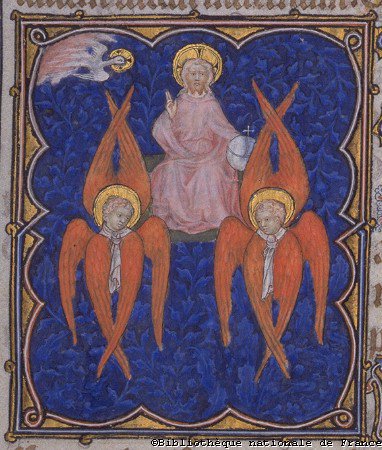 A fourteenth-century miniature of God surrounded by seraphim from the Petites Heures de Jean de Berry. John’s ritual language imagines knowledge descending through an ordered celestial world of God, the Virgin, and angels rather than through an impersonal occult force. Public-domain image via Wikimedia Commons and the Bibliothèque nationale de France.
Unknown Words and the Problem of Spiritual Risk
One reason learned ritual magic worried medieval theologians was the use of unfamiliar words, secret names, and formulas whose meaning could not easily be verified.
The concern was not merely linguistic conservatism. If a practitioner pronounced words he did not understand, how could he know whom he was invoking? A strange formula might claim to address an angel while secretly calling a demon.
This issue appears throughout the history of medieval magic. Thomas Aquinas and other theologians were suspicious of signs and words whose causal relation to an effect could not be explained naturally or sacramentally.
John’s reworking of the Ars Notoria can be understood partly as an attempt to eliminate that ambiguity. He wanted recognizable Christian prayer and Marian authorization to provide transparency where older magical language seemed dangerous.
The irony is that ritual form itself remained suspicious enough that critics could still classify the new system as magic.
Necromancy in John’s Confessions
John does not only discuss the Ars Notoria. His autobiographical material also refers to involvement with nigromancia, the medieval learned tradition modern historians often call necromancy or clerical magic.
The term did not necessarily mean communication with the dead in the narrow modern sense. Medieval Latin nigromantia became associated with ritual practices involving demons, conjurations, circles, spirit operations, and prohibited techniques performed especially by literate clerics.
SecretMagic’s article on the Munich Manual of Demonic Magic provides a useful comparison with a later manuscript preserving more overtly coercive ritual material.
John’s importance is almost the opposite. He tells us what it could look like when a learned practitioner tried to move away from such material while retaining a desire for supernatural knowledge.
Magic and Mysticism Were Not Simple Opposites
Modern writing often contrasts mysticism with magic. Mysticism is described as passive union with the divine; magic as active manipulation of supernatural forces. Medieval texts repeatedly complicate that distinction.
John seeks visions, spiritual purification, Marian guidance, and divine knowledge. Those aims sound mystical. He also uses structured procedures, special figures, prescribed prayers, and a system designed to produce extraordinary intellectual effects. Those features look magical.
The categories overlap because both concern mediated access to invisible realities.
Rather than forcing the Flowers into one box, historians gain more by asking what John himself considered legitimate, what his critics considered dangerous, and why the same act could be categorized differently by different observers.
The 1323 Burning in Paris
The most dramatic event in the text’s reception occurred in Paris in 1323. A copy or version of John’s work was publicly burned after being condemned as a revival of the Ars Notoria.
The incident is preserved through chronicle evidence and became, for centuries, one of the principal reasons John was remembered at all. Before modern manuscript research, scholars largely knew the Liber florum through this condemnation rather than through sustained reading of the surviving text.
That imbalance produced a major historical distortion. A burned book is easy to summarize as “forbidden magic.” A surviving corpus of more than twenty manuscripts reveals something much more complicated.
The condemnation was real. So was the book’s continued circulation.
What Exactly Was Condemned?
Historians should be cautious about imagining one stable object being judged in 1323 and then copied unchanged afterward. John produced multiple versions, and manuscript transmission continued the process of adaptation.
The surviving tradition suggests that later readers did not uniformly inherit the Parisian judgment. Some copies circulated in monastic environments. Readers personalized material. The book appeared across France, Germany, Austria, Poland, Italy, Spain, and England.
Nicholas Watson’s work on Bridget emphasizes that later manuscripts could treat the Flowers as an orthodox expression of Marian devotion even though a version had been burned as heretical.
This is one of the strongest reasons to avoid speaking of “the medieval Church” as if it possessed one perfectly synchronized reaction to every magical text. Institutions, regions, readers, and periods differed.
Burning Did Not Erase the Book
The survival of the Liber florum is historically significant because book burning is often imagined as total erasure. Manuscript culture did not work that way.
A text copied into multiple private or monastic books could survive a local condemnation. There was no central digital switch capable of deleting every copy in Europe. Readers could omit controversial passages, preserve devotional sections, rewrite headings, or simply ignore a judgment made elsewhere.
This helps explain why condemned works sometimes have rich afterlives.
The fact of survival does not prove secret conspiracy or institutional hypocrisy. It demonstrates the decentralized reality of manuscript transmission.
More Than Twenty Surviving Copies
The 2015 critical edition by Fanger and Watson changed the field because it established the Liber florum as a substantial textual tradition rather than a lost curiosity. The Pontifical Institute reports more than twenty copies representing three versions.
That number matters. A unique manuscript can be dismissed as the private obsession of one eccentric writer. A work copied repeatedly across regions and centuries indicates a readership.
Readers invested time and expensive materials in reproducing John’s prayers, visions, and figures. Some annotated or adapted them. The manuscript evidence therefore speaks against the idea that the Paris condemnation ended the work’s religious life.
Why the Book Disappeared from Modern Memory
Despite its medieval circulation, the Flowers became obscure in later scholarship. Several factors contributed.
First, there was no early modern printed edition comparable to famous grimoires that entered print culture. Second, the text existed in multiple complex manuscript versions. Third, its Latin and ritual structure made it difficult to study. Fourth, historians inherited the dramatic 1323 condemnation without having easy access to the work itself.
Modern rediscovery required manuscript comparison rather than simply locating one forgotten printed book.
Claire Fanger and Nicholas Watson spent years reconstructing the text, its versions, and the historical personality behind it. Their work demonstrates why manuscript scholarship remains essential to the history of magic. Entire intellectual traditions can look completely different once texts are edited rather than merely mentioned by hostile witnesses.
A Rare Window into the Psychology of Ritual Magic
John’s visionary autobiography gives historians unusually rich evidence for the emotional life of a practitioner. He expresses fear of deception, desire for certainty, intellectual ambition, penitence, hope, and confidence in supernatural guidance.
Most grimoires tell us what to do, not what it feels like to wonder whether the ritual itself is spiritually dangerous.
This makes John especially valuable for the anthropology of religion. Ritual systems do not operate only through doctrines. They produce doubt, interpretation, memory, authority, anxiety, and revision.
A person can believe deeply in angels while fearing that a particular apparition is demonic. He can reject one magical text while preserving its goals. He can seek certainty through a vision and then need another method to decide whether the vision was trustworthy.
Religion here is not simple belief. It is a continuous practice of discernment.
The Problem of Self-Authentication
John’s project also exposes a philosophical problem that appears in many revelatory traditions: how does a revelation authenticate itself?
Suppose a visionary figure says, “This practice is holy.” If the practitioner’s central worry is that deceptive spirits can imitate holy beings, the statement alone cannot settle the issue.
John responds through a network of safeguards: Marian devotion, sacramental theology, confession, recognizable prayer, moral preparation, repeated experience, and alignment with Christian doctrine as he understood it.
Critics could still reject the system, but the attempt is intellectually serious. He does not treat every vision as automatically true.
The Book as a Negotiation with Orthodoxy
The Flowers repeatedly tries to demonstrate that extraordinary ritual can remain inside legitimate Christianity. This negotiation can be seen in its language, its emphasis on permission, and its autobiographical condemnation of earlier magical error.
Yet the need to insist so strongly on orthodoxy may itself reveal how close the book stood to contested boundaries.
Works unquestionably accepted as ordinary prayer books did not usually need to explain at length why their sacred figures were not necromantic.
The Liber florum is therefore evidence not just for medieval magic but for the process by which “magic” was socially constructed as a category.
How John Differs from the Sworn Book of Honorius
John of Morigny and the Sworn Book of Honorius belong to overlapping worlds of learned Christian ritual magic, but they should not be confused.
The Liber Iuratus Honorii is pseudonymously attributed to Honorius of Thebes and organizes ritual knowledge around sacred names, angelic operations, the divine vision, secrecy, and the Sigillum Dei tradition.
John’s Liber florum, by contrast, is tied to an identifiable fourteenth-century Benedictine author. Its autobiographical narrative, Marian revelations, revisions, and relationship with the Ars Notoria are central to its identity.
Both texts show how the desire to see or know divine realities could exist beside elaborate ritual technology. They represent different solutions to the same medieval tension between revelation and procedure.
How John Differs from Later Renaissance Angel Magic
John’s world also differs from the famous angel conversations of John Dee and Edward Kelley in the sixteenth century. Dee used a scryer, recorded extensive angelic communications, developed a new revealed language, and integrated his work with mathematics, cosmology, imperial ambition, and Christian reform.
John of Morigny wrote more than two centuries earlier. His central objective was infused intellectual knowledge and Marian authorization, not the construction of the later Enochian system.
Still, comparison is useful. Both men were highly educated Christians who understood extraordinary revelation as compatible with intellectual seriousness. Both worried about deception. Both preserved records showing that communication with angels was not, for them, a rejection of Christianity but an attempt to deepen access to divine knowledge.
The comparison also shows why “angel magic” is too broad a term to explain a tradition by itself.
The Seven Liberal Arts and the Desire for Total Knowledge
Medieval education organized foundational learning through the seven liberal arts: the trivium of grammar, rhetoric, and logic, and the quadrivium of arithmetic, geometry, music, and astronomy. Advanced disciplines built upon this structure.
Ritual systems promising mastery of the arts therefore offered more than isolated skills. They promised access to an ordered intellectual universe.
John’s ambition should be read in that context. The goal was not random trivia. It was the transformation of the mind into an instrument capable of grasping the structures through which medieval scholars understood creation.
Knowledge itself had spiritual significance because a rationally ordered cosmos could be interpreted as the work of divine intelligence.
Why Memory Was Spiritually Important
Memory is central to medieval learning because books were scarce, lectures relied heavily on oral transmission, and intellectual culture demanded internal mastery of texts. Memory was also religious. Monks memorized psalms, prayers, liturgy, and scripture.
A supernatural enhancement of memory therefore promised both academic and devotional transformation.
Modern culture often treats memory as data storage. Medieval religious culture could understand perfected memory as part of a morally ordered intellect. To remember sacred truth correctly was to become more capable of contemplation and teaching.
This helps explain why memory magic could appear simultaneously attractive and dangerous.
Did the Rituals “Work”?
The surviving manuscripts show that people copied and used the Flowers, but historical evidence cannot establish that its rites supernaturally infused complete academic knowledge.
Modern science provides no reliable evidence that prayer, fasting, or contemplation of medieval ritual figures can instantly transmit mastery of grammar, astronomy, law, or theology.
However, the question can be separated into several levels.
First, structured prayer and disciplined attention can affect concentration, motivation, emotional state, and memory performance. Second, highly demanding ritual may change how a practitioner interprets dreams and internal experiences. Third, participants can sincerely experience visions they regard as external supernatural encounters. Fourth, the metaphysical claim that angels objectively infuse knowledge remains a religious claim rather than an experimentally demonstrated fact.
Keeping these levels separate allows the history to be taken seriously without presenting medieval supernatural claims as scientific conclusions.
Why Condemned Magic Could Look Like Devotion
The Flowers forces readers to abandon a visual stereotype. Medieval illicit magic did not always look like skulls, demons, black candles, or anti-Christian rebellion.
It could look like fasting.
It could look like prayers to God.
It could look like devotion to the Virgin.
It could use angels rather than demons.
It could be written by a priest.
Precisely because outwardly holy forms could be adapted to unusual ritual goals, medieval theologians developed complex criteria for judging intention, language, causal claims, and hidden spiritual agency.
This is one reason the history of magic cannot be reconstructed simply by searching manuscripts for obviously demonic imagery.
The Boundary Between Gift and Technique
Perhaps the deepest philosophical issue in John’s work is the relationship between grace and method.
If God freely grants wisdom, can humans create a procedure that reliably produces it?
If a practitioner must perform the correct prayers for the correct number of days while contemplating the correct figure, does divine gift begin to look like ritual mechanism?
John attempts to resolve this by emphasizing permission and moral fitness. The practitioner does not command Mary or God. He petitions. The procedure prepares rather than compels.
Yet critics could argue that the expected result remained too predictable and too technically linked to the ritual sequence.
The same debate appears across many religious traditions: at what point does disciplined spiritual practice become an attempt to control the sacred?
A Symbolic Reading of the Flowers
The title Flowers of Heavenly Teaching invites symbolic interpretation. A flower is not manufactured by force; it unfolds from a living process under the right conditions. It is also temporary, beautiful, ordered, and generative.
Read symbolically, the title suggests knowledge as blossoming rather than acquisition. Divine teaching flowers in a prepared mind.
This interpretation fits John’s emphasis on purification and permission better than the modern fantasy of downloading information into the brain.
It should still be identified as an interpretation. The medieval work has its own textual logic, and a modern symbolic reading cannot substitute for historical analysis.
A Symbolic Reading of the Figures
John’s sacred figures can also be read as technologies of attention. A complex image organizes the gaze. It slows the viewer. It establishes relationships among names, forms, colors, and sacred identities.
In this sense, a ritual figure transforms knowledge from a purely verbal object into a spatial one.
The mind does not only read; it inhabits a diagram.
This insight connects the Flowers with broader medieval and Renaissance traditions in which diagrams, memory images, cosmological maps, and symbolic wheels become tools for thinking. SecretMagic’s study of Giordano Bruno’s later magical art of memory shows how radically different later thinkers could also turn visual structure into a method for transforming cognition.
John of Morigny and the History of Religious Experiment
John can be understood as a religious experimenter, provided the term is used carefully. He did not conduct experiments in the modern laboratory sense. But he tried practices, interpreted results, rejected some procedures, revised others, compared visions, and altered his system in response to criticism.
His text is full of iteration.
This makes the Flowers especially valuable for understanding how traditions change. Religious innovation is rarely just the announcement of a new doctrine. It can emerge through trial, fear, reinterpretation, and institutional negotiation.
Why John’s Project Was Dangerous to Authority
A system promising direct heavenly knowledge potentially bypasses ordinary educational and ecclesiastical channels. If a practitioner can obtain mastery from angels or the Virgin, what becomes of the teacher, university, examiner, or institutional gatekeeper?
This does not mean the 1323 condemnation can be reduced to professional jealousy. Theological concerns about magic and demonology were real.
But knowledge is also social power. Ritual access to knowledge raises questions about who has the right to teach, who can certify truth, and how intellectual authority is distributed.
The same structural tension helps explain why revelatory movements throughout history can become institutionally disruptive even when they remain deeply religious.
Why the Book Matters for the History of Mysticism
John’s visions belong beside the history of medieval mysticism because they concern encounters with the Virgin, divine instruction, penitence, and transformed consciousness.
Yet they complicate modern definitions of mysticism by remaining tied to explicit ritual procedures and intellectual goals.
Rather than treating “mysticism” as pure spontaneous experience and “magic” as artificial technique, John’s book shows how visionary life can be structured through texts, images, schedules, and expectations.
Experience and ritual are not opposites. Ritual can create the conditions in which experience becomes meaningful.
Why the Book Matters for the History of Magic
Histories of magic often focus on texts that survive because later occultists printed and celebrated them. The Flowers reminds us that the medieval ritual landscape was broader.
A major ritual work could circulate widely, be condemned, disappear from print culture, and then return to scholarly attention centuries later.
John also forces historians to ask whether “magic” is best defined by intention, ritual form, ecclesiastical condemnation, claimed mechanism, or later classification.
No single criterion solves every case.
Why Modern Occultists Should Be Careful with Reconstruction
The modern revival of interest in medieval grimoires makes texts such as the Liber florum attractive to practitioners as well as historians. But John’s system is particularly difficult to reconstruct responsibly.
It survives in multiple versions. Its ritual logic is tied to medieval Latin Christianity, sacramental assumptions, Marian devotion, penitential practice, and manuscript figures. Modern editions are scholarly reconstructions from complex witnesses.
Extracting one diagram or one prayer and calling it “the John of Morigny ritual” can therefore create a false impression of completeness.
A modern practice inspired by the work may be personally meaningful, but historical honesty requires labeling reconstruction as reconstruction.
Common Misconception: John Was a Secret Anti-Christian Magician
The evidence points in the opposite direction. John understood himself as a Christian monk trying to escape spiritually dangerous magic and produce a divinely authorized replacement.
Whether his solution was orthodox was disputed, but his Christian framework was not a superficial disguise added to an otherwise anti-Christian system.
Common Misconception: The Book Was Destroyed in 1323
A copy or version was publicly burned in Paris, but the work survived in more than twenty manuscripts representing multiple versions. It continued to circulate for centuries.
Condemnation and disappearance are not the same event.
Common Misconception: The Flowers Is Just Another Name for the Ars Notoria
John’s work is deeply indebted to the Ars Notoria but is not identical with it. He explicitly reconstructs its ambitions and some of its ritual logic while adding Marian visions, autobiography, new figures, and a theology of correction.
The relationship is best described as adaptation, rejection, and transformation at the same time.
Common Misconception: Bridget Was Merely a Minor Character
Recent scholarship has shown that Bridget of Autruy deserves attention as a medieval visionary whose experiences form an important part of the Liber florum. She was not simply decorative evidence for her brother’s holiness.
At the same time, because her life is known through John’s text, historians must distinguish her possible agency from his literary framing.
Common Misconception: Medieval Authorities Agreed on What Counted as Magic
The afterlife of the Flowers proves otherwise. Parisian authorities condemned a version in 1323, while later readers in religious houses copied and used the text without necessarily marking it as heretical.
“Medieval Christianity” was not one mind.
Common Misconception: Visionary Experience Proves Supernatural Causation
John’s visions are historically important because he experienced and interpreted them as religious events. Their existence as reported experiences does not scientifically demonstrate that the Virgin or angels objectively appeared in the manner he believed.
Historical respect and scientific caution can coexist.
How to Read the Flowers of Heavenly Teaching Today
The best starting point is the critical scholarly edition and commentary by Claire Fanger and Nicholas Watson, published by the Pontifical Institute of Mediaeval Studies in 2015. Their work establishes the manuscript tradition and makes it possible to distinguish successive forms of John’s project.
Claire Fanger’s Rewriting Magic, published by Penn State University Press, provides a particularly accessible interpretive study of John’s visionary autobiography, penitential concerns, and attempt to reconstruct the Ars Notoria.
Nicholas Watson’s work on Bridget of Autruy adds an important gendered and intellectual dimension that older accounts of John often miss.
Readers should resist summaries based solely on the 1323 condemnation. The condemned-book narrative is dramatic, but the manuscripts show a much richer history.
Frequently Asked Questions
Who was John of Morigny?
John of Morigny was an early fourteenth-century French Benedictine monk, priest, educated cleric, and author of the Liber florum celestis doctrine, or Flowers of Heavenly Teaching. He studied at Chartres and Orléans and later became provost of Morigny.
What is the Flowers of Heavenly Teaching?
It is a complex medieval work combining prayers, sacred figures, visionary autobiography, ritual procedures, and teachings aimed at obtaining divinely infused knowledge. John developed it in stages between roughly 1301 and 1315 or early 1316.
Is it the same book as the Ars Notoria?
No. John had practiced the Ars Notoria and used it as an important model, but he came to regard parts of it as dangerous. The Flowers is his attempt to create a revised, Marian, Christian system of sacred knowledge acquisition.
Why was John’s book burned?
A version was condemned and publicly burned in Paris in 1323 because authorities regarded it as reviving the condemned Ars Notoria. The event did not eliminate the work, which survives in numerous manuscripts.
How many manuscripts survive?
The modern critical edition reports more than twenty surviving copies representing three broad versions distributed across Europe.
Who was Bridget of Autruy?
Bridget was John’s younger sister and an important visionary figure described in the Liber florum. Recent scholarship treats her as a significant medieval religious intellectual rather than only a supporting character in John’s biography.
Did John practice necromancy?
John’s autobiographical writings admit experimentation with forms of condemned magic, including material he calls nigromancia. He presents the Flowers as part of his rejection and correction of those earlier practices.
What kind of knowledge did the rituals promise?
The work sought divine assistance with memory, understanding, eloquence, the liberal arts, and other disciplines, as well as visionary answers to specific questions.
Were the figures magical sigils?
They were ritual visual forms used with prayer and contemplation, but calling them simply “sigils” can import later occult terminology. Their exact role is better understood through John’s own manuscript tradition and the scholarship on the Book of Figures.
Did the rituals actually produce instant knowledge?
There is no scientific evidence that John’s rituals can supernaturally infuse mastery of academic disciplines. The texts do demonstrate that medieval practitioners sincerely pursued such results and built sophisticated theological explanations for them.
Was John considered a heretic everywhere?
No. A version of his work was condemned in Paris, but later manuscript transmission shows that readers in several European regions continued copying and using the text, often without obvious signs that they considered it heretical.
Why is John important to the history of magic?
He gives historians an unusually detailed first-person account of ritual experimentation, fear of demonic deception, visionary discernment, revision, and the attempt to redraw the boundary between magic and legitimate Christian devotion.
Conclusion: A Book Written on the Boundary
John of Morigny’s Flowers of Heavenly Teaching is valuable precisely because it refuses to fit comfortably into the categories modern readers bring to it.
It is too procedural to look like spontaneous mysticism, too devotional to resemble the stereotype of demonic magic, too autobiographical to behave like an anonymous grimoire, and too controversial to pass as an ordinary prayer book.
John’s life gave the text its shape. He wanted knowledge. He experimented with the Ars Notoria and with other forms of condemned ritual. He experienced visions he interpreted as dangerous. He turned to the Virgin Mary as protector and authorizing presence. He rebuilt the structure of supernatural learning around prayer, penance, figures, and visionary permission. Then he revised the project when criticism continued.
The result was not accepted everywhere. In 1323 a version of the work was burned in Paris. If that were the end of the story, John would be little more than a footnote in the history of condemned magic.
But the manuscripts survived.
They crossed regions and centuries. Monks and other religious readers copied them. Different versions accumulated. Bridget’s visions remained embedded in the tradition. What one institution condemned, other readers could reinterpret as Marian devotion.
This afterlife reveals something fundamental about the history of esotericism: religious boundaries are not drawn once. They are negotiated repeatedly by authors, authorities, readers, copyists, and communities.
John thought he had found a way to preserve the promise of supernatural knowledge while removing the spiritual danger of magic. His critics thought the old danger remained inside the new form. Later readers did not all agree with either side.
That disagreement is not an inconvenience to be solved. It is the historical meaning of the book.
The Flowers of Heavenly Teaching stands at the point where prayer becomes method, image becomes instrument, vision becomes evidence, and learning becomes grace. It asks whether divine knowledge can be approached through disciplined technique without turning the sacred into something mechanically controlled.
Seven centuries later, that question remains more interesting than any simple verdict about whether John was a magician or a mystic.
Sources and References
- Pontifical Institute of Mediaeval Studies, John of Morigny. Liber florum celestis doctrine / The Flowers of Heavenly Teaching, edited by Claire Fanger and Nicholas Watson, 2015.
- Claire Fanger, Rewriting Magic: An Exegesis of the Visionary Autobiography of a Fourteenth-Century French Monk, Penn State University Press, 2015.
- Nicholas Watson, “The Visions, Experiments, and Operations of Bridget of Autruy (fl. 1305–15),” in Women Intellectuals and Leaders in the Middle Ages, Cambridge University Press, 2020.
- Claire Fanger, “Libri Nigromantici: The Good, the Bad, and the Ambiguous in John of Morigny’s Flowers of Heavenly Teaching,” Rice University Research Repository.
- Harvard University Department of English, Nicholas Watson, John of Morigny. Liber florum celestis doctrine / The Flowers of Heavenly Teaching.
- Harvard Gazette, “Visions and Magic,” on Nicholas Watson’s research into John of Morigny’s Liber visionum.


