


 Abū Maʿshar al-Balkhī conducting an astronomical experiment, from Kitab al-Bulhan, MS. Bodl. Or. 133, fol. 34r. Bodleian Libraries; image released under CC BY 4.0 via Wikimedia Commons.
Kitab al-Bulhan is often introduced online as a medieval “book of demons.” That description is memorable, visually persuasive, and deeply incomplete. The manuscript does contain extraordinary images of Iblis, planetary jinn kings, nightmare beings, fever spirits, talismanic signs, and creatures that modern viewers may call demonic. Yet those pages belong to a much larger intellectual object: a composite Arabic manuscript that brings together astrology, astronomy, geomancy, divination, cosmography, wonder literature, stories of remarkable places, and carefully designed images.
The surviving codex, held by the Bodleian Libraries under the shelfmark MS. Bodl. Or. 133, was assembled principally in the late fourteenth century in a Jalayirid cultural environment, probably Baghdad. Its pages preserve a world in which observing the heavens, calculating planetary relationships, interpreting signs, remembering inherited stories, and depicting invisible forces could occupy neighboring spaces in the same book. The divisions that modern readers impose between “science,” “religion,” “folklore,” “art,” and “magic” do not map cleanly onto that world.
This article examines the manuscript as a historical object rather than a modern spellbook. It asks what the book actually contains, who compiled it, why its title is difficult to translate, how its damaged order was partly reconstructed, what the jinn images meant within a planetary framework, and why its pictures should not be treated as literal portraits of scientifically verified supernatural beings. It also explains how to read the manuscript responsibly: with attention to Islamic intellectual history, art history, manuscript transmission, religious disagreement, and the limits of surviving evidence.
Editorial note: this is a historical and cultural study. It does not claim that astrology, divination, talismans, jinn encounters, or supernatural causation have been scientifically demonstrated. It does not provide instructions for coercive ritual, spirit summoning, medical treatment, or attempts to harm or control another person.
A Manuscript That Refuses a Single Label
Many famous grimoires announce a narrow practical purpose. They may present prayers, conjurations, seals, instructions for making ritual tools, or methods for addressing named spirits. Kitab al-Bulhan is different. It is a composite manuscript: a codex formed from multiple treatises, textual units, image cycles, and layers of copying. Some sections are associated with the astrological tradition of Abū Maʿshar al-Balkhī. Other sections concern divination attributed to Jaʿfar al-Ṣādiq or the prophets. Still others depict marvels, cities, legendary islands, cosmic diagrams, seasons, lunar stations, and planetary figures.
This composite nature changes how the book should be interpreted. A modern viewer may isolate a striking folio of a jinn king and assume that the whole manuscript was designed as a demonological manual. The codex itself points in another direction. Its celestial images, diagrams, stories, and divinatory materials form a network. The jinn kings make more sense when read beside the seven planets, the days of the week, metals, professions, zodiacal signs, lunar cycles, climates, and inherited theories of cosmic correspondence.
The Bodleian catalogue describes the manuscript as a collection of Arabic divinatory works dating mainly from the late fourteenth century and containing astrological, astronomical, and geomantic texts compiled by ʿAbd al-Ḥasan al-Iṣfahānī. That description is deliberately broader than “magic book.” It identifies the manuscript’s intellectual fields without pretending that their medieval boundaries were identical to modern academic categories.
The book therefore belongs simultaneously to several histories:
- the history of Arabic manuscript production in late medieval Baghdad;
- the transmission of Abū Maʿshar’s astrological thought;
- the visual culture of planets, zodiac signs, lunar stations, and talismanic correspondences;
- the literature of marvels and extraordinary places;
- the religious and folkloric imagination of jinn, illness, nightmares, and invisible agency;
- the later Ottoman transformation of Arabic material into elite illustrated Turkish manuscripts;
- and the modern history of collecting, digitization, online occultism, and decontextualized image circulation.
Any interpretation that recognizes only one of those histories will miss much of what makes the codex important.
What Does “Kitab al-Bulhan” Mean?
The Arabic word kitāb simply means “book.” The difficulty lies in al-bulhān. Scholars and cataloguers have rendered the title in several ways, including Book of Wonders, Book of Surprises, and, in older scholarship, Book of Wellbeing. The variation is not a trivial branding issue. It reveals uncertainty about the title’s linguistic root and the genre to which the manuscript should be connected.
Art historian Stefano Carboni argues that “Book of Surprises” is especially appropriate because it places the codex near the Arabic and Persian literary culture of ʿajāʾib: accounts of wonders, strange creatures, remarkable monuments, unusual natural phenomena, distant islands, marvelous technologies, and the edges of the known world. A famous comparison is Zakariyyā al-Qazwīnī’s ʿAjāʾib al-makhlūqāt wa-gharāʾib al-mawjūdāt, commonly translated as The Wonders of Creation and the Oddities of Existing Things.
That connection helps explain why Kitab al-Bulhan contains both calculated celestial systems and stories that modern readers would classify as fabulous. A medieval book of wonders was not simply a collection of deliberate falsehoods. It could organize knowledge at the boundary between report, inherited authority, geography, cosmology, moral reflection, entertainment, and speculation. The marvelous marked the limits of ordinary experience while demonstrating the perceived abundance and complexity of creation.
For search and general discussion, “Book of Wonders” remains the most recognizable English title. Historically, however, readers should remember that no English phrase perfectly captures the title or the manuscript’s mixed character.
Baghdad Around 1400: The Cultural World of the Codex
The manuscript is associated with the Jalayirid period, when a Turco-Mongol dynasty ruled areas of Iraq and western Iran during the fourteenth and early fifteenth centuries. Baghdad was no longer the capital of a vast Abbasid empire, but it remained a major center of scholarship, religious life, book culture, trade, storytelling, and artistic production. Arabic and Persian cultural currents met there, while older Greek, Indian, Iranian, Mesopotamian, and Islamic bodies of knowledge continued to be copied and reinterpreted.
This environment matters because the manuscript is not evidence of an isolated “underground occult cult.” It emerged from a literate urban world in which courts, scholars, scribes, physicians, astrologers, religious specialists, poets, artisans, and collectors participated in overlapping networks. Astrological knowledge could serve rulers, householders, physicians, calendar makers, and diviners. Illustrated manuscripts could be objects of study, prestige, entertainment, devotion, and political symbolism.
The Jalayirid environment also complicates simplistic national labels. The manuscript is written mainly in Arabic, its compiler’s family was associated with Isfahan, and its probable production context was Baghdad. Its artistic language reflects the broader manuscript cultures of Iraq and Iran. Centuries later, its content was translated and transformed in Ottoman courtly settings. The codex is best understood as a product of connected regions rather than a sealed national tradition.
Its date can be approached through internal evidence. An ownership note records that the manuscript passed from al-Ḍiyāʾ Ḥusayn al-Irbilī to Ḥaydar ibn al-Ḥājj ʿAbd al-Karīm ibn Muḥammad in the Islamic year 812, corresponding to 1409–1410 CE. This provides a firm point by which much of the manuscript already existed. Other copied dates are damaged, leaving scholars to reconstruct a narrower range from calendars, handwriting, artistic style, and ownership information.
The Compiler: ʿAbd al-Ḥasan al-Iṣfahānī
The manuscript identifies ʿAbd al-Ḥasan ibn Aḥmad ibn ʿAlī ibn al-Ḥasan al-Iṣfahānī as an important copyist and compiler. Despite the geographical family name al-Iṣfahānī, he states that he was born in Baghdad. He also describes himself as a student of the demonstrative sciences, using language associated with rational proof and Aristotelian learning.
This self-presentation is significant. Modern summaries sometimes imagine the compiler as a mysterious sorcerer documenting forbidden creatures from personal encounters. The manuscript instead presents a literate organizer of inherited sciences. He copied, selected, arranged, and visually planned material. Carboni draws attention to the compiler’s use of a verb that can mean both “I compiled” and “I drew, sketched, or designed,” followed by references to illustrated drawings and colored figures. The images were not accidental decorations pasted onto an otherwise complete text. They were part of the conceptual plan.
The codex also names al-Ḍiyāʾ Ḥusayn al-Irbilī, a figure connected with its commissioning, ownership, and additional copying. Al-Irbilī wrote sections involving divination, including material attributed to Jaʿfar al-Ṣādiq and a “Divination of the Prophets.” This evidence reminds us that medieval manuscripts were often collaborative and cumulative. A book could preserve the work of an ancient authority, a later compiler, several scribes, artists, owners, translators, and binders.
Authorship must therefore be handled carefully. Abū Maʿshar’s name appears in relation to important astrological materials, but he did not personally create the surviving fourteenth-century codex. Al-Iṣfahānī compiled and copied substantial portions, while al-Irbilī contributed other units. Anonymous painters produced or executed the images. Later Ottoman translators and artists reorganized the tradition again. Calling the whole object “a book written by Abū Maʿshar” hides that layered history.
 Capricorn in the zodiacal cycle of Kitab al-Bulhan, MS. Bodl. Or. 133, fol. 19b. Bodleian Libraries; public-domain image via Wikimedia Commons.
Abū Maʿshar: Why an Earlier Astrologer Stands at the Center
Abū Maʿshar Jaʿfar ibn Muḥammad al-Balkhī, known in medieval Latin Europe as Albumasar, lived from 787 to 886 CE. Born in Balkh and active in Baghdad, he became one of the most influential astrologers of the medieval world. His works drew on Greek, Indian, Iranian, Syrian, and Arabic traditions and were later translated into Latin, Greek, and Hebrew. Through those translations, his ideas influenced Islamic, Byzantine, Jewish, and European intellectual histories.
His importance to Kitab al-Bulhan lies especially in material associated with nativities: the interpretation of celestial configurations at birth. The manuscript’s zodiacal paintings join each sign with a ruling planet and smaller images related to subdivisions of the sign. It also contains planetary diagrams, lunar stations, climates, seasons, professions, exaltations, depressions, and other celestial classifications.
Modern readers often assume that medieval astronomy and astrology were entirely separate subjects, with one being scientific and the other irrational. Historically, the relationship was more complicated. Accurate astrology required astronomical observation, mathematical tables, instruments, calendars, and methods for locating celestial bodies. At the same time, many theologians, jurists, philosophers, and scientists criticized claims that stars determined human events or competed with divine sovereignty. Astrology was widespread, technically sophisticated in some forms, and religiously controversial.
The Metropolitan Museum of Art’s overview of astronomy and astrology in the medieval Islamic world emphasizes this tension. Astrologers served courts and marketplaces, while critics produced arguments against their methods. A ruler might consult an astrologer about an auspicious time for a public action, but a theologian could object that such confidence wrongly assigned causal power to created bodies. There was no single, universally accepted “Islamic view of astrology.”
The manuscript should therefore not be presented as proof that medieval Muslim societies simply accepted every astrological claim. It is evidence that such knowledge circulated, attracted patrons, inspired art, and interacted with larger debates about causation, fate, prediction, free will, and divine authority.
The Book’s Architecture of Knowledge
The surviving codex does not present a neat modern table of contents. Its folios were rebound in a confused order, sections are missing, and some units that once belonged together are separated. Nevertheless, scholarship and comparison with later copies allow the main intellectual architecture to be recognized.
Astronomy and Celestial Measurement
Some diagrams and images concern observable or calculable features of the heavens: lunar phases, planetary positions, zodiacal order, and celestial cycles. These materials existed in a learned tradition of instruments, tables, geometry, and inherited models. A striking image shows Abū Maʿshar conducting an experiment with an astrolabe while an attendant watches in amazement and books fill the study.
The picture is not a photographic record of a specific event. It creates an ideal portrait of the learned astrologer-astronomer: disciplined, instrument-bearing, surrounded by texts, and capable of demonstrating hidden order. The observer’s gesture of surprise links the scientific act to the book’s larger culture of wonder.
Astrological Judgment
The manuscript does more than map the sky. It interprets celestial arrangements as meaningful for births, occupations, climates, seasons, and terrestrial conditions. The zodiac signs appear not as isolated symbols but as parts of a web connecting planets, decans or subdivisions, human activities, and qualities.
These correspondences were not arbitrary inventions of one illustrator. They emerged from a long, multilingual transmission involving Hellenistic astrology, late antique philosophy, Indian astronomy, Sasanian scholarship, Arabic translation movements, and medieval commentary. The manuscript visualizes that accumulated system, even when modern science rejects its predictive premises.
Geomancy and Divination
Geomancy is a method of generating figures from patterned marks, traditionally interpreted through houses, elements, planets, or other correspondences. Arabic geomantic traditions had a long afterlife in Africa, Europe, and the Indian Ocean world. In a composite manuscript, geomancy could sit beside astrology because both offered structured ways of reading signs rather than relying on unorganized intuition.
Other sections attribute divination to revered figures such as Jaʿfar al-Ṣādiq or to prophetic traditions. Historical attribution does not automatically prove that the named authority wrote the surviving text. Premodern works frequently circulated under prestigious names, a practice scholars call pseudepigraphy when the attribution is not historically secure.
Wonder Literature and Marvelous Geography
The manuscript includes images of famous monuments, distant islands, legendary peoples, unusual creatures, and extraordinary natural events. The Lighthouse of Alexandria, the Baths of Tiberias, the Umayyad Mosque, the Wall of Alexander, the Monastery of the Raven, and the Waq-Waq tree belong to a geography where verified travel, inherited stories, religious traditions, and imaginative marvels overlap.
Such sections broaden the book beyond divination. They ask the reader to contemplate how the world exceeds ordinary local experience. A monument may be historically real while the story attached to it is legendary. A distant island may combine geographic rumor with literary fantasy. A natural phenomenon may be interpreted through cosmology rather than modern physics. The images do not flatten these categories; they hold them together.
Why the Present Order Is Unreliable
At some point in its history, the manuscript’s gatherings were separated and rebound in the wrong sequence. Several folios disappeared. As a result, reading the codex from first page to last does not reproduce its original intellectual order. This is one of the most important facts for interpreting individual images.
Fortunately, two richly illustrated Ottoman Turkish manuscripts created around 1582 preserve related material in a more coherent arrangement. They were produced for Ayşe Sultan and Fatma Sultan, daughters of Sultan Murad III, and are known by a title translated as The Ascension of Felicitous Stars and the Sources of Sovereignty, or more simply through the published title Book of Felicity. One copy is associated with the Morgan Library in New York and another with the Bibliothèque nationale de France.
The Ottoman versions are not neutral photocopies. They translate, reorganize, and visually renew the earlier material for a sixteenth-century imperial audience. Yet their sequence helps scholars identify missing pages and reconstruct how some units of the Arabic codex may once have been arranged. The relationship demonstrates that manuscript traditions are living transformations rather than static containers.
It also reveals a striking shift in patronage. Material that modern internet culture frequently labels “forbidden demon magic” was adapted into luxury court manuscripts made for Ottoman princesses. That does not mean the content was religiously uncontroversial or that every reader used it in the same way. It shows that astrological, marvelous, and divinatory imagery could function as elite knowledge, dynastic symbolism, entertainment, and artistic prestige.
Images as Instruments of Thought
The most powerful feature of Kitab al-Bulhan is not a single spirit name or secret formula. It is the manuscript’s use of images to organize relationships. The pictures do not merely illustrate stories after the text has done the intellectual work. They classify, compress, dramatize, and connect information.
A zodiac page links a sign to a planet and subordinate influences. A planetary chart associates heavenly bodies with professions and activities. A lunar diagram turns cyclical time into visible order. A jinn king appears with attendants, colors, weapons, animals, letters, numbers, and talismanic marks that locate the being within a network. A marvelous building becomes a stage where unseen causes explain a famous feature of the world.
This visual logic matters because medieval readers did not necessarily separate “symbol” from “operation” as sharply as modern museum visitors do. An image could teach, remind, classify, protect, warn, dignify, or participate in a talismanic theory. The exact function depended on the page, the reader, and the context. It would be equally misleading to say that every image was a purely decorative metaphor or that every image was automatically used in an enacted ritual.
 A celestial diagram from Kitab al-Bulhan. The page demonstrates how writing, spatial arrangement, circular forms, and named celestial points were combined into a visual system. Bodleian Libraries; public-domain image via Wikimedia Commons.
The Seven Jinn Kings: Planetary Government in Visual Form
The most famous image cycle associates seven jinn kings with the seven days of the week and, through them, the seven traditional planets: Sun, Moon, Mars, Mercury, Jupiter, Venus, and Saturn. The surviving Arabic manuscript is missing the pages for Sunday and Monday, but the later Ottoman copies help identify the larger sequence.
Each king is more than a monster with a personal name. The figure occupies a cosmic office. Color, posture, animal association, weapon, attendants, planetary day, metal, and talismanic signs work together. The image translates an invisible hierarchy into a royal court. Jinn are pictured as kings because kingship is a familiar model of organized power, command, territory, loyalty, and subordinate service.
The Red King of Tuesday, commonly called al-Malik al-Aḥmar, is connected with Mars. Martial qualities are made visible through red coloration, a sword, a severed head, and a lion. This does not prove that a painter saw a physical being and reproduced its anatomy. The image is an iconographic construction of Mars-like force: heat, conflict, blood, courage, danger, and violent authority.
The Black King associated with Wednesday presents another complex image, while Shamhūrash, the king of Thursday, belongs to a Jupiter-related day and is shown with attendants and talismanic signs. The Friday king is often identified as Zawbaʿa, and Saturday with Maymūn of the Clouds. Names and details vary across manuscript traditions and later magical literature. Modern lists frequently combine sources from different centuries as if they were one stable ancient system; responsible study keeps those layers separate.
The cycle can be read at several levels:
- Astrological: each day and king embodies qualities assigned to a planet.
- Political: the invisible world is imagined through kings, courts, servants, and territories.
- Talismanic: letters, numbers, and signs suggest methods of identifying, restraining, or counterbalancing an influence.
- Psychological: threatening forces become visible and therefore narratively manageable.
- Art historical: the figures draw on regional traditions of monstrous bodies, royal portraiture, animal symbolism, and manuscript framing.
None of these readings requires accepting the figures as scientifically documented entities. Nor does historical caution require mocking the religious belief in jinn found in Islamic scripture and culture. The manuscript’s specific painted kings belong to a particular learned and artistic tradition; belief in jinn as a general category is much broader and should not be reduced to these illustrations.
 Al-Aḥmar, the Red King of Tuesday, presented through martial and planetary symbolism in Kitab al-Bulhan, fol. 31r. Bodleian Libraries; public-domain image via Wikimedia Commons.
Iblis, Jinn, Demons, and the Problem of Translation
English discussions often use jinn, demon, devil, and spirit interchangeably. That practice creates confusion. In Islamic theology and folklore, jinn are not simply identical to Christian demons. They are a class of created beings associated with smokeless fire, moral agency, communities, belief, disbelief, and human interaction. Iblis has a distinct scriptural and interpretive history. Shayāṭīn, often translated as devils or satans, refers to rebellious or harmful beings. Later occult texts add hierarchies and names that do not come directly from the Qur’an.
European art history and older cataloguing practices often translated frightening supernatural figures as “demons.” That translation may be convenient for visual comparison, but it can erase theological distinctions. On the other hand, refusing every comparative term can make the material inaccessible to readers unfamiliar with Arabic vocabulary.
A careful approach does three things:
- uses the manuscript’s specific name when it is available;
- explains the broader category without pretending that all traditions agree;
- and labels English words such as “demon” as translations or art-historical conventions rather than exact equivalents.
The famous image of Iblis enthroned among attendants is especially vulnerable to decontextualization. Online it may appear as “the true appearance of Satan in an ancient forbidden book.” Historically, it is a late medieval artistic representation. Its horns, frontal throne, blazing features, attendants, and royal pose communicate a theology of pride, rebellious authority, fear, and hierarchy. The image tells us what an artist and manuscript culture considered visually effective, not what a camera would record.
Nightmare, Fever, and Invisible Causes
Beyond the seven kings, the manuscript depicts beings connected with suffering or disruption. Kābūs represents the nightmare: a threatening figure visiting a sleeper. Ḥummā personifies fever. Other images attach agency to affliction, fear, bodily crisis, or disturbed domestic life.
Modern readers may react in two unhelpful ways. One is literalism: treating every illness image as evidence that disease is caused by an external spirit. The other is ridicule: assuming that personification proves the historical audience had no practical knowledge of bodies or environments. Premodern cultures frequently held multiple explanations at once. A fever could be observed through symptoms, treated with substances, timed astrologically, prayed over, and personified in a story or image.
Personification makes an invisible condition visible. Nightmare becomes an intruder in the bedroom; fever becomes a hostile presence; anxiety becomes an attack. This can express the lived experience of illness with emotional accuracy even when the causal theory is not scientifically valid. Contemporary language still says that depression “holds” a person, addiction “takes control,” or disease “invades” the body. Such language does not replace biology, but it gives form to experience.
For that reason, these pages are valuable to the history of emotion and medicine as well as the history of magic. They show how people imagined vulnerability and how visual culture offered an opponent that could be named, contained, or opposed.
The Lighthouse, the Baths, and a Geography of Hidden Agency
The manuscript’s marvelous geography demonstrates that invisible agency was not confined to private ritual. It could explain monuments, technologies, thermal waters, distant peoples, and famous ruins.
The Lighthouse of Alexandria was one of antiquity’s most celebrated structures. Medieval accounts inherited memories of its height, maritime function, mirrors, signaling devices, and eventual destruction. The Kitab al-Bulhan image places the tower in water and emphasizes its legendary mirror. The picture is not an architect’s measured reconstruction. It is a visual condensation of Alexandria as a place where engineering, imperial memory, wonder, and the sea meet.
The Baths of Tiberias are explained through a story in which jinn maintain the underground fire that keeps the water warm. Modern geology explains thermal springs without spirit labor. Yet the image reveals a historical question: how did people narrate continuous heat when the mechanism was hidden below the ground? The answer takes the form of an invisible workforce, pictured beneath the human bathers. The page turns natural mystery into social structure.
The Umayyad Mosque, the Monastery of the Raven, and the Wall of Alexander similarly combine recognizable locations with stories. These accounts should be evaluated individually. A real monument does not verify every marvel told about it; a legendary element does not make the entire geographic tradition worthless. Historical reading separates physical site, literary motif, religious memory, traveler’s report, and pictorial invention.
 The Lighthouse of Alexandria as imagined in Kitab al-Bulhan, fol. 36a. The image preserves a medieval visual memory of a famous ancient monument rather than a measured architectural reconstruction. Bodleian Libraries; CC BY 4.0 via Wikimedia Commons.
The Waq-Waq Tree and the Edge of the Known World
The Waq-Waq tradition appears across medieval Arabic and Persian geographical and literary sources in changing forms. Waq-Waq may be an island, a region, a distant people, a tree, or a cluster of marvels located at the far edge of navigable space. The name was connected in different texts with East Africa, Southeast Asia, islands of the Indian Ocean, or entirely fabulous geography.
In Kitab al-Bulhan, the Waq-Waq tree bears female bodies like fruit. The figures mature, hang from branches, and fall while crying “waq-waq,” providing a legendary explanation of the name. The image is startling because it combines botanical growth, human reproduction, sound, gender, and distant geography.
It should not be read as a medieval scientific report that a literal human-bearing tree existed. Nor should it be dismissed as random grotesquerie. It belongs to a long reflection on reproduction without ordinary parentage, lands governed by women, the generative power of nature, the strangeness of distant peoples, and the instability of boundaries between plant, animal, and human life.
The image also carries the ethical problems of wonder literature. Distant populations could be imagined as marvelous, monstrous, sexually unusual, or socially inverted because they were unavailable to most readers for correction. The unknown world became a screen for fascination and anxiety. A modern study should appreciate the artistic imagination while recognizing how geography can turn other people into symbols.
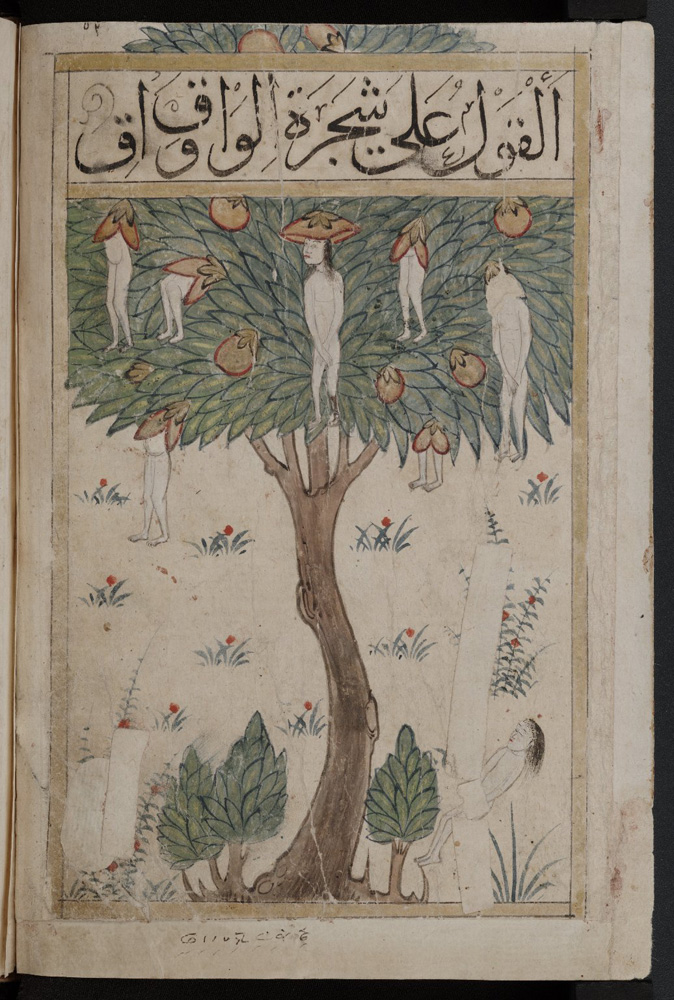 The Waq-Waq tree, a marvelous image from Kitab al-Bulhan, fol. 41b. It belongs to a wider medieval literature of distant islands, strange reproduction, and the limits of geographic knowledge. Bodleian Libraries; CC BY 4.0 via Wikimedia Commons.
How Talismanic Signs Work on the Page
Several supernatural images are accompanied by isolated letters, repeated characters, numbers, geometric marks, small grids, star-like forms, or linked circles sometimes called spectacle signs. Their presence tempts modern readers to search immediately for a usable ritual code. Historical interpretation requires more patience.
Talismanic writing in the medieval Islamic world drew from multiple sources. Qur’anic verses and divine names could appear in protective objects. Letter science connected alphabetic forms with numbers, elements, planets, or divine meanings. Magic squares arranged numbers according to mathematically controlled sums. Astrological talismans joined an image or inscription to a chosen celestial time. Symbols moved between Greek, Syriac, Arabic, Hebrew, Persian, and later European manuscripts, changing shape and explanation.
On a manuscript page, signs can serve several functions:
- identify the planetary or spiritual category represented;
- display a protective or constraining formula;
- signal specialized knowledge without fully explaining it;
- organize memory through repeated visual patterns;
- link the painted being to a wider talismanic tradition;
- or increase the page’s aura of authority and secrecy.
We should not assume that every mark can be translated with certainty. Damaged script, stylized forms, scribal copying errors, and later reinterpretation complicate identification. Online diagrams frequently redraw signs, assign confident modern meanings, and combine them with instructions taken from unrelated grimoires. That process produces a new occult system, not a transparent recovery of the medieval page.
A source-based study begins with the shelfmark, folio number, manuscript image, catalogue description, and scholarly transcription. It compares repeated signs across the codex and related manuscripts. It labels uncertain readings as uncertain. It does not turn visual resemblance into proof of direct historical borrowing.
Astronomy, Astrology, Magic, and Religion: Why Modern Boxes Fail
Kitab al-Bulhan is often used in arguments about whether medieval Islamic culture embraced or rejected magic. Both claims are too broad. Islamic societies contained competing legal schools, philosophical traditions, theological positions, Sufi practices, local customs, court sciences, medical theories, and popular rituals. The acceptability of an act depended on its language, method, claimed source of power, intention, and interpretation.
Prayer, Qur’anic recitation, and lawful protective supplication could be defended as reliance on God. Astrology could be criticized for implying that planets determine fate, while limited celestial observation remained essential for calendars, prayer times, navigation, and astronomy. Talismans might be accepted, tolerated, condemned, or redefined depending on whether they used sacred text, unknown signs, astrological elections, spirit names, or coercive claims. Divination could be rejected as a claim to forbidden knowledge of the unseen, yet dreams, omens, lots, and inherited prognostic traditions continued to circulate.
The manuscript is evidence of circulation, not universal approval. Its survival does not prove that every scholar, jurist, or ordinary believer endorsed its contents. At the same time, condemnation in a legal text does not prove that a practice disappeared. Historical reality lies in the tension between prescription and behavior.
This is one reason the book is valuable. It preserves knowledge that crossed boundaries precisely because those boundaries were debated. Its pages show that celestial calculation, marvelous storytelling, religious imagery, and talismanic theory could share a material object even when readers disagreed about their truth or legitimacy.
A Symbolic Reading: The Cosmos as a Court of Correspondences
The manuscript’s deepest unifying idea is not “demons.” It is correspondence: the conviction that different levels of reality can mirror one another. Planets correspond to days, colors, metals, professions, bodily conditions, regions, rulers, animals, and spiritual figures. A book can map these relationships so that an invisible structure becomes visible.
The political form of the manuscript is especially striking. Planets rule. Jinn are kings. Attendants surround them. Regions fall under celestial governors. Professions belong to planets. The cosmos resembles a court with ranks, offices, alliances, and jurisdictions. This model makes cosmic complexity intelligible through familiar social order.
Yet the system also contains instability. A king may protect or threaten. Mars signifies courage and violence. Saturn can indicate endurance, poverty, agriculture, darkness, old age, or misfortune. The marvelous world is not divided into simple good and evil categories. Power is ambivalent and must be classified, timed, negotiated, restrained, or interpreted.
From a philosophical perspective, the manuscript presents knowledge as relational rather than isolated. To know a sign is to know its ruler, element, time, image, number, and effect. This differs from the modern tendency to extract one symbol and give it a universal dictionary definition. In the codex, meaning comes from position within a system.
A responsible modern symbolic reading can learn from that structure without asserting supernatural causation. The seven planetary kings can be studied as representations of recurring human experiences: authority, aggression, communication, expansion, attraction, limitation, luminosity, and change. The Waq-Waq tree can represent anxiety about distant worlds and nonordinary generation. Kābūs can visualize the felt invasion of nightmare. The Lighthouse can embody knowledge that guides through danger. These are interpretations, not hidden messages proven to have been intended by every historical reader.
Common Misconceptions About Kitab al-Bulhan
“It Is an Ancient Book Written by King Solomon”
No. The surviving manuscript is a late medieval Arabic compilation associated with al-Iṣfahānī, al-Irbilī, and earlier astrological and divinatory authorities. Solomon is central to many Islamic, Jewish, and Christian traditions concerning spirits, but Kitab al-Bulhan should not be relabeled as a Solomonic grimoire without textual evidence.
“It Is a Single, Complete Work in Its Original Order”
No. It is composite, incomplete, and misbound. Some pages are missing. Later Ottoman copies help reconstruct portions of the earlier arrangement, but they are translations and adaptations rather than identical duplicates.
“The Paintings Show What Jinn Literally Look Like”
The paintings show how artists visualized invisible powers through the iconography of their time. They combine royal posture, monstrous anatomy, planetary color, animals, weapons, attendants, and signs. They are historical representations, not scientific photographs.
“Every Symbol Has One Secret Meaning”
No. Signs can change across manuscripts. Some are stylized letters, numerical arrangements, talismanic marks, damaged forms, or copied conventions whose original explanation is uncertain. A confident modern decoding may be speculative.
“The Manuscript Proves Astrology Was Universally Accepted in Islam”
No. Astrology circulated widely and attracted patrons, but it was also criticized on theological, legal, philosophical, and scientific grounds. The manuscript documents one important intellectual tradition, not unanimous belief.
“Because the Book Contains Marvels, Nothing in It Has Historical Value”
Also false. A marvelous story can preserve real place names, artistic conventions, social fears, inherited geography, political symbolism, scientific concepts, and the history of imagination. Historical value does not require every narrative claim to be literally true.
“The Images Can Be Safely Used as Ready-Made Summoning Seals”
The manuscript is not a modern safety-tested ritual manual, and isolated online images lack the original sequence, textual explanation, and cultural context. Treating them as operational instructions can produce fear, obsession, exploitation by fraudulent practitioners, or harmful behavior. Historical study does not require enactment.
How to Study the Manuscript Responsibly
A strong study method separates primary evidence from interpretation and modern adaptation.
- Begin with the manuscript record. Use the Bodleian shelfmark MS. Bodl. Or. 133 and the Digital Bodleian viewer rather than an unattributed social-media image.
- Record the folio. A page number such as fol. 31r or 41b allows the image to be checked and compared.
- Read an art-historical study. Stefano Carboni’s work explains the compiler, patron, missing sequence, Ottoman copies, and iconographic cycles.
- Separate manuscript layers. Distinguish Abū Maʿshar’s earlier intellectual tradition from the fourteenth-century compilation and the sixteenth-century Ottoman adaptations.
- Check translations. Names may appear in multiple transliterations. Search the Arabic form when possible and do not assume that one English spelling identifies a unique being across all sources.
- Compare institutions. Museum, library, and university records often clarify date, provenance, rights, and image description.
- Label belief claims. Write “the manuscript associates,” “the tradition held,” or “the image represents” rather than “this spirit causes” or “this seal guarantees.”
- Avoid medical substitution. Historical images of fever, nightmare, or illness are not diagnoses or treatments.
- Respect religious distinctions. Do not reduce Islamic belief in jinn to horror imagery or present disputed occult practices as the essence of Islam.
- Track modern additions. Contemporary occult books may build useful symbolic systems, but their interpretations should be identified as modern rather than projected backward.
Readers interested in verifying manuscript claims can also consult SecretMagic’s guide, How to Research Occult History Online. For comparison with an older ritual culture in which image, speech, object, and protection operated together, see Heka: How Ancient Egyptian Magic Actually Worked.
Influence and Modern Afterlife
The manuscript’s modern fame is driven less by its technical astrological pages than by its supernatural paintings. Digital archives and Wikimedia Commons made high-quality images available to a global audience. Social media then separated the images from their captions, folio numbers, and neighboring pages. The Red King became a reusable icon for “ancient demonology.” The enthroned Iblis entered horror collages. The Waq-Waq tree circulated as surreal art. Tattoo designs and contemporary occult graphics borrowed individual forms.
This visibility has positive consequences. A manuscript once available mainly to specialists can now attract readers to Arabic art, Islamic intellectual history, manuscript conservation, astrology, folklore, and comparative demonology. Digitization allows viewers to inspect details that older microfilm users could barely see.
It also creates distortions. Search algorithms reward frightening images and simple claims. “Seven kings of the jinn” travels farther than “a misbound late Jalayirid composite codex containing nativities, lunar stations, divination, geomancy, and wonder tales.” AI-generated summaries repeat one another, invent translations, merge the manuscript with Shams al-Maʿārif, or claim that all symbols have been decoded.
The answer is not to hide the images behind academic barriers. It is to publish better explanations beside them: shelfmarks, dates, folio references, licensing, historical uncertainty, and clear distinctions between evidence and interpretation. The visual power of the manuscript can become an entrance to serious study rather than a substitute for it.
Frequently Asked Questions
Where is Kitab al-Bulhan kept?
The principal Arabic manuscript discussed here is held by the Bodleian Libraries at the University of Oxford under the shelfmark MS. Bodl. Or. 133. It has been digitized through Digital Bodleian. Related Ottoman Turkish manuscripts are held in other collections, including the Morgan Library and the Bibliothèque nationale de France.
When was it made?
Most of the surviving composite manuscript dates from the late fourteenth century, with strong evidence placing it in a Jalayirid Baghdad context around the decades before 1409–1410. Individual intellectual sources within it are much older, while later copies date to the Ottoman sixteenth century.
Who wrote it?
There is no single author in the modern sense. ʿAbd al-Ḥasan al-Iṣfahānī was a major compiler and copyist. Al-Ḍiyāʾ Ḥusayn al-Irbilī owned, commissioned, and copied portions. The manuscript incorporates material associated with earlier authorities such as Abū Maʿshar and Jaʿfar al-Ṣādiq. Artists remain largely anonymous.
Is Kitab al-Bulhan the same as Shams al-Maʿarif?
No. They are distinct works with different textual histories, although both are frequently discussed in modern conversations about Arabic occult sciences. Online posts sometimes combine their spirit names, squares, letters, and illustrations without identifying the source of each element.
Is it a grimoire?
The answer depends on how broadly the word is used. It contains divinatory and talismanic material, but it is not a single-purpose conjuration manual. “Composite illustrated manuscript of astrology, divination, geomancy, and wonders” is more precise.
Are the seven jinn kings part of mainstream Islamic theology?
Belief in jinn is part of Islamic scripture and theology. The specific seven planetary kings, their colors, names, metals, talismans, and painted forms belong to later astrological and occult traditions. They should not be treated as a complete summary of Islamic teaching about jinn.
Did Abū Maʿshar paint the manuscript?
No. Abū Maʿshar died in 886 CE, centuries before the surviving codex was made. His writings and reputation influenced sections of the manuscript. The fourteenth-century compiler and anonymous artists created the surviving visual object.
Why are some pages missing?
The manuscript was separated and rebound incorrectly at an unknown date, and some folios were lost. Related Ottoman copies preserve material that helps scholars infer parts of the original order and identify missing subjects.
Can the images be used freely?
Rights differ by digital file. Many Wikimedia Commons reproductions are marked public domain; several Bodleian uploads are released under CC BY 4.0 and require attribution. Always check the individual file page rather than assuming that every image from an old manuscript has identical digital-use terms.
Does the manuscript prove that the depicted beings exist?
It proves that artists, compilers, patrons, and readers preserved specific ways of representing invisible beings and cosmic forces. It does not constitute scientific verification of supernatural existence or causation.
Why Kitab al-Bulhan Still Matters
Kitab al-Bulhan matters because it preserves a form of knowledge that modern categories have pulled apart. Its pages place observation beside interpretation, mathematics beside marvel, royal imagery beside fear, and inherited authority beside artistic invention. The manuscript does not ask the reader to choose between a rational cosmos and an enchanted one. It records a culture in which calculated heavens could also be meaningful heavens.
The jinn kings are unforgettable, but they are not the whole book. Around them stand planets, professions, zodiac signs, lunar stations, geomantic figures, divinatory texts, cities, thermal baths, legendary walls, islands, strange trees, and learned authorities. The manuscript’s true subject is the organization of a complex universe.
Reading it well requires two forms of respect. The first is respect for historical belief: refusing to mock people whose religious, medical, and cosmic assumptions differed from ours. The second is respect for evidence: refusing to turn a beautiful page into proof of whatever a modern occult theory wants it to mean.
Between credulity and dismissal lies a richer approach. The book can be studied as art, manuscript, cosmology, intellectual history, folklore, and symbolic philosophy. Its images can provoke awe without becoming instructions. Its supernatural claims can be described without being marketed as scientific facts. Its mysteries become deeper, not weaker, when their historical layers are restored.
Sources and Further Reading
- Digital Bodleian, University of Oxford. Search for MS. Bodl. Or. 133 for the digitized manuscript and institutional description.
- Biblissima IIIF record for Oxford, Bodleian Library, MS. Bodl. Or. 133, including shelfmark, date range, languages, and composite-manuscript description.
- Stefano Carboni, “The ‘Book of Surprises’ (Kitab al-bulhan) of the Bodleian Library”, La Trobe Journal 91, State Library Victoria, 2013, pp. 22–34.
- University of Western Australia research record for Carboni’s study.
- “Astronomy and Astrology in the Medieval Islamic World”, Heilbrunn Timeline of Art History, The Metropolitan Museum of Art.
- David Pingree, “Abū Maʿshar”, Encyclopaedia Iranica, for the astrologer’s biography, works, and intellectual influence.
- “Lunar Cycle,” Cabinet, University of Oxford, discussing a celestial diagram in MS. Bodl. Or. 133.
- Wikimedia Commons: Kitab al-Bulhan collection, with individual licensing and source information for digitized folios.


