


 Abe no Seimei, drawn by Kikuchi Yōsai. The historical Seimei was a court specialist in astronomy and divination; later literature transformed him into Japan’s most famous magical master. Public domain. View the image record.
Onmyōdō is often introduced today as “Japanese magic,” but that phrase is both useful and dangerously incomplete. It suggests a single secret system of spells, spirit servants, pentagrams, and supernatural combat. Historical Onmyōdō was more complex. It developed through the interaction of imported Chinese yin-yang and five-phase theories, calendrical calculation, astronomy, omen interpretation, Buddhist and Daoist ritual influences, court administration, local religious practices, family lineages, and the practical need to make decisions in an uncertain world.
An onmyōji was not originally a fantasy exorcist wandering from village to village. In classical Japan, specialists connected with the imperial Bureau of Onmyō helped calculate calendars, observe the sky, interpret unusual events, select dates, evaluate directions, and advise the court. Their work influenced travel, construction, ceremonies, medical timing, political decisions, and the management of misfortune. Over centuries, some of these techniques spread beyond the court, merged with popular religion, and generated legends about invisible spirit servants, foxes, curses, miraculous predictions, and the extraordinary powers of Abe no Seimei.
The modern image is therefore not completely invented. Onmyōdō genuinely included divination, ritual protection, the interpretation of hidden causes, and practices that modern readers classify as magic. Yet its most historically important work was frequently administrative and technical: calendars, astronomical records, timekeeping, auspicious dates, directional rules, and the translation of cosmic patterns into decisions.
This guide reconstructs Onmyōdō from academic research, Japanese institutional sources, historical images, calendars, literary traditions, and modern scholarship. It separates the court institution from later folklore, explains what Abe no Seimei probably did, examines shikigami without treating anime as evidence, and offers a safe symbolic exercise inspired by historical principles without pretending to recreate a closed or lost initiation.
Historical and safety note: This article is cultural and historical education. It does not claim that supernatural beings, curses, spirit servants, astrological prediction, or magical exorcism have been scientifically demonstrated. Do not delay medical, veterinary, legal, or mental-health care; accuse real people of possession or sorcery; ingest historical substances; burn unknown materials; trespass at shrines; imitate coercive rituals; or use divination to replace responsible decisions. The modern exercise near the end is reflective, non-coercive, and compatible with a secular interpretation.
Quick Answer: What Was Onmyōdō?
Onmyōdō can be translated approximately as “the Way of Yin and Yang.” It was a distinctively Japanese tradition built from several bodies of knowledge rather than one original book. Its practitioners worked with:
- Yin and yang as complementary modes of change.
- The five phases—wood, fire, earth, metal, and water—as dynamic processes.
- Calendars and the coordination of lunar, solar, seasonal, and ritual time.
- Astronomical observation and interpretation of celestial anomalies.
- Divination for dates, directions, journeys, construction, illness, and public events.
- Omen interpretation involving weather, animals, dreams, accidents, and unusual phenomena.
- Ritual protection, purification, pacification, and the management of harmful influences.
- Inherited family knowledge, official offices, manuscripts, almanacs, and later popular specialists.
Kokugakuin University’s digital encyclopedia describes Onmyōdō as a unique Japanese adaptation of Chinese yin-yang and five-phase theory that established itself around the tenth century. Under the earlier ritsuryō state system, the Bureau of Onmyō handled divination, astrology, calendars, and timekeeping, but the unified category “Onmyōdō” developed later through the work and hereditary authority of families such as the Kamo and Abe. Read Kokugakuin’s overview.
The National Diet Library likewise explains that the Bureau of Onmyō had jurisdiction over calendar preparation, astronomy, and divination, and that calendar work eventually became associated with the Kamo family while astronomy became linked with the Abe lineage, whose most famous figure was Abe no Seimei. See the National Diet Library’s history of the Japanese calendar.
Onmyōdō was therefore simultaneously:
- A body of cosmological ideas.
- A collection of practical techniques.
- A profession within government.
- A hereditary field organized by families.
- A ritual tradition interacting with Buddhism and shrine religion.
- A source of stories, legends, and popular magical identities.
No one definition captures every century. The Onmyōdō of the eighth-century court, the world of Abe no Seimei in the tenth century, the medieval activities of non-court specialists, the early modern Tsuchimikado organization, and the Onmyōdō of contemporary fiction are related but not identical.
Why “Japanese Magic” Can Mislead
Modern Western categories often separate astronomy from astrology, religion from magic, government from ritual, and medicine from divination. Pre-modern Japan did not draw those boundaries in the same places. Observing an eclipse could be technical astronomy and political omen interpretation at the same time. Preparing a calendar could be administrative work, sacred ordering, and practical prediction. Avoiding an inauspicious direction could be ordinary elite etiquette rather than an exotic occult ceremony.
The word “magic” becomes useful when Onmyōdō addresses invisible causation, ritual efficacy, spirit control, protection, curse removal, or extraordinary knowledge. It becomes misleading when it suggests that every onmyōji was primarily a conjurer. Many were trained officials whose authority came from institutional appointment, family transmission, calculation, literacy, and service to the court.
A second problem is that “Japanese magic” sounds purely indigenous. Onmyōdō emerged from international exchange. Its foundations included Chinese cosmology, calendrics, divination, and astral knowledge transmitted through the Korean peninsula and diplomatic, religious, and scholarly networks. Buddhism carried additional ritual technologies, deities, Sanskrit-derived formulas, planetary ideas, and methods of protection. Japan reorganized these materials into new institutions and local forms.
A third problem is that modern fiction compresses many traditions into one. Shinto purification, Buddhist esoteric ritual, Daoist-style talismans, fox folklore, mountain asceticism, yōkai stories, Chinese divination, and Onmyōdō may appear together in a single fictional character. Historical people also combined traditions, but the combinations changed by time and place. A responsible study identifies which layer a claim belongs to.
The Chinese Foundations: Yin, Yang, and the Five Phases
Yin and yang are not simply evil and good, dark and light, or female and male. They describe relational tendencies within change. Yin may be associated with inwardness, darkness, coolness, rest, and receptivity; yang with outwardness, brightness, heat, activity, and expansion. Neither exists independently. Day moves toward night, summer toward winter, growth toward decline, and stillness toward movement.
The five phases—wood, fire, earth, metal, and water—are also not static chemical substances. They are patterns of transformation. Wood suggests growth and extension, fire rising and radiating, earth stabilizing and centering, metal contracting and structuring, water descending and storing. In Chinese systems, the phases generate and control one another through cycles. They can classify seasons, directions, colors, organs, planets, sounds, political changes, and ritual correspondences.
When these ideas entered Japan, they were not copied without change. Japanese specialists integrated them with local geography, political institutions, court rituals, Buddhist cosmology, kami worship, seasonal festivals, and inherited techniques. The result was not “Chinese Daoism in Japan” under another name. The Japanese Journal of Religious Studies special issue on Onmyōdō emphasizes that it became a religion and technical tradition that came into existence specifically within Japan. Read “Chinese Religion and the Formation of Onmyōdō”.
Cosmology mattered because classification permitted action. If a date, direction, person, building, illness, or event could be placed within a pattern, the specialist could recommend avoidance, adjustment, ritual response, or an auspicious time. Onmyōdō turned cosmic theory into a decision-making system.
The Bureau of Onmyō: Magic Inside Government
The Onmyōryō, often translated as the Bureau of Onmyō or Bureau of Divination, belonged to Japan’s centralized ritsuryō administration. Its work shows that divination was not necessarily an underground challenge to authority. It could be part of authority.
The bureau’s broad responsibilities included:
- Onmyō: divination using yin-yang methods and related calculations.
- Tenmon: astronomy and interpretation of celestial events.
- Koyomi: calendar calculation and production.
- Rōkoku: water-clock management and official timekeeping.
These were connected functions. Government needed a calendar to organize taxes, ceremonies, agricultural expectations, court attendance, festivals, and official documents. It needed timekeeping to coordinate administration. It observed the sky because eclipses, comets, unusual stars, planetary conjunctions, and atmospheric events were interpreted as signs concerning political order.
The calendar was not a neutral wall chart. It organized the relationship between state, season, celestial movement, ritual, and human action. To control the calendar was to participate in ordering society.
 A Japanese color woodblock calendar from 1867. This is much later than the classical Bureau of Onmyō, but it illustrates how calendars could combine practical dates, cyclical signs, visual symbolism, and social knowledge. Public domain. View the image record.
Calendars as Technologies of Power
Calendar history may sound less dramatic than spirit conjuration, but it is central to understanding Onmyōdō. A calendar answers questions that shape daily life:
- When does a month begin?
- When should a ceremony occur?
- Which days are favorable or dangerous?
- How should lunar and solar cycles be reconciled?
- When should agricultural and religious activities be expected?
- How should an unusual celestial event be recorded?
Traditional Japanese calendars were lunisolar. Months followed lunar cycles, while intercalation kept the year aligned with the seasons. The National Diet Library notes that months were adjusted according to the moon’s waxing and waning, producing long and short months and requiring sophisticated management. Calendar specialists did not merely predict the future; they manufactured a shared framework in which the future could be discussed.
Calendar knowledge also created social authority. A person who could calculate dates, identify cyclical correspondences, and interpret taboos possessed information unavailable to most clients. In later periods, printed almanacs expanded access, but specialist interpretation remained valuable.
This is one reason Onmyōdō endured through change. Even when particular rituals lost official status, people still wanted auspicious dates, directional guidance, naming advice, protection, and explanations for irregular events.
Astronomy, Astrology, and Political Omens
Modern astronomy studies celestial bodies through physical models and measurement. Premodern court astronomy also measured and recorded, but it operated in a political cosmos. The sky was not separate from government. An eclipse, comet, meteor, planetary conjunction, unusual color, or unexplained light could indicate imbalance, danger, criticism of the ruler, or the need for ritual correction.
This did not mean observers invented events to support superstition. Precise observation could coexist with omen interpretation. Accurate records were necessary because the meaning of an anomaly depended on when, where, and in which celestial region it appeared.
Onmyōji might advise secrecy around alarming signs, recommend ritual responses, or compare an event with precedents. The court’s concern was not merely personal fortune. Celestial anomalies could affect legitimacy, appointments, public ceremonies, war, famine expectations, and the interpretation of disaster.
Astral knowledge also entered medicine and personal divination. Planets, directions, zodiacal cycles, and temporal units could be connected with the body, travel, and individual destiny. Different specialists possessed different levels of mathematical skill. “Astrology” therefore ranged from highly technical court calculation to simplified almanac-based advice.
Directional Taboos: When the Wrong Road Was a Cosmic Problem
One of the most distinctive practical areas associated with Onmyōdō was directional avoidance. Certain directions could be considered temporarily dangerous because of the movement or location of deities and harmful influences. A traveler whose destination lay in an inauspicious direction might postpone the journey or perform katatagae, “changing direction,” by spending a night elsewhere and approaching the destination through a safer route.
To a modern reader, this can sound irrationally inconvenient. In the Heian court, however, direction was part of etiquette, risk management, and elite identity. A noble who ignored a known taboo might be blamed if illness or misfortune followed. Observing the rule demonstrated knowledge, caution, and participation in court culture.
Directional practice reveals three important principles:
- Space was temporal. A direction was not permanently good or bad; its quality changed with the calendar.
- Movement created exposure. Crossing a direction at the wrong time could bring a person into conflict with an influence.
- Ritual systems reshape logistics. Cosmology affected where people slept, when they traveled, and how they entered a destination.
Historical diaries show that elite life was repeatedly adjusted around date and direction. Onmyōdō was powerful because it entered ordinary planning. It did not require a spectacular miracle.
Selecting Auspicious Dates
Date selection applied to travel, marriage, construction, burial, ceremonies, appointments, repairs, and other important transitions. A date could be evaluated through multiple overlapping cycles. The result was not always a simple “good day” or “bad day.” A day might be suitable for one activity and unsuitable for another.
This complexity created the need for expertise. The specialist compared the type of action, direction, person, calendrical signs, and current conditions. Advice could reduce anxiety by turning an uncertain choice into a structured decision.
From a modern psychological perspective, date selection can help people prepare, coordinate, and commit. Historically, its significance was deeper: the chosen moment aligned human action with a patterned cosmos. Timing was part of efficacy.
Abe no Seimei: The Historical Man
Abe no Seimei, conventionally dated 921–1005, became the most famous onmyōji in Japanese history. Historical records place him within the world of court astronomy and divination. He served aristocratic clients, interpreted events, and benefited from a long career during a period when Abe and Kamo family expertise became increasingly important.
The National Diet Library identifies him as the patriarchal figure associated with the Abe family’s hereditary role in astronomy. Academic studies caution that his later fame cannot be read directly back into every event of his life. The article “A Portrait of Abe no Seimei” in the Japanese Journal of Religious Studies examines the difference between the historical official and the miracle-working figure created by later tales. Read the article overview and PDF.
Historically plausible elements of his career include:
- Service within court divination and astronomy.
- Interpretation of omens and unusual events.
- Advice to aristocratic patrons.
- Participation in the growing hereditary authority of the Abe lineage.
- Longevity sufficient to build reputation across generations.
What we cannot do is treat every later story as biography. Tales written after his death gave him a supernatural mother, extraordinary childhood perception, contests with rival magicians, command over shikigami, detection of disguised beings, miraculous healing, and victory over curses. These stories reveal Seimei’s cultural meaning, not necessarily his daily historical activity.
How Seimei Became a Magical Hero
Reputation expands when a historical figure becomes a solution to later narrative needs. Seimei could represent:
- The perfect court expert who sees what others miss.
- The loyal defender who defeats hidden threats.
- The master of technical knowledge beyond ordinary understanding.
- The mediator between human government and invisible forces.
- The clever Japanese counterpart to foreign or rival magicians.
- The ancestor whose prestige legitimizes a lineage or shrine.
Setsuwa tale collections, illustrated narratives, shrine traditions, theater, novels, film, manga, anime, and games repeatedly remade him. Each medium selected different traits. The modern elegant onmyōji with flowing robes, fox associations, pentagram seals, and obedient spirits is the result of centuries of cultural layering.
 An onmyōji in an early Edo-period illustrated version of the Tamamo-no-Mae story. Such narratives helped turn court specialists into dramatic detectors of hidden supernatural identities. Public domain. View the image record.
Tamamo-no-Mae and the Onmyōji as Detector
The Tamamo-no-Mae legend concerns a beautiful court woman eventually revealed as a dangerous fox spirit in later versions. Abe no Seimei is often credited with exposing her hidden nature. The story is historically later than Seimei’s life and developed through multiple literary and theatrical forms.
Its importance lies in the role assigned to the onmyōji. He is not merely attacking a monster. He diagnoses deception. The court sees beauty and refinement; the specialist sees the dangerous pattern beneath appearance. This narrative role resembles the real authority of omen interpreters: identifying meaning hidden within events.
The legend also contributed to the strong association between Seimei and foxes. Some traditions claimed that his mother was Kuzunoha, a fox woman, giving him inherited supernatural perception. These accounts are folklore, not verified genealogy. They explain his powers through a liminal ancestry: human enough to serve the court, otherworldly enough to understand spirits.
Rival Magicians and Contests of Knowledge
Stories frequently pair Seimei with rivals such as Ashiya Dōman. Magical contests allow audiences to see invisible expertise. One practitioner predicts correctly, recognizes a concealed object, survives a curse, or exposes cheating. The rival may represent dangerous, uncontrolled, provincial, or morally ambiguous magic, while Seimei represents legitimate mastery.
These tales should not be used as technical manuals. Their function is literary and social. They stage questions about authorized knowledge:
- Who has the right to interpret the invisible?
- What distinguishes skill from fraud?
- Can a powerful specialist remain loyal to political order?
- Does lineage matter more than personal talent?
- How can an audience judge a claim it cannot independently verify?
The same questions continue in modern occult culture.
Shikigami: Spirit Servants, Literary Motifs, and Modern Misconceptions
Shikigami are commonly described as spirit familiars summoned and commanded by onmyōji. In anime and games they may be animal companions, paper figures, armored warriors, demons, or named supernatural beings with fixed powers. Historical evidence is less standardized.
Carolyn Pang’s study “Uncovering Shikigami” argues that shikigami must be examined through literary narratives, folklore, and the changing religious presentation of Abe no Seimei. The term’s meaning developed through stories rather than one universally preserved ritual system. Read the article overview and PDF.
In historical tales, a shikigami may appear as:
- An invisible or partially visible servant.
- A being sent to perform a task.
- A dangerous force controlled by a skilled practitioner.
- A spirit whose actions reveal the master’s power.
- A literary explanation for information or action occurring at a distance.
The familiar modern image of folding a paper figure and animating it is influenced by later visual and fictional conventions. Paper, writing, seals, and ritual documents were genuinely important in East Asian religious practice, but there is no single public historical recipe that turns a paper doll into a standardized shikigami.
A responsible student should distinguish:
- Historical terminology: how words appear in records and tales.
- Literary function: what the spirit servant allows the story to communicate.
- Institutional identity: how modern shrines and traditions present Seimei.
- Popular culture: creative systems designed for entertainment.
Popular fiction is not worthless. It is evidence for modern reception. It becomes misleading only when treated as a direct description of Heian-period ritual.
Ritual Protection and Exorcistic Work
Onmyōdō specialists could be called upon when illness, disaster, disturbing dreams, spirit fear, unusual births, political danger, or unexplained events required interpretation and ritual response. Their work interacted with Buddhist monks, shrine priests, physicians, diviners, and local healers.
Protection might involve:
- Recitation and formal petition.
- Purification and boundary-making.
- Offerings and ritual objects.
- Written signs, names, or talismanic documents.
- Selection of a proper date and direction.
- Pacification of a harmful influence.
- Transfer or redirection of impurity and misfortune.
- Interpretation of the event so that a response could be chosen.
It is difficult to assign every ritual element exclusively to Onmyōdō. Buddhist esoteric rites, Daoist-derived methods, kami cults, court ceremonies, and local practices overlapped. Specialists borrowed from one another. Institutional boundaries did not prevent practical combination.
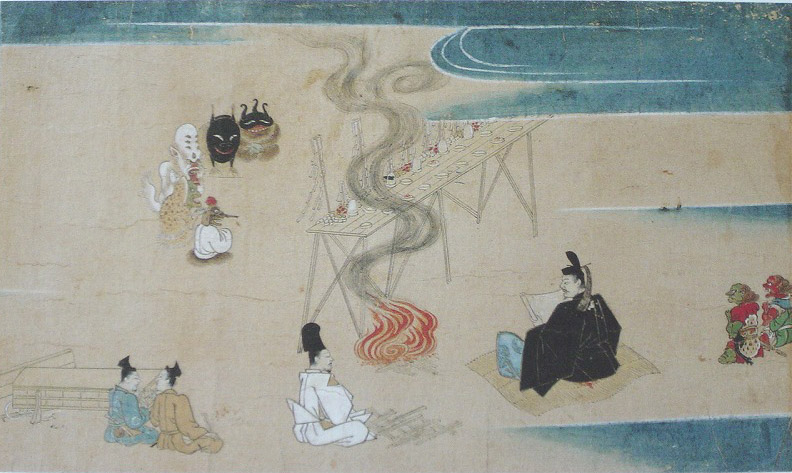 A scene from the Naki Fudō Engi showing Abe no Seimei confronting disease spirits through ritual. The image represents legendary memory rather than a documentary picture of his working room. Public domain. View the image record.
Disease, Spirits, and Competing Specialists
Premodern illness could be interpreted through several causes at once: bodily imbalance, epidemic environment, pollution, karmic consequence, offended beings, hostile ritual, possession, or dangerous timing. A family might consult more than one specialist. A physician could provide remedies, a monk perform rites, and an onmyōji interpret dates or hidden influence.
This plural system was not necessarily experienced as contradiction. Different specialists addressed different layers of the crisis. The patient needed physical treatment, social reassurance, spiritual protection, and an explanation.
Modern readers must not imitate the hierarchy of historical care. Today, suspected infection, poisoning, seizures, psychosis, or neurological symptoms require qualified professional assessment. Historical study explains why ritual systems mattered; it does not prove they are medically sufficient.
Names, Writing, and Talismanic Authority
Writing carried special power because it fixed names, calculations, commands, dates, and correspondences. An official document could change a person’s social reality. A calendar could govern public time. A talismanic document could claim to reorganize invisible conditions.
Onmyōdō manuscripts and related ritual texts could contain diagrams, cyclical signs, deity names, stars, directions, formulas, and instructions. Literacy was itself part of authority. A client unable to read the technical text could still recognize structured writing as evidence of specialist knowledge.
Modern internet “Onmyōdō sigils” often combine unrelated scripts, invented seals, anime symbols, Chinese talismans, and Western occult geometry. A symbol may be artistically meaningful while historically inaccurate. Before attributing an image to Onmyōdō, ask:
- What is the earliest dated source?
- Is the symbol Japanese, Chinese, Buddhist, Daoist, or modern?
- Does it appear in a manuscript, shrine, printed book, or entertainment product?
- Is the claimed translation verifiable?
- Was it used by specialists, or added by a modern illustrator?
The Pleiades and Astral Diagrams
Stars were not decorative. They structured time, direction, and cosmology. The Pleiades, Big Dipper, planets, lunar mansions, and zodiacal cycles appear across East Asian astral traditions. Different diagrams could encode observation, ritual, or divinatory relationships.
 A modern CC0 reconstruction of a Pleiades sign reproduced from an early twentieth-century publication concerning Abe no Seimei. It is useful as an example of astral diagram transmission, but should not be assumed to be Seimei’s personal signature. View the image record.
Astral diagrams are especially vulnerable to false certainty. A modern copy may simplify a damaged source. A symbol associated with a famous person may have been attributed centuries later. Good scholarship records the chain: original manuscript, later edition, modern redraw, and current interpretation.
The Five-Pointed Star and the Seimei Symbol
The five-pointed star is strongly associated today with Abe no Seimei and Seimei Shrine. It is often called the Seimei-kikyō, or Seimei bellflower, and interpreted through the five phases. The symbol appears prominently in modern shrine identity and popular culture.
Western readers may immediately call it a pentagram and assume a direct connection with European ceremonial magic, Pythagorean symbolism, or modern witchcraft. Visual similarity does not prove historical transmission. Five-pointed stars can arise independently and receive different meanings.
Within contemporary Seimei-related symbolism, the five points can express the five phases and balanced protection. That does not mean every Heian onmyōji used the exact modern emblem as a universal magical seal. The responsible formulation is: the five-pointed star is now a central emblem of Seimei devotion and modern Onmyōdō imagery, with interpretations linked to five-phase cosmology.
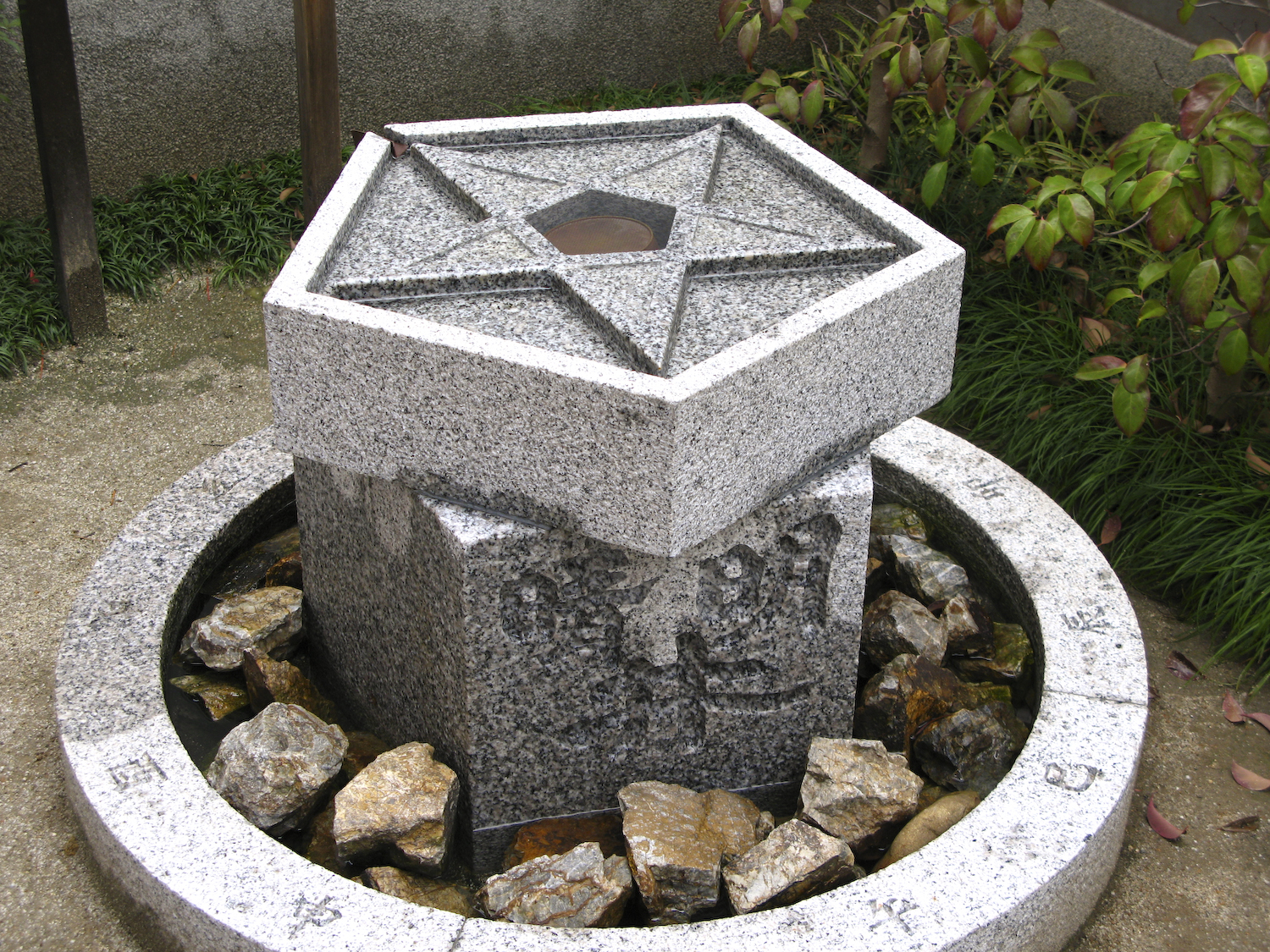 The Seimei Well at Seimei Shrine in Kyoto, displaying the five-pointed emblem now strongly connected with Abe no Seimei. Public domain photograph. View the image record.
Onmyōdō, Buddhism, and Shinto
It is incorrect to say that Onmyōdō was simply a branch of Shinto. It is equally incorrect to say it was merely disguised Buddhism or imported Daoism. It interacted with all of these.
Buddhist institutions possessed their own astrology, protection rites, divination, spirit pacification, mantra, and ritual calendars. Monks sometimes engaged in practices that the state attempted to regulate. The 701 legal code prohibited monks from using certain divinatory and non-Buddhist magical techniques through their clerical status, which itself shows that boundaries required enforcement.
Shrine cults contributed kami, purification, sacred geography, seasonal observance, and local ritual relationships. Over time, Onmyōdō deities and practices could be embedded within shrine contexts. The Kokugakuin overview notes extensive historical influence between Onmyōdō and Shinto while preserving their distinction.
Daoist influence reached Japan through cosmology, texts, ritual technologies, and Chinese state models, but Japan did not establish a direct institutional copy of Chinese organized Daoism in the same form. Onmyōdō became one Japanese solution for managing imported cosmological expertise.
The most accurate model is a network. Court officials, monks, shrine practitioners, physicians, local diviners, aristocratic clients, and hereditary families exchanged methods while defending areas of authority.
From Court Specialists to Medieval Popular Practitioners
As political structures changed, Onmyōdō did not simply disappear. Knowledge moved beyond the narrow classical bureau. Medieval records refer to practitioners sometimes called hōshi onmyōji, religious-looking or monk-like diviners who were not necessarily identical with official court onmyōji.
A 2023 Japanese historical study summarized by the National Diet Library describes these practitioners as part of the broader history of experts in divination and magic, highlighting the tension between legal restrictions and actual religious labor. View the National Diet Library record.
Medieval diffusion produced diversity:
- Some specialists retained connections with elite lineages.
- Some served warriors, temples, shrines, villages, and towns.
- Some combined divination with healing, exorcism, performance, or pilgrimage.
- Some used the prestige of Onmyōdō without formal official appointment.
- Local traditions absorbed terms and symbols into new ritual systems.
This process resembles the spread of astrology, grimoires, and service magic elsewhere. Once a prestigious technical system becomes known, people reproduce simplified, adapted, or unauthorized versions. Authorities then debate authenticity.
Onmyōdō in the Muromachi Period
The Muromachi period saw political decentralization, warfare, new religious networks, and changing patronage. Onmyōdō continued through court lineages but also expanded through regional practice. The Japanese Journal of Religious Studies special issue includes a dedicated study of Onmyōdō in this period, showing that its history cannot be reduced to the Heian court. Explore the full special issue.
Techniques and texts circulated through copying. Family authority remained important because manuscripts alone did not guarantee the right to perform or interpret. Yet manuscript circulation made control imperfect.
War and uncertainty could increase demand for prediction and protection. At the same time, competing ritual specialists offered alternatives. Onmyōdō survived by adapting its services and lineage claims.
The Edo-Period Reorganization
During the Tokugawa period, Onmyōdō entered a new administrative and social environment. The Tsuchimikado family, descended from the Abe lineage in its own historical self-presentation, gained authority over networks of diviners and calendar-related practitioners. Early modern organization attempted to define legitimate specialists, issue permissions, and control a field that had become widely dispersed.
The article “The Development of Early Modern Onmyōdō” examines this transformation and the institutional strategies through which Onmyōdō adapted. Read the article overview and PDF.
Printed culture changed the environment. Almanacs, manuals, popular encyclopedias, and fortune-telling books made cosmological information more accessible. Specialists could no longer rely entirely on monopoly. They offered interpretation, licensing, ritual status, and personalized services.
Early modern Onmyōdō also participated in household concerns:
- Marriage compatibility.
- House orientation and construction.
- Selection of names and dates.
- Protection from directional danger.
- Funerary and memorial timing.
- Agricultural and travel advice.
- Local festivals and ritual calendars.
This period is crucial because many things now imagined as “ancient Onmyōdō” may actually reflect early modern standardization or popularization.
Meiji Suppression and Modern Reinvention
The Meiji state reorganized religion, education, calendars, and government expertise. Western scientific institutions, the Gregorian calendar, State Shinto policy, and new legal categories reduced the official space in which Onmyōdō had operated. The tradition lost formal governmental authority.
Suppression did not erase cultural memory. Practices continued through local diviners, shrine customs, household almanacs, folk religion, hereditary claims, and literature. Abe no Seimei became increasingly available as a historical-cultural figure rather than merely an official ancestor.
The twentieth and twenty-first centuries produced a major revival in representation. Novels and films popularized a refined, powerful Seimei. Manga, anime, games, tourism, shrine branding, and online occult culture created new audiences. This modern Onmyōdō is not simply fake. It is a new historical phase in which entertainment, devotion, heritage, and identity interact.
Modern Shrines and the Construction of Living Memory
Seimei Shrine in Kyoto and Abe Seimei Shrine in Osaka present Abe no Seimei as a figure of protection, intelligence, and spiritual power. Visitors encounter pentagram imagery, statues, wells, amulets, ema plaques, and stories of his life.
Academic research on Seimei and shikigami notes that shrines do not merely preserve a frozen medieval tradition. They participate in constructing modern religious identity through literature, tourism, media, and visitor expectation. This is normal for living heritage. Historical sites continually interpret the past.
A visitor should respect shrine rules and distinguish three questions:
- What is documented about the historical Seimei?
- What does the shrine teach as sacred tradition?
- What has popular culture encouraged visitors to expect?
These answers can coexist without being identical.
Onmyōdō and the History of Japanese Science
Calling Onmyōdō “magic” can hide its relationship with the history of science. Calendar calculation, water clocks, astronomical observation, recordkeeping, and numerical cycles required disciplined knowledge. Premodern science did not need to be modern physics in order to involve systematic observation and technical training.
At the same time, it would be misleading to describe Onmyōdō as purely scientific. Omen theory, ritual efficacy, spirit cosmology, and directional danger were integral to its historical operation.
The most productive approach avoids a false choice:
| Reduction | What It Misses |
|---|---|
| “It was only superstition.” | Institutions, mathematics, observation, calendars, political function, and technical expertise. |
| “It was ancient Japanese science.” | Ritual, spirits, omens, divination, and religious cosmology. |
| “It was secret wizardry.” | Government administration and ordinary scheduling. |
| “It was imported Chinese Daoism.” | Japanese adaptation, institutions, lineages, Buddhism, shrine religion, and local practice. |
What Did an Onmyōji Actually Do in a Working Day?
No single schedule applies to every period, but a historically grounded reconstruction may include:
- Reviewing calendar cycles and official dates.
- Observing or receiving reports of celestial events.
- Comparing an anomaly with established precedents.
- Calculating the suitability of a journey, ceremony, or construction.
- Advising a patron about directions and avoidance.
- Preparing a written interpretation for officials.
- Participating in a protective or pacifying rite.
- Teaching family or appointed students.
- Copying, checking, and protecting technical texts.
- Managing reputation among clients and rival specialists.
The work required patience. Calculation, copying, and bureaucratic reporting occupied more time than dramatic battles with spirits. The fantasy image captures the emotional power of the profession, but not its paperwork.
Ten Common Myths About Onmyōdō
Myth 1: Onmyōdō was a single unchanged religion from ancient China
It drew on Chinese traditions but developed in Japan through changing institutions, families, and religious networks.
Myth 2: Every onmyōji could summon shikigami
Shikigami are prominent in literature and folklore. Historical professional duties were much broader and often administrative.
Myth 3: Abe no Seimei invented Onmyōdō
The relevant cosmology and state offices existed before him. His career helped establish the Abe lineage’s prestige, and later legends made him the tradition’s symbolic master.
Myth 4: The Seimei pentagram proves a connection with Western witchcraft
Similar shapes can develop independently. The symbol’s Japanese meanings should be studied through its own transmission.
Myth 5: Onmyōdō was identical to Shinto
It interacted deeply with shrine religion but had distinct Chinese-derived cosmology, offices, specialists, and texts.
Myth 6: Onmyōdō disappeared completely after the Heian period
It changed through medieval regional practice, early modern organization, local survival, and modern reinvention.
Myth 7: Directional avoidance was only irrational fear
It functioned within a shared social system of risk, etiquette, timing, and elite identity.
Myth 8: Historical onmyōji dressed exactly like anime characters
Fiction draws from historical court clothing but stylizes color, movement, symbols, and equipment.
Myth 9: Any Japanese-looking talisman online is Onmyōdō
Many images mix Daoist, Buddhist, shrine, folk, Chinese, modern occult, and fictional elements.
Myth 10: Learning correspondences makes someone an onmyōji
Historical identity involved office, lineage, training, social recognition, and period-specific institutions. Modern private study is not the same status.
How to Research Onmyōdō Without Getting Lost in Fiction
1. Search with Japanese spellings and academic terms
Use Onmyōdō, Onmyōji, 陰陽道, 陰陽師, Abe no Seimei, 安倍晴明, Onmyōryō, and the names of specific periods. Game titles can overwhelm English search results.
2. Start with the 2013 Japanese Journal of Religious Studies special issue
The issue contains studies on Chinese formation, omens, Abe no Seimei, shikigami, Muromachi practice, and early modern organization. It provides a far stronger foundation than unsourced occult blogs. Open the full issue.
3. Use the National Diet Library for calendars and bibliographic records
The NDL’s Japanese calendar exhibition explains the administrative relationship among calendars, astronomy, and divination. Its search records help identify Japanese scholarship and digitized historical books.
4. Separate primary sources from later retellings
A Heian diary, medieval tale, Edo illustrated book, Meiji biography, modern shrine page, and anime episode belong to different evidentiary levels.
5. Track every image
Do not repost a mysterious diagram without creator, date, repository, and license. Reverse-search the file and inspect the museum or library record.
6. Treat translation as interpretation
Terms such as magic, spirit, demon, god, astrology, and exorcism may hide distinctions in Japanese sources. Record the original word when precision matters.
7. Do not assume secrecy explains missing evidence
Some knowledge was restricted, but “the real system was secret” cannot prove any modern claim. Absence of evidence is not a license to invent.
A Safe Modern Practice Inspired by Onmyōdō’s Historical Logic
The following exercise is not an ancient Onmyōdō ritual and does not make the participant an onmyōji. It is a modern planning practice inspired by four historically important principles: observe the environment, classify a situation, choose timing deliberately, and connect reflection with practical action.
Purpose
Use it for one ordinary decision such as beginning a study project, organizing a room, scheduling a difficult conversation, or preparing for travel. Do not use it to diagnose illness, accuse a person, gamble, predict death, or control another person.
Materials
- A notebook.
- A reliable calendar.
- A weather forecast or factual schedule information.
- A compass application if direction is relevant.
- Five small headings: Wood, Fire, Earth, Metal, Water.
Step 1: Observe Before Interpreting
Write only facts: deadline, available time, people involved, weather, cost, distance, health constraints, and required documents. Historical omen systems began from attention, even when their interpretations differed from modern science.
Step 2: Classify the Needs Through Five Phases
Use the phases metaphorically:
- Wood: What needs to begin or grow?
- Fire: What requires visibility, communication, or energy?
- Earth: What provides stability, resources, and boundaries?
- Metal: What must be edited, structured, measured, or ended?
- Water: What requires research, rest, storage, or patience?
This is a modern analytical use, not a claim that the five phases mechanically control the event.
Step 3: Choose Timing Based on Evidence
Select a date when the necessary people, energy, money, transport, and preparation are available. Do not choose a date merely because it feels mystical. The historical lesson is that timing and preparation belong together.
Step 4: Check Direction as Logistics
If travel is involved, inspect the route, traffic, safety, weather, accessibility, and alternative paths. Direction becomes meaningful through actual conditions rather than supernatural fear.
Step 5: Write a Protective Boundary
List what you will not do: overspend, travel when exhausted, contact someone who requested distance, skip medication, ignore a warning, or proceed without documents. A clear boundary is a practical form of protection.
Step 6: Perform One Concrete Action
Book the appointment, send the message, prepare the folder, charge the phone, confirm the route, or begin twenty minutes of work. Symbolic reflection without action becomes avoidance.
Step 7: Review the Result
After the event, record what was predicted correctly, what was missed, and which assumption failed. This protects against selective memory and builds genuine skill.
Why This Exercise Reflects the History Without Copying It
Historical Onmyōdō connected cosmic classification with administrative decisions. The exercise preserves the structure—observation, categorization, timing, direction, protection, review—while replacing unverifiable supernatural claims with evidence-based planning.
It also respects cultural boundaries. A modern reader can learn from historical systems without claiming hereditary office, secret initiation, or authority over living Japanese traditions.
Frequently Asked Questions
What does Onmyōdō literally mean?
It is commonly translated as “the Way of Yin and Yang.” The historical tradition includes more than the literal phrase: five-phase theory, calendars, astronomy, divination, ritual, and institutional lineages.
What is the difference between Onmyōdō and an onmyōji?
Onmyōdō is the tradition or field. An onmyōji is a practitioner or specialist associated with it. Historical status depended on period and institution.
Was Abe no Seimei a real person?
Yes. He was a historical court specialist who lived in the tenth and early eleventh centuries. Many supernatural stories about him developed later.
Did Seimei really have a fox mother?
That is a later folkloric tradition concerning Kuzunoha, not established historical genealogy.
Are shikigami real historical spirits?
Shikigami appear in historical literary and folkloric material as spirit servants or controlled beings. Modern standardized systems largely come from later interpretation and fiction. Their supernatural existence is a matter of belief, not demonstrated fact.
Did onmyōji use paper dolls?
Paper and written ritual objects were important in Japanese religion, but the familiar animated paper-doll technique should not be treated as a universal documented practice of every onmyōji.
Is the five-pointed star an Onmyōdō symbol?
It is strongly associated today with Abe no Seimei and Seimei Shrine and is interpreted through the five phases. Claims about its exact use in every historical period require specific evidence.
Was Onmyōdō a form of Daoism?
It used Chinese cosmological and ritual materials related to Daoist traditions, but developed as a distinctive Japanese system interacting with Buddhism, court government, and shrine religion.
Was Onmyōdō banned?
Its official institutions and authority were dismantled during modern state reorganization, particularly in the Meiji period. Related customs, diviners, shrine traditions, and cultural memory continued.
Can someone become an onmyōji today?
People can study Onmyōdō history, participate respectfully in relevant religious communities, or practice modern systems inspired by it. That is not automatically equivalent to holding a historical court office or hereditary authorization.
What is the best academic introduction?
The open-access 2013 special issue “Onmyōdō in Japanese History” in the Japanese Journal of Religious Studies is one of the strongest English-language starting points.
Why are calendars so important?
Calendars linked astronomy, administration, ritual, seasonal life, auspicious timing, and state authority. They were one of the main practical technologies of Onmyōdō.
What was directional avoidance?
It was the practice of avoiding temporarily dangerous directions or changing one’s route and overnight location to approach a destination more safely within the divinatory system.
Is Onmyōdō still practiced?
Historical institutions no longer operate in their classical form, but related divination, calendar customs, family traditions, shrine devotion, folk practices, and modern revival movements continue in various forms.
How is anime Onmyōdō different?
Anime emphasizes visible spells, named shikigami, combat, rapid exorcism, and personal supernatural power. Historical work included far more calculation, calendar administration, recordkeeping, omen interpretation, and social service.
Conclusion: Onmyōdō Was a Way of Managing Uncertainty
The enduring power of Onmyōdō lies not in one spell or legendary familiar. It lies in its capacity to turn uncertainty into structure. The sky changed, the calendar advanced, directions shifted, illness appeared, political crises emerged, and people needed to decide what to do. Onmyōdō offered a language connecting those events.
Its specialists occupied a remarkable position. They were technicians of time, interpreters of signs, court officials, ritual experts, family professionals, and eventually legendary magicians. Their authority came from calculation and performance, books and lineage, observation and story.
Abe no Seimei became the perfect symbol because he joined these identities. The historical man worked inside court institutions. The legendary Seimei saw demons, exposed foxes, commanded spirits, defeated rivals, and protected society. The modern Seimei moves through novels, shrines, games, and global popular culture. Each layer tells us something different.
Studying Onmyōdō responsibly requires resisting two temptations. The first is dismissal: calling the entire tradition irrational and ignoring its administrative, scientific, political, and cultural sophistication. The second is romanticization: treating anime lore, internet seals, and later legends as an unchanged secret system from the Heian court.
The better approach is historical precision with imaginative respect. Ask which century, which institution, which text, which family, which ritual setting, and which modern adaptation. Follow the calendar as closely as the spirit stories. Study paperwork as seriously as pentagrams. Recognize that a route changed to avoid an inauspicious direction may reveal more about lived Onmyōdō than the most dramatic fictional battle.
Seen this way, Onmyōdō is not made less magical. Its real complexity becomes visible: an evolving Japanese tradition in which cosmology, government, ritual, science, religion, literature, and daily decision-making were never fully separate.
Sources and Further Reading
- National Diet Library, “Calendar History 1,” The Japanese Calendar. Official exhibition page.
- Kokugakuin University Digital Museum, “Shinto and Onmyōdō.” Complete article.
- Japanese Journal of Religious Studies 40/1 (2013), “Onmyōdō in Japanese History.” Open-access issue.
- Hayashi Makoto, Matthias Hayek, and Christophe Pons, “Editors’ Introduction: Onmyōdō in Japanese History.” Download the PDF.
- Kosoto Yoshihiko, “Chinese Religion and the Formation of Onmyōdō.” Article page.
- Shigeta Shin’ichi, “A Portrait of Abe no Seimei.” Article page.
- Carolyn Pang, “Uncovering Shikigami: The Search for the Spirit Servant of Onmyōdō.” Article page.
- Umeda Chihiro, “The Development of Early Modern Onmyōdō.” Article page.
- National Diet Library record for Abe no Seimei Monogatari, including a digitized Waseda University copy. Bibliographic and digital access record.
- National Diet Library record, “The Historical Character of Hōshi-Onmyōji.” Research record.
Image reuse note: All images in this article are linked to Wikimedia Commons records that identify their public-domain or open-license status. Captions distinguish historical artworks, modern reconstructions, and contemporary heritage photographs.


