


SEO Title: Pistis Sophia Explained: Mary Magdalene, Sophia, and the Askew Codex
Meta Description: A source-based guide to Pistis Sophia: the Askew Codex, Mary Magdalene, Sophia’s fall and restoration, Gnostic cosmology, mysteries, repentance hymns, soul ascent, reincarnation, and modern misconceptions.
Suggested Permalink: pistis-sophia-askew-codex-gnostic-mysteries
Primary Category: Esoteric Study
Tags: Pistis Sophia, Gnosticism, Mary Magdalene, Askew Codex, Sophia, Early Christianity
Primary Keyword: Pistis Sophia
Pistis Sophia Explained: Mary Magdalene, the Fall of Wisdom, and the Mysteries of the Askew Codex
 Leaves from a Coptic manuscript in the Metropolitan Museum of Art collection. This is not the Askew Codex itself, but it illustrates the Coptic manuscript culture through which late antique Christian texts were transmitted. Public domain via Wikimedia Commons and The Metropolitan Museum of Art.
What Is Pistis Sophia?
Pistis Sophia is the conventional modern title of a long Coptic Christian revelatory dialogue preserved in a single manuscript known as the Askew Codex, now British Library Additional MS 5114. The text presents the risen Jesus teaching disciples after the resurrection, answering questions about cosmic realms, divine mysteries, salvation, repentance, the fate of souls, and the figure called Pistis Sophia.
It is often called a “Gnostic gospel,” but that label can mislead if it suggests a narrative biography comparable to the canonical Gospels. The work is better classified as a post-resurrection revelatory dialogue. Jesus is not primarily telling the story of his earthly ministry. He is revealing a hidden cosmology and explaining how souls may be purified, rescued from hostile powers, and brought toward the Kingdom of Light.
The surviving work is not perfectly unified. Scholars have long noticed repetitions, changes of setting, differences in vocabulary, and other signs that it is a compilation rather than one seamless composition. The North American Society for the Study of Christian Apocryphal Literature notes that second- and third-century dates have been proposed for its materials, while recent scholarship has also argued that major portions may belong to the very late third or early fourth century.
The title itself is uncertain. “Pistis Sophia” can be translated in several ways, including “Faith-Wisdom,” “Faithful Wisdom,” or “Wisdom of Faith.” A note inside the manuscript calls part of it “The Second Book of the Pistis Sophia,” but that notation appears to have been added by a different hand. Elsewhere the work calls itself part of the “Books of the Savior.”
That instability is not a defect. It is a clue to how early Christian esoteric literature was copied, combined, interpreted, and preserved.
The Askew Codex: The Only Surviving Manuscript
Everything we know about the complete Pistis Sophia depends on one Coptic manuscript: the Askew Codex. It is named after Anthony Askew, an eighteenth-century English physician and collector who owned it before it entered the British Museum collection in 1785. Today it is held by the British Library as Additional MS 5114.
The manuscript is written in Sahidic Coptic, the form of Coptic associated especially with Upper Egypt. Scholars generally assume that at least much of the work was originally composed in Greek and later translated into Coptic, although the original language has been debated. The text’s references to Egyptian calendrical terminology strongly support an Egyptian setting for the surviving manuscript tradition.
The codex is important far beyond the individual text. Before the Nag Hammadi library was discovered in Egypt in 1945, the Askew Codex was one of the very few major manuscript witnesses through which European scholars could study Christian traditions later grouped under the broad label “Gnosticism.”
Unlike many ancient religious works known only from hostile quotations, Pistis Sophia preserves an extended voice from within an alternative Christian textual community. That does not make it a neutral transcript of all ancient Gnostics. It means historians can study a real religious system on its own terms instead of relying solely on critics who wanted to refute it.
Why the Date Is More Complicated Than Many Websites Admit
Popular introductions often assign Pistis Sophia a single date such as “the second century” or “the third century.” The evidence is more complicated.
The work contains distinct literary layers. Book IV has a different setting from Books I–III and has often been treated as a separate composition. Books I–III place Jesus with the disciples after eleven years of post-resurrection teaching, while Book IV moves to a setting immediately after the resurrection on the Mount of Galilee.
Sarah Parkhouse’s recent research in The Journal of Theological Studies argues that the author or compiler of Books I–III knew a wide range of Christian literature, including canonical Gospel traditions as well as works related to the Apocryphon of John, Gospel of Mary, and Ascension of Isaiah. The development of that textual environment can point toward a late-third- or early-fourth-century context for at least significant portions of the work.
The correct scholarly habit is therefore not to force a false precision. Pistis Sophia emerged through stages. Its surviving form reflects a community that inherited earlier Gnostic myths and Christian texts, reworked them, and organized them into a new revelation dialogue.
The Opening Scene: Eleven Years After the Resurrection
The narrative opens with a striking claim. Jesus has already spent eleven years after his resurrection instructing the disciples, yet he has disclosed only lower levels of mystery. Then an extraordinary event changes the scale of revelation.
Jesus is enveloped in brilliant light, ascends, receives or manifests a greater vesture of light, and returns with authority to reveal mysteries that had previously remained hidden. The disciples are terrified and amazed.
This scene immediately distinguishes the text from canonical resurrection narratives. The post-resurrection Jesus becomes a revealer whose teaching continues for years and is organized into degrees of secrecy.
The historical importance of this structure is not that it proves Jesus literally spent eleven undocumented years giving esoteric instruction. That is the text’s religious claim. What historians can say is that an Egyptian Christian community imagined salvation as requiring graded revelation beyond the public Gospel narrative.
This idea of a hidden teaching transmitted to selected disciples appears in multiple ancient Christian traditions. Competing groups could claim that their theology did not contradict apostolic Christianity but represented its deeper level.
Mary Magdalene as the Leading Questioner
One of the most remarkable features of Pistis Sophia is Mary’s prominence. The text contains both Mary the mother of Jesus and Mary Magdalene, and some passages simply say “Mary,” creating genuine identification problems. Even with that caution, Mary Magdalene is central to the work’s dialogical structure.
Parkhouse counts 115 questions in Pistis Sophia, with Mary asking 67—far more than any other disciple. Peter asks only a small fraction by comparison. Mary is praised as blessed, spiritually perceptive, and capable of interpreting revealed material.
This makes the work indispensable for the study of women’s authority in early Christian literature. Mary does not merely receive information privately. She repeatedly interprets scripture before the community.
Yet modern claims often go too far. The text does not prove that Mary Magdalene historically led a secret Gnostic church founded directly by Jesus. It demonstrates that at least one later Christian textual community imagined Mary as an exemplary interpreter and privileged disciple.
That distinction preserves both the importance of the evidence and the limits of what it can establish.
 Mary Magdalene in a seventeenth-century Cretan-school icon by Konstantinos Tzanes. The image is much later than Pistis Sophia, but it illustrates the enduring Christian reception of the disciple who becomes the text’s most prominent questioner. Public domain via Wikimedia Commons.
Peter’s Unease and the Politics of Spiritual Authority
Several early Christian apocryphal works dramatize tension between Mary and male disciples, especially Peter. Pistis Sophia participates in that larger literary pattern.
The tension matters because apostolic authority was not abstract. Early Christian communities were competing over who correctly interpreted Jesus, which traditions deserved authority, and what kinds of teachers could speak for revelation.
Mary’s prominence in Pistis Sophia is therefore theological and political. She represents spiritual understanding rather than institutional office. Her ability to grasp mysteries legitimizes a model in which insight, not gender alone, determines authority.
Modern readers sometimes turn this into a simple historical story of “Mary’s church versus Peter’s church.” The evidence is not that clean. Different texts deploy Mary and Peter symbolically in different ways.
What can be said securely is that the surviving literature preserves real debates over gender, revelation, and authority, and Pistis Sophia gives Mary an exceptionally powerful voice within those debates.
Who or What Is Pistis Sophia?
Pistis Sophia is both the name by which the text is known and a central cosmic figure within its narrative. She belongs to a world of divine and semi-divine beings structured through layers of light, powers, rulers, and cosmic regions.
Her story is one of desire, error, descent, persecution, repentance, and rescue. She sees a light associated with a higher realm and longs to reach it. She leaves her appointed place, but the light she follows is deceptive. Hostile powers attack her and strip away portions of her light-power.
The figure named Authades—often translated as the Arrogant One or Self-Willed One—plays a major role in her suffering. Yaldabaoth also appears within the narrative environment. The exact relationships differ from better-known Gnostic myths such as those in the Apocryphon of John.
This is important: Pistis Sophia does not merely repeat an older Sophia myth. It rewrites it.
In the Apocryphon of John, Sophia’s independent act leads to the production of the ignorant creator Yaldabaoth. In Pistis Sophia, the story is reorganized so that Sophia herself becomes a persecuted cosmic being whose fall and restoration mirror the spiritual predicament of the human soul.
Sophia’s Fall as a Drama of Misrecognized Light
The most philosophically compelling feature of Sophia’s fall is that she is not simply attracted by darkness. She is deceived by something that looks like light.
That distinction gives the myth unusual psychological depth. Error is not always the rejection of the good; it can be the misidentification of a lower good for a higher one.
Sophia’s desire is upward. Her mistake concerns discernment. She reaches beyond her proper condition before understanding the difference between authentic and counterfeit radiance.
As a modern symbolic interpretation, this can be read as a warning about spiritual ambition. Intensity, brilliance, charisma, or unusual experience does not automatically prove spiritual truth.
Ancient readers may have understood the myth more literally within their cosmology. A historian should not reduce it to psychology. But the symbolic layer helps explain why the narrative has remained meaningful to later esoteric readers.
The Thirteen Repentances of Pistis Sophia
A large portion of the work is structured around Sophia’s repeated prayers of repentance. These are not brief expressions of regret. They form an extended liturgical and interpretive sequence.
Jesus narrates Sophia’s sufferings and repentances. Then disciples, especially Mary, interpret them through scriptural passages. Psalms attributed to David, the Odes of Solomon, and other sacred texts are treated as prophetic anticipations of Sophia’s cosmic drama.
This creates a sophisticated hermeneutic system. Scripture does not merely refer to events in Israel or the historical life of Jesus. It also encodes realities in hidden cosmic dimensions.
The process resembles what scholars call typological or esoteric exegesis. A familiar Psalm acquires a second level of meaning because the disciple recognizes that its words correspond to Sophia’s experience.
The repetitions are part of the work’s pedagogy. The reader learns not only the myth but how to interpret sacred texts through the myth.
Scripture Inside a Gnostic Text
One of the most important recent insights into Pistis Sophia is that its authors did not simply reject the scriptures later used by mainstream Christians.
Parkhouse’s study shows that the work uses the Hebrew Bible, Gospel traditions, Pauline material, and the Odes of Solomon with significant authority. Some texts function almost as proof-texts whose wording is interpreted rather than rewritten.
At the same time, the author appears to know other Christian works that modern scholars classify as noncanonical, including the Apocryphon of John and Gospel of Mary. These are not necessarily quoted as formal scripture but help shape the author’s mythology.
This evidence complicates the old stereotype that “Gnostics rejected the Bible.” Some ancient groups did attack the creator portrayed in Jewish scripture. Others reread inherited scripture through radically different cosmological frameworks.
Pistis Sophia represents a highly literate community engaged in reinterpretation rather than simple rejection.
The Odes of Solomon and Hidden Prophecy
The Odes of Solomon are an early Christian hymn collection whose relationship to Pistis Sophia is especially important. The work uses them alongside biblical Psalms as interpretive witnesses.
This suggests that the textual community behind Pistis Sophia possessed a broader sacred library than a modern New Testament canon would imply.
The distinction between “canonical” and “noncanonical” also needs care when discussing late antiquity. Communities did not all draw boundaries at the same time or in exactly the same way.
For the Pistis Sophia community, a text could carry great religious authority without occupying the same status as a Gospel used in liturgy. The hierarchy of texts was more nuanced than a simple included-versus-banned binary.
The Cosmology of Aeons, Rulers, and the Kingdom of Light
The cosmology of Pistis Sophia is elaborate enough to frustrate modern readers. It includes aeons, rulers, invisible realms, powers, treasuries, gates, orders, mysteries, and a transcendent Kingdom of Light.
It is tempting to convert all of this into a neat chart. Modern diagrams can be useful, but they risk creating a false precision that the manuscript itself does not consistently support.
The key structural idea is hierarchy. Reality has levels. Souls do not move from Earth directly into an undifferentiated heaven. They encounter regions governed by powers and are affected by what they know, what mysteries they have received, and the moral-spiritual condition they carry.
The cosmos therefore functions simultaneously as theology and spiritual geography.
This layered universe resembles other late antique traditions—Neoplatonic hierarchies, Hermetic ascent texts, Jewish palace mysticism, and ritual cosmologies in the Greek Magical Papyri—without being identical to any of them.
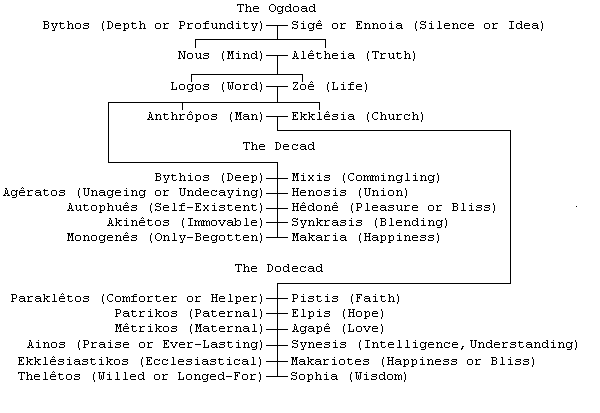 A nineteenth-century diagram of Valentinian aeonology by G. R. S. Mead. It is a modern scholarly-esoteric reconstruction, not an ancient diagram from the Askew Codex. Public domain via Wikimedia Commons.
The Mysteries: Knowledge as Transformative Rite
The word “mystery” appears constantly in Pistis Sophia. Modern readers often hear “mystery” as simply a secret fact. In ancient religious language, however, mystery can involve ritual knowledge, initiation, sacred action, and transformation.
The text speaks of higher and lower mysteries, mysteries of forgiveness, mysteries connected with spiritual ascent, and great mysteries associated with the divine realms.
Erin Evans has described Pistis Sophia and the related Books of Jeu as “handbooks to eternity,” a useful phrase because these texts connect cosmological knowledge to the soul’s fate.
This is not abstract theology. The revelation is supposed to do something.
Historically, we cannot reconstruct every ritual performed by the community behind the Askew Codex. But the text clearly assumes that mysteries are more than concepts read for intellectual interest. They belong to a salvific system.
Baptism, Purification, and Forgiveness
Book III devotes significant attention to questions of baptism, forgiveness, sin, and the conditions under which souls can receive salvation.
This is another reason Pistis Sophia should not be imagined as an anti-Christian occult book operating outside Christian practice. Its ritual world includes recognizably Christian concerns while interpreting them through a distinctive cosmology.
Forgiveness is linked not merely to moral sentiment but to spiritual mechanisms. Mysteries can release bonds and alter a soul’s condition.
The work’s ritual language reflects the broader late antique Christian world in which baptism, anointing, fasting, prayer, renunciation, and sacramental action were understood as real transformations.
The difference lies in the cosmological map surrounding those rites and the esoteric knowledge assigned to them.
The Counterfeit Spirit
One of the most striking doctrines in Pistis Sophia is the “counterfeit spirit.” Parkhouse notes that this technical expression also appears in the Apocryphon of John and provides a strong link between the two traditions.
The counterfeit spirit is described as operating against the soul, inclining human beings toward passions and wrongdoing. It is associated with hostile cosmic rulers and continues to affect the soul after death.
The concept creates an internal anthropology of conflict. Human beings are not simply divided between body and soul. They are influenced by multiple spiritual components and forces.
A modern psychological reader may interpret the counterfeit spirit as a metaphor for compulsive desire, internalized distortion, or self-sabotage. That is a modern reinterpretation. The ancient text presents the idea within a real supernatural cosmology.
The distinction matters because symbolic usefulness does not prove historical authors meant only what modern psychology finds familiar.
Reincarnation and Repeated Lives
Pistis Sophia includes a form of repeated embodiment or reincarnation within its account of the soul’s journey. Souls that do not attain liberation may pass through further cycles before final resolution.
This doctrine separates the text from dominant later Christian teachings that emphasize one earthly life followed by judgment and resurrection.
Reincarnation was not uniquely “Eastern.” Ideas about repeated lives circulated in Plato, Pythagorean traditions, some late antique philosophical schools, and several religious movements around the Mediterranean.
The presence of reincarnation in Pistis Sophia should therefore be understood within a broad ancient intellectual world rather than explained as evidence of hidden Buddhist or Hindu influence unless specific historical transmission can be demonstrated.
The text’s own logic is sufficient: the soul remains trapped in a cosmic system until it acquires the purification and mysteries necessary for release.
The Fate of Souls After Death
The afterlife in Pistis Sophia is procedural. Souls can encounter rulers, punishments, pathways, barriers, and opportunities for release.
This makes the work comparable at a structural level to Egyptian funerary literature, Orphic gold tablets, the Books of Jeu, later Jewish ascent texts, and medieval visionary journeys. But structural similarity does not prove direct borrowing.
Many cultures imagine death as a journey requiring knowledge, moral preparation, or ritual identity.
In Pistis Sophia, esoteric knowledge is not trivia. The mysteries change the soul’s legal or ontological standing within the cosmic hierarchy.
That can sound like a supernatural passport system to modern ears. Historically, however, the model expresses a serious theology of salvation: ignorance leaves the soul vulnerable; revelation transforms its capacity to pass beyond hostile powers.
Melchizedek, Jeu, and the Spiritual Administration of the Cosmos
The work names figures familiar from Jewish and Christian scripture alongside entities belonging to its distinctive esoteric cosmology. Melchizedek becomes especially important in some related Gnostic traditions, while Jeu appears within a broader mystery system shared with the Books of Jeu.
This combination shows how apocryphal Christianity built new systems from inherited names. A biblical figure could be assigned a much larger cosmic office than canonical texts describe.
Such reinterpretation is common in esoteric traditions. Later Jewish mysticism expands Metatron; Islamic esoteric literature expands Idris/Hermes; Christian magic elaborates Solomon’s authority; Gnostic texts give familiar scriptural names new cosmic functions.
The process is not random. Prestigious inherited figures create continuity between new revelation and older sacred history.
The Books of Jeu and Pistis Sophia
Pistis Sophia explicitly knows the Books of Jeu, a related group of Coptic Gnostic texts preserved in the Bruce Codex.
The relationship is important because it demonstrates that the Askew Codex did not arise in isolation. Its community knew a broader ritual and cosmological literature.
The Books of Jeu contain diagrams, divine names, seals, baptisms, and instructions connected with passage through heavenly realms. Their ritual specificity helps scholars interpret what “mystery” could mean in Pistis Sophia.
Yet the two works are not one book. Their cosmologies and literary structures must be compared rather than conflated.
Together they provide some of the richest evidence for a late antique Christian esoteric tradition in which salvation involved both revelation and ritual expertise.
Was Pistis Sophia Valentinian?
The earliest editors sometimes classified Pistis Sophia as Valentinian, linking it to the sophisticated Gnostic movement associated with the second-century teacher Valentinus.
Modern scholarship is more cautious.
The text certainly knows traditions that overlap with Valentinian and Sethian mythologies, but it rearranges them. Sophia’s story is not identical to classical Valentinian accounts, and Yaldabaoth does not occupy exactly the same role found in Sethian literature.
Labels such as Valentinian, Sethian, Jeuian, or “Gnostic” are scholarly tools. They help identify patterns but can become misleading if treated as denominational membership cards.
The safest approach is to recognize Pistis Sophia as a distinctive late antique Christian esoteric compilation that draws on and reworks several earlier streams.
Is “Gnosticism” Even the Right Word?
Modern scholars have debated whether “Gnosticism” is too broad a category. Ancient groups now placed under the label did not necessarily belong to one religion called Gnosticism.
The term remains useful when carefully defined. It can refer to families of ancient Christian and related movements that emphasize revealed knowledge, complex divine realms, myths of cosmic error, and the soul’s estrangement from ordinary material existence.
But the differences are substantial. Valentinian Christians could interpret the creator differently from Sethian texts. Some groups participated in ordinary Christian communities. Others developed distinctive rituals and mythologies.
Pistis Sophia is a perfect example of why the category needs nuance. It looks unmistakably “Gnostic” to modern readers, yet its scriptural library, Christology, ritual practice, and Sophia myth do not simply reproduce one standard Gnostic system.
Mary Magdalene and the Gospel of Mary
The prominent Mary in Pistis Sophia belongs to a broader apocryphal pattern visible especially in the Gospel of Mary.
In both works, Mary is associated with deeper understanding. Male disciples may question her role, while the narrative validates her spiritual insight.
Parkhouse argues that the author of Pistis Sophia probably knew the Gospel of Mary or a closely related tradition. This is historically significant because it suggests a textual community reading across multiple streams of Christian literature.
The similarity does not prove that both books came from a single “Magdalene church.”
What it demonstrates is that Mary functioned as a powerful literary symbol of revelatory authority in some Christian communities outside the later canonical mainstream.
Why Peter Is Not Simply the Villain
Modern retellings often cast Peter as the representative of oppressive institutional Christianity and Mary as the representative of suppressed mystical Christianity.
Ancient texts are more complicated. Peter can be criticized in one passage and respected in another. Pistis Sophia does not erase the male apostles; many participate actively in interpretation.
The literary tension may reflect real disputes about authority, but characters in revelatory dialogues are also teaching devices. Their questions allow doctrine to unfold.
Reducing the work to modern gender politics risks overlooking its actual theology.
A more useful reading recognizes that Mary’s prominence is genuinely extraordinary while refusing to invent a historical organizational conflict that the manuscript itself cannot prove.
Jesus as Esoteric Revealer
The Jesus of Pistis Sophia differs markedly from the teacher presented in the Synoptic Gospels.
He reveals cosmic hierarchies, preexistent mysteries, postmortem mechanisms, and secret knowledge. Yet the text continually anchors this esoteric Christ in familiar Christian language.
This combination reflects a wider ancient practice of rereading public tradition through secret revelation. A community could accept the familiar Jesus story and still insist that its deepest meaning had been reserved for advanced disciples.
That strategy solves a problem faced by many esoteric movements: how can a new doctrine claim antiquity?
The answer is hidden transmission. The teaching is new to outsiders but ancient within the sacred narrative because Jesus supposedly taught it privately from the beginning.
The Light-Vesture and Transformed Identity
The imagery of Jesus’ vesture of light is central to the opening revelation.
Clothing frequently symbolizes spiritual status in ancient religion. Baptismal garments, priestly vestments, royal clothing, and heavenly robes all express transformed identity.
In Pistis Sophia, the luminous vesture communicates authority and cosmic recognition. Jesus’ identity is not merely announced verbally; it is manifested as overwhelming light.
The symbolism later resonated strongly with esoteric traditions that interpret spiritual clothing as an image of a subtle or glorified body.
Historians should distinguish that later reception from the ancient text. The Askew Codex provides evidence for a late antique Christian symbolism of luminous transformation, not scientific evidence for an objectively measurable “light body.”
The Three Robes of Light
The text’s elaborate imagery includes multiple robes or vestures associated with Jesus’ cosmic identity and authority.
Modern occult commentary sometimes treats the robes as direct equivalents of later aura layers, Kabbalistic worlds, or initiatory grades. Those comparisons can be creative, but they are not historical identities.
Within the text itself, the robes help articulate rank, recognition, and the revelation of previously concealed powers.
Clothing is particularly effective as a metaphor for manifestation because it is simultaneously part of a person’s appearance and not identical to the person. A vesture reveals status while concealing essence.
That tension fits Gnostic cosmology, where higher realities must become visible through lower forms without being reduced to them.
Light, Darkness, and the Danger of Simplistic Dualism
Gnostic religion is often summarized as “spirit good, matter evil.” Pistis Sophia is more complex.
Light functions as a primary symbol of divine order, while chaos, hostile powers, passions, and forgetfulness are associated with lower conditions. Yet the narrative’s key deception involves false or stolen light.
The problem is therefore not merely darkness. It is misalignment, imitation, and separation from the true source.
This makes the text less like a simple dualistic battle and more like a hierarchy in which powers possess different degrees and qualities of light.
The distinction matters for modern interpretation. Spiritual discernment requires more than choosing whatever appears luminous.
Astrology, Fate, and the Rulers
The cosmology of Pistis Sophia includes rulers whose powers intersect with fate and the structure of the lower cosmos.
Late antique Christians inherited a world saturated with astrology. Many people believed stars and planetary powers affected human destiny. Christian, Jewish, Hermetic, Neoplatonic, and Gnostic writers developed different responses to that assumption.
Gnostic salvation often involves escape from cosmic rulers precisely because ordinary embodied life is subjected to fate.
This does not mean Pistis Sophia is simply an astrology manual. Rather, astrological cosmology forms part of the intellectual background against which liberation makes sense.
The mystery breaks a bondage that ordinary cosmic mechanisms would otherwise maintain.
Pistis Sophia and the Greek Magical Papyri
Pistis Sophia belongs to the same broad Egyptian late antique environment that produced ritual texts collected today as the Greek Magical Papyri.
There are meaningful points of comparison: sacred names, divine hierarchies, ritual speech, solar imagery, ascent, protection from hostile powers, and the idea that specialized knowledge can change a person’s relationship to invisible beings.
But the collections are not identical. The PGM include love spells, divination, healing, curses, and pragmatic magical operations from many religious backgrounds. Pistis Sophia is a Christian salvific dialogue.
SecretMagic’s guide to the Greek Magical Papyri provides useful comparative context.
The overlap shows how fluid late antique religious categories could be without proving that one text copied the other directly.
Pistis Sophia and Neoplatonic Theurgy
Theurgic Neoplatonists and the community behind Pistis Sophia both imagined a hierarchical cosmos and a form of spiritual ascent requiring more than ordinary reasoning.
In Iamblichean theurgy, ritual symbols and divine action help elevate the soul. In Pistis Sophia, mysteries received from Jesus alter the soul’s capacity to pass through cosmic regions.
The comparison is illuminating because both traditions reject the idea that salvation is merely holding correct opinions.
Yet their theology differs substantially. Neoplatonic theurgy operates within pagan philosophical traditions; Pistis Sophia is explicitly Christian and centered on the risen Jesus.
SecretMagic’s article on Iamblichus and theurgy shows how a neighboring late antique tradition answered similar questions with a different religious vocabulary.
Pistis Sophia and the Chaldean Oracles
The Chaldean Oracles also describe a cosmos structured by divine powers, fiery light, intermediaries, and the soul’s ascent.
Later Neoplatonists treated the Oracles almost as revealed scripture, while the Pistis Sophia community treated Jesus as the revealer of saving mysteries.
Both traditions therefore challenge the idea that philosophy and revelation were mutually exclusive categories in late antiquity.
Their similarities do not make Pistis Sophia a Christian version of the Chaldean Oracles. The historical relationship is one of shared intellectual problems: how can a soul trapped in lower conditions regain access to transcendent reality?
The Manuscript’s Rediscovery in European Scholarship
Anthony Askew’s possession of the codex brought the text into eighteenth-century European manuscript collecting. After the British Museum acquired it, scholars gradually began studying and publishing it.
Moritz Gotthilf Schwartze prepared the first printed Coptic edition with Latin translation, published posthumously in 1851 by Julius Heinrich Petermann. Later Carl Schmidt produced major critical work, and Violet MacDermot provided an important modern English translation in the Brill Coptic Gnostic Library.
G. R. S. Mead introduced the text to a much wider English-speaking esoteric audience through translations and commentary in the late nineteenth and early twentieth centuries.
This reception history matters because modern occult understanding of Pistis Sophia often comes through Mead rather than directly through current Coptic scholarship.
G. R. S. Mead and the Esoteric Revival
G. R. S. Mead was associated with the Theosophical Society before later founding the Quest Society. His translations of Gnostic and Hermetic material helped shape the modern Western rediscovery of late antique religious texts.
His 1896 English Pistis Sophia made the work accessible to readers interested in comparative mysticism and esotericism decades before the Nag Hammadi discoveries transformed Gnostic studies.
Mead deserves credit as an important translator and popularizer, but his interpretive context was late Victorian and Theosophical. Modern readers should distinguish his historical work from the esoteric synthesis surrounding it.
This is not unique to Mead. Every translation belongs to an intellectual moment.
Current scholarship can appreciate his contribution while correcting outdated assumptions about authorship, sectarian identity, and the structure of “Gnosticism.”
Nag Hammadi Changed Everything
The discovery of the Nag Hammadi codices in 1945 radically expanded the evidence for ancient Christian and Gnostic diversity.
Before that discovery, the Askew, Bruce, and Berlin codices carried an enormous burden. Scholars had only a few large firsthand Gnostic texts to compare with heresiological reports written by opponents such as Irenaeus and Epiphanius.
Nag Hammadi revealed works such as the Apocryphon of John, Gospel of Thomas, Gospel of Philip, and numerous cosmological, revelatory, and philosophical treatises.
Ironically, Pistis Sophia then became less famous in academic discussion than some newly available texts.
Recent scholarship is correcting that imbalance by treating the Askew Codex not as an awkward relic but as evidence for a sophisticated late-third-century Egyptian Christian reading community.
Common Misconception: Pistis Sophia Is a Lost Gospel Written by Mary Magdalene
No surviving evidence identifies Mary Magdalene as the author of Pistis Sophia.
She is one of its central characters and the most frequent questioner, but literary prominence is not authorship.
The text was composed centuries after the lifetime of the historical Mary Magdalene and survives in a later Coptic manuscript.
Calling it “Mary Magdalene’s secret gospel” may attract clicks, but it is historically inaccurate.
Common Misconception: The Vatican Suppressed the Askew Codex
There is no evidence that the Vatican secretly possessed and suppressed the Askew Codex.
The manuscript entered a British collection through Anthony Askew and the British Museum. It was published in the nineteenth century and has long been available to scholars.
Early Christian institutions did condemn many teachings later classified as Gnostic, and ancient books certainly disappeared. But turning every lost text into a modern Vatican conspiracy replaces history with speculation.
The real transmission story—survival in Egypt, manuscript collecting, Coptic scholarship, and modern publication—is already fascinating.
Common Misconception: Pistis Sophia Proves Reincarnation Was Original Christianity
The text demonstrates that some ancient Christians accepted repeated embodiment or related cycles of rebirth.
It does not prove that reincarnation was the universal original teaching of Jesus or the earliest Christian movement.
Early Christianity was diverse. Different communities developed different ideas about resurrection, judgment, immortality, preexistence, and the soul.
A later Egyptian esoteric text is evidence for its own community and intellectual ancestry, not a time machine that settles every first-century theological debate.
Common Misconception: Sophia Is Simply the Goddess of All Gnostics
Sophia means wisdom in Greek and appears in multiple Jewish, Christian, philosophical, and Gnostic traditions.
There is no single universal Gnostic Sophia myth. Her role differs dramatically from text to text.
In some systems she participates in cosmic creation; in others her error produces a lower creator; in Pistis Sophia she is herself a fallen and persecuted being rescued from Chaos.
Modern spirituality often merges all versions into one archetypal goddess biography. That can be meaningful as contemporary mythology, but it should not be presented as one ancient doctrine.
Common Misconception: Gnostics Hated the Material World in Exactly the Same Way
Ancient Gnostic traditions do not share one perfectly uniform attitude toward matter.
Some texts use strongly negative language for the lower cosmos. Others emphasize ignorance, counterfeit power, fate, or disordered mixture rather than declaring every physical object intrinsically evil.
Pistis Sophia is particularly concerned with entrapment in lower cosmic structures and passions, but its salvific system also employs ritual actions performed by embodied human beings.
The relationship between body, matter, and salvation is therefore more complicated than the slogan “matter is evil.”
Common Misconception: Every Diagram Online Comes from the Askew Codex
Modern internet graphics often present elaborate Gnostic cosmological charts as if they were photographs of an ancient diagram.
Most are modern reconstructions.
Nineteenth-century scholars such as G. R. S. Mead created diagrams to make complicated aeonologies easier to understand. Contemporary artists continue the process.
Charts can be useful, but their status should be explicit. A modern visualization is an interpretation of textual evidence, not an archaeological artifact.
This article labels such material accordingly.
A Symbolic Reading of Sophia’s Repentance
Sophia’s thirteen repentances can be read symbolically as a model of transformation through repeated recognition.
She does not escape immediately after one insight. Her restoration unfolds through a sequence of cries, interpretations, and interventions.
That pattern challenges the modern fantasy of instant enlightenment. Spiritual error is not repaired merely by realizing once that a mistake occurred.
A psychological interpretation might see the sequence as repeated reorientation: desire is examined, false light recognized, responsibility accepted, and identity gradually restored.
The ancient text frames this process cosmologically and religiously. The modern interpretation does not replace that meaning, but it shows why the narrative still resonates outside its original theology.
A Symbolic Reading of Mary as Discernment
Mary’s role in the dialogue is not passive devotion. She listens, interprets, connects revelation with earlier scripture, and repeatedly demonstrates understanding.
Symbolically, she represents discernment.
The spiritual student is not expected merely to experience mystery. The student must interpret it correctly.
This is particularly significant in a text where Sophia’s original error begins with misrecognizing light. The remedy to false light is not blindness but better vision.
Mary becomes the human counterpart to that lesson: she hears revelation and recognizes its hidden pattern.
A Symbolic Reading of the Counterfeit Spirit
The counterfeit spirit offers a powerful image for the experience of inner conflict.
Human beings often experience impulses that feel like “me” in one moment and alien in retrospect. Religious traditions describe that conflict through sin, temptation, passions, intrusive spirits, karmic conditioning, or competing parts of the psyche.
Pistis Sophia gives the conflict a supernatural cosmological explanation.
A modern reader can use the image symbolically without claiming ancient authors secretly meant psychology. The counterfeit spirit becomes a metaphor for whatever imitates authentic desire while pushing the self away from its deeper aims.
That symbolic usefulness helps explain the survival of ancient esoteric language in modern spiritual discourse.
Why Pistis Sophia Matters to the History of Esotericism
Pistis Sophia matters because it preserves a form of Christianity in which revelation, initiation, cosmology, scripture, ritual, and the soul’s ascent are inseparable.
It challenges neat historical categories.
It is Christian but outside later orthodoxy. It reveres Jesus yet radically expands the Gospel narrative. It uses biblical scripture while drawing on myths modern scholars classify as Gnostic. It values knowledge but also ritual mysteries and repentance. It elevates Mary while retaining the other apostles.
For historians of esotericism, the work demonstrates that “secret teaching” is not a modern invention imposed on Christianity from the outside. Some ancient Christian communities genuinely imagined salvation through graded mysteries and hidden revelation.
That fact does not prove modern occult systems preserve those mysteries unchanged. It proves the historical landscape was far more diverse than later orthodox canons alone suggest.
How to Read Pistis Sophia Responsibly
Start by remembering that the work is a compilation preserved in one Coptic codex, not a perfectly stable first-century gospel.
Use a critical modern edition or translation when possible. Violet MacDermot’s English translation based on Carl Schmidt’s text remains an important scholarly resource, while the NASSCAL e-Clavis entry provides an excellent bibliography and summary.
Distinguish secure evidence from later interpretation. When a modern author identifies every Mary as Mary Magdalene, dates the entire work precisely to the second century, or maps all cosmic levels into a modern occult system, check the claim.
Read the work beside related literature: the Apocryphon of John, Gospel of Mary, Books of Jeu, Odes of Solomon, and canonical Psalms and Gospels.
Finally, allow the text to be strange. The goal of historical understanding is not to make every ancient doctrine sound like modern psychology, quantum physics, or perennial philosophy.
Its differences are part of its value.
Frequently Asked Questions
What does Pistis Sophia mean?
The title can be translated in several ways, including “Faith-Wisdom,” “Faithful Wisdom,” or “Wisdom of Faith.” It is also the name of the central cosmic figure in much of the text.
Where is the Pistis Sophia manuscript?
It survives in the Askew Codex, British Library Additional MS 5114.
What language is Pistis Sophia written in?
The surviving manuscript is in Sahidic Coptic. Much of the work is usually assumed to derive from Greek compositions, although the original language and compositional history remain debated.
When was Pistis Sophia written?
Different portions may have different dates. Scholars have proposed second- and third-century origins for materials, while recent work argues that major portions may fit the late third or early fourth century.
Did Mary Magdalene write Pistis Sophia?
No evidence supports that claim. Mary is an exceptionally important character and leading questioner, but the work was composed long after her lifetime.
Why is Mary Magdalene so important in Pistis Sophia?
She repeatedly questions Jesus and interprets sacred texts in relation to Sophia’s story. Her prominence makes the work important evidence for alternative models of female spiritual authority in early Christianity.
Does Pistis Sophia teach reincarnation?
It includes repeated embodiment within its account of the soul’s fate and salvation. This shows that some ancient Christians accepted such ideas, not that reincarnation was a universal original Christian doctrine.
Is Pistis Sophia part of the Nag Hammadi library?
No. It is preserved in the separate Askew Codex. The Nag Hammadi discoveries later provided important comparative texts for understanding its mythology.
Is Sophia a goddess?
In Pistis Sophia, Sophia is a cosmic spiritual being within an elaborate Christian-Gnostic hierarchy. Calling her simply a goddess can obscure the specific theology of the text.
Is Pistis Sophia historically reliable about Jesus?
Historians generally treat it as evidence for later ancient Christian beliefs and communities rather than as a direct eyewitness record of the historical Jesus.
Conclusion: A Gospel of Discernment More Than Secret Information
Pistis Sophia survives because one Coptic codex escaped the ordinary destruction of time. That accident preserved one of the richest windows into a form of Christianity that later became marginal.
Its world is filled with light, but the central myth warns that light itself can deceive.
Sophia falls because she reaches toward a brilliance she does not correctly understand. Her restoration requires repeated repentance, discernment, revelation, and rescue. The disciples then learn to read familiar scripture as a hidden map of her journey.
Mary’s role gives the drama a human interpreter. She repeatedly recognizes patterns others miss. Her authority does not depend on owning an institution. It arises from understanding.
The text’s cosmology may appear bewildering, but its spiritual logic is coherent. Human beings inhabit a layered universe shaped by powers, passions, fate, and ignorance. Salvation requires more than belief. It requires mysteries that transform the soul’s condition and knowledge that allows it to recognize where it belongs.
Modern historians cannot prove that the rulers, aeons, mysteries, or postmortem journeys described by the text objectively exist. They can demonstrate that ancient Christians built serious religious lives around such ideas.
That distinction makes Pistis Sophia more—not less—interesting.
It is evidence that early Christianity was not a single smooth road toward later orthodoxy. Communities experimented with scripture, ritual, cosmology, gender, authority, and the meaning of resurrection. Some imagined Jesus as a public teacher. Others imagined that the most important teaching began after the resurrection and continued in secret.
The Askew Codex preserves one of those imaginations at extraordinary length.
For students of esotericism, its greatest lesson may therefore be discernment rather than secrecy. A hidden teaching is not valuable merely because it is hidden. A bright vision is not true merely because it is bright. Revelation must be interpreted.
Sophia learns that lesson through suffering. Mary demonstrates it through understanding.
Nearly two millennia later, that tension between experience and discernment remains one of the most enduring questions in the history of mysticism.
Sources and References
- Caroline Crews, “Pistis Sophia,” e-Clavis: Christian Apocrypha, North American Society for the Study of Christian Apocryphal Literature.
- Sarah Parkhouse, “The Canon of the Pistis Sophia Books 1–3,” The Journal of Theological Studies 73.2 (2022): 649–675.
- British Library Coptic Manuscript Collection / Archives Hub, Askew Codex (Add MS 5114).
- Carl Schmidt, ed., and Violet MacDermot, trans., Pistis Sophia, Coptic Gnostic Library, Brill, 1978.
- Erin Evans, The Books of Jeu and the Pistis Sophia as Handbooks to Eternity: Exploring the Gnostic Mysteries of the Ineffable, Brill, 2015.
- Antti Marjanen, The Woman Jesus Loved: Mary Magdalene in the Nag Hammadi Library and Related Documents, Brill, 1996.
- G. R. S. Mead, Pistis Sophia: A Gnostic Gospel, 1896 public-domain edition, Internet Archive.
- Bodleian Archives & Manuscripts, C. G. Woide transcript of the Sahidic text of Pistis Sophia from the Askew manuscript.


