


SEO Title: The Book of Soyga Explained: John Dee, Angelic Cryptography, and the 36 Magic Tables
Meta Description: Explore the Book of Soyga, the mysterious Renaissance magical manuscript owned by John Dee: its 36 letter tables, astrology, Christian Cabala, angelic conversations, rediscovery, and modern decoding.
Suggested Permalink: book-of-soyga-john-dee-magic-tables
Primary Category: Grimoires and Manuscripts
Tags: Book of Soyga, John Dee, Renaissance Magic, Angelic Magic, Cryptography, Christian Cabala
Primary Keyword: Book of Soyga
The Book of Soyga Explained: John Dee, Angelic Cryptography, and the 36 Magic Tables
 Portrait of John Dee, painted around 1594 and now in the Ashmolean Museum, Oxford. Public-domain image via Wikimedia Commons.
Introduction: A Book John Dee Could Not Stop Thinking About
Among the books associated with John Dee, few are as strange as the manuscript now known as the Book of Soyga. It is not famous because it founded a religious movement or because its ritual system became standard ceremonial magic. Its fascination lies elsewhere. Soyga sits at the intersection of astrology, angelology, Christian Cabala, cryptography, manuscript culture, and Dee’s own attempt to discover whether language and number could reveal a hidden divine order.
Dee, the Elizabethan mathematician, astrologer, collector, court intellectual, and occult philosopher, owned a copy and cared deeply about it. His spiritual diaries show that he asked purported angelic beings about the book during his experiments with the scryer Edward Kelley. The manuscript contains prose treatises, astrological and magical material, angelic names, lunar mansions, invocations, and—most famously—thirty-six immense letter tables. Each table is a thirty-six-by-thirty-six grid: 1,296 letters arranged with an order that looks random until examined mathematically.
For centuries, the book was known largely through Dee’s references. In the twentieth century, scholar Deborah Harkness located two manuscript witnesses, one in the Bodleian Library and one in the British Library. Cryptologist Jim Reeds then showed that the supposedly chaotic letter tables were produced by a deterministic algorithm. That discovery solved one mystery while opening another: knowing how the tables were generated does not necessarily tell us what their author thought they meant.
This article separates documented history from occult belief. Dee’s diary records conversations he and his scryers understood as angelic communications. That is historical evidence for Dee’s religious practice, not scientific proof that independent angels spoke through the sessions. Likewise, the mathematical structure of the Soyga tables is demonstrable; claims that those tables encode supernatural revelation remain unverified.
What Is the Book of Soyga?
The title Book of Soyga is a modern shorthand for a Latin magical manuscript tradition also identified by the title Aldaraia sive Soyga vocor. One manuscript is British Library Sloane MS 8; another is Bodleian Library Bodley MS 908. The manuscripts are closely related but not identical.
Jim Reeds describes the Bodleian witness as containing a substantial Liber Aldaraia, a long Liber Radiorum, shorter related works, and the thirty-six final tables. The British Library witness compresses some material, especially the Liber Radiorum, while preserving the extraordinary sequence of letter grids.
Soyga is therefore not only a set of coded tables. It is a composite learned magical text. Its contents include astrology, conjunctions, lunar mansions, demonological or spirit material, angelic names, magical instructions, and references to other obscure books.
That mixture is characteristic of Renaissance learned magic. Practitioners did not necessarily separate astrology, mathematics, theology, Cabala, spirit invocation, and natural philosophy into modern academic departments. Soyga belongs to a culture in which a table of letters could be simultaneously mathematical, linguistic, cosmological, and potentially ritual.
Why the Title “Soyga” Is Mysterious
The title itself became part of the puzzle. One explanation recorded in the manuscript tradition links “Soyga” with “Agyos” or “Agios,” a Greek term meaning holy, through reversal or transposition. Reeds notes that the manuscript displays a wider fascination with reversal. Names of alleged source books can appear as ordinary Latin words written backwards: for example, forms corresponding to lapis and bonum can be reversed into apparently mysterious titles.
That practice belongs to a long history of esoteric writing in which concealment signals privileged knowledge. A reversed word looks foreign or arcane until the reader knows the operation.
Yet Dee’s own angelic diary complicates the neat explanation. In a 1583 exchange, a spirit identified in the diary challenged the idea that Soyga simply meant Agyos. The episode is valuable because it shows Dee actively testing textual interpretations through his visionary practice.
Historically, we should not let the supernatural framing obscure the intellectual action. Dee encountered an ambiguous word, recognized possible ciphering or reversal, and then subjected the problem to another knowledge system he trusted: angelic consultation.
John Dee Before Soyga: Mathematics, Astrology, and Universal Knowledge
John Dee was born in 1527 and became one of the most ambitious intellectual figures of Elizabethan England. He studied mathematics and astronomy, wrote on navigation, advised on calendrical and geographical questions, collected an enormous library, and pursued alchemy, astrology, cryptography, and angelic communication.
The Royal College of Physicians’ reconstruction of Dee’s library emphasizes the breadth of his reading. Surviving books show intensive annotation across mathematics, astronomy, alchemy, medicine, history, languages, and occult sciences.
Dee’s magical interests were not a late abandonment of scholarship. They emerged from the same desire to discover an underlying order connecting number, language, nature, and divine providence.
This intellectual unity is essential for understanding why Soyga appealed to him. A modern reader may see a coded magical grid and classify it as superstition. Dee could see a possible mathematical artifact whose formal structure might disclose a divine or angelic science.
The Monas Hieroglyphica and Dee’s Search for a Universal Symbol
In 1564 Dee published the Monas Hieroglyphica, one of the most enigmatic works of Renaissance occult philosophy. It revolves around a single composite glyph formed from astronomical and alchemical signs.
The Monas is not the Book of Soyga, and one should not assume that Soyga’s unknown compiler shared Dee’s entire system. Yet the comparison illuminates Dee’s mindset. He believed symbolic compression could disclose relationships among planets, elements, alchemical processes, numbers, and sacred structures.
The hieroglyphic monad treats the visible sign as an intellectual machine: its geometry invites analysis beyond ordinary language.
Soyga’s tables offered another version of the same temptation. Thousands of letters arranged in immense squares looked like language converted into architecture. To Dee, who already believed number and symbol could reveal hidden unity, such a structure was almost impossible to ignore.
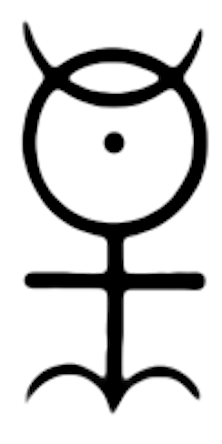 John Dee’s Monas Hieroglyphica symbol, published in 1564. Public-domain image via Wikimedia Commons.
Thirty-Six Tables of Thirty-Six by Thirty-Six Letters
The most famous part of Soyga consists of thirty-six tables. Each table contains thirty-six rows and thirty-six columns, producing 1,296 letter cells. Across all thirty-six tables, the total is 46,656 cells.
The scale matters. These are not ordinary magic squares containing a few numbers or divine names. They are vast fields of letters, visually repetitive but formally organized.
Reeds demonstrated that the tables were not generated by random scribal improvisation. Each one is based on a code word and constructed using a deterministic procedure. Once the procedure is known, the table can be reproduced.
This discovery changes the historical question. Before the algorithm was found, one could imagine a mysterious cipher waiting for plaintext. After the algorithm, it became clear that the tables are generated structures. But generated structure is not the same thing as decoded meaning.
We know how the machine builds the grid. We do not know with equal confidence what conceptual, ritual, or theological meaning the maker assigned to the resulting letters.
The Zodiacal Organization of the Tables
The tables are associated with zodiacal signs and appear in groups related to astrological organization. Reeds’ analysis lists code words tied to Aries, Taurus, Gemini, Cancer, Leo, Virgo, Libra, Scorpio, Sagittarius, Capricorn, Aquarius, and Pisces, with multiple sequences across the full set.
This zodiacal architecture situates the tables inside astral magic rather than pure cryptography.
Renaissance astrology treated the zodiac as a real framework of celestial qualities. If letters could be algorithmically arranged under zodiacal categories, the tables might be understood as a formal representation of celestial order or as a tool for accessing it.
Modern science does not support astrological causation in the premodern occult sense. The historical significance is nevertheless substantial: mathematical regularity could make an astrological cosmology appear visible and manipulable.
The Liber Radiorum and the Language of Rays
The title Liber Radiorum, Book of Rays, connects Soyga to a major medieval and Renaissance concept: celestial influences were often imagined as rays or radiations descending from stars and planets.
The Arabic philosopher al-Kindī’s influential work commonly known in Latin as De radiis developed a theory in which celestial and terrestrial things emit rays, helping explain astrology, magical effects, and hidden sympathies. Later magical traditions absorbed and transformed such ideas.
Soyga’s use of a “book of rays” therefore places it within a learned tradition of astral causation.
The surviving versions differ significantly in length, reminding us that manuscripts are not stable printed objects. Texts could be abridged, expanded, rearranged, or copied from different exemplars. The work we call Soyga is a manuscript family, not a perfectly uniform authorial edition.
Lunar Mansions and Medieval Astral Magic
Soyga includes material concerning lunar mansions, the divisions of the Moon’s apparent path that became important in Arabic and Latin astrology.
Lunar-mansion magic appears in several medieval astral traditions. Different mansions could be associated with images, intentions, elections, and forms of celestial influence.
The presence of this material links Soyga conceptually with broader traditions explored in works such as the Picatrix, though the books are not identical and should not be treated as one system.
This is a useful example of how magical manuscripts accumulated layers. A compiler could combine lunar astrology, angelic names, reversed words, letter arithmetic, and other techniques because all were understood as methods for discovering hidden order.
Christian Cabala and Alphabetic Magic
Reeds argues that Soyga’s obsession with letters, reversal, and alphabet arithmetic fits the sixteenth-century environment of Christian Cabala. Renaissance thinkers such as Pico della Mirandola, Johannes Reuchlin, and later Heinrich Cornelius Agrippa adapted selected Jewish Kabbalistic ideas within Christian theological and magical frameworks.
Letter manipulation could appear to offer access to the architecture of creation because sacred language was believed to reflect divine order.
Soyga is not a Jewish Kabbalistic text. Its alphabetic methods belong to a Christian and Latin magical environment that borrowed, reinterpreted, and sometimes misunderstood Jewish traditions.
This distinction is especially important for modern readers. Calling every Renaissance alphabetic technique “Kabbalah” can erase historical difference between Jewish Kabbalah and Christian Cabala.
Agrippa and the Culture of Magical Tables
Large letter grids are not a normal feature of classical Jewish Kabbalah, but by Agrippa’s era tables, seals, planetary squares, and alphabetic correspondences had become central to European learned magic.
Agrippa’s Three Books of Occult Philosophy synthesized astrology, natural magic, angelology, number symbolism, Cabala, and ceremonial material into an influential cosmological framework.
SecretMagic’s article on Cornelius Agrippa’s three worlds of magic provides the larger Renaissance context in which numerical and alphabetic correspondences became a technology of occult philosophy.
Soyga belongs to this world while remaining highly idiosyncratic. Its tables are more algorithmically elaborate than ordinary planetary magic squares and appear to encode a specialized construction method.
John Dee’s Lost Book Problem
Dee’s diaries contain a surprisingly mundane detail that makes the story more human: at one point he could not find his Soyga manuscript.
On April 18, 1583, the book was discussed during a scrying session. Dee’s concern was not abstract. He possessed a physical manuscript that could be misplaced among an enormous working library.
The image of the Renaissance magician surrounded by books is historically accurate in Dee’s case. His library may have approached four thousand titles and was one of the greatest private collections in England.
This material reality matters. Esoteric knowledge was vulnerable to theft, fire, damp, bad cataloguing, inheritance, dispersal, and simple misplacement. “Lost books” often vanish through ordinary history rather than supernatural concealment.
The Angel Uriel and the Claim of Adamic Revelation
During Dee’s angelic conversations, he asked about Soyga. The responses recorded in his spiritual diaries treated the book as something connected with primordial revelation and angelic wisdom.
One famous tradition from the conversations presents Soyga as a book associated with Adam and says that the archangel Michael was involved in its interpretation.
Such claims belong to the revelatory world of Dee and his scryers. They are not independent evidence that a manuscript literally descended from Adam.
Their historical importance lies elsewhere. Renaissance magicians regularly sought to place occult knowledge inside sacred genealogies. A book attributed to Adam, Solomon, Moses, Enoch, or Hermes gained authority by appearing older than ordinary human philosophy.
The Adamic claim also fits Dee’s search for a pure language or knowledge before corruption. If the Fall fragmented human understanding, angelic or primordial wisdom offered the possibility of restoration.
Edward Kelley, Scrying, and the Problem of Evidence
Edward Kelley became Dee’s most famous scryer. During sessions, Kelley reported visions and messages that Dee carefully recorded.
Historians disagree about Kelley’s motives and psychological state. He has been portrayed as fraud, visionary, collaborator, reluctant medium, and opportunist. The surviving record does not reduce neatly to one explanation.
For the study of Soyga, the important fact is that Dee treated the visionary conversations as an epistemic method. When books failed to answer his questions, he asked angels.
This does not mean the historical researcher must accept the angelic explanations. It means that understanding Dee requires recognizing that he did not separate textual scholarship and spiritual revelation as sharply as many modern readers do.
 A wax Sigillum Dei associated with John Dee’s later angelic experiments, now in the British Museum. Photograph by Vassil, CC0 via Wikimedia Commons.
Soyga Before Enochian Magic
The Book of Soyga is often folded into “Enochian magic,” but chronology matters. Dee’s intense interest in Soyga appears early in his angelic project, before the later system usually called Enochian had reached its developed form.
That makes Soyga especially important. It may illuminate the intellectual expectations Dee brought into the conversations rather than being a product of those conversations.
Large letter tables later became central to Dee’s angelic material, especially the Liber Loagaeth. Scholars have therefore compared Soyga’s grids with Dee’s later tables.
Comparison does not prove direct copying. It does show that Dee was already fascinated by the idea that huge arrays of letters could embody angelic knowledge before his own visionary records produced similarly monumental textual structures.
Soyga and the Liber Loagaeth
The Liber Loagaeth, preserved among Dee’s angelic manuscripts, contains forty-nine-by-forty-nine letter tables associated with revelations received through scrying.
The visual resemblance to Soyga is immediately suggestive: both turn language into large tabular fields.
Yet their construction and textual histories differ. Reeds’ work on Soyga demonstrates an algorithmic procedure behind its thirty-six-by-thirty-six tables. The later Dee material arises inside documented angelic sessions.
The safest historical conclusion is not that one system secretly decodes the other, but that Soyga gave Dee a conceptual precedent for imagining enormous letter grids as containers of superhuman knowledge.
Cryptography or Magic? The Wrong Either-Or
Modern readers often ask whether Soyga is “really” a cipher rather than magic. The question assumes that the categories must exclude one another.
In the Renaissance, cryptographic methods could carry diplomatic, intellectual, mystical, and magical significance. Johannes Trithemius’s Steganographia is the classic example: a work framed through spirits and magical-looking procedures also contains systems of hidden communication.
The Royal College of Physicians notes Dee’s interest in cryptography and his ownership of Trithemian material.
Soyga similarly demonstrates that formal letter manipulation can be simultaneously computational and esoteric. Discovering an algorithm does not automatically prove that the author intended an ordinary secret message. It may instead reveal that algorithmic generation itself was the ritual or cosmological point.
Jim Reeds and the Modern Decoding of the Tables
Cryptologist Jim Reeds transformed modern understanding of Soyga by reconstructing the algorithm that generates the tables.
The breakthrough came from treating the grids as formal data rather than mystical noise. Repeated patterns, code words, and letter relationships allowed the rules to be inferred.
Reeds also identified scribal errors and could distinguish some mistakes inherited by both surviving manuscripts from errors introduced independently. This makes the algorithm useful for textual criticism as well as cryptography.
The result is one of the most elegant intersections of humanities and computation in occult studies: mathematical reconstruction reveals the genealogy of handwritten magical texts.
What the Algorithm Does—and Does Not—Explain
Once a deterministic algorithm is known, it becomes tempting to declare the mystery solved. That would be premature.
The algorithm explains generation. It does not automatically explain interpretation.
Why exactly thirty-six tables? Why those code words? Why the zodiacal organization? What ritual or contemplative purpose did the complete tables serve? Did the compiler believe the grid itself received astral influence, encoded divine language, functioned as a mnemonic device, or displayed a mathematical harmony?
Some clues exist in surrounding prose, but no single consensus answers every question.
Soyga therefore illustrates an important distinction in cryptanalysis: decoding a procedure is not identical to recovering semantic intention.
Scribal Errors as Historical Evidence
At first glance, errors might seem disappointing in a supposedly sacred or angelic book. For historians, they are invaluable.
A copied table of 1,296 letters creates enormous opportunity for mistakes. When two manuscripts share the same anomaly, that can suggest descent from a common exemplar already containing the error.
This turns occult manuscripts into ordinary witnesses of textual transmission. Whatever their theological claims, they were copied by human hands.
The contrast is instructive: a text can claim primordial revelation while surviving through imperfect scribes. Historical criticism studies the second fact even when the first was spiritually decisive for readers.
The Rediscovery in 1994
By the modern period, scholars knew Soyga largely through Dee’s references and later notices. The manuscript itself was thought lost.
In 1994 Deborah Harkness, while researching Dee’s angelic writings, identified copies at the Bodleian Library and the British Library. The Folger Shakespeare Library has publicly recounted Harkness’s discovery and its later influence on her fiction.
The manuscripts had not magically reappeared. They were sitting in major collections under titles that had not been recognized as Dee’s mysterious Soyga.
This is a classic archival lesson: a lost text can survive under an unexpected catalogue title. Rediscovery often depends on recognizing names, incipits, provenance, and textual details that earlier cataloguers could not connect.
Sloane MS 8 and the Dee Provenance Question
The British Library manuscript Sloane MS 8 is widely considered a strong candidate for the copy once owned by Dee, partly through provenance evidence involving the Duke of Lauderdale and later collectors.
Elias Ashmole recorded a Soyga manuscript associated with Dee and Lauderdale. Reeds connected this history with the surviving Sloane witness.
The identification is persuasive but should still be described with the appropriate scholarly caution rather than transformed into absolute certainty where documentary gaps remain.
Provenance research is especially important in occult history because famous names attract retrospective attribution. Objects, books, mirrors, and crystals have repeatedly been linked with Dee on the basis of later tradition. Each connection must be evaluated independently.
Bodley MS 908 and the Independent Witness
Bodley MS 908 is the second crucial manuscript witness. Its presence at Oxford proves that the Soyga tradition cannot be reduced to one eccentric copy uniquely owned by Dee.
The Bodleian manuscript contains a fuller version of some material and therefore helps reconstruct the broader textual tradition.
Having two related manuscripts also made Reeds’ comparison of errors possible.
This is why manuscript studies require witnesses rather than myths. The book becomes historically richer when we see it not as “Dee’s unique secret book” but as a text that circulated independently of him.
Was the Book of Soyga Written by John Dee?
No reliable evidence shows that Dee wrote Soyga.
He owned and studied a copy, asked about it during angelic sessions, and was fascinated by its tables. Those facts have led some modern summaries to blur the line between owner and author.
The manuscript tradition and internal evidence point to a work that Dee encountered rather than composed.
This distinction is crucial for search accuracy. Soyga is a book associated with John Dee, not simply one of John Dee’s own authored works.
Did Soyga Influence Enochian Magic?
Influence is possible at the level of imagination and form, but it should not be overstated.
Dee had already seen monumental letter tables in Soyga before his later angelic records produced large grids. That precedent could have shaped his expectations of what revealed language might look like.
Yet the Enochian corpus has its own documented sequence of sessions, names, calls, tables, and cosmology. There is no evidence that Soyga contains a hidden key that mechanically generates the entire later system.
The responsible claim is therefore modest: Soyga belongs to the intellectual background of Dee’s angelic project and provides an important comparative model for his fascination with tabular revelation.
Why the Number Thirty-Six Matters
Thirty-six had numerous mathematical and astrological resonances in premodern thought. The zodiac’s 360 degrees, the thirty-six decans of ten degrees each, and other numerical schemes made thirty-six cosmologically suggestive.
Soyga’s thirty-six tables and thirty-six-by-thirty-six format therefore invite comparison with decanic astrology.
One should be cautious about claiming a single intended explanation unless the manuscript explicitly establishes it. Renaissance esoteric authors often layered multiple numerical associations onto the same structure.
What we can say securely is that a thirty-six-based architecture would have looked cosmologically meaningful in an astrological culture.
The Tables as Visual Objects
A table is not only data. It is an image.
Thousands of letters arranged into a perfect square create an experience of density, regularity, and apparent inexhaustibility. The reader sees order before understanding it.
This visual effect is part of Soyga’s historical power. The grid suggests that language can be mapped spatially, almost like a celestial chart.
Later occultism would repeatedly exploit the same principle in magic squares, angelic tablets, talismanic seals, and Kabbalistic diagrams. Visual form gives hidden knowledge an architecture.
A Symbolic Reading: The Grid as Cosmos
A modern symbolic interpretation can read the Soyga tables as miniature cosmologies.
Each square contains a limited alphabet but produces an enormous patterned field. Simple elements generate complexity through rules. That is structurally similar to many cosmological models in which a finite set of principles gives rise to a diverse universe.
This reading is philosophically suggestive even without assuming magical efficacy.
However, it should be labeled as interpretation. We do not know that Soyga’s compiler consciously intended the grid as a modern-style model of emergent complexity.
A Symbolic Reading: Secrecy and the Desire for Perfect Language
Soyga also reflects a recurring esoteric dream: ordinary language seems inadequate, so hidden language promises greater precision.
Reversed words, code terms, angelic names, arithmetic transformations, and immense letter arrays all move away from ordinary prose.
For Dee, the desire for a more fundamental language eventually became bound up with angelic revelation.
Symbolically, this can be understood as a search for a language untouched by ambiguity—a system in which signs and reality correspond perfectly. The dream appears in Kabbalah, universal-language projects, cryptography, mathematics, and modern computing in very different forms.
Soyga and the History of Computing
Calling Soyga a “computer program” would be anachronistic, but the algorithmic nature of its tables makes comparison with computation intellectually useful.
A deterministic rule takes a seed word and produces a large structured output. That is precisely the kind of relationship modern computer science formalizes.
The historical creator achieved this without electronic machines. The tables demonstrate substantial procedural thinking and extraordinary patience.
This does not make Soyga an early computer in the technological sense. It makes it evidence that algorithmic imagination has a much longer cultural history than digital computers.
Modern Occult Interpretations
Contemporary practitioners have attempted to reconstruct magical uses for Soyga’s tables, connect them with Enochian practice, meditate on code words, or treat them as angelic talismans.
Such experimentation belongs to the modern reception of the book.
The historical problem begins when reconstruction is presented as documented sixteenth-century procedure. The surviving manuscripts do not provide a complete modern ritual curriculum explaining every possible use of the tables.
A transparent practitioner can distinguish source text from personal method. Historical accuracy and creative practice do not have to be enemies.
Common Misconception: The Tables Have Been Fully “Decoded”
Reeds decoded their construction algorithm. That is a major achievement.
But claims that the tables have been translated into a hidden English, Latin, Enochian, or extraterrestrial message are not supported by the same evidence.
The distinction between algorithm and message is essential. A generated table can have formal structure without containing plaintext in the ordinary cryptographic sense.
Common Misconception: Soyga Is an Enochian Book
Soyga predates the mature Enochian system associated with Dee and Kelley.
It became entangled with Dee’s angelic work because he asked spirits about it and because later Dee material also uses large letter tables.
Historically, it is better classified as a Renaissance magical and astrological manuscript associated with Dee rather than an Enochian revelation produced by his sessions.
Common Misconception: It Was Lost in a Secret Vault Until 1994
The book’s “rediscovery” is sometimes narrated like an occult thriller.
In reality, manuscripts survived in major institutional collections. What was lost was the identification linking those catalogue items with the mysterious Soyga mentioned by Dee.
That is still a remarkable scholarly discovery, but it is archival rather than supernatural.
Common Misconception: Dee Proved Angels Authored the Book
Dee’s diaries report angelic statements about Soyga. Those statements tell us what Dee and his circle believed they were receiving.
They do not provide independently verifiable evidence of angelic authorship.
The correct historical wording is that Dee consulted purported angels about the book and recorded revelatory claims concerning its origin.
Why Soyga Matters for the History of Western Esotericism
Soyga matters because it shows learned magic before neat modern systems.
It combines astrology, alphabetic manipulation, Cabalistic interests, angelology, manuscript lore, and mathematical procedure. Dee’s response connects it with visionary religion, while Reeds’ analysis connects it with cryptography and computation.
The book therefore sits at a crossroads between several histories that are too often written separately.
It also reminds us that esoteric texts can be technically sophisticated without their supernatural claims becoming scientifically true. Mathematical complexity and magical interpretation can coexist inside the same artifact.
How to Study the Book of Soyga Responsibly
Begin with Jim Reeds’ study of the tables rather than sensational summaries. His chapter provides the essential mathematical and manuscript analysis.
Read Deborah Harkness on Dee’s angel conversations to understand why the book mattered within his larger religious and intellectual project.
Consult institutional resources on Dee’s library from the Royal College of Physicians and Folger Shakespeare Library to place him in Renaissance scholarly culture.
Finally, distinguish four things: the surviving manuscript text; Dee’s interpretation of it; the angelic claims recorded in his diaries; and modern occult reconstruction. Keeping those layers separate makes the history clearer rather than less mysterious.
Frequently Asked Questions
What is the Book of Soyga?
It is a Renaissance Latin magical and astrological manuscript tradition, also called Aldaraia, famous for thirty-six enormous tables of letters and for its association with John Dee.
Did John Dee write the Book of Soyga?
No. He owned and studied a copy, but the work appears to predate his involvement and circulated independently.
How many Soyga tables are there?
Thirty-six. Each table is a 36 by 36 grid containing 1,296 letter cells.
Are the tables random?
No. Jim Reeds demonstrated that they are generated by a deterministic algorithm based on code words.
Have the tables been completely decoded?
The construction method has been reconstructed, but the ultimate intended meaning or ritual function of the tables remains uncertain.
Is Soyga part of Enochian magic?
It is associated with Dee’s angelic interests and may have influenced his expectations, but it predates the mature Enochian system and should not simply be classified as an Enochian text.
Where are the manuscripts?
The two key witnesses are British Library Sloane MS 8 and Bodleian Library Bodley MS 908.
Who rediscovered the Book of Soyga?
Historian Deborah Harkness identified surviving manuscripts in major library collections in 1994.
Did Dee ask angels about Soyga?
Yes. His spiritual diaries record questions about the book during angelic scrying sessions. Those records are historical evidence of his practice, not scientific proof of angelic communication.
Why is Soyga important?
It provides rare evidence for the intersection of Renaissance magic, astrology, Christian Cabala, cryptography, manuscript transmission, and the intellectual background of John Dee’s angelic experiments.
Conclusion: The Mystery That Survived Its Solution
The Book of Soyga is a perfect example of how historical mysteries change rather than disappear.
For John Dee, the mystery was immediate. He possessed a manuscript whose enormous letter tables seemed to promise knowledge beyond ordinary reading. He tried scholarship, symbolic interpretation, and even angelic consultation. The book fit his conviction that number, language, astrology, and divine wisdom might form one interconnected science.
For modern scholars, the mystery became archival. The supposedly lost work survived unnoticed in major collections until Deborah Harkness connected the manuscripts with Dee’s references.
Then the mystery became mathematical. Jim Reeds demonstrated that the thirty-six tables were not random and reconstructed the algorithm behind them.
Yet the central interpretive problem remains. An algorithm can tell us how a table was made without telling us why someone believed it mattered.
That unresolved gap is precisely what makes Soyga important. It shows us a Renaissance intellectual world in which calculation and revelation were not opposites. A grid could be mathematical and magical. Reversal could be encryption and sacred concealment. Astrology could organize data. Angels could be treated as sources of knowledge. Manuscript copying could preserve a system while corrupting individual letters.
Soyga also changes how we see John Dee. He was not simply the creator of an isolated “Enochian” system. He was a reader working inside a much larger archive of medieval and Renaissance occult learning. His angelic project grew from decades of engagement with books, mathematics, cryptography, astrology, theology, and universal-language ambitions.
The thirty-six tables therefore deserve neither credulous worship nor dismissal as meaningless gibberish. Their structure is real. Their historical context is recoverable. Their supernatural claims remain unverified. Their intended final meaning is still uncertain.
A book once thought lost has been found. A code once thought chaotic has been reconstructed. And still the most interesting question survives: what did its maker believe the pattern revealed?
Sources and References
- Jim Reeds, “John Dee and the Magic Tables in the Book of Soyga,” in Stephen Clucas, ed., John Dee: Interdisciplinary Studies in English Renaissance Thought, Springer.
- Jim Reeds, full-text version of “John Dee and the Magic Tables in the Book of Soyga.”
- Folger Shakespeare Library, interview with Deborah Harkness discussing her 1994 rediscovery of the Book of Soyga and her scholarship on John Dee.
- Royal College of Physicians, Scholar, Courtier, Magician: The Lost Library of John Dee.
- Royal College of Physicians, “Code making and code breaking: John Dee and the art of cryptography.”
- Deborah E. Harkness, John Dee’s Conversations with Angels: Cabala, Alchemy, and the End of Nature.
- Bodleian Libraries, Digital Bodleian, institutional manuscript collections.


