


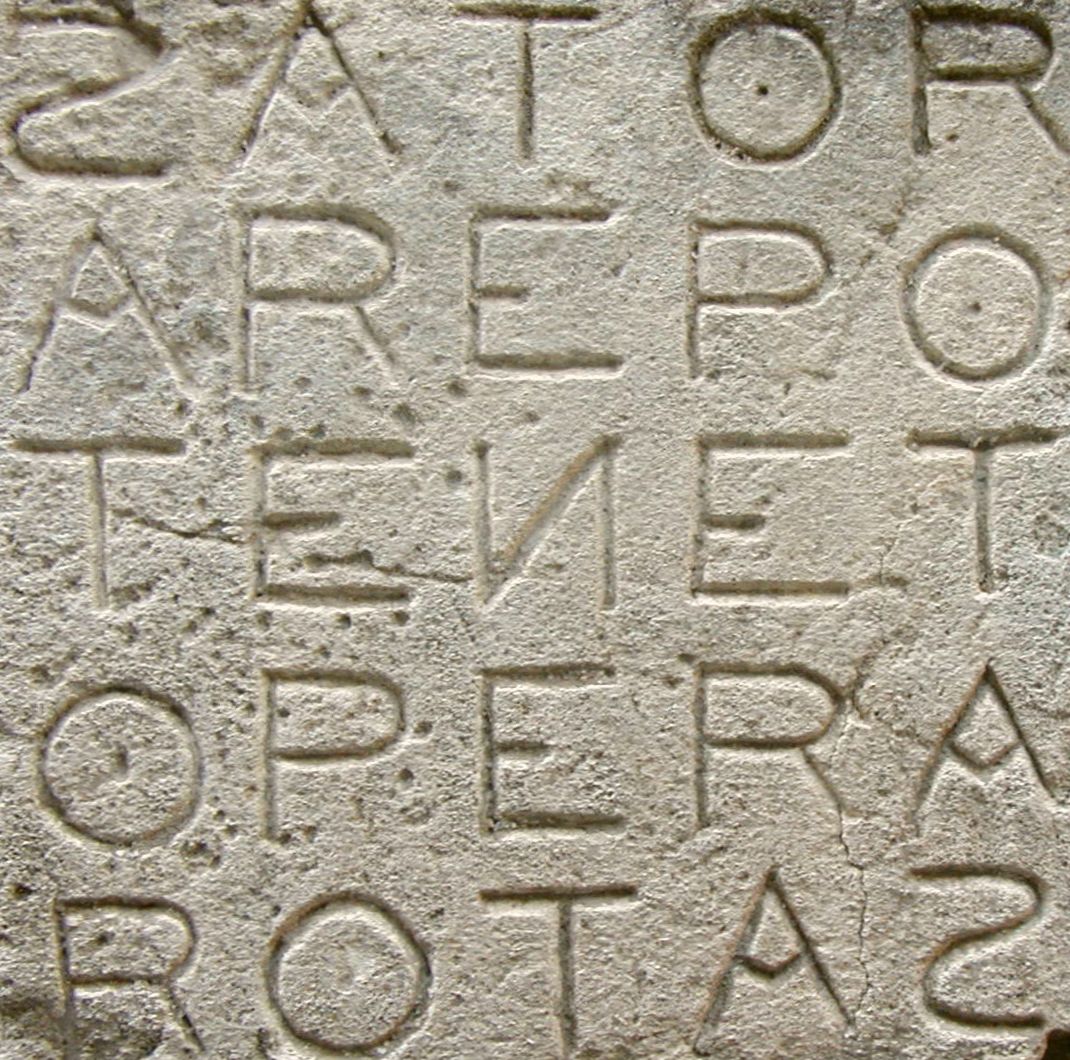
 The ROTAS form of the Sator Square from Roman Cirencester. Photograph by Throwawayhack, CC BY-SA 3.0, via Wikimedia Commons.
Few ancient inscriptions have attracted as much certainty from people who disagree with one another as the Sator Square. Five short Latin words—SATOR AREPO TENET OPERA ROTAS—form a five-by-five grid that can be read horizontally and vertically, forward and backward. The design looks so deliberate that generations of readers have assumed it must conceal a key: a Christian creed, a Jewish formula, a Mithraic diagram, a philosophical statement, a magical charm, an agricultural sentence, or some combination of these. The puzzle has survived because none of those explanations has achieved universal acceptance.
The oldest securely datable examples are especially important. Versions of the square were present at Pompeii before the eruption of Vesuvius in 79 CE, and other Roman-period examples are known from places such as Cirencester, Aquincum, Dura-Europos, and Conimbriga. That early archaeological record complicates the once-popular claim that the square began as a secret Christian cryptogram. Later, however, the same formula unquestionably entered Christian and magical environments. Medieval and early modern people carved it into churches, copied it into books, carried it as an amulet, used it in healing, and assigned it protective power against fire, disease, and other threats.
The best way to understand the Sator Square is therefore not to force every surviving example into one origin story. Its history is a history of reuse. A formally brilliant Roman word square became a portable ritual object. Communities with different religious assumptions found new meanings in the same twenty-five letters. The square’s geometry made it easy to remember, easy to copy, and easy to treat as complete in itself. Its obscurity made reinterpretation almost inevitable.
This article follows that long history from Roman graffiti to medieval amulets while separating what the evidence securely establishes from what remains disputed. The result is more interesting than any single sensational solution: the Sator Square shows how a linguistic puzzle can acquire sacred authority, how inscriptions migrate between ordinary and ritual settings, and how magical meaning can grow around an object without requiring one unchanging doctrine behind it.
What Exactly Is the Sator Square?
In its familiar form, the square is written:
SATOR
AREPO
TENET
OPERA
ROTAS
The same twenty-five letters can also be presented in the reversed order beginning with ROTAS. Because the rows and columns mirror one another, the sequence can be read in several directions. The center is occupied by TENET, itself a palindrome, and the third row and third column intersect in a cross. The formal elegance is not an illusion. This is a carefully constructed word square, not a random collection of Latin words.
Four of the five terms are ordinary Latin. Sator can mean a sower, planter, begetter, founder, or creator. Tenet means “holds,” “keeps,” or “maintains.” Opera can refer to works, efforts, care, labor, or deeds, depending on grammatical interpretation. Rotas is the accusative plural of rota, “wheel.” The difficulty is arepo, a word without a secure ordinary Latin meaning. It has been treated as a personal name, a foreign loan, a technical term, an invented filler required by the palindrome, or the surviving trace of some lost phrase.
This linguistic uncertainty is central. Translations such as “The sower Arepo holds the wheels with care” circulate widely, but they are reconstructions, not transparent translations of an unproblematic Latin sentence. The grammar is awkward, and the interpretation of arepo determines much of what the sentence can be made to say. Any responsible history of the square must distinguish the indisputable geometry from the disputed semantics.
The Pompeian Evidence Comes First
The two Pompeian examples transformed the debate because Pompeii supplies a firm terminus. Whatever the square meant, it existed before the city was buried in 79 CE. Older scholarship sometimes tried to preserve a later Christian origin by suggesting that the Pompeian squares were scratched into the ruins after the eruption by later visitors or treasure seekers. That proposal has not won broad support. Donald Atkinson, reviewing the archaeological context and earlier arguments in the Journal of Ecclesiastical History, treated the Pompeian evidence as genuinely ancient and addressed the serious chronological problems it creates for a developed Christian interpretation.
The more complete Pompeian example uses the ROTAS-first arrangement rather than the now-popular SATOR-first form. That distinction matters because the earliest material history of the object is a history of the Rotas-Sator square, not necessarily the standardized medieval presentation familiar from modern occult books and websites.
Pompeii was covered with writing. Citizens and visitors scratched names, insults, advertisements, electoral endorsements, erotic boasts, jokes, drawings, numerical exercises, and fragments of verse onto walls. In such an environment, a word square did not automatically announce itself as a secret religious document. It could have been a learned game, an apotropaic inscription, an identity marker, a riddle, a ritual sign, or something that crossed those categories. The archaeological setting warns against starting with a theological interpretation and then reading it backward into the first century.
The square’s early presence in Pompeii also places it inside a Roman world in which writing itself could have many ritual functions. Names could be inscribed to bind enemies; protective words could be carried on the body; dedications addressed gods; and short formulas could operate at the boundary between language and object. SecretMagic’s discussion of the Greek Magical Papyri as ritual handbooks shows how written formulae and material procedures could function as active ritual technologies rather than passive records. The Sator Square belongs to a different corpus, but the comparison reminds us that ancient writing could be understood as an action.
Cirencester and the Square Across the Roman World
The archaeological story does not stop at Italy. A Roman-period Rotas Square discovered at Cirencester in Britain became one of the best-known provincial examples. Other finds extend the distribution across the Roman world. The spread matters because it makes local explanations less satisfactory. If the design moved between distant communities, its portability was part of its success.
 A later Sator Square at San Pietro ad Oratorium, Capestrano, Italy. Photograph by Poecus, CC BY-SA 3.0, via Wikimedia Commons.
The British find also helps demonstrate that a word square could exist outside the cultural environment of the Bay of Naples. The Roman Empire was held together by roads, military service, commerce, administration, migration, slavery, pilgrimage, and the movement of craftsmen and texts. Short formulas traveled extremely well in such systems. A person did not need a library to transmit twenty-five letters.
Mobility also changes the question of meaning. A design can be invented for one purpose and later used for another. An inscription copied because it is admired as a verbal feat may be reinterpreted as sacred once its origin is forgotten. A charm can be copied by someone who no longer shares the original religious assumptions. A Christian can receive a pre-Christian formula and Christianize it. A healer can adopt something from a devotional setting because it already carries a reputation for efficacy.
Hetty Taylor’s work on the migrations of the Sator formula emphasizes precisely this movement across place, period, and purpose. The formula’s afterlife is not a footnote to its origin; it is one of the main historical facts that require explanation.
The Pater Noster Cross
The most famous proposed solution was popularized in the twentieth century. If the letters of the square are rearranged, they can form PATER NOSTER twice in a cross, sharing the central N. The four remaining letters are two As and two Os. These can be interpreted as Alpha and Omega, the beginning and end, an explicitly Christian title for God in Revelation.
The result is visually compelling. It seems to turn the obscure square into a concealed confession. Once this observation became widely known after Felix Grosser’s 1926 discussion, the Christian interpretation dominated much popular writing. It also encouraged a dramatic historical scenario: early Christians, threatened by persecution, encoded the Lord’s Prayer in a harmless-looking puzzle.
The problem is chronology. A formal anagram proves that the letters can be rearranged into Pater Noster; it does not prove that this was the intention of the first-century inventor. Cambridge-published scholarship has repeatedly noted the difficulty. The Pompeian examples are very early. Secure evidence for a Christian community at Pompeii is lacking. The use of Alpha and Omega as a developed Christian symbolic pair belongs more securely to later periods. Furthermore, many other anagrams can be generated from a constrained letter set.
That does not make the Pater Noster cross historically irrelevant. On the contrary, it is an excellent explanation for why Christians later found the square irresistible. Once someone recognized—or constructed—the cruciform reading, the square could be absorbed into Christian devotional and apotropaic culture with extraordinary ease. A later Christian meaning does not require an originally Christian invention.
Why the Early-Christian Hypothesis Became So Attractive
The early-Christian theory satisfies several desires at once. It explains the cross shape in TENET. It explains the duplicated Pater Noster. It interprets A and O through Revelation. It turns the obscure arepo into camouflage rather than a lexical problem. And it provides an emotionally compelling narrative of persecuted believers communicating secretly.
Historians must resist explanations simply because they make every feature feel meaningful. Elegant solutions can be overfitted. The square itself is highly constrained: creating a reversible five-by-five Latin word square drastically limits the available letters and arrangements. Some patterns may emerge from structure rather than intention. The central cross, for example, follows naturally from an odd-numbered square in which the middle word is palindromic.
The correct question is not whether Christian readers could read the square Christianly. They certainly did. The question is whether the earliest archaeological examples require that explanation. Here the evidence is much weaker.
This distinction between origin and reception is fundamental throughout esoteric history. A later community may understand an old object in a way that becomes culturally powerful even if that interpretation is historically secondary. Comparable processes can be seen in the history of Abrasax and Greco-Roman magical gems, where names, images, and later interpretations do not always point back to one simple origin.
Is “Arepo” a Name, a Tool, or an Invented Word?
No interpretation can avoid arepo. The word appears nowhere securely in ordinary Latin with a meaning that resolves the sentence. Scholars and enthusiasts have proposed connections with Celtic languages, agricultural implements, personal names, Egyptian words, Hebrew, and other sources. None has ended the debate.
One economical explanation is that Arepo is a name. Latin inscriptions preserve countless personal names of diverse linguistic origin, including names that appear only once. If “Arepo” is a proper name, then the sentence can be forced toward something like “The sower Arepo holds the wheels with effort.” Yet this remains awkward, and calling a difficult term a name solves less than it may appear to solve.
Another possibility is formal rather than lexical: the inventor needed a five-letter sequence with particular letters in particular positions and coined or adapted arepo to make the square work. Word games frequently produce artificial forms. If this is correct, searching for a precise etymology may be asking the wrong question.
The uncertainty is useful because it reminds us that an inscription can survive without a stable translation. Medieval users who treated the square as a charm did not need to parse every word according to classical grammar. Indeed, opacity could enhance its ritual status. An inherited formula whose words resist normal explanation can sound older, more secret, and more authoritative.
Word Game or Magical Object?
Modern debates often pose a false choice: either the Sator Square was merely a clever palindrome or it was magic. Ancient practice does not require such a sharp division. A formally impressive word game can become magical precisely because its symmetry appears extraordinary.
In antiquity, numerical, alphabetic, poetic, and geometric structures frequently attracted religious interpretation. Acrostics, shaped poems, repeated divine names, vowel sequences, and letter patterns could demonstrate learning while also suggesting cosmic order. The visual regularity of the Sator Square invites contemplation. Every row participates in a larger structure. The reader can begin from different sides and recover the same sequence. At the center, TENET “holds” the design together in a particularly suggestive way.
There is no need to assume that every Roman viewer regarded this geometry as supernatural. The point is that the formal qualities that make the square a good puzzle also make it a good charm. It is compact, memorable, difficult to corrupt, visually complete, and apparently self-validating. Repetition can generate authority. Symmetry can imply stability. Reversibility can suggest control over reversal, return, containment, or cyclicality.
These associations become especially clear in later magical use, when the square is no longer merely encountered as graffiti but deliberately deployed for protection and healing.
From Inscription to Amulet
By late antiquity and the Middle Ages, the Sator formula appears in contexts that leave much less doubt about religious and apotropaic use. An example discussed by the Berlin Papyrus Database comes from an Egyptian amulet, demonstrating that the formula moved far beyond its early western Mediterranean settings. The Berlin discussion also surveys later uses against rabies and fire, showing how durable the reputation of the words became.
An amulet is not defined simply by size or material. It is an object carried, worn, deposited, displayed, or otherwise used to protect a person, animal, building, or community. Text can be the most important component of such an object. A written formula may invoke a deity, name an illness, command a hostile force, cite scripture, reproduce a sacred narrative, or rely on the inherent authority of letters.
The Sator Square was exceptionally suited to amuletic life. Unlike a long prayer, it could fit almost anywhere. Unlike an image that required artistic skill, it could be copied by a moderately literate person. Unlike a formula tied to one language’s syntax, its reputation could survive even when users did not fully understand the Latin.
This is comparable to the way unfamiliar divine names and compact formulas appear on Roman magical gems. A small surface can become dense with authority when image, sound, geometry, and inherited tradition converge.
Christianization Without Simple Origins
By the medieval period, the Sator Square was unmistakably at home in Christian Europe. It appears on churches and in manuscripts; Christian interpretations flourish; and the formula could coexist with prayers, crosses, saints, and biblical language. The Sator Square at San Pietro ad Oratorium in Capestrano, carved into a Christian architectural setting, is a striking example of this later reception.
This creates a historical pattern common in the study of magic and religion: an object with disputed or non-Christian beginnings becomes fully Christian in later use. The process is sometimes described too casually as “pagan survival,” but that phrase can obscure active reinterpretation. Medieval Christians did not necessarily think they were preserving Roman paganism. They could understand the square through Christian theology, scriptural associations, the cross, and the Lord’s Prayer.
Christian ritual culture had ample room for protective writing. Biblical verses were worn as amulets; names of God were invoked against disease; crosses were placed over doors; written prayers were carried; relics and blessed objects protected bodies and buildings. Clerical authorities sometimes criticized practices they judged superstitious, but the boundary between accepted blessing and forbidden charm was contested rather than obvious.
The Sator Square flourished inside that contested field. Its Christian reinterpretation made it legible enough to be accepted, while its mysterious structure preserved an aura of special power.
The Sixth-Century Christian Evidence
Material evidence from late antiquity strengthens the case for Christian reception while leaving the first-century origin open. Taylor notes a sixth-century bronze amulet from Asia Minor bearing the Sator formula in Greek characters together with Christian symbols including fish and an ICHTHUS reference. By that point, Christian use is not hypothetical. The square has been embedded in an explicitly Christian symbolic environment.
This example is historically more useful than trying to make the Pompeian graffiti bear the entire burden of a Christian origin. It shows a real process of adoption. A formula that had circulated for centuries could be rewritten in another alphabet, combined with Christian signs, and given a new interpretive frame.
Writing the Latin words in Greek letters also highlights an important principle of ritual transmission: sound and sequence can matter more than ordinary language competence. A user can preserve a formula phonetically while moving it into another script. Similar processes occur throughout the magical papyri and late antique amulets, where Greek, Egyptian, Hebrew, and other divine names cross linguistic boundaries. SecretMagic’s overview of the Greek Magical Papyri provides a broader context for this multilingual ritual environment.
Healing Uses: Rabies and Beyond
One of the most remarkable chapters in the square’s afterlife is medical. In parts of early modern Europe, the formula was used against rabies and other illnesses. The Berlin Papyrus Database notes traditions in which the words were inscribed on bread and administered to the sick. Such practices seem bizarre if judged only through modern biomedical categories, but they fit a long history in which healing involved substances, spoken formulas, prayer, sacred writing, and ritual timing.
The bread is significant. A written charm becomes ingestible. The patient does not merely carry the letters; the letters enter the body through a medium associated with nourishment and, in Christian culture, powerful sacramental resonances. Whether every historical user connected the practice with the Eucharist cannot be assumed, but the material logic is clear: the formula’s protective order is transferred to the patient through consumption.
Written medicine has many ancient and medieval parallels. Text could be washed from a surface into water and drunk. Sacred words could be written on food. Amulets could be placed against afflicted body parts. The distinction between pharmacology and prayer was often porous.
The Sator Square’s medical uses do not tell us what the Pompeian graffitist intended. They tell us what later communities believed the formula could do. That later efficacy is part of the object’s genuine history.
Protection Against Fire
Another widely reported use involved fire. The square could be written on plates or other objects and thrown into flames, displayed on buildings, or otherwise deployed as protection against burning. In a premodern world where urban fires, wooden structures, open hearths, and limited firefighting technology created constant danger, a compact protective sign had obvious appeal.
Why the Sator formula in particular? Its symmetry may have suggested containment. Its reputation as an old and powerful charm created cumulative authority. Christian users could interpret it through divine protection. Folk practice often works through precedent: a charm is used because it is known to have been used.
Ritual traditions accumulate case histories even when those histories are not written scientifically. Stories of successful protection strengthen the charm’s prestige; failures can be explained through incorrect copying, insufficient faith, ritual impurity, or extraordinary circumstances. The same dynamics sustain many protective technologies across cultures.
The fire tradition also shows that the square’s function was not fixed. A formula can move from general apotropaic protection into specific specialized uses as local custom develops.
Buildings, Thresholds, and Architectural Protection
When the Sator Square is carved into a wall, doorway, or church, its relation to space changes. A portable amulet protects a moving body; an architectural inscription protects or marks a place. Thresholds have long attracted apotropaic practices because they are points of transition: inside and outside, safe and unsafe, sacred and profane, domestic and public.
The Capestrano example demonstrates how the square could become part of Christian sacred architecture. Other European examples appear on stone, plaster, and architectural elements. It is not always possible to know whether every carving was intended as a formal protective installation, an antiquarian curiosity, or a visitor’s inscription. Context must be evaluated individually.
Still, the square’s geometry works particularly well on walls. A viewer immediately sees an enclosed order. The inscription has no obvious beginning or end. It seems able to face every direction at once. In a protective context, those properties can acquire spatial meaning: the sign does not merely say something; it occupies and organizes a surface.
 A Sator Square at Oppède, France. Photograph by M Disdero, CC BY-SA 3.0, via Wikimedia Commons.
Magic, Religion, and the Problem of Labels
Should the Sator Square be called magical? For many later examples, the answer is clearly yes if “magic” is used descriptively for apotropaic, healing, or ritual applications of special words. Yet the category should not erase religious context. A Christian healer using the square alongside prayer may not have regarded the act as an alternative to Christianity. A Roman writer may have understood the design as a game. A late antique amulet maker may have combined traditions we now separate into religion and magic.
Historians increasingly treat such labels as questions rather than assumptions. A similar problem appears in SecretMagic’s study of the Arabic Ghāyat al-Ḥakīm and its later Latin Picatrix reception, where categories such as science, religion, astrology, philosophy, and magic shift across time and language.
Calling something “magic” can be useful when it draws attention to claims of extraordinary efficacy, specialized ritual knowledge, protective objects, and contested authority. It becomes misleading when it implies a universal secret religion opposed to official faith.
The Sator Square is valuable precisely because its history crosses those boundaries. It can be graffiti, riddle, amulet, church carving, medicinal charm, devotional cryptogram, and antiquarian puzzle without ceasing to be recognizably the same arrangement of letters.
Mithraic, Jewish, and Other Proposed Origins
The Christian theory is not the only attempt to locate the square inside a specific religious tradition. Scholars and independent researchers have proposed Mithraic, Jewish, Orphic, Pythagorean, Stoic, Egyptian, and other origins. Some proposals are imaginative and carefully constructed; others rely on speculative anagrams or numerical coincidences.
Walter O. Moeller, for example, developed a substantial Mithraic interpretation of the Rotas-Sator Square. The theory attempts to connect the text’s words, numerical properties, and geometry with Mithraic cosmology. Earlier scholarship also recorded suggestions of Mithraic and Eleusinian or Orphic origins. Atkinson noted such proposals while observing their difficulties.
These theories deserve historical mention because they form part of the modern reception of the square. They should not be presented as settled explanations. Mystery religions are especially vulnerable to overinterpretation because their surviving evidence is fragmentary. When a symbol is enigmatic and a cult is poorly documented, it is easy to use one mystery to explain another.
Jewish interpretations likewise point to genuine features of ancient religious culture—sacred names, letter manipulation, numerical interpretation, and the circulation of Jewish ritual elements in the Roman world—but direct evidence tying the first-century invention of the square to a Jewish community remains insufficient.
The responsible position is comparative without being credulous. Parallels can generate questions; they cannot replace provenance.
The Seduction of Anagrams
The Sator Square is an anagram-generating machine. Because its alphabet is limited and letters repeat in balanced quantities, researchers can rearrange it into suggestive phrases. This creates a methodological danger. If enough combinations are tried, meaningful-looking results become inevitable.
An anagram becomes historically persuasive only when supported by independent evidence. The Pater Noster cross is unusually elegant, but even it faces chronological questions. More elaborate reconstructions involving obscure divine names, astronomical numbers, hidden phrases, or multiple languages require proportionally stronger evidence.
Ancient people certainly enjoyed acrostics, word games, numerical patterns, and cryptic writing. Therefore hidden structure cannot be dismissed merely because it is hidden. The test is whether the proposed structure explains features that would otherwise be unlikely and whether it fits the date, place, language, and cultural context of the artifact.
The square teaches a useful discipline for all esoteric research: pattern recognition must be constrained by history.
The Geometry of TENET
The central word TENET has attracted special attention because its row and column form a cross. The Latin verb itself means “holds” or “maintains,” so the design seems to enact its meaning: TENET holds the square together. This semantic-visual coincidence may be one of the reasons the construction proved so memorable.
Yet even here, caution is needed. Because the word square is symmetrical, some structural features are required by design. We cannot automatically convert every geometric property into theology. At the same time, ancient and medieval readers were perfectly capable of noticing the cross and investing it with meaning.
In Christian reception, the central cross could reinforce the Pater Noster interpretation. In magical reception, the cross-like symmetry could be treated as protective even without elaborate theology. In a purely ludic reading, it is simply the elegant center of the puzzle.
These interpretations can coexist historically because different viewers encounter the same form.
The Difference Between SATOR-First and ROTAS-First
Modern reproductions usually begin with SATOR, but some early Roman examples begin with ROTAS. Because the square is reversible, both arrangements preserve the same structure. Still, the choice of orientation has historical implications.
Calling the object “the Sator Square” can make the SATOR-first form seem original. The archaeological evidence warns against that assumption. Some scholars therefore prefer “Rotas-Sator Square” when discussing early examples. The naming issue is small but instructive: modern terminology can quietly impose later standardization onto diverse ancient artifacts.
The orientation also affects translation. If a reader believes the first line should begin a sentence, SATOR-first encourages “the sower…” while ROTAS-first begins with “wheels.” But a word square need not be a sentence meant to be read from the upper left like normal prose. Its defining property is multidirectional reading.
Perhaps the desire for one grammatical sentence says more about modern readers than about the inventor.
The Sator Square as a Memory Device
One underappreciated feature of the square is mnemonic efficiency. Twenty-five letters are arranged so redundantly that the pattern helps correct memory. If a copyist remembers the first row and the rule, much of the rest follows. Errors become visible because they break symmetry.
This has major consequences for transmission. Long magical prayers mutate easily; the Sator Square contains its own error-checking mechanism. Its geometry is a kind of textual technology. The design protects itself.
That self-correcting quality may have contributed to the impression of perfection. A formula that reproduces itself in multiple directions appears complete in a way ordinary prose does not. This formal closure could encourage users to believe that the square possessed inherent order.
From the standpoint of cultural evolution, it is an extraordinarily successful information package: short, striking, reproducible, and resistant to corruption.
Why the Formula Survived for Centuries
Many ancient spells disappeared because they depended on specialized languages, institutions, or manuscripts. The Sator Square survived because it demanded very little infrastructure. It required only knowledge of five short letter sequences and a surface on which to write them.
Its ambiguity also helped. A formula with a single explicit pagan invocation might become unacceptable in a Christian environment. The Sator Square could be reinterpreted. A Protestant, Catholic, folk healer, antiquarian, or occultist could encounter the same letters and assign them different meanings.
Ambiguity can be a survival strategy. What cannot be easily defined cannot be easily confined to one obsolete theology.
The formula’s spread into medical, architectural, devotional, and magical settings demonstrates cultural resilience through reinterpretation. Each new use added another layer to its reputation.
Later Books and Learned Curiosity
The Sator Square did not remain only on walls and amulets. It entered books. Magdalene College in Cambridge preserves printed and manuscript evidence of Sator squares and has discussed their appearance within book culture. Once the formula enters learned collections, it gains another mode of survival: antiquarian preservation.
Books detach inscriptions from place. A church carving belongs to one building; a printed square can be reproduced thousands of times. Scholars can compare examples. Physicians, clerics, and collectors can encounter a formula they have never seen in the landscape.
This bookish afterlife also changes classification. What one community uses as a charm another may catalog as a curiosity. A magical formula can become a specimen of linguistic ingenuity without losing its ritual associations.
The history of Western esotericism is full of such crossings between practical use and scholarly collection. Ritual materials survive because skeptics, believers, antiquarians, and librarians all find different reasons to preserve them.
The Square in Popular Healing Traditions
By the early modern and modern periods, the Sator formula entered vernacular healing and protective traditions in several regions. Recipes could prescribe writing the words on specific materials, repeating them a certain number of times, consuming or carrying them, or placing them in relation to an afflicted person or animal.
Such practices should be studied as historical medicine rather than mocked as isolated superstition. Premodern households faced diseases for which effective biomedical treatments were limited. Healing systems combined observation, inherited remedies, religious confidence, and ritual action. A charm’s social power could matter even when its physiological mechanism did not correspond to modern medicine.
The persistence of the Sator Square in healing also reveals trust in textual authority. The user did not need to know who invented the formula. Antiquity itself could become a credential.
What the Square Does Not Prove
The Sator Square has been used to support sweeping claims about secret Christianity at Pompeii, lost mystery cults, universal ancient wisdom, coded cosmology, medieval occult brotherhoods, and even direct lines of transmission into modern magical organizations. The surviving evidence supports none of those grand narratives by itself.
The square proves that a particular word construction existed in the Roman period and circulated widely. Later evidence proves that it was repeatedly Christianized, ritualized, medicalized, and used apotropaically. Those facts are already remarkable.
We do not need to turn every gap into a hidden lineage. Esoteric history becomes stronger when uncertainty is preserved rather than filled with attractive stories.
Comparing the Sator Square with Other Ancient Formulae
The Sator Square becomes clearer when compared cautiously with other ancient ritual texts. The Abrasax and magical-gem tradition demonstrates how compact names, images, and formulae can circulate for centuries and acquire new explanations. Roman magical gems show how small objects condense images and names into portable ritual technology. Curse tablets show that inscription can be an action. The Greek Magical Papyri show multilingual experimentation with sacred names and formal patterns.
None of these traditions is identical to the Sator Square. The comparison reveals shared mechanisms: compression, repetition, authority through antiquity, materialization of speech, and reinterpretation across communities.
The square’s distinctive feature is geometric reversibility. That geometry makes the text unusually self-contained. A charm written as prose still points beyond itself to grammar and context. A perfect word square appears almost like an object made from language.
A Formula Between Language and Image
The Sator Square is readable, but it is also visual. This dual nature helps explain its place in ritual culture. If the words are copied as a normal line—SATOR AREPO TENET OPERA ROTAS—much of the force disappears. The square arrangement is essential.
That makes the artifact comparable to diagrams, seals, characteres, magic squares, and sacred calligraphy. The letters do semantic work while the arrangement does visual work. Readers can pronounce the words, inspect the symmetry, trace the cross, or simply display the completed grid.
In this sense, the Sator Square anticipates later Western fascination with alphabetic diagrams in grimoires and talismanic traditions without requiring a direct genealogical line from one to the other. The broader principle is that writing can become image.
Modern Occult Reception
Modern occultism adopted the Sator Square because it already possessed every quality attractive to esoteric reinterpretation: antiquity, disputed origins, perfect symmetry, Christian associations, magical uses, and an unresolved word. Contemporary practitioners may place it on talismans, use it in protection rituals, analyze it numerologically, or connect it with elemental and planetary systems developed long after the Roman period.
These modern practices are historically real as modern practices. Problems arise only when recent interpretations are projected backward and presented as the square’s ancient meaning. A nineteenth- or twentieth-century occult correspondence can be meaningful within its own system without becoming archaeological evidence for Pompeii.
This distinction allows respectful study without collapsing centuries. Traditions evolve. New ritual meanings do not need counterfeit antiquity to be culturally significant.
Why “Magic Square” Can Mislead
The expression “magic square” has a technical mathematical meaning: a grid of numbers whose rows, columns, and often diagonals have equal sums. The Sator Square is not a numerical magic square in that sense. It is a word square and multidirectional palindrome.
Calling it a magical square can also imply that its original purpose was ritual magic, which remains uncertain. It is better to say that it is a word square that later has abundant documented magical and apotropaic uses.
Precision matters because terminology quietly shapes interpretation. If a reader first encounters the artifact labeled “ancient Roman magic square,” the magical conclusion has already been supplied before any evidence is considered.
The Best Historical Model: Layered Meaning
A productive way to interpret the Sator Square is through layers rather than one secret solution.
- Roman layer: the word square exists before 79 CE and circulates across the empire. Its precise original purpose remains uncertain.
- Formal layer: its symmetry, reversibility, and central TENET cross make it memorable and invite symbolic interpretation.
- Late antique layer: the formula enters more clearly religious and amuletic settings and can be written in Greek characters.
- Christian layer: the Pater Noster cross and Alpha-Omega interpretation provide a powerful theological reading, while the square appears on Christian objects and buildings.
- Medieval and early modern layer: the formula develops specialized protective and healing uses, including traditions against fire and disease.
- Modern layer: scholars, occultists, artists, and popular culture continue to reinterpret the design.
These layers do not cancel one another. The mistake is to choose a late layer and declare it the only possible origin.
How to Evaluate Claims About the Sator Square
- Ask for the date of the evidence. A medieval interpretation cannot automatically explain a first-century graffito.
- Separate artifact from commentary. What is physically present on the object, and what is supplied by a later interpreter?
- Check the linguistic method. Does a proposed translation treat arepo honestly, or quietly assume a disputed meaning?
- Watch for unconstrained anagrams. Rearranged letters can produce impressive coincidences.
- Require independent support. A Mithraic, Jewish, Christian, or Egyptian theory should fit archaeological and textual evidence beyond the square itself.
- Distinguish origin from use. A formula can become genuinely Christian or magical even if it did not begin that way.
- Respect uncertainty. “Unknown” is sometimes the most accurate conclusion.
This method is useful far beyond the Sator Square. Esoteric objects often attract explanations more precise than the sources justify.
The Power of a Perfectly Portable Mystery
Why has the square endured when so many Roman inscriptions are known only to specialists? Part of the answer is aesthetic. The Sator Square can be understood at a glance even before it is translated. Anyone who knows the alphabet can see the symmetry. The central TENET cross is visually immediate. The reversal is satisfying.
Another part is unresolved meaning. A solved puzzle becomes a historical fact; an unsolved puzzle invites participation. Every generation can imagine that the missing key is still recoverable.
Finally, the square has a genuine ritual biography. It was not merely rediscovered by modern puzzle enthusiasts. For centuries people actually treated the words as protective, healing, and sacred. The mystery is therefore attached to human practice, not abstract cryptography.
Conclusion: The Sator Square Without the Myth of One Answer
The Sator Square is most revealing when we stop demanding a single explanation capable of covering two thousand years.
Its earliest securely dated history is Roman. Examples at Pompeii establish the word square before 79 CE and create serious problems for a fully developed Christian-origin theory. The famous Pater Noster cross remains an ingenious and historically influential interpretation, but the anagram alone cannot settle the first-century question. The obscure word arepo continues to resist consensus, and proposals ranging from personal names to foreign loans and deliberate invention remain debated.
What becomes much clearer after antiquity is use. The formula moved across the former Roman world, entered Christian settings, appeared on amulets and architecture, and developed a long reputation for protection. It was used in healing traditions, against fire, and in devotional contexts. Christian readers could see the Lord’s Prayer and Alpha-Omega symbolism in its letters. Magical users could value the square for its symmetry, antiquity, and inherited efficacy. Scholars could preserve it as a linguistic and archaeological puzzle.
The square therefore illustrates a fundamental principle of esoteric history: meaning can be cumulative. An object does not need one immutable doctrine to possess a coherent tradition. It can survive because each period discovers something usable in its form.
Twenty-five letters were enough. Their symmetry carried them from Roman walls into churches, books, amulets, healing customs, scholarly debates, and modern occult imagination. The Sator Square’s greatest secret may be less dramatic than a hidden creed but historically more powerful: a perfectly designed text can become a ritual object simply because generations refuse to stop copying it.
Sources and References
- Donald Atkinson, “The Origin and Date of the ‘Sator’ Word-Square,” The Journal of Ecclesiastical History 2.1: Cambridge University Press.
- “On the Origin of the Rotas-Sator Square,” Harvard Theological Review: Cambridge University Press.
- Hetty Taylor, “Place, period and purpose: migration(s) of the SATOR AREPO formula,” Kent Material Studies Network, University of Kent: University of Kent.
- Kierán Meinhardt, “The Return of the Sower: Egyptian Amulet,” Berlin Papyrus Database, Staatliche Museen zu Berlin: Berlin Papyrus Database.
- “Sator Squares,” Magdalene College, University of Cambridge: Magdalene College.
- Carlos Pérez-rubín, “Las ruinas enterradas de Pompeya y un antiguo ejemplar enigmático de Epigrafía fortuita romana,” Documenta & Instrumenta, Universidad Complutense de Madrid: Universidad Complutense de Madrid.
- Wikimedia Commons, “Rotas square from Cirencester,” CC BY-SA 3.0: file record.
- Wikimedia Commons, “Sator Square Capestrano,” CC BY-SA 3.0: file record.


