


SEO Title: Shugendō Explained: Yamabushi, Sacred Mountains, En no Gyōja, and Japanese Mountain Asceticism
Meta Description: A source-based history of Shugendō, Japan’s mountain ascetic tradition: yamabushi, En no Gyōja, Ōmine, Dewa Sanzan, Zaō Gongen, ritual practice, Meiji suppression, and modern revival.
Suggested Permalink: shugendo-yamabushi-mountain-asceticism
Primary Category: Asian Esoteric Traditions
Tags: Shugendō, Yamabushi, En no Gyōja, Ōmine, Dewa Sanzan, Japanese Religion
Shugendō is often reduced in popular culture to a striking image: a white-robed yamabushi blowing a conch shell on a remote Japanese mountain. The image is real, but by itself it explains almost nothing. Shugendō is not simply “mountain Buddhism,” not a surviving fragment of a single prehistoric nature religion, and not a Japanese equivalent of Western ceremonial magic. It is a historically layered religious tradition in which mountain pilgrimage, ascetic ordeal, Buddhist ritual, local kami worship, esoteric cosmology, healing, divination, pilgrimage guidance, and ideas about spiritual power were combined and repeatedly reorganized.
That complexity is exactly why Shugendō belongs in the history of esoteric and ritual traditions. It offers a case study in how religious power can be imagined as something cultivated through the body, the landscape, repetition, danger, memory, and sacred geography. Its practitioners did not merely contemplate mountains from a distance. They entered them, walked prescribed routes, fasted, endured cold water, climbed difficult passes, sounded conch shells, invoked deities, crossed symbolic thresholds, and returned to ordinary society with a changed ritual status.
Historical caution is essential. Sources document that practitioners believed ascetic training could generate extraordinary religious efficacy, purification, protection, healing power, visionary experience, and other benefits. Those claims belong to the religious worldview of Shugendō and should not be presented as scientifically demonstrated supernatural facts. The historically verifiable story is no less remarkable: for more than a millennium, Japanese communities built institutions, pilgrimage routes, images, legends, and ritual systems around the idea that mountains could transform human beings.
Yamabushi on the Ōmine Okugakemichi near Yoshino. Photograph by Wolfgang Michel, released under CC0 via Wikimedia Commons.
What Does Shugendō Mean?
The Japanese term Shugendō is commonly rendered as “the way of cultivating power through practice,” “the way of training and testing,” or similar formulations. The term points toward one of the tradition’s defining assumptions: religious efficacy is not acquired by belief alone. It is cultivated through shugyō—disciplined practice, often involving bodily hardship and mountain training.
Practitioners are commonly called shugenja, “those who cultivate or manifest efficacy,” or yamabushi. The familiar translation of yamabushi as “one who lies down in the mountains” is evocative, though etymological explanations vary in popular and scholarly literature. More important than a literal translation is the social identity the term came to carry: a religious specialist associated with mountain pilgrimage, austerities, ritual services, protective rites, divination, healing, and the mediation of sacred power.
Modern summaries often describe Shugendō as a blend of Shintō, Buddhism, Daoism, and folk religion. That shorthand is useful only if handled carefully. “Shintō” itself changed historically, and medieval Japanese religion did not always separate kami and buddhas into the clean institutional categories familiar today. Shugendō developed within a world of combinatory religion in which local deities, Buddhist figures, sacred mountains, esoteric rites, pilgrimage, and inherited continental ideas could coexist inside one ritual landscape.
Why Mountains Became More Than Backdrops
Mountains in Japanese religion have long been places of unusual religious intensity. They could be imagined as abodes of kami, zones associated with the dead, sources of water, places of dangerous wilderness, sites of revelation, and environments in which ordinary social order weakens. Shugendō did not invent the sacred mountain. It systematized particular ways of entering, traversing, interpreting, and ritualizing it.
This distinction matters because the mountain is not merely scenery for a ceremony that could happen anywhere else. The route itself becomes ritual. A pass may represent a threshold. A waterfall may become a site of purification. A cave can be interpreted as womb, tomb, or place of retreat. Climbing, descending, fasting, exhaustion, cold, darkness, and exposure all become elements of religious meaning.
The University of Michigan Press describes Miyake Hitoshi’s influential studies of Shugendō as examining history, organization, ritual, austerities, cosmology, exorcism, and ideas of death and rebirth. That breadth reflects the fact that sacred mountains function as total environments. They combine geography, myth, bodily discipline, institutional authority, and cosmology.
En no Ozunu: Historical Ascetic, Legendary Founder
Shugendō traditions revere En no Ozunu, more commonly known as En no Gyōja, as a foundational figure. He is one of the clearest examples of how a historical person can become the center of an expanding sacred biography.
Kokugakuin University’s Encyclopedia of Shinto identifies En no Ozunu as a thaumaturge thought to have lived around Mount Katsuragi in the second half of the seventh century. The early chronicle Shoku Nihongi records that in 699 he was exiled to the Izu Islands after accusations connected with his unusual religious activity. This is among the strongest historical anchors for his existence.
Later legend greatly expands the story. En no Gyōja becomes a master of mountains, a controller of supernatural attendants, a worker of miracles, and a founder linked with numerous sacred sites. These traditions are historically important as traditions, but they should not be confused with contemporary seventh-century documentation. The farther the stories move from the early chronicle, the more carefully historians separate devotional biography from recoverable history.
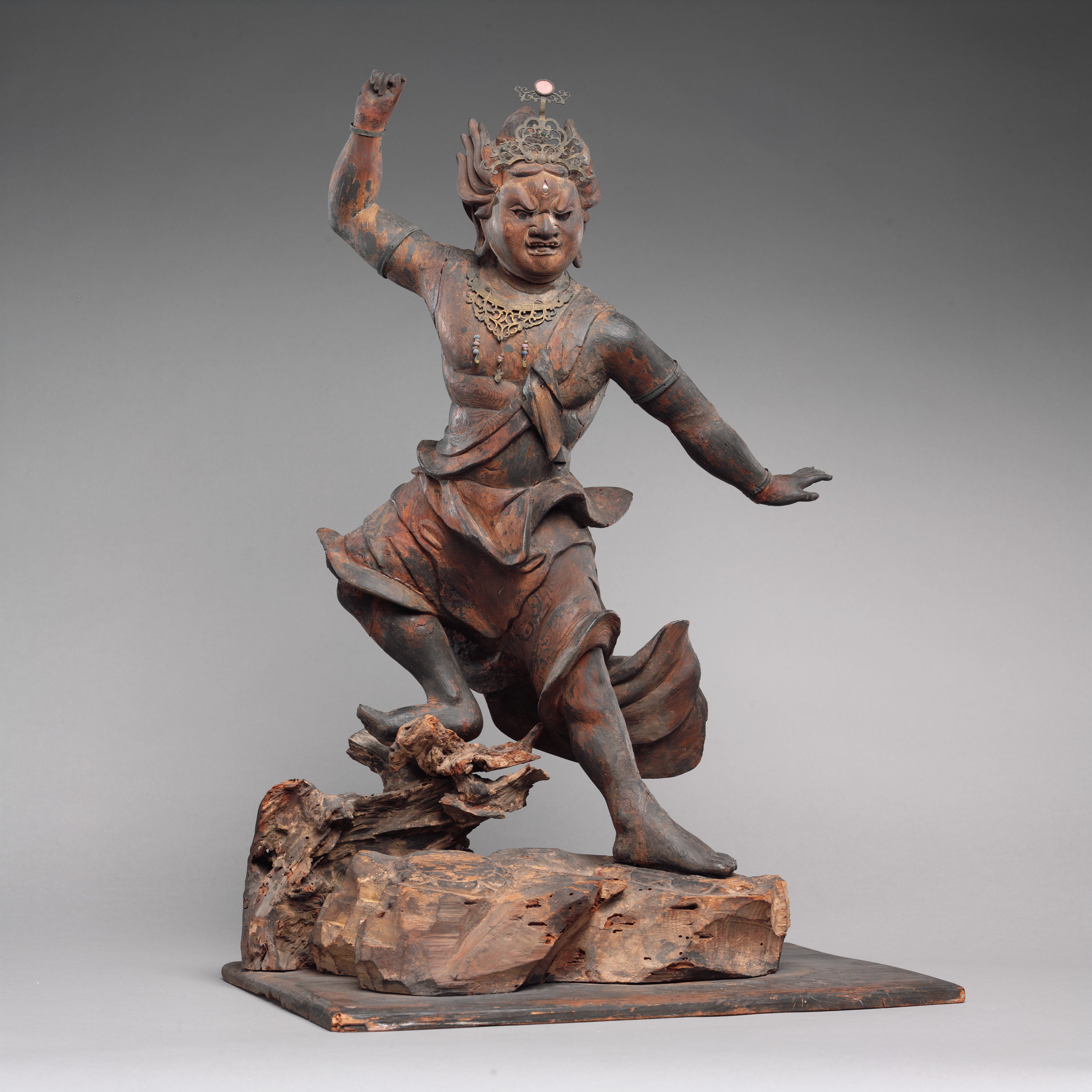 Zaō Gongen, Nanbokuchō or Muromachi period, Japan. The Metropolitan Museum of Art, public domain.
Zaō Gongen: A Deity Born from Combinatory Religion
One of the most important deities of the Yoshino–Ōmine religious world is Zaō Gongen. The Metropolitan Museum of Art describes Zaō Gongen as a specifically Japanese deity within the Buddhist pantheon and explicitly connects his worship with mountain ascetics practicing Shugendō.
The word gongen refers to a “provisional manifestation,” a concept central to medieval combinatory thought in which buddhas and bodhisattvas could manifest in Japan through local divine forms. Zaō Gongen embodies this religious logic. He is fierce, dynamic, and visually unlike the calm meditative image many modern viewers expect from Buddhist art. His raised leg, forceful gesture, and wrathful expression communicate active power.
In traditional narratives, En no Gyōja’s relationship with Zaō Gongen becomes a charter for the sacred authority of the mountains around Yoshino and Ōmine. Historically, what matters is not whether a supernatural apparition can be verified, but how the story organizes sacred geography, ritual legitimacy, and institutional memory.
Shugendō Took Shape Gradually, Not in a Single Founding Moment
It is tempting to tell a simple story: En no Gyōja founded Shugendō in the seventh century, and later yamabushi continued his system. Scholarship presents a more complicated process. Kokugakuin University’s Encyclopedia of Shinto notes that Shugendō gradually took recognizable institutional form between roughly the twelfth and fourteenth centuries, even though earlier mountain ascetics and En no Ozunu were retrospectively incorporated into its sacred history.
This difference between legendary origin and institutional formation is crucial. Religious traditions often look backward and organize earlier saints, stories, and places into a coherent genealogy. The resulting lineage may be religiously meaningful without being a literal administrative history.
By the medieval period, mountain ascetic networks had become sophisticated enough to develop routes, temples, initiatory structures, ritual specialists, and affiliations with major Buddhist institutions. The tradition was no longer simply a matter of solitary hermits.
Esoteric Buddhism and the Ritualization of the Mountain
Shugendō developed in close interaction with Japanese esoteric Buddhism, especially Shingon and Tendai traditions. Esoteric Buddhist ritual brought mantras, mudras, mandalas, consecrations, fire rites, visualization, complex pantheons, and theories of ritual transformation into the mountain environment.
This did not erase older sacred geography. Instead, mountains could be reinterpreted as mandalic landscapes. Paths, peaks, caves, and waterfalls could correspond to stages of practice or sacred domains. The body of the practitioner moved through a terrain that had become both physical geography and religious diagram.
This mountain-mandala principle is one of the most sophisticated symbolic dimensions of Shugendō. In a painted mandala, the eye travels through sacred space. In a pilgrimage mandala, the practitioner’s body becomes the moving point. Geography becomes liturgy.
Ōmine: The Mountain Range as Ritual Text
The Ōmine mountains in the Kii Peninsula became one of Shugendō’s central ritual landscapes. UNESCO’s World Heritage documentation for the “Sacred Sites and Pilgrimage Routes in the Kii Mountain Range” recognizes Yoshino and Ōmine alongside Kumano Sanzan and Kōyasan as part of a cultural landscape that reflects more than 1,200 years of sacred mountain tradition.
The UNESCO property includes the Ōmine Okugakemichi pilgrimage route. The route does not function like a modern recreational hiking trail onto which religious meaning is later added. Its historical importance comes from a sequence of sacred stations and ritual associations embedded in movement through the range.
The physical difficulty of such routes matters. Fatigue alters perception. Weather creates vulnerability. Group discipline becomes necessary. Experienced leaders acquire authority not only because they know prayers but because they know where to walk, rest, cross, climb, and perform rites. Ritual competence and environmental competence become inseparable.
The Logic of Ordeal
Shugendō is famous for austerities: fasting, night vigils, waterfall practice, long mountain marches, exposure to cold, and other demanding disciplines. Popular media sometimes sensationalize the most dramatic examples, such as cliff-related tests or severe endurance practices. A deeper reading asks why hardship became religiously meaningful.
First, ordeal marks separation from ordinary life. Daily comfort, predictable food, sleep, and social routine are suspended. Second, difficulty generates commitment: the body cannot treat the ritual as an abstract idea. Third, hardship is interpreted through a sacred narrative. Pain or exhaustion becomes purification, testing, death, rebirth, or the burning away of attachment.
These are historical and anthropological interpretations. They do not establish supernatural causation. They help explain why ascetic systems across cultures repeatedly use deprivation, repetition, and difficult landscapes as technologies of transformation.
Waterfall Practice: Purification Through Cold and Impact
Waterfall austerity is among the best-known images associated with contemporary yamabushi. Standing beneath cold falling water intensifies bodily sensation, breathing, posture, and attention. In religious interpretation, water is associated with purification, renewal, and preparation.
Modern observers should avoid assuming that every waterfall practice seen in Japanese religion is identical or that every practitioner interprets it in the same way. Ritual traditions vary by lineage, temple, mountain, and teacher. Shugendō itself has never been a perfectly standardized single system.
There is also a practical caution. Cold-water exposure, severe fasting, cliff training, and strenuous mountain pilgrimage can carry genuine medical and physical risks. Historical importance does not make an ordeal safe for untrained imitation. Serious practice belongs under qualified guidance within its living traditions.
The Horagai: Why Yamabushi Carry a Conch Shell
The conch shell trumpet, or horagai, is one of the most recognizable pieces of yamabushi material culture. Its sound can travel through mountain terrain, making it practical for communication, but it is also deeply ritualized.
Different calls can have conventional meanings. The instrument announces presence, coordinates a group, marks transitions, and sonically transforms the environment. A mountain that seems silent becomes filled with a human-made sound that carries religious associations.
Material culture is important because religions are not made only of doctrines. Clothing, staffs, footwear, ropes, shells, rosaries, fire, paper talismans, statues, and pathways shape what practitioners actually do.
White Robes, Death, and Rebirth
The white garments associated with many yamabushi are frequently interpreted in relation to purity and death. In some explanations of mountain training, entering the mountain is symbolically compared to dying to ordinary identity and returning renewed.
Miyake Hitoshi’s scholarship emphasizes death-and-rebirth structures in Shugendō ritual. This pattern gives the mountain a double symbolism. It is dangerous wilderness and generative womb; place of death and place of rebirth.
Such symbolic systems are powerful because they allow physical movement to carry existential meaning. Crossing into the mountain can become crossing out of ordinary identity. Emerging from it becomes a return to society, not merely a descent in altitude.
Fire Ritual and Saitō Goma
Fire rites form another important dimension of Shugendō practice. The saitō goma is an outdoor fire ritual related to the broader esoteric Buddhist goma tradition. Fire transforms offerings visibly: wood, petitions, and ritual objects are consumed, while smoke and heat alter the space.
Symbolically, fire can represent purification, wisdom, destruction of obstacles, or the transformation of desire. Institutionally, public fire rites also connect yamabushi to communities. The mountain ascetic is not necessarily an isolated mystic who abandons society. Historically, shugenja could return from training to perform rites for households, villages, pilgrims, and patrons.
Healing, Divination, and Practical Religious Services
Shugendō was not only a path of private spiritual attainment. Yamabushi historically provided practical services. Sources and scholarship discuss exorcism, healing, divination, prayers for protection or worldly benefit, pilgrimage leadership, and mediation between local communities and sacred mountains.
This practical dimension helps explain the tradition’s social durability. A religious specialist who can guide a dangerous pilgrimage, perform rites, interpret omens, pray for health, or protect a household has a social function. In premodern communities, the boundary between “religion,” “medicine,” and “magic” could be far less rigid than modern categories suggest.
Claims that a rite cured disease or expelled an invisible being should be treated as historical claims about belief and reported experience, not as substitutes for modern medical evidence.
Honzan-ha and Tōzan-ha: Two Major Institutional Networks
By the later medieval and early modern periods, two major institutional streams became especially influential. Honzan-ha was associated with Tendai Buddhism and centered on Shōgo-in in Kyoto. Tōzan-ha was affiliated with Shingon Buddhism and associated with Sanbō-in at Daigo-ji.
Kokugakuin University notes that both networks centered important practices on the Ōmine mountains and eventually controlled extensive systems of shugen and temples across Japan. This institutional history corrects the romantic image of yamabushi as purely independent hermits.
Shugendō possessed hierarchy, authorization, routes, documents, temples, and competing centers of authority. Wilderness and bureaucracy coexisted.
Dewa Sanzan: A Different Mountain World
The Three Mountains of Dewa—Haguro, Gassan, and Yudono in present-day Yamagata Prefecture—developed one of the most famous Shugendō environments outside the Yoshino–Ōmine complex. H. Byron Earhart’s landmark study of Mount Haguro demonstrates how a regional tradition could develop a distinct ritual life while participating in the broader category of Shugendō.
The Dewa mountains are often symbolically interpreted as a sequence of death and rebirth, though modern presentations can simplify or standardize explanations that have varied historically. Mount Haguro is especially accessible and became a major religious center. Gassan and Yudono carry different ritual associations and seasonal conditions.
 Torii on Mount Haguro, Dewa Sanzan. Photograph by Japanexperterna.se, CC BY-SA 3.0 via Wikimedia Commons.
Mountain Pilgrimage as Embodied Cosmology
One of the most useful ways to understand Shugendō is to see pilgrimage as embodied cosmology. The practitioner does not merely learn a doctrine stating that the universe has levels, powers, deities, and thresholds. The body enacts a model of transition through landscape.
Walking is therefore intellectual and religious action. The route teaches through sequence. A gate encountered before a climb means something different from the same gate seen in a museum. A waterfall encountered after hours of ascent carries a different sensory force from a photograph of water.
This is why purely textual descriptions can never fully explain mountain religion. The tradition is designed around situated experience, even though scholars can still analyze its history without accepting supernatural claims.
Shugendō and Onmyōdō: Similarities Without Collapsing Them
Shugendō is sometimes casually mixed with Onmyōdō, another Japanese tradition associated in popular culture with ritual specialists, divination, directional taboos, and spirit lore. The traditions interacted historically with wider Japanese systems of calendrical and ritual thought, but they are not the same institution.
Onmyōdō developed strongly around court divination, calendars, yin-yang and five-phase cosmology, omens, and ritual specialists known as onmyōji. Shugendō is centered far more explicitly on ascetic mountain practice and pilgrimage. Shared cultural vocabulary does not erase institutional difference.
Comparing them is useful precisely because it reveals multiple ways esoteric knowledge operated in Japan: one heavily tied to calendrical expertise and court service, another to sacred mountains and bodily austerity.
Shugendō Is Not “Japanese Shamanism” in a Simple Sense
Older scholarship and popular summaries sometimes describe Shugendō as shamanic. Certain comparisons are understandable: spirit mediation, trance-like experiences, healing, divination, and claims of extraordinary power can resemble phenomena studied under the broad comparative category of shamanism.
But the term can obscure as much as it reveals. Shugendō is deeply entangled with Buddhist institutions, esoteric ritual, specific Japanese sacred landscapes, pilgrimage networks, and textual traditions. Calling it “shamanism” can flatten these features into a universal template.
A more precise description is that some Shugendō practices can be compared with practices labeled shamanic elsewhere, while the tradition itself should be studied in its Japanese historical setting.
Women, Sacred Mountains, and Contested Exclusion
Gender is one of the most difficult aspects of Shugendō history. Some mountains and routes historically excluded women under practices of nyonin kekkai, the restriction of women from particular sacred spaces. These exclusions were justified through ritual purity concepts, institutional custom, and gendered ideas about ascetic danger.
It would be inaccurate, however, to conclude that women were absent from Shugendō as a whole. Practices varied by site and period, and women participated in pilgrimage and related religious networks in multiple contexts. Modern Shugendō groups also differ in policy.
The persistence of restrictions on parts of Mount Ōmine remains a contemporary issue and should be described as such, rather than romanticized as an unchanging “ancient tradition.” Religious heritage can be historically important and ethically contested at the same time.
The Meiji State and the 1872 Ban
The most dramatic institutional rupture in modern Shugendō history came during the Meiji period. Beginning in 1868, the new government promoted policies separating kami and buddhas, known as shinbutsu bunri. These policies disrupted religious institutions whose identities depended on centuries of combinatory practice.
Kokugakuin University’s Encyclopedia of Shinto states that Shugendō was forced into decline by the separation policies of 1868–1870 and by the specific ban on Shugendō in 1872. Yamabushi institutions were compelled to affiliate with recognized Buddhist or Shintō structures, abandon certain identities, or reorganize.
This episode is crucial because it disproves the idea that “Shintō” and “Buddhism” had always existed as neatly separate religious systems in Japan. The state had to actively separate institutions because their historical lives were deeply intertwined.
Suppression Did Not Erase the Tradition
Legal prohibition can destroy institutions, but it rarely erases memory immediately. Ritual knowledge, sacred routes, local communities, temples, family lineages, and devotional identities can survive inside new legal forms.
H. Byron Earhart’s work on Mount Haguro describes how Shugendō heritage survived the period of suppression through Shintō and Buddhist forms. After 1945, when Japan’s postwar religious environment allowed new organizational freedom, Shugendō-derived groups could again become independent religious corporations.
Modern Shugendō is therefore both old and new. Its sacred mountains, legends, and ritual repertoires may be centuries old, while some present-day institutions are products of postwar legal reorganization.
What “Revival” Really Means
Calling twentieth- and twenty-first-century Shugendō a “revival” can be misleading if it suggests a dead tradition was simply resurrected intact. Some practices continued under altered institutional identities. Others were reconstructed. Modern tourism, heritage policy, media, international interest, and environmental concerns also changed how mountain practice is presented.
Living traditions are never museum pieces. They respond to new publics. Contemporary yamabushi may train lay participants, work with heritage organizations, appear in documentaries, communicate online, or explain practices in psychological and ecological language that earlier practitioners would not have used in the same way.
This does not automatically make modern practice inauthentic. It demonstrates that authenticity in living religion is negotiated through continuity and adaptation.
UNESCO and the Transformation of Sacred Geography into Heritage
In 2004, UNESCO inscribed the “Sacred Sites and Pilgrimage Routes in the Kii Mountain Range” as a World Heritage property. The designation recognizes Yoshino and Ōmine, Kumano Sanzan, Kōyasan, and associated pilgrimage routes as a cultural landscape shaped by long interaction among Shintō, Buddhism, and Shugendō.
Heritage recognition protects landscapes and increases global visibility, but it also changes them. A pilgrim route becomes simultaneously sacred path, national heritage, international tourism destination, hiking trail, conservation zone, and research object.
These identities can reinforce one another or create tension. Increased visitation may support local economies while placing pressure on fragile environments. Ritual secrecy may sit uneasily beside tourism marketing. Sacred landscapes become public heritage without ceasing to be religious places.
The Mountain as Mandala, Tomb, Womb, and Teacher
Shugendō symbolism repeatedly treats mountains as more than one thing at once. A mountain can be a mandala, mapping Buddhist cosmology onto terrain. It can be a realm of death, entered through temporary separation from society. It can be a womb, from which the practitioner emerges renewed. It can be a teacher whose lessons come through cold, fatigue, danger, silence, and scale.
These interpretations are not interchangeable slogans. Different lineages, routes, and historical periods emphasize different meanings. But together they reveal a central principle: landscape is capable of carrying theology.
This is one reason Shugendō resists reduction to doctrine. The mountain is not just something practitioners believe about. It is something they move through.
Can Shugendō Be Called “Magic”?
For a site devoted to the comparative history of magic, this question deserves precision. Shugendō historically includes claims of gen or religious efficacy acquired through ascetic practice, as well as healing, protection, exorcistic, divinatory, and other practices that historians of religion may compare with magic.
Yet simply labeling the entire tradition “Japanese magic” would be misleading. Shugendō is a religious path with Buddhist doctrines, pilgrimage, institutions, sacred places, and soteriological aims. The modern Western category “magic” captures only part of it.
The better comparative question is not “Is Shugendō magic?” but “Which practices were understood as producing extraordinary efficacy, how was that efficacy explained, and how did practitioners distinguish legitimate sacred power from dangerous or illicit techniques?”
Ritual Power as Something Earned
One of the most striking differences between Shugendō and many modern occult self-help systems is its suspicion of effortless power. Traditional authority depends on training, lineage, route knowledge, bodily endurance, and repeated participation.
The mountain validates the practitioner through ordeal. You cannot persuade a steep ascent to become easier by changing vocabulary. Weather, distance, hunger, and fatigue resist wishful thinking. This gives the system a built-in material test, even if supernatural interpretations of the result remain matters of belief.
In symbolic terms, the mountain externalizes resistance. Spiritual transformation is dramatized through terrain that genuinely requires effort.
The Role of the Sendatsu
Mountain training is often led by experienced guides known as sendatsu. Their authority is practical and ritual. They know routes, hazards, prayers, timing, ritual stations, group discipline, and inherited forms.
This role is especially important because modern media sometimes encourages solitary imitation of dramatic austerities. Historically, serious mountain practice is relational. Knowledge is transmitted person to person, and safety can depend on that transmission.
The sendatsu also embodies a broader esoteric principle: initiation is not merely possession of hidden information. It is competent participation in a practice under recognized authority.
Why Secrecy Matters
Like many initiatory traditions, Shugendō contains teachings and ritual details that may be restricted by lineage or circumstance. Secrecy can protect authority, preserve identity, regulate dangerous practices, and distinguish embodied transmission from casual curiosity.
Modern researchers must navigate this carefully. Publicly documented history can be analyzed freely, but not every living community regards every ritual detail as material for indiscriminate publication.
Respecting that boundary does not require accepting supernatural claims. It means recognizing that a living religious tradition is not merely a database for outsiders.
Shugendō and Environmental Thought
Contemporary discussions often present Shugendō as an ecological spirituality because of its intense engagement with mountains, forests, rivers, and waterfalls. There is genuine basis for this interpretation, but it should not be projected backward uncritically.
Premodern practitioners did not necessarily hold modern environmentalist concepts. Sacred nature is not identical to conservation science. Yet traditions that assign religious value to particular landscapes can contribute to preservation, local stewardship, and resistance to purely extractive views of land.
UNESCO’s recognition of the Kii landscape makes this relationship especially visible: religious continuity and environmental preservation now overlap institutionally.
Modern Tourism: Access, Simplification, and Opportunity
Today, some organizations offer short yamabushi experiences to visitors. These programs can create meaningful cultural access, support rural communities, and introduce people to living traditions. They can also compress practices that historically required long training into experiences designed for contemporary schedules.
This is not unique to Shugendō. Pilgrimage traditions worldwide must negotiate between local religion and global tourism. The key is transparency. A one-day introductory experience is not the same as years of lineage training, and responsible programs usually make that distinction clear.
Common Misconception: Shugendō Is Just “Shintō Mountain Worship”
Shugendō cannot be reduced to Shintō. Its history is deeply shaped by Buddhism, especially esoteric forms, as well as local mountain cults, pilgrimage, imported cosmologies, and other currents. The modern separation of Shintō and Buddhism was partly a product of Meiji state policy.
Common Misconception: Every Yamabushi Is a Buddhist Monk
Some practitioners are ordained Buddhist clergy, but yamabushi identity has historically included lay specialists and practitioners with varying institutional statuses. The term refers to a field of mountain ascetic practice, not one universal clerical office.
Common Misconception: En no Gyōja’s Miracles Are Historical Facts
En no Ozunu is anchored in early textual evidence, but later miracle stories belong to hagiography and religious tradition. Historians distinguish the seventh-century figure from the sacred biography that developed around him.
Common Misconception: Shugendō Disappeared in 1872
The Meiji government banned Shugendō as an institution, but practices, communities, and sacred sites survived through reclassification and adaptation. Postwar religious freedom allowed new forms of reorganization.
Common Misconception: Severe Practices Prove Supernatural Powers
Ascetic training can produce powerful physical and psychological experiences, but those experiences do not scientifically establish claims of supernatural efficacy. Historical study can respect practitioners’ interpretations while maintaining evidentiary distinction.
Common Misconception: There Is One Standard Shugendō
Regional lineages differ. Ōmine, Haguro, Hikosan, Fuji, Ontake, and other mountain traditions developed distinct histories. Honzan-ha and Tōzan-ha represented major networks, but they did not erase local variation.
A Comparative Perspective: Shugendō and the Phurba Tradition
SecretMagic’s study of the Tibetan phurba and Vajrakīlaya tradition offers a useful comparison. Both Tibetan Vajrayana ritual and Japanese Shugendō can involve wrathful imagery, esoteric Buddhist inheritance, initiation, sacred geography, and practices framed as transforming obstacles.
But similarities should not be mistaken for a shared single tradition. Shugendō developed in Japan through local mountain religion and Japanese Buddhist institutions. Tibetan Vajrayana developed through different textual, monastic, ritual, and cultural histories.
Comparison is strongest when it clarifies difference rather than manufacturing a universal occult system.
What Practitioners Mean by “Power”
The concept of power in Shugendō should not be translated automatically into the modern fantasy of paranormal ability. Religious efficacy can include endurance, purity, ritual authority, capacity to bless, healing reputation, protection, insight, discipline, and recognized spiritual status.
Traditional narratives also attribute extraordinary powers to saints and ascetics. Those claims should be identified as traditional beliefs. Their historical significance lies partly in how they establish charisma. A practitioner believed capable of surviving impossible hardships or commanding unseen beings acquires authority in narrative even when such claims cannot be independently verified.
The Body Is the First Ritual Instrument
Many esoteric systems depend heavily on books, seals, talismans, or complex ritual objects. Shugendō certainly uses material culture, but its deepest instrument is the practitioner’s body.
Feet climb. Lungs struggle at altitude. Skin feels cold water. Hunger interrupts concentration. The shell is blown with breath. Prayers are voiced while moving. The body measures distance and danger.
This gives Shugendō a distinctive comparative importance. It demonstrates that esoteric knowledge need not be primarily secret information. It can be knowledge inscribed through repeated physical practice.
A Symbolic Reading: Why the Mountain Still Matters in a Digital Age
Modern life increasingly separates knowledge from place. We can read about a mountain from a phone, watch a ritual in video, inspect a 3D model of a statue, and follow a route on a digital map. Shugendō represents the opposite logic: place is part of knowledge.
Its symbolic challenge to modern culture is therefore powerful. Transformation cannot always be downloaded. Some forms of understanding depend on duration, fatigue, uncertainty, weather, community, and physical presence.
This does not mean everyone should attempt yamabushi training. It means the tradition preserves a model of knowledge in which the body and landscape are epistemological partners.
How to Study Shugendō Responsibly
Start with institutional and academic sources rather than social-media mythology. Kokugakuin University’s Encyclopedia of Shinto provides concise historical entries. Hitoshi Miyake’s collected studies, published in English by the University of Michigan Press, remain foundational. H. Byron Earhart’s monograph on Mount Haguro is important for regional religious life. More recent scholarship such as Defining Shugendo, edited by Andrea Castiglioni, Fabio Rambelli, and Carina Roth, revisits old assumptions and emphasizes local diversity and material culture.
Second, distinguish documented history from lineage tradition. A sacred story can be true within religious memory without functioning as modern historical evidence.
Third, treat living practitioners as participants in a religion, not as exotic performers. The tradition is not preserved solely for the consumption of tourists, photographers, or occult enthusiasts.
Frequently Asked Questions
What is Shugendō?
Shugendō is a Japanese mountain ascetic tradition that developed through the interaction of sacred mountain worship, Buddhism—especially esoteric Buddhism—local kami traditions, pilgrimage, and other religious currents. Its practitioners cultivate ritual efficacy through disciplined practice.
What is a yamabushi?
A yamabushi is a practitioner associated with Shugendō mountain training. Historically, yamabushi could serve as ascetics, pilgrimage guides, healers, ritual specialists, and mediators between sacred mountains and local communities.
Who founded Shugendō?
En no Ozunu, or En no Gyōja, is revered as the founder in traditional accounts. Historically, he appears in early Japanese sources as a seventh-century ascetic, while Shugendō as an organized religious tradition developed gradually over later centuries.
Is Shugendō Buddhist or Shintō?
Historically, that either-or question is too simple. Shugendō formed within combinatory Japanese religion, integrating Buddhist and kami traditions among other influences. The sharp institutional separation of Shintō and Buddhism was intensified by modern state policy.
Why do yamabushi train in mountains?
Mountains are treated as sacred environments in which purification, ordeal, pilgrimage, death-and-rebirth symbolism, and contact with divine power can be enacted through the body.
What is Zaō Gongen?
Zaō Gongen is a fierce Japanese deity strongly associated with the Yoshino–Ōmine Shugendō world. In medieval combinatory religion, gongen were understood as local manifestations linked with Buddhist sacred beings.
Was Shugendō banned?
Yes. The Meiji government’s separation of kami and buddhas disrupted Shugendō, and the tradition was formally prohibited in 1872. Practices nevertheless survived in altered institutional forms and were reorganized after World War II.
Do yamabushi have scientifically proven supernatural powers?
No scientific evidence establishes supernatural powers as a result of Shugendō training. Historical and ethnographic sources document beliefs, experiences, reputations, and ritual claims, which should be distinguished from scientific verification.
Can foreigners practice Shugendō?
Some contemporary organizations offer training to international participants, while other lineages are more restricted. Introductory experiences should not be confused with long-term lineage training.
Is Shugendō still practiced today?
Yes. Living groups continue mountain training and ritual activity in several regions of Japan, including the Ōmine and Dewa Sanzan environments, though institutional forms differ from the pre-Meiji period.
Conclusion: The Mountain as a Technology of Transformation
Shugendō is easiest to misunderstand when it is treated as a collection of exotic techniques. Its real historical power lies in the way those techniques are bound to a theory of place, body, authority, and transformation.
The tradition took earlier Japanese sacred mountain practices and combined them with Buddhist ritual systems, local cults, pilgrimage, institutional networks, and evolving theories of religious efficacy. It turned difficult terrain into a religious curriculum. Peaks became stations. Waterfalls became thresholds. Exhaustion became a medium of meaning. Legends of En no Gyōja established sacred ancestry, while Zaō Gongen gave the mountain world a fierce divine form.
Shugendō also reveals how misleading modern religious categories can be. Before the Meiji state forcibly separated kami and buddhas, Japanese religious life often operated through combinations that modern labels divide. The 1872 ban did not simply suppress one sect; it attacked a form of religious hybridity that had been normal for centuries.
The tradition’s survival demonstrates the resilience of ritual memory. Institutions can be outlawed, but paths remain in mountains. Communities preserve stories. Temples adapt. Practitioners reorganize. Old forms return under new names.
For historians of esotericism, Shugendō expands the meaning of hidden or transformative knowledge. Knowledge here is not primarily a secret formula locked in a manuscript. It is a path walked under discipline, a body altered by effort, a landscape interpreted through ritual, and an authority earned through repeated encounter with difficulty.
That is why the yamabushi on the ridge is more than an arresting image. The conch shell, white robe, staff, and mountain belong to a sophisticated historical system that asks a demanding question: what happens when spiritual knowledge is not merely believed or read, but physically traversed?
Sources and Further Reading
- Kokugakuin University Digital Museum, Encyclopedia of Shinto: “Shugendō.”
- Kokugakuin University Digital Museum, Encyclopedia of Shinto: “En no Ozunu.”
- Miyake Hitoshi, Shugendo: Essays on the Structure of Japanese Folk Religion, University of Michigan Press.
- H. Byron Earhart, A Religious Study of the Mount Haguro Sect of Shugendō, Monumenta Nipponica / Sophia University.
- Andrea Castiglioni, Fabio Rambelli, and Carina Roth, eds., Defining Shugendo: Critical Studies on Japanese Mountain Religion, Bloomsbury Academic.
- UNESCO World Heritage Centre, “Sacred Sites and Pilgrimage Routes in the Kii Mountain Range.”
- The Metropolitan Museum of Art, “Zaō Gongen,” 11th century.
- Wikimedia Commons, “Yamabushi-Omini-Okugakemichi-Yoshino.jpg,” CC0.
- Wikimedia Commons, “Torii in the mist v1.JPG,” CC BY-SA 3.0.


