


The Sigillum Dei Aemeth is one of the most recognizable diagrams associated with John Dee’s angelic work, yet it is also one of the most frequently misunderstood. It is often treated as a mysterious occult logo, a decorative “Enochian seal,” or a ready-made talisman whose meaning can be reduced to a few correspondences. None of those descriptions is sufficient. In Dee’s records, the seal belongs to a carefully staged ritual environment in which geometry, language, material objects, prayer, scrying, and claims of angelic instruction were brought together.
This article approaches the seal historically and symbolically. It asks where the design appears, what the surviving sources actually say, how the diagram is structured, why the number seven dominates it, how it functioned beneath the shew-stone and Holy Table, and why later occult traditions have interpreted it so differently. It also separates documented facts from later reconstruction. That distinction matters because the Sigillum Dei Aemeth has accumulated centuries of legend, and its power as an image can make readers forget how incomplete and difficult the evidence sometimes is.
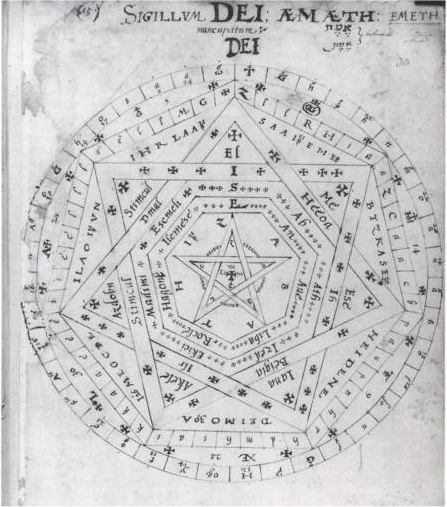 John Dee’s 1582 diagram of the Sigillum Dei Aemeth from Sloane MS 3188. Public domain image via Wikimedia Commons.
What Does “Sigillum Dei Aemeth” Mean?
The Latin phrase Sigillum Dei means “Seal of God.” The added word Aemeth, usually understood as a form of the Hebrew word emeth or emet, means “truth.” The phrase is therefore commonly translated as “Seal of the Truth of God”, “Seal of God’s Truth”, or “Seal of the True God.” Each translation emphasizes a slightly different theological nuance, but all point toward authenticity, divine order, and protection from deception.
This language is important. Dee did not present the seal merely as a personal emblem. He understood it within a Christian cosmology in which true angelic knowledge had to be distinguished from false spirits, illusion, human invention, and demonic fraud. The word “truth” therefore functions as more than a label. It names the central problem of Dee’s angelic project: how can a human being know whether a visionary communication is genuinely divine?
The seal does not solve that problem automatically. A diagram cannot prove the source of a vision. But within Dee’s ritual logic, the Sigillum Dei Aemeth marked the space as ordered under divine names and angelic hierarchies. Its structure acted as a theological map and as a material statement of intention. The seal said, in effect, that the operation was not supposed to be an uncontrolled séance, but a disciplined appeal to a cosmos believed to be governed by God.
The Historical Setting: Mortlake, 1582
The design belongs to the early phase of Dee’s recorded “spiritual actions.” The British Library’s catalogue describes Sloane MS 3188 as a record of his conferences with angels from December 1581 to May 1583. These sessions involved a scryer, a crystal or shew-stone, spoken questions, visionary responses, prayers, diagrams, and Dee’s unusually detailed note-taking. Edward Kelley became the best-known scryer associated with the work, although the history includes other figures and changes in personnel.
The Sigillum Dei Aemeth was developed in March 1582, before the later material that modern readers usually identify most strongly with “Enochian magic,” such as the Great Table, the Watchtowers, and the angelical Calls. This chronology matters. The seal belongs first to Dee’s early angelic and Heptarchic framework. Modern systems often use it for nearly every Enochian operation, but that broad application is a later development rather than a simple repetition of a fully standardized sixteenth-century manual.
According to the manuscript tradition, Dee was directed toward a divine seal connected with books already in his possession, but the available versions were not sufficient. The resulting design was then delivered or corrected through the visionary process. This places the Sigillum at an intersection between older medieval ritual literature and Dee’s own angelic revelations. It is neither wholly invented from nothing nor merely copied unchanged from an earlier grimoire.
That mixed origin is characteristic of Renaissance esotericism. Learned magicians did not necessarily see tradition and revelation as opposites. An ancient text could preserve part of a truth, while angelic communication could restore, correct, or complete it. Dee’s seal emerged from exactly this kind of intellectual environment: biblical theology, Hebrew names, planetary angelology, mathematical proportion, manuscript study, and visionary experimentation.
Was the Seal Completely New?
No. The name Sigillum Dei and related seal traditions existed before Dee. Scholars and occult historians have compared Dee’s diagram with seals found in medieval ritual texts, particularly traditions associated with the Sworn Book of Honorius. The resemblance includes layered circles, divine names, stars, and complex arrangements of letters. Dee therefore worked within an existing family of sacred diagrams.
Yet the differences are just as significant as the similarities. Dee’s version contains a distinctive system of names and letter derivations linked to his angelic records. It is shaped by the repeated number seven and by hierarchies specific to the revelations he recorded. Calling it simply a copy of a medieval seal would erase the transformations that made it uniquely important within Dee’s system.
A more accurate description is that the Sigillum Dei Aemeth is a Renaissance reconstruction of a sacred-seal tradition. It uses inherited forms but reorganizes them into a new angelic grammar. This is one reason it continues to fascinate historians: it demonstrates how early modern occultists could combine scholarship, ritual technology, and claims of revelation in a single object.
The Material Seal: Wax, Table, Stone, and Sacred Space
The manuscript diagram is only one form of the Sigillum. Dee’s ritual instructions called for physical seals made from wax. A larger seal was placed at the center of the Holy Table, beneath the shew-stone or its frame. Smaller versions were associated with the table’s supports. In later descriptions and reconstructions, four smaller seals are placed beneath the four legs, often protected by wooden holders.
This arrangement created a layered ritual architecture:
- the floor or ground beneath the operation;
- four supporting seals associated with the table’s legs;
- the Holy Table as an ordered square structure;
- the principal Sigillum at the center;
- cloths separating and covering sacred objects;
- the shew-stone positioned above the seal;
- the scryer and Dee situated around the table in prayer and observation.
The seal was therefore not merely displayed. It supported the visionary instrument both physically and symbolically. The stone rested above a diagram of divine and angelic names, while the table itself was elevated on smaller versions of the same pattern. The operation was imagined as being held within a network of sacred order.
This physical placement helps explain why attachment images alone may be misleading in modern articles and books. When readers see the Sigillum isolated on a white page, it appears to be an independent talisman. In Dee’s practice it functioned as one component within a larger assemblage. Table, seals, cloths, ring, lamen, candles, prayers, and the human participants all contributed to the meaning of the action.
The Dominance of the Number Seven
The Sigillum Dei Aemeth is saturated with sevenfold structure. It contains heptagons, heptagrams, groups of seven names, and letter sequences organized through sevenfold permutations. This is not decorative numerology added after the fact. The number seven was central to the religious and cosmological imagination of the period.
Seven could evoke:
- the seven days of Creation;
- the seven traditional planets;
- the seven planetary angels or archangels;
- the seven churches and seals of Revelation;
- the sevenfold gifts of the Spirit;
- cycles of time, completion, and sacred governance.
Within Dee’s Heptarchic material, seven also described a hierarchy of angelic kings, princes, and ministers. The Sigillum can therefore be read as a compressed image of divine administration. Its geometry does not show an empty mathematical universe; it shows a universe populated by names, ranks, relations, and delegated powers.
At the same time, the diagram resists a simple “one symbol equals one meaning” approach. The same sevenfold form may carry planetary, biblical, angelic, and mathematical significance at once. Renaissance symbolic systems often worked through accumulation rather than reduction. A heptagon could be meaningful precisely because several traditions converged upon it.
The Outer Circumference
The seal’s outer ring contains letters and characters arranged around the circumference. These are not random ornaments. They participate in a system of names generated through specific reading patterns and transformations. The outer boundary establishes the seal as a closed and differentiated field. Visually, it separates the ordered interior from what lies beyond it.
In ritual symbolism, a boundary can protect, define, and authorize. But it can also function intellectually: it tells the reader that the diagram must be read according to rules. A circular text is not approached in the same way as a normal sentence. Its beginning and end may be ambiguous; direction, counting, and sequence become part of interpretation.
This makes the outer circumference an appropriate threshold for the whole seal. Anyone attempting to understand the design must move from appearance to method. The apparent maze of letters becomes more intelligible only when the derivation systems behind the names are studied.
Heptagons, Heptagrams, and Nested Order
Inside the circumference, the seal layers multiple seven-sided figures and star forms. The eye is drawn inward through a sequence of boundaries. This nested geometry gives the impression of approaching a center through successive orders of meaning.
The heptagram is especially important because it creates movement. Unlike a static polygon, a star connects non-adjacent points and crosses the interior. It turns seven separate positions into a network. In symbolic terms, this can represent communication among planetary or angelic stations, the circulation of divine authority, or the hidden unity connecting distinct powers.
It is tempting to assign one fixed definition to each layer, but the surviving evidence and later reconstructions do not always agree in every detail. A responsible interpretation should distinguish between:
- what is visibly present in Dee’s diagram;
- what can be reconstructed from the instructions in the diaries;
- what later editors and occultists infer from the name-derivation systems;
- what belongs to modern practical or psychological interpretation.
This layered method prevents two opposite errors. The first is treating the seal as meaningless because it is complex. The second is pretending that every line has one universally agreed explanation.
The Divine and Angelic Names
The Sigillum contains numerous names that appear unfamiliar even to readers who know the standard archangels. Some are connected through transformations and permutations of known angelic or divine names. Others belong to hierarchies developed within Dee’s own records. The design therefore acts partly as a name-machine: a way of deriving, arranging, and relating sacred names through number and geometry.
Names in ritual magic are not ordinary labels. They may express office, authority, essence, relationship, or a key to invocation. In Jewish, Christian, and magical traditions, divine names were often treated as powerful because they condensed theological claims. To write a name was to place a specific concept of authority into the ritual field.
For Dee, however, the authority of the names depended on divine legitimacy. He did not understand them as independent forces that a magician could simply manipulate. His prayers repeatedly place the work beneath God. This is one of the most important differences between Dee’s self-understanding and some later popular presentations of Enochian magic as a neutral technology of command.
Truth, Protection, and the Problem of Deception
The phrase “Seal of God’s Truth” suggests that protection from deception was central to the object’s meaning. Visionary work produces a difficult epistemological problem. A scryer may see a luminous figure, hear a majestic voice, or receive an elaborate system. None of these experiences alone proves that the source is truthful.
Dee’s records show repeated anxiety about this issue. Questions of identity, obedience, testing, sin, pride, and spiritual danger recur throughout the diaries. The seal can be interpreted as part of Dee’s answer: establish a space marked by divine names, pray for lawful knowledge, and situate the visionary instrument within a consecrated structure.
Modern readers should not confuse this historical intention with empirical proof. The presence of a sacred diagram does not independently verify a supernatural claim. But the seal remains historically valuable because it reveals the seriousness with which Dee approached the problem. He did not imagine visionary information as automatically reliable.
This concern also makes the Sigillum relevant beyond occult history. It can be read as an emblem of disciplined interpretation. Any intense experience—religious, psychological, artistic, or visionary—requires testing. Beauty, terror, complexity, and certainty can all mislead. The seal’s language of truth reminds readers that discernment is part of spiritual practice, not an obstacle to it.
Relationship to the Holy Table
The Holy Table was itself a complex symbolic object. Its square form, letters, central arrangement, and associated ensigns created a structured platform for angelic work. The Sigillum occupied the center, linking the square table to a circular and sevenfold seal.
This combination of square and circle is symbolically rich. The square can represent manifestation, stability, the ordered world, and the four directions. The circle can represent unity, eternity, divine perfection, or a field without beginning or end. Placing the circular seal at the center of the square table visually joins heaven and earth, unity and multiplicity, center and extension.
The contrast should not be pushed into a rigid universal formula; symbols change across contexts. Yet the physical design clearly invites reflection on mediation. The shew-stone was positioned at the meeting point of these forms. The visionary gaze was therefore directed into an instrument supported by a diagram that joined mathematical order, sacred names, and ritual space.
Is the Sigillum “Enochian”?
The answer depends on how the word is being used. In modern occult vocabulary, “Enochian magic” often includes nearly all the angelic material associated with Dee and Kelley. By that broad definition, the Sigillum is unquestionably Enochian.
Historically, however, Dee did not package all the material into the unified modern system familiar from Golden Dawn and Thelemic books. The Sigillum belongs to an early phase of the actions and is strongly connected with the Heptarchic and Holy Table material. The later elemental tablets, Calls, and Aethyrs developed through additional sessions and different structures.
Therefore, it is accurate to call the seal part of the broader Dee-Kelley angelic corpus, while also noting that its universal use across all later Enochian operations is partly the result of modern synthesis. This is not a criticism of later practitioners. Traditions evolve. It is simply important to name the evolution honestly.
The Golden Dawn and Later Ceremonial Magic
The Hermetic Order of the Golden Dawn played a major role in transforming Dee’s manuscripts into a teachable magical system. Golden Dawn adepts reorganized the tablets, directions, divine names, elemental correspondences, and ritual procedures. Later writers associated with Thelema and independent Enochian practice continued this process.
Within these systems, the Sigillum often became a general emblem of Enochian authority. It appeared on altars, beneath crystals, in temple diagrams, and in printed manuals. Some practitioners reproduced the full wax arrangement; others used paper, wood, metal, or digital images. Still others treated the seal primarily as a contemplative symbol.
These adaptations demonstrate the diagram’s extraordinary visual strength. But they also create historical confusion. A modern altar arrangement may be spiritually meaningful to its user without being an exact reconstruction of Dee’s room at Mortlake. Responsible writing should respect living practice while keeping source history clear.
Psychological and Symbolic Readings
A psychological reading does not require dismissing the religious meaning of the seal. It asks how the image organizes attention. The multiple circles encourage concentration; the nested geometry draws the eye inward; the unfamiliar names interrupt ordinary language; the repeated sevenfold patterns create rhythm and expectation.
From this perspective, the seal functions as a cognitive architecture. It narrows attention while presenting a field too complex to grasp instantly. The mind alternates between detail and totality, control and mystery. This can make the diagram especially effective in meditation or imaginative work.
A symbolic reading may also understand the seal as a model of integrated authority. The outer boundary, planetary orders, angelic names, and central forms suggest that spiritual power is not chaotic. It is arranged through relationship and hierarchy. Whether one interprets those hierarchies metaphysically or psychologically, the diagram opposes fragmentation.
Yet modern readers should be cautious with claims that simply looking at the seal will produce guaranteed effects. No historical source or scientific evidence justifies promises of automatic wealth, protection, visions, or supernatural power. The value of the Sigillum lies in its history, symbolic density, and role within a larger discipline—not in marketing claims.
Common Misconceptions
“It is just an Enochian pentacle.”
The seal is far more specific than a generic pentacle. It belongs to Dee’s early angelic actions, contains a complex sevenfold hierarchy, and functioned materially beneath the shew-stone and Holy Table.
“Dee invented it entirely from nothing.”
The design has precedents in medieval sacred-seal traditions. Dee’s version is distinctive, but it emerged through engagement with earlier texts as well as claimed angelic correction.
“Every symbol has one agreed meaning.”
Some structures and derivations can be reconstructed with confidence; others remain debated. Later occult systems add additional layers of interpretation.
“Owning a printed seal reproduces Dee’s practice.”
A print may be useful for study or devotion, but Dee’s recorded work involved a larger ritual environment, specific prayers, physical objects, a scryer, and an evolving body of instructions.
“The British Museum objects are unquestionably Dee’s originals.”
Objects traditionally associated with Dee are historically important, but modern scholarship has raised careful questions about provenance. Similarity to manuscript descriptions is significant; absolute ownership claims require caution.
How to Study the Seal Responsibly
A serious study begins with sources rather than social-media diagrams. Compare the Sloane MS 3188 image with transcriptions of the early spirit diaries. Examine how the names are derived and where editors disagree. Study the seal alongside the Holy Table rather than in isolation. Note the difference between manuscript evidence, museum objects, nineteenth-century occult revival, Golden Dawn synthesis, and contemporary reconstruction.
It is also useful to keep three notebooks or columns:
- Documented source: what Dee’s manuscript, a catalogue, or a physical object actually shows.
- Traditional interpretation: how later magicians explain the feature.
- Personal reflection: what the image suggests to the modern reader.
This method protects personal insight without confusing it with history. It also strengthens the quality of occult writing. Readers gain more value from an honest account of evidence and uncertainty than from invented certainty.
Frequently Asked Questions
What is the simplest definition of the Sigillum Dei Aemeth?
It is a complex sevenfold sacred seal recorded by John Dee in 1582 and used beneath the shew-stone within his angelic ritual environment.
What does “Aemeth” mean?
It is generally connected with the Hebrew word for truth, giving the title the sense “Seal of God’s Truth” or “Seal of the True God.”
Was it used to summon demons?
Dee understood his work as Christian angelic communication under divine authority. Later traditions interpret and use the seal differently. Sensational labels such as “demon-summoning seal” distort the historical context.
Why are there so many sevens?
Seven connected biblical Creation, the traditional planets, planetary angels, apocalyptic imagery, and Dee’s Heptarchic hierarchy. The number provides the seal’s main organizing principle.
Did the crystal sit directly on the seal?
The principal seal was positioned beneath the shew-stone or its frame, with cloth and other elements used in the arrangement described in the records and later summaries.
Can the seal be used as a featured image or illustration legally?
The 1582 manuscript diagram used in this article is in the public domain. The specific Wikimedia Commons file is identified as free of known copyright restrictions. Modern redrawn versions may have separate copyrights, so their licenses should be checked individually.
Is the seal scientifically proven to have supernatural effects?
No. It is a historically significant ritual and symbolic object. Claims of guaranteed supernatural effects are matters of belief, not established scientific fact.
Conclusion
The Sigillum Dei Aemeth is best understood neither as a decorative occult symbol nor as an automatic machine of power. It is a compact record of John Dee’s religious and intellectual world: Christian prayer, Hebrew truth, planetary angelology, sacred mathematics, manuscript learning, material ritual, and the difficult search for trustworthy revelation.
Its nested circles and sevenfold stars draw the eye inward, but its history pushes the reader outward—toward medieval sources, Renaissance scholarship, museum provenance, Golden Dawn reconstruction, and modern symbolic interpretation. The seal’s enduring value lies in this combination of precision and mystery. It is mathematically ordered but not easily exhausted; historically documented but surrounded by disputed objects and later legends; created for angelic truth yet permanently tied to the human problem of discernment.
Studied responsibly, the Sigillum Dei Aemeth becomes more than an emblem of Enochian magic. It becomes a case study in how sacred images are made, transmitted, reinterpreted, and used to organize the boundary between knowledge and vision.
Sources and Further Reading
- British Library Archives and Manuscripts Catalogue: Sloane MS 3188, John Dee’s conferences with angels
- Wikimedia Commons: John Dee’s 1582 Sigillum Dei Aemeth diagram and public-domain status
- The John Dee Publication Project: reconstructions of the early spirit diaries
- Silke Ackermann and Louise Devoy, “The Lord of the Smoking Mirror”: objects associated with John Dee
- John Dee’s Holy Table and Lamen: source-based reconstruction and manuscript references
Editorial note: This article is a historical and symbolic study. It does not present visionary claims as scientific facts, offer supernatural guarantees, or replace medical, legal, financial, or mental-health advice.


