


SEO Title: Sixth and Seventh Books of Moses: History, Seals, Hoodoo, and Pennsylvania Dutch Magic
Meta Description: Explore the real history of the Sixth and Seventh Books of Moses: its German print origins, Johann Scheible, magical seals, pseudepigraphic Moses traditions, Pennsylvania Dutch powwowing, African American hoodoo, Caribbean circulation, and modern misconceptions.
Suggested Permalink: sixth-seventh-books-moses-history
Primary Category: Grimoires and Manuscripts
Tags: Sixth and Seventh Books of Moses, Grimoires, Folk Magic, Hoodoo, Pennsylvania Dutch, Moses
Primary Keyword: Sixth and Seventh Books of Moses
The Sixth and Seventh Books of Moses: How a German Grimoire Crossed the Atlantic and Entered American Folk Magic
 Title page of the 1880 English edition of The Sixth and Seventh Books of Moses, translated from the German publishing tradition associated with Johann Scheible. Public domain via Wikimedia Commons.
Introduction: A “Lost Book of Moses” That Was Never Lost from the Bible
The Sixth and Seventh Books of Moses is one of the most revealing examples of how a magical book can invent an ancient past, acquire new meanings through print, and then cross religious, ethnic, and geographic boundaries far beyond the world in which it was first assembled. Its title claims access to hidden books of Moses supposedly omitted from the familiar Pentateuch. Its pages promise sacred names, seals, spirit conjurations, protective formulas, healing, and explanations for the miracles attributed to Moses and Aaron. Yet historians do not treat it as an ancient Hebrew scripture.
The work known under this title took recognizable printed form in German-speaking Europe, especially through Johann Scheible’s influential 1849 publication. It drew together earlier magical, Christian, Jewish, pseudo-Jewish, Kabbalistic, and grimoire materials into a composite book that advertised itself as the secret magical inheritance of Moses. From German print culture it moved into the United States, where English and German editions circulated among Pennsylvania Dutch communities, occult publishers, African American practitioners of hoodoo and conjure, and readers across the Caribbean and Atlantic world.
That movement is more historically important than the book’s claim to antiquity. A grimoire assembled in nineteenth-century print culture could become traditional in communities that did not share the same language, theology, or social history as its first publishers. The book’s seals could be copied into private notebooks, its authority could be reinterpreted through the Bible, and its name could become shorthand for dangerous or powerful magical knowledge.
This article separates documented textual history from religious and supernatural claims. The book asserts that sacred names and seals can compel spirits, protect their users, heal, reveal hidden things, or produce other effects. Those claims are historically significant, but they are not scientifically established facts. What can be documented is the book’s publication history, its composite sources, its changing readerships, and its remarkable ability to become meaningful in several very different traditions.
What Are the Sixth and Seventh Books of Moses?
The Sixth and Seventh Books of Moses is a grimoire: a book of ritual formulas, seals, sacred names, prayers, conjurations, and magical instructions. It claims to preserve secret teachings attributed to Moses that explain or extend the miraculous powers described in the biblical Exodus narrative.
The title deliberately continues the sequence of the five books traditionally attributed to Moses—Genesis, Exodus, Leviticus, Numbers, and Deuteronomy. By calling itself the sixth and seventh books, the grimoire presents its material as a hidden continuation of scriptural revelation.
Historically, that claim is pseudepigraphic. Pseudepigraphy means attribution to an authoritative figure who did not actually write the surviving work. Ancient and medieval religious literature contains many such attributions to Adam, Enoch, Solomon, Moses, Ezra, Hermes, and other sages. The practice does not automatically imply modern-style fraud; sacred authority was often constructed through legendary authorship. In the case of the Sixth and Seventh Books, however, the surviving printed tradition is much later than the biblical period.
The Library of Congress preserves a 1910 Chicago edition published under L. W. de Laurence’s editorship. Its bibliographic record identifies it as an occult book, not a biblical manuscript, and the volume’s contents openly combine material from multiple eras and sources.
Why Moses Became a Magical Authority
Moses had been associated with extraordinary power long before the nineteenth-century grimoire appeared. The biblical Exodus narrative presents him confronting Egyptian magicians, turning a staff into a serpent, bringing plagues, parting the sea, receiving revelation on Sinai, and speaking with God in ways unavailable to ordinary people.
Late antique magical and religious texts developed these associations further. In Greco-Egyptian magical literature, the name of Moses could function as a mark of powerful antiquity. Jewish magical traditions also attributed secret names, angelic knowledge, and ritual powers to Moses.
SecretMagic’s article on The Sword of Moses examines a much earlier Jewish magical work whose “sword” is a chain of sacred names rather than a metal weapon. That text is historically distinct from the Sixth and Seventh Books, but comparison shows why Moses became such a persuasive figure for magical authorship.
Moses represented revelation, law, confrontation with foreign magicians, mastery over miraculous signs, and direct contact with divine authority. A grimoire claiming Mosaic origin therefore borrowed one of the strongest possible religious credentials available in Christian and Jewish culture.
The Book Is Not an Ancient Jewish Scripture
One of the most persistent misconceptions is that the Sixth and Seventh Books of Moses were removed from the Bible by church authorities and then secretly preserved.
No evidence supports that story. The work does not appear among the ancient biblical manuscript traditions, Jewish canon lists, Dead Sea Scrolls, ancient translations of the Torah, or early Christian biblical codices as a lost sixth and seventh Mosaic book.
The surviving textual history points instead to early modern and modern European magical print culture. Versions and components circulated before the famous 1849 edition, but the recognizable composite book belongs to a much later environment.
This distinction does not make the grimoire culturally unimportant. On the contrary, understanding its real history reveals a more interesting phenomenon: modern print culture could create new “ancient” scriptures that readers then adopted into living religious practice.
Johann Scheible and the 1849 Breakthrough
The name Johann Scheible is central to the modern history of the book. Scheible was a German antiquarian bookseller and publisher associated with the massive collection Das Kloster, which brought together folklore, magic, Faustian literature, occult texts, legends, and historical curiosities.
In 1849, a version of the Sixth and Seventh Books of Moses appeared in this publishing environment. Scheible’s edition was not simply the recovery of one ancient manuscript. It was a compilation.
Later bibliographic descriptions and modern editorial research show that the printed volume assembled several texts under the Mosaic title. This included magical seals, conjurations, discussions of “Israelite magic,” collections of sacred names, material connected with the magical use of Psalms, and other pieces drawn from earlier occult and religious literature.
The act of compilation was decisive. Once bound under one title, heterogeneous pieces began to appear as parts of one secret Mosaic tradition. Print created coherence where manuscript history had been more fragmented.
A Composite Grimoire Rather Than a Single Original Text
The composite character of the book is one of its most important features.
Modern readers often assume that a famous grimoire must have one author and one original edition. In reality, magical books frequently grow by accumulation. A printer adds a treatise. A translator changes a heading. An editor inserts an older essay. A publisher adds new seals or rearranges sections. Later readers then inherit the expanded object as though it were ancient unity.
The Sixth and Seventh Books exemplifies this process. HathiTrust’s bibliographic record notes that part of the English text called “The Magic of the Israelites” derives from Joseph Ennemoser’s nineteenth-century Geschichte der Magie. Other material comes from earlier traditions of Psalm magic and European ceremonial magic.
This means the book is best studied as a textual assemblage. Its importance lies not in recovering a mythical single autograph by Moses, but in tracing how different magical traditions were packaged together and made portable through print.
The Sixth Book: Reimagining the Miracles of Exodus
The sections labeled the Sixth Book transform biblical miracles into ritualized magical operations. The burning bush, the staff becoming a serpent, water turning to blood, plagues, and other signs from Exodus are re-presented as if they belonged to a hidden technical tradition.
This is a striking change in genre. In the biblical narrative, the miracles demonstrate divine authority within a story of liberation and covenant. In the grimoire, the same episodes become evidence that Moses possessed specialized magical knowledge.
The book therefore reframes scripture. It does not reject the Bible; it reads the Bible esoterically. Miracles become clues to secret arts.
This method is common in Western esotericism. A canonical text remains sacred while hidden explanations are added behind it. The visible scripture is treated as the outer narrative; the grimoire claims access to the inner mechanism.
The Seventh Book: Spirits, Names, and Ritual Authority
The Seventh Book extends the same logic into spirit conjuration and sacred names. It contains formulas framed as Mosaic or biblical in authority, including citations, dismissals, names, and symbolic characters.
The language can move rapidly between Christian, Jewish, biblical, magical, and pseudo-Hebrew elements. To a modern philologist, some words may appear corrupt, invented, or transmitted through multiple languages. To a practitioner, obscurity itself could signal antiquity and power.
The book’s supernatural claims should be read historically. When a text says a particular name compels a spirit, that statement documents the ritual theory of the grimoire. It does not establish that the spirit exists or that the formula produces the claimed effect.
What is historically demonstrable is that special names and graphic characters became central to the book’s identity and later reception.
The Power of Seals
Visual seals are among the most memorable features of the Sixth and Seventh Books. Circular designs combine names, characters, letter-like forms, crosses, directional labels, and graphic arrangements.
Their visual authority matters. A reader who cannot understand every word can still recognize that the page is presenting specialized sacred technology.
Seals perform several functions at once. They make invisible spiritual hierarchies visible. They distinguish the grimoire from ordinary devotional literature. They create objects that can be copied, carried, redrawn, or incorporated into amulets.
Because printed seals are easy to reproduce, they also travel extremely well. A complex theological argument may be forgotten, while a diagram survives in a notebook, charm, or later book.
The reproducibility of images was therefore one reason the grimoire could cross cultural boundaries so effectively.
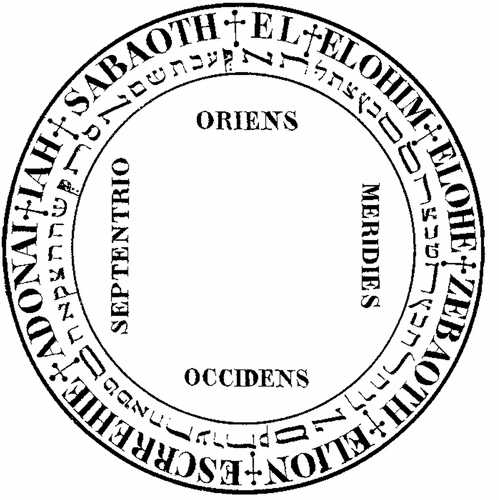 The “Fourth Seal” in the 1880 edition, a circular ritual design associated in the book with ministering Cherubim and Seraphim. Public domain via Wikimedia Commons.
What the “Hebrew” in the Book Actually Is
The book repeatedly claims Hebrew, Kabbalistic, Talmudic, or Israelite authority. Yet these claims should not be accepted at face value.
Some elements do derive ultimately from Jewish traditions: divine names, Psalm practices, Hebrew letters, biblical narratives, and older magical materials circulated extensively through Christian Kabbalah and European grimoires.
Other forms are corrupt, pseudo-Hebrew, or reorganized through Christian occult transmission. The result is not a reliable handbook of classical rabbinic Judaism or historical Kabbalah.
This distinction is especially important because nineteenth-century publishers often used “Hebrew,” “Talmud,” and “Kabbalah” as markers of ancient secrecy. The words could sell a book even when the content had only partial relationship to authentic Jewish textual traditions.
Readers who want historically grounded context should compare the grimoire with SecretMagic’s study of The Sword of Moses and with older Jewish esoteric traditions rather than assuming that every Hebrew-looking character in a European grimoire is genuinely ancient.
Kabbalah, Cabala, and the Problem of Borrowed Authority
The word Kabbalah has several historical meanings. Jewish Kabbalah developed as a complex mystical tradition with major medieval centers and distinctive doctrines concerning the sefirot, creation, divine names, scripture, and spiritual interpretation.
Christian Cabala emerged when Renaissance Christian scholars adapted Jewish Kabbalistic material into Christian theological systems. Later occult Kabbalah developed again through magical and esoteric synthesis.
The Sixth and Seventh Books belongs to this long history of borrowing and transformation. It uses the cultural authority of “Cabala” without representing the full intellectual world of Jewish Kabbalah.
This is not unique. European occult publishing repeatedly treated Kabbalah as a reservoir of divine names, letter mysteries, numerical symbolism, and ancient secret knowledge.
The historian’s task is therefore not to ask whether the book is “really Kabbalah” in a yes-or-no sense, but to identify which Kabbalistic ideas, pseudo-Kabbalistic claims, and Christian occult adaptations appear in each layer.
Semiphoras and the Prestige of Secret Divine Names
The book includes material associated with Semiphoras and related traditions of secret divine names. The terminology reflects the long afterlife of the Hebrew concept of the divine Name and of the Shem ha-Mephorash in Christian and magical literature.
In Jewish textual history, divine names were treated with extraordinary reverence and surrounded by legal, liturgical, mystical, and magical traditions. European occultists expanded and rearranged these materials in many directions.
By the time of nineteenth-century grimoire publishing, “Semiphoras” could function as a label for collections of powerful names attributed to biblical patriarchs.
The Sixth and Seventh Books uses this prestige to reinforce its central claim: Moses possessed not merely faith but secret verbal knowledge capable of producing extraordinary effects.
The Magical Use of Psalms
Another important layer concerns the magical or practical use of biblical Psalms.
Across Jewish, Christian, and folk-magical traditions, Psalms have been recited for protection, healing, justice, travel, safety, reconciliation, and other needs. Such practices can function simultaneously as prayer and magic depending on the categories used by the practitioner or observer.
The grimoire’s Psalm material connects it with a broader devotional culture. This helps explain why it could move into strongly Christian communities without being experienced simply as anti-Christian sorcery.
A Bible verse could be understood as powerful because it was scripture. The line between prayer, charm, blessing, and magical formula was not always clear in lived religion.
From Germany to the United States
The Atlantic history of the book accelerated through migration and print.
German-speaking immigrants had already carried rich traditions of charm books, devotional manuals, folk medicine, astrology, and magical practice to North America. The Sixth and Seventh Books entered a cultural environment prepared to treat printed religious formulas as practical tools.
German-language editions circulated before English translations made the book accessible to a wider public. The 1880 English edition helped establish the title in the United States, and later occult publishers expanded its reach.
The Library of Congress preserves a 1910 Chicago edition associated with the publisher L. W. de Laurence, demonstrating how the book had moved from European compilation into American commercial occult publishing.
Pennsylvania Dutch Powwowing and Braucherei
The Pennsylvania Dutch tradition known as powwowing, Brauche, or Braucherei provides one of the best documented American contexts for the grimoire.
Penn State University Press describes powwowing as a religious folk-healing practice rooted in Pennsylvania German culture. Practitioners could understand their ability as a gift from God, while critics sometimes accused them of witchcraft or diabolical magic.
David W. Kriebel’s fieldwork documents the importance of charm books in this environment. The Long Lost Friend, first published in Pennsylvania in the early nineteenth century, became one of the best-known practical books. Kriebel also notes the use of the Sixth and Seventh Books of Moses among powwowers.
Yet the Mosaic grimoire carried a darker reputation. Some Pennsylvania Dutch people regarded it as a “hex book,” particularly because of its spirit-conjuring material. Ownership itself could be denied or kept secret.
This reputation is historically revealing. The same book could be viewed as sacred knowledge by one reader and dangerous magic by another within the same religious culture.
The Long Lost Friend and the Everyday Side of Folk Magic
Johann Georg Hohman’s Long Lost Friend helps explain the environment into which the Sixth and Seventh Books entered.
Hohman’s book emphasizes practical healing, household protection, remedies, charms, and Christian formulas. It belongs to a world in which scripture, spoken words, domestic medicine, and inherited practice overlapped.
Compared with that familiar charm-book tradition, the Sixth and Seventh Books could appear more advanced, secretive, or dangerous because of its elaborate seals and conjurations.
This contrast created a hierarchy of magical books. Some were considered acceptable household help; others were feared as books one should not own casually.
That social reputation sometimes mattered more than the actual frequency with which every ritual was performed.
Why a Book Could Be Feared Without Being Widely Practiced
A magical book can acquire power through reputation even when few people perform its most complicated operations.
Stories about dangerous books are common in European and American folklore. A grimoire may be said to resist burning, attract spirits, drive readers mad, or bring misfortune to a household. Such narratives turn the physical book into a charged object.
The Sixth and Seventh Books accumulated similar associations. People could believe that merely owning it indicated involvement with forbidden powers.
Folklore should not be confused with physical evidence. There is no scientific proof that a printed book attracts supernatural beings. But fear itself has social consequences: books are hidden, inherited secretly, destroyed, or discussed in whispers.
The book’s history therefore includes not only what was printed on its pages but what communities believed possession of those pages meant.
African American Hoodoo and the Adoption of European Grimoires
One of the most important chapters in the book’s afterlife is its adoption within African American hoodoo and conjure traditions.
Hoodoo developed through the experiences of enslaved and free African Americans, drawing deeply on West and Central African religious and medicinal inheritances while also incorporating biblical Christianity, Native American botanical knowledge, European folk practices, and new materials available in American life.
Cheap occult print became one such material. By the late nineteenth and early twentieth centuries, mail-order catalogues and urban occult suppliers circulated books, oils, powders, candles, seals, and instructions to African American customers.
The Sixth and Seventh Books of Moses carried obvious appeal. Moses was already an immensely powerful biblical figure in African American Christianity: liberator from slavery, miracle worker, lawgiver, and leader chosen by God.
A grimoire claiming to reveal Moses’s secret power could therefore enter hoodoo without requiring practitioners to accept the cultural assumptions of its German publishers.
Moses in African American Religious Imagination
The importance of Moses in African American culture cannot be reduced to occultism.
The Exodus story became one of the central biblical narratives through which enslaved people and their descendants interpreted bondage, liberation, divine justice, and promised freedom. “Pharaoh” could become a symbol of oppressive power; crossing the Red Sea could signify deliverance.
When the Sixth and Seventh Books entered African American magical practice, it encountered an already powerful Moses tradition.
This helps explain why cultural transfer was possible. Practitioners did not simply import a German grimoire unchanged. They could reinterpret it through an African American biblical worldview.
The book’s authority therefore changed as it moved. Print remained the same, but cultural meaning did not.
Hoodoo Is Not the Same Thing as the Book
It is equally important not to reverse the relationship and define hoodoo by the Sixth and Seventh Books.
African American conjure existed through oral tradition, herbal practice, protective objects, spirit beliefs, divination, root work, prayer, and community knowledge long before mass-market occult publishers made this book widely available.
The grimoire became one tool among many.
Scholars of African American religion repeatedly emphasize adaptation rather than passive borrowing. Practitioners selected useful elements and placed them inside existing systems of meaning.
Calling hoodoo “European magic from the Sixth and Seventh Books of Moses” would therefore erase African American creativity and the deep African roots of conjure.
L. W. de Laurence and the Mail-Order Occult Economy
Lauron William de Laurence was one of the most important—and controversial—figures in early twentieth-century occult publishing.
Based in Chicago, de Laurence republished and repackaged a large body of magical, hypnotic, spiritualist, astrological, and esoteric literature. His catalogues helped distribute occult texts far beyond specialist bookshops.
The 1910 edition of the Sixth and Seventh Books of Moses preserved by the Library of Congress belongs to this commercial world.
De Laurence’s business model mattered because a grimoire no longer needed to move only through initiatory transmission or local booksellers. Mail-order distribution could carry it to rural readers, migrants, Caribbean customers, and people excluded from elite libraries.
The technology of modern commerce became part of the transmission of “ancient” magic.
The Caribbean Afterlife of the Book
The book also circulated through the Caribbean, where colonial law, African diasporic religions, Christianity, Indian religious traditions, and occult publishing interacted in complicated ways.
Alexander Rocklin’s study of colonial Trinidad shows that the Sixth and Seventh Books of Moses belonged to the broader world of occult manuals that could be associated by colonial authorities with “obeah” or illicit ritual practice.
The legal category of obeah was itself unstable and politically charged. Colonial governments frequently labeled diverse healing and spirit practices as criminal superstition.
A European-derived grimoire appearing in such cases demonstrates how misleading racialized categories could be. What colonial officials called primitive African superstition could involve mass-produced European books, biblical language, Indian practitioners, Christian prayer, and global commercial networks.
Magic in the colonial Caribbean was modern and transnational, not a sealed survival from an imagined tribal past.
From the Caribbean to West Africa
European and American occult books also traveled to West Africa through colonial trade, missionaries, returning migrants, merchants, sailors, and mail-order networks.
The Sixth and Seventh Books of Moses became known in several African settings, where its biblical framing and seals could be incorporated into existing Christian, Islamic, and indigenous ritual worlds.
The process should not be described as the book “returning to Africa” as though its magical content were originally African. The printed grimoire was European-American in formation.
What returned across the Atlantic was a book that had already been transformed by African diasporic readers.
This circular movement is one of the most fascinating features of modern esoteric history: traditions do not travel in one direction. They loop, hybridize, and acquire new authority in each setting.
Print Culture Changed What a Grimoire Could Be
Before cheap printing, ritual books were relatively difficult to obtain. Manuscripts required hand copying, literacy, access to exemplars, and substantial time.
Nineteenth-century industrial printing changed that ecology.
A grimoire could be standardized, illustrated, advertised, translated, mailed, pirated, excerpted, and sold cheaply. The magical book became a commodity.
This did not necessarily make it less sacred. Commercial availability and ritual authority can coexist. A reader could buy a mass-produced book and still regard its contents as divinely powerful.
The Sixth and Seventh Books is therefore not a degraded remnant of manuscript magic. It is a distinctly modern magical object created by the possibilities of print capitalism.
Why the Strange Lettering Looks So Powerful
Many seals and plates contain distorted Hebrew, pseudo-Hebrew characters, crosses, invented signs, and Latin letters.
To a trained reader of Hebrew, some forms may look corrupt. To a nineteenth-century occult reader, illegibility could increase authority.
Esoteric writing often gains power through resistance to ordinary reading. A familiar sentence can be dismissed as prose; an unknown script appears to require initiation.
The visual rhetoric of the grimoire therefore depends partly on obscurity. Ancient-looking characters suggest that the reader is seeing a language hidden from ordinary society.
This does not prove that publishers intentionally fabricated every form. Copying errors accumulate naturally when printers reproduce unfamiliar scripts. Over generations, corruption itself can become tradition.
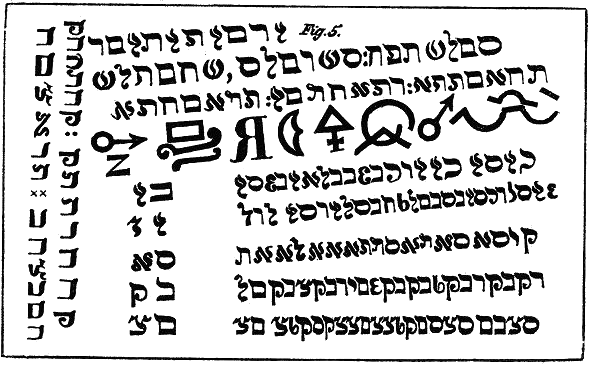 Plate 19 from the 1880 English edition, showing the mixture of Hebrew-like, Latin, and occult characters typical of the grimoire’s visual language. Public domain via Wikimedia Commons.
The Fourth Seal and the Language of Cosmic Order
One well-known plate from the 1880 edition presents the Fourth Seal associated with ministering Cherubim and Seraphim. Its circular structure includes directional terms and sacred names.
The design is a useful example of how the book creates authority visually. Directions organize sacred space. Names surround the center. The reader encounters a bounded cosmos in which spiritual beings appear to occupy intelligible positions.
The seal does not need to represent historical Jewish angelology accurately in order to function within the grimoire.
Its purpose is ritual and symbolic: to make hierarchy visible.
Whether such a seal can compel or contact supernatural beings is an unverified religious claim. Its historical power as an image, however, is undeniable.
The Book and the Key of Solomon Tradition
The Sixth and Seventh Books belongs to a broader European world in which Solomonic magic was already influential.
Grimoires attributed to Solomon used divine names, circles, seals, ritual purity, prayers, and spirit hierarchies. Moses and Solomon were complementary authorities: Moses represented primordial revelation and miracle; Solomon represented wisdom and command over spirits.
Later publishers freely combined motifs from different traditions.
Readers should therefore avoid imagining separate, perfectly sealed “Mosaic” and “Solomonic” schools. Printed occultism was eclectic. Material moved among books.
The book’s identity comes less from doctrinal purity than from its ability to present many older techniques as one Mosaic secret tradition.
The Book and Authentic Jewish Magic
The relationship to Jewish magic is real but indirect.
Jewish magical texts from late antiquity and the medieval period contain angels, divine names, adjurations, amulets, biblical verses, and ritual instructions. SecretMagic’s article on The Sword of Moses shows that powerful name traditions associated with Moses genuinely existed many centuries before Scheible.
But similarity does not prove direct textual descent.
The nineteenth-century grimoire passed through Christian European occult culture, where Jewish materials were translated, transformed, misunderstood, and combined with non-Jewish sources.
The most accurate statement is therefore that the book participates in the long Christian reception and adaptation of Jewish magical authority, rather than preserving a pure hidden Jewish scripture.
What Practitioners Believed the Seals Could Do
Different editions attribute varied purposes to seals and formulas: protection, fortune, healing, obedience, spirit contact, treasure, knowledge, and other goals.
These attributions are historically important because they show what readers wanted from practical magic.
They also reveal a world in which religion was expected to have material consequences. Protection from enemies, recovery from illness, success in legal matters, financial security, and family safety were not separate from spirituality.
Modern historians should neither ridicule these concerns nor repeat the book’s supernatural promises as fact.
The practical goals are human. The claimed mechanisms remain unverified.
Common Misconception: The Book Was Written by the Biblical Moses
There is no credible historical evidence that Moses authored this grimoire.
The book’s surviving textual and publication history belongs to Europe many centuries later. Its Mosaic authorship is pseudepigraphic.
This does not mean every reader who used it was foolish. Sacred pseudepigraphy has a long history, and users often judged a text by perceived spiritual efficacy rather than modern authorship standards.
Common Misconception: It Was Removed from the Bible
There is no manuscript evidence that these texts were once canonical sixth and seventh books of the Torah and later removed.
Ancient Jewish and Christian biblical traditions do not preserve them as lost Mosaic scripture.
The title is an occult publishing strategy built on the familiar five books of Moses.
Common Misconception: It Is Purely Jewish Kabbalah
The book borrows Jewish names, biblical authority, Hebrew forms, and Kabbalistic prestige, but its composite printed text belongs largely to Christian European occult culture.
Calling it an authentic manual of rabbinic Kabbalah misrepresents both the grimoire and Jewish mystical history.
Common Misconception: It Created Hoodoo
Hoodoo did not originate from this book.
African American conjure developed from African diasporic knowledge, biblical Christianity, local healing, rootwork, and other sources. The Sixth and Seventh Books was adopted later as one useful and prestigious printed resource.
Its influence is significant precisely because hoodoo practitioners transformed it rather than being created by it.
Common Misconception: Every Seal Has One Fixed Universal Meaning
Different editions, translations, publishers, and later occult manuals can assign different interpretations or uses to visual material.
A seal copied from an 1880 edition may appear differently in a twentieth-century booklet.
Source criticism matters. Readers should identify the edition and page rather than relying on unattributed images circulating online.
A Symbolic Reading of the Hidden Books
The title itself has lasting symbolic power.
A “sixth” and “seventh” book implies that official knowledge is incomplete. Behind public scripture lies another layer containing the mechanism of miracle.
This idea appears throughout esoteric culture: visible religion teaches law and story, while secret tradition claims technique.
As a symbolic reading, the grimoire represents the desire to move from believing a sacred story to possessing its hidden key.
That interpretation helps explain the book’s appeal without asserting that the hidden Mosaic books actually existed in antiquity.
A Symbolic Reading of the Seal
A seal turns language into space.
Names that would normally appear in a line are arranged into circles, directions, borders, and centers. The reader no longer only reads sacred words; the reader enters a diagram of order.
Symbolically, this transforms uncertainty into structure. Invisible powers receive boundaries. Directions become meaningful. The center becomes protected.
That psychological and philosophical reading does not replace the historical ritual claim. Practitioners could believe the seal possessed objective supernatural efficacy.
Both levels can be described without confusing them.
Why the Book Matters to the History of Esotericism
The Sixth and Seventh Books of Moses matters because it challenges several simplistic histories at once.
It is not ancient, yet it became traditional.
It is European in printed formation, yet it became important in African American and Caribbean magical cultures.
It uses Jewish authority, yet it is not a straightforward Jewish Kabbalistic text.
It is mass-produced, yet readers could treat it as sacred and dangerous.
It demonstrates that esotericism is not only the history of secret societies and rare manuscripts. It is also the history of inexpensive books, migration, religious improvisation, translation, commerce, race, and everyday attempts to gain protection or agency.
How to Study the Book Responsibly
Start with dated editions rather than anonymous online PDFs. The Library of Congress copy of the 1910 de Laurence edition provides a stable primary source. The 1880 English translation preserved in major digital collections makes it possible to compare earlier American print.
Then study the German publishing context and Johann Scheible’s role. Bibliographic records from HathiTrust and modern editorial work help identify the composite nature of the text.
For American reception, use scholarship on Pennsylvania Dutch powwowing, African American conjure, colonial Caribbean religion, and occult publishing.
Finally, separate the book’s claims from historical evidence. A seal can be documented as printed in 1880. Its use in a community can be documented through interviews or archives. A supernatural effect attributed to the seal belongs to belief or testimony unless independently demonstrated.
Frequently Asked Questions
When was the Sixth and Seventh Books of Moses written?
The recognizable work belongs to eighteenth- and nineteenth-century European magical print traditions, with Johann Scheible’s 1849 German publication becoming especially influential. It is not an ancient Mosaic manuscript.
Did Moses really write the Sixth and Seventh Books?
No historical evidence supports authorship by the biblical Moses. The attribution is pseudepigraphic.
Were the books removed from the Bible?
No. Ancient biblical manuscript traditions do not preserve these texts as lost canonical books of the Torah.
Why does the book use Hebrew and Kabbalistic language?
European occult traditions borrowed extensively from Jewish divine-name traditions, Christian Cabala, biblical material, and pseudo-Hebrew magical writing. Some material has genuine Jewish ancestry, while other elements are transformed or corrupt.
What are the seals in the book?
They are ritual diagrams combining names, characters, directions, and symbolic forms. The book attributes supernatural functions to them, but those claims are not scientifically established.
Was the book used by Pennsylvania Dutch powwowers?
Yes. Scholarly work on Braucherei documents its use, although the book also carried a reputation as a dangerous “hex book.”
Was it used in African American hoodoo?
Yes. The book became one of several mass-market occult texts adopted by some hoodoo and conjure practitioners, especially in the late nineteenth and twentieth centuries.
Did the book create hoodoo?
No. Hoodoo has much deeper African American and African diasporic roots. The grimoire was a later addition to an existing tradition.
Is the Sixth and Seventh Books of Moses the same as the Sword of Moses?
No. The Sword of Moses is a much earlier Jewish magical text. The nineteenth-century Sixth and Seventh Books is historically distinct.
Do the seals actually summon spirits?
The grimoire claims ritual efficacy, and practitioners may report personal experiences. There is no established scientific evidence that the printed seals objectively summon supernatural beings.
Conclusion: The Real Mystery Is How the Book Traveled
The most interesting mystery of the Sixth and Seventh Books of Moses is not whether church authorities concealed two biblical books for thousands of years. The historical evidence points elsewhere.
The real mystery is cultural mobility.
A nineteenth-century German occult compilation presented itself as the secret magical continuation of Moses’s scripture. Print transformed a collection of diverse materials into a portable grimoire. English translation widened its audience. American occult publishers turned it into a mail-order commodity. Pennsylvania Dutch readers placed it beside Christian charm traditions. African American practitioners encountered a Moses already charged with the theology of liberation and reinterpreted the book through hoodoo and conjure. Caribbean readers encountered it in religious environments shaped by colonial law, Christianity, African diaspora traditions, and global commerce.
Each movement changed the book.
Its strange seals survived because images travel easily. Its Mosaic title survived because biblical authority traveled even more easily. Its claims of Hebrew and Kabbalistic antiquity gave it a prestige that exceeded the accuracy of its textual history.
The book therefore reveals something fundamental about esotericism: traditions are not preserved only by faithful repetition. They survive through creative misunderstanding, selective borrowing, translation, commerce, fear, devotion, and reinvention.
A seal printed in New York in 1880 could be treated as ancient. A German grimoire could become meaningful within African American Christianity. A mass-market book could be hidden in a household because neighbors believed it dangerous.
None of those transformations requires us to accept the grimoire’s supernatural claims as scientific fact.
Its documented history is extraordinary enough. The Sixth and Seventh Books of Moses became powerful not because it was secretly written at Sinai, but because generations of readers repeatedly found ways to make Moses’s imagined hidden book speak to their own needs.
Sources and References
- Library of Congress, The Sixth and Seventh Books of Moses … The Wonderful Magical and Spirit Arts of Moses and Aaron, Chicago: De Laurence, Scott & Co., 1910.
- HathiTrust catalog record for The Sixth and Seventh Books of Moses, including bibliographic notes on Johann Scheible’s 1849 German edition and later English printing.
- David W. Kriebel, Powwowing Among the Pennsylvania Dutch: A Traditional Medical Practice in the Modern World, Penn State University Press.
- Alexander Rocklin, “Obeah and the Politics of Religion’s Making and Unmaking in Colonial Trinidad,” Journal of the American Academy of Religion 83.3 (2015): 697–721.
- University of North Carolina at Charlotte, doctoral research on the textual history and circulation of The Sixth and Seventh Books of Moses.
- Owen Davies, Grimoires: A History of Magic Books, Oxford University Press.
- Joseph H. Peterson, ed., The Sixth and Seventh Books of Moses, modern critical edition and commentary.


