


SEO Title: The Sworn Book of Honorius: Medieval Angel Magic, the Beatific Vision, and the Sigillum Dei
Meta Description: A source-based history of the Sworn Book of Honorius (Liber Iuratus), its oath-bound secrecy, angelic rituals, beatific vision, Sigillum Dei, manuscripts, and influence on John Dee.
Suggested Permalink: sworn-book-honorius-liber-iuratus-history
Primary Category: History of Magic
Suggested Tags: Sworn Book of Honorius, Liber Iuratus, medieval magic, angel magic, Sigillum Dei, John Dee
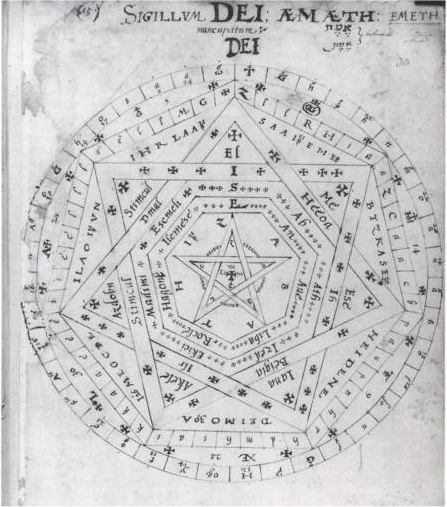 John Dee’s 1582 diagram of the Sigillum Dei Aemeth, preserved in British Library Sloane MS 3188. The design belongs to a longer medieval history of the “Seal of God” that reaches back to the Liber Iuratus tradition. Public-domain image via Wikimedia Commons.
The Sworn Book of Honorius is easy to misread. Modern readers often encounter it as a mysterious grimoire filled with divine names, angels, planetary spirits, seals, prayers, and elaborate ritual preparations. That description is not wrong, but it misses what makes the book historically remarkable. The work known in Latin as Liber Iuratus Honorii, Liber Sacratus, or the “oath-bound” or “consecrated” book presents itself not merely as a manual of magic but as a threatened body of sacred knowledge that must survive persecution through secrecy, controlled transmission, and moral discipline.
At the center of the text lies an ambition that complicates the usual modern division between “religion” and “magic”: the desire to attain a visionary knowledge of God. Around that central aim the book organizes angelic hierarchies, sacred names, prayers, cosmological structures, astral timing, spirit conjurations, and practical operations. Its ritual world is intensely Christian in language, yet it occupies precisely the zone that medieval theologians, bishops, inquisitors, and later demonologists often treated with suspicion. It is therefore a particularly valuable document for understanding learned ritual magic in medieval Europe.
The Sworn Book is also important because it did not remain locked inside a single manuscript tradition. Elements associated with it circulated across later magical literature. Its complex Sigillum Dei, or “Seal of God,” became one of the most recognizable diagrams in the history of Western ceremonial magic. Centuries after the earliest manuscripts, John Dee encountered related material and adapted a version of the seal in the angelic experiments he conducted with Edward Kelley. The result is a striking chain of transmission: a medieval ritual text, copied in changing manuscript forms, enters the intellectual and magical environment of Renaissance England and is eventually reimagined in the modern occult imagination.
This article approaches the Sworn Book of Honorius as a historical and textual object. It distinguishes documented manuscript evidence from traditional claims, examines what the oath and secrecy actually do inside the work, explains the central role of the beatific vision, traces the Sigillum Dei, compares the book with neighboring traditions such as the Ars Notoria and Solomonic magic, and asks why a work written for a tiny circle of initiated readers became so influential centuries later.
What exactly is the Sworn Book of Honorius?
The title “Sworn Book of Honorius” translates one of the common Latin names, Liber Iuratus Honorii. The adjective iuratus does not simply mean that the book itself has somehow taken an oath. It points to a system of oath-bound possession and transmission. The knowledge is represented as something that should not circulate freely. A master gives it to a carefully selected successor under solemn restrictions. This is one reason the English title “Sworn Book” is more informative than it may first appear: secrecy is not decoration added to the text but part of its theory of authority.
The work is attributed to “Honorius of Thebes,” sometimes described in the tradition as the son of Euclid and a master of Thebes. Historians do not possess secure independent evidence for this figure as the historical author of the book. The name functions instead as an authorizing identity inside the tradition. That is common in medieval and early modern esoteric literature. Texts were frequently placed under the names of Solomon, Aristotle, Hermes, Raziel, Moses, or other prestigious figures. Such attribution could signal lineage, wisdom, antiquity, or religious legitimacy rather than modern authorship in the sense of a verifiable individual composing a text and signing it.
The surviving work is not a single frozen document. Different manuscripts preserve different forms, omissions, additions, and textual relationships. That matters because any claim that “the Sworn Book says X” should ideally be tested against manuscript families and critical editions rather than assumed from one modern transcription. Gösta Hedegård’s critical edition of the Latin text and later work by scholars including Jean-Patrice Boudet, Claire Fanger, Robert Mathiesen, Katelyn Mesler, Jan R. Veenstra, and others have made it possible to place the book within the broader study of medieval ritual magic rather than treating it as an isolated occult curiosity.
Dating the book: what can historians actually say?
The dating of the Liber Iuratus has long attracted debate. The work is often described as a thirteenth-century grimoire, but the safest historical formulation is more cautious. Scholars place its emergence around the late thirteenth or early fourteenth century, while the secure manuscript and documentary evidence belongs to the fourteenth century onward. The book’s own rhetoric of persecution also fits an environment in which learned ritual practices, spirit invocation, and suspect magical books faced increased scrutiny.
A particularly important documentary point is the appearance of a work identifiable with the Liber Iuratus in a fourteenth-century prosecution context. Research on the 1347 trial of Étienne Pépin in Gévaudan has helped establish that material associated with the book was known in the first half of the fourteenth century. Later medieval authors also refer to books of this type within lists or discussions of prohibited magical texts.
This does not mean that every component originated at the same moment. Ritual books are often compilations. Prayers, names, cosmological classifications, ritual technologies, and diagrams can be older than the manuscript that gathers them. The Sworn Book itself appears to have drawn on earlier traditions while reshaping them into a distinctive program. In other words, dating the book is not the same as dating every idea inside it.
That distinction is crucial for understanding medieval magic. A modern reader may imagine a grimoire as a book written once by one author and then copied faithfully. Manuscript culture worked differently. A scribe could abbreviate, expand, reorder, translate, correct, corrupt, or combine material. A later compiler might inherit a ritual from an earlier text but place it inside a new theological framework. The history of a grimoire is therefore often the history of a moving textual network.
The fictional council of magicians and the politics of secrecy
The prologue of the Sworn Book creates a dramatic origin story. It describes a crisis in which magical knowledge is threatened by religious authorities. Masters of the art respond by preserving the most important material in a single book and binding its transmission with strict obligations. Historically, this should not be read as a literal transcript of a documented international congress of magicians. The scene functions as literary myth, institutional memory, and defense of the text.
Why invent such a story? Because it explains three things at once. First, it justifies why powerful knowledge is rare. If authorities destroy magical books, scarcity becomes evidence of persecution rather than weakness. Second, it explains why the surviving text claims to condense a larger field of learning. Third, it establishes a moral hierarchy between legitimate possessors and irresponsible outsiders. The oath makes the reader part of an imagined chain.
Secrecy also solves a theological problem. If the book contains divinely oriented knowledge, why is it hidden? The answer offered by the tradition is not that truth is shameful but that sacred knowledge is dangerous when handled without preparation. Medieval religious culture already contained strong models of restricted knowledge, from clerical education and monastic discipline to the guarded interpretation of certain mystical or theological subjects. The Liber Iuratus adapts this atmosphere to ritual magic.
Modern occult publishing often markets secrecy as a form of mystique. In the Sworn Book, however, secrecy is more structural. It defines who may inherit the text, how many copies may exist, and what kind of person is supposedly worthy to possess it. The book’s imagined social world is tiny, selective, and controlled. Knowledge is not public information; it is a burden attached to character.
Why the book is intensely Christian even though it was considered magical
One of the most persistent misconceptions about medieval grimoires is that they belong to a completely separate “occult religion” operating outside Christianity. The Sworn Book of Honorius makes that model difficult to sustain. Its vocabulary is saturated with Christian theology, prayer, divine names, angelology, penitential discipline, and the desire for salvation. The operator is not presented simply as someone seeking power for its own sake. He is repeatedly situated before God, sin, judgment, purity, and the celestial hierarchy.
This does not mean church authorities approved the system. Medieval theologians could distinguish legitimate prayer from condemned attempts to compel spirits, obtain forbidden knowledge, or manipulate hidden powers. A ritual might quote psalms and invoke God while still being classified by critics as illicit magic. The presence of Christian language therefore does not automatically convert a grimoire into orthodox devotion.
The more useful historical question is how the practitioner understood the relationship. In many works of learned ritual magic, the operator claims that divine authority makes spiritual action possible. Holy names are not decorations pasted onto a fundamentally nonreligious ceremony; they are the claimed source of legitimacy. The magician may imagine himself as acting through prayer, purity, and divine order rather than against them.
This helps explain why ritual magic flourished among literate clerical or clerically educated environments. Literacy in Latin, access to liturgical language, familiarity with psalms, astronomical learning, and the ability to copy complex diagrams were concentrated among educated men. The same cultural tools that served theology, medicine, astronomy, law, and liturgy could be redirected into prohibited or ambiguous ritual experimentation.
The central mystery: the beatific vision
The most important operation in the Sworn Book is not treasure hunting, love magic, or the command of demons. It is a visionary goal: the sight or knowledge of the divine majesty, often discussed by scholars in relation to the Christian concept of the beatific vision. This immediately distinguishes the work from the popular image of the grimoire as merely a catalogue of spirits and spells.
In orthodox medieval theology, the beatific vision refers to the blessed vision of God associated above all with the perfected state of the saved. The possibility of seeking such a vision through a ritual technology in earthly life was therefore theologically charged. The Liber Iuratus does not simply repeat scholastic doctrine; it relocates the aspiration into a practical program involving moral purification, prayers, names, timing, ritual space, and celestial intermediaries.
Robert Mathiesen and Jean-Patrice Boudet drew attention to this feature because it reveals the text’s theurgic character. “Theurgy” is a modern scholarly term with a complicated history, but in this context it helps identify ritual practices oriented toward divine or angelic ascent rather than only material manipulation. The operator seeks a transformation of knowledge and perception. The desired result is not merely information about the world but privileged access to the structure of heaven and divinity.
This ambition places the Sworn Book beside other medieval works that promise extraordinary intellectual or visionary gifts through ritualized prayer. SecretMagic.space has already examined the Ars Notoria, a related medieval tradition that joins prayers, special figures, and angelic mediation to the acquisition of knowledge. The Sworn Book and the Ars Notoria are not identical systems, but their proximity shows how prayer, vision, knowledge, and ritual technique could overlap in medieval learned magic.
Purification before power
The book’s structure repeatedly insists that access to higher operations requires preparation. This includes prayer, moral restraint, confession-like purification, fasting or controlled behavior in certain recensions, and carefully prepared ritual conditions. To a modern reader, these may look like arbitrary obstacles placed before the “real” magic. Within the logic of the text, they are the real foundation.
The idea is theological as much as technical. A human being approaching divine or angelic realities must become appropriately ordered. Purity establishes correspondence between the operator and the celestial hierarchy. This is a recurring principle in ritual traditions: efficacy depends not only on words and objects but on the transformed status of the person performing the operation.
That principle also gives the book an ethical defense. If dangerous knowledge is restricted to disciplined, faithful, morally tested practitioners, then the text can present itself as the opposite of reckless sorcery. Whether medieval critics accepted that defense is another matter. The important historical point is that the book argues for its own legitimacy through the character of the operator.
Names of God and the medieval imagination of sacred language
One of the most striking features of the Liber Iuratus is its use of long sequences of divine or angelic names. Some appear to derive from Hebrew, Greek, Latin, or hybrid traditions; others have been transformed by repeated copying. To modern eyes, such sequences can look like meaningless strings. In the ritual imagination of the text, however, sacred names function as concentrated signs of divine authority.
Medieval Christian Europe inherited multiple traditions concerning the power of names. Biblical narratives emphasized the importance of divine naming; Jewish mystical and magical traditions transmitted elaborate reflections on the names of God; late antique ritual texts used voces magicae and sacred formulae; Arabic and Hebrew learning entered Latin intellectual culture through translation and intercultural contact. The result was not a single unified “name magic” but an overlapping field of linguistic speculation.
The famous Schemhamphoras or Shem ha-Mephorash language that appears in Western magical literature demonstrates how concepts could migrate and change. Christian magicians often encountered Hebrew terms through imperfect translations, transliterations, compilations, and secondary explanations. A sequence presented as ancient Hebrew authority might already have passed through several stages of transformation before reaching a Latin scribe.
This is why a historian should resist the temptation to “correct” every strange name automatically. Corruption itself is evidence. If two manuscripts share the same unusual error, that can reveal a textual relationship. If a later edition normalizes a name according to contemporary occult expectations, the correction may erase the history of transmission. Philology treats strange spellings not merely as obstacles but as fingerprints.
The Sigillum Dei: why the Seal of God matters
No image associated with the Sworn Book has had a longer afterlife than the Sigillum Dei, the Seal of God. The design exists in multiple forms across manuscript and later occult traditions. In the Liber Iuratus, the seal integrates geometry, sacred names, letters, number symbolism, and cosmological structure. It is not simply a logo. It is a diagrammatic condensation of the ritual universe.
The precise forms vary between witnesses. Circles, polygons, pentagrams or heptagonal structures, letter sequences, names, and color instructions can shift. This variation is historically important. A diagram is copied differently from ordinary prose. A scribe may misunderstand a line, rotate a letter, omit a name, or simplify a shape. The seal is therefore both symbol and manuscript problem.
The tendency of modern occult culture to seek “the one correct Sigillum Dei” can obscure this history. Medieval and early modern diagrams often survive as families rather than perfectly stable originals. The meaningful question is not only “what is the correct shape?” but “which manuscript, date, textual branch, and ritual context produced this shape?”
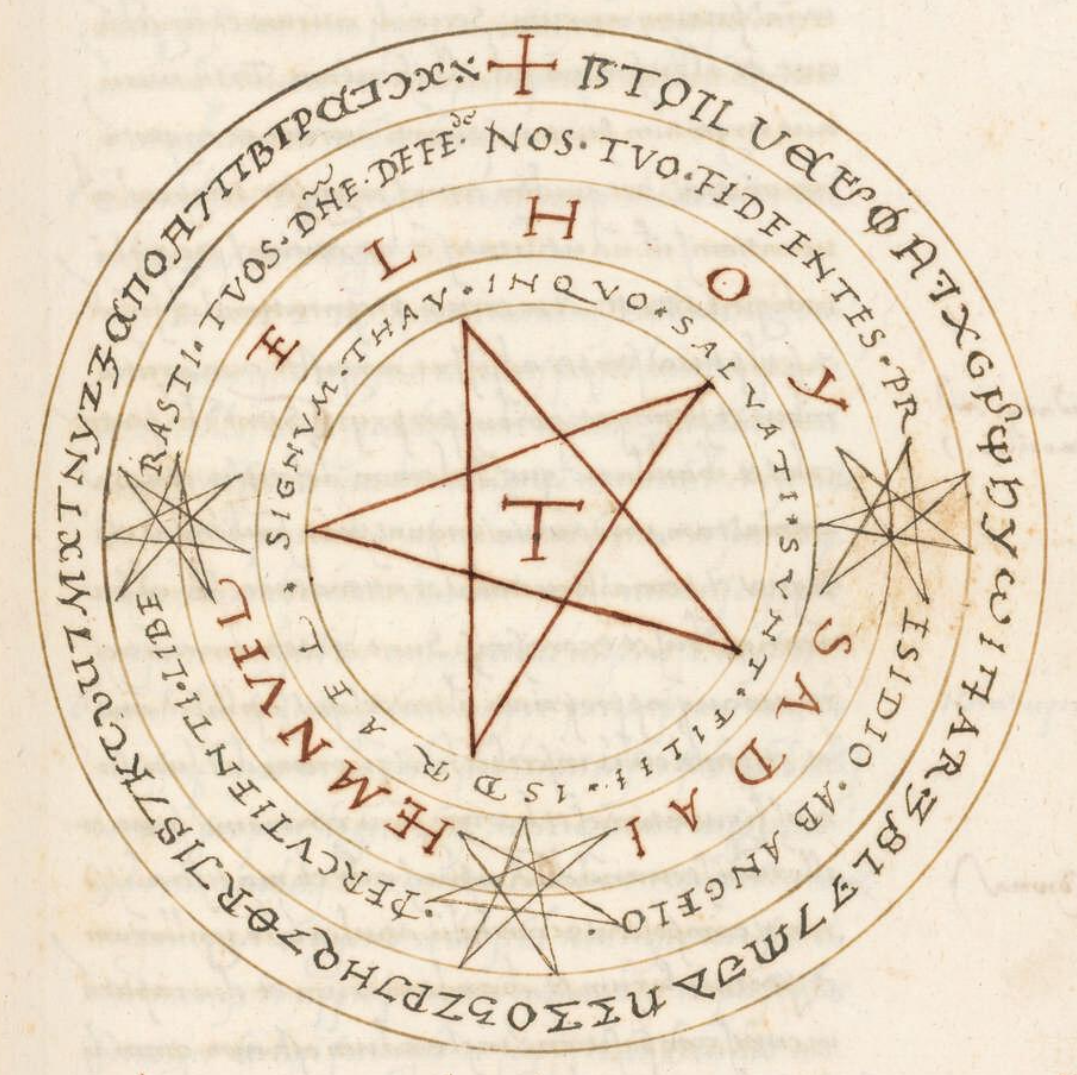 An early sixteenth-century Sigillum Dei associated with Giorgio Anselmi, from Florence, Biblioteca Medicea Laurenziana, Plut. 44.35. Its differences from other forms show how the Seal of God circulated as a family of related diagrams rather than one perfectly fixed image. Public-domain reproduction via Wikimedia Commons.
Geometry as theology, memory, and ritual technology
Why would a religiously charged magical text use geometry at all? The simplest answer is that medieval intellectual culture did not treat number and shape as spiritually neutral. Geometry could carry theological and cosmological associations. Three suggested the Trinity; seven evoked planetary and angelic orders as well as biblical structures; circles represented perfection, enclosure, and celestial order; stars and polygons generated networks of numerical relationship.
A complex figure also performs a cognitive function. It organizes names spatially. The operator does not only read a list; he encounters a map. This transforms abstract hierarchy into visible structure. Similar strategies appear in memory diagrams, theological schemata, astrological charts, and devotional images. The boundary between “diagram for thinking” and “diagram for ritual” is not always sharp.
For the historian, the Sigillum Dei is especially valuable because it reveals how text and image cooperate. The seal cannot be reduced to prose instructions, and the prose cannot be fully understood without the seal. This makes the Sworn Book part of a larger medieval culture in which knowledge was often diagrammatic.
The celestial hierarchy of the Liber Iuratus
The Sworn Book imagines a richly populated cosmos. Angels, planetary powers, aerial spirits, directional rulers, and other classes appear in structured relationships. The exact classification varies with textual version, and translating medieval terms into modern occult categories can be misleading. A word rendered as “spirit,” “angel,” “king,” or “demon” may carry different implications in different witnesses.
The important point is that the cosmos is hierarchical. The operator does not approach an undifferentiated supernatural world. He navigates levels, names, offices, directions, times, and authorities. This hierarchical imagination resembles medieval political and ecclesiastical organization: power descends through ranks, messengers, offices, and jurisdictions.
Such a model gives ritual language a bureaucratic quality. Correct names and offices matter because the world is imagined as ordered. A petition directed to the wrong rank is not merely impolite; it is structurally incorrect. This administrative metaphor helps explain why grimoires obsess over titles, seals, days, directions, and lists.
Planetary magic without reducing the book to astrology
The Liber Iuratus includes planetary and astral structures, but it should not be reduced to a simple astrological handbook. Medieval learned magic often assumed a cosmos in which celestial motion mattered. Planets marked times, qualities, and layers of influence. Rituals could therefore be coordinated with celestial conditions.
Yet the book’s highest goal exceeds astrological manipulation. The beatific vision, angelic knowledge, and divine names place astrology inside a larger sacred cosmology. The planets are not the final reality; they are part of a layered universe.
This is one point of comparison with the later Heptameron, a text already discussed on SecretMagic.space in a source-based history of its planetary days, angels, and ritual structure. The Heptameron shares material and conceptual territory with the Sworn Book, but it reorganizes the world into a more compact weekly framework. Their relationship is best understood as participation in overlapping textual traditions rather than as a simple one-way copy.
Solomon, pseudo-Solomonic authority, and the imagined lineage of magic
The Sworn Book participates in a vast medieval and early modern tendency to attribute ritual knowledge to Solomon. The biblical king had become, by late antiquity and the Middle Ages, a legendary master of spirits, divine wisdom, seals, and hidden knowledge. Works connected to him include multiple “Keys of Solomon,” the Testament of Solomon, the Ars Notoria, the Almandal, and later compilations that would eventually feed into early modern grimoire culture.
Calling a ritual “Solomonic” does not mean it was written in ancient Israel by the historical Solomon. It describes a lineage of authority and literary attribution. Medieval Christian, Jewish, Byzantine, Arabic, and later European traditions all contributed to the evolving image of Solomon as a ruler who commanded invisible beings through divine wisdom.
This imagined lineage gives the Sworn Book its antiquity. Honorius is not presented as inventing magic from nothing. He organizes inherited wisdom. That claim is typical of esoteric texts: innovation is often framed as restoration. The author gains authority by saying, in effect, “I am preserving what was already ancient.”
SecretMagic.space has explored the Byzantine Hygromanteia and its relationship to the Key of Solomon. Reading the Liber Iuratus beside such material makes clear that “Solomonic magic” is not one book but a large family of texts, practices, attributions, and ritual technologies moving across languages and centuries.
Jewish and Islamic currents: influence without simplistic borrowing stories
Scholars have long noticed that medieval Latin ritual magic contains materials that cannot be explained within Latin Christianity alone. Hebrew divine names, angelological structures, astrological learning, Arabic magical sciences, and translated philosophical ideas entered Europe through multiple channels. The Sworn Book belongs to this environment of exchange.
However, it is easy to replace one myth with another. Older occult histories sometimes imagined a single secret tradition moving unchanged from Egypt to Israel to Arabia to Europe. Modern scholarship instead emphasizes complex translation, adaptation, misunderstanding, recontextualization, and invention.
A Hebrew word copied by a Latin Christian may change sound and spelling. An Arabic astrological idea may be translated through Spanish or Italian intermediaries. A Jewish angelic tradition may be detached from its original liturgical or mystical context and inserted into a Christian ritual. The result is not “pure transmission” but cultural transformation.
This is why the Sworn Book is so valuable for comparative study. It shows how medieval Christian ritual magic could absorb external authorities while thoroughly Christianizing them. The presence of Hebrew-derived names does not make the work a Jewish grimoire, just as the use of astrology with Arabic roots does not make it an Islamic text. The book is a Latin Christian compilation shaped by a multilingual intellectual world.
How the Sworn Book differs from the Ars Notoria
The Ars Notoria is one of the closest comparison points because both works combine prayer, sacred names, visionary or angelic aspirations, and learned goals. Yet their emphases differ. The Ars Notoria is famous for promising mastery of arts and sciences through prayers and notae, special figures contemplated within a disciplined program. The Sworn Book is broader and more cosmologically ambitious, integrating the vision of God with spirit operations and multiple ritual domains.
Some recensions of the Liber Iuratus appear to draw directly on Ars Notoria material. This relationship is a reminder that medieval ritual texts were modular. Prayers could travel. A sequence designed in one tradition could be repurposed in another.
The distinction is nevertheless significant. The Ars Notoria often presents itself as a sacred art of intellectual enhancement and revelation. The Sworn Book more openly includes operations that later readers would recognize as ceremonial spirit magic. In one volume, contemplative ambition and conjurational technique stand side by side.
From divine vision to practical operations
Although the beatific vision is the conceptual summit of the work, the Sworn Book also contains practical aims: obtaining knowledge, locating hidden things, dealing with spirits, understanding celestial structures, and performing operations associated with worldly concerns. This range can feel inconsistent if we expect a mystical book to exclude practical magic.
For the medieval compiler, the contradiction was not necessarily absolute. If the cosmos is governed by God through hierarchical powers, then knowledge of that hierarchy can theoretically produce both contemplation and action. The same theological order that allows ascent can also authorize command over lower spirits.
That is one reason the modern categories “mysticism” and “magic” do not map neatly onto the text. The book is devotional, visionary, technical, cosmological, and coercive in different places. Its identity lies precisely in the uncomfortable combination.
Magic, necromancy, and the problem of medieval labels
Medieval Latin writers used terms such as magia, nigromantia, necromantia, ars, and related classifications in ways that do not always match modern usage. “Necromancy” in learned medieval contexts could refer broadly to ritual spirit magic, not only communication with the dead. Richard Kieckhefer’s work on the “clerical underworld” of learned magic showed how educated practitioners adapted liturgical, astrological, and scholastic materials into illicit ritual systems.
Calling the Sworn Book a work of “necromancy” can therefore be historically defensible in certain contexts but misleading for modern readers who imagine cemetery séances. The book’s own self-understanding is more exalted. It presents sacred and angelic aims while including material that critics could classify as dangerous spirit magic.
The disagreement between insider and outsider categories is itself historical evidence. A practitioner can call an art holy while an inquisitor calls it demonic. A theologian can argue that any spirit responding to coercive signs must be a demon, while the operator insists he is invoking angels. Historians should preserve the conflict rather than decide it by adopting either vocabulary uncritically.
Manuscripts: the real body of the tradition
The surviving manuscripts are the closest thing the Sworn Book has to a physical biography. Important witnesses survive in collections including the British Library. Sloane manuscripts associated with magical material preserve versions and related texts, and at least one manuscript connected to the tradition passed through the hands of John Dee.
British Library catalogue records show how these magical works often survive inside composite volumes. A manuscript may contain a grimoire beside astrological notes, alchemical material, medical recipes, ciphers, or other magical treatises. Such combinations reveal how collectors classified knowledge. What modern libraries separate into “religion,” “science,” “magic,” and “medicine” could coexist in one early modern book.
Manuscript comparison also exposes the life of errors. Divine names are especially vulnerable to corruption because a scribe cannot always recognize the language being copied. Diagrams create additional risk. When a copyist does not understand why a letter sits at a particular point in a polygon, he may reproduce the overall shape while moving the letter. Over generations, small changes become new versions.
This is why a responsible modern edition is more than a clean transcription. It must compare witnesses, identify relationships, note variants, and distinguish late additions from earlier layers. The work of critical editors is therefore essential to understanding magical texts historically.
John Dee and the medieval afterlife of the Sigillum Dei
John Dee is where the Sworn Book becomes especially visible to modern readers. Dee was a sixteenth-century mathematician, astrologer, geographer, antiquarian, court intellectual, and collector whose interests ranged from navigation and imperial strategy to alchemy and angelic communication. His library contained works of medieval learned magic, including material related to the Liber Iuratus.
In the 1580s Dee and his scryers, most famously Edward Kelley, recorded a series of visionary sessions in which they believed angels communicated through a crystal or other seeing medium. The resulting system later became known as Enochian magic, though that modern label can obscure the complexity of Dee’s own notebooks.
The Sigillum Dei Aemeth used in Dee’s experiments demonstrates continuity and transformation at the same time. Dee did not simply photocopy a medieval seal. He consulted existing textual material, compared forms, and then received or developed a version within his own angelic project. The addition of Aemeth—a form of the Hebrew word for “truth”—became closely associated with Dee’s seal.
 A wax “Seal of God” associated with John Dee, now in the British Museum. Dee’s angelic work transformed the medieval Sigillum Dei tradition into a central object of his own ritual environment. Photograph released under CC0 via Wikimedia Commons.
Dee’s surviving wax seals show that a medieval diagram could become a three-dimensional ritual object. Large seals supported the table or seeing stone, while smaller versions were placed in the ritual arrangement. Geometry left the page and entered physical space.
Historically, this is more interesting than the claim that Dee merely “used the Sworn Book.” He was a reader, compiler, critic, and experimenter working across manuscripts. His angelic system emerged from a Renaissance environment already saturated with older magical, kabbalistic, astrological, and Christian sources. The Liber Iuratus was one stream feeding a much larger river.
Was the Sworn Book the origin of Enochian magic?
No. The relationship is real but should not be exaggerated. Dee’s angelic diaries contain distinctive tables, names, languages, calls, cosmologies, and visionary narratives that are not simply copied from the Sworn Book. The medieval Sigillum Dei provided an important precedent and material resource, but the Enochian corpus developed through Dee and Kelley’s own recorded sessions.
A more precise formulation is that Dee’s work demonstrates the Renaissance reuse of medieval ritual magic. He inherited a library of techniques and symbols. Some were adopted, some questioned, some revised, and some absorbed into new revelations. This is how esoteric traditions often develop: not by preserving a single unchanged system but by producing new systems from authoritative fragments.
A visual culture of learned magic
Modern presentations of grimoires often separate text from image. Historical manuscripts did not. Circles, seals, alphabets, tables, planetary figures, and marginal marks could carry as much importance as paragraphs. Their visual density helped create the impression that the book itself was an instrument.
In the Liber Iuratus, this instrumental quality is especially strong. A diagram is not merely an illustration of an idea; it can be required within the ritual logic. The operator must construct, view, inscribe, or position a figure. Reading becomes making.
This helps explain the continued fascination of the Sigillum Dei. Even readers who know nothing about the text can recognize the design as “occult.” But historical interpretation requires moving in the opposite direction: away from generic occult aesthetics and back toward the specific manuscripts, prayers, names, and theological concepts that gave the diagram meaning.
Why the book was dangerous to authorities
Ritual magic created several problems for medieval religious authorities. It could appear to claim access to revelation outside approved sacramental channels. It could imitate liturgy. It could invoke spirits and use divine names in ways theologians considered superstitious or coercive. It could promise knowledge unavailable through ordinary study. And it could circulate secretly among educated practitioners.
The Sworn Book intensifies all of these concerns because it claims sacred authority while restricting access through an oath. Its secrecy can look, from the outside, like proof of hidden error. Its angelology can be interpreted by critics as disguised demonology. Its desire for divine vision can appear presumptuous. Its practical operations blur the boundary between prayer and conjuration.
Yet persecution should not be romanticized. The fact that a text was condemned does not prove that its claims were true, just as condemnation does not make every practitioner a heroic rebel. What persecution does prove is that categories of legitimate and illegitimate knowledge had real institutional consequences.
Common misconception: “Honorius” was Pope Honorius
The Sworn Book of Honorius is frequently confused with the later Grimoire of Pope Honorius. They are not the same work. The latter is an early modern grimoire falsely attributed to Pope Honorius III and belongs to a different textual environment. Similarity of names encouraged later confusion.
The Honorius of the Liber Iuratus is “Honorius of Thebes,” a legendary or pseudonymous magical authority. There is no secure evidence that Pope Honorius III wrote the Sworn Book. Treating the two as identical collapses several centuries of textual history.
Common misconception: the Theban alphabet came from the Sworn Book
Another persistent claim links the “Theban alphabet” or “witches’ alphabet” directly to Honorius of Thebes and the Sworn Book. The alphabet was published by Johannes Trithemius in the early sixteenth century and later reproduced by Heinrich Cornelius Agrippa. It was attributed to Honorius, but the known Liber Iuratus tradition does not establish that Honorius of Thebes invented it.
This is a classic example of attribution growing around a famous name. Once “Honorius” becomes associated with ancient magical authority, later scripts, seals, or texts can be attached to him. Repetition then turns attribution into apparent fact.
Common misconception: every divine name has one recoverable pronunciation
Modern practitioners frequently ask how the names in medieval grimoires “should” be pronounced. Historically, the question is more difficult than it sounds. Manuscripts preserve different spellings; scribes worked across languages; some sequences may be transliterations; some may be corrupted; and medieval Latin pronunciation itself varied by region and period.
There may be philological arguments for particular linguistic origins, but the surviving evidence rarely supports the idea that one universally correct ancient pronunciation can be reconstructed for every magical name. The textual instability is part of the source.
Common misconception: old manuscripts prove supernatural effectiveness
A manuscript can prove that a ritual existed, circulated, was copied, and was valued. It can reveal what practitioners believed and how they structured their world. It cannot by itself establish that angels objectively appeared, that spirits obeyed seals, or that a diagram produced measurable supernatural effects.
This distinction allows serious study without contempt. Historical belief is worthy of careful analysis whether or not the supernatural claim can be scientifically demonstrated. The goal is neither automatic debunking nor automatic acceptance.
Common misconception: medieval magicians were simply anti-Christian rebels
The Sworn Book makes this claim especially difficult to maintain. Its authors and users operated inside Christian symbolic worlds. They cited God, angels, sin, salvation, sacred names, and prayer. Their conflict with authorities arose not because they rejected Christianity in a modern secular sense but because they reconfigured the boundaries of legitimate sacred action.
Some practitioners may have considered themselves unusually devout. Others may have pursued power more opportunistically. The manuscripts do not allow one psychological profile. What they do show is that medieval magic could be produced from the same intellectual materials as medieval religion.
A philosophical reading: secrecy as a technology of value
Beyond its historical context, the Sworn Book offers a powerful example of how secrecy creates value. Information that can be copied freely is ordinary. Information surrounded by oaths, tests, restricted succession, and danger becomes precious. The book does not merely hide knowledge; it manufactures an identity for the person who possesses it.
The oath tells the reader: you are not merely reading. You are entering a lineage. This shifts knowledge from the public sphere into a relationship between master, student, and sacred authority.
Such mechanisms occur far beyond magic. Guilds protect techniques, religious communities restrict initiatory teachings, governments classify information, and academic disciplines require years of training before granting professional authority. The Sworn Book dramatizes an extreme medieval version of a general human principle: controlled access can turn knowledge into status.
A philosophical reading: the diagram as a model of a governable universe
The Sigillum Dei also expresses a philosophical dream: that the cosmos can be compressed into a figure. Names, ranks, directions, numbers, and geometry are placed inside a bounded form. The infinitely complex universe becomes something that can be written, viewed, and handled.
This helps explain the emotional power of esoteric diagrams. They offer more than decoration. They imply that hidden complexity has an order and that the order can be known. In a world that often appears chaotic, the diagram promises legibility.
The promise is epistemic before it is magical. Even if one does not accept any supernatural efficacy, the psychological and intellectual appeal is understandable. A seal turns invisibility into structure.
A philosophical reading: the magician as priest, scholar, and technician
The operator imagined by the Sworn Book does not fit a single modern role. He prays like a religious devotee, studies like a scholar, calculates like an astrologer, copies like a scribe, constructs objects like a craftsman, and commands like an official. The identity is hybrid.
This hybridity is one reason the history of magic is so useful for understanding premodern knowledge. Modern academic categories encourage us to separate science, religion, art, medicine, and occultism. Medieval practitioners often moved across borders that were contested but differently drawn.
The transformation from manuscript secret to printed occult classic
For most of its early history, the Sworn Book circulated through manuscripts rather than mass print. This suited its ideology of secrecy. Yet by the modern period it became increasingly accessible through catalogues, transcriptions, occult editions, scholarly studies, and eventually digital scans.
This shift fundamentally changed the meaning of the oath. A work designed for restricted transmission can now be downloaded in seconds. The modern reader encounters secrecy as historical content rather than practical barrier.
Digital access creates both opportunity and distortion. It allows scholars and independent researchers to compare editions, but it also encourages decontextualized copying. A diagram stripped from its manuscript may circulate on social media with a false date. A corrupted modern transcription may be treated as ancient authority. The more accessible the image becomes, the easier it is to lose its provenance.
How to research the Sworn Book responsibly
A strong research method begins by separating four layers: manuscript evidence, critical editions, historical scholarship, and modern occult interpretation. Each answers different questions.
Manuscripts show what survives physically and how particular copies differ. Library catalogues help establish shelfmarks, dates, provenance, and contents.
Critical editions compare witnesses and reconstruct textual relationships. Gösta Hedegård’s Liber Iuratus Honorii: A Critical Edition of the Latin Version of the Sworn Book of Honorius is central here.
Historical scholarship situates the work in medieval theology, angelology, learned magic, persecution, manuscript culture, and intercultural transmission. The studies of Jean-Patrice Boudet, Robert Mathiesen, Claire Fanger, Katelyn Mesler, Jan R. Veenstra, Richard Kieckhefer, and related scholars are especially important.
Modern occult editions can be useful for reception history and access, but they should not automatically be treated as substitutes for manuscripts or critical scholarship. Editorial decisions, modernization, and ritual interpretation can change the text.
The Sworn Book and modern ceremonial magic
The work’s modern influence is partly direct and partly retrospective. Through John Dee, the Sigillum Dei became connected to later Enochian practice. Through manuscript studies and occult publishing, the Sworn Book itself re-entered the twentieth- and twenty-first-century magical world. Practitioners now read it alongside the Key of Solomon, Heptameron, Abramelin, and Dee’s angelic records.
But modern ceremonial magic often reconstructs medieval material through later frameworks. Golden Dawn correspondences, Thelemic ideas, modern kabbalistic diagrams, psychological interpretations, and contemporary ritual theory can all be layered onto the old text. Such reinterpretation is culturally legitimate as a new practice, but it should not be mistaken for a transparent recovery of what a fourteenth-century scribe thought.
The distinction between historical reconstruction and living tradition is healthy. A modern practitioner may find spiritual meaning in the Sigillum Dei while a historian asks how the diagram changed between manuscripts. Both questions can exist, provided they are not confused.
 Henry Gillard Glindoni’s later artistic imagining of John Dee performing an experiment before Queen Elizabeth I. The painting is not documentary evidence of a specific magical session; it shows how Dee himself became a legendary figure in the cultural memory of occult learning. Image from Wellcome Collection, CC BY 4.0 via Wikimedia Commons.
Why John Dee became the bridge between medieval and modern occultism
Dee occupies a unique cultural position because he was both historically documented and later mythologized. His surviving papers show serious mathematical, astronomical, linguistic, imperial, alchemical, and angelic interests. This combination made him irresistible to later occultists.
When later readers encountered the Sigillum Dei Aemeth in Dee’s work, they received a medieval symbol through a Renaissance personality. Dee became the bridge. The same diagram that might otherwise have remained a specialist manuscript artifact entered modern magical consciousness through Enochian literature.
This process demonstrates how influence often works. A medieval source does not need to remain continuously popular. It can disappear from broad attention, survive in archives, then re-emerge because a later influential figure used it. Cultural transmission can be discontinuous.
What the Sworn Book tells us about medieval ideas of knowledge
The deepest historical value of the Liber Iuratus may lie in its theory of knowledge. It assumes that the world contains truths inaccessible to ordinary study but available through disciplined sacred technique. Vision can outrank argument. Names can carry powers unavailable to translation. Geometry can encode cosmic hierarchy. Moral purification can change what a person is capable of knowing.
This is not the epistemology of a modern laboratory, but it is internally coherent. Knowledge is relational: the knower must become worthy of the known. The cosmos does not reveal itself equally to every observer.
That idea links ritual magic to mysticism. In both, the transformation of the person may be considered a condition of revelation. The difference lies in the degree to which the Sworn Book systematizes that transformation into reproducible operations.
Why the book still attracts readers
Several features explain the Sworn Book’s continuing appeal.
- It is genuinely old. Unlike many grimoires marketed as ancient, the Liber Iuratus has a documented medieval manuscript history.
- It combines mysticism and magic. The vision of God stands beside practical spirit operations.
- It contains one of the most famous magical diagrams in Western history. The Sigillum Dei is visually powerful and historically traceable.
- It connects to John Dee. This links medieval ritual magic to Renaissance angelic experimentation and later Enochian traditions.
- Its secrecy narrative is compelling. The oath creates an atmosphere of endangered knowledge.
- It rewards scholarly study. Manuscript variation, intercultural influence, and theological ambiguity make it richer than a simple “spell book.”
Frequently asked questions
Who wrote the Sworn Book of Honorius?
The text is attributed to Honorius of Thebes, described in the tradition as a master connected with Thebes and sometimes as a “son of Euclid.” Historians do not have secure independent evidence identifying this figure as the real author. “Honorius of Thebes” is best treated as a pseudonymous or legendary authority attached to the text.
How old is the Sworn Book?
The work is generally placed in the late thirteenth or early fourteenth-century environment of learned ritual magic, with secure evidence for its circulation in the fourteenth century. Individual components may be older, and surviving manuscripts reflect later copying and revision.
Why is it called “Sworn”?
The title refers to oath-bound transmission. The work presents its knowledge as restricted and says it should pass only under solemn conditions to a small number of worthy successors. Secrecy is therefore central to the book’s identity.
Is the Sworn Book a Christian text?
It is a Christian magical text in language and cosmology, filled with prayers, divine names, angelology, and salvation concerns. That does not mean it was accepted as orthodox by church authorities. Its importance lies partly in showing how Christian devotion and condemned ritual magic could overlap.
What is the main goal of the book?
Its highest goal is the visionary knowledge or sight of the divine majesty, often discussed in scholarship in relation to the beatific vision. The book also includes lower or practical operations involving spirits, knowledge, and worldly concerns.
What is the Sigillum Dei?
The Sigillum Dei, or Seal of God, is a complex sacred diagram combining geometry, letters, names, and numerical symbolism. Forms of the seal appear in the Liber Iuratus tradition and later became especially famous through John Dee’s Sigillum Dei Aemeth.
Did John Dee own the Sworn Book of Honorius?
Manuscript evidence and library scholarship connect Dee with material from the Liber Iuratus tradition. He knew versions of the Seal of God and incorporated a transformed Sigillum Dei Aemeth into his angelic experiments.
Is the Sworn Book the same as the Grimoire of Pope Honorius?
No. They are distinct works from different periods and textual traditions. The Grimoire of Pope Honorius is a later work falsely attributed to Pope Honorius III. The Sworn Book is attributed to Honorius of Thebes.
Is the Theban alphabet from the Sworn Book?
The famous Theban alphabet was published by Trithemius and later Agrippa and attributed to Honorius. The surviving Liber Iuratus tradition does not securely establish that the alphabet originated with the author of the Sworn Book.
Does the book prove that medieval people actually saw angels?
It proves that medieval and early modern readers copied, preserved, studied, and in some cases likely practiced systems intended to produce angelic or divine experiences. The manuscripts document belief and practice; they do not provide scientific proof of supernatural beings.
Conclusion: a book caught between heaven, secrecy, and the archive
The Sworn Book of Honorius survives because secrecy failed—and because manuscripts endured. A text that imagined itself passing from master to chosen successor eventually entered libraries, catalogues, scholarly editions, occult publishing, and the internet. Its once-restricted diagrams can now be viewed by anyone.
Yet easy access has not made the book simple. The Liber Iuratus remains one of the most complicated witnesses to medieval ritual magic because it refuses modern categories. It is a grimoire that seeks God. It is a Christian text that could be condemned as magic. It is a manual of spirit operations built around prayer. It is a secret book that survives through copying. It is a medieval work whose most famous symbol became inseparable from a Renaissance magician.
The Sigillum Dei captures the paradox perfectly. Its nested geometry promises that the invisible world has order. Names can be placed, ranks mapped, circles closed, and heaven represented. But when historians compare manuscripts, the seal changes. Letters move. Shapes differ. Colors disappear. Meanings migrate. The object that promises cosmic stability becomes evidence of textual change.
That is why the Sworn Book deserves to be studied not as a collection of exotic instructions but as a major document in the history of religion, manuscripts, secrecy, and Western esotericism. It shows medieval intellectual culture at one of its most daring boundaries: the point where prayer becomes technique, contemplation becomes ritual, and the desire to know God becomes inseparable from the desire to map the hidden architecture of the universe.
Sources and further reading
- Gösta Hedegård, Liber Iuratus Honorii: A Critical Edition of the Latin Version of the Sworn Book of Honorius, Studia Latina Stockholmiensia 48, 2002.
- Jean-Patrice Boudet, “Magie théurgique, angélologie et vision béatifique dans le Liber sacratus sive juratus attribué à Honorius de Thèbes,” Mélanges de l’École française de Rome. Moyen Âge 114.2 (2002), 851–890.
- Robert Mathiesen, “A Thirteenth-Century Ritual to Attain the Beatific Vision from the Sworn Book of Honorius of Thebes,” in Claire Fanger (ed.), Conjuring Spirits: Texts and Traditions of Medieval Ritual Magic.
- Katelyn Mesler, “The Liber Iuratus Honorii and the Christian Reception of Angel Magic,” in Claire Fanger (ed.), Invoking Angels: Theurgic Ideas and Practices, Thirteenth to Sixteenth Centuries, Penn State University Press.
- Jan R. Veenstra, “Honorius and the Sigil of God: The Liber Iuratus in Berengario Ganell’s Summa Sacre Magice,” in Invoking Angels, Penn State University Press.
- Richard Kieckhefer, Magic in the Middle Ages, Cambridge University Press.
- British Library, Sloane Manuscripts catalogue, for manuscript records relating to learned magic and the Liber Iuratus tradition: British Library Archives and Manuscripts.
- Cambridge University Press, “Learned Magic,” in The Cambridge History of Magic and Witchcraft in the West: Cambridge Core.
- Joseph H. Peterson (ed.), Liber Juratus Honorii, or the Sworn Book of Honorius, online textual resource: Esoteric Archives.
- Folger Shakespeare Library catalogue entry for Claire Fanger (ed.), Conjuring Spirits: Folger Shakespeare Library.
- Wikimedia Commons file pages for the historical and documentary images used above; individual licensing information appears in each captioned source page.


