


One of the strangest books to cross from the medieval Arabic-speaking world into Latin Europe was attributed to Plato, framed through Galen, linked to the famous translator Ḥunayn ibn Isḥāq, and filled with claims about artificial generation, altered perception, marvelous houses, strange lights, weather, plants, animals, and hidden properties of matter. Modern scholars usually call it the Kitāb al-Nawāmīs in Arabic and the Liber vaccae, or Book of the Cow, in Latin.
The title alone can mislead. This was not really a lost dialogue by Plato, and it was not a stable ancient “grimoire” passed intact from classical Greece into Islam and then into Europe. It was a medieval compilation that deliberately borrowed the prestige of Greek philosophy. The surviving Arabic text is fragmentary, while the work is known much more fully through a Latin translation made in medieval Spain, probably in the late twelfth century. That translation circulated under several names, including Liber aneguemis, Liber institutionum activarum, Liber tegimenti, and Liber vaccae.
Its content also demands caution. Some experiments described in the work involve animal killing, bodily substances, toxic or irritating materials, dangerous fumes, and other practices that would be unethical, unsafe, or illegal to reproduce today. This article therefore treats them as evidence for the history of ideas, not as instructions. The real value of the Book of the Cow lies in what it reveals about medieval arguments over nature: what counted as a legitimate hidden property, what crossed the line into magic, whether artificial generation could imitate life, and whether a marvel produced by natural causes was fundamentally different from a miracle.
The resulting history is more important than the sensational recipes. The Liber vaccae became a test case for scholastic theologians, natural philosophers, physicians, astrologers, and readers of secret books. It was condemned, excerpted, imitated, translated, censored, and sometimes quietly preserved. Its path from an Arabic pseudo-Platonic milieu into Latin and later Hebrew culture shows how magic moved through the same translation networks that carried medicine, astronomy, philosophy, and mathematics.
 A medieval cow illustration from British Library Harley MS 4751, dated to the thirteenth century. It is not an illustration from the Liber vaccae, but it provides period visual context for the animal symbolism that gave the Latin work its best-known title. Public-domain image via Wikimedia Commons.
Why the “Book of the Cow” Is Not Really a Book by Plato
The first historical task is to separate attribution from authorship. The work presents itself through an elaborate chain of authorities involving Plato, Galen, and Ḥunayn ibn Isḥāq. That chain gave the text intellectual prestige because all three names carried enormous weight in medieval learned culture. Plato represented ancient philosophy; Galen represented medicine and rational natural knowledge; Ḥunayn was one of the most famous translators of Greek science into Arabic.
Modern scholarship does not accept this attribution. The Arabic Kitāb al-Nawāmīs is generally treated as a pseudo-Platonic work produced in the Islamicate world, probably in the ninth century. David Pingree connected it with the learned environment of the Ṣābians of Ḥarrān, a community famous in medieval sources for astral religion, philosophy, and the preservation or reinvention of ancient pagan traditions. More recent scholars, including Liana Saif and Lucia Raggetti, have refined the picture by examining Arabic parallels, technical vocabulary, and the transmission of pseudo-Platonic material.
Pseudonymous attribution was not unusual. Medieval scientific and esoteric works were frequently assigned to Aristotle, Plato, Hermes, Solomon, Galen, or other prestigious figures. Such attributions could serve as intellectual branding: they told a reader what kind of authority the book wanted to claim. In this case the Platonic association was especially clever because the Arabic title al-Nawāmīs could evoke the idea of “laws,” recalling Plato’s genuine Laws, even though the magical work is entirely different in content.
The point is not simply to expose a fake. The false attribution itself is evidence. It shows that the compiler wanted extraordinary operations to appear as part of ancient philosophical science rather than as random folk sorcery. The book sought legitimacy by placing marvel-making inside a lineage of learned natural knowledge.
What Does Kitāb al-Nawāmīs Mean?
The Arabic title has generated debate because nawāmīs can carry more than one resonance. It is related to the Greek nomos, “law,” transmitted into Arabic, but medieval lexical usage also gave the term associations with secrets or hidden things. Liana Saif has suggested that a translation such as “Book of Sacred Secrets” may better capture the magical context than the flat English “Book of Laws.”
The Latin translators did not settle on one title. Liber aneguemis reflects a transliteration of the Arabic term. Liber institutionum activarum tries to render the work as a book of active or operative institutions. Liber tegimenti connects with the idea of covering or concealment. The famous title Liber vaccae, “Book of the Cow,” arose from the notorious first group of experiments involving a cow.
These changing names matter because titles guide reception. Calling the text “Plato’s Laws” would place it near philosophy; calling it a “Book of Active Institutions” suggests technical art; calling it the “Book of the Cow” highlights its most shocking material. Medieval readers did not encounter a neutral object. They encountered a book already interpreted by its title.
The multiple titles also remind us that manuscript culture was flexible. A work could circulate anonymously, under a false author, under a descriptive title, or inside a larger collection where scribes changed headings. The modern desire for one canonical title often conceals that historical fluidity.
Where and When Was the Arabic Work Composed?
The exact date and place of composition remain subjects of scholarly reconstruction rather than absolute certainty. David Pingree argued for a late ninth-century origin in a Ṣābian environment connected with Ḥarrān. The argument rests on the work’s pseudo-Platonic character, its relationship with Hermetic and astral materials, and later Arabic citations. The text was certainly old enough to influence or be cited within early Arabic occult and alchemical traditions.
The word “Ṣābian” itself requires care. Medieval Islamic sources used it in several ways, and modern historians distinguish the historical community of Ḥarrān from the Qurʾānic Ṣābians and other groups. The Ḥarrānians became associated in Arabic intellectual culture with astral religion, ancient philosophy, mathematics, and Hermetic wisdom. That reputation made them a natural setting for later scholars seeking to explain pseudo-Platonic magical texts.
The work’s intellectual world is deeply hybrid. It draws on Greek philosophical authority but was created in Arabic. It treats generation, perception, material transformation, and hidden properties in ways that intersect alchemy, medicine, natural philosophy, and magic. It is therefore misleading to force it into a simple ethnic or religious box.
A better description is that the Kitāb al-Nawāmīs belongs to the multilingual scientific-esoteric culture of the medieval Islamicate world, where Greek philosophical inheritance was translated, reworked, and expanded rather than merely preserved.
What Survives in Arabic?
One of the great ironies of the text is that the supposed Arabic original survives only in fragments, while the medieval Latin translation preserves a much fuller version. A small Arabic fragment is preserved in Bibliothèque nationale de France, Arabe 2577, and another fragment was once reported from a private Cairo collection. The Paris fragment contains only a tiny portion of the material.
This imbalance makes the Book of the Cow a classic problem in transmission history. We know an Arabic work chiefly through a Latin witness. Any attempt to reconstruct the Arabic archetype must therefore distinguish what certainly belonged to the original from what may have changed during translation, copying, or later compilation.
Scholars have found important Arabic parallels. Liana Saif has compared the work with later Arabic magical and alchemical material, especially writings associated with Abū al-Qāsim al-ʿIrāqī. Such comparisons help recover vocabulary and conceptual patterns that the Latin sometimes obscures.
The situation also warns against treating translation as transparent. A Latin technical word may represent several possible Arabic terms. A strange recipe may reflect a mistranslated ingredient. A grammatical difficulty can conceal a damaged exemplar. Medieval translators often worked under conditions where the subject itself was obscure, making errors especially likely.
The Latin Translation and Medieval Spain
The Latin version was probably translated in Spain in the late twelfth century. The translator is unknown. Spain is plausible because it was a major zone of Arabic-Latin translation and because related occult, astrological, philosophical, and medical texts moved through Iberian intellectual networks.
The oldest surviving complete Latin witness is Munich, Bayerische Staatsbibliothek, Clm 22292, generally dated to the end of the twelfth or beginning of the thirteenth century. This gives a firm terminus for the translation’s existence. By the 1220s, William of Auvergne knew the work and criticized it. By the middle of the thirteenth century, a copy or closely related item was associated with the library of Richard de Fournival.
This chronology is important because it places the Liber vaccae among the first major waves of Arabic occult science entering the Latin West, before the later Renaissance synthesis familiar from Agrippa. The translation networks that carried Aristotle, Avicenna, medical works, mathematical astronomy, and astrology also carried texts that challenged the boundaries of natural philosophy.
Readers interested in that wider transmission can compare this history with SecretMagic’s study of how the Arabic Ghāyat al-Ḥakīm became the Latin Picatrix. The two works differ profoundly, but both show that “Western magic” was partly built through Arabic-Latin translation rather than arising from an isolated European tradition.
 A twelfth-century Arabic manuscript diagram of the eye from a work associated with Ḥunayn ibn Isḥāq. The Kitāb al-Nawāmīs falsely places Ḥunayn inside its chain of transmission, showing how his genuine reputation as a translator of Greek science could be borrowed to authorize a magical text. Public-domain image via Wikimedia Commons.
Why Ḥunayn ibn Isḥāq Was the Perfect Name to Borrow
Ḥunayn ibn Isḥāq, who died in the ninth century, was one of the most important translators of Greek medical and philosophical literature into Syriac and Arabic. He and his circle translated or revised major works of Galen and other Greek authorities. His name therefore became synonymous with reliable learned transmission.
The pseudo-Platonic prologue exploits that prestige. By presenting Ḥunayn as a translator or intermediary, the work acquires an apparently credible route from Greek antiquity into Arabic scholarship. To a later reader, this could make extraordinary magical material appear as one more branch of the ancient sciences recovered through translation.
Modern philology dismantles that claim, but the strategy remains historically meaningful. Esoteric texts often survive not because their readers reject scholarship, but because they imitate scholarly forms. They cite authorities, explain lineages, organize chapters, use technical vocabulary, and embed themselves in recognizable intellectual traditions.
This is why the history of magic cannot be written simply as the history of irrationality. The Book of the Cow is extraordinary precisely because it uses the apparatus of learned knowledge to authorize claims that many other learned readers found unacceptable.
What Kind of Magic Does the Book Contain?
The Liber vaccae contains dozens of experiments organized in two major books. They concern artificial generation, strange sensory effects, marvelous appearances, weather, plants, animals, lamps, inks, knowledge, and transformations of material conditions. Some sections appear closer to recipes for illusion or spectacle; others belong to speculative theories about life and generation.
Modern scholars have used several labels. Maaike van der Lugt emphasizes its place in medieval debates over natural magic. Sophie Page has discussed its “organic magic,” because bodily matter and the manipulation of living substances play such a prominent role. David Pingree used the phrase “psychic magic” for techniques based on substances believed to carry vital or psychic qualities.
None of these labels should be treated as perfect. The text predates modern disciplinary boundaries. What a medieval compiler considered one body of hidden natural knowledge may now be divided among chemistry, toxicology, medicine, psychology, stage illusion, animal lore, and impossible or fictional procedures.
The most important historical point is that the work usually does not explain its effects by openly commanding demons. Its operations are presented as manipulations of nature. That made the book especially disturbing to theologians: if the magic was natural rather than demonic, then banning it required a more complicated argument.
Natural Magic Was Not Automatically Harmless
A common modern simplification says that medieval thinkers accepted “natural magic” while rejecting “demonic magic.” The Liber vaccae shows why the reality was far less tidy. Natural magic could be theoretically acceptable when it meant using hidden but created properties of stones, plants, animals, or celestial influences. Yet a practice could still be condemned as immoral, deceptive, dangerous, or contrary to the proper order of nature even if no demon was invoked.
William of Auvergne is a central example. He was one of the earliest Latin theologians to discuss natural magic in a systematic way, and he knew the Liber vaccae. He did not need to deny that strange natural effects might exist. His objection concerned the work’s transgression of natural and moral order.
This is an important distinction. Medieval debates over magic were not simply debates over whether an effect was “real.” A theologian could believe an operation produced something and still condemn it. Conversely, an operation could be fraudulent and still be morally problematic because it deceived people.
SecretMagic’s article on Agrippa’s three worlds of Renaissance occult philosophy shows how later writers continued to negotiate the unstable line between natural, celestial, and ceremonial forms of magic. The Liber vaccae belongs to an earlier stage of that long argument.
Artificial Generation and the Anxiety of Making Life
The most famous parts of the Book of the Cow concern attempts to generate unusual living beings through artificial conditions. The details are disturbing and should not be reproduced as procedures. What matters historically is the underlying question: can human art imitate or redirect the processes by which nature produces life?
Medieval natural philosophy already contained theories of spontaneous generation. Worms, insects, and other creatures were sometimes believed to arise from decaying matter under the right mixture of heat, moisture, and material disposition. Alchemy likewise encouraged the idea that hidden transformations could be accelerated through art.
The Liber vaccae radicalizes these assumptions. It imagines human technique reorganizing organic matter to create beings outside ordinary reproductive order. This is why van der Lugt describes the text as provoking anxiety over “abominable mixtures.” The issue was not just supernatural power; it was the moral status of crossing species boundaries and imitating generation.
For modern readers, the text can resemble later legends of homunculi or laboratory-created life. Direct continuity should not be assumed in every case, but the comparison is useful at the level of intellectual history. Western esoteric and scientific imagination repeatedly returns to the dream—and fear—of manufacturing life.
The Difference Between a Marvel and a Miracle
Medieval thinkers developed increasingly careful distinctions among natural events, preternatural marvels, demonic illusions, and true miracles. A miracle in strict Christian theology depended on divine action beyond the ordinary powers of created nature. A marvel could be astonishing without being supernatural in that theological sense.
The Liber vaccae occupied the dangerous zone of the preternatural: effects that seemed to exceed normal experience while still claiming to arise from hidden natural causes. That category allowed intellectuals to discuss magnetism, unusual medical effects, celestial influence, and magical tricks without declaring every marvel miraculous.
But the category also created uncertainty. If an effect is rare and its cause hidden, how can an observer distinguish genuine occult property from demonic deception? If a magician knows a natural secret unknown to ordinary people, does that make the practice legitimate, fraudulent, or morally suspect?
The book became useful precisely because it forced these questions. It was a theoretical stress test for medieval concepts of nature.
Illusion, Perception, and the Manufacture of Wonder
Not every experiment in the Liber vaccae is about generation. Some concern sensory manipulation, unusual appearances, smoke, light, or conditions intended to make observers perceive extraordinary things. Modern readers may be tempted to classify these as stage magic, hallucination, chemistry, or toxicology.
Those categories can be useful retrospectively, but they do not map perfectly onto medieval theory. Vision was understood as a physical and psychological process susceptible to alteration. Odors, vapors, medicines, emotional states, and environmental conditions could affect perception. A recipe that changed what people saw could therefore be framed as natural knowledge even if its social use was deceptive.
The history of illusion matters because “magic” has always included more than claims about invisible spirits. It also includes knowledge asymmetry: one person understands a hidden cause while the audience sees only an impossible effect. The Liber vaccae sometimes turns secrecy itself into power.
This is one place where comparison with the Greek Magical Papyri is instructive. The PGM preserve a very different ritual culture, but both corpora blur modern boundaries among religion, material technique, spectacle, pharmacology, and the manipulation of perception.
Marvelous Houses and Controlled Environments
A particularly revealing cluster of experiments concerns houses or enclosed spaces designed to produce extraordinary experiences. The book imagines architecture not as a passive container but as part of an operation. Materials, fumes, light, and spatial arrangement could transform what occupants perceived or felt.
This makes the Liber vaccae unexpectedly relevant to the history of immersive spectacle. Medieval and ancient traditions knew mechanical theaters, automata, mirrors, acoustical tricks, incense, colored illumination, and engineered marvels. Courtly and religious settings alike could use controlled environments to intensify wonder.
The book’s recipes are not evidence that every described effect was actually achieved. Some claims are implausible or impossible. But the conceptual ambition is clear: nature can be staged. A knowledgeable operator can combine environmental conditions to produce an experience that appears marvelous to the uninformed.
That idea would remain central to later natural magic, where authors such as Giambattista della Porta mixed genuine observations, optical tricks, recipes, and inherited marvel lore. The line from secret science to experimental entertainment is not straight, but the cultural connection is real.
Magic, Alchemy, and the Transformation of Matter
The Kitāb al-Nawāmīs emerged in a world where alchemy and magic were not yet separated by modern disciplinary boundaries. Both could investigate hidden transformations of matter. Both used furnaces, substances, timing, and technical secrecy. Both were transmitted under legendary authorities.
Yet the aims differed. Alchemical works often centered on metals, dyes, elixirs, medicines, or theories of material composition. The Liber vaccae extends transformation into organic and perceptual domains. It treats life, sensation, and environment as things that can be reconfigured.
SecretMagic’s study of Zosimos of Panopolis and early Greco-Egyptian alchemy provides a much earlier example of how laboratory practice, religious symbolism, and technical transformation could coexist. The Book of the Cow belongs to a later Arabic-Latin world, but it inherits the broader premise that matter contains hidden possibilities accessible through specialized art.
The comparison also cautions against calling every premodern transformation “alchemy.” The Liber vaccae is better treated as a magical-natural compilation that overlaps with alchemical culture rather than as a conventional alchemical treatise.
Why Plato Was Associated with Hidden Natural Power
Plato’s genuine surviving works do not contain the experiments of the Liber vaccae. Why, then, was his name useful? By the medieval period, “Plato” represented far more than the historical Athenian author. Neoplatonic, Hermetic, astrological, and magical traditions accumulated around Platonic authority.
Pseudo-Platonic texts could claim to reveal the practical secrets behind philosophical cosmology. If the visible world participates in higher forms and if soul, number, proportion, and celestial order structure reality, later readers could imagine an operative side to Platonism that the public dialogues concealed.
This is a common mechanism of esoteric pseudepigraphy: the famous philosopher becomes the visible tip of a hidden tradition. The secret book explains what the public book only hints at.
The contrast with Iamblichus’s philosophical defense of theurgy is illuminating. Iamblichus is a real late antique Platonist whose ritual theory survives in an identifiable intellectual context. The Liber vaccae, by contrast, uses Plato’s name as pseudonymous authority for a much later technical compilation.
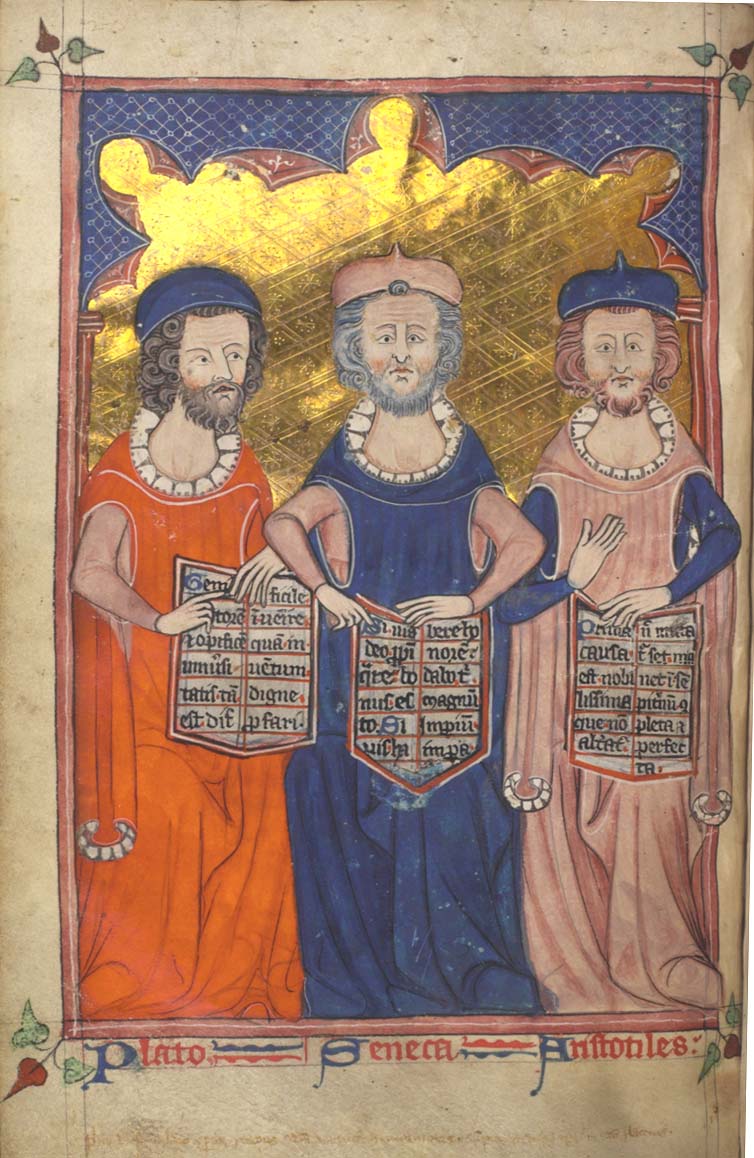 Plato, Seneca, and Aristotle in a fourteenth-century manuscript miniature. The Kitāb al-Nawāmīs used Plato’s name pseudonymously to frame magical experiments as ancient philosophical knowledge. Public-domain image via Wikimedia Commons.
The Book’s Relationship with the Picatrix
The Book of the Cow and the Picatrix belong to overlapping worlds of Arabic occult science, but they are not the same kind of text. The Ghāyat al-Ḥakīm, translated into Latin as Picatrix, is a vast synthesis of astral magic, philosophy, talismanic images, planetary correspondences, ritual substances, and spirit theory. The Kitāb al-Nawāmīs is more heavily organized around experiments in hidden natural properties, generation, perception, and marvelous effects.
Their histories intersect because both participated in Arabic learned magic and later Latin reception. Scholars have noted textual and conceptual relationships within the broader occult corpus. The transmission of one text can help date or contextualize another.
The more important comparison is methodological. Neither book should be treated as a timeless occult manual. Both are products of translation, compilation, and changing intellectual contexts. Arabic sources were reinterpreted by Latin readers who brought Christian theology and scholastic categories to material composed in different religious settings.
This cross-cultural movement is one of the foundations of medieval European magic. What later looks like a self-contained Latin tradition often rests on Arabic scientific and esoteric scholarship.
William of Auvergne: A Theologian Reads the Book
William of Auvergne, bishop of Paris from 1228 to 1249, is one of the earliest important Latin witnesses to the reception of the Liber vaccae. He knew magical and astrological literature and tried to classify its claims within a Christian philosophical framework.
William is especially important because he did not reject every hidden natural property as impossible. He accepted that nature contained powers not obvious to ordinary sense. This made his criticism of the Liber vaccae more sophisticated than simple disbelief.
His objections target the moral and ontological disorder represented by some experiments. Artificial combinations that seemed to violate proper species boundaries or manipulate generation could be condemned even if they were understood as natural rather than demonic.
This reveals a medieval ethics of nature. “Natural” did not mean “morally neutral.” Nature was understood as an ordered creation with purposes and hierarchies. Human art could cooperate with that order, imitate it, or distort it.
Nicole Oresme and the Later Scholastic Critique
The Liber vaccae continued to attract attention after the thirteenth century. Nicole Oresme, the fourteenth-century philosopher and bishop, referred critically to magical mixtures and unusual operations associated with this tradition. His objections help show how learned skepticism about magical causation developed within scholastic natural philosophy.
Oresme was willing to seek natural explanations for marvels. He criticized credulity and recognized that unusual phenomena could arise through causes people misunderstood. Yet he also objected to practices involving disturbing substances or morally unacceptable manipulations.
The important point is that medieval criticism of magic was intellectually diverse. Some attacks were theological; some moral; some natural-philosophical; some skeptical. The same book could be criticized because its effects were impossible, because they were possible but illicit, or because they were deceptive.
This plurality of criticism is one reason the category “medieval superstition” explains so little. Scholars argued vigorously about causes, evidence, and the limits of art.
A Book Read by Clerics, Physicians, and Learned Collectors
The manuscript record shows that the Liber vaccae circulated among educated readers. Copies appear in codices containing medicine, natural philosophy, astrology, and related magical works. The oldest Munich witness belonged at some point to the monastery of Windberg. Other copies survive in learned collections at Oxford, Montpellier, the Vatican, and elsewhere.
This does not mean monasteries endorsed the experiments. Medieval libraries preserved prohibited, controversial, or merely curious works for many reasons. A dangerous text could be copied to refute it, study it, extract harmless material, or because an owner was personally fascinated.
The codicological context is therefore crucial. A magical text copied beside medicine may be classified differently from the same text copied beside necromancy. Marginal notes, ownership marks, missing leaves, and altered titles can reveal readers’ changing judgments.
Maaike van der Lugt’s manuscript study shows that some owners explicitly marked the work as necromantic even though its operations were theoretically natural. The label itself became part of reception history.
Censorship, Loss, and Selective Survival
Magical books often survive incompletely, and the Liber vaccae is no exception. Some manuscripts omit the most controversial material. The Hebrew translation, for example, does not preserve the opening experiments in the same way as the Latin tradition. In at least one Latin witness, material may have disappeared after a medieval index identified a Liber vacce nigromanticus.
We cannot always know whether missing leaves were deliberately removed, lost accidentally, or stolen because someone wanted the forbidden material. That ambiguity is part of manuscript history.
Selective copying also shaped the work’s influence. Later authors could borrow relatively harmless experiments while excluding material involving artificial generation or disturbing mixtures. In this way a condemned text could feed mainstream collections of marvels without being named.
Transmission is therefore not all-or-nothing. Ideas can survive through excerpts even when the parent work is criticized.
The De mirabilibus mundi and the Sanitizing of Magical Knowledge
The anonymous De mirabilibus mundi, later associated falsely with Albert the Great, borrowed material from the Liber vaccae. Yet it did not simply reproduce the entire work. It selected, rearranged, and reframed marvels.
This is a powerful example of textual domestication. A controversial magical source could be mined for recipes or natural secrets that seemed acceptable enough to circulate under the authority of a famous scholastic figure. The most disturbing experiments could be left behind.
The process resembles what happens in many intellectual traditions: radical material becomes respectable through excerpting. Once detached from its original title and context, a recipe may appear as ordinary natural philosophy or a harmless curiosity.
The history of magic is therefore partly a history of hidden citation. Not all influence is acknowledged.
From Arabic into Latin—and Then into Hebrew
The direction of transmission becomes especially interesting when the Latin version was later translated into Hebrew. The work therefore moved from Arabic into Latin and then, in at least one branch, from Latin into Hebrew. This reverses the simplistic assumption that Jewish or Arabic magical material always moved in one direction toward Christian Europe.
The Hebrew witness, preserved in Munich as Codex Hebraicus 214, appears alongside a Hebrew version of the Picatrix. This codex demonstrates how Latin occult translations could re-enter Jewish learned culture in transformed form.
Translation history is not a one-way pipeline from “East” to “West.” Medieval knowledge circulated through loops. A Greek philosophical name could authorize an Arabic magical work; Latin translators could reshape it; Hebrew readers could then encounter that Latinized version.
Such loops make cultural ownership difficult to simplify. The Book of the Cow belongs to no single civilization in isolation. Its surviving form is a product of movement.
Why the Book Became a Problem for the Definition of Science
The Liber vaccae reached Latin Europe during a period when universities were absorbing vast bodies of translated Aristotle, medicine, astronomy, and Arabic philosophy. Scholars were actively defining which forms of causal explanation belonged to legitimate natural knowledge.
A text claiming that hidden material properties could produce spectacular effects was therefore not automatically absurd. Magnetism, medicinal drugs, optical phenomena, and celestial influences all challenged ordinary intuition. The world genuinely contained powers invisible to casual observation.
The difficulty was deciding where credible hidden causation ended. The Liber vaccae exploited exactly that uncertainty. It mixed plausible natural assumptions with extravagant or impossible claims. Its learned style made the boundary harder to police.
In this sense, the book is historically important even where its claims fail. Pseudoscience can reveal the standards of science because it forces a culture to explain why one hidden cause is acceptable and another is not.
What Modern Science Says About the Book’s Claims
There is no scientific evidence that the impossible transformations or artificial beings promised in the Liber vaccae can be produced by its medieval methods. Some sensory effects may have depended on smoke, irritants, psychoactive substances, lighting, suggestion, or ordinary deception, but each claim would need separate analysis.
Premodern theories of spontaneous generation have also been replaced by modern biology. Organisms do not arise through the kinds of mixtures imagined by medieval natural philosophy. Modern developmental biology, genetics, microbiology, and reproductive science provide radically different accounts of generation.
This does not make the book historically worthless. Failed theories can be extraordinarily important. They show what questions people asked, what analogies they trusted, and how they interpreted limited observations.
Scientific caution also protects the text from sensationalism. The Book of the Cow does not become more interesting by pretending its most impossible operations secretly work. Its genuine historical significance is already substantial.
Why the Most Dangerous Experiments Should Not Be Reconstructed
Some historical magic can be studied through harmless reconstruction, such as copying a diagram or examining astronomical timing. The Liber vaccae includes a different class of material. Procedures involving animal harm, bodily fluids, toxic substances, dangerous fumes, or deliberate impairment of perception raise clear ethical and safety problems.
Historical curiosity is not a sufficient reason to reproduce them. Scholars can analyze ingredients, compare manuscripts, reconstruct intellectual context, and examine reception without performing harmful procedures.
This distinction is important for responsible esoteric history. Preserving a text does not require reenacting everything it contains. Museums preserve weapons without using them; historians study poisons without administering them. Magical literature deserves the same ethical maturity.
The safest and most informative approach is to treat these experiments as documents of premodern theories of matter, life, and perception.
A Symbolic Reading: The Cow as a Boundary of Nature
The title Book of the Cow was not the work’s original philosophical name, but it became symbolically powerful because the cow marks the book’s central transgression: ordinary reproductive nature is taken apart and reorganized by human technique.
Symbolically, the animal stands at the boundary between cultivation and creation. Humans have bred, fed, milked, sacrificed, and worked with cattle for millennia. The magical experiment imagines moving one step further—not merely managing life, but redesigning its generative process.
This symbolic reading should not be confused with the text’s historical literal claims. But it helps explain why the book still feels unsettling. It raises a question that remains modern: when does technological control over living systems become the manufacture of forms that challenge existing moral categories?
Medieval theology and modern bioethics use very different concepts, yet both confront the tension between what humans can attempt and what they should attempt.
The Book of the Cow and the Modern Myth of the Homunculus
Modern occult culture often connects the Liber vaccae with the homunculus, the artificial human associated especially with later alchemical legend and Paracelsian reception. There is a family resemblance, but chronology matters.
The Liber vaccae is much earlier than Paracelsus. It contains artificial-generation fantasies that later readers can recognize as precursors to homunculus traditions, but we should not assume a single continuous recipe transmitted unchanged for centuries.
The broader history is one of recurring intellectual possibilities. Once a culture accepts that art can imitate nature and that life emerges from organized matter, the idea of artificial generation becomes thinkable in multiple forms.
The Book of the Cow is therefore important not because it is the one original source of every homunculus legend, but because it documents an early and unusually explicit medieval version of the artificial-life imagination.
How the Work Changes Our Picture of Medieval Magic
Popular images of medieval magic emphasize demons, circles, forbidden names, and grimoires of spirit conjuration. The Liber vaccae offers a different landscape. Its central problem is material nature itself.
This matters because learned magic developed along several causal models. Some traditions invoked angels or demons. Some emphasized astral influences. Some worked through divine names. Others sought hidden virtues in natural substances. The same reader could move among more than one model.
The Book of the Cow demonstrates that natural magic could be as disturbing to theologians as spirit conjuration. A demonless operation might still threaten moral boundaries, species order, or the distinction between art and creation.
That complexity makes the work essential for understanding why medieval “magic” cannot be reduced to one mechanism.
How to Read the Liber Vaccae Historically
A responsible reading begins with manuscript history rather than modern occult editions. Ask which version is being used, whether the passage comes from Latin, Arabic, or Hebrew, and how the manuscript is dated. Distinguish the ninth-century Arabic composition from the late twelfth-century Latin translation and from later copies.
Next, separate attribution from authorship. Plato, Galen, and Ḥunayn belong to the work’s authority narrative; they are not the demonstrated authors of the magical compilation.
Third, compare claims with contemporary natural philosophy. A strange experiment makes more sense when placed beside theories of spontaneous generation, occult qualities, optics, medicine, and alchemy.
Finally, read reception as part of the text. William of Auvergne, Nicole Oresme, manuscript owners, later compilers, and translators all changed what the Book of the Cow meant. A controversial book is partly made by its critics.
Frequently Asked Questions
What is the Book of the Cow? It is the common Latin nickname for the Liber vaccae, a medieval Latin translation of the Arabic Kitāb al-Nawāmīs, a pseudo-Platonic compilation of magical and natural experiments.
Did Plato write it? No. The attribution to Plato is pseudonymous. Modern scholarship places the Arabic work in the medieval Islamicate world, probably around the ninth century.
Why is it called the Book of the Cow? The Latin nickname comes from notorious opening experiments involving a cow. The Arabic title is Kitāb al-Nawāmīs, which can be associated with laws, secrets, or sacred secrets.
Does the Arabic original survive? Only in small fragments. The work is known much more fully through its medieval Latin translation.
When was it translated into Latin? Probably in Spain in the late twelfth century. The oldest surviving complete Latin manuscript dates from around the turn of the thirteenth century.
Is it a demonic grimoire? Not in the straightforward sense. Its operations are usually presented as natural or material rather than as explicit demon conjuration, although medieval readers could still classify the book as illicit magic.
Is it related to the Picatrix? The two works belong to overlapping Arabic and Latin occult environments and have important contextual relationships, but they are separate texts with different structures and emphases.
Did its experiments work? There is no scientific evidence for its impossible claims of artificial generation or extraordinary transformations. Some perceptual or material effects may reflect ordinary physical, pharmacological, or deceptive mechanisms.
Why is it historically important? It became a major test case for medieval debates about natural magic, artificial generation, hidden properties, preternatural marvels, and the moral limits of manipulating nature.
Conclusion: A Magical Book That Forced Europe to Define Nature
The Kitāb al-Nawāmīs and its Latin Liber vaccae are important not because they preserve a secret scientific technology lost to modernity, but because they reveal a world in which the boundaries of nature were still being argued into existence.
The work borrowed Plato, Galen, and Ḥunayn ibn Isḥāq to construct an ancient pedigree. It moved from Arabic into Latin, probably in Spain, and later into Hebrew. Its manuscripts traveled among monasteries, physicians, scholars, and collectors. Its most provocative claims concerned the possibility that hidden natural properties could be used to generate life, alter perception, transform environments, and produce marvels.
Those claims alarmed readers because the book did not always rely on demons. It suggested that nature itself might contain powers capable of destabilizing ordinary categories. The challenge was therefore philosophical as much as theological.
William of Auvergne and later scholastics had to ask whether an effect could be natural yet illicit. Manuscript owners had to decide whether to preserve, label, excerpt, or remove the work. Later compilers could borrow its safer marvels while leaving its disturbing experiments behind.
The result is a history of selective survival. The most sensational recipes made the book infamous, but its deeper legacy lies in the questions surrounding them: Can art imitate generation? Are hidden properties legitimate science? Does producing a marvel mean understanding its cause? When does manipulation of nature violate the order that gives nature meaning?
Modern science has answered many of the book’s factual claims negatively. Its impossible creatures do not belong to biology, and its most extreme transformations do not belong to experimental science. Yet the intellectual problem it dramatizes has not disappeared. Human beings still debate the limits of intervention in living systems, the ethics of engineered nature, and the authority of technical expertise.
For historians of magic, the Book of the Cow therefore deserves a place beside the better-known grimoires. It reminds us that medieval magic was not only about spirits. Sometimes the most unsettling magic was the claim that nature itself could be taken apart, recombined, and made to reveal powers hidden inside matter.
Seen in that light, the Liber vaccae is less a manual of wonders than a medieval argument about the meaning of possibility.
Sources and References
- Maaike van der Lugt, “‘Abominable Mixtures’: The Liber vaccae in the Medieval West, or the Dangers and Attractions of Natural Magic,” Traditio 64.
- Liana Saif, “The Cows and the Bees: Arabic Sources and Parallels for Pseudo-Plato’s Liber vaccae (Kitāb al-Nawāmīs),” Journal of the Warburg and Courtauld Institutes 79 (2016).
- Biblissima, authority record for the Liber vaccae / Liber institutionum activarum Platonis.
- Handschriftenportal, Munich, Bayerische Staatsbibliothek, Clm 22292.
- Bibliotheca Philosophica Virtualis, Liber institutionum activarum: manuscript list and bibliographic record.
- Sarah Ortega, The Liber vaccae/Kitāb al-nawāmīs: Magic in Motion in a Medieval Manual, PhD thesis, University of Leeds, 2020.


