


The Ars Almadel is usually encountered today as a small section of the Lemegeton, or Lesser Key of Solomon: a ritual in which a square wax tablet, four candles, incense, a golden seal, and a set of prayers are used to summon angels belonging to four celestial “altitudes.” Read in that familiar early modern form, the text looks like a compact example of Christian Solomonic angel magic.
Its medieval history is much stranger. Long before the English Lemegeton was assembled, Latin manuscripts preserved works called Almandal, Almandel, or Almadel that scholars now treat as related stages in a changing ritual tradition. The earliest Latin evidence points toward a work translated from Arabic, probably in the twelfth or early thirteenth century. In that older layer, the summoned beings are much closer to jinn and demonic spirits than to the serene Christian angels of the later Ars Almadel. Over time, copyists and redactors altered names, prayers, cosmology, ritual goals, and even the identity of the spirits themselves.
Julien Véronèse’s critical study of the Latin Almandal and Almadel is especially important because it shows that this was not a simple story of one grimoire being copied unchanged. It was a process of rewriting and religious acculturation. A ritual that likely entered Latin Europe through Arabic translation was gradually Christianized. Spirits associated with an Islamic or Arabic magical environment became increasingly angelic. Material that medieval theologians could classify as nigromantia was reworked into a more devotional, theurgic form influenced by the Ars Notoria and other Christian ritual arts.
That transformation makes the Almandal tradition one of the best case studies for understanding how medieval magic actually moved between cultures. Texts crossed languages, but translation did not preserve them like museum objects. Christian scribes interpreted unfamiliar terms, replaced suspect beings, inserted recognizable prayers, altered ritual ethics, and reorganized cosmology. The result was neither purely Arabic nor simply Christian. It was a layered artifact of encounter.
This article reconstructs that development from the medieval Latin evidence to the later English Ars Almadel. It distinguishes the early Almandal from the Christianized Almadel, explains the famous ritual object without turning the article into an operational manual, examines the problem of the word’s origin, traces the role of Solomon, angels, altitudes, images, names, and incense, and shows how the text eventually became part of the Lemegeton. The supernatural claims of the ritual are treated as historical beliefs rather than scientific facts.
 A public-domain magic circle from a 1572 Key of Solomon manuscript tradition. It is not an Almandal diagram, but it illustrates the wider Solomonic manuscript culture in which ritual space, divine names, and geometric forms became central. Via Wikimedia Commons.
What Is the Ars Almadel?
The Ars Almadel is the name most modern readers know from the seventeenth-century English Lemegeton. In that compilation it is usually counted as the fourth of five arts, after the Ars Goetia, Ars Theurgia-Goetia, and Ars Paulina, and before an Ars Notoria section in some arrangements. The surviving English versions describe a square ritual object called an almadel, often made of wax, whose corners are pierced so that candles can support or interact with the object while incense rises beneath it.
The rite seeks contact with angels arranged into four groups associated with four altitudes or celestial divisions. The operator uses prayers, divine names, a seal, colors, and ritual timing. The text presents the beings as angelic and the operation as pious, even while its structure belongs to the technical world of Solomonic ritual magic.
If that were the entire history, the Ars Almadel would be interesting but not exceptional. What makes it historically important is that the early modern English text descends from a much older Latin tradition. Medieval witnesses use several related titles, especially Almandal and Almadel. These versions differ enough that scholars cannot treat them as simple copies of one stable archetype.
The distinction between titles is not merely spelling. Véronèse’s edition shows two major tendencies. The Almandal preserves more traces of an Arabic-derived spirit-conjuration environment, while the Almadel is more thoroughly Christianized and angelic. The later English text descends from the Christianized branch.
The Earliest Latin Witnesses and a Probable Arabic Translation
The medieval Latin West received a large body of scientific, philosophical, astrological, and magical material through translation from Arabic. From the twelfth century onward, scholars working in Iberia, Sicily, southern Italy, and other multilingual zones translated works on astronomy, medicine, mathematics, astrology, talismans, and occult properties. Ritual magic participated in the same movement, although its transmission is harder to document because such texts were often anonymous, pseudonymous, or condemned.
Véronèse argues that numerous linguistic and structural clues in the Almandal tradition point toward an Arabic prototype translated into Latin, probably in the twelfth century. The exact Arabic source has not survived in a form that allows a simple side-by-side reconstruction. That absence matters: historians should say “Arabic-derived” or “translated from an Arabic prototype” rather than pretending that a known Arabic original lies open beside the Latin manuscripts.
Earlier scholarship sometimes proposed more distant origins, including possible Sanskrit or Persian connections. Those hypotheses remain much less secure. The strongest historical evidence concerns the Arabic-to-Latin stage visible in terminology, spirit categories, ritual forms, and the cultural environment of translation.
This pattern resembles the transmission of other magical works. The Latin Picatrix, for example, demonstrably descends from the Arabic Ghāyat al-Ḥakīm. The Almandal case is less textually straightforward, but both traditions show how Latin magic absorbed material that had developed in Arabic-speaking intellectual worlds.
From Jinn and Shayatin to Christian Angels
One of the most revealing features of the textual history is the changing identity of the beings summoned. Sophie Page, summarizing the process of Christian adaptation in medieval magic, notes that versions of the Liber Almandal show jinn and shayāṭīn from Islamic tradition becoming progressively more like Christian angels. This is not a small vocabulary change. It transforms the religious meaning of the rite.
In an Arabic magical environment, jinn occupy a complex category. Islamic traditions describe them as created beings distinct from humans and angels, morally variable and capable of belief, rebellion, deception, or cooperation. Shayāṭīn are more strongly associated with rebellious or harmful spirits. A Christian Latin copyist encountering such categories did not possess a perfect conceptual equivalent.
Latin Christian demonology tended to polarize spiritual beings more sharply into good angels and fallen demons. A translator or redactor therefore faced a theological problem. If a ritual claimed to command ambiguous spirits, it could look like prohibited demonic magic. If the same rite was reframed as petitioning holy angels through divine names and prayers, it could be defended as a form of sacred knowledge—even if authorities still remained suspicious.
The movement from jinn-like spirits to angels is thus a process of doctrinal translation. It is not evidence that medieval Christians simply misunderstood Arabic vocabulary. Redactors actively reorganized the text so that its spiritual population fitted a Christian cosmology.
This process also warns against reading the later Ars Almadel backward. The angels of the English Lemegeton are not proof that the earliest form was always a Christian angelic art. They are the result of centuries of transformation.
Why Medieval Scribes Rewrote Magic
Magic texts were especially vulnerable to religious rewriting because copying them involved risk. A scribe could preserve a text exactly, but he could also remove formulas that looked demonic, substitute saints or angels, translate foreign divine names into familiar forms, add Christian prayers, or reinterpret a ritual goal.
Such rewriting could be practical self-protection. Clerics who owned magical books lived within institutions that condemned necromancy and demonic invocation. A text emphasizing angels, God, purity, and prayer was easier to reconcile with Christian identity than one that explicitly invoked suspect spirits.
Rewriting could also be devotional rather than defensive. Some medieval practitioners sincerely believed that there was a difference between demonic sorcery and legitimate angelic revelation. They did not necessarily think they were disguising magic. They might believe they were purifying a corrupted art.
The history of the Ars Notoria and the later work of John of Morigny shows the same kind of theological negotiation. Ritual structure, unusual names, fasting, prayer, diagrams, and visionary goals could be defended as sacred while remaining controversial. The Almandal tradition belongs to this wider medieval effort to decide which forms of extraordinary knowledge came from God and which came from demons.
The Almandal as a Portable Ritual Object
At the center of the tradition is the object that gives the art its name: the almandal or almadel. In different versions it can be constructed from different materials. Earlier descriptions may involve metal or a figure made upon the ground, while the later Christian Almadel branch emphasizes wax. The English Lemegeton version famously describes a small square wax tablet with openings at its corners.
The object functions simultaneously as diagram, altar, support, and symbolic map. Names and figures are placed upon it. Incense rises beneath or around it. Lights define its corners. The invoked beings are expected to manifest in a space related to the object rather than inside a conventional large magic circle.
Jan Veenstra called attention to the Almandal as an angelic technology serving intellectual goals. The apparatus is important because it compresses ritual space. Instead of constructing an entire ceremonial environment on the floor, the practitioner can use a relatively small portable device.
This portability may help explain the text’s durability. A ritual technology that can be described, drawn, copied, and transported in a manuscript has advantages over a site-specific rite. The book itself becomes a blueprint for rebuilding sacred space.
Because this article is historical rather than instructional, the precise measurements, sequences, conjurations, and operative procedures are not reproduced. The significant point is conceptual: a geometric object could be treated as a meeting place between material craftsmanship, sacred names, celestial order, and visionary expectation.
Is ‘Almandal’ an Arabic Word?
The title has long encouraged etymological speculation because its initial al- resembles the Arabic definite article. Medieval Latin magical literature contains many words whose foreign appearance contributed to their authority. Yet identifying an exact Arabic root is difficult.
Some older explanations treated almandal as if it transparently named the wax tablet itself in Arabic. Modern scholarship is more cautious. The textual tradition supports Arabic transmission, but that does not automatically give us a secure dictionary etymology for the Latinized title.
Words change during oral transmission, transliteration, and manuscript copying. A term can pass through Arabic, Romance, and Latin spellings until its original morphology is obscured. Copyists may also transform unfamiliar words into forms that look meaningful in their own language.
This linguistic instability is important beyond etymology. Medieval ritual texts often treat foreign or semi-foreign words as powerful precisely because they resist ordinary comprehension. Julien Véronèse’s work on performative language shows that shifts between languages and invented sacred vocabularies were central to ritual efficacy in Latin magic.
Accordingly, the responsible position is double: the Almandal tradition bears strong signs of Arabic transmission, but the exact derivation of the title remains uncertain.
Solomon as the Master of Translated Magic
The Almandal is attributed to Solomon, like many medieval ritual books. Historically, the biblical king did not write the surviving Latin manuscripts. The attribution is pseudepigraphic. Its significance lies in what Solomon represented.
Biblical tradition portrays Solomon as a king of extraordinary wisdom. Later Jewish, Christian, and Islamic legends expanded that image, especially around his command of spirits, knowledge of hidden names, understanding of nature, and possession of magical seals. These stories made Solomon the ideal authority for ritual texts that claimed to organize invisible beings.
Attribution to Solomon also made translated foreign knowledge easier to absorb. A rite with Arabic terminology might look culturally alien; a rite presented as the ancient wisdom of Solomon could be imagined as returning to a biblical source that predated Islam and Christianity alike.
This strategy appears throughout Solomonic literature. SecretMagic’s study of the Byzantine Hygromanteia shows another branch of the tradition in which Greek ritual materials were organized under Solomon’s authority. The different texts are not one original book, but Solomon provides a shared legendary center.
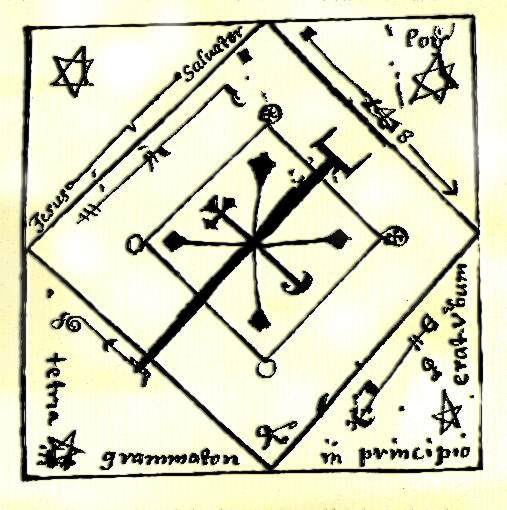 A public-domain diagram from a 1572 Key of Solomon manuscript tradition, combining the Tetragrammaton with explicitly Christian sacred language. Although not an Almadel page, it illustrates the kind of Christianization visible across later Solomonic magic. Via Wikimedia Commons.
From Nigromancy to Theurgy
Véronèse’s description of the textual transformation is especially useful because he frames it as a movement from material that medieval theologians could condemn as nigromancy toward a purified form of theurgy. These terms need careful explanation.
Medieval Latin nigromantia or necromancy did not always mean communication with dead human souls. Learned clerical necromancy often involved conjuring demons through names, circles, prayers, sacrifices, or adjurations. Theologians condemned it because demonic cooperation was understood as spiritually dangerous and because humans had no legitimate authority to compel fallen spirits.
Theurgy, by contrast, is a modern scholarly label often used for ritual intended to reach divine or angelic beings for elevated purposes. Medieval Christian authors did not always use the term in exactly the late antique Neoplatonic sense. In the Almandal context, it helps describe the reorientation from coercive or ambiguous spirit magic toward angelic revelation and sacred knowledge.
The important point is that the same textual skeleton can migrate between categories. A rite may preserve geometry, timing, names, and invocation while changing the theological identity of the beings and the moral explanation of the operation. Classification is therefore historical, not mechanical.
This transformation also undermines the modern assumption that “white magic” and “black magic” are timeless categories. Medieval redactors worked with different distinctions: angel versus demon, licit prayer versus illicit conjuration, divine gift versus pact, natural causation versus spiritual agency.
The Influence of the Ars Notoria
The later Almadel branch shows signs of influence from the Ars Notoria, the medieval ritual art that promised extraordinary learning through prayers, sacred figures, divine names, and angelic assistance. Véronèse specifically connects the Christianized development of the Almadel with the older Notory Art.
This influence matters because it changes the aim of ritual. A demonic conjuration may seek treasure, power, revenge, or practical information. The Ars Notoria focuses strongly on knowledge, memory, eloquence, and intellectual perfection. As Almandal material becomes more angelic, the ritual can be interpreted as participation in a sacred economy of wisdom.
Jan Veenstra’s study, “The Holy Almandal: Angels and the Intellectual Aims of Magic,” emphasizes this learned dimension. The ritual is not merely spectacle. Communication with angels can be imagined as a route to knowledge unavailable through ordinary human study.
That intellectual ambition links the Almadel to a broader family of medieval arts in which magic and scholarship overlap. A university-trained cleric could desire supernatural acceleration of learning while still understanding himself as a Christian intellectual.
What Are the Four Altitudes?
The famous later Ars Almadel divides its angels into four “altitudes.” Modern occult manuals sometimes present these as fixed cosmic zones with perfectly stable names and correspondences. The manuscript history is less tidy.
The term suggests ordered celestial regions or heights, but different witnesses vary in angel names, colors, directions, and associated signs. Copying errors are inevitable in material containing unfamiliar names and diagrams. The concept is more stable than every detail.
The fourfold structure itself is symbolically powerful. Four can map directions, seasons, elements, quarters of the heavens, or other cosmic divisions. In Solomonic ritual, fourfold organization helps transform invisible space into a comprehensible diagram.
Yet historians should resist assuming that every fourfold system in magic descends from one ancient source. Four is a common organizing number in many cultures. What matters is how a particular manuscript explains its own structure.
In the later English Ars Almadel, the altitudes provide a hierarchy of angelic groups and ritual conditions. In earlier Latin material, the cosmological organization participates in a more fluid history of spirit classification.
Angels, Colors, and the Materialization of Heaven
Later Almadel rituals associate different celestial groups with colors and material preparations. This is more than decorative symbolism. Medieval and early modern ritual systems often made invisible distinctions visible through substances.
Color can classify a celestial region. Wax can receive inscriptions. Incense creates an atmosphere that is simultaneously material and symbolic. Light defines sacred space. A seal establishes identity and authorization. These sensory elements make cosmology physically performable.
Such systems should not be described using vague modern language about “frequencies” unless a historical source actually uses an equivalent concept. Medieval authors generally explained efficacy through divine names, celestial influence, spiritual agency, natural virtues, or sacred correspondences.
The ritual object therefore reveals a theory of embodiment: spiritual contact is sought through carefully ordered matter. The operator does not escape the material world; matter becomes the medium through which celestial order is represented.
Incense and the Rising Medium
Incense plays a distinctive role in Almadel traditions because the small altar-like object is arranged so that fragrant smoke rises into the ritual space. In many ancient and medieval religions, incense marks sacred presence, prayer, purification, and offering.
In ritual magic it can serve additional functions. A fragrance may correspond to a planet or spirit class. Smoke makes air visible. It creates a temporary zone in which a manifestation can be imagined or perceived. In some visionary systems, the changing surface of smoke can also encourage visual interpretation.
None of this establishes that incense objectively causes angels to appear. Sensory conditions can influence expectation, attention, and perception. Historians can describe the ritual phenomenology without making supernatural claims.
Theologically, incense also helps Christianize the rite. Incense was familiar from liturgical worship. A practice using prayer, sacred names, light, and incense could resemble church devotion even when its private goal remained outside approved liturgy.
The Ritual Object as a Miniature Cosmos
The almadel can be read symbolically as a miniature cosmos. Its square form creates ordered space; its corners define a world; its inscriptions identify divine authority; its elevated position separates it from ordinary surfaces; its lights establish luminous boundaries; smoke connects below and above.
This interpretation does not claim that every medieval copyist articulated exactly the same symbolic theory. It is a way of understanding why portable geometric devices recur in ritual magic.
A ritual diagram compresses relationships. Instead of explaining celestial hierarchy in paragraphs, the object lets the practitioner inhabit it spatially. Center and edge, above and below, inside and outside become theological categories.
This same principle appears in magic circles, talismanic images, astrological houses, memory diagrams, Kabbalistic trees, and cosmological wheels. The visual form does intellectual work.
For the Almandal tradition, portability adds another dimension. A miniature cosmos can travel with the book that describes it.
Why the Ritual Was Attractive to Learned Clerics
The surviving Latin tradition belongs to the world of literate magic. Its users needed access to manuscripts, Latin, ritual instructions, divine names, and often some understanding of astrology or theology. This already places the art far from stereotypes of purely rural folk magic.
Clerics were particularly well positioned to engage such texts. They knew liturgical language, possessed books, and had training in prayer, exorcism, and sacred names. Those same skills could be redirected into illicit ritual.
This proximity made clerical magic dangerous in the eyes of church authorities. A priest who knew how to bless, adjure, and read Latin possessed the cultural tools needed to construct a convincing private ritual.
At the same time, clerical literacy allowed practitioners to argue that their art was not demonic. They could quote scripture, invoke God, emphasize purity, and classify beings as angels. The battle over legitimacy occurred inside learned Christianity, not simply between Christianity and an external magical culture.
The Almandal and the Liber de Essentia Spirituum
The Almandal tradition can be compared with another medieval work of spirit communication, the Liber de essentia spirituum. That text, preserved in a unique manuscript associated with St Augustine’s Abbey at Canterbury, also reveals a complicated relationship between Arabic-derived spirit lore and Christian ritual interpretation.
Both cases show that the medieval Latin West did not merely receive ready-made “Arabic magic.” Translators and readers negotiated foreign categories through Christian theology.
SecretMagic’s recent study of the Liber de Essentia Spirituum examines that process in a different manuscript environment. The comparison helps separate common historical dynamics from the unique features of each text.
In both traditions, the identity of spirits is central. Translation becomes demonology: deciding what a foreign spirit category “really” is can determine whether a ritual is interpreted as forbidden conjuration or legitimate angelic contact.
The Almandal and the Sworn Book of Honorius
The Sworn Book of Honorius offers another useful comparison. It is also pseudonymously authoritative, strongly Christian, deeply ritualized, and concerned with access to elevated spiritual knowledge.
Yet its structure and history are distinct. The Liber Iuratus is organized around sworn transmission, prayers, complex names, and the pursuit of the divine vision, among other operations. The Almandal centers on a characteristic ritual device and a tradition of summoning spirits or angels through that apparatus.
Placing the texts beside each other reveals a medieval spectrum rather than a single “angel magic system.” Different authors and copyists developed competing ritual technologies for approaching the invisible world.
Their shared Christian language does not mean church authorities approved them. Both illustrate the paradox of medieval ritual magic: the more pious the language becomes, the harder it can be for a modern reader to see why contemporaries might still regard the practice as dangerous.
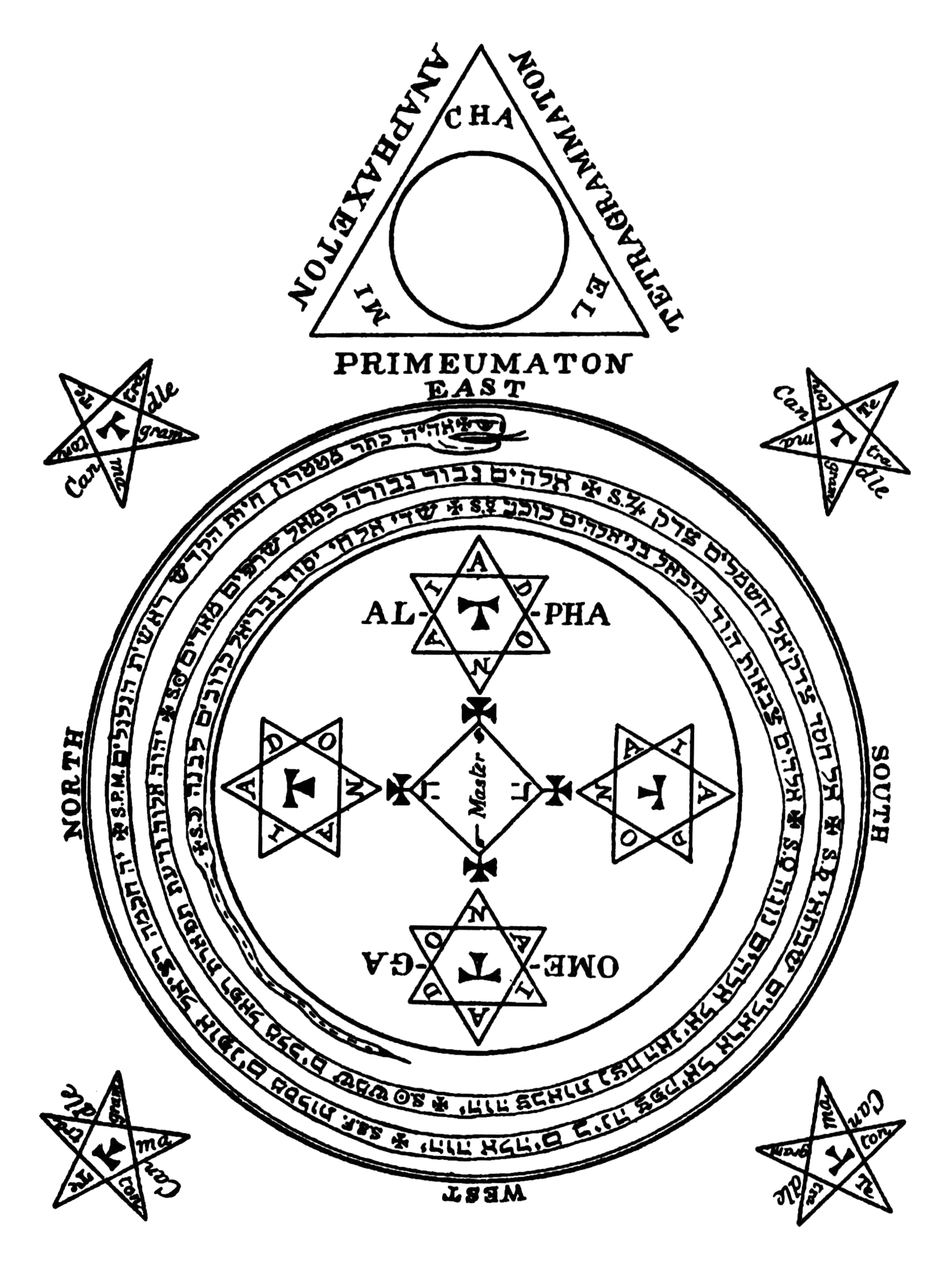 The Circle and Triangle of Solomon from the 1904 Mathers–Crowley Goetia. This image belongs to a different art within the later Lemegeton, not to the medieval Almandal, and is included to show how several formerly independent Solomonic ritual traditions were eventually gathered into one early modern compilation. Public domain via Wikimedia Commons.
How the Almadel Entered the Lemegeton
The Lemegeton Clavicula Salomonis, usually called the Lesser Key of Solomon, is an early modern English compilation rather than a single medieval book written by one author. Its component arts have different histories.
The Ars Goetia, Theurgia-Goetia, Ars Paulina, Ars Almadel, and Ars Notoria were assembled under a Solomonic frame. Some parts drew on printed works, some on manuscript traditions, and some on much older ritual currents.
The Almadel’s presence in this collection is therefore an act of compilation. A medieval tradition already centuries old was inserted into a new English magical encyclopedia.
This editorial act changes how later readers perceive history. Once several arts appear between the same covers, they look like chapters of one ancient system. In reality, their genealogies diverge.
The Lemegeton is thus not simply a source for medieval Almadel practice. It is evidence for the seventeenth-century reception and reorganization of the tradition.
Trithemius and the Reputation of a Forbidden Book
Johannes Trithemius, the Benedictine abbot famous for the Steganographia, listed a book of Almadel attributed to Solomon among suspect magical works in his early sixteenth-century writings. His notice demonstrates that the title had acquired an independent reputation before the familiar English Lemegeton compilation.
Trithemius is valuable as a witness because he stood at the boundary between learned occult interests and explicit condemnation of magical literature. His catalogs of forbidden or suspicious books preserve names that might otherwise have disappeared.
At the same time, a hostile catalog does not tell us the exact contents of every manuscript circulating under a title. Medieval and Renaissance books often share titles while differing substantially.
The reference confirms cultural visibility, not textual uniformity.
What the Hebrew Key of Solomon Adds to the Story
Material related to the Almadel also appears in Hebrew Solomonic contexts, including versions of the Key of Solomon. This complicates any simple one-directional story from Arabic to Latin to English.
Solomonic magic moved through multilingual networks. Hebrew, Latin, Greek, Arabic, Italian, French, and English traditions interacted over centuries. A motif could pass from one language to another and later re-enter a related tradition in altered form.
This kind of circulation is better imagined as a network than a straight line. A family tree is useful for individual manuscripts, but cultural transmission often creates cross-branches.
The result is that similar diagrams or names do not automatically prove direct descent. Scholars compare wording, sequence, ritual logic, errors, and manuscript chronology before proposing relationships.
The Problem of Exact Angel Names
Modern practitioners often seek a definitive list of Almadel angels. Manuscripts resist that desire. Unfamiliar names are among the most unstable elements in handwritten transmission.
A copyist may misread letters, normalize a name toward a familiar angel, split one word into two, or merge separate names. Transliteration from another language adds another layer of distortion.
Ritual texts may also preserve names whose meaning was already unclear to medieval readers. Their opacity could increase rather than diminish perceived sacred power.
For historical study, variant names are evidence. They show transmission paths and moments of adaptation. For claims of exact supernatural technique, however, the variation creates an obvious problem: if efficacy depends on perfect pronunciation, the manuscript tradition rarely gives us certainty.
That tension was not invisible to medieval thinkers. Debates about unknown words and divine names repeatedly ask whether unintelligible speech is holy, demonic, or simply corrupt.
The Almandal and the History of Translation
The Almandal is a case study in translation that goes beyond vocabulary. Translators move cosmologies.
When a jinn becomes an angel, the change is theological. When an Arabic-derived name is interpreted through Latin Christian sacred language, the change is linguistic and doctrinal. When a spirit-conjuration procedure becomes a pious request for angelic knowledge, the change is ethical.
This is why historians increasingly speak of acculturation rather than mere translation. The receiving culture does not passively accept the text; it makes the text intelligible according to local assumptions.
Such transformation occurred across medieval science and philosophy as well, but magic makes the process especially visible because spiritual categories carried high religious stakes.
The Almandal survived partly because it could change.
Was the Almadel ‘White Magic’?
Calling the later Ars Almadel “white magic” is historically imprecise. The phrase belongs to later moral classifications and can conceal the medieval debate.
A Christianized text invoking angels through God’s names may look benevolent to a modern reader, but medieval theologians could still object to unauthorized rituals, attempts to compel spiritual beings, divination, or the use of unknown names.
Conversely, an Arabic-derived rite involving jinn cannot simply be labeled “black magic.” Islamic traditions distinguish moral categories among jinn and different legal or theological judgments concerning occult practices.
The historical question is not which modern color label fits. It is how each community classified spiritual agency, authority, intention, and ritual method.
Does the Ars Almadel Have Anything to Do with John Dee?
Modern occult discussions sometimes connect the Almadel with John Dee because Dee collected magical manuscripts and because later angelic magic shares certain ritual themes. Some writers also compare the almadel table with Dee’s Holy Table.
Direct historical claims require caution. Similar use of tables, divine names, angels, and visionary procedures does not by itself establish that Dee copied the Almadel.
Dee certainly participated in a learned environment where Solomonic, Notory, cryptographic, and angelic materials circulated. SecretMagic’s article on the Book of Soyga shows how deeply he engaged with older magical literature.
The safest conclusion is that the Almadel belongs to the broader ritual culture that made Dee’s experiments possible, while any claim of direct borrowing must be demonstrated from specific textual evidence.
Why the Wax Almadel Became the Famous Version
The wax-table form is memorable because it is visually distinctive. Readers can imagine it immediately: a small square sacred platform, elevated by candles, filled with divine names, with incense rising below.
Visual distinctiveness gives ritual technologies strong afterlives. A paragraph of angelology may be forgotten; a diagram is reproduced.
The seventeenth-century English version also benefited from the later fame of the Lesser Key of Solomon. Modern occult publishers repeatedly reprinted that compilation, especially the Goetia. The presence of the Almadel within the same work gave it a readership far larger than its limited medieval manuscript circulation might otherwise have produced.
This modern visibility can distort historical proportion. The best-known form is not necessarily the earliest or most representative.
Common Misconceptions About the Ars Almadel
Misconception 1: the Ars Almadel began as the fourth book of the Lesser Key. The Almadel tradition is centuries older than the surviving English Lemegeton. Its inclusion there is a later act of compilation.
Misconception 2: the medieval text always summoned Christian angels. Earlier Almandal material preserves stronger Arabic and jinn/demonic features. The angelic form is the result of progressive Christianization.
Misconception 3: we possess the exact Arabic original. Scholarship strongly supports Arabic transmission, but the prototype is not preserved in a simple surviving source that can be identified as the one original.
Misconception 4: Almandal and Almadel are merely spelling variants with identical content. The titles correspond to significantly different textual states and degrees of Christian adaptation.
Misconception 5: every Solomonic diagram belongs to the Almadel. The Key of Solomon, Goetia, Hygromanteia, Almadel, and other traditions have different diagrams and ritual objects. Similar visual language should not erase textual distinctions.
Misconception 6: historical evidence proves the rite produces angelic manifestations. Manuscripts prove that people copied, adapted, and sometimes practiced the rites. They do not scientifically establish supernatural causation.
A Symbolic Reading: The Altar Between Cultures
The almadel can be interpreted symbolically as an altar between worlds in more than one sense.
Within the ritual, it stands between material and spiritual reality. Wax, light, geometry, names, and incense create a physical structure intended to mediate contact with celestial beings.
Historically, the text itself stands between cultures. Arabic-derived categories enter Latin, then become Christian angelology, then enter English Solomonic compilation. The ritual object’s changing form mirrors the text’s changing religious identity.
This symbolic reading should not replace manuscript history, but it helps explain why the tradition is so revealing. The almadel is not only an occult artifact. It is a monument to translation.
Every surviving version answers the same basic question differently: what kind of invisible being may a human legitimately approach, and through what language?
What Modern Practitioners Should Know
Modern practitioners are free to build spiritual systems inspired by historical texts, but responsible reconstruction requires labeling adaptation as adaptation.
A seventeenth-century English Ars Almadel is not a transparent window onto a twelfth-century Arabic rite. A modern diagram redrawn from a printed occult edition is not necessarily identical with a medieval manuscript figure.
Likewise, modern angelology often blends Kabbalah, Golden Dawn correspondences, Renaissance magic, New Age archangel traditions, and Solomonic names. That synthesis may be meaningful, but it is historically later.
The more honestly these layers are distinguished, the more interesting the tradition becomes. Historical complexity does not weaken ritual symbolism; it prevents invented antiquity from replacing real transmission.
Frequently Asked Questions
How old is the Ars Almadel? The tradition behind it reaches back to medieval Latin texts, probably derived from an Arabic prototype translated around the twelfth or early thirteenth century. The familiar English Ars Almadel in the Lemegeton is much later.
What is the difference between Almandal and Almadel? Scholars use the terms to distinguish related textual branches. The Almandal preserves more Arabic-derived and spirit-conjuration elements; the Almadel is more heavily Christianized and angelic.
Was the original written by Solomon? No surviving evidence supports literal authorship by the biblical king. Solomon functions as a pseudepigraphic authority for many magical texts.
Is the almadel always made of wax? No. Different textual states describe different constructions. Wax is especially characteristic of the later Christianized Almadel tradition.
What are the four altitudes? In the later Ars Almadel, they are celestial divisions associated with groups of angels and ritual correspondences. Details vary between manuscripts.
Is the rite demonic or angelic? That depends on the textual stage. Earlier forms contain stronger jinn/demonic features; later Christian forms recast the operation as angel magic.
Is it part of the Key of Solomon? The Ars Almadel was eventually incorporated into the Lemegeton or Lesser Key of Solomon, but it circulated independently before that compilation existed.
Did John Dee practice the Ars Almadel? Dee knew many magical texts and worked within a related angelic-ritual culture, but direct dependence should not be asserted without specific documentary evidence.
Does the ritual scientifically summon angels? There is no scientific evidence demonstrating objective angelic manifestation through the ritual. Its importance is historical, religious, textual, and cultural.
Conclusion: A Grimoire That Changed Its Spirits
The history of the Almandal is a history of transformation. It likely entered Latin Europe through an Arabic-derived ritual environment in which the beings addressed were not simply the Christian angels familiar from later occult books. Latin translators and copyists inherited a text whose spiritual categories did not fit neatly into their theology.
They did not leave the problem untouched.
Across the manuscript tradition, jinn and suspect spirits become angels. Foreign language is reframed through Christian divine names. Ritual goals become more intellectual and devotional. The influence of the Ars Notoria helps move the text toward sacred knowledge rather than straightforward spirit coercion. The ritual object itself changes, eventually becoming the famous wax almadel of the later English tradition.
By the time the art entered the Lemegeton, its medieval instability had been hidden behind a new editorial unity. Readers opening the Lesser Key of Solomon could imagine five arts belonging to one ancient Solomonic system. Manuscript history reveals something richer: independent traditions were gathered together after centuries of separate development.
This does not make the Ars Almadel less authentic as an early modern grimoire. It makes its history more significant. It preserves, in compressed form, one of the central processes of medieval esotericism—the translation of not only words but spirits.
The Almandal crossed from an Arabic-derived magical world into Latin Christianity. To survive, it learned a new theology. To become respectable to some readers, it exchanged dangerous beings for angels. To remain powerful, it kept the prestige of Solomon, sacred names, ritual geometry, incense, and hidden knowledge.
The result is neither purely Islamic nor purely Christian, neither simply necromancy nor simply theurgy. It is a textual record of negotiation.
For SecretMagic readers, that is the real value of the art. The most revealing question is not whether one can reproduce a wax table today. It is how a ritual could cross languages and religions while changing the identity of the very beings it claimed to summon. Few texts show more clearly that the history of magic is also the history of translation.
Sources and References
- Julien Véronèse, L’Almandal et l’Almadel latins au Moyen Âge: Introduction et éditions critiques, SISMEL–Edizioni del Galluzzo, 2012.
- Julien Véronèse, “L’Almandal/Almadel Salomonis: bilan et perspectives d’une recherche,” CNRS–IRHT seminar record.
- Julien Véronèse, study of the rewriting of spirit-invocation rituals in Latin Solomonic traditions, Revue de l’histoire des religions.
- Sophie Page, “Entangled Magic in the Medieval Latin West,” on processes of translation and Christian acculturation in learned magic.
- Gideon Sofer, Conjuring the Arab Magician, Cambridge University Press, 2025.
- Frank Klaassen, “Christian Ritual Magic in the Middle Ages,” History Compass 11.9 (2013).
- The Recipes Project, “Recipes for Magic,” discussion of the Almandal as ritual object in manuscript culture.
- Wikimedia Commons, public-domain Key of Solomon ritual circle, 1572.
- Wikimedia Commons, public-domain Solomonic Tetragrammaton diagram, 1572.
- Wikimedia Commons, public-domain Circle and Triangle from the 1904 Goetia.

