


 Machig Labdrön, the Tibetan yogini associated above all with Chöd, in a nineteenth-century Tibetan painting now in the Rubin Museum collection. Public-domain reproduction via Wikimedia Commons.
Chöd is one of the most dramatic traditions in Tibetan Buddhism, which is precisely why it is so easy to misunderstand. Popular descriptions often reduce it to a lurid formula: a practitioner goes to a cemetery at night, blows a trumpet made from a human thigh bone, summons demons, imagines chopping up the body, and feeds the pieces to terrifying spirits. Every element in that sentence has some relationship to real Chöd traditions, but the summary becomes misleading when the symbolism is separated from Buddhist philosophy, lineage, ritual discipline, and the history of Machig Labdrön.
The Tibetan word gcod means “cutting” or “severing.” What is ultimately cut is not a demon outside the practitioner but the clinging that creates the rigid distinction between “me” and “what threatens me.” The ritual language can be violent because it stages the destruction of attachment to the body and ego. The practitioner visualizes radical generosity: instead of defending the body as the final possession, the body itself becomes an offering. Fear is not conquered by attacking frightening beings but by removing the self-protective grasping that makes them enemies.
This logic is inseparable from Mahāyāna Buddhism, especially Prajñāpāramitā, the “Perfection of Wisdom” literature centered on emptiness, non-grasping, and the bodhisattva path. It also belongs to Vajrayāna, where visualization, mantra, sound, deity yoga, subtle symbolism, and ritual implements can transform perception. Chöd is therefore neither a pre-Buddhist ghost rite with a thin Buddhist coating nor simply a philosophical meditation dressed in theatrical imagery. It is a Tibetan Buddhist synthesis whose history includes Indian tantric and Prajñāpāramitā materials, the teachings associated with Padampa Sanggye, and the extraordinary career of the eleventh- to twelfth-century woman Machig Labdrön.
Machig is especially important because Tibetan traditions remember her not merely as a transmitter of an imported Indian teaching but as a major Tibetan teacher whose Chöd lineages spread widely, including back toward India according to hagiographic tradition. Modern scholarship treats the details of her biography carefully because her life survives through hagiographies composed and transmitted in religious communities. Yet her historical importance is not in doubt. The Treasury of Lives, in a scholarly biography by Michelle Sorensen, dates her to 1055–1149 and situates her within Kadam, Zhijé, and Chöd networks. The Rubin Museum describes her as one of the most prominent female masters and lineage holders in Tibetan Buddhism.
To understand Chöd, then, we need to move beyond the image of “feeding demons” and ask a more historically precise question: how did a Buddhist tradition turn fear, death, the body, and hostile beings into a practice of wisdom and generosity?
What the Word Chöd Actually Means
The Tibetan verb gcod has a broad semantic range connected with cutting, severing, deciding, or breaking through. The University of Virginia’s Tibetan and Himalayan Library glosses Chöd as “cutting” and defines the religious tradition as a practice associated with Machig Labdrön and Padampa Sanggye, based strongly on Prajñāpāramitā and directed toward cutting ego-clinging and the “four māras.”
The word therefore names an action rather than a creed. This matters because Chöd is not a separate Buddhist school in the same institutional sense as Gelug, Sakya, Kagyu, or Nyingma. Chöd lineages traveled through several Tibetan traditions. The Treasury of Lives notes that Zhijé and Chöd teachings weave in and out of multiple Buddhist schools even though Chöd itself did not become the dominant doctrinal system of one great monastic institution.
That mobility helps explain the diversity of Chöd. There is no single ritual sequence used identically by every lineage. “Mother Chöd,” associated especially with Machig, is distinguished in Tibetan historiography from other Chöd transmissions. Later Nyingma treasure traditions, Kagyu traditions, and other lineages developed their own liturgies and commentarial frameworks.
The common thread is severance: cutting the attachment that turns self, body, possessions, reputation, fear, and spiritual achievement into objects of grasping.
Machig Labdrön: History and Hagiography
Machig Labdrön’s name is often translated as something like “Single Mother, Lamp of Lab,” referring to the Lab region associated with her. Tibetan biographies celebrate miraculous signs at her birth, extraordinary intelligence, mastery of Prajñāpāramitā reading, encounters with teachers, visionary experiences, and the establishment of a community at Zangri Kangmar.
Modern scholars distinguish historical probability from hagiographic embellishment without treating the latter as worthless. A saint’s life tells us how a community understood religious authority. Miracles, prophecies, and visionary encounters express what later practitioners believed made Machig exceptional.
The Treasury of Lives records her early training as a reader of Prajñāpāramitā texts for patrons, her study with Drapa Ngönshe and Kyotön Sönam Lama, her relationship with the Indian yogi Topa Bhadra, her children, and her eventual community at Zangri Kangmar. Jerome Edou’s Machig Labdrön and the Foundations of Chöd translated and synthesized important Tibetan biographical and doctrinal materials for English readers, while later scholarship by Sorensen and others has refined the historical picture.
One fact is especially striking: Machig’s religious authority emerged in a Tibetan Buddhist world dominated institutionally by male monastics, yet her lineage became enormously influential. Her gender is not incidental to how she was remembered. She became “Machig,” the One Mother, an authoritative female yogini whose teachings were accepted across sectarian boundaries.
Why Prajñāpāramitā Is the Philosophical Core
Chöd cannot be understood without the Perfection of Wisdom. Prajñāpāramitā literature teaches that persons and phenomena lack the independent, permanent essence that ordinary grasping attributes to them. This is not nihilism. Emptiness means dependent, relational existence rather than self-established substance.
For Chöd, the crucial implication is psychological and ritual. Fear intensifies when “I” is imagined as a solid entity threatened by equally solid external dangers. If the self is understood as dependently arisen, the boundary around what must be defended becomes less absolute.
The practice dramatizes that insight. Instead of merely thinking, “the body is empty,” the practitioner visualizes surrendering the body. Instead of merely thinking, “demons are constructions of mind,” the practitioner invites them to the feast. Instead of suppressing fear, the ritual moves toward the place where fear is strongest.
This is why modern museum descriptions often summarize Chöd as “cutting the ego.” The phrase is useful as long as “ego” is not reduced to ordinary confidence or personality. The target is clinging to a reified self.
The Four Māras: What Is Actually Being Cut?
Tibetan Chöd explanations frequently organize obstruction through the four māras. The Sanskrit māra can designate forces that obstruct awakening. In Buddhist tradition Māra is also personified as the tempter who challenges the Buddha, but the category extends beyond one supernatural being.
Machig’s teachings famously reinterpret demons in psychological and phenomenological terms. External threatening beings matter less than the grasping that makes experiences into enemies. Later summaries describe four forms of māra in ways that distinguish tangible obstacles, intangible or emotional obstacles, the māra of elation or attachment to spiritual experience, and the deepest māra of ego-clinging.
Different texts translate and classify these in slightly different ways. What matters is the movement inward. The most dangerous demon is not the being with fangs in a charnel ground; it is the structure of fixation that makes fear and hope govern the mind.
That shift is one reason Chöd has attracted modern psychological reinterpretation. Yet the historical tradition should not be reduced entirely to psychology. Tibetan practitioners inhabit a cosmology that includes gods, local spirits, protectors, ghosts, and other nonhuman beings. Machig’s genius lies partly in refusing a simple choice between “the demons are real” and “the demons are imaginary.” Whatever appears becomes material for cutting grasping.
Padampa Sanggye and the Zhijé Connection
Padampa Sanggye, an Indian Buddhist master active in Tibet around the eleventh and early twelfth centuries, is central to the history of Zhijé, “Pacification,” and to several Chöd genealogies. Tibetan traditions remember him as traveling repeatedly between India and Tibet and teaching methods for pacifying suffering and obstacles.
The relationship between Padampa and Machig is described differently across sources. Some lineages portray direct encounters; others transmit teachings through intermediaries. The Treasury of Lives notes that Padampa taught a method for cutting demonic obstruction to Kyotön Sönam Lama, who then transmitted it to Machig. Later hagiographies intensify the connection.
Historically, the important point is that Chöd developed within a period of extraordinary translation and exchange between Indian and Tibetan Buddhist worlds. It did not emerge in isolation. Prajñāpāramitā philosophy, Indian tantric ritual, yogic traditions, and Tibetan local religious environments interacted.
Machig’s achievement was to synthesize these materials into a lineage that Tibetans understood as distinctively her own.
Why Machig’s Teaching Was Considered Remarkably Tibetan
Tibetan Buddhist histories are often structured around transmission from India to Tibet. Indian origin carried enormous prestige because India was the land of the Buddha and the source of Sanskrit Buddhist scripture.
Machig’s Chöd is unusual because tradition celebrates it as a Tibetan teaching whose reputation reached India. Hagiographies tell of Indian scholars questioning whether a Tibetan woman could produce authentic Dharma and investigating her teachings. The story culminates in recognition of her doctrine.
Whether every detail of this narrative is historical is impossible to verify. Its ideological meaning is clear. Machig’s authority is so exceptional that the normal direction of Buddhist transmission is reversed.
The story also answers a potential objection: if Chöd is genuinely Buddhist, where is its Indian precedent? The tradition responds by grounding Machig deeply in Prajñāpāramitā while simultaneously insisting that authentic realization can produce new Tibetan expression.
The Body as the Final Possession
Why offer the body?
Buddhist literature contains many stories of radical generosity in which bodhisattvas give flesh, blood, limbs, or even life for others. Jātaka narratives describe previous lives of the Buddha offering the body to hungry animals or sacrificing himself for beings in need. These stories cultivate the perfection of generosity by pushing giving beyond property.
Chöd internalizes and ritualizes this ideal. The practitioner does not physically injure the body. Through visualization, the body is transformed into an inexhaustible feast satisfying every guest.
The symbolic force comes from the fact that the body feels like “mine” in the most immediate way. Giving money can still leave the giver intact. Giving the imagined body strikes at the root of possessiveness.
The Feast Is Not Self-Harm
The visual language of dismemberment makes Chöd easy to sensationalize. It is essential to distinguish visualization from literal violence.
Traditional Chöd is not a prescription for self-injury. The body is visualized as transformed through tantric ritual imagination. It may become nectar, an enormous offering substance, a banquet, or forms appropriate to different guests. The point is generosity and non-attachment, not destruction of physical health.
This distinction is especially important in modern contexts where ritual imagery can circulate without qualified instruction. Historical description should not turn advanced Buddhist visualization into a do-it-yourself harm practice.
White Feast and Red Feast
Many Chöd liturgies distinguish kinds of feast imagery, often described in English as white and red feasts. In simplified terms, the white feast transforms the body into pure nectar or pleasing offerings, while the red feast uses more graphic imagery of flesh, blood, and bodily components.
These are not competing moral levels. They work with different aspects of attachment and perception. Pleasant transformation challenges possessiveness through generosity; shocking transformation challenges disgust, fear, and fixation more directly.
Specific liturgies vary, and the terminology should not be treated as one universal ritual grammar for every Chöd lineage.
Who Is Invited to the Feast?
The guest list can be vast. Chöd liturgies may invite Buddhas and bodhisattvas, lineage teachers, protectors, local gods, karmic creditors, hostile spirits, beings toward whom the practitioner has obligations, and all sentient beings.
This hierarchical hospitality is crucial. The ritual is not merely “feed your demons.” It can include offerings upward toward sources of refuge and generosity outward toward beings across the cosmos.
Hostile beings are transformed by inclusion. Rather than being expelled, they are fed until satisfied. The logic resembles conflict resolution more than warfare.
This offers a fascinating contrast with the Vajrakīlaya and phurba tradition, where wrathful imagery often emphasizes pinning, subjugating, or transforming obstacles. Both belong to Vajrayāna, yet they dramatize awakened activity differently.
Charnel Grounds and the Training of Fearlessness
Traditional accounts associate Chöd with charnel grounds, cremation places, remote valleys, caves, crossroads, haunted ruins, and other frightening locations. The Rubin Museum’s description of a Chöd kangling explains that practitioners historically performed in charnel grounds, where exposure to corpses and death intensified the practice.
The location is pedagogical. A peaceful room allows a person to imagine being fearless. A place associated with death tests the claim.
Charnel grounds already had deep significance in Indian tantric Buddhism. Wrathful deities and yogins are depicted amid corpses, jackals, vultures, flames, bones, and cremation sites. Such environments symbolize impermanence and the transformation of what ordinary society rejects.
Chöd turns that symbolic landscape into practice: go where fear arises, then cut the grasping that gives fear its authority.
The Kangling: Why a Human-Bone Trumpet?
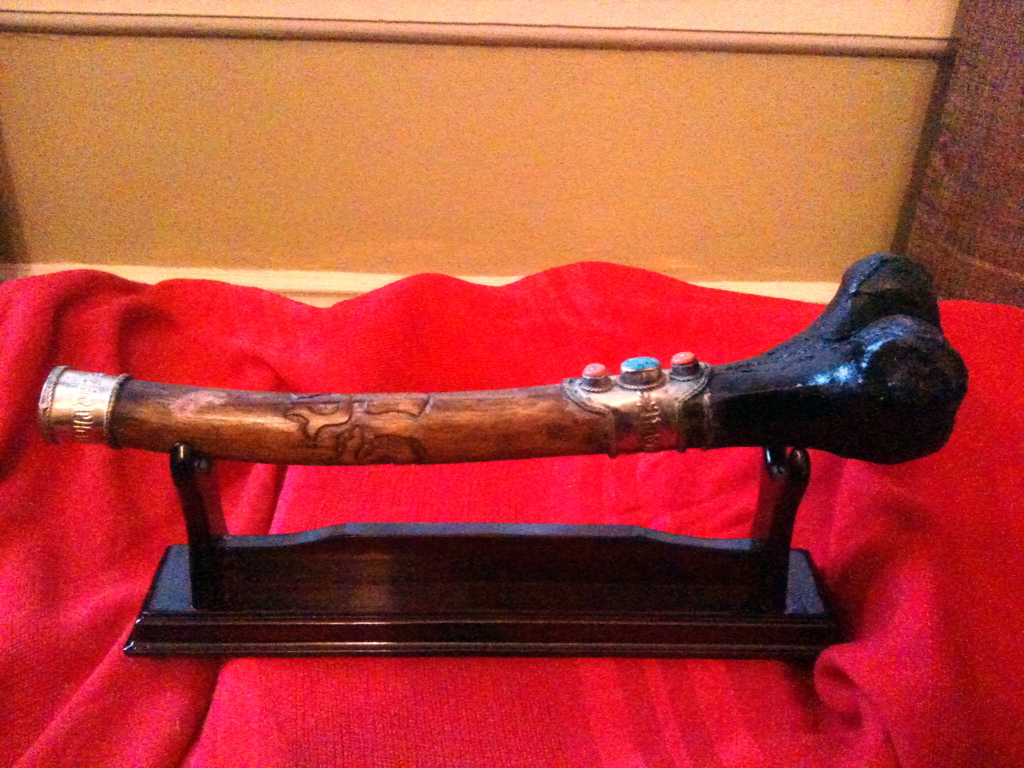 A Tibetan kangling, a trumpet traditionally made from human thigh bone. Photograph by Owlmonkey, licensed CC BY-SA via Wikimedia Commons.
The rkang gling, commonly written kangling, literally means “leg flute” or “leg trumpet.” Traditional examples are made from a human femur or tibia, often fitted with metal ornament. The Rubin Museum preserves an eighteenth- to nineteenth-century example made from human bone, copper, coral, and leather and explicitly identifies it as an implement used by Chöd practitioners.
Its sound has multiple functions. It announces ritual presence, calls beings to the offering, marks the practitioner’s confrontation with death, and creates an acoustic environment very different from ordinary devotional chanting.
Human bone is not used because Buddhism celebrates morbidity for its own sake. Tantric use of bone implements turns death into instruction. The material says what philosophical language says abstractly: bodies are impermanent.
Damaru: Rhythm, Impermanence, and Ritual Structure
 Tibetan drum and trumpet in an illustration published in 1904. Public domain via Wikimedia Commons.
The large Chöd damaru is a double-headed hand drum played by rotating the wrist so that attached strikers hit both drumheads. The Rubin Museum explains that the specialized Chöd drum accompanies the severance practice and that its dissipating sound can symbolize impermanence. The Metropolitan Museum also preserves Tibetan damaru drums used within Buddhist ritual contexts.
Rhythm structures the ritual. Chant, visualization, movement, drum, bell, and trumpet create a coordinated sensory field. Chöd is therefore not simply a silent meditation plus unusual props.
Sound helps transform attention. Repetition stabilizes visualization. Sudden trumpet calls intensify atmosphere. The ritual becomes embodied philosophy.
Why Bone Ornaments Appear in Machig’s Iconography
Paintings often show Machig as a dancing white yogini or ḍākinī wearing bone ornaments. The Rubin Museum describes her in precisely this form, holding ritual instruments and surrounded by deities and lineage figures.
Bone ornaments are common in tantric iconography. They evoke charnel-ground imagery and the transformation of death into wisdom. They also mark a figure as belonging to an ecstatic, nonconventional religious domain rather than ordinary social respectability.
Machig’s dancing body communicates freedom from the very body-clinging her practice seeks to cut.
The Ḍākinī and Female Religious Authority
Machig is frequently represented as a ḍākinī, a complex category in tantric Buddhism encompassing female deities, visionary figures, enlightened manifestations, and women recognized as spiritually powerful.
It would be simplistic to say that the ḍākinī category makes Tibetan Buddhism straightforwardly feminist. Historical institutions remained heavily male-dominated. Women often had fewer educational and monastic opportunities.
Yet Machig’s authority is still extraordinary. A female Tibetan teacher became the source of lineages practiced by male and female yogins across sectarian boundaries. Her biographies portray intellectual mastery rather than merely devotional purity.
This makes Chöd important for the history of women in Buddhism as well as for the history of ritual.
Reading Prajñāpāramitā as Religious Labor
Machig’s early association with reading Prajñāpāramitā texts is especially revealing. In Tibetan societies, literate specialists could recite scriptures on behalf of patrons who sponsored the merit-generating performance.
Scripture was therefore not only studied silently. It was sounded, sponsored, heard, and ritually deployed.
Machig’s transition from reader of Prajñāpāramitā to teacher of Chöd can be understood symbolically: the philosophy she recited becomes the structure of her own practice.
Emptiness moves from page to body.
Emptiness Does Not Mean Nothing Exists
Modern occult descriptions often misunderstand Buddhist emptiness as a claim that the world is unreal in a simple sense.
Prajñāpāramitā reasoning is subtler. Things exist dependently, conventionally, relationally. What they lack is independent, permanent essence.
Chöd therefore does not ask the practitioner to pretend the body does not exist or that pain is meaningless. It targets the extra layer of fixation that says the body is an absolute self.
This distinction is ethically important. Emptiness in Buddhist philosophy is paired with compassion, not indifference.
Why Generosity and Emptiness Must Work Together
Without generosity, emptiness can become abstract metaphysics. Without emptiness, generosity can reinforce the identity “I am the generous giver.”
Chöd fuses the two. The practitioner gives the body while simultaneously examining who gives, what is given, and who receives.
In ideal Mahāyāna terms, giver, gift, and recipient are empty of independent essence.
The feast is therefore both ethical and philosophical.
Demons as Karmic Creditors
Some Tibetan ritual frameworks speak of beings who have karmic claims against the practitioner. Harm done in past relationships creates debt. Whether understood literally across rebirths or symbolically, the idea shifts the moral position of the practitioner.
The frightening being may not be an unprovoked enemy. It may represent a creditor.
Feeding becomes repayment.
This logic reduces the righteousness of aggression and replaces it with accountability.
The Radical Reversal of Exorcism
Many ritual traditions respond to hostile spirits by expelling, binding, threatening, or destroying them. Chöd can reverse this pattern.
The practitioner does not defend the body from the spirit. The body is offered.
The move is strategically paradoxical. If an enemy exists because it wants something from “me,” giving away the very thing “I” defend dissolves the structure of conflict.
This does not mean Tibetan Buddhism lacks exorcistic rites. It has many. Chöd is distinctive because generosity itself becomes a weapon against grasping.
Chöd and the Meaning of “Demon”
The English word “demon” carries Christian and horror-film associations that do not map neatly onto Tibetan categories.
Tibetan ritual worlds include many kinds of beings: gods, protectors, local spirits, obstructive entities, ghosts, serpent beings, oath-bound forces, and classes inherited from Indian Buddhism. Some are dangerous; some are ambivalent; some can be converted or enlisted.
Machig’s teaching pushes the word even further by declaring that anything that obstructs liberation can function as a demon.
A desire for praise may therefore be more dangerous than a frightening apparition.
The Four Demons as a Map of Attachment
- Tangible demons include external objects or situations that provoke attachment and aversion.
- Intangible demons include fear, confusion, emotional disturbance, and internal experiences.
- The demon of elation appears when spiritual success itself becomes an object of pride or attachment.
- The demon of ego-clinging is the root fixation that constructs an inherently existing self.
Terminology varies by translation and lineage, but the structure is powerful: spiritual practice can create new demons if attainment becomes identity.
Why Chöd Can Look Terrifying and Still Be Compassion Practice
Vajrayāna often uses wrathful images in a Buddhist ethical framework. Skulls, severed heads, weapons, flames, and charnel grounds do not automatically signify hatred.
The same is true in SecretMagic’s article on the phurba and Vajrakīlaya: wrathful visual language can symbolize decisive transformation rather than literal violence.
Chöd goes further by making the practitioner the offered victim. Aggression is turned inward against clinging, then outward as generosity.
The terrifying surface and compassionate purpose belong together.
Is Chöd a Shamanic Survival?
Older comparative literature sometimes described Chöd as “Tibetan shamanism,” often because of trance-like performance, spirit encounters, bone instruments, cemeteries, and local deities.
The comparison can illuminate certain structural features but becomes misleading if it implies Chöd is merely a pre-Buddhist ritual preserved under Buddhist vocabulary.
The textual and philosophical framework is deeply Buddhist. Prajñāpāramitā, bodhisattva generosity, tantric deity practice, refuge, lineage, and mantra are not superficial additions.
Local Tibetan spirit traditions certainly shaped how Buddhism developed in Tibet, just as Buddhist practice reshaped local religious categories. Cultural interaction is more plausible than a simple hidden-survival theory.
Chöd and Bön
Chöd practices also developed within Bön traditions, Tibet’s other major institutional religious tradition. This demonstrates the ritual’s adaptability across sectarian boundaries.
But Buddhist and Bön Chöd should not be collapsed. Lineages, deities, scriptures, and doctrinal frameworks differ.
The existence of Bön Chöd is better understood as evidence of a shared Tibetan religious environment in which powerful ritual forms could be adapted and reinterpreted.
Why the Practitioner Goes to Frightening Places
Fear reveals attachment efficiently.
In ordinary conditions, a practitioner may believe they have overcome clinging. A cemetery at night, an isolated mountain pass, or a place associated with spirits exposes how quickly the mind creates threat.
Traditional biographies often praise practitioners who deliberately seek difficult places rather than comfortable retreat settings.
The aim is not thrill-seeking. The environment functions as a diagnostic instrument.
Chöd as Exposure to Fear—But Not Modern Exposure Therapy
Modern psychologists sometimes compare Chöd with exposure therapy because both involve approaching feared stimuli rather than avoiding them.
The analogy is interesting but historically limited. Chöd was not developed from clinical behavioral science, and exposure therapy does not require Buddhist cosmology, deity visualization, or body offering.
Still, the structural resemblance helps modern readers understand why deliberately entering frightening settings could reduce fear under disciplined conditions.
Comparison should clarify mechanism without claiming historical identity.
Modern Psychological Adaptations
Contemporary teachers have adapted Chöd-inspired ideas into psychological methods, most famously Lama Tsultrim Allione’s “Feeding Your Demons.” Such methods reinterpret demons as addictions, fear, self-hatred, jealousy, perfectionism, and other obstructive patterns.
These adaptations can be valuable modern practices, but they should not be presented as the complete historical Chöd liturgy of Machig Labdrön.
Historical Chöd includes refuge, lineage, tantric ritual, Buddhist cosmology, offerings, mantra, instruments, and doctrinal commitments that secular adaptations often simplify.
Modern reception is part of the tradition’s afterlife, not a transparent window into the eleventh century.
Chöd Is Not One Standard Script
Because English readers often encounter one translated liturgy, it is easy to imagine that all Chöd practitioners perform one fixed ceremony.
Tibetan history shows otherwise. Mother Chöd lineages, Kagyu Chöd, Nyingma treasure Chöd, Gelug transmissions, Sakya contexts, and Bön adaptations developed different ritual cycles.
Some emphasize specific deities. Some use more elaborate feast visualizations. Some are integrated with protectors or lineage practices.
“Chöd” names a family of severance traditions rather than one immutable script.
The Lineage Is Part of the Technology
Modern occult culture often treats ritual instructions as detachable information: if one has the words and objects, one has the practice.
Vajrayāna traditions generally reject that assumption. Transmission, empowerment where required, oral instruction, and relationship with teachers are treated as part of efficacy and correct understanding.
Chöd is no exception. Public historical study can explain symbolism without claiming that explanation substitutes for lineage training.
This boundary is especially important because some Chöd practices are advanced tantric liturgies rather than generic mindfulness exercises.
Why the Ritual Can Be Public and Esoteric at Once
Chöd performances may occur in communal settings and can be highly audible. Drums, bells, chanting, and kangling are not secret in the ordinary sense.
Yet Vajrayāna esotericism often distinguishes between seeing the outer performance and understanding the inner practice. Visualization, identity, initiation, and subtle ritual meaning may remain restricted or require instruction.
Esoteric does not always mean physically hidden.
A ritual can be public to the ears and still private in its interpretive depth.
Chöd and the Buddhist Critique of Sacrifice
At first glance, offering one’s body resembles sacrifice. But the ritual is imaginary, and the ethical structure differs from killing another being.
Buddhist traditions generally prohibit taking life. Chöd solves the problem of maximum generosity without requiring an actual victim.
The body is visualized, transformed, and distributed while the practitioner remains alive to continue the bodhisattva path.
Visualization allows sacrifice to become ethical theater.
The Body Becomes Nectar
In many liturgies the visualized body does not remain flesh in an ordinary biological sense. It is transformed into nectar or inexhaustible substances suitable to each recipient.
This matters because the ritual is not merely a horror image of cannibalism.
Tantric visualization changes the ontology of the offering. What begins as attachment to one limited body becomes limitless generosity.
The feast is abundant because awakened generosity is imagined as inexhaustible.
The Skull Cup and the Transformation of the Body
Skull cups appear frequently in tantric imagery and in depictions of Machig. They symbolize the transformation of death, impurity, and ordinary identity into ritual offering.
The skull is literally what remains when much of personal appearance disappears. In tantric symbolism, it can become a vessel of wisdom rather than a sign of horror.
Like the kangling, the object reverses ordinary avoidance of death.
What society rejects becomes a support for awakening.
Impermanence as Sensory Knowledge
Buddhists can read thousands of pages about impermanence while still behaving as though the body will last indefinitely.
Chöd’s material culture makes impermanence sensory. Bone can be held. The trumpet can be heard. Charnel grounds can be smelled and seen. The imagined body can be dismantled.
This is not anti-intellectualism. It is pedagogy.
Ideas become embodied so that understanding penetrates beyond conceptual agreement.
Fear, Disgust, and Attachment
Fear is not the only emotion Chöd confronts. Disgust also protects identity.
People distinguish clean from unclean, self from corpse, edible from repulsive, sacred from polluted. Tantric imagery deliberately destabilizes some of these categories.
The goal is not to abolish ordinary hygiene or ethical boundaries. It is to expose how quickly aversion becomes metaphysical certainty.
A charnel-ground image asks whether awakening depends on maintaining psychological distance from death.
Why Chöd Is a Practice of Hospitality
One of the least sensational but most illuminating ways to understand Chöd is as radical hospitality.
Every being is invited, including the beings the practitioner least wants to meet.
The host offers the best possible food and refuses to exclude enemies.
This transforms the ritual from horror into ethics. The test of generosity is whether hospitality extends to the unwanted guest.
Chöd and the Logic of Debt
Tibetan ritual culture often imagines karmic relationships as networks of debt and obligation. Beings harmed in the past may appear as obstructors in the present.
Instead of asking only “How do I remove this obstacle?” Chöd asks “What if I owe something?”
The body feast becomes compensation at the most radical scale.
The question changes from defense to responsibility.
Why the Practice Is Called Cutting Rather Than Feeding
Modern English presentations often foreground “feeding demons” because the phrase is memorable. Traditional naming foregrounds cutting.
The difference is revealing. Feeding is a method; cutting is the goal.
The practitioner does not feed hostile beings simply to make them nicer. The act cuts self-clinging, fear, dualistic fixation, and attachment to spiritual security.
Without that severance, the feast can be reduced to imaginative therapy.
Machig’s Own Demon Teaching
Later Chöd literature attributes to Machig the teaching that anything which blocks liberation is a demon. This formulation became one of the tradition’s most influential interpretive keys.
Its power lies in refusing easy externalization.
A person can spend years fighting supernatural enemies while preserving the deepest obstruction—the self that needs enemies.
Chöd redirects attention toward that hidden structure.
Why Spiritual Pride Becomes a Demon
The “demon of elation” is especially sophisticated because it identifies success as danger.
Fear can trap the practitioner, but so can visions, reputation, charisma, confidence, and the belief “I am spiritually advanced.”
Esoteric traditions are particularly vulnerable to this problem because extraordinary experiences can become social capital.
Machig’s framework turns attainment itself into another object to cut.
Chöd and the Marketplace of Miracles
Historical Tibetan religious specialists could gain reputation for healing, exorcism, prophecy, weather control, and protection. Chöd practitioners also acquired stories of extraordinary powers.
Hagiographies naturally amplify such accounts.
Yet the doctrine creates an internal critique: attachment to miraculous reputation is another obstacle.
The tradition therefore contains both charismatic miracle narrative and a philosophy warning against clinging to charisma.
Was Machig a Sorceress?
Calling Machig a sorceress imposes a category foreign to her own religious identity.
She was remembered as a Buddhist teacher, yogini, lineage founder, Prajñāpāramitā practitioner, and ḍākinī-like figure.
Her ritual repertoire deals with spirits and frightening imagery, which places her naturally in comparative histories of magic. But “sorcery” can imply antisocial or coercive practice that does not capture Chöd’s goals.
Comparative vocabulary should illuminate without replacing native categories.
Chöd and Tibetan Medicine
Traditional Tibetan societies did not sharply separate religious, medical, astrological, and ritual approaches to suffering. A person facing illness might consult physicians, perform protective rites, commission prayers, seek divination, or address suspected spirit obstruction.
Chöd practitioners could be called in contexts of illness or haunting, but Chöd should not be presented as a substitute for medicine.
Its primary transformation concerns attachment and ritual relationships, even when healing is expected.
Historical coexistence does not make every ritual a medical treatment.
Why Chöd Survived Across Sectarian Boundaries
A practice survives when multiple communities find it useful and interpretable.
Chöd’s Prajñāpāramitā foundation gave it doctrinal legitimacy. Its powerful ritual aesthetics gave it practical and emotional force. Its lineage through Machig provided charismatic authority. Its flexibility allowed integration with different tantric systems.
The result was unusual longevity without a single centralized institution.
Chöd became portable.
The Ritual and the Road
Chöd has often been associated with itinerant yogins who traveled to remote places carrying a relatively compact set of implements.
This portability differs from rituals requiring large temples, elaborate mandalas, or substantial communities.
A drum, bell, kangling, texts, and trained visualization can travel.
The practitioner turns the landscape itself into ritual space.
Remote Places as Teachers
Mountains, caves, burial grounds, and abandoned places remove ordinary social reassurance.
There is no crowd confirming identity, no household routine, no familiar protection.
For a practice aimed at cutting ego-clinging, this deprivation is useful.
The environment exposes dependency on comfort and reputation.
The Chöd Practitioner as Performer
Chöd is often intensely performative. The practitioner sings liturgical poetry, plays instruments, changes tempo, and constructs a vivid sequence of visualizations.
Performance does not mean insincerity. Religious traditions frequently use theatrical form to create real transformation.
Sound, gesture, and imagery allow doctrine to be enacted rather than merely stated.
The ritual is philosophy performed through the body.
Women in Chöd Lineages After Machig
Machig’s prominence did not create full gender equality in Tibetan Buddhism, but it offered a powerful female model of realization and authorship.
Later women could invoke her as lineage source. Nuns, yoginis, and lay practitioners participated in Chöd traditions, while male teachers also transmitted her teachings.
The lineage therefore complicates any simple claim that Tibetan ritual authority was exclusively male.
Machig’s image remained a living argument for female spiritual capacity.
How Art Remembers Machig
Paintings usually show Machig dancing rather than seated rigidly like a scholar. Her white body, flowing hair, bone ornaments, damaru, bell or kangling, and dynamic pose make her recognizable.
This visual vocabulary condenses biography into iconography. She is learned, but the painting emphasizes realized freedom rather than manuscript study.
The Rubin Museum’s nineteenth-century Machig painting also includes Prajñāpāramitā and lineage figures, visually placing her inside the Buddhist intellectual and tantric worlds that produced Chöd.
Iconography is therefore theology in compressed form.
Chöd and the Modern Wellness Market
In global spirituality, Chöd can be repackaged as trauma release, shadow work, demon integration, fear therapy, or empowerment.
Some adaptations are created by trained Buddhist teachers; others are loosely inspired.
These modern forms reveal the flexibility of Chöd’s central metaphor, but they can remove karma, refuge, bodhicitta, lineage, and emptiness.
A practice can be useful in translation while no longer being identical to its source tradition.
Why “Shadow Work” Is Not an Ancient Tibetan Term
Jungian “shadow” language provides one modern way of interpreting rejected or feared psychological material. Chöd can resemble shadow work because it turns toward what is feared.
But Machig did not teach Carl Jung’s psychology eight centuries before Jung.
The concepts arise from different intellectual worlds.
Comparison is legitimate; retroactive identity is not.
What Chöd Shares with Other Buddhist Protective Traditions
Chöd exists within a Buddhist world where sacred sound, mantra, dhāraṇī, ritual objects, deity visualization, and merit transfer are widespread.
SecretMagic’s article on Buddhist dhāraṇī shows how protective formulas could be spoken, copied, printed, worn, and deposited as relic-like objects.
Chöd differs in method but shares the larger Buddhist assumption that speech, visualization, material objects, and disciplined intention can transform religious conditions.
It is not an isolated strange survival at the edge of Buddhism.
What Chöd Does Not Share with Every Vajrayāna Practice
At the same time, Chöd’s body offering, charnel-ground emphasis, Machig lineage, large hand drum, and kangling create a distinctive ritual identity.
Not every Tibetan Buddhist uses these instruments. Not every tantric practice asks the practitioner to visualize bodily dismemberment. Not every lineage seeks frightening places.
“Tibetan Buddhism” is not one ritual system.
Specificity protects against exotic generalization.
Five Myths About Chöd
“Chöd is a ritual for literally feeding demons with flesh.”
No. The body offering is visualized. The practice is directed toward cutting attachment and cultivating generosity, not physical self-injury.
“Machig Labdrön invented everything from nothing.”
No. Her tradition draws deeply on Prajñāpāramitā, Indian tantric Buddhism, and teachings linked with Padampa Sanggye, while Tibetan tradition also recognizes her distinctive synthesis and lineage authority.
“Chöd proves Tibetan Buddhism is really shamanism.”
No. Comparative shamanic language may illuminate some practices, but Chöd is deeply embedded in Buddhist philosophy, tantra, refuge, bodhisattva ethics, and lineage.
“A kangling is used because Tibetan Buddhists worship death.”
No. Human bone functions as a direct reminder of impermanence and as a ritual instrument in tantric contexts. Death is confronted to transform attachment, not worshipped for its own sake.
“Feeding Your Demons is the complete ancient Chöd ritual.”
No. It is a modern Chöd-inspired adaptation. Historical Chöd lineages include much broader liturgical and doctrinal frameworks.
What We Can Say with Confidence
- Machig Labdrön was a major historical Tibetan Buddhist teacher. Her life is known through hagiographic traditions that require critical reading, but her lineage significance is secure.
- Chöd means cutting or severance. The central target is attachment, especially ego-clinging.
- Prajñāpāramitā is foundational. Chöd is not intelligible apart from emptiness, non-grasping, and bodhisattva generosity.
- Body offering is visualized rather than literal. The ritual transforms possessiveness into generosity.
- Charnel grounds and frightening places are historically significant. They create conditions in which fear and attachment become immediate.
- Specialized instruments are characteristic. The large damaru and kangling structure Chöd performance in many lineages.
- The tradition is plural. Chöd moved through multiple Tibetan Buddhist schools and also developed in Bön contexts.
What We Should Not Claim
We should not claim that every story in Machig’s hagiography is independently verifiable historical biography. We should not claim that all Tibetan spirits are psychological projections. We should not claim that the ritual is merely an exorcism, merely therapy, or merely philosophy. We should not reconstruct restricted liturgical details from museum objects alone. And we should not turn human-bone instruments into proof of a “dark” religion.
The evidence supports something more interesting: a sophisticated ritual tradition that deliberately occupies the boundary between terror and generosity.
Why Chöd Matters for the Comparative Study of Magic
Chöd challenges common assumptions about magical power.
Power need not mean domination. The practitioner can gain freedom by giving rather than controlling. The frightening being can be transformed through hospitality rather than expulsion. The strongest protective act can be the surrender of the fantasy that the self can be permanently protected.
In comparative perspective, this creates an unusual ritual logic. Many magical traditions seek stronger boundaries around the practitioner. Chöd experiments with loosening the boundary itself.
That difference makes it especially valuable for a history of esoteric practice.
Chöd as Anti-Exorcism
Calling Chöd “anti-exorcism” is not a traditional label, but it highlights the reversal.
Exorcism says: leave my space. Chöd says: enter, and be fed.
Exorcism protects the body. Chöd gives the body away in imagination.
Exorcism identifies an invader. Chöd asks what attachment creates the category “invader.”
The reversal is not absolute—Tibetan lineages also contain coercive rites—but it captures Chöd’s distinctive ethical imagination.
The Deepest Cut: The Spiritual Self
The final target is not ordinary identity but spiritual identity.
A practitioner who becomes proud of fearlessness has created a new attachment. A practitioner who believes they possess secret power has created another. A practitioner who uses Chöd to prove superiority has turned the medicine into poison.
This is why the demon of ego-clinging remains after external demons have disappeared.
The practice cuts even the person who says, “I have cut through.”
Conclusion: Feeding Is the Method, Cutting Is the Point
Chöd survives in modern imagination because its imagery is unforgettable: a white yogini dancing with a drum, a trumpet made from human bone, cemeteries and mountains, wrathful beings gathered for a feast, the practitioner’s own body transformed into an offering.
But the imagery becomes intelligible only when returned to its Buddhist framework.
Machig Labdrön’s tradition rests on Prajñāpāramitā: the insight that self and phenomena do not possess the independent solidity that grasping assigns to them. It rests on Mahāyāna generosity: the bodhisattva ideal of giving without limit. It rests on Vajrayāna ritual imagination: the capacity to transform body, sound, space, fear, and perception into a path. And it rests on lineage: teachings transmitted, adapted, and interpreted across centuries.
The demon feast is therefore not the center by itself. It is a method of severance.
The practitioner moves toward what is feared and offers what is most defended. The body that seems to guarantee identity becomes food. The hostile being that seems to threaten identity becomes a guest. The frightening place becomes a training ground. The sound of bone and drum becomes a reminder that everything assembled will disintegrate.
Machig’s radical claim is that the deepest demon is grasping itself.
This is why Chöd cannot be reduced to “Tibetan demon magic,” even though it belongs naturally in the comparative history of ritual and esotericism. Its power lies in reversing the ordinary magical instinct to build a stronger fortress around the practitioner. Instead of asking how to make the self invulnerable, Chöd asks what happens when the self we defend is examined so deeply that the fortress is no longer necessary.
Historically, that question allowed a Tibetan woman of the eleventh century to become one of the most enduring lineage figures in Himalayan Buddhism. Ritually, it turned death imagery into generosity. Philosophically, it transformed emptiness from an idea into an embodied confrontation with fear.
And that is why “feeding demons” is only half the story. The feast is offered so that something more fundamental can be cut: the conviction that there is a solid self at the center of experience who must win every battle.
Sources and References
- Michelle Sorensen, “Machik Labdron,” The Treasury of Lives: Treasury of Lives.
- Rubin Museum of Himalayan Art, “Machik Labdron (1055–1153),” object C2010.3: Rubin Museum.
- Rubin Museum of Himalayan Art, “Leg Bone Trumpet (Kang Ling),” object SC2019.3.2: Rubin Museum.
- University of Virginia, Tibetan and Himalayan Library, definition and lexical resources for gcod: Mandala Collections.
- Jerome Edou, Machig Labdrön and the Foundations of Chöd, Snow Lion Publications, 1996.
- Sarah Harding, Machik’s Complete Explanation: Clarifying the Meaning of Chöd, Snow Lion Publications, 2003.
- Himalayan Art Resources, “Machig Labdron,” lineage and iconographic record: Himalayan Art Resources.
- The Metropolitan Museum of Art, “Damaru,” Tibetan, nineteenth century, object 1980.354a,b: The Met.
- Wikimedia Commons, “Machig Labdron, the Tibetan Yogini – Google Art Project,” public-domain reproduction: Wikimedia Commons.
- Wikimedia Commons, “Kangling example,” CC BY-SA: Wikimedia Commons.
- Wikimedia Commons, “Plate 7 Tibetan Drum and Trumpet,” public domain: Wikimedia Commons.


