


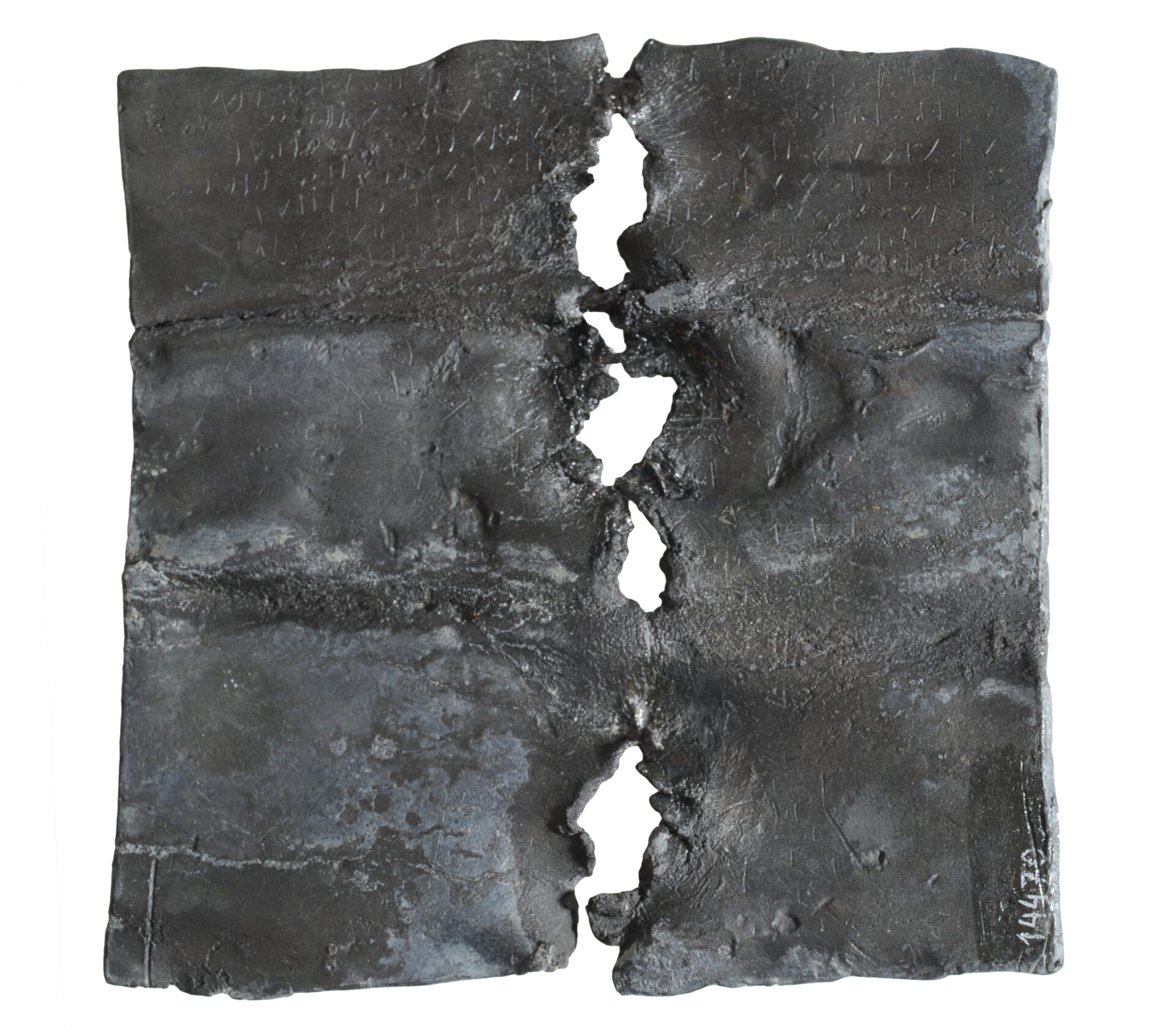
 Lead curse tablet X 14470 from Athens, dated 345–335 BCE, National Archaeological Museum of Greece. The tablet was wrapped and pierced before deposition. Image courtesy of the National Archaeological Museum.
Ancient Greek and Roman curse tablets are among the most intimate documents to survive from the classical world. They preserve voices that formal histories rarely record: litigants frightened about a trial, athletes anxious about rivals, lovers attempting to control desire, victims of theft demanding restitution, merchants competing for customers, and ordinary people who believed that a written object could carry a grievance into the domain of gods and the dead. Archaeologists and historians usually call these objects defixiones, from Latin terminology associated with binding or fastening, while Greek texts often use words related to katadesmos, a binding-down spell.
The popular image is simple: someone scratches an enemy’s name onto lead, drives a nail through the sheet, and throws it into a grave. Real evidence is more varied. Some tablets were pierced; many were not. Some ask a deity to immobilize an opponent, while others resemble petitions for justice. Some name professional rivals, courtroom adversaries, thieves, lovers, horses, charioteers, or entire groups. Some are written carefully in ordinary language; others use reversed writing, magical signs, drawings, divine names, or deliberately distorted scripts. Their locations also vary: graves, wells, sanctuaries, baths, arenas, and other places understood to provide access to supernatural powers.
What unites them is not one universal spell but a ritual technology that combined writing, material, deposition, divine address, and social conflict. A curse tablet was not merely a hostile sentence written on metal. Its physical treatment mattered. The sheet could be folded, rolled, pierced, nailed, buried, immersed, or placed beside a corpse. The location could make the message available to underworld deities or other powers. The words could bind a tongue, memory, body, business, performance, or legal strategy. The tablet therefore functioned simultaneously as text and object.
This article examines what historians can actually say about Greek and Roman curse tablets, how the technology developed, why lead became its characteristic material, what kinds of conflicts generated curses, how gods and the dead were involved, and why modern labels such as “black magic” often obscure more than they explain.
What Is a Defixio?
A defixio is conventionally defined as an inscribed object, very often a thin sheet of lead, intended to constrain, bind, disadvantage, punish, or otherwise affect a person through supernatural means. The Latin scholarly term derives from defigere, which can mean to fasten, fix, or transfix. Greek examples often employ verbs of binding, especially forms related to katadeō, “I bind down.”
The category is useful but not perfectly tidy. Ancient practitioners did not all belong to one organized cult called “curse-tablet magic,” and the surviving objects span many centuries and regions. A fifth-century BCE Athenian judicial binding and a fourth-century CE Christianized curse from the eastern Mediterranean may share material habits while differing greatly in theology, language, and social setting.
Scholars therefore increasingly study curse tablets as a family of related ritual technologies rather than a single fixed tradition. Christopher Faraone, David Jordan, Henk Versnel, John Gager, Esther Eidinow, and many other specialists have shown that texts must be read alongside archaeological context and material treatment. The 2022 University of Chicago volume The Materiality of Greek and Roman Curse Tablets makes this point explicit: earlier scholarship often concentrated on deciphering inscriptions while treating the lead itself as a passive carrier. Current work asks how folding, corrosion, piercing, placement, and manufacture contributed to ritual meaning.
How Old Is the Practice?
The earliest securely identified Greek curse tablets appear in the archaic and early classical periods, especially from the late sixth and fifth centuries BCE. Sicily is exceptionally important. Selinous and other Sicilian sites have produced early lead curses whose language and archaeological setting demonstrate that the technology was already established outside Athens. Recent Cambridge scholarship stresses that Sicilian evidence should not simply be treated as a provincial imitation of an Athenian model.
By the classical and Hellenistic periods, curse tablets are widely attested across the Greek-speaking Mediterranean. Under Roman rule, the practice continued and expanded through Latin as well as Greek contexts. Tablets appear in Italy, Britain, Gaul, North Africa, the Balkans, Asia Minor, Egypt, and elsewhere. They remained in use into late antiquity, when Christian, Jewish, Egyptian, and traditional Greco-Roman elements could coexist or interact within ritual texts.
There is no reason to assume that written curses invented hostile ritual. Oral maledictions, prayers against enemies, oaths, and symbolic acts are much older than the surviving tablets. What changed was the combination of writing and durable material. As recent work in Greece & Rome argues, curse tablets emerged from the convergence of technologies: metallurgy, literacy, letter writing, contractual practice, and oral cursing. Writing allowed a hostile speech act to persist after the speaker had left.
Why Lead?
Lead became the characteristic material because it offered practical and symbolic advantages. It was comparatively inexpensive, soft enough to inscribe with a stylus, easy to cut into thin sheets, and durable in soil or water. A person did not need a professional stonecutter to scratch names and commands onto it.
But practicality is only part of the story. Ancient and modern interpreters have also connected lead with heaviness, coldness, dull color, baseness, and the underworld. Cambridge research on the sensory materiality of curses notes that the coldness and “deadness” of lead could participate in the desired effect: a victim’s tongue, activity, or power might metaphorically become as cold or inert as the deposited metal.
We should avoid pretending that every practitioner consciously followed one theory of lead symbolism. Some may simply have used the standard material available for the genre. Yet the repeated physical manipulation of lead suggests that material qualities were meaningful. A curse did not merely happen to be written on metal; the metal helped make the curse what it was.
Writing as Ritual Action
In ordinary literacy, writing records speech or information. In a curse tablet, writing could itself become an operation. To inscribe someone’s name was to isolate that person as a target. To write “I bind” was not merely to describe a future action; the inscription could perform the binding.
This resembles what linguists call a performative utterance: words that accomplish something by being spoken or written in the correct context. Ancient ritual, however, adds divine and material dimensions. The text works because it is addressed, deposited, and embodied.
Some tablets intensify the relationship between script and desired outcome. Letters may be reversed so that the victim’s affairs are likewise reversed. Names may be crossed out, repeated, distorted, or enclosed. A tablet may be folded so the words become hidden. The physical fate of the text models the intended fate of the target.
The University of Chicago materiality project is especially valuable here because modern imaging has shown details that older editions missed. Multispectral photography and computational processing can recover faint scratches, while conservation reveals folds, nail holes, corrosion, and manufacturing traces. The curse is increasingly studied as an archaeological performance rather than only a transcription.
Binding the Body
Many Greek curses use formulaic lists of body parts or capacities. A litigant might ask that an opponent’s tongue, mind, hands, feet, speech, memory, or plans be bound. An erotic spell might target desire, sleep, appetite, sexual organs, or the ability to remain away from the petitioner.
Such lists can sound violent, but their ritual logic is precise. The practitioner identifies the functions that allow an opponent to succeed and symbolically disables them. In court, speech and memory are weapons. In sport, limbs and coordination matter. In commerce, reputation and customers matter. In love, attention and desire matter.
The curse therefore maps social competition onto the body. Binding a tongue is a supernatural strategy for controlling rhetoric. Binding hands can obstruct work or action. Binding thought attacks planning itself.
Judicial Curses
Legal conflict produced a major class of curse tablets. Courtrooms in classical cities depended heavily on oral performance. Litigants and witnesses needed to remember arguments, speak persuasively, and respond under pressure. A person facing a dangerous opponent might therefore seek supernatural assistance by binding the opponent’s tongue, memory, witnesses, or advocates.
These objects complicate the modern division between law and magic. The same person could prepare a legal case, recruit supporters, consult social networks, and also deposit a curse. Ritual did not necessarily replace practical action. It supplemented it.
Cambridge research on Sicilian legal curses describes them as “paralegal” instruments embedded in civic rivalries. That formulation is useful. A curse tablet could operate beside formal law, attempting to influence the uncertain human contest that law created.
Athenian Political and Social Networks on Lead
A striking Athenian tablet now highlighted by the National Archaeological Museum of Greece dates to approximately 345–335 BCE. It was found near a sanctuary of Zeus Meilichios along the Sacred Way. The lead sheet contains more than a hundred names and binding language on both sides. The named individuals include people from varied social categories, illustrating how a single curse could map a network rather than target one isolated enemy.
Such tablets are historical evidence even when their supernatural claims cannot be verified. Names, professions, relationships, dialect, handwriting, and findspots reveal social worlds. A curse can preserve people who would otherwise be invisible.
The tablet also reminds us that ancient magic was not necessarily marginal. The targets could include politically active or economically significant people. Ritual hostility participated in civic life.
Competition in Business
Shops, workshops, taverns, and other businesses could become targets of binding. In highly competitive urban economies, success depended on customers, reputation, supply, and social connections. A practitioner might ask that a rival’s establishment lose business or that customers turn elsewhere.
These curses are not evidence that ancient merchants relied only on magic. They are evidence that economic anxiety could be ritualized. When the reasons for success or failure are uncertain, supernatural explanation becomes attractive.
The same logic appears in later magical traditions: commerce creates measurable stakes but unpredictable outcomes, making it fertile ground for ritual attempts to control uncertainty.
Athletic and Circus Curses
Sport and spectacle generated another important category. Competitors, horses, charioteers, and teams could be named and bound. Late antique circus curses are sometimes elaborate, invoking divine or demonic powers to make horses stumble, drivers lose control, or rivals fail.
These texts belong to a world of intense fandom, gambling, patronage, and public identity. A chariot race was not merely entertainment. Teams could attract enormous loyalties and financial stakes.
Ritual aggression reflects the emotional economy of competition. The curse attempts to transform uncertainty into controlled failure.
Erotic Binding
Love magic is one of the most sensationalized parts of the corpus. Some erotic tablets seek attraction, separation, or sexual compulsion. Their language can be coercive by modern standards, and responsible discussion should not romanticize that fact.
Ancient erotic magic was not one genre. Some rites aim to draw a desired person toward the practitioner; others attempt to separate a couple; still others express jealousy or revenge. Gender patterns vary across texts and periods.
What matters historically is that desire could be conceptualized as something externally manipulated. Sleeplessness, burning, wandering, inability to eat, and obsessive longing appear as ritual goals. The desired person’s body becomes the field on which the spell is imagined to operate.
The Oxyrhynchus Love Charm and Material Assemblage
The University of Oxford’s Oxyrhynchus project provides an unusually vivid example of how texts could belong to larger ritual assemblages. A second- or third-century CE ceramic bowl from a cemetery at Oxyrhynchus bears a love charm intended to attract Matrona, daughter of Tagene, to Theodorus, son of Techosis. Oxford notes that the same text appears on two lead defixiones found with it.
Another bowl in the group contained an extended love charm written on papyrus and wrapped around two humanoid wax figures holding one another. This archaeological context is crucial. It shows that lead tablets, pottery, papyrus, figurines, cemetery deposition, and written formulae could work together.
A “spell” was not necessarily one text. It could be an assemblage of objects and actions.
Figurines and Sympathetic Binding
Some binding rites use small human figures pierced with nails or needles, tied, twisted, or placed with inscribed tablets. Modern popular culture immediately compares these with “voodoo dolls,” but that label is historically misleading and unfair to distinct Afro-Caribbean religions.
The better concept is sympathetic or analogical action. The figurine represents a target; manipulating the representation models the desired effect on the person.
Greek and Roman ritual traditions did not need a later Caribbean precedent to develop this logic. Similar representational acts occur independently across many cultures because the conceptual move is straightforward: what is done to the image is intended to affect what the image represents.
Why Fold the Tablet?
Many curse tablets were folded or rolled before deposition. Folding protects and conceals the inscription, but concealment may itself be ritual.
A hidden text becomes inaccessible to ordinary human readers while remaining available to supernatural recipients. Folding can also physically enclose the names, reinforcing the concept of binding.
Modern conservation complicates interpretation because unfolding ancient lead can damage it. Scholars must balance the desire to read inscriptions against preservation. Non-invasive imaging increasingly allows researchers to examine surfaces without destructive handling.
Why Pierce It with a Nail?
The nail is iconic, but not universal. Some tablets were pierced through after inscription; others have holes that may relate to suspension or fastening; many have no nail at all.
When deliberate piercing is clear, it may intensify the semantics of fixing or transfixing. The target is not merely named but materially pinned.
Still, a nail should not automatically be interpreted as sadistic symbolism. The ancient vocabulary of binding includes fastening, and nails are practical fastening devices. Ritual meaning may grow from ordinary technology.
Graves and the Dead
Graves are among the most famous deposition sites. Why place a curse with the dead?
One explanation is communication. The dead inhabit or approach the underworld and can carry a message toward chthonic deities. People who died prematurely or violently were sometimes thought especially restless and therefore useful as intermediaries.
Some spells explicitly address a dead person or supernatural powers associated with the grave. Others simply use the cemetery as a liminal location.
The practice should not be reduced to “necromancy” in every case. Depositing a tablet in a grave does not necessarily mean attempting to summon and converse with the corpse. The dead may function as messengers, guardians, witnesses, or points of access.
Wells, Springs, and Water
Water is another major deposition environment. Wells and springs provide depth, concealment, and connection to divine or chthonic powers. Lead survives well in such conditions, which also helps explain archaeological recovery.
Recent scholarship emphasizes the sensory logic of watery deposition: cold, depth, darkness, and permanence could reinforce binding. Throwing a tablet into a well removes it from ordinary circulation and sends it into a vertical space beneath the living city.
Water could also belong to a sanctuary, making deposition an offering or petition rather than mere disposal.
 Roman lead defixio from London, British Museum 1934,1105.1. The inscription binds Tretia Maria’s life, mind, memory, speech, and internal organs. Photograph by Marie-Lan Nguyen, CC BY 2.5, via Wikimedia Commons.
The Bath Curse Tablets
The Roman sanctuary at Bath, ancient Aquae Sulis, produced one of the most important collections of curse tablets in the western Roman Empire. Many concern theft. Petitioners ask the goddess Sulis Minerva to punish people who stole clothing, money, or other possessions, sometimes offering the stolen property to the goddess so that the thief effectively becomes liable to divine justice.
These texts challenge the assumption that every curse is secret criminal aggression. A victim of theft could understand a curse as a legitimate appeal to a deity when human enforcement failed.
Henk Versnel famously distinguished such “prayers for justice” from purely malicious binding, although the categories overlap. The Bath tablets show why moral labels must be used carefully. To the petitioner, divine punishment may have been justice rather than evil magic.
Curse or Prayer for Justice?
Consider two scenarios. In one, a litigant secretly binds an innocent rival’s speech to win a case. In another, a person whose cloak has been stolen asks a goddess to torment the unknown thief until it is returned.
Both may be written on lead and deposited in sacred or hidden places. Yet their ethical self-understanding differs.
Versnel’s work drew attention to texts in which petitioners explain an injury, name a wrongdoer if known, and appeal to divine authority. These resemble complaints or petitions. They often ask for punishment proportional to a perceived offense.
The distinction is not absolute. A prayer for justice can be terrifyingly punitive. But it reminds us that “curse tablet” is a modern umbrella category.
Gods of the Underworld
Greek tablets frequently invoke chthonic deities such as Hades, Persephone, Hermes in an underworld aspect, Hecate, or other powers associated with the dead. Late antique texts may combine Greek, Egyptian, Jewish, and other divine names.
The choice of deity depends on function and context. Hermes can serve as messenger and guide between worlds. Persephone and Hades govern the realm where many tablets are deposited. Hecate is associated with crossroads, ghosts, and nocturnal ritual in various sources.
But no single “god of curse tablets” existed. The pantheon of binding is plural and historically changing.
Sulis Minerva and Local Religion
Bath demonstrates how curse practice adapted to local cult. Sulis was a local goddess identified with Roman Minerva. The combined name Sulis Minerva reflects the religious negotiation of Roman Britain rather than the simple replacement of one deity by another.
Petitioners addressed the power available at the sanctuary. This is a general principle of ancient magic: ritual technologies travel, but they are localized through gods, languages, and institutions.
A lead tablet from Britain can therefore look structurally familiar to a Greek katadesmos while belonging to a different religious landscape.
Magical Names and Characteres
Later tablets sometimes include strings of unusual names, voces magicae, or non-alphabetic signs often called characteres. These features also occur in the Demotic and Greek magical traditions of Roman Egypt.
Such signs should not be dismissed as nonsense. Their opacity can be part of their authority. A name unknown to ordinary speech may be imagined as a divine or secret name. A sign that cannot be read like prose may function visually, ritually, or cryptographically.
At the same time, not every strange sequence has a recoverable meaning. Scholars distinguish identifiable divine names from corrupt transmission, scribal error, invented sounds, and deliberately esoteric language.
Reversed and Distorted Writing
Some tablets write text backwards or distort names. The Getty Museum Journal has discussed examples in which reversed writing parallels the intended reversal of a victim’s affairs. Other texts conceal the practitioner’s identity while clearly naming targets.
This is ritualized literacy. Writing is manipulated because its visual form matters.
The same principle appears in other magical traditions where letters are arranged geometrically, repeated, reduced, mirrored, or transformed. The script is not only a vehicle for semantic content; it is an image and action.
Professional Magicians or Do-It-Yourself Curses?
Who made these tablets? The answer varies.
Some inscriptions are crude and could have been scratched by ordinary individuals. Others display sophisticated formulae, specialized signs, careful layouts, or close parallels with magical handbooks, suggesting professional assistance.
Ancient literary sources mention ritual experts who sold spells and purification services. Archaeological evidence also shows repeated formulae that may derive from templates.
We should therefore imagine a spectrum: personal improvisation, borrowed formulas, semi-professional specialists, and highly trained ritual practitioners.
Magical Handbooks and Curse Recipes
Late antique papyri preserve instructions for manufacturing binding spells. These recipes illuminate archaeological tablets because they specify materials, names, figurines, divine invocations, and deposition procedures.
One famous recipe in the Greek Magical Papyri has close parallels on actual tablets found in Egypt. Cambridge scholarship notes this correspondence as evidence that handbook traditions and deposited objects were connected.
Yet surviving handbooks are much later than the earliest classical tablets. We cannot simply project a fourth-century CE Egyptian manual backward onto fifth-century BCE Athens. The recipes demonstrate continuity in some techniques, not an unchanged universal system.
Secrecy and Public Knowledge
Curse tablets were often hidden, but the practice itself was not unknown. Ancient literature refers to binding magic, and people feared magical attacks. Laws and moral criticism occasionally addressed harmful ritual.
This creates a paradox: the individual operation may be secret while the technology is culturally recognizable.
Secrecy protects the practitioner and prevents interference. It also enhances the object’s liminal status. Once deposited, the tablet leaves the human social world and enters a divine archive.
The Curse Tablet as a Letter
One of the most illuminating comparisons is with letter writing. Many tablets have an addressee, a named subject, a request, and an expected action. They are messages sent to supernatural recipients.
Recent scholarship suggests that the development of curse tablets may have drawn partly on documentary habits. Contracts, petitions, lists, and letters taught people to imagine writing as durable delegated agency.
A letter allows someone absent to act at a distance. A curse tablet extends that principle beyond human communication.
The Curse Tablet as a Contract
Some tablets resemble legal documents in structure. Names are listed, obligations are specified, and property can be transferred symbolically to a god. Theft curses at Bath sometimes dedicate stolen goods to Sulis, making divine ownership the basis for punishment.
This contractual logic blurs boundaries between religion, law, and magic. The petitioner does not merely shout anger into the universe. The complaint is formalized.
The power of writing lies partly in bureaucracy: names and claims become fixed.
The Curse Tablet as an Archive
Laura Nasrallah’s recent Cambridge study of ancient Christians and curses draws attention to deposition as a kind of archival practice. Wells and shafts containing many tablets can resemble supernatural repositories. Each petitioner adds a document to a hidden collection.
This metaphor is especially productive at sites where dozens of tablets accumulate. The location becomes a divine filing system of grievances.
Unlike a civic archive, however, the documents are meant for nonhuman readers.
Can We Know Whether People Believed the Curses Worked?
The existence of a tablet proves that someone participated in a practice, not exactly what that person believed.
A practitioner might have possessed strong supernatural conviction, anxious hope, social habit, or a “nothing to lose” attitude. Ritual participation does not reveal private psychology with certainty.
Repeated investment of time and materials nevertheless shows that the technology was meaningful. People copied formulas, sought specialists, traveled to deposition sites, and concealed objects. These actions exceed casual joking.
Historical method can document practice without claiming to prove supernatural efficacy.
Did Curse Tablets Cause Death?
Some texts ask for severe suffering or death. That does not demonstrate that supernatural forces killed the targets.
Modern historical and scientific methods can establish that people created ritual objects intended to harm others. They cannot verify magical causation from a later misfortune.
Coincidence also creates powerful confirmation. If a cursed rival later becomes ill, loses a case, or dies, believers may interpret the event as success. Failures are less likely to be remembered.
Studying belief responsibly requires separating historical fact from metaphysical claim.
Why “Black Magic” Is an Inadequate Label
“Black magic” is a modern moral category with a complicated history. Applied indiscriminately to ancient curse tablets, it creates several problems.
First, some petitioners understood themselves as victims seeking justice. Second, public and private religion overlapped with practices modern people classify as magic. Third, ancient societies did not organize ritual according to one universal white-versus-black binary.
A judicial binding intended to silence an opponent is aggressive. A theft petition asking a goddess for punishment is also aggressive. Historians can describe coercion without pretending that all practitioners shared a later occult taxonomy.
Magic and Religion Were Not Opposites
Curse tablets invoke gods, sanctuaries, offerings, prayer, and concepts of divine justice. Calling them “magic” does not mean they existed outside religion.
Modern scholarship often treats magic as a contested social category rather than a natural substance. Practices may be labeled magical when they are private, coercive, unauthorized, foreign, secret, or technically specialized. The same culture may approve one divinatory or protective rite and condemn another.
Ancient curse tablets are particularly useful because they expose the inadequacy of a simple opposition between religion and magic.
 Fragments of a lead curse tablet dated around 400 CE, displayed in the Altes Museum, Berlin. Photograph by Gary Todd, dedicated to the public domain under CC0 via Wikimedia Commons.
Christians and Curse Tablets
Curse practices did not disappear when Christianity spread. Late antique texts can contain Christian names, biblical language, crosses, angels, or invocations alongside older ritual structures.
Laura Salah Nasrallah’s work demonstrates that ancient Christians participated in worlds where curses remained materially and socially powerful. Christian authors condemned harmful magic, but lived religion was more complicated than official doctrine.
Religious change often transforms ritual technologies rather than instantly erasing them.
Jewish and Egyptian Elements in Late Antique Binding
Late antique magical texts sometimes invoke names understood as Jewish, Egyptian, Greek, or Christian. The Greek Magical Papyri are especially famous for such combinations, and SecretMagic has explored related hybridity in studies of Sefer ha-Razim and the magical papyri.
Modern readers should resist describing this simply as random syncretism. Ritual experts selected names because they carried authority. A foreign or archaic divine name could be powerful precisely because it sounded specialized.
The result is not a harmonious universal religion but a practical repertoire assembled within multilingual societies.
Archaeological Context Changes Interpretation
A tablet purchased on the antiquities market loses much of its historical value because its original location is unknown. A tablet excavated scientifically from a grave, well, sanctuary, or bath preserves relationships that help reconstruct ritual.
Context can tell us whether many curses were deposited together, whether they accompanied burials, whether they cluster around a particular deity, and how they relate to surrounding architecture.
This is why modern archaeology values provenience as much as inscription.
Modern Imaging and the Recovery of Faint Texts
Lead corrodes, folds crack, and shallow scratches can become nearly invisible. Older scholars sometimes read tablets under ordinary light and produced uncertain transcriptions.
Reflectance transformation imaging, multispectral photography, high-resolution microscopy, and computational enhancement now allow specialists to distinguish strokes from corrosion. The University of Chicago’s materiality project documents how these methods improve both palaeography and conservation.
Technology does not eliminate interpretation, but it gives scholars better evidence.
What a Curse Tablet Can Tell Us About Literacy
Curse tablets complicate assumptions about ancient literacy. Some are grammatically polished; others contain spelling errors, phonetic writing, uneven letters, or awkward layouts.
These variations may reflect different educational levels, professional scribes, second-language writers, or changing spoken language.
Because curses often preserve informal names and language, they can be valuable evidence for historical linguistics. A hostile magical document may tell us how ordinary people pronounced Latin or Greek more clearly than an elite literary manuscript does.
Women, Slaves, Foreigners, and Social Visibility
Formal ancient literature disproportionately preserves elite male voices. Curse tablets sometimes widen the social field. Women appear as petitioners and targets. Slaves, freedpeople, immigrants, prostitutes, artisans, and people identified only by personal relationships can enter the record.
This does not make the corpus democratically representative. Preservation is accidental, and many tablets are anonymous. But the genre captures conflicts below the level of grand political narrative.
Magic becomes a source for social history.
Ethics: Studying Coercion Without Romanticizing It
Ancient magic is often aestheticized as mysterious or empowering. Curse tablets demand a more careful response because many are attempts at coercion.
A spell designed to make someone sexually obsessed, silence a witness, destroy a competitor, or inflict illness expresses a wish to override another person’s agency. Historical distance should not erase that.
At the same time, moral judgment should be informed by context. A theft victim appealing to a deity is not identical to a jealous rival seeking harm. The corpus contains aggression, fear, desperation, revenge, justice-seeking, and competition.
What Curse Tablets Are Not
They are not all nailed through.
Piercing is real but not universal. Folding, rolling, and simple deposition are also common.
They are not all written by professional sorcerers.
Some show specialist knowledge; others look personal or improvised.
They are not all death curses.
Many aim to restrain speech, business, athletic performance, affection, or legal success rather than kill.
They are not evidence that everyone in antiquity believed the same thing.
Practices varied across regions and centuries, and ancient intellectuals could criticize magic.
They are not “voodoo.”
That comparison collapses distinct histories and misrepresents Afro-Caribbean religions.
They do not prove supernatural efficacy.
They prove ritual intention, material practice, and belief environments.
How Curse Tablets Relate to the Greek Magical Papyri
The Greek Magical Papyri preserve recipes for many operations, including binding, attraction, divination, protection, and ritual encounter with gods. Some late antique curse tablets closely parallel recipes in those handbooks.
But the corpora are not identical. The earliest Greek lead bindings predate the surviving magical papyri by centuries. Curse tablets are deposited artifacts; magical papyri are often manuals or collections of recipes. One tells us what was actually placed in the ground or water; the other can tell us how specialists conceptualized procedures.
Used together, they reveal both practice and instruction.
How Curse Tablets Relate to Amulets
Amulets and curse tablets can share materials, divine names, signs, and ritual language, yet their typical orientations differ. An amulet is usually carried, worn, or placed to protect or benefit its owner. A curse tablet is usually deposited to affect someone else.
The boundary is not absolute. Protective texts may attack hostile forces, and justice curses may protect a victim by punishing a thief. Still, the distinction helps explain why amulets remain close to the body while curses often disappear into hidden places.
One is retained; the other is sent.
The Technology of Sending
This idea of sending may be the most useful way to understand deposition.
The practitioner writes a message, transforms it materially, and places it where supernatural recipients can receive it. A grave sends it downward. A well sends it into sacred depth. A sanctuary delivers it to a deity. A racecourse places it near the site where the desired effect should occur.
The tablet’s disappearance from ordinary view is part of its activation.
Why Curse Tablets Matter for the History of Magic
Few ancient magical practices are documented by so many objects created by practitioners themselves. Literary authors often describe magic from outside, sometimes mockingly or polemically. Curse tablets are different. They are artifacts of actual operations.
They preserve the intersection of literacy and ritual, emotion and technology, religion and conflict. They show that ancient magic was not merely a set of abstract beliefs. It involved buying or obtaining lead, preparing a surface, writing names, folding or piercing the object, traveling to a deposition site, and physically surrendering the object to a hidden environment.
Magic here is labor.
A Responsible Modern Reconstruction of Meaning
Modern readers sometimes ask how to “perform” an ancient curse tablet. Historical study should distinguish reconstruction from revival. The evidence allows us to describe ancient techniques, but reproducing coercive rites against real people raises ethical issues and tells us little about whether ancient supernatural claims were true.
A more productive exercise is analytical reconstruction: identify the target, desired restriction, divine addressee, material metaphor, deposition site, and social conflict. This reveals the internal logic without turning scholarship into instructions for harassment.
The purpose of historical esotericism is not to flatten every artifact into a usable modern spell. Sometimes understanding the past requires allowing it to remain past.
Conclusion: Written Conflict Sent Below
Greek and Roman curse tablets survive because lead is durable, but their historical importance lies in something less tangible: they preserve attempts to manage uncertainty through ritualized writing.
A courtroom opponent might speak too well. A rival shop might attract customers. A lover might choose someone else. A thief might never be caught. A horse might win the race. Ancient people faced these uncertainties with ordinary strategies—law, persuasion, competition, negotiation—and sometimes with supernatural ones.
The curse tablet transformed anxiety into an object. A name could be scratched into metal. A grievance could become a formal petition. A rival’s tongue could be symbolically bound. A stolen cloak could be transferred to a goddess. A sheet could be folded until its words vanished from human sight, pierced to intensify its fixing, and dropped into a grave or well where divine powers were expected to receive it.
This ritual technology was remarkably adaptable. It appeared in archaic Sicily, classical Athens, Hellenistic cities, Roman Britain, imperial arenas, and late antique religious environments. Its gods changed. Its languages changed. Its formulas expanded. Yet the core idea remained powerful: writing could carry agency beyond the writer.
The tablets also challenge easy distinctions. They are magical objects that invoke recognized gods. They can be private acts embedded in public law. They can express malicious competition or desperate appeals for justice. They can resemble letters, contracts, prayers, and legal petitions while remaining something different from all of them.
Most importantly, they restore emotional texture to ancient history. Behind each scratched name was a relationship. Behind each folded sheet was a problem someone could not fully control. Behind each deposition was a hope that hidden powers might intervene where ordinary human power seemed insufficient.
For historians, the supernatural result remains unprovable. The human act is undeniable. Someone wrote the words. Someone folded the lead. Someone carried it to a place of ritual significance and let it disappear.
Two thousand years later, archaeology has brought many of those hidden messages back into the light.
Sources and References
- Sofía Torallas Tovar and Raquel Martín Hernández, eds., The Materiality of Greek and Roman Curse Tablets: Technological Advances, Institute for the Study of Ancient Cultures, University of Chicago, 2022: ISAC.
- Christopher A. Faraone, “Curse Tablets: The History of a Technology,” Greece & Rome, Cambridge University Press: Cambridge Core.
- Laura Salah Nasrallah, Ancient Christians and the Power of Curses: Magic, Aesthetics, and Justice, Cambridge University Press, 2024.
- University of Oxford, Oxyrhynchus Papyri, “Daily Life,” discussion of the magical bowl and related love-binding assemblage: University of Oxford.
- National Archaeological Museum of Greece, “I bind down, bury deeply and make disappear from humanity…,” Lead Curse Tablet X 14470: National Archaeological Museum.
- Henk S. Versnel, studies of prayers for justice and the boundary between prayer and curse in Greco-Roman religion.
- John G. Gager, ed., Curse Tablets and Binding Spells from the Ancient World, Oxford University Press, 1992.
- David R. Jordan, “A Survey of Greek Defixiones Not Included in the Special Corpora,” Greek, Roman and Byzantine Studies 26 (1985).
- Esther Eidinow, Oracles, Curses, and Risk Among the Ancient Greeks, Oxford University Press, 2007.


