


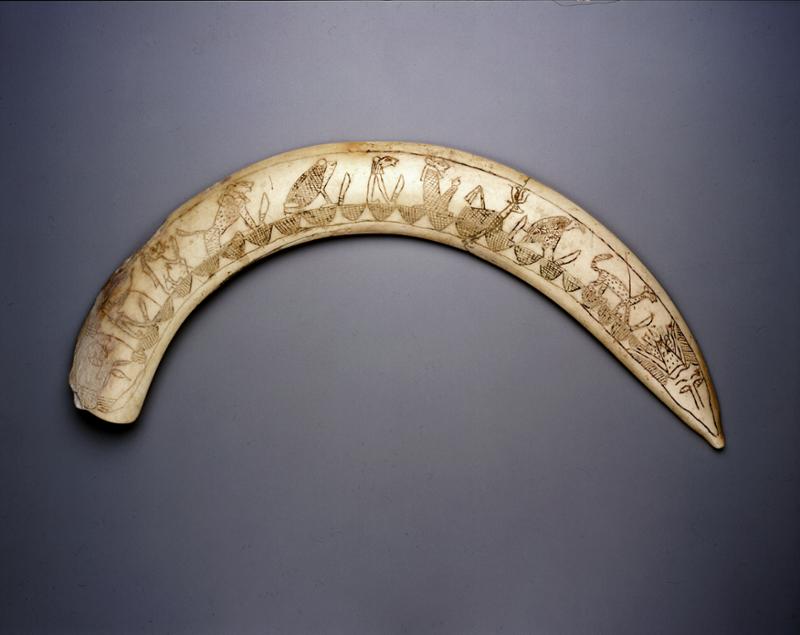
Middle Kingdom apotropaic wand, ca. 1981–1640 BCE, carved from hippopotamus ivory and engraved with protective beings. The Metropolitan Museum of Art, Open Access, Public Domain.
Ancient Egyptian “magic wands” are among the most visually arresting ritual objects of the Middle Kingdom. Curved like crescent blades, carved from hippopotamus ivory, and crowded with hybrid beings carrying knives, snakes, standards, and emblems, they look at first glance like weapons from a mythic bestiary. Modern labels have called them magic knives, birth tusks, apotropaic rods, ivory wands, and magical batons. None of those names is fully ancient, because the Egyptians left us no surviving technical term that identifies this object class with certainty.
What survives instead is a remarkable pattern. Most dateable examples belong to the late Middle Kingdom and Second Intermediate Period, especially the Twelfth and Thirteenth Dynasties. Several were found in burials. Many are made from sliced hippopotamus tusks whose natural curve determines the object’s form. Some carry short inscriptions invoking “protection by day” and “protection by night.” One extraordinary Metropolitan Museum example preserves a longer formula in which a group of protectors announces that it has come to surround a named child, Minhotep, with protection. Wear marks on several pieces suggest they were used before entering tombs.
The iconography strongly links them with childbirth and infant protection. Taweret, the hippopotamus goddess associated with pregnancy and birth, appears repeatedly. Bes-like beings, lions, crocodiles, frogs, serpents, jackals, baboons, griffins, and other composite creatures march across the ivory surface. Many hold knives. These are not necessarily demons in the modern sense of evil spirits. In Egyptian ritual imagery, frightening beings can be dangerous to enemies and protective toward the vulnerable person whose safety they enforce.
That logic makes the wands a perfect case study in Egyptian heka: ritual power working through image, material, speech, myth, body, and boundary. The object is not simply a symbolic sculpture. It is a technology of protection built from a dangerous animal’s tooth, transformed into a curved ritual implement, populated by supernatural guardians, and sometimes personalized through inscription.
This article examines what these wands were, why hippopotamus ivory mattered, how scholars reconstruct their use in birth and childhood, what the knife-bearing beings mean, how the Abydos birth brick changed interpretation, why tomb deposition may reflect rebirth rather than only funerary protection, and where modern reconstructions go beyond the evidence.
What Are These Objects?
The objects conventionally called apotropaic wands are curved pieces of ivory, usually made from hippopotamus tusk. Their natural crescent shape is not accidental: the tusk itself determines the arc. The Metropolitan Museum notes that the teeth used for these objects were among the hippopotamus’s most powerful weapons. That material origin contributed to the object’s protective logic. The same animal that could destroy a human body became a source of defensive power once transformed into ritual equipment.
Most surviving examples are incised on one face with rows of supernatural beings. The reverse may be blank or inscribed. Figures can include Taweret-like hippopotamus goddesses, Bes-like dwarf or leonine beings, lions, crocodiles, snakes, frogs, vultures, jackals, baboons, composite felines, and creatures difficult to identify with any later canonical deity.
Some modern museum labels use “magic wand,” while others prefer “apotropaic wand.” “Apotropaic” comes from Greek terminology for turning away or averting harm. It is useful because it describes function without assuming a precise Egyptian name.
Other scholars use “birth tusk,” emphasizing both material and childbirth context. Stephen Quirke has preferred language that keeps the tusk origin visible and situates the objects inside a wider “armoury of health” around 1800 BCE. The terminology matters because “wand” can suggest a European ceremonial magician pointing a rod, while “knife” can suggest a cutting weapon. Neither modern image should dominate interpretation.
A Short-Lived but Intense Tradition
One of the most puzzling features is chronology. University College London’s Digital Egypt project notes that dateable examples cluster strongly in the late Middle Kingdom, roughly the nineteenth to seventeenth centuries BCE, with some continuation into the Second Intermediate Period and early New Kingdom.
This is not an object type that remains common throughout three thousand years of pharaonic history. It appears, flourishes, and then largely disappears in this recognizable form.
That short chronology raises important questions. Why did this particular ritual technology become popular at that moment? Did social change produce new concerns about childbirth? Did the iconographic repertoire emerge from court or temple theology and move into household protection? Did changes in burial customs help preserve objects that had previously been used but not buried?
No single explanation has won universal agreement. What is secure is that the Middle Kingdom saw intense experimentation in protective imagery, funerary religion, medicine, domestic ritual, and textual traditions. The wands belong to that intellectual environment.
Hippopotamus Ivory: Turning Danger Into Defense
The material is one of the clearest clues to ritual logic. Hippopotamuses were among the most dangerous animals of the Nile environment. Their size, aggression, and powerful jaws made them potentially lethal. Egyptian symbolism therefore treated the animal ambivalently. Hippopotamus forms could represent chaos, dangerous force, fertility, motherhood, and protective power depending on context.
Taweret herself embodies this transformation. She combines the pregnant body of a hippopotamus with other dangerous animal features and becomes one of the most approachable protectors of women and children.
The wand follows the same logic. A tooth capable of violence is redirected. Its dangerous potential becomes apotropaic force.
This pattern appears widely in Egyptian ritual. Crocodiles, lions, snakes, and other threatening animals can protect precisely because they are feared. The question is not whether an animal is “good” or “evil.” The question is whose side its power is placed on.
Why Knife-Bearing Guardians Are Not Simply Evil Demons
Many wands show supernatural beings holding large knives. To a modern viewer, the scene can look sinister. Yet the knives are usually understood as weapons against hostile forces.
The Metropolitan Museum explicitly describes these figures as protective deities carrying knives to ward off evil forces. UCL notes related knife-bearing beings in later funerary compositions. Joshua Roberson’s research has explored how some Middle Kingdom wand imagery anticipates elements later developed in New Kingdom netherworld iconography.
Egyptian religion contains many beings whom modern classification struggles to label. Some are named gods with temple cults. Others are localized protectors. Others appear only in ritual compositions. Some later Egyptological writing called such figures “demons,” but that word can mislead because it implies morally evil beings in modern Christianized vocabulary.
A better description is liminal protective beings. They may be terrifying by design. Their threat is directed outward.
The Child Minhotep: A Rare Personalized Inscription
One Met wand, object 08.200.19, is especially important because its inscription names the person being protected. The text announces that a group of protectors has come to extend protection around “the healthy child Minhotep,” born of a woman named Sitsobek.
This inscription anchors interpretation more securely than iconography alone. The object is not simply funerary or abstractly mythological. It explicitly concerns the health and protection of a child.
Other wands carry shorter formulae such as “protection by day” and “protection by night.” Together these texts indicate continuous vigilance. Danger does not operate only during ritual. The guardians cover the vulnerable person across temporal cycles.
This is one of the strongest pieces of evidence connecting the class with infancy and early life.
Birth Was Dangerous
The biological danger of childbirth provides a practical background that modern readers should not overlook. Without antibiotics, blood transfusion, surgical obstetrics, neonatal intensive care, or modern infection control, pregnancy and infancy carried significant risks. Hemorrhage, obstructed labor, infection, premature birth, infant disease, and malnutrition could kill mothers and children.
Ancient Egyptian responses combined practical treatment, midwifery, medicine, diet, ritual speech, amulets, divine protection, and household practice. The Lahun gynecological papyrus, roughly contemporary with the wand tradition, preserves prescriptions and diagnostic material concerning women’s health and reproduction. UCL’s Digital Egypt survey places Middle Kingdom birth manuscripts alongside later medical and magical papyri.
The wand should therefore not be isolated as “superstition” opposed to medicine. It belongs to a broader health culture in which ritual and practical care could coexist.
The Penn Museum Birth Brick Changed the Debate
 Middle Kingdom birth wand, Penn Museum E2914, carved from hippopotamus ivory and decorated with protective figures. Penn Museum collection image.
One of the most important archaeological discoveries for understanding the wands came not from a wand but from a brick. In 2001, Josef Wegner and the University of Pennsylvania expedition at South Abydos discovered a painted mud-brick in a Middle Kingdom domestic context. The object is widely interpreted as a birth brick, one of the supports on which a woman could squat during labor. Egyptian texts had long referred to birth bricks, but this discovery provided rare archaeological evidence for an actual decorated example.
The brick carries imagery closely related to the world of the ivory wands: protective beings, mother-and-child imagery, and visual references to divine protection. Wegner argued that the imagery invokes the cosmic rebirth of the solar child and Hathoric protection of human birth.
This find strengthened the case that the ivory wands belonged to childbirth-related ritual. It connected their strange bestiary with an object found in a domestic setting specifically interpretable through birth.
Birth Bricks, Squatting, and the Body
Egyptian childbirth was commonly imagined and represented in a squatting or kneeling position supported by bricks. The goddess Meskhenet personified the birth brick and destiny connected with birth.
Ritual objects therefore interacted directly with the body. A birth brick was not merely a symbol displayed nearby. It participated physically in labor.
The wand may likewise have been used around the bodily space of mother and child. Some museum interpretations propose that a protective circle could have been scratched around a bed, nursing area, or birth location.
This idea is plausible but should be labeled carefully. The Met itself presents the circle-scratching proposal as a possibility, not a securely described ancient procedure.
No surviving Egyptian manual gives a step-by-step instruction saying, “Take this ivory wand and draw a circle around the woman.” Modern reconstructions should not turn an inference into a documented ritual.
Did the Wand Draw a Magical Circle?
The “protective circle” theory has become popular because it resembles later magical practices and because worn wand tips suggest contact with a surface.
The evidence is suggestive. Several objects show wear. Their curved form could be held and moved. The inscriptions speak about extending protection around a child.
But wear can result from many actions, and “around” in an inscription does not necessarily mean a literal geometric circle scratched into earth.
The safest conclusion is that the wands were active implements, not merely grave ornaments. Exactly how they were moved remains uncertain.
This distinction is essential for responsible historical magic writing. The difference between “may have been used to mark protective space” and “Egyptian magicians drew circles with these wands” is the difference between evidence and invention.
Taweret: The Hippopotamus Who Protects Birth
Taweret is among the most recognizable deities on the wands. She appears as a pregnant hippopotamus with pendulous breasts, often combined with leonine limbs and crocodilian features.
Her body looks monstrous by classical artistic standards, but that is precisely why it is powerful. She gathers dangerous animal capacities into maternal defense.
Taweret was not a distant state god requiring massive temple institutions. She belongs especially to domestic religion, childbirth, infancy, and household protection.
Her presence on the wands is one of the strongest iconographic links with birth.
Aha and the Figure Later Called Bes
Another recurring protector is a frontal dwarf- or lion-like being often connected with Aha, “the Fighter,” a Middle Kingdom precursor to later forms of Bes.
UCL notes Aha as a protector of women and children at birth, later associated with the widespread Bes tradition.
Bes-like figures use frontal display, grimacing faces, animal features, knives, and aggressive posture. In Egyptian art, frontal orientation itself can mark extraordinary presence because most human and divine figures are shown in profile.
The protector confronts the viewer directly. Again, ugliness or ferocity is not evidence of evil. The frightening appearance is the defense.
Frogs, Lions, Crocodiles, and Hybrid Beings
The wand bestiary is broader than Taweret and Bes. Frogs can evoke fertility, abundance, and emergence because of their association with Nile inundation and large numbers of offspring. Lions embody dangerous strength and solar protection. Crocodiles can represent terrifying aquatic power and divine authority. Jackals connect with liminal desert zones and funerary protection. Baboons have solar and lunar associations and can appear in ritual contexts.
Composite creatures combine multiple capacities. A winged feline, for example, is not necessarily a deity with a temple and standardized name. It can be a deliberately intensified protective form.
Egyptian artists did not need every powerful image to correspond to one entry in a divine dictionary.
Hybrid Deities as Concentrated Power
The Met’s fragment 32.8.5 is especially useful for understanding hybrids. The museum describes beings composed of multiple animal and human elements integrated into new potent divine entities.
This is not random fantasy. Hybridization can concentrate powers that no ordinary animal possesses alone. A being may combine leonine aggression, serpentine danger, avian mobility, human agency, and divine insignia.
Such figures are ideal for apotropaic work because they visually exceed ordinary nature. They are images of controlled excess.
The Knife as a Boundary Tool
Knives on the wands can be read literally as weapons, but they also participate in boundary symbolism. To protect a mother and child is to separate safe space from dangerous intrusion. A knife cuts. It divides. It destroys threatening forces.
In later funerary texts, knife-bearing guardians defend gates, regions, and divine bodies. The same iconographic grammar appears in different contexts: danger must be stopped at a boundary.
Birth itself is a boundary event between womb and world, nonperson and social person, danger and survival. The knife-bearing protectors are therefore perfectly suited to the moment.
Why Birth and Death Share the Same Imagery
Many wands were found in tombs. If they were birth objects, why bury them with adults?
The answer lies in Egyptian ideas of rebirth. Death was not only an ending. Funerary religion sought regeneration. The deceased became Osiris, joined solar cycles, and was expected to emerge into renewed existence.
Birth protection could therefore become rebirth protection.
The Penn Museum’s childbirth overview and the Met both make this connection explicit: objects used to protect infants in life could be deposited in tombs to defend the deceased in eternal rebirth.
The same ritual technology protects two vulnerable transitions.
The Tomb as a Second Birth Chamber
This idea deserves emphasis because it changes the meaning of burial goods. A wand in a tomb is not necessarily proof that the dead person was a magician. It may be a reused protective object whose logic fits funerary regeneration.
The tomb itself can be understood as a place of transformation. Coffin imagery, funerary texts, amulets, and ritual equipment work toward reconstitution.
Protective beings who once guarded a newborn can guard the dead person becoming alive again.
This continuity between birth and rebirth is one of the most characteristically Egyptian features of the tradition.
Wear Marks Prove Use—but Not Exactly How
Several wands show worn tips. The Met highlights this evidence for objects 30.8.218 and 15.3.197.
Wear is important because it argues against the idea that every piece was manufactured only for burial. The object lived before the tomb.
Yet archaeology cannot tell us the exact motion that produced the wear. The wand could have touched floors, bedding, skin, ritual substances, other objects, or storage surfaces.
Material evidence narrows possibilities without always identifying one procedure.
Ancient Repairs and the Value of Keeping a Wand Alive
UCL notes that some birth wands preserve ancient repairs. Broken ivory was joined and reused rather than discarded.
This suggests value beyond raw material. A repaired protective object may have possessed accumulated ritual significance. Perhaps it belonged to a household, specialist, or family. Perhaps replacement was expensive. Perhaps the object’s history mattered.
Whatever the exact reason, repair demonstrates that people cared enough to preserve function. This is another sign that the wands were not disposable props.
Personalized Protection
The Minhotep inscription shows that at least some wands could be personalized. Personalization changes the relationship between image and user. The protective beings are not guarding an abstract concept of childhood. They are surrounding one named child born of one named woman.
This resembles the logic of later Egyptian amulets and magical papyri, where ritual formulae insert a client’s personal name into a traditional structure.
The formula becomes specific through naming. Naming tells the supernatural world whom to protect.
“Protection by Day” and “Protection by Night”
Short inscriptions dividing protection into day and night suggest total temporal coverage.
Night was especially vulnerable in many ancient societies because darkness, sleep, animals, disease, and reduced visibility increased fear. Egyptian protective traditions contain many nocturnal threats.
But day also required protection. Disease, accident, social hostility, and supernatural danger were not limited to darkness.
The formula therefore creates completeness by pairing opposites. Day and night together mean always.
Words and Images Work Together
Not every wand contains text, and not every protective meaning requires inscription. The imagery itself communicates protection. Taweret, Aha/Bes, knife-bearing guardians, lions, and other beings form a visual sentence even without hieroglyphs.
When text appears, it reinforces or personalizes the visual force.
This relationship between word and image is central to Egyptian magic. SecretMagic’s article on Horus cippi likewise shows how Egyptian protective practice could combine divine image, inscription, healing, and material contact rather than treating them as separate domains.
The wand is a compact demonstration of that system.
Image Was Not Mere Illustration
Modern books use images to illustrate ideas expressed in text. Egyptian ritual images could be operative.
A knife-bearing protector does not merely tell the viewer that protection exists. Its representation participates in making protective presence available.
This is why damaged, erased, or decapitated figures can matter in magical and funerary contexts. Image has agency within the ritual imagination.
The wand therefore functions visually even when no one reads an inscription aloud.
Was the Wand Used by a Midwife?
This is possible but not demonstrated. Egyptian evidence for childbirth includes female attendants, household women, medical practitioners, ritual specialists, and divine protectors. A decorated birth brick shows attendants beside mother and newborn.
But no surviving inscription identifies a specific wand as “the tool of the midwife.”
The user could have been a household member, ritual specialist, healer, nurse, midwife, or another person involved in birth.
Modern reconstructions should therefore avoid assigning a professional title without evidence.
Was It Used Only for Elite Children?
Many surviving examples come from elite burials, which can create the impression that the practice belonged only to wealthy families.
Archaeology is biased toward durable materials and well-furnished tombs. Hippopotamus ivory was valuable, and decorated pieces required skilled labor. It is therefore reasonable to think elite access mattered.
But elite archaeological survival does not prove that ordinary families lacked analogous rituals. Perishable wooden, reed, clay, textile, or spoken protective practices would be far less likely to survive.
The ivory wand may represent an expensive version of a broader protective culture.
The Abydos Brick Suggests Domestic Ritual
The South Abydos birth brick is particularly important because it was found in a residential building rather than a tomb.
Its context connects protective iconography with actual domestic life.
That does not prove every wand was used in exactly the same room type, but it weakens the idea that Middle Kingdom protective imagery belonged only to mortuary religion.
The home was a sacred environment too.
Household Religion in Ancient Egypt
Egyptian religion is often represented through monumental temples because stone survives spectacularly. Household religion is harder to reconstruct.
Families used amulets, figurines, domestic shrines, prayers, protective images, ancestor practices, fertility objects, and small-scale ritual technologies.
Taweret and Bes are especially important because they appear repeatedly in nonmonumental contexts.
The birth wands help restore the home to the history of Egyptian religion.
Health Was a Ritual Condition
The Minhotep formula describes the child repeatedly as alive, sound, and healthy.
This formulaic emphasis reveals what protection aims to preserve: bodily integrity and life.
Health in Egyptian thought is not merely absence of disease. It is participation in order. The body must remain whole, properly functioning, and defended against forces that cause breakdown.
Magic, medicine, and religion converge at that point.
Did the Wands Protect Against Specific Demons?
Not in a way that can always be reconstructed. Some figures may have names in other texts. Others remain unidentified. The protective inscription may refer generally to harmful forces rather than one demonological catalogue.
Later Egyptian magical texts contain named diseases, demons, ghosts, gods, and hostile beings. Middle Kingdom wand iconography may reflect an earlier or different system of protective entities.
We should resist assigning later demon names automatically to earlier images.
The Problem of Calling Them “Magic Knives”
“Magic knife” is vivid but potentially misleading. The objects are not sharpened metal blades. They are curved ivory pieces retaining the tusk form.
The knife association comes partly from shape and partly from the knives held by the engraved protectors.
The term can therefore be useful historically as a museum label, but readers should not imagine ritual stabbing.
The wand is a protector covered with knife imagery, not necessarily a knife wielded against a physical target.
Could the Hippopotamus Tusk Itself Be a Weapon?
Biologically, yes. A hippopotamus canine is a formidable weapon. Ritually, that origin may be precisely the point.
The Met stresses that these teeth are among the animal’s most powerful weapons. Transforming such a tooth into an apotropaic object preserves an index of violence even after carving.
The material remembers what the animal could do. Protection appropriates that danger.
Dangerous Beings as Guardians
This principle appears across Egyptian iconography. Lions guard thresholds. Cobras protect crowns. Crocodile power can belong to Sobek. Taweret uses hippopotamus danger maternally. Bes-like figures glare, bare teeth, and carry weapons.
The logic is apotropaic inversion: the frightening thing frightens the threat. A different Middle Kingdom use of hostile imagery appears in SecretMagic’s study of Egyptian execration texts, where materialized enemies are ritually targeted rather than protected.
Protective magic often works by becoming more dangerous than what it opposes.
The Wand as a Portable Boundary
Even if a literal circle was not always drawn, the object itself establishes conceptual boundary.
Its imagery says that harmful beings are outside and guardians are inside.
The inscription around Minhotep makes this spatial logic explicit through language of surrounding protection.
The curved form may intensify that enclosure symbolically. The wand becomes a portable edge between vulnerability and safety.
Why Infants Needed Extraordinary Protection
Infants occupy an uncertain social and biological threshold. They are alive but fragile, socially present but not yet independent, vulnerable to disease and environmental danger.
Many cultures develop especially dense ritual protection around newborns for precisely this reason.
Egyptian birth magic should therefore be understood as a rational social response within its cosmology to a genuinely high-risk stage of life.
The Solar Child and Human Birth
Wegner’s interpretation of the Abydos birth brick links childbirth with the daily rebirth of the solar god.
This is deeply Egyptian in structure. Myth provides a divine precedent for human crisis.
If the sun is reborn safely after passing through danger, human birth can be placed inside the same cosmic pattern.
Ritual imagery then transfers divine protection to mother and child. Birth becomes a small-scale repetition of cosmic renewal.
Myth as Protective Technology
Egyptian magical texts frequently use what scholars call a historiola: a short mythic episode establishes precedent.
A god suffered a danger and was saved; therefore the human patient can be saved.
The wand contains a visual equivalent. Protective deities who defend divine birth or cosmic order are assembled around a human child.
The client enters the mythic pattern through ritual representation.
From Birth Magic to Funerary Magic
The same mythic logic explains tomb reuse. The dead person needs rebirth just as the infant needs birth.
Funerary religion repeatedly treats the deceased as a being who must be regenerated, nourished, protected, and reconstituted.
A birth wand entering a tomb therefore does not change function completely. Protection continues across another transition.
Why Some Wands Were Broken
Some examples survive in fragments, and some show ancient repair.
Breakage can result from ordinary use, burial pressure, excavation, or deliberate ritual action.
Scholars have sometimes proposed deliberate “killing” of ritual objects before burial, but this should not be assumed for every fragment.
When ancient repairs are present, they prove that at least some broken objects were valued enough to restore rather than ritually discard.
Black Inlay and Visual Intensification
Some incised figures retain dark material in the carved lines. The Met notes black substance accentuating images on certain fragments.
This would have made the protective beings more visible against pale ivory.
Contrast matters in ritual art. A figure that appears faint today may originally have looked far more dramatic.
Modern museum lighting can therefore understate ancient visual impact.
The Wand Was Once New
Archaeological objects often look naturally ancient, but ritual users encountered them as new things.
Fresh ivory had color and sheen. Incised lines could be darkened. The surface was unworn. The tusk retained sensory associations with the animal source.
Over years, handling changed it.
Thinking about the object’s biography helps recover ritual life before burial.
Protective Technology and Social Memory
A wand used for one child might later protect another. A family could remember previous successful births associated with it.
This is possible but not directly documented. Ancient repair and wear make repeated use plausible.
If so, the object’s authority may have grown through household memory: it had protected before, therefore it could protect again.
Such cumulative ritual reputation is common in sacred objects globally.
What We Know About the Owners
Named inscriptions are rare, and find contexts vary. Some wands come from elite cemeteries at sites such as Lisht. Others lack precise archaeological context because they entered collections through older excavations or the antiquities market.
This uneven documentation limits social reconstruction. We know more about object type than about individual users.
Lisht and the Middle Kingdom Court World
The Met’s collection includes several wands excavated at Lisht, near royal pyramid complexes of the Middle Kingdom.
This concentration links the tradition with the Memphite court environment and elite cemeteries.
It does not prove invention at court, but it suggests that elite households invested in this form of protection.
Royal and domestic religious worlds were not sealed from each other. Images and theological ideas could circulate between them.
Thebes and Regional Spread
British Museum examples and other finds connect the tradition with Thebes as well.
The geographical range shows that this was not one local household custom.
The object class circulated across major Egyptian regions during the Middle Kingdom.
That spread implies shared ritual vocabulary even if local workshops varied.
The Elkab Evidence
UCL notes a later tomb-chapel at Elkab in which children of a local governor are shown with nurses holding objects of similar curved form.
If the identification is correct, this provides rare visual evidence for association between children, caregivers, and wand-like objects.
The scene helps bridge the gap between archaeological artifacts and social use.
Again, the image does not provide a complete ritual manual, but it supports the childcare context.
Protection in the Hands of Nurses
The possible Elkab scene raises the importance of caregivers.
Infant ritual was not only about the mother. Nurses, attendants, relatives, healers, and household women could all participate in protection.
Egyptian elite households employed wet nurses and attendants whose roles could be socially significant.
A birth wand may therefore belong to a network of care rather than one performer.
Magic and Care Are Not Opposites
Modern language sometimes contrasts practical care with magical care.
Ancient households did not necessarily experience that contradiction.
Feeding, washing, nursing, administering remedies, reciting spells, wearing amulets, invoking deities, and using protective objects could all be part of one caregiving strategy.
The wand becomes more understandable when placed beside care rather than against it.
The Ramesseum Magical Papyri and a Wider Protective World
Middle Kingdom and early Second Intermediate Period Egypt also preserves ritual manuscripts concerned with healing and protection, including the Ramesseum papyri.
These texts show that elaborate magical knowledge existed alongside material objects.
The wand may therefore represent only the visible part of a larger ritual event involving words, gestures, medicines, or offerings that left no archaeological trace.
Objects survive better than speech.
Why No Instruction Manual Survives
This absence should not surprise us. Many ritual techniques are transmitted orally or embedded in professional practice. Written instructions may have existed but disappeared. Papyrus preservation is highly selective.
It is equally possible that users did not need a separate manual because the meaning of the object was culturally familiar.
Modern researchers therefore reconstruct function from inscriptions, iconography, wear, archaeological context, and comparison rather than from one definitive text.
Reconstruction Without Fantasy
The strongest historical reconstruction includes several secure claims:
- Material: many wands are carved from hippopotamus ivory.
- Date: most belong to the late Middle Kingdom and Second Intermediate Period.
- Imagery: they carry protective beings, often armed with knives.
- Childbirth link: Taweret, Bes-like figures, child-protection inscriptions, the Abydos birth brick, and related evidence strongly connect them with birth and infancy.
- Use before burial: wear and repair indicate that some objects had active lives before tomb deposition.
- Funerary reuse: burial contexts probably extend birth protection into rebirth after death.
Beyond these points, confidence should decrease.
Claims We Should Treat as Hypotheses
The following ideas are plausible but not securely demonstrated for every wand:
- that every wand was used specifically during labor;
- that a midwife always wielded it;
- that it was always used to scratch a literal circle;
- that every engraved being can be identified by name;
- that all wands followed one standardized ritual;
- that breakage was always deliberate;
- that psychoactive, blood, or sacrificial substances were used with the object.
Separating secure evidence from attractive speculation is especially important because the objects invite dramatic reconstruction.
Why Modern Occultism Loves the “Magic Knife” Image
A curved ivory object covered with knife-bearing monsters fits modern expectations of ancient magic almost too well.
It looks like a ceremonial weapon. It invites comparison with magic circles, wands, athames, demon banishing, and protective talismans.
Those comparisons can stimulate imagination but create false continuity.
There is no evidence that the Middle Kingdom wand is the ancestor of the modern ceremonial magician’s wand or ritual knife.
Similarity of form does not establish transmission.
The Word “Apotropaic” Is Better Than “Occult”
“Occult” often implies hidden doctrine or secret philosophy.
The wands appear to be practical protective objects embedded in health, household, childhood, and burial.
“Apotropaic” is therefore more precise because it focuses on averting harm.
The object’s purpose is defense.
Protection by Multiplication
Why place so many beings on one wand?
Egyptian protection often works through accumulation. Multiple divine names, images, amulets, spells, and guardians create redundancy.
If one protector is powerful, an assembled company is more formidable.
The Minhotep inscription even speaks in the plural voice of “many protectors.”
The wand is an army in miniature.
Visual Procession
The beings often appear in a row, moving along the curve.
This procession can be read as a patrol around the protected person.
The object’s form turns static images into implied movement.
Guardians march across the tusk as though circling danger.
Why the Ends Matter
Some wands terminate in animal heads, including lion and jackal forms.
These terminals can make the whole object resemble a living protective creature or a bounded procession.
The ends may also reinforce the idea that the wand’s arc is complete and guarded.
Again, precise ancient explanation is absent, but the deliberate shaping shows that craftsmen treated the terminals as meaningful.
Craftsmanship and Ritual Expertise
Creating a wand required several forms of knowledge.
Someone obtained and prepared the tusk. A craftsperson sliced and shaped the ivory. A designer selected figures. An engraver incised them. A scribe may have added inscription. A ritual practitioner or household then used the object.
One artifact therefore connects animal exploitation, luxury craft, artistic repertoire, literacy, and ritual practice.
Magic here is materially labor-intensive.
Ivory and Social Value
Ivory was not an ordinary disposable substance.
Its rarity and workability made it suitable for prestige objects. Hippopotamus hunting or access to tusks required economic networks.
The material itself therefore marks investment in protection.
A family commissioning such an object placed significant value on the survival of mother and child.
The Dangerous Animal Becomes Family Protection
This transformation may be the most elegant feature of the entire tradition.
The hippopotamus threatens humans in the Nile. Taweret turns hippopotamus power into maternal protection. The animal’s tooth becomes the physical substrate of the protective object.
Material, deity, and function all reinforce one another.
Danger is not eliminated. It is recruited.
Birth Magic and Female Religious Experience
Monumental Egyptian religion is dominated in surviving evidence by kings and male officials.
Birth magic restores female experience to the historical picture.
Pregnancy, labor, nursing, infertility, infant survival, and maternal risk were major religious concerns even when they received less monumental representation.
The wands, birth bricks, gynecological texts, figurines, and domestic deities reveal a religious world organized around women’s bodies and household survival.
But We Should Not Assume Women Controlled Every Ritual
Recovering female experience does not justify assigning every object to female specialists.
Men could be scribes, healers, priests, craftsmen, or ritual experts involved in birth-related protection.
Household ritual likely involved overlapping gendered roles.
The evidence supports female-centered concerns more strongly than exclusively female ritual authority.
The Lahun Gynecological Papyrus as Context
The Kahun/Lahun gynecological papyrus, dating to roughly the same broad period, preserves diagnoses and treatments concerning women’s reproductive health.
Its existence demonstrates that childbirth and fertility were subjects of technical knowledge.
Placing it beside the wands helps dismantle the false opposition between “medical science” and “magic.”
Ancient Egyptian healthcare could address the same body through prescriptions, prognosis, ritual, and divine protection.
Why Egyptian Medicine Looks Mixed to Modern Eyes
Modern medicine divides physical cause from supernatural cause because its explanatory framework is biomedical.
Egyptian texts do not always make that division.
A wound can be treated practically while an incantation is spoken. A disease can be described physically and mythically. A child can receive care and amulets.
The wand belongs to that mixed system.
Magic as Technology of Risk
Childbirth is uncertain. Magic converts uncertainty into action.
The family cannot guarantee survival, but it can assemble protectors, prepare medicines, use ritual objects, invoke deities, and create guarded space.
Ritual gives agency where control is limited.
This does not prove supernatural efficacy. It explains social efficacy.
Why Ritual Objects Reduce Anxiety
A prepared protective object gives danger a visible counterforce.
Instead of facing invisible threats with nothing, the household possesses a material ally.
The engraved beings make protection visible. The ivory can be held. The inscription can be read. The object can be placed near the vulnerable body.
Material religion makes abstract security tangible.
From Birth Chamber to Museum Case
 Middle Kingdom hippopotamus-ivory amuletic wand, British Museum. Museum collection image.
Today many wands are displayed behind glass in London, New York, Philadelphia, and other museums.
This changes their category.
They become art, antiquity, evidence, and aesthetic objects rather than active household tools.
Museum labels can partially restore context, but no display can reproduce the anxiety of labor, the smell of a home, the voices of caregivers, or the ritual actions that once surrounded the object.
Why Object Biography Matters
An apotropaic wand may have passed through several lives:
- hippopotamus tooth;
- crafted ivory object;
- household or ritual implement;
- repaired heirloom;
- burial good;
- excavated antiquity;
- museum object;
- digital image circulating online.
Each stage changes meaning.
Historical interpretation should not freeze the object at only one moment.
Digital Images Create a New Kind of Wand
Open Access museum photography now allows high-resolution images of these objects to circulate globally.
This is valuable for scholarship and education. It also creates new occult receptions. Modern practitioners can copy figures, redraw them, turn them into tattoos, print them on altars, or reconstruct imagined rituals.
Those modern uses are part of the objects’ afterlife, not evidence for their ancient function.
Historical transparency allows both scholarship and creative reception to coexist.
Three Objects That Define the Evidence
The Met apotropaic wand 30.8.218
This wand preserves classic late Middle Kingdom form, hippopotamus ivory, protective figures, visible wear, and short protective inscriptions. It demonstrates use before burial and the connection between material and protective imagery.
The Minhotep wand 08.200.19
This object is crucial because its inscription explicitly names a child and describes a company of protectors extending protection around him. It converts a broad scholarly hypothesis into direct textual evidence.
The Penn Museum wand E2914
This richly decorated example is important in discussions of childbirth iconography and is often presented alongside the South Abydos birth brick. Together they help connect museum objects with domestic birth ritual.
Five Myths About Egyptian Apotropaic Wands
“They were weapons used to stab demons.”
No evidence shows physical stabbing. The objects are ivory ritual implements covered with weapon-bearing protective figures.
“Every one was used to draw a magic circle.”
Possible, but unproven. Wear and protective language support active use, not one universal movement.
“They belonged to evil magicians.”
No. The strongest evidence links them with health, childbirth, infancy, and funerary rebirth.
“The monsters are demons attacking the child.”
Most are better understood as protectors whose dangerous appearance is directed against hostile forces.
“They prove modern ceremonial magic came from Egypt.”
No. Similarity between ancient ritual implements and later wands or knives does not establish historical transmission.
How the Wands Fit the Larger History of Egyptian Magic
The apotropaic wands occupy an important position between earlier royal protective symbolism and later magical corpora.
They show that image-based domestic protection was highly developed long before the Greek Magical Papyri. They also belong centuries before the later dream and omen practices discussed in Papyrus Chester Beatty III and long before late antique Coptic ritual handbooks.
This matters because ancient Egyptian magic is often studied backward from famous later texts.
The wands reveal a Middle Kingdom world with its own material technologies of protection.
From Wands to Cippi: Continuity Without Identity
SecretMagic’s recent article on Horus cippi examines a later Egyptian tradition in which protective images and inscriptions empowered water for healing venom.
The wands and cippi are not the same object class.
Yet both demonstrate a recurring Egyptian principle: dangerous divine and animal powers can be assembled visually to defend a vulnerable human body.
The continuity is conceptual rather than mechanical.
From Wands to Protective Amulets
The wands also belong beside Egyptian amulets.
An amulet condenses divine or symbolic power into wearable material. A wand is larger and may be handled ritually, but both make protection portable.
The difference reminds us that “amulet,” “wand,” “image,” and “tool” are modern analytical categories applied to a continuum of ritual objects.
Ancient practice cared more about efficacy than museum taxonomy.
What the Wands Reveal About Egyptian Childhood
Children are underrepresented in elite historical narratives.
The wands reveal how important child survival was.
A named child receives a company of supernatural guardians. Valuable ivory is carved for protection. Dangerous animals are enlisted. Day and night are ritually covered.
This is an archaeology of parental fear and hope.
Protection Was an Act of Care
It is easy to write about magic abstractly and forget the human situation.
Someone feared that a child might die.
Someone obtained ivory, paid a craftsperson, consulted a specialist, or preserved a protective object.
The wand is therefore not only evidence for demonology. It is evidence for care.
The Object’s Violence Serves Vulnerability
This contrast gives the wand its emotional force.
The ivory comes from a dangerous animal. The figures are armed. The guardians are monstrous.
Yet the protected person may be a newborn.
The entire apparatus of violence is mobilized around fragility.
Why This Matters for Comparative Magic
Many ritual traditions protect vulnerable persons by surrounding them with stronger-than-human allies.
Kongo minkisi, Tibetan protective deities, Jewish amulets, Buddhist dhāraṇīs, Mesopotamian household figurines, and Egyptian birth wands all show different versions of this human strategy.
Comparison should never erase local theology.
What it can reveal is a recurring structure: danger becomes manageable when given a material counterforce.
Conclusion: An Armoury for the Most Vulnerable
The Middle Kingdom apotropaic wand is one of the clearest examples of Egyptian magic as practical theology.
Its material comes from a dangerous animal. Its curved shape preserves the tusk. Its surface gathers guardians whose hybrid bodies and knives express controlled violence. Taweret and Bes-like protectors connect it with childbirth. Inscriptions call for protection by day and night and, in the case of Minhotep, explicitly surround a named child with a company of defenders. Wear and repair show that at least some objects were handled and valued before burial.
The South Abydos birth brick strengthens the childbirth interpretation by placing related protective imagery in a domestic context directly associated with labor. Funerary deposition then extends the same logic into Egyptian ideas of rebirth. The dead, like the newborn, must cross a dangerous threshold and emerge safely into a new state of existence.
What we do not possess is a complete ritual manual. We cannot say with certainty who always held the wand, whether it always traced a circle, what words were always spoken, or how every creature was named. Those gaps matter. They prevent historical evidence from becoming modern fantasy.
But the surviving evidence is already rich enough. These were not decorative “monster sticks.” They were carefully crafted protective implements embedded in a culture where health, divine power, image, medicine, family care, and ritual action overlapped.
The most useful modern image is therefore not the ceremonial magician’s wand or the sorcerer’s knife. It is an armoury placed around a vulnerable body.
Ancient Egyptian families could not control every danger of childbirth or infancy. What they could do was make protection visible. They could take the weapon of a hippopotamus, carve guardians into its surface, name the child to be defended, and place that child—at least ritually—inside a company of beings stronger than the threats outside.
That combination of fear, craft, theology, and care is what makes the apotropaic wands enduringly important to the history of magic.
Sources and References
- The Metropolitan Museum of Art, “Apotropaic Wand,” object 30.8.218: The Met.
- The Metropolitan Museum of Art, “Magic wand,” object 08.200.19, with the Minhotep protection inscription: The Met.
- The Metropolitan Museum of Art, “Magic Wand,” object 86.1.91: The Met.
- The Metropolitan Museum of Art, “Fragment of an apotropaic wand,” object 32.8.5: The Met.
- Penn Museum, Charlotte Rose, “Childbirth Magic,” Expedition, 2017: Penn Museum.
- Josef Wegner, “The Magical Birth Brick,” Expedition 48.2, Penn Museum, 2006: Penn Museum.
- University College London, Digital Egypt, “Childhood in Ancient Egypt”: UCL Digital Egypt.
- University College London, Digital Egypt, “Healing Papyri”: UCL Digital Egypt.
- British Museum, “Amuletic wand,” EA18175: British Museum.
- Stephen Quirke, Birth Tusks: The Armoury of Health in Context—Egypt 1800 BC, Middle Kingdom Studies.
- Joshua Aaron Roberson, “The Early History of ‘New Kingdom’ Netherworld Iconography: A Late Middle Kingdom Apotropaic Wand Reconsidered,” in David P. Silverman, Josef Wegner, and William Kelly Simpson, eds., Archaism and Innovation: Studies in the Culture of Middle Kingdom Egypt, 2009.
- Geraldine Pinch, Magic in Ancient Egypt, British Museum Press.


