


 Deir el-Medina, the community associated with the manuscript archive that preserved Papyrus Chester Beatty III. Nineteenth-century view by David Roberts; public-domain image via Wikimedia Commons.
Long before modern psychology turned dreams into windows onto the unconscious, ancient Egyptian scribes were already classifying them as meaningful events. They did not approach dreams with one single theory. A dream might be an omen of future good or danger, a divine encounter, a symptom of vulnerability during sleep, a message requiring interpretation, or an event whose threatening effects could be countered by protective ritual. The surviving evidence therefore belongs simultaneously to the histories of divination, religion, medicine, magic, literacy, and everyday anxiety.
The most famous Egyptian witness is Papyrus Chester Beatty III, now in the British Museum. Written in hieratic and associated with the New Kingdom community of Deir el-Medina, the papyrus preserves the longest surviving pharaonic Egyptian manual for interpreting dreams. Friedhelm Hoffmann’s survey of Egyptian magic for the Cambridge History of Magic and Witchcraft notes that it contained at least 230 dream reports and explanations. The British Museum describes the recto explicitly as a manual for interpreting dreams, while the verso preserves literary material connected with the famous Battle of Kadesh and later additions by members of the scribal family who owned the manuscript.
Calling the text a “dream book” is convenient, but it can mislead modern readers. It is not a diary recording what one ancient person dreamed. It is not an Egyptian version of Freud’s Interpretation of Dreams. It does not offer one universal symbolic dictionary in which a snake always means one thing or water always means another. Instead, the text belongs to a learned divinatory tradition in which dream scenes are classified, judged as favorable or unfavorable, and linked to predicted outcomes through cultural associations, wordplay, social expectations, theology, and inherited interpretive conventions.
The result is one of the most intimate intellectual artifacts from ancient Egypt. It tells us not only what a group of scribes thought dreams might predict, but what they considered desirable, shameful, dangerous, prosperous, sexually charged, socially disruptive, or divinely significant. A dream manual is therefore also a map of values.
What Papyrus Chester Beatty III Actually Is
Papyrus Chester Beatty III is divided today into several mounted sections in the British Museum. The museum identifies it as EA10683 and dates it to the New Kingdom, with the dream manual copied on the recto in a fine literary hand. The papyrus is associated with the archive of Qenherkhepshef, a literate official connected with the royal tomb-building community at Deir el-Medina.
University College London’s Digital Egypt project places the papyrus within a larger group of manuscripts from Deir el-Medina that included literary works, medical prescriptions, incantations, letters, accounts, hymns, and educational texts. That archive is crucial. The dream manual did not survive in isolation. It belonged to a world in which a literate household might possess stories, royal literature, magical and medical material, religious compositions, administrative documents, and divinatory knowledge together.
This mixed archive immediately challenges a modern separation between “literature,” “magic,” “science,” and “religion.” Ancient scribes did not organize knowledge according to present-day academic departments. A person capable of copying a poem about Ramesses II might also preserve a dream manual or protective incantation. The same household could contain legal records and texts concerned with invisible danger.
The papyrus itself also had a biography. Material was copied by different hands at different moments. The verso preserves a version of the Kadesh composition, and later family members added names or notes. The manuscript was therefore used, inherited, and repurposed. It was not produced as a pristine museum artifact.
Deir el-Medina: The Village Behind the Dream Book
 Deir el-Medina during early twentieth-century excavations. Archivio fotografico Museo Egizio, Turin; CC0.
Deir el-Medina was the settlement of specialized workers responsible for building and decorating royal tombs in the Theban necropolis. Its ancient inhabitants included tomb artists, stonecutters, scribes, foremen, and their families. Because the site has yielded unusually rich documentary evidence, it offers one of the clearest views of nonroyal life in pharaonic Egypt.
Workers recorded absences from work, disputes, rations, marriages, property transfers, letters, prayers, jokes, medical remedies, and religious concerns. This was not an illiterate village receiving elite doctrine passively. It was a community containing highly skilled craftsmen and scribes who worked inside royal sacred architecture while maintaining domestic and personal religious lives of their own.
That context matters for interpreting the dream book. A manual of omens in such a community was not necessarily a temple secret used only by priests at a distant cult center. It could belong to a scribal household whose members navigated both royal institutions and ordinary family life.
Deir el-Medina also helps explain why dream interpretation should not be treated as an eccentric fringe practice. These workers lived in a world saturated with divine images, funerary texts, ritual speech, protective objects, and local cults. They built the houses of eternity for kings while worrying about sickness, debt, family tensions, divine displeasure, and tomorrow’s work like everyone else.
Qenherkhepshef and the Life of a Scribal Archive
Qenherkhepshef is central because several texts in the archive can be linked with him or his family. UCL summarizes the reconstruction developed by scholars such as Alan Gardiner, Georges Posener, and Pieter Pestman: literary papyri were collected during the late Nineteenth Dynasty, and some compositions were copied by Qenherkhepshef, who served as an accountant connected with the king’s tomb project. The collection then passed through descendants who added documentary materials and reused older papyri.
This family history reveals something important about ancient Egyptian knowledge. A text could remain useful for generations even when its original copying context changed. A dream manual might be inherited like other valuable intellectual property.
Ownership also did not imply authorship. Qenherkhepshef did not necessarily invent the dream interpretations. The manuscript probably preserves older traditions copied into a form useful to his milieu. The language itself can preserve archaism, learned conventions, and formulaic structures that suggest a textual history beyond one individual.
The dream book is therefore best understood as a manuscript witness to a tradition, not the spontaneous creation of one dream interpreter.
How the Dream Manual Is Organized
The surviving entries follow a recognizable pattern. A conditional formula introduces a dream scene: if a man sees himself in a dream doing or encountering something, the text classifies the vision and gives an interpretation. Many entries are explicitly labeled “good” or “bad.” In the manuscript layout, these judgments can be visually distinguished, including through the use of red ink in unfavorable contexts.
This structure turns the dream into an omen statement. The dream image is the sign; the interpretation is the consequence.
The method resembles other ancient divinatory sciences in its basic grammar. Mesopotamian omen texts also pair a condition with an outcome: if a sign occurs, then a consequence follows. SecretMagic’s study of Mesopotamian extispicy shows the same intellectual habit in a very different medium. A liver feature, eclipse, animal event, or dream becomes meaningful through learned classification.
But Egyptian dream interpretation has its own logic. The associations can depend on Egyptian language, social ideals, ritual danger, bodily symbolism, or myths. It should not simply be treated as a local copy of Mesopotamian oneiromancy.
Good and Bad Dreams Are Cultural Judgments
A modern reader can be surprised by ancient evaluations. Some dream scenes that sound disturbing to us receive favorable interpretations; others that sound ordinary are judged dangerous.
This is a reminder that dream symbolism is not universal. A modern internet “dream dictionary” might claim that teeth represent anxiety or water represents emotions. Papyrus Chester Beatty III operates inside a specific New Kingdom symbolic world.
The dreamer’s actions may imply abundance, domination, humiliation, purity, disorder, sexual transgression, divine favor, or social inversion. The predicted outcome emerges from that cultural network.
Studying the entries therefore reveals social values indirectly. What counts as “good” often corresponds to prosperity, authority, divine protection, social elevation, healthy relations, or victory. What counts as “bad” may involve loss, imprisonment, magic directed against the dreamer, bodily danger, social disgrace, or divine hostility.
The manual is not merely about dreams. It is a catalogue of what a community feared and desired.
Wordplay: When Language Creates the Omen
One of the most important advances in modern interpretation came from scholars examining Egyptian wordplay. Scott Noegel and Kasia Szpakowska showed that some dream interpretations rely on relationships between the sound or spelling of the dream image and the predicted outcome.
This is difficult to see in English translation. A translator can give the literal dream and the literal prediction while losing the pun that connects them.
For an Egyptian scribe, however, language itself could reveal hidden structure. Similar-sounding words were not necessarily accidental noise. In divination, verbal resemblance could become evidence that two events belonged together.
This practice has parallels elsewhere in ancient divination, where puns, names, homophones, and etymologies generate meaning. It also demonstrates why ancient oneiromancy cannot be reduced to modern psychoanalysis. The interpretation may depend not on an unconscious personal association but on a scribal linguistic association.
A dream manual is therefore partly a technology of language.
Dreaming Was Not the Same as Receiving a Divine Oracle
Ancient Egyptian sources distinguish several ways in which dreams could matter. Some dreams were treated as omens to be interpreted. Others involved direct divine appearance or communication. Later temple practices could seek dreams intentionally through incubation or ritual preparation. Magical papyri from Roman Egypt contain procedures for requesting dream revelation.
These forms overlap, but they are not identical.
Papyrus Chester Beatty III is primarily a classificatory manual. It tells the interpreter how to read dream content. It does not require every dream to be a direct sentence spoken by a god.
This distinction is important when comparing the New Kingdom manual with the later Demotic Magical Papyrus of London and Leiden, where ritual procedures deliberately seek divine vision through lamps, vessels, dreams, and controlled revelation. One tradition interprets spontaneous nocturnal signs; another may attempt to generate a revelatory event.
Both belong to Egyptian divinatory history, but they represent different technologies of access.
Night Was a Vulnerable Time
Kasia Szpakowska’s work on dreams and nightmares in ancient Egypt emphasizes that sleep could be spiritually dangerous. The sleeping person is physically passive, perception changes, and frightening beings may appear.
Ancient protective texts show concern with nocturnal attacks, demons, dangerous dead, and hostile forces. A nightmare was therefore not always interpreted only as a sign about the future. It could be experienced as an intrusion requiring protection.
This helps explain why Egyptian dream culture intersects with magic. A bad dream can be both meaningful and harmful. If the vision indicates danger, ritual may be used to counteract that danger.
The distinction resembles the broader Egyptian logic explored in SecretMagic’s article on heka: magical speech, divine names, images, medicines, and protective action were integrated into ordinary strategies for maintaining order.
Dreams, Heka, and the Defense Against the Night
Egyptian magic was not simply the art of forcing supernatural beings to obey. The concept of heka belonged to the created order and could be used by gods and humans for protection, healing, and ritual efficacy.
When nightmares or ominous dreams threatened a person, protective texts could reframe the dream through myth and divine authority. A dangerous nocturnal image might be addressed as a hostile force and repelled through spoken formulae.
Robert Ritner’s The Mechanics of Ancient Egyptian Magical Practice discusses the dream book in relation to magical danger and shows how hostile magic appears as one of the predicted outcomes. This is significant: the dream may tell the sleeper not only that misfortune is coming, but that another person’s magical aggression is involved.
Divination and magic therefore form a sequence. The omen identifies danger; ritual action may respond to it.
The Red Ink of Danger
Egyptian scribes used red ink for many purposes, including headings, emphasis, corrections, dangerous names, and distinctions within texts. In the dream manual, unfavorable judgments are associated with visual marking.
Red carried complex symbolism. It could evoke desert, fire, blood, danger, disorder, and Seth, but it was not universally negative. Like all color symbolism, meaning depended on context.
In a divinatory handbook, visual contrast allows rapid consultation. The page becomes functional technology. A reader can distinguish dangerous entries from favorable ones without treating every line as identical prose.
This reminds us that manuscript design is part of meaning. Columns, rubrics, larger signs, and color help the manual work as an instrument.
The “Followers of Seth” and Human Classification
One section of the dream book introduces dreams associated with a category often translated as the “followers of Seth.” Scholars have debated exactly how this section should be understood.
Descriptions connected with Sethian identity can involve disorderly, violent, sexually excessive, or socially troubling characteristics. The classification may reflect physiognomic or typological thinking in which certain people are associated with the dangerous god Seth.
This does not mean there was a simple secret “Seth cult” whose members used a different dream dictionary. The category functions within a larger Egyptian tendency to classify people, gods, animals, places, and behaviors through symbolic oppositions.
Seth himself was never simply “the devil.” He could defend the solar god against the serpent Apophis and possess legitimate divine power. Yet he also represented storm, foreignness, violence, desert, and disruption in many contexts.
The dream manual uses that symbolic ambiguity to classify human character and omen.
Sexual Dreams and the Social Body
Some entries involve sex, nudity, bodily fluids, or socially transgressive encounters. These passages attract modern attention because they feel intimate and sometimes shocking.
But reading them as evidence for ancient private fantasies misses the genre. The manual does not ask why one individual secretly desires something. It asks what the dream predicts.
Sexual imagery can symbolize fertility, dominance, shame, inversion, pollution, abundance, or social hierarchy depending on context. The body becomes an omen-bearing system.
This is one area where psychoanalytic assumptions can be especially misleading. The ancient interpretation may operate through cultural values or wordplay rather than repressed desire.
Eating and Drinking in Dreams
Food and drink occupy a major place in Egyptian life and religion, so it is unsurprising that they appear in dreams.
Eating can signify abundance or danger depending on what is consumed and how. Drinking can evoke celebration, divine favor, intoxication, impurity, or social context.
Ancient Egyptian offering cult depended on food as a medium connecting living and divine or dead recipients. Daily household life also revolved around grain, beer, bread, meat, fish, and seasonal supply.
A dream about food therefore carries more than appetite. It activates the economic and religious meanings of sustenance.
Animals as Omen-Bearing Images
Egyptian religion famously used animal forms for divine beings, but animals in dreams were not automatically gods.
A crocodile, dog, bird, cattle, snake, or other creature could generate an interpretation through behavior, mythic association, social use, danger, or wordplay.
Animals were part of daily work, landscape, diet, religion, and danger. A dream image therefore carried dense cultural associations that modern symbolic dictionaries cannot reproduce.
Later Egyptian divinatory systems continued to classify animal signs, showing the persistence of zoological omen logic even as language and religious institutions changed.
Dream Books and Egyptian Taxonomy
Luigi Prada’s work on Egyptian oneiromancy emphasizes classification. Dream books organize the world by turning many possible images into structured outcomes.
This classificatory habit resembles Egyptian lists in other fields: onomastica, medical symptoms, calendars, ritual catalogues, and administrative inventories. Scribal knowledge often works by organizing multiplicity.
A dream is chaotic personal experience. The manual converts it into a known type.
Classification itself is power because it reduces uncertainty. Once the image belongs to a category, action becomes possible.
Is This “Science”?
Modern discussions sometimes call ancient omen interpretation science and sometimes call it superstition. Both labels can obscure the historical logic.
The dream manual is systematic. It collects observations, classifies signs, preserves precedents, and teaches interpretation. In that sense it belongs to an intellectual tradition of technical knowledge.
But its causal assumptions are not those of modern experimental psychology or neuroscience. It does not test dream predictions statistically or explain REM sleep.
The most accurate description is historical: it is a learned divinatory handbook. Calling it “science” may illuminate its systematization; calling it “magic” may illuminate its supernatural framework; neither term alone exhausts it.
Dreams and Fate
Does a bad dream predict an unavoidable future?
The broader Egyptian ritual world suggests not necessarily. Omens reveal danger, but magical and religious action can respond. Egyptian thought often treats knowledge as an opportunity for intervention.
This is comparable to the Mesopotamian logic of namburbi, where a threatening omen could be ritually “undone” or averted. Egypt and Mesopotamia developed distinct traditions, but both reject the simplistic idea that divination only predicts a fixed destiny.
If warning creates the possibility of protection, then a dream manual is not merely fatalistic. It is preventive knowledge.
Dreams and Royal Ideology
Egyptian royal inscriptions also record significant dreams. Kings or rulers may receive divine messages, promises, or instructions through sleep.
These royal dream narratives differ from Papyrus Chester Beatty III because they serve political and monumental purposes. A divine dream can legitimize action by showing that a god commanded or favored the ruler.
The famous Dream Stela of Thutmose IV, for example, presents the future king receiving a message from the Great Sphinx while resting near it. Whether read as historical memory, royal ideology, or both, the dream authorizes kingship.
The dream manual operates at another scale. Its concerns are ordinary enough to include personal prosperity, danger, bodily experience, and social outcomes. Together, the sources show that dreams could matter from royal monument to household manuscript.
The Dream Stela Is Not a Dream Dictionary
It is useful to distinguish narrative dreams from technical dream manuals.
A royal inscription tells one important dream because its meaning has political significance. A manual collects many hypothetical dreams and supplies rules for interpretation.
The difference is similar to the difference between a biography containing one medical event and a medical textbook classifying hundreds of symptoms.
Both are evidence for dream culture, but they answer different questions.
Temple Incubation and Deliberately Sought Dreams
In later Egyptian history, especially under Greek and Roman rule, evidence grows for practices in which people sought revelatory dreams near temples or through ritual preparation.
Dream incubation is well documented in the wider Mediterranean world. A person sleeps in a sacred setting hoping for a healing or divine message.
Egyptian temple environments participated in these developments, though each site had local traditions. Demotic and Greek papyri also preserve techniques for requesting dream oracles.
This later history should not be projected wholesale onto the Ramesside dream book. Papyrus Chester Beatty III does not require a temple incubation setting.
From Hieratic Dream Manuals to Demotic Oneiromancy
Egyptian dream interpretation did not end with the New Kingdom. Demotic dream books from later periods show that the tradition continued and changed.
Later texts may classify dreams according to social type, calendar, astrology, or more elaborate technical systems. Scholars such as Joachim Quack and Luigi Prada have published important evidence showing the continuity of Egyptian oneiromancy across long periods.
This continuity is remarkable because Egyptian language and institutions transformed dramatically. Hieratic, Demotic, Greek, and eventually Coptic textual cultures overlapped in changing ways.
Dream interpretation survived because the basic human problem survived: sleep generates vivid events whose meaning is uncertain.
The Demotic Book of Thoth and Scribal Knowledge
SecretMagic’s study of the Demotic Book of Thoth explores a later Egyptian scribal discourse about knowledge, sacred writing, animals, and priestly learning.
Although that text is not a dream manual, placing it beside Chester Beatty III reveals a long Egyptian tradition in which specialized knowledge is transmitted through trained scribes and ritual intellectuals.
Knowledge is never merely abstract. It is tied to writing systems, professional identity, divine patrons, archives, and controlled interpretation.
The dream interpreter and the learned scribe belong to the same broader history of experts who make hidden patterns legible.
Could Ordinary Egyptians Interpret Their Own Dreams?
Almost certainly some did.
Not every dream required consulting a written handbook. Human beings share stories, family interpretations, local beliefs, and personal intuitions without formal texts.
The existence of a technical manual does not mean interpretation was monopolized completely by scribes. It means literate specialists preserved one learned tradition.
We should imagine several levels of dream culture: household explanations, religious stories, specialist handbooks, royal narratives, and later temple or magical procedures.
The surviving papyri disproportionately preserve the literate layer because writing survives archaeologically better than conversation.
Why a Scribe Would Want a Dream Manual
A dream manual could serve several purposes.
It might be consulted directly after someone reported a dream. It might train a specialist in interpretive patterns. It might preserve prestigious knowledge regardless of how often it was used. It might function as part of a broader scribal collection demonstrating expertise.
These possibilities are not mutually exclusive.
Ancient technical manuscripts often contain more information than one person uses every day. Ownership itself can be valuable because it provides access when needed.
Dream Interpretation as Social Advice
A predicted outcome affects behavior.
If a dream is interpreted as danger from an enemy, a person may become cautious. If it predicts prosperity, they may feel confidence. If it signals divine displeasure, they may make an offering or seek ritual protection.
Interpretation therefore changes the future indirectly even if the omen itself does not.
This social effect is important for understanding divination. An oracle does not need to be empirically accurate to influence decisions. Belief in its significance reorganizes action.
The Interpreter Holds Power
Any system of ambiguous signs creates authority for those trained to read them.
The dreamer remembers an image; the interpreter classifies it. The difference between good and bad may depend on technical knowledge unavailable to the client.
This gives specialists social power, but not unlimited power. Interpretive traditions constrain them. A recognized manual provides precedent.
The existence of written rules can therefore both authorize and discipline the interpreter.
Why the Manuscript Uses Formulae
Repeated verbal structure makes a technical text easier to scan, memorize, and expand.
The formula “if a man sees himself in a dream…” creates a stable frame into which variable dream images are inserted. The interpreter learns the grammar once and then consults the specific content.
This is similar to the structure of medical and omen texts elsewhere in the ancient Near East.
Formulaic writing is not primitive style. It is information design.
Dreams, Medicine, and Diagnosis
Ancient Egyptian medicine combined empirical observation, pharmacological treatments, ritual language, and divine models. Dreams could intersect with illness because sleep itself was part of bodily experience and because nightmares could be interpreted as dangerous attack.
Yet the Chester Beatty dream book is not primarily a medical papyrus.
This distinction matters because its archive also contained medical and magical texts. The same household could preserve specialized genres without collapsing them.
Modern readers should likewise distinguish the functions while recognizing the shared intellectual environment.
Dreams and the Dead
Ancient Egyptians maintained complex relationships with the dead through tombs, offerings, letters to the dead, ancestor cult, and protective funerary texts.
Dreams could offer another possible space of encounter. Later and comparative evidence shows that deceased relatives might appear in dreams as meaningful presences.
But Papyrus Chester Beatty III should not be turned into a necromancy manual. Its main logic is omen interpretation, not deliberate consultation of deceased spirits.
This differs from deliberate necromantic traditions, where ritual acts intentionally summon or consult the dead.
Dreams and Divine Images
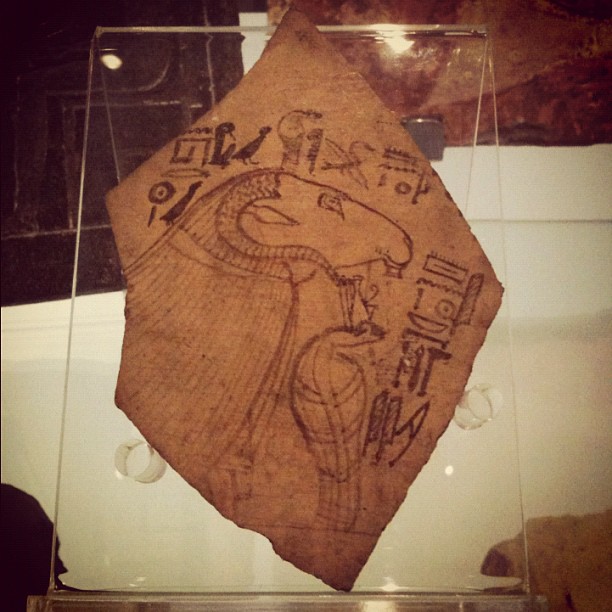 New Kingdom ostracon showing Amun-Re as a ram, probably from Deir el-Medina. Manchester Museum; image released under CC0.
Dreaming of a deity could carry special significance because Egyptian gods were encountered through images, names, hymns, festivals, dreams, and ritual presence.
A dream image of a god was not merely a random symbol in the modern psychological sense. It belonged to an established religious world in which gods acted.
At Deir el-Medina, local devotion included major state gods, deified royal figures, household deities, and highly personal forms of piety. Amun, Ptah, Hathor, Meretseger, Amenhotep I, Ahmose-Nefertari, and others could matter to workers and families.
The dream manual must therefore be read against living cult, not in isolation from religion.
Meretseger and the Theban Landscape of Fear
The goddess Meretseger, “She Who Loves Silence,” was especially important around the Theban necropolis and Deir el-Medina. Associated with the mountain overlooking the royal tombs, she could punish wrongdoing and heal those who repented.
Her cult reveals a religious logic relevant to dreams: misfortune may be morally meaningful, but divine punishment can be reversed through acknowledgment and correct action.
This is another reason fatalistic interpretations of Egyptian omens are too simple. Divine order allows warning, repentance, protection, and restoration.
Dreams as Evidence for Personal Religion
Egyptologists have long debated how to reconstruct “personal piety” from formal texts and monuments.
Dream evidence is valuable because sleep is inherently personal. Even when a manual standardizes interpretation, the underlying event belongs to an individual body and mind.
The text therefore stands at the boundary between institutional knowledge and private experience.
That boundary is one reason dream manuals are so rich for cultural history.
What the Dream Book Says About Fear
Bad dreams reveal a vocabulary of fear: magic, imprisonment, hostility, sickness, loss, humiliation, social disruption, divine danger, and bodily vulnerability.
These fears are not unique to Egypt, but their organization is culturally specific.
A modern reader learns as much from what the manual fears as from what it predicts.
Oneiromancy is therefore social history written through nightmares.
What the Dream Book Says About Hope
Good dreams point toward the opposite values: food, prosperity, household stability, respect, victory, health, sexual success in approved contexts, divine favor, and social elevation.
Ancient Egyptians did not dream only about eternity and gods. They hoped for ordinary success.
The manual humanizes a civilization often represented almost entirely through tombs and pharaohs.
The Problem with Quoting Isolated Dream Entries
Popular articles often list “ten strange Egyptian dream meanings” without context.
That approach can be entertaining but is historically weak. A single translated entry may depend on damaged text, disputed restoration, lost wordplay, or a classification scheme invisible outside the column.
Responsible interpretation therefore cites the manuscript and scholarship rather than treating each line as a timeless fortune-cookie meaning.
The dream book deserves to be studied as a system.
No, It Is Not an Egyptian Freud
Comparisons with Freud are tempting because both ancient oneiromancy and psychoanalysis treat dreams as meaningful.
The resemblance ends quickly.
Freudian interpretation seeks hidden psychological processes shaped by desire, repression, memory, and symbolic transformation. Papyrus Chester Beatty III seeks omen relationships between dream images and external outcomes.
The ancient text asks, in effect, “What does this dream indicate will happen?” Freud more often asks, “What hidden psychological wish or conflict produced this dream?”
The difference is fundamental.
And It Is Not Jung Either
Jungian language about archetypes is also frequently projected onto ancient Egypt.
Egyptian gods and symbols can certainly inspire modern depth-psychological interpretation, but that is a modern reception, not the method of Papyrus Chester Beatty III.
The dream book does not discuss a collective unconscious or individuation.
Historical interpretation begins by allowing ancient categories to remain ancient.
Dream Dictionaries Then and Now
Modern dream dictionaries resemble the Chester Beatty manual superficially because both pair images with meanings.
But internet dream dictionaries usually mix folklore, pop psychology, spirituality, and invented universal symbolism.
The Egyptian manual belongs to a scribal divinatory tradition preserved in a specific language and society.
The comparison is useful only if it highlights the human desire to classify dreams, not if it suggests direct continuity.
How Scholars Reconstruct the Text
The manuscript is fragmentary. Egyptologists must join pieces, identify columns, read hieratic signs, compare vocabulary, restore damaged phrases, and evaluate earlier editions.
Alan Gardiner’s 1935 publication was foundational. Later researchers have corrected readings, studied wordplay, reconsidered social categories, and compared the manual with Demotic evidence.
Every English translation is therefore an interpretation of an ancient damaged document.
This is why precise claims should remain modest when the underlying line is uncertain.
Why the British Museum Object Record Matters
Museum records are not substitutes for specialist editions, but they anchor the discussion materially.
The British Museum identifies the object number, physical sections, script, contents, and collection history. It confirms that the dream manual is not a nineteenth-century occult fabrication or a modern paraphrase.
Digital museum catalogues also allow readers to see the manuscript structure even when reuse rights for photographs require care.
For an evidence-based esoteric site, linking directly to the object record is better than recycling unsourced images.
The Dream Book and the History of Magic
Friedhelm Hoffmann includes Chester Beatty III in a history of Egyptian magic not because dream interpretation is identical to spell-casting, but because ancient Egyptian technical knowledge crosses modern boundaries.
Omens, magical protection, medicine, divine communication, and ritual expertise interacted.
A dream warning about magic can lead to protective action. A nightmare can be treated as an encounter with hostile force. A ritual can seek a dream intentionally.
The history of magic therefore includes the history of interpreting signs.
The Dream Book and the History of Divination
Divination is the more precise category for the manual itself.
Divination transforms uncertain signs into claims about hidden or future reality. It requires three things: a sign, an interpretive code, and an authority capable of applying the code.
Chester Beatty III supplies the code.
The dreamer supplies the sign.
The scribe or specialist supplies interpretation.
Why Dreams Are Ideal Divinatory Material
Dreams are private but vivid. They arrive without conscious control. They combine familiar people and impossible events. They feel meaningful even when they are confusing.
Those qualities make them ideal for divination.
An event that seems to come from outside deliberate thought can easily be understood as a message, warning, intrusion, or omen.
Human cultures repeatedly develop techniques for making dream uncertainty legible.
Egypt and Mesopotamia: Similar Grammar, Different Worlds
Both Egyptian and Mesopotamian traditions preserve technical dream interpretation.
The comparison is valuable because both classify dreams through conditional structures and predicted outcomes.
Yet the corpora differ in language, theology, institutional setting, textual history, and symbolic associations. SecretMagic’s article on Iškar Zaqīqu examines the much larger Mesopotamian dream-omen tradition.
Comparative study should therefore ask why two cultures systematized dreams without assuming one simply copied the other.
Dreaming and Scribal Prestige
A handbook gives the scribe access to invisible knowledge.
This matters in a society where writing itself carried prestige. Egyptian scripts required substantial training, and scribal identity was celebrated in didactic literature.
The ability to read a dream book therefore combines literacy with divination. The interpreter does not merely know symbols; he possesses access to written precedent.
Knowledge becomes authority because it is archived.
Why the Text Survived
Papyrus survives poorly in most environments. The dry conditions of Egypt, the preservation of Theban material, and the historical accidents of collection made Chester Beatty III possible.
Its survival should not be confused with uniqueness.
The fact that only a small number of Egyptian dream manuals survive does not mean only a small number ever existed. The archaeological record is radically incomplete.
The manuscript may therefore represent a much broader lost tradition.
The Archive Was Almost a Personal Library
The Deir el-Medina group has sometimes been described in ways that resemble a family or household library.
The comparison should be used carefully because ancient storage and ownership did not match modern private libraries exactly.
Still, the diversity of literary, practical, medical, magical, administrative, and religious texts shows long-term accumulation.
This archive gives us something rare: not just one text, but the intellectual environment in which a text lived.
Dreams Between Order and Chaos
Egyptian ideology frequently values ma’at: truth, justice, balance, correct order.
Dreams are inherently unstable. They collapse categories, reverse normal relationships, and produce impossible scenes.
A dream manual restores order by classifying them.
Interpretation is therefore a small act of cosmic organization: the confusing image receives a place and consequence.
Why Bad Dreams Can Be Useful
A bad omen is frightening, but warning has value.
If danger can be identified, a person can prepare. They can seek protection, make offerings, avoid risky action, consult another specialist, or address social conflict.
This practical value helps explain why societies invest in divination even when predictions are uncertain.
The omen gives uncertainty a form.
Dreams and Moral Interpretation
Not every interpretation is morally neutral.
Some dream categories reflect judgments about proper behavior, sexuality, violence, purity, and social type. Dreams therefore reinforce cultural norms.
The manual can tell the reader not only what may happen, but indirectly what kind of world is considered orderly.
Divination becomes social education.
Why the Dream Book Is Not a Ritual Manual
Although it belongs to the wider history of magic and religion, Chester Beatty III does not provide a step-by-step ceremony for inducing dreams.
This distinction prevents a common mistake in modern occult writing, where any ancient divinatory text is converted into a practice guide.
The papyrus is primarily interpretive.
Its value lies in historical evidence, not in pretending that a complete Ramesside dream ritual can be reconstructed from it.
Modern Reconstruction and Responsible Practice
Contemporary spiritual practitioners may find inspiration in ancient Egyptian dream culture. There is nothing historically wrong with modern creative practice if it is labeled as modern.
A modern dream journal inspired by Egyptian religion is not the same thing as Papyrus Chester Beatty III. A meditation invoking Thoth is not a documented Ramesside oneiromantic procedure unless evidence supports it.
Distinguishing inspiration from reconstruction protects both history and practice.
It allows ancient evidence to remain precise while modern spirituality remains honest.
Five Myths About the Egyptian Dream Book
“It contains the meaning of every dream.”
No. It preserves a finite set of classified dream scenes in one manuscript tradition. It was never a universal encyclopedia of all possible dreams.
“Qenherkhepshef wrote down his own dreams.”
No. The papyrus is a technical manual, not a personal dream diary.
“Every dream was believed to be a direct message from a god.”
No. Egyptian sources recognize several modes of dream significance. The manual often treats dreams as omens rather than direct divine speech.
“Bad dreams predicted unavoidable fate.”
Not necessarily. Egyptian ritual culture provided many strategies for protection, purification, and averting danger.
“The papyrus proves Egyptians invented psychoanalysis.”
No. The manual is divinatory and omen-based, not a theory of unconscious psychological causation.
What the Dream Book Reveals About Ancient Egyptian Knowledge
Its greatest significance may be epistemological.
The manuscript shows how Egyptians transformed private experience into public technical knowledge. A dream begins in one sleeper’s mind, but the handbook removes it from individuality and places it inside a shared system.
The same image can then be recognized across generations.
Knowledge becomes transmissible because experience becomes formula.
What It Reveals About Ancient Egyptian Anxiety
The manual also reveals a society attentive to hidden danger.
Magic from enemies, bodily harm, loss of status, imprisonment, social conflict, and divine displeasure are all imaginable futures.
Night becomes a place where those dangers can announce themselves before daylight.
The dream is frightening because it may know more than the dreamer.
What It Reveals About Ancient Egyptian Hope
Yet the text is not dominated by fear.
Favorable dreams promise prosperity, respect, abundance, successful relations, protection, and positive transformation.
Oneiromancy offers reassurance as well as warning.
A good dream is a small revelation that the future may be aligned with order.
From Ramesside Egypt to the Long History of Dream Interpretation
Dream interpretation continued through Demotic Egypt, the Hellenistic world, Roman temples, late antique magical traditions, Christianity, Islam, medieval oneirocritica, and modern popular culture.
Direct lines of transmission are complex. We should not claim that every later dream dictionary descends from Chester Beatty III.
What the manuscript proves is older and more important: by the New Kingdom, Egyptian scribes had already developed a sophisticated written technology for classifying dreams.
The desire to decode the night is ancient.
Conclusion: The Night as an Archive of Signs
Papyrus Chester Beatty III survives because a literate community treated dreams as knowledge worth preserving.
Its pages do not reveal an Egyptian Freud, a universal symbolic dictionary, or a complete mystical initiation. They reveal something historically richer: a scribal system for converting unstable nocturnal experience into ordered predictions.
The manual belongs to Deir el-Medina, a community where craftsmen and scribes built royal tombs while maintaining households full of letters, medicines, incantations, prayers, stories, disputes, and fears. In that environment, a dream book was not out of place. It was one tool among many for navigating a world understood to contain visible and invisible causes.
Its interpretive logic could draw on language, myth, social hierarchy, body symbolism, color, divine association, and inherited precedent. A dream could be good or bad, but the judgment was never merely subjective. It belonged to a cultural code.
The manuscript also demonstrates why “magic,” “religion,” “science,” and “psychology” become unstable when applied too rigidly to ancient Egypt. Dream interpretation is divination, but a dangerous dream may lead to magical protection. Divine appearance belongs to religion, but ritual can seek revelation deliberately. Scribal classification resembles technical science, but its premises are cosmological rather than experimental.
Most of all, the dream book reminds us that ancient people did not experience sleep as meaningless downtime. Night could reveal danger before it arrived. It could expose hidden hostility. It could promise prosperity. It could place the dreamer briefly inside a symbolic world where animals, gods, food, sex, social rank, color, and language pointed beyond themselves.
For the modern historian, the challenge is not to make those meanings universal. It is to recover the world that made them sensible.
Nearly three and a quarter millennia after the papyrus was copied, the dream scenes remain strange because the society that interpreted them is gone. Yet the act behind the manuscript remains immediately recognizable: someone wakes from an unsettling image and asks, “What did that mean?”
Papyrus Chester Beatty III is one of humanity’s oldest surviving attempts to answer that question systematically.
Sources and References
- British Museum, Papyrus Chester Beatty III, EA10683: British Museum Collection.
- Friedhelm Hoffmann, “Ancient Egypt,” in The Cambridge History of Magic and Witchcraft in the West, Cambridge University Press, 2015: Cambridge Core.
- University College London, Digital Egypt, “Manuscripts from Deir el-Medina”: UCL Digital Egypt.
- Kasia Szpakowska, Behind Closed Eyes: Dreams and Nightmares in Ancient Egypt, Classical Press of Wales, 2003.
- Kasia Szpakowska, “Dream Interpretation in the Ramesside Age,” in Ramesside Studies in Honour of K. A. Kitchen, 2011.
- Scott B. Noegel and Kasia Szpakowska, “‘Word Play’ in the Ramesside Dream Manual,” Studien zur Altägyptischen Kultur 35.
- Luigi Prada, “Classifying Dreams, Classifying the World: Ancient Egyptian Oneiromancy and Demotic Dream Books,” in Current Research in Egyptology 2011.
- Robert K. Ritner, The Mechanics of Ancient Egyptian Magical Practice, Studies in Ancient Oriental Civilization 54, Oriental Institute of the University of Chicago: Institute for the Study of Ancient Cultures.
- Alan H. Gardiner, Hieratic Papyri in the British Museum, Third Series: Chester Beatty Gift, British Museum, 1935.
- Joachim Friedrich Quack, studies of late Egyptian and Demotic dream books and divination.


