


 Page 1 of the Codex Borgia, a pre-Hispanic divinatory manuscript organized around the 260-day ritual count. Public-domain facsimile via Wikimedia Commons.
The 260-day ritual count of central Mexico is often introduced to modern readers as an “Aztec horoscope.” The comparison is tempting. A person’s birth date mattered. Day signs could be favorable or dangerous. Specialists interpreted combinations of signs and numbers. Certain dates were considered more suitable for particular activities than others. Yet the horoscope analogy can mislead as quickly as it clarifies.
The Nahuatl term tonalpohualli is usually translated as “count of the days” or “counting of the day signs.” It refers to a cycle created by combining thirteen numbers with twenty day signs, producing 260 distinct positions before the same number-and-sign combination returns. This count was used for calendrical prognostication, ritual scheduling, naming, interpretation of birth destinies, decisions about marriage or travel, and other forms of divination. It was represented in painted manuscripts known to scholars as tonalamatl or divinatory almanacs, and it was read by specialists whose expertise joined counting, interpretation, memory, ritual knowledge, and manuscript literacy.
But the tonalpohualli was not simply a personality test. Nor was it one isolated Aztec invention. Variants of the 260-day count were used across Mesoamerica for centuries and survived colonial disruption in several Indigenous communities. Its logic belonged to a broader ritual ecology in which days were not empty containers for events. Time itself possessed qualities, relationships, patrons, directions, sequences, and consequences.
Understanding the tonalpohualli therefore requires more than memorizing the twenty day signs. We have to ask how specialists read the count, how manuscripts arranged its cycles, how birth dates were interpreted, how colonial authors translated Indigenous divination into European categories such as “judicial astrology” or “sorcery,” and how modern scholarship is correcting older assumptions about elite control, fatalism, and a supposedly uniform “Aztec calendar.”
This article approaches the tonalpohualli as a ritual technology of time: a structured way of turning dates into signs that could guide human action.
What the 260-Day Count Actually Is
The basic arithmetic is simple. One sequence contains the numbers one through thirteen. Another contains twenty day signs. The two sequences advance together, but because thirteen and twenty are different lengths, they do not reset at the same moment. After 260 positions, every possible pairing has occurred once and the original combination returns.
This produces a cycle of 260 named days.
The twenty day signs are commonly rendered in English with names such as Crocodile or Alligator, Wind, House, Lizard, Serpent, Death, Deer, Rabbit, Water, Dog, Monkey, Grass, Reed, Jaguar, Eagle, Vulture, Movement, Flint, Rain, and Flower. Nahuatl names and translations vary across scholarship, and some English labels are approximations. The important point is that each sign is a culturally specific graphic and verbal entity, not a generic zodiac symbol.
The number sequence also matters. A day is not simply “Reed” but something like “One Reed,” “Eight Reed,” or another number-sign pairing. The numerical position changes the divinatory value.
Cambridge research on Mesoamerican mantic names describes the tonalpohualli as the central 260-position cycle used for hemerology, the interpretation of favorable and unfavorable qualities of days. The count informed judgments about births, marriages, offerings, journeys, and other actions. A recent Ancient Mesoamerica study likewise stresses that the 260-day system combined calendrical record with mantic value rather than functioning as an ordinary solar calendar.
Why 260 Days?
The origin of the 260-day count remains debated. Scholars have proposed connections with agriculture, human gestation, astronomical observations, ritual numerology, seasonal cycles, latitude-specific solar events, and the interaction of several older counting systems.
No single explanation has achieved universal acceptance.
This uncertainty is important. Popular accounts often present one theory as settled fact, especially the idea that 260 days simply equals the length of human pregnancy. Gestation may have contributed symbolic resonance, but biological pregnancy is variable and does not explain the full historical system by itself.
What is certain is that the 260-day count is very old in Mesoamerica. Calendrical signs and numerical systems appear in pre-Hispanic traditions long before the Mexica empire. By the Late Postclassic period, variants of the cycle were deeply integrated into religious and social life across multiple regions.
The Nahua tonalpohualli therefore belongs to a Mesoamerican intellectual inheritance rather than a single late invention by Tenochtitlan.
The Twenty Signs Were Not a Zodiac
Modern comparisons with the twelve-sign zodiac are understandable because both systems connect time with qualitative interpretation. But the structures differ fundamentally.
The European zodiac divides the ecliptic into twelve signs associated with the annual solar cycle and, in astrological practice, with planets, houses, aspects, and celestial positions. The tonalpohualli uses twenty day signs rotating against thirteen numbers in a 260-day sequence independent of the 365-day solar year.
Some Mesoamerican divinatory traditions also used celestial observations, Venus cycles, solar events, directions, gods, and other counts. Yet the 260-day system is not a disguised form of Mediterranean astrology.
Colonial writers sometimes translated Indigenous practice through the language of “astrology” because that was the nearest European scholarly category available to them. Sahagún’s Book 4 was framed in Spanish as dealing with “judicial astrology or the divinatory art.” That translation tells us as much about sixteenth-century European classification as it does about Nahua categories.
Calling the tonalpohualli an “Aztec zodiac” therefore creates a false sense of equivalence.
The Tonalpouhqui: Reader of the Day Count
The specialist who interpreted the tonalpohualli is often called a tonalpouhqui. The word is connected with counting or reading the day signs. The Digital Florentine Codex glosses related terms with meanings such as wise person, soothsayer, reader, and one who reads a book.
This is one of the most important facts about the system. Divination was not merely automatic arithmetic.
A client did not need only to know that a child was born on a certain date. The date had to be interpreted within a network of patrons, day-sign qualities, trecena context, associated deities, directional and numerical relationships, and inherited precedent.
The specialist therefore resembles other technical diviners who interpret structured signs. An Ifá diviner does not merely generate an Odù; they interpret a vast oral corpus and the client’s situation. A Mesopotamian diviner does not merely inspect a liver; they read a technical tradition. A Homeromanteion user does not merely roll dice; the numerical result routes the consultant to a verse whose ritual significance must be understood.
The tonalpouhqui’s expertise likewise lies in reading relationships, not merely identifying a symbol.
The Florentine Codex and the Colonial Archive
Much of what modern readers know about central Mexican divination comes from colonial-era sources produced after the Spanish invasion. The most important is the Florentine Codex, compiled under the direction of the Franciscan Bernardino de Sahagún with extensive participation by Nahua scholars, scribes, and artists.
Book 4 discusses the day count and the fortunes associated with particular signs. The Digital Florentine Codex, created by the Getty Research Institute and collaborators, now allows readers to compare Nahuatl text, Spanish translation, English translation, and images at folio level.
This source is invaluable and difficult.
It preserves Indigenous knowledge that might otherwise have been lost. At the same time, it was produced within a Christian colonial project whose purpose included identifying and suppressing pre-Hispanic religious practices. The Spanish headings can call the system “sorcery” or “judicial astrology.” Nahua informants may have selected what to explain, reformulated practices under new conditions, or spoken through categories shaped by colonial encounter.
The Florentine Codex is therefore not a transparent photograph of pre-Conquest religion. It is a multilingual archive created in a world already transformed by conquest, epidemic disease, Christianization, and political reorganization.
Book 4: Good Days, Bad Days, and Human Possibility
Book 4 organizes material around day signs and their prognostic qualities. Some births are associated with favorable destinies; others with difficulty, danger, or instability. Yet the text also complicates simple fatalism.
A person born under a favorable sign could ruin their fortune through negligence or misconduct. A difficult sign did not necessarily erase all possibility of improvement. Social behavior, ritual action, naming, upbringing, and timing could interact with calendrical destiny.
This is crucial because modern horoscope language often encourages a static model: your birth sign defines your personality forever.
Nahua hemerology appears more dynamic. A birth date creates tendencies and conditions within a moral and ritual world. Fortune can be strengthened, damaged, postponed, redirected, or negotiated.
Time constrains without turning humans into passive objects.
Trecenas: The Thirteen-Day Periods
The 260-day count can be divided into twenty periods of thirteen days, conventionally called trecenas by modern scholars. Each begins with a day numbered one.
These periods were represented in codices through patron deities, offerings, day signs, and other symbols. The divinatory meaning of a day therefore depends not only on its individual sign but on its position within a larger thirteen-day sequence.
Codex Borbonicus preserves especially clear trecena pages. One famous page represents the thirteenth trecena under the patronage of Tlazolteotl, with the thirteen day positions arranged around the composition.
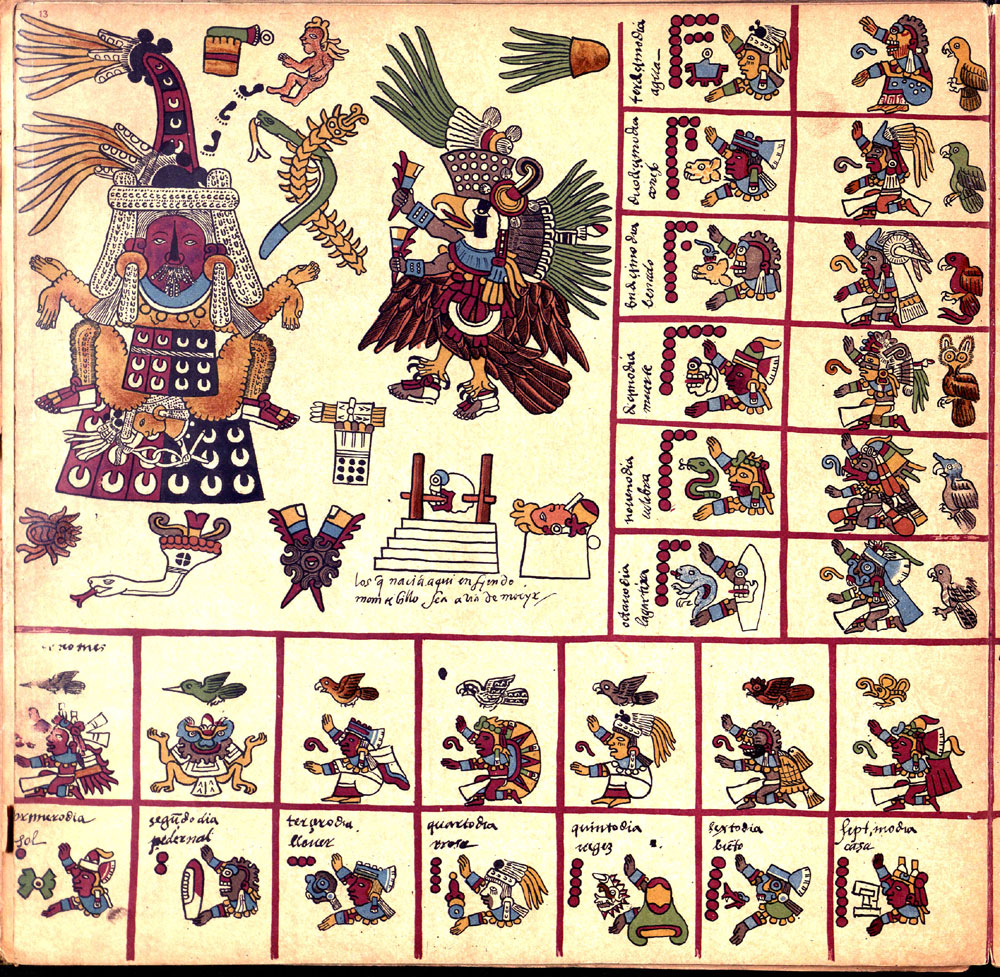 Page 13 of the Codex Borbonicus, representing the thirteenth trecena of the ritual count. Public-domain facsimile via Wikimedia Commons.
A modern reader who isolates one glyph from such a page loses the system. The page is a diagram of relationships. Deity, number, day sign, direction, offering, body, costume, and sequence interact.
Tonalamatl: The Book of Destinies
The painted divinatory manuscripts are often called tonalamatl, usually translated as “book of days” or “book of destinies.” These were not books in the modern sense of continuous prose.
Many were screenfold manuscripts painted with complex visual programs. The reader navigated diagrams, numerical series, day signs, deities, footprints, body parts, offerings, and directional patterns.
The Codex Borgia is the most famous surviving example of the broader Borgia Group. Its exact place of production remains debated, and it should not be treated simply as an “Aztec book from Tenochtitlan.” It belongs to a central Mexican or Puebla-Tlaxcala-related ritual manuscript tradition and preserves multiple divinatory almanacs.
Its pages demonstrate that reading a tonalamatl was a specialized visual practice. The manuscript does not explain itself through ordinary sentences. Meaning emerges from trained interpretation.
Codex Borgia Page 17: Time Written on the Divine Body
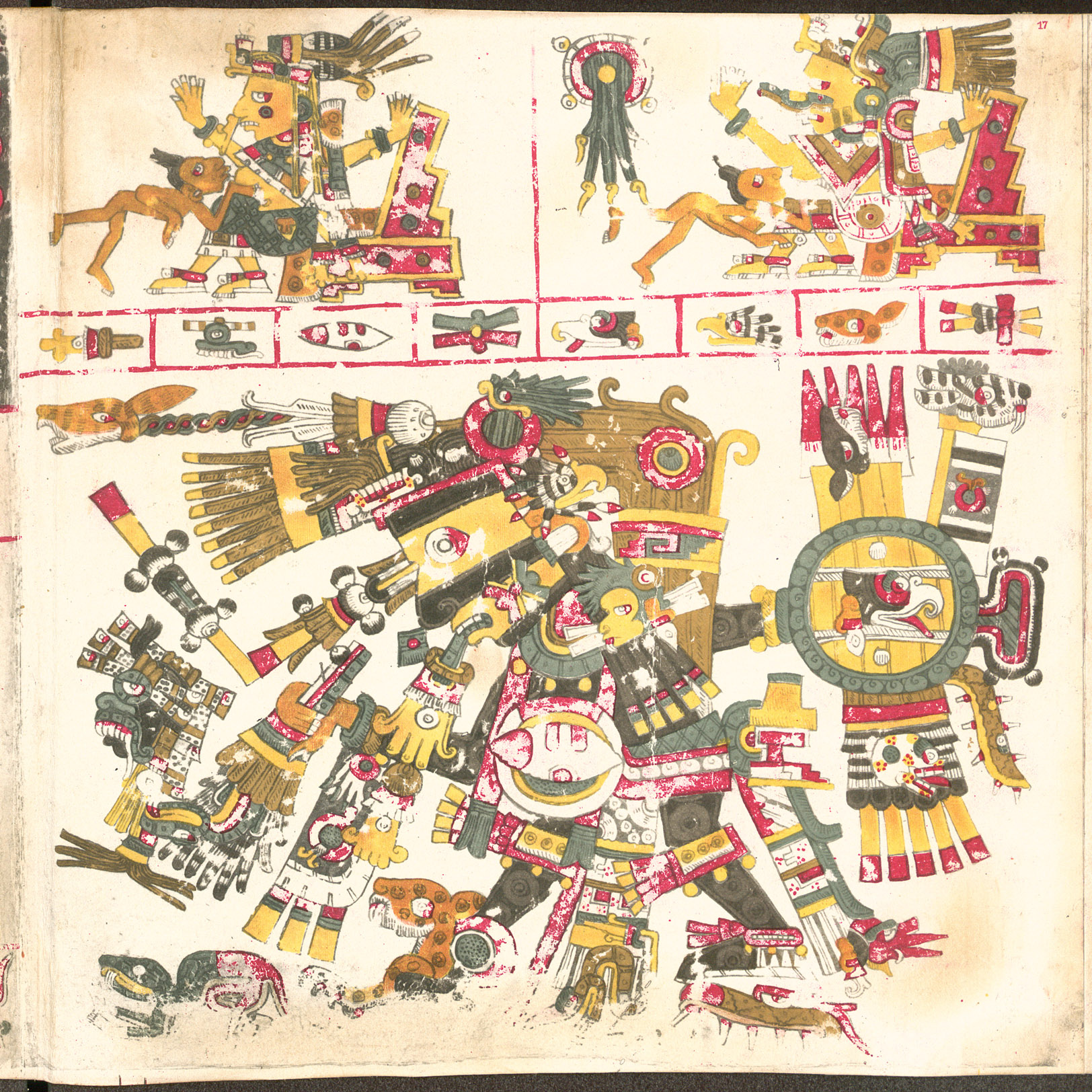 Codex Borgia, page 17. The central figure of Tezcatlipoca is integrated with the twenty day signs, turning the divine body into a calendrical field. Public-domain facsimile via Wikimedia Commons.
Page 17 of the Codex Borgia offers a striking example of how divinatory time could be visualized. The page centers on a dark form of Tezcatlipoca, with day signs distributed across the composition and, according to the manuscript’s modern description, across elements of the deity’s body and regalia.
This is not a calendar in the modern wall-chart sense. Time is embodied.
The image suggests that day signs participate in divine anatomy, ritual equipment, and cosmic power. The reader is not simply counting forward from Monday to Tuesday. They are interpreting a world in which calendar positions are woven into divine presence.
This embodied logic also helps explain why modern “birth sign” summaries are inadequate. A day sign belongs to myth, image, ritual, deity, direction, and sequence all at once.
Tezcatlipoca and the Instability of Fortune
Tezcatlipoca is especially appropriate in a divinatory context because he is associated with rulership, conflict, night, destiny, sorcery, vision, and sudden reversal.
His name is commonly translated as “Smoking Mirror.” Mirrors in Mesoamerican ritual could be linked with seeing, divination, rulership, and supernatural knowledge.
Tezcatlipoca’s mythic personality resists simple moral labeling. He can elevate and destroy, grant power and remove it, test rulers, deceive, reveal, and punish arrogance.
This instability reflects a central principle of divination: fortune is powerful but not secure.
Birth Dates and the Naming of Children
One major use of the tonalpohualli concerned birth.
The Florentine Codex records specialists interpreting the day on which a child was born. Families could consult the day reader to learn the qualities of the sign and decide how to proceed with naming or related ceremonies.
A child’s calendrical identity could therefore become part of social identity from the beginning of life.
The system did not necessarily assign a permanent public name identical to the day sign in every case. Naming practices varied. What matters is that birth inserted the child into a temporal structure whose qualities were interpreted ritually.
Time was not background. It was one component of personhood.
Could a Bad Birth Day Be Changed?
Some colonial descriptions suggest that rituals or delayed naming could respond to unfavorable birth timing. Scholars debate details, but the broader pattern is clear: calendrical danger could sometimes be negotiated.
This fits Mesoamerican divination more generally. A sign tells you about conditions; it does not necessarily abolish human action.
The logic resembles other omen traditions. SecretMagic’s article on Mesopotamian namburbi shows how a bad omen could prompt an apotropaic ritual. The systems are unrelated historically in any simple way, but both treat foreknowledge as useful because response remains possible.
Divination matters most when information can affect behavior.
Marriage, Travel, and Choosing the Right Time
Hemerology is not limited to birth destiny. The qualitative value of days can affect decisions.
Cambridge research on Mesoamerican mantic names notes that the 260-day count was used to assess marriages, travel, offerings, and other activities. Historical sources also connect day readers with selecting or interpreting appropriate times for events.
This is sometimes called electional divination: choosing a time because the date itself matters.
The logic is familiar across the world. Onmyōdō developed elaborate systems for avoiding dangerous directions and selecting auspicious times. Chinese almanacs classify favorable days. Astrology can choose election charts. Religious calendars distinguish holy and inauspicious periods.
The tonalpohualli belongs to this global history of qualitative time without being reducible to any of those systems.
Time Was Not Empty
Modern industrial societies often imagine time as homogeneous. One hour is mathematically equivalent to another. Meaning is added by human schedules.
Mesoamerican ritual time works differently. Days possess qualities before a person chooses what to do with them.
This does not mean ancient Nahuas lacked numerical or practical timekeeping. They had sophisticated calendrical systems. The point is that calculation and meaning were not separated.
A number-sign combination could be mathematically precise and ritually charged at the same time.
The calendar was therefore both arithmetic and divination.
The 260-Day Count and the 365-Day Year
The tonalpohualli operated alongside a 365-day solar count often called xiuhpohualli in Nahuatl contexts.
The two systems interlocked. Because 260 and 365 repeat against one another over a larger cycle, combinations of dates return after fifty-two solar years.
This larger pattern contributed to the famous Mesoamerican Calendar Round.
Yet the two counts served different functions. The 365-day cycle was closely tied to seasonal festivals and the solar year. The 260-day count had strong divinatory and ritual functions.
Calling both simply “the Aztec calendar” hides the existence of multiple simultaneous temporal systems.
The Fifty-Two-Year Round
The interaction of the ritual and solar counts produced a fifty-two-year cycle before the same pairing of day and annual positions returned.
Among the Mexica, the completion of this cycle was associated with the New Fire ceremony, a major renewal event.
This does not mean the New Fire ceremony was merely an expanded birthday horoscope. It belonged to state religion, cosmic renewal, fire ritual, and political order.
The connection illustrates how Mesoamerican calendrics operated at several scales at once: individual day, trecena, ritual cycle, solar year, and multi-decade cosmic period.
The Tonalpohualli and the Body
Divinatory manuscripts often associate calendar signs with body parts, gods, and directions.
This creates a microcosmic logic in which the human or divine body can mirror calendrical structure.
Medical, ritual, and divinatory interpretations may therefore overlap. A date can be related to vulnerability, bodily symbolism, or divine patronage.
Modern readers should resist turning such associations into a standardized “Aztec chakra system.” The evidence is specific to manuscripts and ritual contexts, not a universal energy anatomy.
Directions and the Fourfold Cosmos
Fourfold directional organization is widespread in Mesoamerican cosmology.
Divinatory manuscripts divide the 260-day count into directional or spatial patterns. Some arrangements group trecenas or day positions into four sectors, producing subcycles of sixty-five positions.
A recent Ancient Mesoamerica study emphasizes that sixty-five is not random: four sets of sixty-five generate the complete 260-day count. Codices can arrange such periods graphically to make calendrical relationships visible.
Direction is therefore part of number.
East, north, west, and south can carry different colors, gods, birds, trees, or destinies depending on the system.
The Number Thirteen
Thirteen structures the tonalpohualli at every level.
Each trecena contains thirteen positions. The number sequence repeats after thirteen. Twenty trecenas make 260 days.
Why thirteen acquired this importance cannot be reduced to one simple explanation. Mesoamerican cosmologies contain layered heavens and underworlds in some traditions, but direct one-to-one derivations should be handled cautiously.
What can be said is that thirteen became a fundamental ritual number embedded in calculation, divination, and manuscript design.
The Number Twenty
Twenty also has deep Mesoamerican significance.
Many Mesoamerican languages use vigesimal, or base-twenty, counting systems. Human fingers and toes likely contribute to the intuitive importance of twenty, but the numerical culture developed far beyond bodily counting.
The twenty day signs therefore sit naturally within a wider base-twenty mathematical environment.
When thirteen and twenty combine, two important numerical logics intersect.
Tonalamatl as Visual Computing
It is useful to think of divinatory codices as visual computing devices.
This does not mean they are mechanical calculators. It means they externalize relationships that would be difficult to hold in memory simultaneously.
A page can display day signs, sequence, patron deity, numerical groups, and ritual symbols at once.
The trained reader moves through this diagram according to established conventions.
In that sense, the codex performs intellectual labor. It organizes possibilities.
Why Pictorial Manuscripts Are Hard to Read
Alphabetic readers expect a text to begin at one corner and proceed in a clear line.
Mesoamerican divinatory manuscripts often demand another kind of literacy. Reading order may follow bands, columns, quadrants, footprints, circles, or numerical pathways.
Images can function as names, gods, actions, dates, directions, quantities, or narrative events.
This is why a modern viewer can recognize beautiful images while remaining unable to use the page.
Seeing the symbols is not the same as reading the system.
The Codex Borgia Was Not an “Aztec Tarot Deck”
Modern esoteric culture sometimes treats Borgia Group images as archetypal cards that can be intuitively read like Tarot.
Creative modern practice is possible, but historically the analogy is weak.
The codex is not a shuffled deck. Its imagery is ordered by calendrical and ritual sequences. The signs do not acquire meaning through random card selection.
Divination operates through date, count, and structured almanac.
The manuscript is closer to a complex ritual calendar than to Tarot.
Colonial “Astrology” and the Problem of Translation
Spanish missionaries needed vocabulary for unfamiliar systems.
They used categories such as astrology, divination, idolatry, superstition, and sorcery. These translations sometimes capture real structural similarities while adding Christian polemical judgment.
Sahagún’s Spanish framing of Book 4 as “judicial astrology” is a good example. In sixteenth-century Europe, judicial astrology referred to predicting human affairs from celestial configurations. The tonalpohualli also predicted human affairs, so the analogy made sense.
But the source of prognostication differed. The Nahua system was not simply reading planetary aspects.
Translation created understanding by creating distortion.
Why Missionaries Preserved What They Condemned
The Florentine Codex demonstrates a recurring paradox in the history of esotericism.
Authorities who wanted to eliminate a ritual tradition often documented it in extraordinary detail.
Missionaries needed to know which practices were incompatible with Christianity. That encouraged them to record gods, calendars, festivals, diviners, medicines, omens, and ritual language.
Without such documentation, much knowledge would be lost. Yet the documentation must always be read through the colonial purpose that produced it.
Indigenous Scholars Were Coauthors of the Archive
Older scholarship often spoke of “Sahagún’s account” as though one Franciscan simply observed Aztec culture and wrote it down.
The Digital Florentine Codex project makes the collaborative reality impossible to ignore.
Nahua scholars supplied language, categories, explanations, and images. Indigenous artists created visual programs that sometimes communicate information not reducible to the Spanish text.
Colonial ethnography was therefore co-produced under unequal power conditions.
Recognizing Indigenous intellectual authorship changes how the source is read.
Calendrical Knowledge Was Not Only Elite
For many years, scholars tended to treat Mesoamerican calendars as highly specialized elite knowledge controlled by priests and rulers.
Elizabeth Brumfiel’s research challenged this picture. Comparing archaeological, historical, and ethnographic evidence, she argued that the 260-day count served commoner purposes for at least a millennium.
Calendrical cosmology was not necessarily confined to palace specialists.
Ordinary households could know day meanings, consult local experts, and incorporate calendrical logic into everyday decisions.
This does not mean everyone possessed equal expertise. Technical readers still mattered. It means the system was socially broader than a court monopoly.
Calendrical Divination Survived Conquest
The Spanish invasion and Christianization did not erase the 260-day count everywhere.
Variants survived in several Indigenous communities in Mexico and Guatemala, sometimes integrated with Christian festivals, saints, new social institutions, and local languages.
Modern survivals should not be treated as unchanged fossils from the fifteenth century. They have their own colonial and modern histories.
But their persistence shows the resilience of Mesoamerican calendrical thought.
A divinatory technology can survive even when the empire that once used it disappears.
The Calendar and Naming
Day names can become personal names in several Mesoamerican traditions.
This practice makes calendar identity social and visible.
A person can carry time in their name.
The exact relationship between calendrical names, baptismal names, household names, and political names changed after colonization, but the principle remains significant historically.
The Calendar and Moral Character
Colonial descriptions often associate birth signs with temperament or life trajectory.
This has encouraged the horoscope comparison, but the cultural model is different.
A day sign can shape tendencies without functioning like a modern psychological type. Moral behavior, family instruction, and ritual timing still matter.
Character is calendrical, social, and ethical at once.
Good Fortune Could Be Wasted
One of the most revealing themes in the Florentine Codex is that a favorable sign does not guarantee a good life.
A person can waste opportunity through laziness, drunkenness, irresponsibility, or other failures.
This principle prevents divination from collapsing into determinism.
Fortune is a resource rather than a prison.
Bad Fortune Could Be Managed
Likewise, unfavorable timing could lead to caution, ritual response, adjusted schedules, or other strategies.
This is why technical divination is practical.
If nothing can change, interpretation has little utility.
The existence of specialists suggests that knowledge was expected to help.
Birth Destiny and Social Inequality
Calendrical explanations can naturalize social differences by interpreting success and failure through timing.
Yet they can also provide explanations for unpredictable life outcomes.
A child born into a difficult situation may still be understood through a meaningful cosmic framework rather than pure accident.
Historical analysis should consider both functions without reducing divination to social control.
Tlazolteotl and the Thirteenth Trecena
The Codex Borbonicus page associated with the thirteenth trecena centers Tlazolteotl, a goddess connected with sexuality, impurity, confession, purification, and fertility.
Her presence demonstrates how a trecena is more than a numbered block of days.
The patron deity contributes mythic and moral texture.
The calendrical page therefore combines arithmetic with theology.
Tezcatlipoca, Tlazolteotl, and the Personal Future
Figures such as Tezcatlipoca and Tlazolteotl are not decorative illustrations surrounding an independent calendar.
They are part of the interpretive machinery.
A day under a particular patronage participates in that deity’s field of power.
Divination becomes a way of locating a person inside divine relationships.
Tonalli: Day, Heat, Fate, and Vital Force
The Nahuatl word tonalli has a rich semantic field. It can refer to day, warmth from the sun, calendrical destiny, and aspects of personal vitality or fate.
Modern translations struggle because one English word cannot reproduce all these associations.
This linguistic complexity helps explain why the tonalpohualli is more than a calendar.
Counting days also means reading qualities of life.
The Head and Tonalli
Ethnohistorical scholarship has linked tonalli with the head and with personal vitality.
This has sometimes been simplified into claims that ancient Nahuas believed in a single “soul” stored in the skull.
The reality is more complex. Nahua ideas of personhood involved several animating entities and bodily centers, interpreted differently across sources.
Calendrical destiny is therefore one dimension of personhood, not a complete soul theory.
Why “Energy” Is an Incomplete Translation
Modern spiritual writing often translates tonalli as “energy.”
The word can help convey vitality, but it risks stripping away calendrical, thermal, social, and religious meanings.
Energy sounds universal and scientific.
Tonalli is culturally specific.
Good translation sometimes requires keeping the original word.
Divination and Responsibility
If a sign influences destiny but behavior still matters, then divination can reinforce responsibility.
A favorable birth is not an excuse for failure. An unfavorable birth is not necessarily moral guilt.
The specialist interprets conditions within which action occurs.
This model is more subtle than simple fortune-telling.
Public Ritual and Private Consultation
Mesoamerican calendars operated at several social scales.
State festivals followed calendrical cycles. Communities organized ritual events. Families consulted specialists about births. Individuals sought guidance for decisions.
The same temporal system could therefore structure public religion and private uncertainty.
This overlap is common in ritual calendars around the world, but its Nahua form was distinctive.
Divination Without Randomness
Many forms of divination generate a random result through dice, lots, bones, cards, or thrown objects.
The tonalpohualli is different.
The date already exists. The diviner does not create the sign by chance.
The interpretive problem is hemerological: what qualities belong to this position in the count?
This distinguishes it from SecretMagic’s articles on astragalomancy and the Homeromanteion, where randomizing devices select an oracle.
Hemerology: Reading the Quality of Days
Hemerology is a useful comparative term for systems that classify days as favorable or unfavorable for persons or actions.
It appears in many cultures, including Mesopotamia, China, Japan, and Mesoamerica.
Yet hemerology should not imply one shared origin.
Human societies repeatedly discover that calendars can do more than count. They can organize risk.
Time as a Political Resource
Rulers and institutions can gain authority by controlling calendrical knowledge.
Correctly timing festivals, wars, agricultural rituals, or dynastic ceremonies demonstrates access to cosmic order.
In Mexica state religion, calendrical systems helped coordinate large-scale ritual life.
But Brumfiel’s work reminds us that cosmological knowledge was not simply imposed downward by elites.
Commoners could participate actively in temporal interpretation.
The Calendar Was Not Purely Fatalistic
Colonial Christian authors sometimes portrayed Indigenous divination as irrational bondage to fate.
Modern readers can reproduce that judgment by imagining people terrified of “bad days.”
The evidence instead suggests strategic use.
Knowing that a date is difficult can change how one acts. Knowing that a date is favorable can create confidence or ritual opportunity.
Calendrical knowledge is a tool for navigation.
The Tonalpohualli and Agricultural Life
The 260-day count is independent of the 365-day solar year, yet agriculture still intersects with divination.
Ritual timing, rain gods, planting concerns, offerings, and seasonal festivals appear in manuscripts and archaeology.
Recent research on Tetzcotzinco has examined 65-day subcycles and their possible relationship with rain-related almanacs.
This shows how ritual counts can connect with ecology without being reducible to a farming calendar.
Tlaloc and Rain Almanacs
Rain was existentially important in central Mexico.
Tlaloc and related rain beings appear throughout Mesoamerican ritual imagery. Divinatory almanacs can organize offerings and dates associated with rain.
This is not merely symbolic weather spirituality. Agricultural success, famine, and political stability depended on precipitation.
Calendrical divination therefore had material stakes.
Venus, Astronomy, and the Limits of the “Calendar” Label
Mesoamerican manuscripts combine multiple counts, including Venus cycles and other astronomical or ritual periods.
The Codex Borgia contains material that scholars interpret in relation to Venus as well as the 260-day count.
This complexity is another reason “the Aztec calendar” is too vague.
Different systems tracked different patterns while interacting mathematically and ritually.
Why the Calendar Stone Is Not the Tonalpohualli Manual
The famous Mexica Sun Stone is often called the “Aztec Calendar Stone.”
It contains calendrical imagery, including day signs, but it is not a practical tonalamatl equivalent to the Codex Borgia or Borbonicus.
The monument belongs to imperial religious art and cosmic ideology.
Using it as the sole illustration for tonalpohualli can therefore create confusion between monumental cosmology and working divinatory manuscripts.
From Manuscript to Consultation
How might a consultation have worked?
The sources do not preserve one universal procedure, and any reconstruction must remain cautious.
A family could approach a specialist with a child’s birth date or another calendrical question. The tonalpouhqui would identify the relevant position, consult learned associations, perhaps use a painted manuscript, and interpret the implications.
The result would be spoken advice, not merely a number read aloud.
The consultation therefore transformed visual and numerical knowledge into social action.
Why Interpretation Could Vary
Divinatory systems are rarely mechanical enough to eliminate judgment.
Different specialists may emphasize different aspects of the same date. Local traditions may assign different patrons or values. Manuscripts may preserve variant arrangements.
This flexibility does not imply arbitrary invention.
Interpretation operates within a tradition that constrains possibilities without fixing one sentence forever.
Codices as Living Tools, Not Museum Art
Modern museums display codices as masterpieces of Indigenous painting.
That recognition is valuable, especially after centuries in which European collectors dismissed such works as primitive curiosities.
Yet aesthetic appreciation can create a new distortion if we forget use.
A tonalamatl was meant to be read, consulted, handled, and interpreted.
Its beauty served knowledge.
Why Reproduction Changes the Experience
Digital scans make codices accessible globally, but they flatten scale and materiality.
A screenfold manuscript can be opened across several pages at once. The reader can compare distant sections physically. Pigments, hide or paper, fold direction, wear, and sequencing contribute to use.
A cropped image isolates details at the cost of structure.
Digital access is transformative, but manuscript interpretation still benefits from material awareness.
Did Common People Own Tonalamatl?
Direct evidence for ownership is uneven.
Painted manuscripts required specialized labor and materials, so many surviving examples likely belonged to elite or professional contexts.
But widespread knowledge of the 260-day count does not require everyone to own a manuscript.
Calendrical knowledge can circulate orally, through specialists, household practice, and local teaching.
Calendrical Knowledge as Oral and Visual Tradition
Modern readers often assume that if a codex was destroyed, the knowledge disappeared with it.
But ritual calendars can live in memory.
Specialists memorize sequences, interpretations, names, and songs. Visual books support rather than replace oral expertise.
This helps explain survival after colonial book destruction.
The Violence of Manuscript Loss
Spanish conquest and Christian campaigns destroyed many Indigenous ritual manuscripts.
Only a small fraction of pre-Hispanic painted books survives.
This loss radically limits modern reconstruction.
When scholars debate whether a pattern was universal, they often work from a tiny surviving sample.
Historical humility is therefore necessary.
Modern “Aztec Astrology” and Reinvention
Contemporary websites frequently assign users an “Aztec zodiac sign” based on birth date.
Some draw loosely on real day signs. Others invent twelve-sign systems modeled directly on Western astrology.
These modern constructions should not be confused with historical tonalpohualli practice.
A genuine reconstruction requires the 260-day count, correct calendrical correlation, Indigenous terminology, and attention to source traditions.
The Correlation Problem
Converting a modern Gregorian birth date into a pre-Hispanic tonalpohualli position is not always as simple as online calculators suggest.
Scholars and living Indigenous traditions may use different correlations and continuity assumptions.
Post-Conquest calendrical disruptions complicate the question.
Any modern calculator should therefore state its correlation method rather than present one answer as unquestionable.
Living Traditions Deserve Their Own Authority
Some Indigenous communities continue 260-day counts today.
These traditions are not museum reconstructions waiting for outsiders to authenticate them with codices.
They have their own histories of transmission, adaptation, Christianity, colonialism, and local authority.
Academic reconstruction and living practice can inform one another without one erasing the other.
Comparing Tonalpohualli with Ifá
SecretMagic’s article on Ifá divination offers a useful comparison because both systems involve highly structured sign repertoires interpreted by trained specialists.
But the mechanisms differ.
Ifá generates one of 256 Odù through a divinatory procedure and interprets it through an extensive oral corpus. Tonalpohualli starts from a calendrical position generated by the ongoing count of days.
The comparison reveals a shared principle—structured signs plus expert interpretation—without implying historical connection.
Comparing Tonalpohualli with Onmyōdō
The article on Onmyōdō provides another contrast.
Japanese onmyōji worked with calendars, directions, astronomy, yin-yang and Five Phases theory, court institutions, and ritual avoidance.
Nahua day readers likewise treated time as qualitatively charged.
Yet the cosmologies, mathematics, institutions, and histories differ completely.
Hemerology is a recurring human technology, not proof of one universal occult science.
Why Time Becomes Divinatory
A calendar already organizes uncertainty.
It tells people when seasons change, festivals occur, debts come due, rulers commemorate events, and children become older.
Divinatory calendars go one step further: they ask whether time itself carries signs.
Once that premise is accepted, every birth and decision enters a preexisting structure of meaning.
Calendars Turn Chance into Pattern
No one chooses the exact day of their own birth.
That makes birth date ideal divinatory material.
It is random from the individual’s perspective but ordered by the calendar.
The tonalpohualli transforms biological accident into cosmological placement.
Does This Mean People Had No Free Will?
No surviving source gives us a simple philosophical treatise on free will in modern terms.
But practical evidence suggests that people were expected to act within calendrical conditions.
Warnings matter. Advice matters. Moral conduct matters.
Destiny is not the same as total determinism.
The Tonalpohualli as Social Memory
Calendars do more than predict.
They preserve the names of gods, signs, rituals, directions, and cycles across generations.
A day count is therefore also a mnemonic system.
Every repetition of the 260-day sequence rehearses a cosmology.
The Tonalpohualli as a Technology of Identity
Birth places a person within the count.
Naming can connect the person publicly with that temporal identity.
Specialists interpret the sign’s possibilities.
Time becomes one layer of who a person is.
The Tonalpohualli as a Technology of Risk
Travel, marriage, naming, offerings, and other actions involve uncertainty.
The day count provides a framework for evaluating risk.
Even when prediction is not empirically testable in modern terms, the system creates a disciplined way of discussing uncertainty.
That social function is real.
The Tonalpohualli as a Technology of Power
Those who can interpret time possess authority.
Specialists advise families. Ritual institutions organize festivals. Rulers align action with cosmic cycles.
Calendrical expertise therefore intersects with social power.
But the evidence of commoner use warns against imagining total elite control.
Five Myths About the Tonalpohualli
“It is the Aztec zodiac.”
No. It is a 260-day Mesoamerican ritual count based on thirteen numbers and twenty day signs, not a twelve-sign ecliptic zodiac.
“Your day sign permanently determines your personality.”
No. Birth timing mattered, but colonial sources also emphasize conduct, ritual response, and the possibility of strengthening or damaging fortune.
“The Aztecs invented it.”
No. The 260-day count has much older and broader Mesoamerican roots.
“Only priests knew the calendar.”
Specialists possessed advanced expertise, but archaeological and historical research indicates that the count also served commoner needs and circulated beyond elite institutions.
“One modern online calculator can recover your exact ancient sign with certainty.”
Not necessarily. Correlation problems, colonial disruption, and living regional traditions complicate modern conversion.
What the Tonalpohualli Teaches About Divination
The 260-day count reveals that divination does not always require randomness, trance, visions, or supernatural beings speaking aloud.
A system can be divinatory because it interprets a structured sequence already unfolding in time.
The sign is not thrown. It arrives.
The specialist’s task is to read the quality of that arrival.
What It Teaches About “Magic”
Colonial writers often placed the tonalpohualli inside categories of sorcery and superstition.
Modern scholarship can study it within the history of magic while remaining more precise.
The system overlaps with divination, ritual timing, religious cosmology, manuscript technology, and personal destiny.
Calling it magic is useful only if the term remains broad enough to include learned calendrical interpretation.
What It Teaches About Manuscripts
A painted book can be an instrument rather than a container of prose.
The Codex Borgia and Borbonicus demonstrate forms of literacy in which images, numbers, sequence, color, and space work together.
This challenges alphabetic assumptions about what counts as writing.
A divinatory page can compute without equations and narrate without sentences.
What It Teaches About Colonial Sources
The Florentine Codex is indispensable because it preserves Indigenous knowledge.
It is also dangerous if read uncritically because Christian colonial categories frame that knowledge.
The best method compares Nahuatl text, Spanish translation, images, archaeology, pre-Hispanic codices, and living traditions.
No single source should be allowed to stand for the entire system.
Conclusion: Reading Time Before the Horoscope Analogy
The tonalpohualli was not an Aztec horoscope in the modern sense. It was something more structurally complex and historically significant: a Mesoamerican technology for reading the qualitative dimensions of time.
Its 260 positions emerged from the interaction of thirteen numbers and twenty day signs. Specialists interpreted those positions through divinatory manuscripts, oral knowledge, deities, directional schemes, trecenas, and inherited precedent. Birth inserted a child into this temporal field. Marriage, travel, offerings, naming, and ritual could also be evaluated through it.
The system was mathematical without being merely arithmetic. It was religious without requiring every reading to be a direct divine message. It was divinatory without always using randomization. It was visual without being reducible to art. It could be socially authoritative without belonging exclusively to elites.
The codices make this complexity visible. On Codex Borgia page 17, day signs are woven into the body and regalia of Tezcatlipoca. On Codex Borbonicus trecena pages, gods, numbers, and signs form a graphic system whose meaning depends on trained reading. In the Florentine Codex, Nahua experts explain the count through a colonial archive that simultaneously preserves and condemns it.
Modern “Aztec zodiac” summaries usually remove precisely the relationships that made the system work. They isolate one sign, attach a personality profile, and ignore number, trecena, deity, correlation, ritual context, manuscript structure, and Indigenous intellectual history.
A more accurate understanding begins with a different premise: for Nahua diviners, time was not empty.
A day arrived already related to other days, to divine powers, to number, to direction, to memory, and to possible futures. The work of the tonalpouhqui was to read those relationships and translate them into advice.
That practice places the tonalpohualli within a global history of divination while preserving what makes it distinctly Mesoamerican. Like Ifá, it depends on specialist interpretation. Like Onmyōdō, it treats time as qualitatively charged. Like Mesopotamian hemerology, it can classify days as favorable or dangerous. Yet its twenty signs, thirteen numbers, codex layouts, divine patrons, and historical communities belong to their own cultural world.
The most respectful way to study the tonalpohualli is therefore neither to dismiss it as superstition nor to universalize it as timeless astrology. It is to recognize it as a sophisticated Indigenous system for transforming the passage of days into a readable field of possibility.
Sources and References
- Digital Florentine Codex, Book 4, edited by Kim N. Richter, Alicia Maria Houtrouw, Kevin Terraciano, Jeanette Peterson, Diana Magaloni, and Lisa Sousa, Getty Research Institute, 2023: Getty Research Institute.
- Digital Florentine Codex, Book 6, folio 168v, image of parents consulting a day reader: Getty Research Institute.
- Elizabeth M. Brumfiel, “Technologies of Time: Calendrics and Commoners in Postclassic Mexico,” Ancient Mesoamerica 22.1, Cambridge University Press, 2011: Cambridge Core.
- Elizabeth Hill Boone, Cycles of Time and Meaning in the Mexican Books of Fate, University of Texas Press, 2007.
- Ancient Mesoamerica, “Mesoamerican mantic names as an etymological source of Mixtec vocabulary,” Cambridge University Press: Cambridge Core.
- Ancient Mesoamerica, “From simple row of dots to the rain god calendar: Interpretation of the pecked cross petroglyph from the Late Postclassic Tetzcotzinco,” Cambridge University Press: Cambridge Core.
- Codex Borgia, Vatican Library, Borg.mess.1; public-domain facsimile images via Wikimedia Commons.
- Codex Borbonicus, Bibliothèque de l’Assemblée nationale, Y 120; public-domain facsimile images via Wikimedia Commons.


