


The history of the Key of Solomon does not begin with a single Hebrew book secretly carried into medieval Europe, nor with one authoritative manuscript written by King Solomon. Behind the famous Latin and vernacular Clavicula Salomonis tradition stands a much less familiar body of Greek material: the text modern editors commonly call the Magical Treatise of Solomon, or Hygromanteia. Preserved in late Byzantine and post-Byzantine manuscripts, it reveals a world in which planetary timing, Christian prayers, angelic and demonic names, ritual implements, talismanic diagrams, divination, and inherited Solomonic legend were assembled into a practical literature of learned magic.
The Hygromanteia matters because it complicates nearly every simple story told about European ceremonial magic. It is not merely an early edition of the Key of Solomon. It is not simply a manual of water divination, despite the name by which it became widely known. It is not a work demonstrably written by Solomon, and it does not survive as one pristine original. Instead, it is a manuscript tradition: overlapping Greek texts whose contents vary, whose components circulated in different arrangements, and whose later history intersects with the formation of the Western Solomonic grimoires.
That distinction is more than bibliographical caution. It changes how we understand the transmission of magic between Byzantium, the eastern Mediterranean, Italy, and western Europe. Rather than imagining occult traditions as isolated inventions, the manuscripts show ritual knowledge moving through languages, religious environments, scribal workshops, and changing intellectual worlds. The result is a case study in how a magical book is made over centuries.
 A folio associated with British Library Harley MS 5596, a fifteenth-century Greek manuscript containing divination, Solomonic texts, and ritual magic. Public-domain manuscript image via Wikimedia Commons.
What the Hygromanteia Actually Is
The safest way to define the Hygromanteia is as a Greek Solomonic magical tradition preserved in multiple manuscripts, rather than as a single fixed book. Modern English readers often encounter it through Ioannis Marathakis’s edition and translation, The Magical Treatise of Solomon, or Hygromanteia, first published in 2011 and later reissued. That edition collates material from a number of Greek witnesses, including manuscripts in London, Bologna, Athens, Paris, Munich, and elsewhere. The editorial reconstruction is invaluable, but the very need to reconstruct the work demonstrates that medieval and early modern readers did not possess one universally standardized Hygromanteia.
One particularly important witness is British Library Harley MS 5596. The British Library catalog dates the codex to the fifteenth century and describes it broadly as a collection of “Divinations, magic, etc.” Its contents are strikingly heterogeneous. They include arithmomancy, cleromancy, a text attributed to Pythagoras, magical recipes, portions of the Testament of Solomon, the Magical Treatise of Solomon itself, material on angels and demons of the days, astrological material, palmomancy, lunar zodiacal lore, ink-making instructions, and plant correspondences.
This codicological context is essential. Harley MS 5596 does not present “magic” as a modern bookstore category with neat boundaries. Divination, astrology, ritual technique, inherited ancient authorities, Christian supernatural beings, plants, numbers, and celestial timing coexist in the same physical volume. A reader who isolates one ritual from that environment can miss how the manuscript itself organized knowledge.
The British Library identifies folios 18v–39v as the Magical Treatise of Solomon, beginning with the Greek title Archē tēs apotelesmatikēs pragmateias. Nearby folios contain parts of the Testament of Solomon, another important pseudepigraphic work in which Solomon exercises authority over demons. Their physical proximity does not prove that they were originally composed together. It does, however, show how a fifteenth-century compiler could place different Solomonic traditions within the same manuscript environment.
Why Calling It “Hygromanteia” Can Be Misleading
The word hygromanteia suggests divination through water or moisture. This has encouraged a persistent misunderstanding: that the whole work is fundamentally a treatise on hydromancy. In fact, water divination is only one strand within a much broader ritual collection. Marathakis has emphasized that the title does not adequately describe the full contents of the textual tradition.
This is a useful warning about historical titles in general. Manuscripts can acquire labels from a particular copy, catalogue, incipit, section, or later scholarly convention. A title familiar to modern occult readers may not correspond to an author’s original conception—especially when there is no identifiable author and no surviving autograph. “Hygromanteia” is therefore convenient, but “Magical Treatise of Solomon” better signals the collection’s breadth.
Water divination itself belongs to a much older and wider family of techniques in which reflective surfaces, vessels, liquids, children acting as seers, lamps, mirrors, or other media were used in attempts to obtain hidden knowledge. Similar structural motifs occur in late antique and medieval ritual literature across linguistic and religious boundaries. Historical comparison does not mean that every such rite derives from one source. It means that techniques could be adapted repeatedly because they answered recurring ritual questions: how can an invisible being be made perceptible, how can uncertain information be externalized, and how can a diviner create an authoritative setting for revelation?
From a modern critical perspective, there is no scientific evidence that such procedures provide supernatural knowledge. Their historical significance lies elsewhere: in what they reveal about concepts of vision, authority, purity, mediation, and the porous boundary between prayer, divination, and magic.
Solomon as an Author Who Did Not Write the Book
The attribution to Solomon is traditional, not historical. The biblical king became one of the most important imagined authorities in Jewish, Christian, Islamic, and Mediterranean traditions concerning wisdom, spirits, hidden knowledge, and extraordinary command. Late antique and medieval literature greatly expanded this reputation. The Testament of Solomon, for example, presents a legendary Solomon interrogating and controlling demons during the building of the Temple. Later magical texts repeatedly place instructions in his mouth or frame them as wisdom transmitted to his son Rehoboam.
This is pseudepigraphy: the attribution of a text to an authoritative figure who is not its historical author. Pseudepigraphy should not automatically be reduced to crude forgery. In premodern literary cultures, prestigious names could function as claims about lineage, authority, genre, revelation, or inherited wisdom. A Solomonic title tells us how a work wished to be read, even when it does not tell us who composed it.
For the Hygromanteia, the gap between legendary attribution and manuscript evidence is enormous. The historical Solomon, if situated within the conventional chronology of the ancient Israelite monarchy, belongs to the first millennium BCE. The principal Greek manuscripts relevant to the Magical Treatise are medieval, many centuries later. No responsible historical method can bridge that gap simply because the text says “Solomon.”
Yet the attribution had real consequences. By presenting ritual expertise as Solomonic wisdom, scribes and practitioners inserted potentially controversial techniques into a sacred historical imagination. Solomon could serve simultaneously as king, sage, exorcist, astrologically informed ruler, and master of spirits. His name transformed miscellaneous operations into parts of a recognizable tradition.
The Manuscript Is More Important Than the Myth
Harley MS 5596 offers unusually concrete evidence because its catalogue description allows us to see the manuscript as an artifact rather than a legend. The codex is written in Greek, consists of fifty-eight folios, and is dated by the British Library to the fifteenth century. Its paper, dimensions, script, later ownership, and acquisition history belong to the recoverable life of a physical object.
That physical history matters. Magical literature is especially vulnerable to decontextualization because modern editions often combine material from multiple witnesses into a smooth reading text. Such editions are necessary for study, but a reconstructed book can look more unified than its manuscript ancestors actually were. The historian therefore asks two related but different questions: What does the reconstructed tradition contain? and What does this particular manuscript contain, in this particular order?
In Harley 5596, Solomonic ritual instructions sit beside methods of divination and astrological lore. This suggests a working library of techniques rather than a philosophical treatise with a single systematic argument. The manuscript’s value is partly cumulative. Different forms of knowledge are gathered because they can be used, compared, copied, or preserved.
Such compilatory behavior is common in manuscript culture. A scribe could add material from another exemplar; a later owner could bind previously separate units; recipes could migrate independently; diagrams could be copied imperfectly; names could be altered through phonetic transmission. The concept of a stable “edition” is therefore dangerous when projected backward onto a fluid ritual tradition.
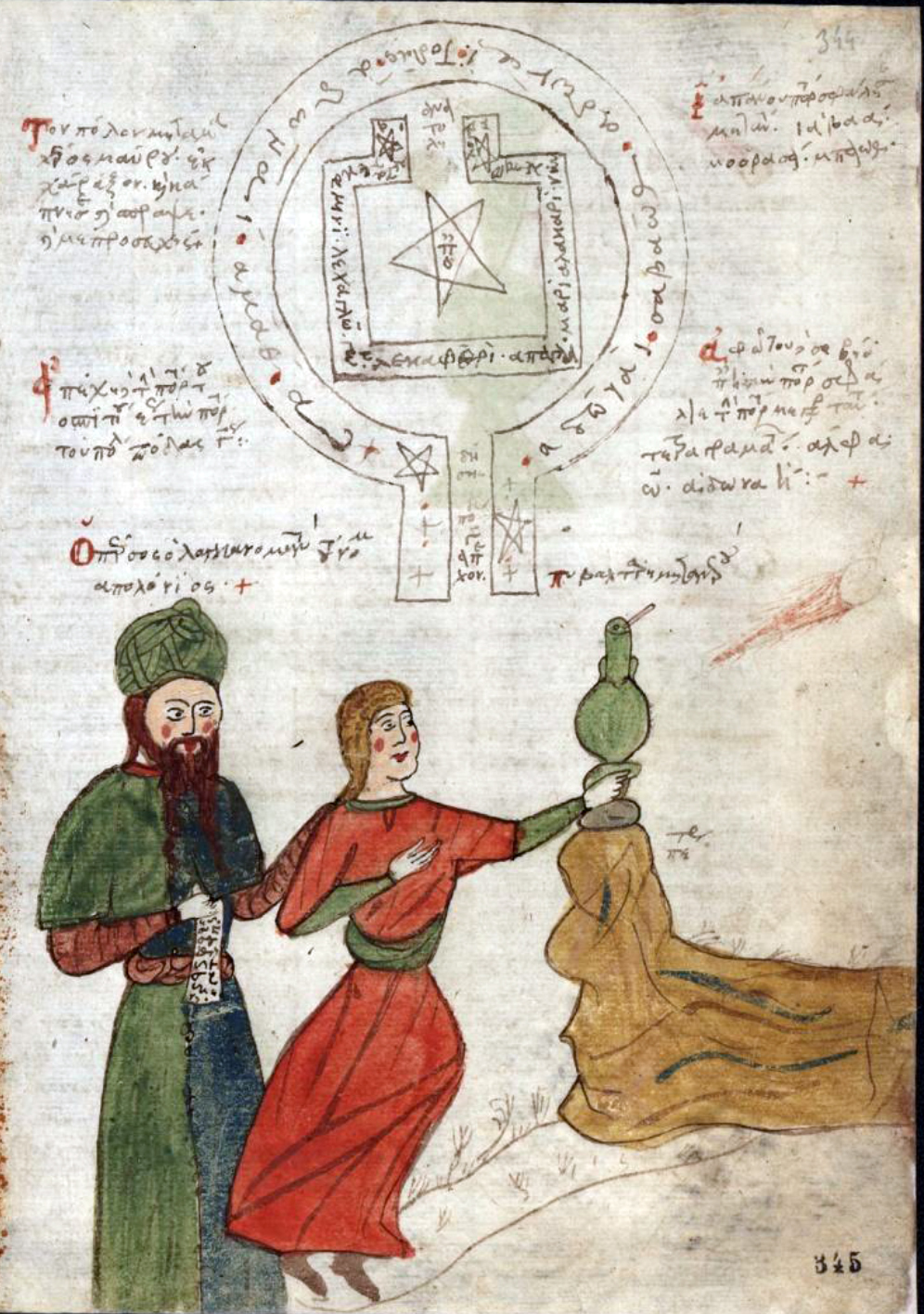 An illustrated page associated with the Greek Magical Treatise of Solomon tradition, reproduced by the Chancellor Robert R. Livingston Masonic Library for a scholarly lecture on the Hygromanteia.
A Ritual Cosmos Built from Planets, Angels, Demons, and Materials
The Hygromanteia belongs to a worldview in which the cosmos is structured by correspondences. Planets, days, hours, plants, colors, substances, angels, demons, names, and ritual actions can be coordinated. This does not mean every manuscript gives the same lists. On the contrary, variation is one of the tradition’s defining features. But the underlying logic is recognizable: effective ritual depends on fitting an operation to a meaningful cosmic order.
Planetary magic had deep roots before the fifteenth century. Greek astrology, late antique ritual traditions, Arabic astral sciences, Byzantine practices, and Latin medieval learned magic all contributed to environments in which celestial bodies were associated with terrestrial effects. The Hygromanteia stands within this broad Mediterranean history rather than outside it.
Its planetary material is especially important for understanding later ceremonial magic. The familiar idea that a magician should choose an appropriate planetary day and hour, use corresponding materials, construct a consecrated object, and address spiritual beings associated with the celestial hierarchy did not suddenly appear in Renaissance printed occultism. Manuscripts such as those preserving the Hygromanteia show related ritual grammars already circulating in Greek.
At the same time, we should resist imagining a perfectly coherent “system.” Medieval magical books often preserve layers. One operation may reflect astrological timing; another may depend on divine names; another on a physical recipe; another on a visionary technique. Later editors and practitioners are often more systematic than the manuscripts they inherit.
The Strange Coexistence of Christian Devotion and Spirit Conjuration
Modern readers sometimes assume that Christian prayer and ritual magic must be mutually exclusive categories. Historical manuscripts repeatedly challenge that assumption. Learned magical texts could invoke God, angels, biblical figures, crosses, psalms, and explicitly Christian formulas while also containing spirit conjurations, talismans, divination, or coercive language.
This does not mean medieval church authorities approved such practices. Theological and legal condemnations of magic were real, and ritual specialists could face serious accusations. Nor does it mean practitioners saw all their operations as religiously innocent. Rather, the sources show that the lived boundary between licit devotion and illicit magic was contested.
Solomonic magic exploited this ambiguity particularly well. If Solomon had received extraordinary wisdom from God and commanded spirits, a later ritual author could imagine magical authority as ultimately descending from divine permission. Conjurations often work rhetorically by placing the operator within a hierarchy: God commands angels; sacred names embody authority; Solomon serves as legendary precedent; the ritualist speaks through inherited formulas.
From a symbolic perspective, the structure dramatizes a universe in which legitimate order defeats chaos. From a historical perspective, it also gives ritual practitioners a language through which dangerous acts could be framed as disciplined, pious, or authorized rather than arbitrary sorcery.
Ritual Tools Were Technologies of Authority
Later Solomonic grimoires are famous for knives, circles, swords, wands, seals, pentacles, robes, incense, and carefully prepared writing materials. Greek Solomonic material helps illuminate the earlier development of this ritual technology.
It is tempting to interpret every object as a purely symbolic emblem, but ritual tools had several functions at once. They structured space. They marked transitions from ordinary activity into specialized action. They embodied preparation and expense. They gave visible form to invisible claims of authority. They also made ritual reproducible: a written instruction could specify an object, its preparation, and its role in a sequence.
Diagrams are especially significant. A magical circle is not merely decoration. On the manuscript page it acts as a compressed map of relationships among names, directions, celestial forces, and the ritualist’s position. To copy such a figure is to translate cosmology into geometry.
Modern readers should nevertheless distinguish historical analysis from practical endorsement. Some premodern magical recipes involve materials or actions that would be unsafe, unethical, or illegal today. Studying them as evidence for ritual culture does not require reproducing them. Their intellectual value lies in what they tell us about historical concepts of purity, sacrifice, sympathy, spiritual hierarchy, and material efficacy.
Why the Diagrams Matter as Much as the Words
Occult manuscripts are visual artifacts. Their circles, characters, stars, seals, letter forms, marginal additions, and spatial arrangements can carry information that disappears in plain transcription. Harley MS 5596 is a powerful example because its surviving images show elaborate concentric constructions and unusual characters whose meaning depends partly on placement.
A diagram can do something prose cannot. It can make simultaneous relationships visible. Names that would appear sequentially in a sentence can surround a center. Planetary or spiritual hierarchies can become rings. Directions can be mapped. Boundaries can be drawn. The page becomes a ritual model.
This also creates problems of transmission. Words can be miscopied, but so can images. A scribe unfamiliar with a character may reproduce its shape inaccurately. A seal can rotate, simplify, or acquire extra strokes. If a diagram is copied from a damaged exemplar, visual corruption can become tradition. Consequently, the existence of different sigils across manuscripts should not automatically be interpreted as evidence for different supernatural systems. It may reflect ordinary scribal history.
For historians, this is one reason high-quality manuscript images are indispensable. A modern typeset edition can normalize what was unstable. The original page preserves hesitation, correction, scale, color, and the relationship between text and image.
From Byzantine Greek to the Western Key of Solomon
The most consequential question is how the Greek tradition relates to the later Clavicula Salomonis, the Key of Solomon. Modern editions of the Hygromanteia emphasize substantial relationships between the two. Numerous structures and ritual concepts familiar from the Key have precedents or parallels in the Greek material, and the chronological manuscript evidence gives the Greek tradition priority over the surviving early modern Western witnesses.
But “the Hygromanteia became the Key of Solomon” is still too simple. Textual transmission is rarely a one-step translation. Material can be selected, omitted, rearranged, expanded, Christianized differently, adapted to local magical vocabularies, and translated more than once. A Latin or Italian compiler may have had access to only part of a Greek exemplar. Another manuscript may preserve material from a related branch rather than a direct ancestor.
The fall of Constantinople in 1453 is often invoked as a dramatic moment in the movement of Greek books westward. Greek scholars and manuscripts certainly circulated into Italy before, during, and after the fifteenth-century political crises of Byzantium. Yet a compelling historical narrative should not turn 1453 into an unsupported single-event explanation for every Greek text found in Renaissance Italy. The precise routes by which individual magical exemplars traveled are often uncertain.
What can be said more securely is that the late medieval and Renaissance Mediterranean supported intense movement of texts and people. Southern Italy, Venice, Greek-speaking communities, humanist collectors, clerics, physicians, astrologers, translators, and scribes all participated in environments where Greek technical literature could encounter Latin and vernacular readers.
The Key of Solomon tradition that emerged in western Europe was itself unstable. Latin, Italian, French, English, and other manuscripts differ. Later printed and occult-revival editions often created the impression of a canonical book where manuscript evidence reveals families of texts. The Hygromanteia therefore does not replace one “original Key” with another. It pushes us toward a more accurate model: Solomonic magic as a network of related textual traditions.
The Hebrew-Origin Story and Why It Persisted
Western copies of the Key of Solomon sometimes claim Hebrew origins, and nineteenth-century occultists helped popularize the idea that the work was fundamentally translated from Hebrew. Such claims fit Solomon’s biblical identity and gave the grimoire an aura of ancient authenticity.
Modern textual research makes the picture more complicated. The Greek evidence represented by the Hygromanteia provides a strong and early witness to many elements later associated with the Key. This does not mean Jewish magical traditions were irrelevant to Solomonic magic. Jewish divine names, biblical materials, angelologies, and Hebrew or pseudo-Hebrew elements deeply influenced European ritual magic. But influence is not the same thing as proving that a particular surviving grimoire was translated wholesale from a lost Hebrew original.
This distinction is methodologically important. Magical texts routinely claim ancient languages, lost sages, secret translations, and prestigious origins. Those claims are part of the evidence, but they cannot serve as their own proof. Historians compare manuscripts, languages, textual variants, dates, and transmission patterns.
The more interesting question is often not “Is the legend true?” but “Why did this origin story matter?” A Hebrew pedigree linked a grimoire to biblical antiquity and to the imagined wisdom of Solomon. It also participated in early modern Christian fascination with Hebrew as a sacred language. Claims of translation could therefore enhance both antiquity and authority.
What Harley MS 5596 Reveals About Magical Classification
The contents of Harley 5596 undermine modern efforts to divide premodern occult practice into clean boxes. Arithmomancy appears beside cleromancy. The Testament of Solomon appears beside a practical magical treatise. Palmomancy, zodiacal material, plants, and ritual recipes share the same codex.
To a modern reader, these may belong to separate subjects: numerology, demonology, astrology, herbal magic, chiromancy, and ceremonial magic. A manuscript compiler could instead treat them as adjacent techniques for understanding and acting within a meaningful cosmos.
This does not imply that all practitioners accepted every method. Manuscripts are collections, not opinion polls. A codex can preserve contradictory materials. But its architecture still tells us something about perceived relevance. Someone considered these texts worth copying, preserving, or binding together.
That observation is especially valuable for the history of esotericism. Modern occult movements often retrospectively construct unified “traditions.” Manuscripts show a messier reality: borrowing, recombination, translation, practical selection, and changing taxonomies. The apparent coherence of a later magical system may be the achievement of editors who inherited heterogeneous sources.
The Four Broad Zones of the Magical Treatise
Modern discussion of the Hygromanteia often organizes its material into several broad zones: planetary and talismanic operations; preparations and ritual instruments; spirit evocation; and additional independent operations preserved across the manuscript witnesses. This organization is useful as an analytical map, but it should not be mistaken for evidence that every surviving manuscript contains an identical four-part architecture.
Planetary and talismanic material
Here the operative principle is correspondence. Celestial bodies are associated with times, beings, materials, and desired classes of action. The practitioner attempts to place a terrestrial object within an astrologically meaningful framework. Such procedures belong to the wider history of astral magic, where celestial influence was imagined as capable of being received, focused, or represented through prepared matter.
Preparation of ritual instruments
Ritual implements make authority material. A knife, circle, garment, incense, or inscribed object is not simply a prop. Its preparation creates a chain of controlled actions. In a manuscript culture, instructions for making tools also transform embodied practice into transmissible knowledge.
Evocation and spiritual hierarchy
Lists of angels and demons, sacred names, conjurations, and spatial boundaries locate ritual within a populated supernatural cosmos. The names vary among witnesses, reminding us that angelological and demonological taxonomies were not universally fixed.
Independent operations and divinatory procedures
Additional rites broaden the text beyond the modern stereotype of ceremonial evocation. Divination, practical recipes, and specialized operations show how a grimoire could function as a repository rather than a single-purpose manual.
Angels and Demons Were Not a Stable Database
One of the most misleading habits in modern occult reference culture is to treat spirit names as if medieval manuscripts formed a consistent database. The Hygromanteia demonstrates the opposite. Names, offices, spellings, planetary assignments, and hierarchies can vary. Some differences reflect distinct traditions; others may result from translation or scribal corruption.
This matters because unusual names are especially vulnerable to copying errors. A familiar Greek word offers a scribe contextual clues. A foreign, invented, or ritual name may not. When copied across centuries and languages, one phonetic sequence can produce several written forms.
The instability is not a defect to be edited away. It is historical evidence. It reveals how ritual authority survives even when its vocabulary changes. A practitioner may regard an inherited name as ancient and exact while the manuscript historian can demonstrate multiple forms.
This tension between ritual claims of precision and textual evidence of variation appears throughout grimoire literature. It should encourage caution whenever a modern source presents one spelling, one seal, or one hierarchy as timeless and universal.
How the Hygromanteia Differs from the Testament of Solomon
Because Harley MS 5596 contains both traditions, readers can easily confuse the Testament of Solomon with the Magical Treatise. They are related through the broader Solomonic imagination but are not the same work.
The Testament of Solomon is primarily a pseudepigraphic narrative centered on Solomon’s encounters with demons and his authority over them, especially in connection with the Temple. It contains demonological catalogues and magical-religious ideas, but its literary form is substantially narrative.
The Hygromanteia is more directly procedural. Its emphasis falls on operations, correspondences, tools, figures, timings, and instructions. The distinction resembles the difference between a story explaining why a legendary king possessed supernatural authority and a handbook claiming to transmit techniques associated with that authority.
Their coexistence in one codex is therefore revealing. Narrative and procedure reinforce one another. The legendary Solomon supplies a mythic precedent; the practical treatise turns Solomonic authority into repeatable ritual forms.
Was the Hygromanteia “Byzantine Magic”?
Calling the work Byzantine is useful but requires precision. The principal manuscripts belong to the late Byzantine or closely connected Greek cultural world, and the language is Greek. Yet “Byzantine magic” should not imply an isolated, ethnically pure tradition sealed off from surrounding cultures.
Byzantium was part of a Mediterranean and Near Eastern world of trade, diplomacy, warfare, pilgrimage, translation, and intellectual exchange. Greek ritual traditions existed alongside Jewish, Arabic, Latin, Syriac, and other bodies of knowledge. Astrology in particular had crossed linguistic boundaries repeatedly.
The Hygromanteia’s significance lies partly in this position. It is Greek and Christian in important ways, but its broader ritual grammar belongs to centuries of intercultural exchange. The Solomonic legend itself had multiple lives in Jewish, Christian, and Islamic traditions. A magical manuscript attributed to Solomon was therefore already participating in a transreligious history, even when a particular copy was made by a Greek Christian scribe.
Scholars must balance two errors: pretending traditions developed without contact, and assuming every resemblance proves direct borrowing. Similarities require evidence of chronology, geography, textual correspondence, or plausible channels of transmission. The Hygromanteia invites comparative study precisely because it preserves both distinctive Greek forms and motifs with wider Mediterranean analogues.
Magic, Astrology, and the Problem of Natural Causation
Premodern intellectuals did not always draw the modern boundary between “magic” and “science.” Astrology could be taught, debated, condemned in certain forms, and used in medicine or political forecasting. Discussions of occult properties in nature could overlap with philosophy and pharmacology. A talismanic operation might therefore combine assumptions that a modern reader separates into religion, astronomy, material science, and magic.
The Hygromanteia is not a scientific text in the modern sense, and its supernatural claims should not be represented as empirically established. But dismissing it as irrational nonsense would also erase its intellectual context. Its procedures attempt to make the world intelligible through ordered correspondences.
The planets are not merely distant objects in such a worldview. They are temporal markers and symbolic powers. Materials are not chemically neutral substances but participants in networks of sympathy. Names can possess authority. Geometry can model hierarchy. Prayer can be an action rather than only an expression of belief.
Understanding this worldview does not require accepting it. Historical interpretation asks what assumptions made the system meaningful to its users.
Why Ritual Purity Appears So Often in Solomonic Magic
Solomonic texts frequently insist on preparation, abstinence, washing, prayer, confession, clean garments, controlled timing, or other forms of ritual discipline. These requirements can be read in several ways.
First, they borrow from religious cultures in which purity and preparation mark encounters with sacred power. Second, they distinguish the trained operator from ordinary life. Third, they create psychological and social seriousness: an operation requiring days of preparation feels categorically different from an impulsive act. Fourth, purity rhetoric can legitimate magic by aligning the practitioner with divine order rather than with uncontrolled sorcery.
There is also a literary function. A demanding procedure increases the prestige of a text. Failure can be attributed to incorrect preparation rather than to the ineffectiveness of the system. This does not mean medieval authors cynically designed excuses; it means ritual systems often protect their own authority by making success dependent on disciplined conditions.
Modern practitioners may interpret these disciplines spiritually, psychologically, or literally. Historical scholarship cannot verify supernatural efficacy, but it can analyze the role that discipline played in constructing ritual identity.
The Key of Solomon Was a Process, Not an Event
The Hygromanteia is most illuminating when it frees us from the search for a single moment when the Key of Solomon was “written.” Grimoires often grow through transmission. A compiler copies an older operation. A translator changes terminology. A scribe inserts a prayer. A diagram is redrawn. A planetary list is replaced. A local spirit name enters the text. Material from another book is added. Centuries later, an editor chooses among manuscripts and produces a printed volume.
Each stage can look authoritative to its own readers. The history of the Key is therefore better described as textual evolution than as publication.
This perspective also explains why modern editions differ so sharply. A nineteenth-century English occultist might translate a selection of French or Latin manuscripts and present a coherent system. A twenty-first-century scholar can then identify Greek precedents that were unavailable or neglected in that edition. Neither printed book is identical with “the tradition” as a whole.
For readers of esoteric literature, this is a powerful lesson in source criticism. The question “Which version is real?” may be less productive than “Which manuscript family does this version represent, when was it copied, what did its compiler inherit, and what did later editors change?”
What the Hygromanteia Tells Us About the Word “Grimoire”
“Grimoire” is a useful modern umbrella term for books of magic, especially manuals containing rituals, spirit conjurations, talismans, and occult procedures. But the word can flatten cultural difference. A Greek manuscript compiler did not necessarily conceptualize the Hygromanteia through the same genre categories as a seventeenth-century French bookseller or a twentieth-century ceremonial magician.
Calling it a grimoire is therefore descriptively helpful as long as we remember that genre is retrospective. The manuscript itself belongs to a specific linguistic and religious environment. Its Greek titles, codicological neighbors, and scribal practices matter.
This is why the phrase “Greek magical treatise” can sometimes be more informative than “ancient grimoire.” The latter sounds mysterious but can be chronologically misleading. The important surviving witnesses are medieval, not products of classical Greece, and the Solomonic attribution is pseudepigraphic.
Common Misconceptions About the Hygromanteia
“It was written by King Solomon”
No historical evidence supports Solomonic authorship. The attribution belongs to a long pseudepigraphic tradition that used Solomon as an authority for wisdom and spirit command.
“It is an ancient Greek book”
The surviving manuscript evidence is medieval and post-medieval Greek. Some components may preserve older ideas, but the age of an idea cannot be established merely from a legendary attribution.
“It is only about water divination”
No. Water divination appears within the tradition, but the surviving material includes planetary magic, ritual implements, spiritual beings, talismanic and evocatory procedures, and other operations.
“The Key of Solomon is simply a direct translation of one Hygromanteia manuscript”
The relationship is substantial but textually complex. The later Key tradition developed through selection, translation, rearrangement, and adaptation. It is safer to speak of ancestry and transmission than of one straightforward translation event.
“All spirit names and seals are identical across manuscripts”
They are not. Variation is a normal feature of the tradition and an important source of evidence for its transmission.
“A Christian manuscript cannot contain magic”
Historical Christian societies produced both condemnations of magic and manuscripts that combined Christian sacred language with practices authorities might classify as magical. The categories were contested, not absent.
Reading the Hygromanteia Without Sensationalism
There are two easy ways to misread a magical manuscript. The first is credulous sensationalism: treating every spirit, seal, and legendary attribution as literal proof of hidden supernatural history. The second is dismissive reductionism: assuming that because supernatural efficacy is unverified, the text has no serious intellectual value.
A better approach separates different kinds of claims. The existence and dating of Harley MS 5596 are historical matters supported by manuscript cataloguing. The attribution to Solomon is a traditional claim. The belief that certain names command spirits is a ritual belief. The interpretation of a circle as a model of cosmic order is a scholarly or symbolic reading. Claims that a rite objectively produces paranormal effects are not established by the manuscript’s existence.
These distinctions allow the text to remain strange without becoming sensational. They also respect historical practitioners by taking their ideas seriously enough to study them accurately.
The Symbolism of the Circle: Boundary, Cosmos, and Text
Among the most visually memorable features of Solomonic manuscripts are circles and nested geometries. Their symbolism is not reducible to one universal meaning, but several functions recur.
A circle creates a boundary. It distinguishes inside from outside and gives the operator a defined ritual location. It can also model cosmic order: names and signs arranged around a center turn space into hierarchy. Finally, the circle is textual. Written names are placed geometrically, so language becomes architecture.
This last point deserves emphasis. In ritual manuscripts, writing is not always merely a record of speech. A name can be written because its visible form is thought to matter. A seal can condense identity into a sign. A diagram can organize sacred words spatially. The manuscript page therefore participates in the ritual imagination.
From a psychological perspective, highly structured diagrams can focus attention and intensify the sense of entering a special cognitive environment. That observation does not explain away their religious meaning; it simply shows how symbolic and embodied functions can coexist.
The Hygromanteia and the Renaissance Recovery of Greek Learning
The fifteenth century transformed the place of Greek texts in western Europe. Italian humanists sought Greek manuscripts, scholars moved westward from Byzantine territories, and translation activity expanded. Philosophical, scientific, theological, and literary works entered new networks of circulation.
Magical texts should be placed within that same history of books, even though their transmission is often harder to document. A ritual manuscript could travel with other Greek books. Collectors interested in astrology, medicine, antiquity, or theology might encounter magical material in mixed codices. The boundaries of respectable learning were themselves unstable.
It would be misleading to portray Renaissance humanism as a simple “revival of magic.” Many humanists rejected ritual magic. Yet the recovery of Greek and late antique texts expanded the materials available to thinkers interested in Platonism, Hermetism, astrology, angelology, and occult philosophy. Solomonic literature entered an environment already fascinated by the relationship between ancient wisdom and Christian truth.
The later Western Key of Solomon is therefore not an isolated underground book. It belongs to a much broader transformation in the circulation and translation of technical knowledge.
From Manuscript to Modern Occult Canon
For centuries, readers of Western ceremonial magic knew versions of the Key of Solomon far better than the Greek materials now grouped as the Hygromanteia. Nineteenth- and twentieth-century occult revivals further canonized certain Latin, French, and English forms. Organizations and individual magicians extracted pentacles, divine names, circles, planetary correspondences, and consecration procedures and incorporated them into new systems.
Modern access to Greek witnesses changes the genealogy. Practices once imagined as belonging to a self-contained Latin or Hebrew-derived Key can be compared with Byzantine predecessors. This does not make later occult systems invalid as cultural creations. It makes their history richer.
Every revival edits the past. The Hermetic Order of the Golden Dawn, modern Solomonic practitioners, academic editors, and digital archives all select and reorganize material differently. The difference is that scholarship attempts to make those editorial decisions visible.
Digitization has created another transformation. A manuscript once accessible mainly to specialists in a reading room can now circulate globally as high-resolution images. Diagrams become social-media icons, sometimes detached from shelfmark, folio, date, and context. Digital access democratizes research while also increasing the risk of decontextualization.
How to Evaluate Claims About Solomonic Manuscripts
Readers can apply a simple source-critical method whenever they encounter dramatic claims about an old magical book.
- Ask for the shelfmark. A claim about a manuscript should ideally identify the library and manuscript number.
- Separate composition from surviving copy. A fifteenth-century manuscript may contain older material, but that does not automatically date the composition to antiquity.
- Check the language. Claims of translation from Hebrew, Greek, Arabic, or Latin require textual evidence.
- Distinguish attribution from authorship. “Attributed to Solomon” is not equivalent to “written by Solomon.”
- Compare witnesses. If several manuscripts disagree, a modern edition may represent editorial reconstruction rather than one historical copy.
- Inspect catalogues and scholarly editions. Library metadata is often less exciting than occult lore, but it anchors the discussion in verifiable objects.
- Treat supernatural efficacy as a separate question. Historical evidence can establish that people copied and used a rite; it cannot by itself establish paranormal causation.
Frequently Asked Questions
What does “Hygromanteia” mean?
The term is associated with divination involving water or moisture. It became a conventional name for the broader Magical Treatise of Solomon tradition, although the surviving material covers far more than water divination.
How old is the Hygromanteia?
The textual tradition is medieval. Important surviving Greek witnesses are dated to the late medieval period; British Library Harley MS 5596 is catalogued as fifteenth century. Individual ideas within the work may have older precedents, but that is different from claiming that the surviving treatise itself is ancient.
Did Solomon write it?
No evidence supports historical authorship by the biblical Solomon. The text is pseudepigraphically attributed to him, as are many works of ancient and medieval esoteric literature.
Is it the same book as the Key of Solomon?
No. It is a Greek Solomonic tradition with important textual and structural relationships to the later Clavicula Salomonis. It is best understood as a major ancestor or source complex rather than simply another title for every version of the Key.
Is Harley MS 5596 entirely the Hygromanteia?
No. The British Library catalogue shows that Harley 5596 is a composite collection containing many kinds of divinatory and magical material. The Magical Treatise occupies folios 18v–39v, with related magical material elsewhere in the codex.
Why are there different seals and spirit names in different versions?
Because manuscript traditions change. Scribes copy from different exemplars, names are corrupted or adapted, diagrams are redrawn, and compilers select different materials. Variation is expected evidence of transmission.
Does the Hygromanteia prove that ceremonial magic works?
No. It proves that historical people copied, organized, and transmitted elaborate ritual systems. Claims of supernatural efficacy belong to belief and practice and are not established scientifically by the age or complexity of a manuscript.
Why This Obscure Greek Text Changes the History of Western Magic
The Hygromanteia is important not because it offers a more exotic set of spells than later grimoires, but because it changes the historical map. It shows that central features of Solomonic ceremonial magic were already taking shape in Greek manuscript culture before the better-known early modern Western Keys reached their mature forms.
It also demonstrates that the history of magic is a history of books. Spirits and planets may dominate the content, but scribes, translators, collectors, libraries, and editors determine what survives. A ritual system that later appears timeless may depend on a chain of fragile paper manuscripts, each with its own omissions and alterations.
Most importantly, the Hygromanteia replaces a myth of pristine transmission with a more interesting reality. Solomonic magic was not handed intact from an ancient king to Renaissance Europe. It was built through centuries of pseudepigraphy, compilation, translation, religious reinterpretation, and practical adaptation. Greek Christians copied texts that drew on older Mediterranean currents. Western readers transformed Greek materials into Latin and vernacular traditions. Modern occultists reorganized those traditions again. Scholars then returned to the manuscripts and discovered that the genealogy was more complicated than the printed canon suggested.
That complexity is not a problem to solve away. It is the real subject.
Conclusion: The Grimoire as a Living Manuscript Tradition
To study the Hygromanteia responsibly is to abandon the fantasy of a single secret book and encounter something more historically valuable: a living manuscript tradition. Its surviving witnesses preserve the labor of unnamed scribes, the prestige of Solomon’s legendary wisdom, the structures of Byzantine Christian cosmology, planetary correspondences, ritual technologies, divinatory practices, and the unstable vocabulary of spirits and sacred names.
The work’s relationship to the Key of Solomon makes it central to the history of Western ceremonial magic, but its importance extends beyond genealogy. It teaches us how esoteric traditions actually survive. They survive by changing. They cross languages imperfectly. They absorb neighboring ideas. They acquire new titles. They lose sections and gain others. Their diagrams mutate. Their legendary authors remain constant while their human copyists disappear from view.
For the modern reader, this offers a disciplined form of enchantment. The manuscript does not need to be literally ancient, supernaturally verified, or personally written by Solomon to be extraordinary. Its real history is remarkable enough: a Greek ritual tradition preserved on paper, carried through the upheavals of the late medieval Mediterranean, transformed into new Solomonic books, and eventually recognized as one of the missing links in the development of the Western grimoire.
Sources and References
- British Library, Harley MS 5596: Divinations, magic, etc. Catalogue record for the fifteenth-century Greek manuscript and its contents.
- British Library, Harley MS 5596, ff. 18v–39v. Catalogue record for the Magical Treatise of Solomon section.
- Ioannis Marathakis, ed. and trans., The Magical Treatise of Solomon, or Hygromanteia. Golden Hoard Press, 2011; later revised edition.
- Pablo A. Torijano, Solomon the Esoteric King: From King to Magus, Development of a Tradition. Brill, 2002.
- WorldCat bibliographic record for The Magical Treatise of Solomon, or Hygromanteia.
- Wikimedia Commons: MS Harley 5596. Manuscript image and provenance information.
- Chancellor Robert R. Livingston Masonic Library: The Magical Treatise of Solomon or Hygromanteia. Lecture page documenting Ioannis Marathakis’s presentation on the manuscript tradition.

