


Among medieval books of learned magic, few are as revealing—or as difficult to classify—as the Liber iuratus Honorii, commonly called the Sworn Book of Honorius. It is a ritual handbook, a work of angelology, a catalogue of spirits, a manual of sacred names, and a program of ascetic preparation whose highest stated goal is not treasure, domination, or divination but a vision of divine majesty. Its pages place prayers familiar from Christian devotion beside geometrical seals, planetary intelligences, mysterious names, and conjurations. That combination makes the book especially valuable for understanding a world in which the boundaries between prayer, mystical aspiration, forbidden curiosity, and magic were argued over rather than simply fixed.
The Sworn Book is also important because it disrupts a modern stereotype. Medieval ritual magic is often imagined as a simple collection of commands for summoning demons. The Liber iuratus is more complicated. Its central operation seeks the visio Dei, the vision of God, and demands purification, confession, fasting, prayer, and elaborate ritual preparation. Yet the same textual tradition also contains operations concerned with spirits, knowledge, celestial powers, and practical effects. The tension is not accidental. It is one of the keys to the book.
Modern scholarship has therefore treated the Liber iuratus not merely as an occult curiosity but as evidence for the religious imagination of learned magic in medieval Europe. The work shows how practitioners could appropriate liturgical language, angelic hierarchies, biblical authority, sacred names, and the prestige of ancient wisdom while constructing rites that ecclesiastical authorities could regard as illicit. It also preserves an early and influential form of the Sigillum Dei, the “Seal of God,” a diagram later transformed in the angelic experiments of John Dee.
This article approaches the book historically rather than as an instruction manual. It distinguishes the work’s legendary self-presentation from what manuscripts and scholarship can actually establish, examines the theology behind its ritual architecture, and follows the changing meaning of the Seal of God from medieval manuscript culture into the Renaissance. Claims made by the text about angels, visions, and supernatural efficacy are part of its religious and magical worldview; they are not treated here as scientifically demonstrated facts.
A Book That Claims to Have Been Saved from Destruction
The Sworn Book begins with a story about crisis. In its prologue, magical knowledge is imagined as being threatened by hostile authorities and by a world corrupted through demonic influence. A gathering of learned masters is said to have taken place, and the book presents itself as a concentrated preservation of their art. Different witnesses transmit the story with variations, but one famous version speaks of eighty-nine masters associated with centers such as Naples, Athens, and Toledo. Their knowledge is gathered and entrusted to a figure called Honorius, master of Thebes.
This is literary self-presentation, not reliable evidence for an actual international congress of magicians. Medieval magical works often established authority through pseudonymous sages, legendary lineages, revelations, or claims of ancient transmission. “Honorius of Thebes” cannot be securely identified as a historical author of the work. Gösta Hedegård, whose 2002 critical edition transformed scholarly study of the Latin text, treats the attribution as pseudonymous. The title itself appears in several forms, including Liber sacer, “Sacred Book,” and Liber iuratus, “Sworn Book.” The language of oath and secrecy is integral to the work’s identity.
The prologue matters even if its story is fictional. It tells us how the text wants to be read. Knowledge is represented as precious, endangered, morally serious, and unsuitable for indiscriminate circulation. The oath is not decorative branding. It creates a social model of transmission: a restricted body of knowledge passes from a qualified possessor to another person under conditions of secrecy and responsibility. In a manuscript culture, where books were copied by hand and could circulate through personal networks, such claims could shape how a text was owned, copied, excerpted, and guarded.
The rhetoric also reveals a defensive strategy. The book does not introduce itself as a rebellion against Christianity. Instead, it repeatedly situates its authority within a Christian sacred universe. That is one reason the Liber iuratus is historically fascinating. It illustrates how ritual magic could be constructed from materials that were, individually, deeply familiar to medieval Christian religious life: divine names, psalmic language, prayer, confession, angelic orders, fasting, purity, and the hope of seeing God.
When Was the Sworn Book Written?
Dating the Liber iuratus requires separating composition from surviving manuscripts. The text itself was not “written in the fifteenth century” simply because a famous English witness belongs to that period. Scholars have proposed earlier dates for the underlying Latin work. Robert Mathiesen argued for a thirteenth-century setting, while other scholars have debated the precise chronology. Hedegård’s critical study places firm limits on what can be claimed and emphasizes the complexity of the textual tradition.
The surviving evidence is clearer. One of the most important Latin witnesses is British Library Sloane MS 3854, copied in the fourteenth century. Jean-Patrice Boudet identifies it as the oldest and best of the principal manuscripts he examined, dating it to the middle of that century. Sloane MS 313 is another major Latin witness. A later and especially famous manuscript, Royal MS 17 A XLII, contains a partial English translation alongside Latin material and other magical texts. The British Library catalogue dates that codex to the fifteenth century, while scholarship has also drawn attention to evidence of later textual intervention and borrowing. The safest approach is therefore to distinguish the age of the codex, the date of individual textual layers, and the earlier history of the Latin work.
This distinction is essential in grimoire studies. A magical book is rarely a single immutable object. A work may be composed in one period, copied in another, translated later, expanded by a subsequent reader, and reorganized again by an early modern compiler. A manuscript can preserve old material and new material on the same page. The Liber iuratus exemplifies this layered transmission.
Hedegård’s edition is particularly important because earlier readers often depended heavily on the partial English tradition. His work established the Latin text on the basis of the manuscript evidence and demonstrated that the Flores aurei Apollonii, a form of the Ars Notoria tradition, was a major source for the Liber iuratus. That finding changes how the book should be understood: it is not an isolated invention but part of a larger medieval family of ritual texts concerned with revelation, knowledge, prayer, and angelic mediation.
The Ars Notoria Connection: Magic as a Technology of Knowledge
The Ars Notoria is one of the most important backgrounds to the Sworn Book. Medieval versions of the Ars Notoria promise extraordinary intellectual gifts through a disciplined combination of prayers, sacred words, ritual schedules, and complex figures or notae. The desired results include memory, eloquence, understanding, and mastery of branches of learning. Rather than presenting knowledge as something acquired only through ordinary study, the tradition imagines knowledge as a divine gift that can be sought through ritualized devotion.
This does not mean that medieval users necessarily saw study and ritual as opposites. The Ars Notoria developed in a learned environment. Its imagined practitioner is precisely the kind of person for whom grammar, rhetoric, theology, philosophy, and the organization of knowledge mattered. The ritual does not reject intellectual culture; it attempts to accelerate or sacralize access to it.
The Liber iuratus inherits material from this world but reconfigures it. Claire Fanger has emphasized how medieval angel-magic texts such as the Ars Notoria and Liber iuratus occupy a zone where devotional practice and condemned magic can intersect. The Sworn Book uses familiar Christian prayers and sacred frameworks while pursuing forms of revelation and power that could move beyond accepted devotional boundaries.
This helps explain why the book’s highest aspiration is so striking. The vision of God is not merely one item in a catalogue of magical tricks. It gives the work a theological horizon. Knowledge, purification, angelic hierarchy, sacred names, and ritual geometry are organized around the possibility of crossing the ordinary limits of human perception. Whether any practitioner actually experienced what the book promises is a different question. Historically, what matters is that the text makes such a promise intelligible within its own religious universe.
The Visio Dei: Why a Magical Book Seeks the Vision of God
In medieval Christian theology, the ultimate vision of God belongs above all to the destiny of the blessed. The language of the beatific vision therefore carries enormous theological weight. A ritual text that claims to provide a path toward divine vision during earthly life enters sensitive territory. It risks appearing to turn grace into technique.
The Liber iuratus attempts to manage that problem by making the operation intensely devotional. The practitioner is not simply told to draw a sign and issue a command. The ritual world of the text is structured by preparation. Prayer, confession, fasting, purity, reverence, and carefully ordered acts establish the operator as a penitent and supplicant. The text’s magical logic does not eliminate dependence on God; it repeatedly invokes it.
Robert Mathiesen’s study of the ritual for attaining the vision of God drew attention to precisely this feature. The operation belongs to the history of ritual magic, yet it borrows the aspirations and disciplines of religious devotion. The practitioner seeks an extraordinary experience through a procedure whose components would have been recognizable as sacred: prayers, divine names, angelic mediation, and moral preparation.
The tension remains. A prayer may ask; a magical operation may appear to compel, guarantee, or technically organize access to what prayer ordinarily leaves to divine will. Medieval critics of magic were acutely sensitive to such distinctions. A rite could use Christian language and still be condemned if its structure implied illicit contracts, deceptive spirits, superstition, or an attempt to manipulate sacred power.
For the historian, the important question is therefore not “Was this really prayer or really magic?” as if the categories were always obvious to everyone involved. A better question is how the text constructs religious legitimacy for a practice that could be classified as magic by opponents. The Sworn Book shows the categories being negotiated in real time.
 Medieval manuscript diagrams associated with the Sigillum Dei tradition. The geometry of seals made sacred names visible as ordered spatial structures.
The Sigillum Dei: A Diagram That Is More Than a Symbol
The most famous visual element associated with the Liber iuratus is the Sigillum Dei, the Seal of God. Modern reproductions can make it look like a static occult logo. In the medieval text, however, the seal belongs to a ritual system. Its circles, polygons, letters, divine names, and angelic names are not merely decorative. They map relationships among sacred language, celestial hierarchy, number, and ritual authority.
This is an important difference between a symbol viewed in isolation and a diagram embedded in a manuscript operation. The meaning of the Sigillum Dei is not exhausted by identifying its shapes. The seal is produced, named, interpreted, and used within a sequence. Its geometry gives visible order to invisible relationships. The act of constructing it is itself part of the ritual logic.
Medieval learned magic frequently treats writing as an active medium. Names can be spoken, copied, arranged, enclosed, worn, displayed, or contemplated. Letters are not only carriers of semantic information; they can participate in sacred order. A divine name written in a circle has a different ritual function from the same word appearing in ordinary prose. Geometry creates boundaries and hierarchies. Repetition creates patterned authority. Numerical structures connect the visible artifact to cosmological systems.
The Seal of God is therefore best understood as a ritual diagram. It materializes a theory of mediation. The human operator stands in the material world, angels occupy ordered celestial ranks, and divine names mark the ultimate source of authority. The seal makes those relationships spatial.
It is tempting to decode every letter as though the diagram were a modern cipher with a single hidden solution. That approach can be misleading. Manuscripts vary. Names become corrupted through copying. Scribes misread unfamiliar sequences. Different witnesses preserve different forms. Some elements may derive from traditions whose original linguistic logic was already obscure to later copyists. The diagram’s history is therefore philological as well as symbolic.
Sacred Names and the Problem of “Meaningless” Words
The Liber iuratus contains numerous divine, angelic, and spirit names, along with what scholars often call voces mysticae: mysterious words or sequences whose ordinary lexical meaning may be unclear. To a modern reader, such material can appear nonsensical. Within ritual traditions, opacity can itself create authority.
Ancient and medieval magical texts frequently preserve names from multiple languages, transliterations, corrupted borrowings, invented forms, and sequences valued for sound or sacred association. A copyist might encounter a name whose original language he did not know and reproduce it imperfectly. Repeated copying could create further changes. A word that once had a recognizable etymology could become opaque; another may have been designed to sound numinous from the beginning.
Hedegård’s critical edition includes extensive attention to these names because textual variation is central to reconstructing the work. The problem is not trivial. If a ritual text insists that exact names matter, scribal corruption creates a paradox: the manuscript tradition preserves a technology that depends on precision while simultaneously demonstrating how difficult precision is to maintain.
This paradox tells us something profound about manuscript magic. Authority resides partly in the claim of exact transmission, but transmission is human. Scribes omit, normalize, misunderstand, reorder, and repair. Magical books often respond by intensifying their rhetoric of secrecy and fidelity. The more fragile the text, the more valuable exact copying becomes.
For modern readers, this is a warning against confident pseudo-etymology. Not every strange name should be “translated” by forcing it into Hebrew, Greek, Arabic, or another language. Some names do have identifiable sources; others remain uncertain. Responsible interpretation distinguishes demonstrated linguistic connections from speculative resemblance.
Christian, Jewish, and Islamic Currents in Medieval Angel Magic
The Sworn Book emerged in a medieval world where intellectual and ritual materials moved across linguistic and religious boundaries. Scholars have identified Jewish and Islamic elements in medieval Christian angel magic, but the history is more complicated than the popular idea that one tradition simply copied a secret book from another.
Translation movements carried works of astronomy, astrology, medicine, philosophy, mathematics, and occult sciences from Arabic into Latin. Jewish scholars and texts participated in overlapping networks of learning. Sacred-name traditions circulated and were reinterpreted. Christian authors could adopt material associated with Hebrew or Arabic learning while reframing it inside Christian theology.
Katelyn Mesler’s work on interreligious elements in medieval angel magic has shown why close textual comparison matters. Similarity alone does not prove direct borrowing. Scholars ask whether names, structures, technical vocabulary, or sequences can be traced through specific textual channels. In the Liber iuratus, the presence of materials associated with Jewish sacred-name traditions is significant, but they appear within a thoroughly Christian ritual architecture.
This process is better described as adaptation than as simple preservation. A borrowed name changes meaning when placed beside the Trinity, Christian prayers, saints, or a Christian theory of angels. A cosmological scheme can be translated not only linguistically but theologically.
The result is a hybrid learned culture. That hybridity should not be romanticized as evidence of harmonious interfaith exchange; medieval relations among Christians, Jews, and Muslims included persecution, polemic, legal restriction, warfare, and unequal power. Yet texts could cross boundaries even when communities were in conflict. The history of magic often exposes precisely these uncomfortable forms of intellectual entanglement.
Angels, Spirits, and the Medieval Cosmos
To understand the Sworn Book, one must resist imagining “spirits” as a single category. Medieval cosmologies distinguished many kinds of nonhuman beings. Christian theology had elaborate traditions concerning angels and demons, while magical texts could add planetary spirits, aerial beings, elemental associations, directional rulers, and named entities whose status was not always consistent across sources.
The Liber iuratus organizes spiritual beings in relation to a structured cosmos. Celestial order matters. Planets, directions, times, names, and hierarchies can determine how a being is classified and approached. Such systems reflect the wider medieval conviction that the universe is ordered rather than random. Astrology, angelology, natural philosophy, and ritual magic could all draw on the idea of a cosmos arranged through levels of causation and correspondence.
But the moral status of spirits was a major problem. Christian authorities repeatedly warned that demons could disguise themselves as benevolent beings. A magician who believed he was addressing an angel might, according to critics, be deceived. This theological suspicion made spirit conjuration especially dangerous from an orthodox perspective.
Ritual texts answered the problem in different ways. Some emphasized divine names as protective authority. Others demanded purity and confession. Some attempted to classify spirits so precisely that the operator could distinguish celestial from demonic powers. These strategies reveal anxiety as much as confidence. The elaborate safeguards tell us that practitioners themselves imagined spiritual contact as risky.
Modern historical study should preserve that distinction. We can document that manuscripts describe angels and spirits and that practitioners believed ritual contact was possible. We cannot convert those beliefs into empirical proof that the entities exist exactly as the texts describe them. The historical reality of the belief and practice is substantial even when the supernatural claim remains unverified.
Secrecy Was a Social Technology
The adjective “sworn” points toward one of the work’s most revealing themes: secrecy. In popular occult culture, secrecy is often romanticized as proof that a teaching is especially powerful. Medieval secrecy had more practical dimensions.
First, magical books could be dangerous possessions. Clerics and scholars who copied condemned material risked reputation, discipline, or prosecution. Restricting circulation reduced exposure. Second, secrecy created communities. An oath distinguishes insiders from outsiders and transforms information into a bond between teacher and recipient. Third, secrecy supported authority. Knowledge that is difficult to obtain appears more valuable than knowledge freely available.
Connor Feliu’s study of secrecy in the Sworn Book emphasizes the importance of examining the dynamics of secrecy rather than treating “the secret” as a hidden object waiting to be uncovered. The oath organizes relationships. It defines who may know, who may transmit, and under what moral conditions.
This is particularly relevant to manuscript culture. A handwritten book is already a limited object. To copy it requires access, time, literacy, materials, and often institutional connections. A vow of restricted transmission adds another layer of control. Yet secrecy never prevented circulation completely. The survival of multiple witnesses proves that texts moved.
There is an irony here. The Sworn Book survived because people broke the absolute logic of secrecy enough to copy it. Every surviving manuscript is evidence both of restriction and transmission. The book’s history is the history of a secret that could not remain entirely secret.
Why Clerics Appear So Often in Learned Magic
Many surviving medieval magical manuscripts are connected, directly or indirectly, with clerical culture. This does not mean that “the medieval Church practiced magic” as an institution. It means that the people best equipped to read Latin, copy books, understand liturgy, calculate calendars, and access libraries were often clerics, students, or men trained in ecclesiastical environments.
Learned ritual magic demanded precisely those skills. Its operator might need to read Latin prayers, understand astronomical timing, copy complex diagrams, recognize biblical language, and navigate elaborate written instructions. The same educational infrastructure that produced theologians and administrators could also produce readers curious about prohibited arts.
Frank Klaassen has shown how manuscript evidence complicates simple oppositions between “religion” and “magic.” Magical texts were copied in miscellanies beside works on medicine, astrology, devotion, and natural philosophy. A manuscript owner did not necessarily classify books according to modern bookstore categories.
The Liber iuratus is especially revealing because its ritual language is so deeply Christian. Its author or compiler knew the grammar of devotion well enough to build magical procedures from it. This is not folk magic recorded from oral tradition. It is literate ritual engineering.
That learned character also explains why condemnation could be intense. A cleric experimenting with spirit magic was not simply an outsider practicing a rival religion. He was using privileged sacred knowledge and institutional literacy in ways authorities could regard as a corruption of his vocation.
The Book’s Practical Promises and Its Mystical Center
The Sworn Book is sometimes described as though it were exclusively a mystical text because of the visio Dei. That is incomplete. Its wider ritual world includes operations involving knowledge of spirits and other extraordinary aims. Medieval magical manuals commonly combine elevated and practical goals.
This coexistence can look contradictory. Why would a person seeking divine vision also care about worldly information or command over spirits? Medieval texts do not always share the modern expectation that mysticism must be detached from practical power. Knowledge of divine order could be imagined as the source from which lesser forms of knowledge flowed.
The structure resembles a hierarchy. The highest knowledge concerns God; below it are angels, celestial powers, and the organization of the cosmos; lower still are operations directed toward temporal conditions. The practitioner’s authority is imagined as descending from the sacred summit.
This does not erase ethical tension. Christian theologians could object that seeking supernatural power for temporal purposes was precisely the corruption that turned sacred aspiration into illicit magic. The Sworn Book stands on that fault line.
For modern interpretation, the tension is more informative than any attempt to resolve it. The work demonstrates that medieval ritual magic could be both mystical and instrumental, ascetic and ambitious, devotional and transgressive. Those combinations are not failures of classification. They are the historical phenomenon itself.
From Manuscript Diagram to John Dee’s Sigillum Dei Aemeth
The later history of the Seal of God leads to one of the best-known figures in Renaissance occultism: John Dee (1527–1608/9), mathematician, astrologer, antiquary, adviser, and experimenter in angelic communication. Dee owned manuscripts of medieval magic and knew the Liber iuratus tradition. A form of the Sigillum Dei appears in material connected with his library.
During the angelic experiments conducted with Edward Kelley in the 1580s, the seal was reworked into what became known as the Sigillum Dei Aemeth, the Seal of God of Truth. Dee’s surviving records show that the diagram occupied a central place in the ritual furniture of his angelic sessions. Wax versions were associated with the holy table and the scrying apparatus.
It is crucial not to collapse Dee’s seal into the medieval seal as though they were identical. Dee inherited a diagrammatic tradition and transformed it. His angelic system developed its own vocabulary, tables, names, and revelatory claims. The relationship is one of reception and adaptation.
This continuity is historically valuable because it shows how grimoires evolve. Renaissance magicians did not simply “revive ancient magic.” They read medieval books, selected elements, reinterpreted them, and combined them with new revelations and contemporary intellectual concerns. Dee’s work is innovative precisely because it is also archival.
The Sigillum Dei thus has at least two major historical lives. In the Liber iuratus, it belongs to medieval learned ritual magic and the quest for sacred vision. In Dee’s practice, it becomes part of a new angelic project shaped by Elizabethan scholarship, apocalyptic expectation, mathematics, and scrying. Modern occultism often remembers the second life more vividly than the first.
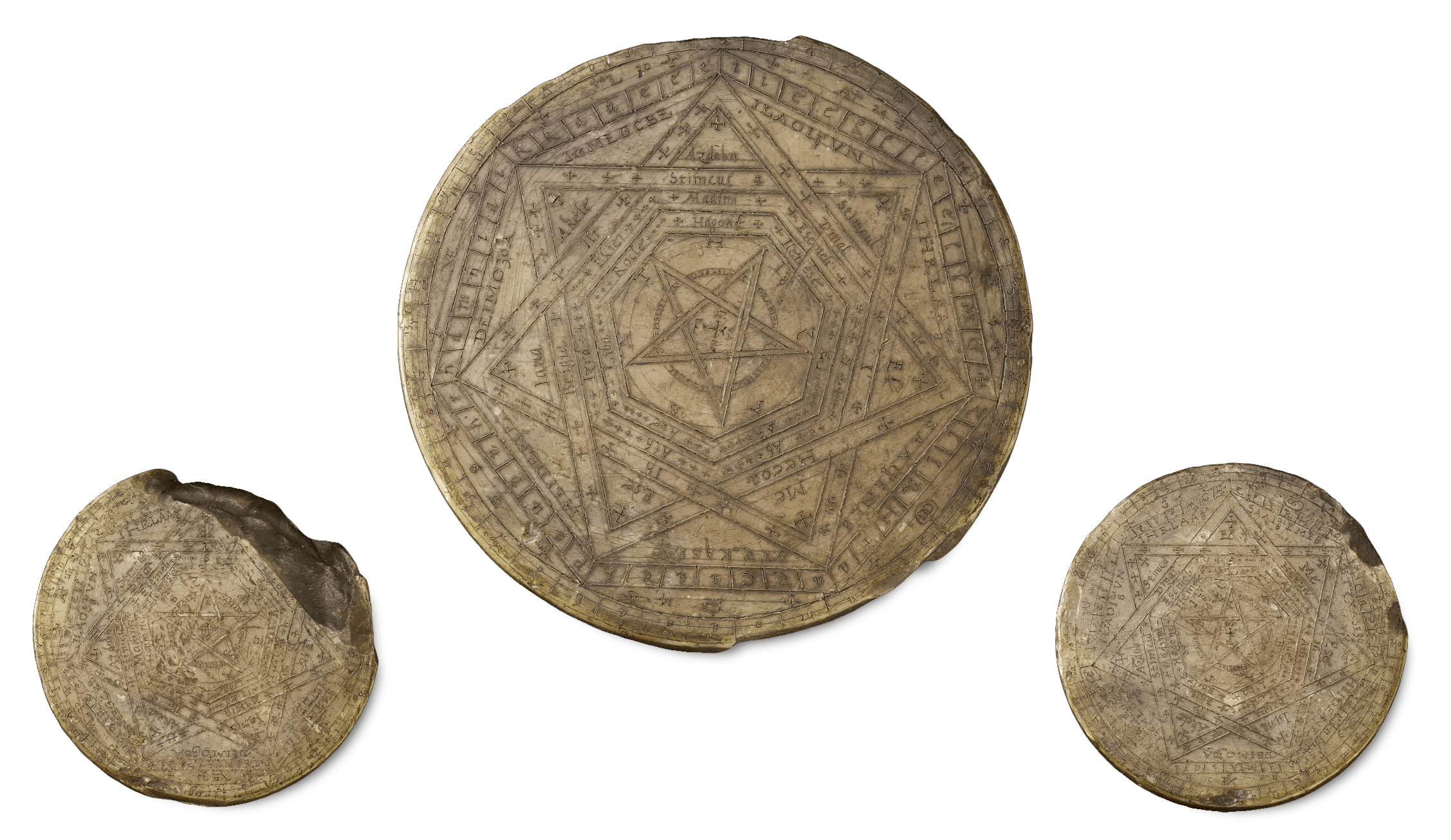 Wax disks associated with John Dee’s angelic experiments show how a medieval seal tradition was materially reworked in the sixteenth century.
The Seal as Sacred Geometry
Why did ritual magicians invest so much effort in geometry? The answer is not simply aesthetic. In medieval and Renaissance intellectual culture, number and proportion could reveal order. Geometry belonged to the quadrivium and therefore to legitimate learned knowledge. At the same time, circles, stars, polygons, and numerical groupings could be interpreted symbolically.
A circle has no obvious beginning or end and can signify perfection or enclosure. A pentagonal structure can gather fivefold correspondences. Sevenfold figures readily invite association with the seven traditional planets and other septenary systems. Multiple layers allow a diagram to map hierarchy.
Yet one should avoid assuming that every geometric feature has one universal meaning. The same shape can function differently in different texts. A circle in a necromantic manual may define ritual space; in another work it may organize letters; in a cosmological diagram it may represent a celestial sphere. Interpretation must begin with the specific manuscript context.
In the Sigillum Dei, geometry works together with language. Names are placed on edges, within rings, and around figures. The diagram is simultaneously visual and verbal. Reading it requires the eye to move through spatialized text.
Stephen Clucas has described the importance of visual and “inspectival” knowledge in Dee’s engagement with such diagrams. This insight applies more broadly to learned magic. Some knowledge is not presented as a sentence to be read from left to right. It is arranged to be contemplated as a whole. The diagram teaches through position.
What Manuscript Variation Teaches Us About Magic
Modern printed occult books encourage the expectation of a definitive diagram: one correct seal, one correct spelling, one exact sequence. Manuscripts undermine that confidence. The Liber iuratus survives in witnesses that differ.
Variation can arise from ordinary scribal processes. A copyist skips a line because two lines end similarly. A strange name is misread. A diagram is copied from memory. Colors disappear because the new scribe lacks pigments. A later owner inserts a correction from another manuscript. A translator chooses a familiar word for an obscure Latin term.
Magical texts add special difficulties. Their names and letter strings are unusually vulnerable because a scribe cannot always correct them through ordinary grammar. If a familiar Latin prayer contains a misspelling, context reveals the intended word. If an unknown angelic name contains one altered letter, context may offer no help.
This is why critical editions matter. A scholarly editor compares witnesses rather than treating whichever manuscript happens to be most accessible as the original. Hedegård’s edition made it possible to see relationships among the Latin manuscripts and to identify source material more reliably.
The lesson extends beyond the Sworn Book. Grimoires are textual traditions, not frozen artifacts. When a modern practitioner asks for “the original version” of a seal, the historical answer may be that no single surviving image deserves that title without qualification.
Was Honorius a Real Magician?
The safest answer is that the authorial figure presented by the book cannot be verified as the historical creator of the text. “Honorius, son of Euclid, master of Thebes” belongs to the work’s authority structure.
Pseudonymous attribution was common in premodern esoteric literature. A text associated with Solomon, Hermes, Aristotle, Apollonius, or another prestigious sage entered a ready-made chain of authority. The name told readers what kind of wisdom they were being offered.
Thebes itself carried multiple resonances. To a medieval reader, a distant learned master associated with a famous ancient city could sound more authoritative than an anonymous contemporary compiler. “Euclid” similarly evokes mathematical prestige, even when the genealogy is fictional.
Calling the attribution pseudonymous does not make the book fraudulent in the modern commercial sense. Premodern authorship operated differently. Authority could be traditional, revelatory, legendary, or collective. The name on a text might express intellectual lineage rather than modern legal authorship.
For historical study, anonymity can actually sharpen our attention. Instead of building a biography around an unverified magician, we examine the work’s sources, language, manuscript circulation, and institutional context. The book becomes evidence for a community of learned practices rather than the product of a romantic solitary genius.
The “Pope Honorius” Confusion
The Sworn Book of Honorius is sometimes confused with later works bearing the name Honorius, especially the so-called Grimoire of Pope Honorius. They are not the same work and should not be merged into a single tradition merely because the names resemble one another.
The Liber iuratus Honorii is a medieval Latin ritual-magic text with a manuscript tradition reaching back to the fourteenth century and probably an earlier composition. The Grimoire of Pope Honorius belongs to a much later printed grimoire culture. Its pseudonymous papal attribution serves a different polemical and magical function.
This confusion illustrates a broader problem in occult bibliography. Titles migrate. Famous names are reused. Publishers rename books. Later compilers borrow earlier material. A search for “Honorius grimoire” can therefore produce texts separated by centuries.
Good historical practice identifies a work by its manuscript tradition, incipit, contents, language, and bibliography, not by title alone. The same principle is essential for texts attributed to Solomon, Albertus Magnus, Cyprian, or Faust.
Ritual Purity: Discipline Rather Than Decoration
The preparatory demands in the Sworn Book deserve attention because they reveal the anthropology behind the ritual. The operator is not imagined as a neutral technician. His bodily condition, moral state, attention, speech, and devotional discipline matter.
Fasting changes the body. Repeated prayer structures time. Confession addresses moral guilt. Cleanliness marks a boundary between ordinary and sacred activity. Silence and restricted company can intensify concentration. Whether or not one accepts the text’s supernatural explanation, these practices clearly produce a distinct ritual state.
From a religious-studies perspective, this resembles many traditions in which extraordinary access requires preparation. Priests purify before sacrifice; monks fast before feast days; pilgrims prepare for sacred journeys; initiatory traditions impose abstinence or seclusion. The magical text participates in a wider human logic of ritual differentiation.
The difference lies in the goal and authorization. A church-approved fast and a privately constructed angelic operation may use similar disciplines while receiving radically different institutional judgments. Practices do not carry fixed classifications by themselves. Context matters.
This is another reason the Liber iuratus cannot be understood through sensational summaries. Its ritual world is slow, disciplined, textual, and devotional. The dramatic promise of spirit contact sits on top of a large foundation of preparation.
Dangerous Historical Materials and Why They Should Stay Historical
Premodern magical texts sometimes prescribe materials or procedures that are unsafe, cruel, unsanitary, or illegal by modern standards. The Sigillum Dei tradition has been associated in some witnesses and later descriptions with animal-derived substances and blood. Such details are historically relevant because they show how ritual efficacy was imagined, but they are not necessary to reproduce as practical instructions.
Historical reconstruction should distinguish understanding from reenactment. A manuscript can be studied through photographs, editions, codicology, and comparison without repeating hazardous acts. Modern readers also live under different ethical, medical, and legal standards.
This is especially important online, where a historical description can easily be mistaken for advice. The purpose of studying medieval ritual magic is not to flatten the distance between the fourteenth century and the present. That distance is part of the subject.
Why the Sworn Book Matters to the History of Western Esotericism
The Liber iuratus matters for at least five reasons. First, it is a major witness to medieval learned ritual magic. Second, it demonstrates the porous boundary between devotional forms and magical operations. Third, it preserves and transforms material related to the Ars Notoria. Fourth, its Sigillum Dei became part of the later history of John Dee’s angelic magic. Fifth, its manuscript tradition allows scholars to study how secret knowledge actually circulated.
It also challenges a simplistic genealogy in which “ancient magic” passes unchanged from Egypt to the Renaissance and then to modern occultism. The real history is messier and more interesting. Texts are translated, excerpted, misunderstood, corrected, Christianized, reorganized, and reinvented.
The Sworn Book is medieval in precisely this productive sense. It gathers older materials but creates something new from them. Dee later does the same with the book. Modern occultists do it again with Dee.
Western esotericism is therefore not a single secret doctrine hidden unchanged beneath history. It is a history of reception. The same diagram can mean different things in a fourteenth-century Latin manuscript, a sixteenth-century angelic diary, a seventeenth-century antiquarian discussion, and a twenty-first-century occult website.
Common Misconceptions
“The Sworn Book was written by Pope Honorius.”
No reliable evidence supports that claim. The text attributes itself to Honorius of Thebes, a pseudonymous master figure. It should not be confused with later grimoires attributed to a pope named Honorius.
“The surviving English manuscript is the original.”
No. The work is fundamentally a Latin textual tradition. The famous English material in Royal MS 17 A XLII is partial and later than important Latin witnesses. Hedegård’s critical edition was necessary precisely because scholarship had relied too heavily on the English version.
“The Sigillum Dei was invented by John Dee.”
No. Dee’s Sigillum Dei Aemeth has medieval antecedents, including the seal tradition preserved in the Liber iuratus. Dee transformed the diagram within his own angelic system.
“The book is simply a demon-summoning manual.”
That description misses its central religious and theurgic dimensions. The work contains spirit operations, but its highest ritual aspiration is the vision of God, framed through extensive prayer and purification.
“Every mysterious name can be translated if you know the right occult language.”
No. Some names have identifiable linguistic or textual sources, while others are corrupted, transformed, or uncertain. Manuscript variation makes confident universal decoding unreliable.
The Sworn Book and the Meaning of Theurgy
The term theurgy is useful but must be handled carefully. In late antique Neoplatonism, especially in Iamblichus, theurgy describes ritual participation in divine order. Medieval Christian ritual magic developed in a different intellectual and theological environment. Calling the Liber iuratus “theurgic” highlights its aspiration toward divine and angelic contact, but it should not imply that the book is simply a medieval copy of Iamblichean ritual philosophy.
The resemblance lies in structure: ritual is imagined as a means of ascent or contact with higher realities. The differences lie in theology, sources, liturgical language, and historical context.
Jean-Patrice Boudet’s study of the Liber sacratus sive juratus explicitly places the work in relation to theurgic magic, angelology, and the beatific vision. That triad captures its unusual character. The book is not content with divination. It seeks a transformation of perception through sacred mediation.
This is also where the text becomes philosophically interesting. It assumes that knowledge is not purely intellectual. To know the highest realities requires purification and ritual alignment. The body, voice, calendar, diagram, and moral condition of the practitioner all participate in knowing.
Modern academic knowledge usually separates observation from ritual transformation. The Sworn Book belongs to a world in which some truths were imagined to become accessible only when the knower changed.
How to Read the Sworn Book Today
A historically responsible reading begins with editions and manuscript catalogues rather than modern occult summaries. The British Library’s catalogue for Royal MS 17 A XLII provides a concrete map of the manuscript’s contents and shows that the codex includes more than a single continuous text. Hedegård’s critical edition remains fundamental for the Latin tradition. Boudet, Mathiesen, Fanger, Klaassen, and later scholars place the work within medieval ritual magic, angelology, secrecy, and learned culture.
Second, read claims at different levels. When a catalogue says that a manuscript contains chapters of the Liber iuratus, that is a documentary claim. When the medieval text says an angel can reveal divine mysteries, that is a claim within the text’s religious-magical worldview. When a modern practitioner reports an experience, that is testimony. These are different kinds of evidence.
Third, compare versions. A single online transcription can be useful, but it should not be mistaken for the whole tradition. Variant manuscripts reveal how the work changed.
Fourth, pay attention to ordinary religious language. The most illuminating parts of a grimoire are not always the spectacular names and seals. Familiar prayers can show how the compiler understood authority, sin, purity, and divine permission.
Finally, read the diagrams as manuscript objects. Their scale, color, placement, surrounding text, and scribal execution matter. A clean digital redraw can clarify geometry while erasing the evidence of use and transmission preserved by the original page.
Frequently Asked Questions
What is the Sworn Book of Honorius?
It is a medieval Latin work of learned ritual magic, usually known as the Liber iuratus Honorii or Liber sacer. It combines Christian prayers, sacred names, angelology, ritual diagrams, spirit lore, and operations whose highest goal includes a vision of God.
How old is it?
The surviving principal manuscripts include fourteenth-century Latin witnesses, while scholars have argued that the work itself was composed earlier, probably in the medieval period before those copies were made. Exact dating remains debated, so composition date and manuscript date should not be conflated.
Who was Honorius of Thebes?
He is the pseudonymous master to whom the work is attributed. There is no secure historical biography establishing him as the actual author.
What is the Sigillum Dei?
The Sigillum Dei, or Seal of God, is a complex ritual diagram using circles, polygons, letters, divine names, and angelic names. A medieval form appears in the Liber iuratus tradition. John Dee later developed a related form known as the Sigillum Dei Aemeth.
Did John Dee own the Sworn Book?
Dee had access to the Liber iuratus tradition and owned a manuscript associated with it. His angelic work shows clear engagement with the Seal of God tradition, though his later system should not be treated as identical to the medieval text.
Is the Sworn Book a Solomonic grimoire?
Scholars sometimes place it within or near pseudo-Solomonic learned magic because it shares the broader medieval culture of ritual authority associated with Solomon, sacred names, spirits, and celestial knowledge. Yet its own attribution is to Honorius, and its relationship with the Ars Notoria is especially important.
Does the book prove that medieval magicians saw angels?
No. It proves that medieval and early modern texts described, sought, and theorized angelic encounters. Reports of supernatural visions are historical evidence for beliefs and experiences, not scientific proof of the entities described.
Conclusion: A Grimoire at the Boundary of Prayer and Magic
The enduring importance of the Sworn Book of Honorius lies in its refusal to fit modern expectations. It is neither simply a prayer book nor simply a manual of demonic conjuration. It is a learned ritual synthesis whose author believed—or wanted readers to believe—that sacred knowledge could be preserved through oaths, embodied through diagrams, activated through prayer, and mediated through angels.
Its manuscript history makes that ambition visible. The work survives not as a perfect secret transmitted unchanged but as a family of copies, translations, excerpts, variants, and reinterpretations. The very names that promise exact celestial authority are altered by human scribes. The diagrams that claim sacred order vary from witness to witness. Secrecy produces circulation; fidelity produces variation.
The Sigillum Dei captures the paradox beautifully. It appears to be a fixed geometry of divine order, yet its historical life is one of transformation. Medieval compilers inscribed it in a Christian ritual program. John Dee inherited and remade it. Later occult traditions remembered Dee and often forgot the medieval book behind him. Modern scholarship has reconstructed that deeper genealogy through manuscripts.
For readers interested in the history of magic, the lesson is larger than one grimoire. Esoteric traditions survive because people reinterpret them. A sacred name crosses a language boundary. A prayer becomes part of a ritual operation. A diagram migrates into a new cosmology. A manuscript owned by a Renaissance scholar becomes evidence for a medieval tradition. What looks like a single “occult symbol” turns out to be a record of centuries of reading.
The Liber iuratus Honorii is therefore best approached neither with credulous sensationalism nor with dismissive amusement. It deserves the same historical care given to other difficult religious texts. Its supernatural promises cannot be verified by manuscript scholarship, but its cultural importance can. It shows learned people testing the boundaries of devotion, knowledge, secrecy, and ritual power—and leaving behind one of the most intricate witnesses to the medieval imagination of the invisible world.
Sources and References
- British Library, Royal MS 17 A XLII: Sworne Book of Honorius or Liber iuratus Honorii.
- Gösta Hedegård, Liber iuratus Honorii: A Critical Edition of the Latin Version of the Sworn Book of Honorius, Stockholm University, 2002.
- Jean-Patrice Boudet, “Magie théurgique, angélologie et vision béatifique dans le Liber sacratus sive juratus attribué à Honorius de Thèbes,” Mélanges de l’École française de Rome 114.2 (2002), 851–890.
- Claire Fanger, ed., Invoking Angels: Theurgic Ideas and Practices, Thirteenth to Sixteenth Centuries, Penn State University Press.
- M. W. J. M. Houët, The Sworn Book of Honorius, Radboud University thesis, 2015.
- Connor Feliu, “Dynamics of Secrecy in the Sworn Book of Honorius,” Syracuse University, 2022.

