


 Abe no Seimei in a later historical portrait by Kikuchi Yōsai. The image is in the public domain via Wikimedia Commons.
Few figures in the history of Japanese esotericism have accumulated as much legend as Abe no Seimei. In modern novels, manga, film, games, and television, he appears as a supernatural master who commands invisible familiars, defeats monsters, reads destiny from the stars, and draws protective symbols with effortless precision. That image is culturally important, but it can obscure the more interesting historical reality. Seimei was not a fantasy sorcerer working outside society. He belonged to a technical and ritual world tied to the court, the calendar, astronomy, divination, directional taboos, purification, and the management of uncertainty. That world is usually called Onmyōdō, the “Way of Yin and Yang.”
Onmyōdō is difficult to describe in a single modern category. It was not simply “Japanese Taoism,” not merely astrology, not only magic, and not identical with Shinto or esoteric Buddhism. It emerged in Japan through the selective adaptation of continental knowledge—especially theories of yin and yang, the Five Phases, calendrical calculation, omen interpretation, and divination—within the institutions of the Japanese state. Over time it developed distinctive rites, lineages, specialists, and forms of personal protection. Its practitioners advised elites about dangerous directions, auspicious dates, illnesses, strange events, journeys, construction, funerals, and political anxieties. At some points they were bureaucrats. At others they functioned as ritual experts whose authority extended far beyond the palace.
The most important scholarly correction is therefore simple: Onmyōdō was not a timeless occult system that arrived in Japan fully formed. According to the National Museum of Japanese History and modern scholarship, the practices that later came to be grouped under the name Onmyōdō developed within the Japanese ritsuryō state and changed substantially across ancient, medieval, and early modern periods. The system combined imported cosmological sciences with institutions, ritual needs, and social conditions specific to Japan. That history explains why the real Onmyōdō is more complex—and in many ways more fascinating—than the popular image of a wizard surrounded by spirits.
What Onmyōdō Actually Was
The word Onmyōdō is written with characters meaning, roughly, the “Way of Yin and Yang.” Yet the name can mislead modern readers into imagining a single coherent doctrine comparable to a church, school, or closed initiatory order. Historically, the term covered a changing body of knowledge and practice. Masuo Shin’ichirō, writing in the Japanese Journal of Religious Studies, emphasizes that Onmyōdō drew on the Chinese theories of yin and yang and the Five Phases but became a specifically Japanese religious and institutional formation. The word itself was not the name of an equivalent religion in China or Korea.
Its roots lie partly in the transfer of East Asian cosmological sciences to the Japanese archipelago. Yin and yang provided a language for describing complementary and alternating tendencies: dark and light, inward and outward, quiescent and active. The Five Phases—wood, fire, earth, metal, and water—did not function simply as physical “elements” in the modern sense. They described cyclical relationships and processes used to interpret time, direction, color, planets, seasons, bodily states, political order, and ritual correspondence. Such frameworks could be joined to calendrical systems, astronomy, astrology, the Yijing, omen lore, and methods for determining auspicious or dangerous moments.
In ancient Japan, these bodies of knowledge were not initially organized as a free-floating magical tradition. They were embedded in government. The Onmyōryō, or Bureau of Yin-Yang, was an official institution under the legal-administrative order of the state. Its personnel worked in areas that included divination, astronomy and astrology, calendar studies, and timekeeping. The National Museum of Japanese History describes early onmyōji as public officials who handled techniques that had entered Japan from China and were studied through state institutions. This bureaucratic setting matters because it places early Onmyō practice close to governance. Calculating the calendar or evaluating an omen was not merely private curiosity; it could shape court ceremony and political decisions.
The Bureau’s responsibilities reflected a worldview in which time and space possessed qualitative differences. A day could be favorable for one act and unfavorable for another. A direction could be safe at one time but dangerous at another. An eclipse, unusual star, comet, earthquake, epidemic, or unexpected animal behavior might be interpreted as meaningful rather than random. The court therefore needed specialists able to translate unusual events into intelligible patterns and recommend responses. In this sense, Onmyōdō was partly a technology for managing uncertainty.
This did not mean that every decision was controlled by divination or that every Japanese person lived according to the same rules. Historical practice varied by period, rank, location, and social context. Yet diaries and administrative sources show that aristocratic society could take directional prohibitions, auspicious dates, and divinatory warnings seriously enough to change travel plans, postpone activities, or arrange ritual countermeasures.
The Bureau of Yin-Yang and the Government of Time
To understand why calendar making belonged to an esoteric tradition, modern readers have to forget the idea of a calendar as a neutral grid of numbered days. Premodern calendars could encode an entire cosmology. They organized months, seasonal transitions, cyclical signs, heavenly stems and earthly branches, directions, auspicious and inauspicious times, and predictions associated with specific combinations. Control over calendrical knowledge therefore meant control over an important form of practical authority.
Officials attached to the Onmyōryō studied and maintained such knowledge. The bureau included specialists associated with onmyō divination, tenmon astronomy or astrology, rekidō calendrical study, and timekeeping. These were related but not identical disciplines. Their boundaries shifted. Families could become identified with particular branches of knowledge, and the transmission of technical expertise increasingly took hereditary forms.
The importance of timekeeping should not be underestimated. Court ceremony depended on regulated schedules. Agricultural, political, and religious life depended on seasonal reckoning. Eclipses and other celestial events demanded interpretation. Calendar experts helped establish the rhythm by which the court understood its relation to heaven and to the ordered passage of time.
Onmyōdō thus connected cosmology to administration. A bureaucrat who interpreted a celestial sign was doing something very different from a modern astronomer who measures an event without assigning it ritual meaning. Yet the work was not irrational within its own intellectual setting. The same cosmos that produced measurable cycles was also thought capable of revealing qualitative patterns. Calculation and divination therefore existed side by side.
This mixture of observation, inherited textual knowledge, ritual interpretation, and mathematical reckoning is one reason modern categories often fail. Calling Onmyōdō “magic” can be useful if the word points to ritual techniques for influencing or managing unseen forces. It becomes misleading when it implies the opposite of knowledge, scholarship, or bureaucracy. Many Onmyō specialists were learned technicians. Their authority came partly from specialized literacy and mastery of systems unavailable to most people.
A similar problem appears in other esoteric traditions. A text such as the Picatrix also combines cosmology, astrology, material correspondences, and ritual action in ways that modern readers tend to divide into separate fields. The comparison should not erase cultural differences. Rather, it helps reveal a broader historical pattern: esoteric knowledge often flourished where calculation, ritual, and cosmological meaning overlapped.
Dangerous Directions and the Geography of Fortune
One of the most characteristic aspects of Onmyōdō was the interpretation of direction. Space was not treated as homogeneous. Depending on the day, the movement of calendrical deities, and other factors, particular directions could become dangerous. Aristocrats might avoid traveling directly toward a prohibited direction, delay a journey, or perform a detour known as katatagae, literally “changing direction.”
This practice can sound arbitrary when described without context. But within the Onmyō cosmology, movement placed a person inside a shifting field of relations among time, direction, celestial cycles, and spiritual agencies. To move at the wrong time in the wrong direction could expose the traveler to misfortune. The solution was not necessarily to abandon the journey forever. Instead, ritual and strategic adjustments could alter the relationship between person, time, and place.
Directionality also demonstrates that Onmyōdō was not primarily about spectacular supernatural feats. Much of its practical importance lay in decisions that might appear mundane: when to depart, where to sleep, how to orient movement, whether to postpone an undertaking, or which ritual should precede a change in residence. For aristocratic households, such advice could become part of ordinary planning.
The concern with directional danger intersected with beliefs about deities whose positions changed according to calendrical cycles. Some were feared as sources of harm if confronted improperly. Others could be petitioned or ritually managed. This created a mobile sacred geography that differed from the fixed sacredness of a temple, shrine, mountain, or burial place. The danger moved with time.
That dynamic quality is central to Onmyōdō. Fortune was not imagined as a single permanent destiny written once and never altered. Timing mattered. Orientation mattered. Ritual response mattered. One might receive an unfavorable indication yet still reduce its consequences by choosing another day, changing direction, performing purification, or commissioning a protective rite. Divination did not merely predict; it could generate a strategy.
Purification, Calamity, and Ritual Response
As Onmyōdō developed, its specialists became involved in more explicitly ritual forms of protection. The Kokugakuin University Digital Museum notes that from the Heian period, Onmyō officials took on rites connected with spirit pacification, thanksgiving, purification, agricultural welfare, and the personal protection of the emperor. The list of named Onmyōdō rites in historical sources is long, reflecting a tradition that had moved beyond simple date selection or omen reading.
Purification was one of the major bridges linking Onmyōdō to the wider religious world of Japan. Ideas and ritual forms circulated among court institutions, Buddhist specialists, shrine traditions, and Onmyō practitioners. Borrowing did not make these traditions identical. Instead, ritual techniques could be adapted to new cosmological frameworks. The history of Japanese religion repeatedly shows this kind of overlap.
For Onmyōdō, purification could answer a basic problem: what should be done when a threatening sign had already appeared? If an ominous dream, illness, celestial event, directional conflict, or unusual disturbance suggested danger, interpretation alone was insufficient. A rite could attempt to remove, redirect, neutralize, or transform the threat.
This logic is comparable to the apotropaic systems found in many historical traditions, though each developed its own vocabulary and theology. Mesopotamian specialists, for example, used rituals to respond to ominous signs; Egyptian ritual experts employed spoken and material protection; Buddhist traditions developed protective dhāraṇī and rites. Onmyōdō belongs to this larger human history of ritualized risk management, but it should be studied through Japanese sources rather than treated as another version of a universal occult formula.
Some rites addressed individual protection; others served the court or wider community. Epidemics, disasters, agricultural anxiety, and political instability could all be interpreted within a world populated by visible and invisible causes. Ritual action offered a structured response. That response could involve recitation, offerings, purification, symbolic substitution, calendrical timing, directional placement, and the invocation or pacification of spiritual powers.
Over time, Onmyō practitioners also drew from and interacted with Buddhist ritual technologies, especially esoteric Buddhism. Masuo’s study stresses the importance of Chinese religious materials and Mikkyō in the formation of Onmyōdō. This is crucial because the tradition was never culturally sealed. It grew precisely through synthesis, adaptation, and the institutional reorganization of imported knowledge.
Abe no Seimei: Historical Official and Legendary Magician
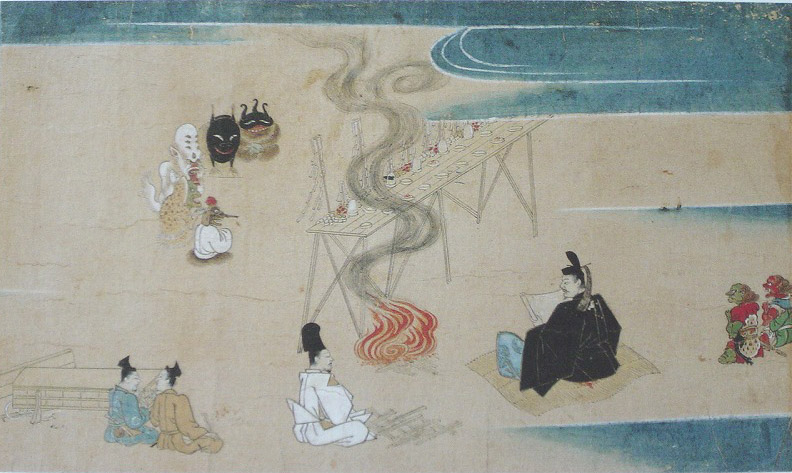 A later narrative image depicting Abe no Seimei in conflict with a disease spirit. Public-domain reproduction via Wikimedia Commons.
Abe no Seimei, who lived in the tenth and early eleventh centuries, became the most famous name associated with Onmyōdō. The historical Seimei was a court specialist whose career placed him inside the technical institutions of the Heian state. Later tradition transformed him into something much larger: a miracle worker, demon master, diviner of impossible accuracy, and protagonist of supernatural tales.
The difference between the historical person and the legendary persona is not a reason to dismiss the legends. Legends reveal what later communities wanted Seimei to represent. His reputation became a vessel for ideas about secret knowledge, mastery of invisible forces, dangerous intelligence, ritual purity, and the power to perceive what ordinary people could not see.
Historical evidence places Seimei within the world of astronomy, calendrical knowledge, divination, and court service. He rose in status and became associated with the Abe lineage that later played a major role in Onmyō traditions. By contrast, medieval and early modern stories increasingly describe supernatural episodes. Some depict him defeating spirits or exposing hidden beings. Others associate him with shikigami, spiritual entities that later imagination often treats as familiars or servants.
It is tempting to take these stories as literal biographies, but that approach collapses centuries of storytelling into the life of one man. The better method is to ask when a story appears, what kind of text preserves it, and what religious or literary purpose it serves. A tale written generations after Seimei’s death may tell us more about medieval concepts of magical authority than about an event in the 970s.
Seimei’s posthumous image also demonstrates how an official expert can become a culture hero. The bureaucrat who interpreted stars and calendars becomes, in later memory, the archetypal onmyōji. This transformation resembles the legendary expansion around other learned magical figures. Medieval and Renaissance Europe turned some scholars into magicians; Arabic and Persian traditions attached occult works to famous sages; Jewish magical texts could accumulate Solomonic or angelic attributions. Secret knowledge tends to attract famous names because authority itself becomes part of the ritual imagination.
Yet Seimei’s legend remained distinctively Japanese. His stories were embedded in Heian court culture, Buddhist demonology, local cult, literary narrative, and the evolving institutions of Onmyōdō. The result was not simply “Japan’s Merlin.” Such comparisons flatten both traditions. Seimei became important because his legend occupied a uniquely Japanese intersection of state knowledge, cosmology, religion, and storytelling.
Shikigami: Spirits, Servants, and the Problem of Later Folklore
Modern popular culture often presents shikigami as one of the defining features of Onmyōdō. They may appear as paper familiars, summoned creatures, demons bound to a magician, or animal-shaped servants. Historical sources are more complicated. The term and associated stories developed across time, and later folklore cannot simply be projected backward into the earliest institutional Onmyōdō.
In narratives about Seimei, shikigami often function as proof of his superior spiritual power. They perform tasks, reveal hidden dangers, or act in ways ordinary humans cannot. Such stories helped separate the master onmyōji from lesser diviners. The ability to command invisible agents dramatized what specialized ritual knowledge was supposed to achieve: control over forces beyond ordinary perception.
But popular depictions can encourage two errors. The first is to assume that every onmyōji possessed a personal army of spirit familiars. The second is to treat shikigami as a single clearly defined species of supernatural being. Japanese religious vocabulary is rarely so tidy. Terms shift across genres and periods. Storytelling, ritual manuals, shrine traditions, Buddhist demonology, and later entertainment all influence how supernatural categories are imagined.
The safest historical approach is therefore contextual. When a shikigami appears in a source, ask what the source is, when it was written, and what role the being plays. Is it a narrative test of a magician? A ritual agent? A demon-like figure? A literary device? A later folkloric elaboration? This source-by-source method prevents a modern fantasy taxonomy from replacing historical evidence.
That caution does not make shikigami unimportant. On the contrary, their popularity reveals the cultural power of the onmyōji image. They symbolize the idea that ritual expertise grants access to intermediary beings and hidden mechanisms of causation. In a cosmology where illness, misfortune, directions, stars, and spirits could intersect, an invisible assistant made narrative sense.
The Pentagram and the Myth of a Universal Occult Symbol
Another modern association with Abe no Seimei is the five-pointed star often called the Seiman or linked with the Abe lineage. Because Western ceremonial magic also uses pentagrams, modern occult writing sometimes suggests a direct historical equivalence. That conclusion requires caution.
Fivefold diagrams can emerge from very different intellectual traditions. In Onmyō-related contexts, the number five naturally resonates with the Five Phases and their cyclical relationships. A five-pointed form can therefore be interpreted through East Asian cosmological logic rather than through the symbolism of the Western pentagram. Similar geometry does not prove common origin.
This is a useful methodological lesson for comparative esotericism. Historians constantly encounter visual similarities: circles, stars, squares, grids, seals, directional diagrams, letter tables, and cosmograms. The temptation is to treat resemblance as evidence of transmission. Sometimes there was transmission. At other times, simple geometric forms were independently useful for organizing five, seven, eight, nine, or twelvefold systems.
The same caution applies when comparing Onmyōdō diagrams with European ritual circles such as those found in the Hygromanteia or the later Solomonic tradition. Both may map space and create ritual order, but they do so through different languages, cosmologies, and histories. Comparison is strongest when it identifies a shared problem—such as controlling ritual space—without pretending that identical solutions imply a hidden universal tradition.
Onmyōdō, Buddhism, and Shinto: Entanglement Rather Than Isolation
One of the hardest questions is how Onmyōdō relates to Shinto and Buddhism. Popular summaries often place Japanese traditions in separate boxes: Shinto for kami, Buddhism for enlightenment and temples, Onmyōdō for magic. Historical reality is much more entangled.
Kokugakuin University’s reference work on Shinto and Onmyōdō shows extensive borrowing and interaction. Onmyō practitioners adopted and reworked ritual forms associated with purification. Shinto thinkers later used yin-yang and Five Phases cosmology. Buddhist ideas and rites, especially esoteric Buddhist technologies, contributed to the formation of Onmyō practice. Meanwhile, court institutions linked all of these traditions through patronage and ceremony.
This was not simply confusion or careless mixing. Premodern Japanese religion often operated through layered participation. A court noble could commission Buddhist rites, observe directional restrictions advised by onmyōji, visit shrines, and participate in ancestral or state ceremonies without experiencing these actions as mutually exclusive religious identities.
Onmyōdō therefore makes more sense when studied as part of an ecosystem of specialists. Monks, shrine priests, diviners, ascetics, healers, spirit mediums, astrologers, and court officials sometimes competed and sometimes borrowed from one another. Their authority depended on different lineages and institutions, but clients often cared less about theoretical boundaries than about whether a specialist could solve a problem.
That same environment helped generate new syncretic systems. Medieval Shinto theories incorporated cosmological diagrams and correspondences. Esoteric Buddhist ritual integrated astronomy, deities, mantras, and calendrical timing. The wider Japanese religious landscape contained multiple technologies for protection, purification, healing, and divination.
This is one reason the site’s earlier exploration of Trithemius and the Steganographia offers a useful comparative contrast. In Europe, Christian prayer, angelic names, cryptographic structures, and occult cosmology could inhabit a single learned work. In Japan, bureaucratic divination, imported cosmology, Buddhist ritual, and local purification practices likewise overlapped without becoming identical. Esoteric traditions often develop not by remaining pure, but by organizing crossings.
The Kamo and Abe Lineages
By the later Heian period, Onmyō knowledge became increasingly associated with hereditary lineages, especially the Kamo and Abe families. The Kamo became strongly connected with calendrical expertise, while the Abe lineage became prominent in astronomy and astrology. These distinctions were not eternally fixed, but they helped structure the transmission of specialist knowledge.
Hereditary control made sense in a world where technical texts, interpretive rules, ritual procedures, and institutional appointments could be treated as family resources. Knowledge was capital. A lineage that controlled expertise could secure court patronage and social status.
Secrecy also mattered. Esoteric knowledge often derives authority from restricted transmission. A method known to everyone loses some of its value as specialist expertise. In Onmyōdō, as elsewhere, technical learning could therefore be preserved through family instruction, manuscripts, and controlled access.
Over time, the balance among lineages changed. Kokugakuin’s historical overview notes that the Kamo line declined while the Tsuchimikado, descendants of the Abe line, eventually took responsibility for both calendrical and astronomical knowledge. This later concentration became especially important in the early modern period.
From Court Specialists to Early Modern Religious Organization
Onmyōdō did not disappear when the political structure of classical court society changed. Instead, it transformed. Hayashi Makoto’s study of early modern Onmyōdō emphasizes that the Edo period gave the tradition a different social meaning. The Tsuchimikado family obtained official recognition from the Tokugawa shogunate and expanded authority over practitioners involved in divination and related activities.
At the same time, some functions once associated with the old Bureau of Yin-Yang shifted elsewhere. Calendar production and astronomical observation became increasingly tied to institutions created by the shogunate. This separation is historically significant. It demonstrates that “Onmyōdō” was never a fixed package of astronomy, magic, calendar making, and religion. Political reorganization could detach one function from another.
Early modern Onmyōdō also spread more widely through society. Calendar divination became practical knowledge beyond elite court circles. Mariko Baba’s recent study of early modern calendar divination shows that multiple systems developed, including traditions associated with the Hokinaiden and military strategy texts. Knowledge that had once been strongly tied to aristocratic and specialist contexts could be adapted for broader use.
This process changed the social identity of onmyōji. Some practitioners operated under licensing structures connected to the Tsuchimikado. Others occupied local religious economies where divination, protection, purification, and calendrical advice served ordinary communities. The category therefore widened even as political authorities attempted to regulate it.
The transformation resembles what happened to many esoteric traditions once print culture and broader literacy expanded. Techniques once guarded by elites could circulate in manuals, almanacs, popular books, and local networks. Authority then had to be renegotiated. A hereditary lineage might claim legitimate transmission while popular practitioners adopted similar techniques outside its control.
 A mid-nineteenth-century boxwood netsuke representing Abe no Seimei, from the Los Angeles County Museum of Art. LACMA released the image as public domain.
The Meiji Suppression and the Invention of “Superstition”
The modern period brought a dramatic change. The Meiji government dismantled many older institutions as it constructed a centralized modern state. Practices associated with Onmyōdō were increasingly classified as superstition or as obstacles to modernization. The institutional framework that had supported recognized onmyōji was suppressed.
This was not simply the victory of “science” over “magic.” It was also a political reorganization of legitimate knowledge. The modern state wanted standardized calendars, astronomy, education, religion, and administration. A hereditary ritual organization claiming authority over divination and calendrical matters did not fit easily into that project.
The category of superstition is itself historical. Governments and reformers use it to separate approved forms of knowledge from disapproved ones. Once Onmyōdō lost official legitimacy, many of its practices survived in altered form through local custom, popular religion, family traditions, almanacs, folklore, shrine culture, and eventually mass entertainment.
Ironically, suppression helped create the conditions for reinvention. Removed from its old bureaucratic function, Onmyōdō could later be remembered primarily as mysterious magic. The onmyōji became easier to imagine as a sorcerer once most people no longer encountered onmyōji as regulated specialists in calendars, directions, and court ritual.
How Modern Popular Culture Rebuilt the Onmyōji
The twentieth and twenty-first centuries transformed Abe no Seimei again. Fiction emphasized dramatic elements: spirit battles, shikigami, pentagrams, demons, curses, and supernatural detective work. These themes are not invented from nothing, but popular culture rearranges historical materials according to modern expectations of fantasy.
The result has been enormously influential. For many people inside and outside Japan, “onmyōji” now means a magical combatant rather than a specialist in calendar calculation or directional divination. This is similar to how modern fantasy turned “alchemist,” “druid,” or “necromancer” into stable character classes detached from the diversity of historical practice.
Scholarly correction should not require hostility toward fiction. Popular media keeps historical names alive and can inspire serious research. The problem arises only when fictional conventions are treated as documentary evidence. A game mechanic in which paper dolls become familiars may be artistically rooted in Japanese motifs without proving that Heian officials routinely performed the same act.
A more productive approach is to enjoy the modern image while recognizing its layers. Behind the fantasy onmyōji stands the Edo storyteller; behind the storyteller stands the medieval legend; behind the legend stands the Heian court specialist; behind the specialist stands an institutional history shaped by continental cosmology, state formation, calendrical knowledge, and ritual exchange.
Why Onmyōdō Matters in the Comparative Study of Magic
Onmyōdō is especially valuable for comparative study because it breaks several modern assumptions at once. First, it shows that magic and bureaucracy are not opposites. Ritual specialists can be state officials. Second, it shows that astrology and calendar science can belong to administrative systems rather than private occult subcultures. Third, it demonstrates that religious traditions can form through deliberate cultural adaptation rather than by preserving a pure ancient core.
It also complicates the relationship between prediction and intervention. Divination is often described as passive: the practitioner supposedly discovers what will happen. In Onmyōdō, however, knowledge of danger often produced action. A bad direction could be avoided. An inauspicious date could be changed. A threatening sign could call for purification. Divination and ritual therefore formed a practical sequence: identify risk, classify it, then respond.
This pattern appears in many cultures. The exact systems differ, but the intellectual problem is recognizable. Human beings want to know whether a crisis is random, whether it can be interpreted, and whether action can alter its course. Esoteric systems answer by turning uncertainty into structured relationships among signs, times, materials, directions, deities, and rites.
Onmyōdō also reminds us that “magic” is a category historians should use carefully. Many historical practitioners would not have understood themselves through the same magic-versus-religion distinction familiar in modern English. An onmyōji could be a government official, diviner, ritual expert, and calendar specialist without seeing those roles as contradictory.
Reading the Sources Without Repeating the Myths
A serious study of Onmyōdō benefits from three habits. The first is chronological discipline. Ancient state institutions, Heian ritual culture, medieval Seimei legends, Edo licensing systems, and modern fantasy should not be collapsed into a single timeless tradition.
The second is source awareness. Museum exhibitions and academic articles can clarify institutional history, while narrative tales reveal changing images of magical authority. Ritual manuals illuminate techniques. Calendars show practical cosmology. Shrine traditions reveal memory and cult. Each source answers a different kind of question.
The third is comparative restraint. It is tempting to connect Onmyōdō to every global occult symbol or magical system. Sometimes comparison is illuminating, but resemblance alone does not establish historical contact. Yin-yang theory should not be translated into generic “positive and negative energy.” The Five Phases should not be treated as interchangeable with the four classical elements. Seimei’s star should not automatically be explained through European pentagram lore. Shikigami should not be reduced to Western familiars.
Respecting difference actually makes comparison stronger. When two traditions solve similar ritual problems in different ways, the contrast reveals more than a claim that “all magic is the same.” The strongest comparative history asks both what human concerns recur and how each culture gives those concerns a distinct form.
From Hidden Forces to Practical Decisions
The enduring fascination of Onmyōdō comes from the scale on which it operated. It connected the movement of planets to the movement of travelers, state calendars to private anxiety, cosmological diagrams to household decisions, and court ritual to stories about spirits. It translated a vast universe into practical advice.
That practical orientation helps explain the historical prestige of the onmyōji. A successful specialist did not merely possess mysterious knowledge. He made that knowledge usable. Which day should a journey begin? Is a direction dangerous? Does an unusual event require ritual response? Is a planned action aligned with the calendar? What should be done after a disturbing omen? These questions brought cosmology into everyday life.
Abe no Seimei became legendary because later generations condensed the authority of an entire specialist tradition into one unforgettable figure. But the deeper story is larger than Seimei. Onmyōdō was built by institutions, families, scribes, calendar makers, diviners, ritual specialists, clients, monks, shrine traditions, and storytellers across many centuries.
Seen historically, Onmyōdō is neither a lost Japanese wizard school nor a simple import from China. It is a case study in how cultures transform knowledge. Chinese-derived cosmologies entered Japanese institutions; government techniques became ritual traditions; hereditary specialists created lineages; lineages entered popular religion; suppression turned official knowledge into folklore; and folklore later returned as global fantasy.
That long transformation is the real magic of the history—not because it proves supernatural powers, but because it shows how systems of meaning survive by changing form.
Calendars as Everyday Esoteric Technology
The spread of calendrical divination into early modern society is one of the clearest examples of how a court-centered body of knowledge could become ordinary practical culture. An almanac was not merely a list of dates. It could act as a compact map of relationships among cyclical signs, directions, seasonal transitions, lucky and unlucky periods, and activities thought to fit particular moments. Such information helped translate an abstract cosmology into choices about travel, marriage, construction, funerals, agriculture, commerce, and household affairs.
This process also changed the nature of expertise. A specialist at court might work from technical traditions, inherited texts, and institutional training. A merchant or householder consulting a printed calendar encountered a simplified interface to parts of the same cosmological world. The wider circulation of almanacs did not erase professional diviners, but it redistributed fragments of their knowledge. People could make some decisions for themselves while still consulting specialists when a situation seemed unusually dangerous or ambiguous.
Mariko Baba’s study of calendar divination shows that early modern Japan did not possess one single popular system. Different texts developed different rationales, and military strategy literature could reorganize calendrical information around historical examples and practical decision-making. The Hokinaiden, often treated as a representative work, was only one strand among several. This diversity matters because it prevents us from imagining Onmyōdō as a frozen doctrine transmitted unchanged from the Heian court to village households.
Calendars also reveal how esoteric knowledge survives institutional change. Even when official offices are reorganized, people continue to care about timing. Births, journeys, weddings, funerals, building projects, illness, and uncertain ventures still demand decisions. A cosmological calendar gives those decisions a language of pattern. Whether one accepts its premises or not, its historical function is clear: it converts uncertainty into a schedule of possibilities.
That function helps explain why Onmyōdō could remain culturally powerful after its formal political structures weakened. The most durable part of an esoteric system is not always its grand theology. Sometimes it is the practical habit it teaches: look at the day, look at the direction, identify the pattern, and choose accordingly. In that sense, the calendar was one of Onmyōdō’s most effective ritual objects because it placed cosmic order directly into the hands of ordinary readers.
Sources and References
- National Museum of Japanese History, “What is an Onmyōji?: Fortunetelling, Good-luck Spells, and Almanac-Making.”
- Masuo Shin’ichirō, “Chinese Religion and the Formation of Onmyōdō,” Japanese Journal of Religious Studies 40.1 (2013).
- Hayashi Makoto, “The Development of Early Modern Onmyōdō,” Japanese Journal of Religious Studies 40.1 (2013).
- Kokugakuin University Digital Museum, “Shinto and Onmyōdō.”
- Mariko Baba, “The Formation of Calendar Divination in Early-Modern Japan,” Journal of Religious Studies 97.3 (2023).
- Wikimedia Commons, historical portrait of Abe no Seimei by Kikuchi Yōsai.
- Wikimedia Commons, public-domain narrative image of Abe no Seimei and a disease spirit.
- Wikimedia Commons / Los Angeles County Museum of Art, public-domain Abe no Seimei netsuke.


