


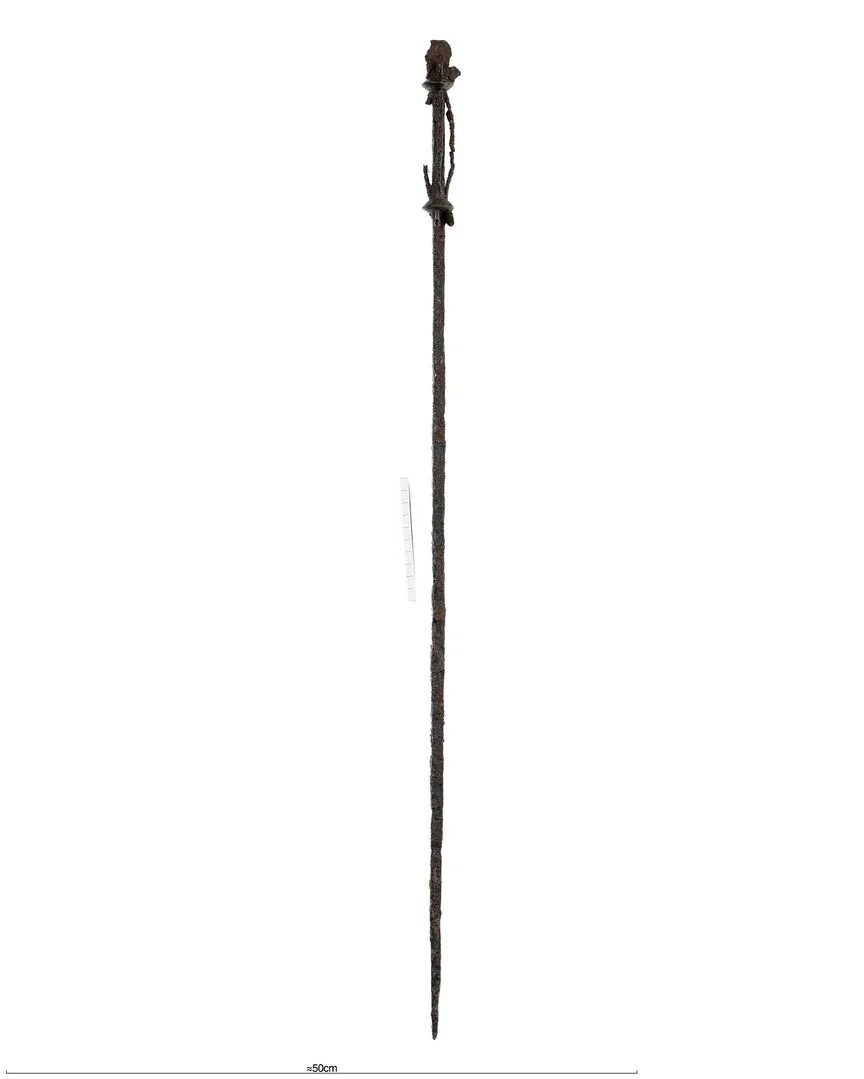
 The Klinta staff from Öland, one of the most elaborate Viking Age staffs interpreted as belonging to a völva. Swedish History Museum, photograph by Ola Myrin/SHM, CC BY 4.0.
Few subjects in Norse religion have been more romanticized than seiðr. Modern books and social media often present it as a clearly defined “Viking witchcraft” system: a northern shamanism centered on trance, spirit travel, fate-weaving, prophecy, and a staff-bearing priestess called the völva. Some of those elements have roots in real sources. The problem is that the surviving evidence does not describe one standardized religion, one ritual manual, or one universally agreed set of techniques.
What we actually possess is a difficult archive assembled from different centuries and genres. Medieval Icelandic sagas describe seeresses visiting households, sitting on raised seats, carrying staffs, and answering questions about famine and the future. Eddic poetry places prophetic women at the center of myth. Snorri Sturluson’s prose presents the goddess Freyja as a teacher of seiðr and Odin as a male practitioner whose use of the art is associated with social shame. Archaeologists have excavated wealthy women’s graves containing unusual iron staffs, imported objects, intoxicating plants, amulets, animal remains, and other objects that have been interpreted—sometimes convincingly, sometimes more cautiously—as evidence for ritual specialists.
The resulting picture is neither empty fantasy nor simple fact. It is a reconstruction. Scholars such as Neil Price, Catharina Raudvere, Leszek Gardeła, and others have shown that seiðr must be studied through archaeology, philology, comparative religion, gender history, and the social context of the Viking Age. Every source has limitations. Sagas were written down centuries after conversion to Christianity. Archaeological objects do not come with labels saying “magic staff.” Medieval authors could exaggerate pagan ritual for literary effect. Modern readers can also project their own ideas of witchcraft, shamanism, sexuality, and feminism backward into the past.
Yet something important remains beneath those layers. Viking Age Scandinavians did recognize specialized forms of supernatural knowledge. Prophetic women could be feared and respected. Certain rituals were connected with altered states, song, divination, cursing, weather, warfare, fertility, and the manipulation or perception of fate. Seiðr was not simply marginal superstition. In the literary record it reaches the gods themselves, especially Freyja and Odin, and in archaeology it appears in some of the richest burials known from the period.
This article examines what can responsibly be said about seiðr, the völva, and Norse ritual magic before the modern “Viking witch” image took shape.
What Does Seiðr Mean?
The Old Norse noun seiðr names a category of magical or ritual practice, but its exact etymology and original semantic range remain debated. Medieval sources use the word for activities that include prophecy, influencing minds, producing misfortune, affecting weather, harming enemies, obtaining hidden knowledge, and other forms of supernatural action. The related verbs and practitioner terms are similarly flexible.
This flexibility is important. Modern readers often want a precise definition comparable to a modern religious denomination or magical school: “seiðr is a trance-based method of X.” The sources do not support that level of neatness. Seiðr may have encompassed several techniques linked by social perception rather than one consistent ritual structure.
Catharina Raudvere has warned against forcing overly rigid taxonomies onto Old Norse magical language. The surviving literature contains overlapping terms for incantation, sorcery, prophecy, supernatural knowledge, and harmful magic. Galdr, for example, often refers to magical song or incantation and can overlap with seiðr without being identical to it. Spá refers more directly to prophecy or foresight. A spákona is a prophetic woman; a seiðkona is a woman associated with seiðr. A völva is conventionally translated as seeress or prophetess.
The categories overlap because ritual life overlaps. A woman known for prophecy may also use incantations. A practitioner who performs harmful magic may also divine. A mythic figure can move between prophecy and curse. Modern classification should follow the sources rather than make them obey a later occult syllabus.
Völva: The Staff-Bearer
The word völva is usually connected with völr, “staff” or “wand,” making the title something like “staff-bearer.” Cambridge scholarship on the literary figure notes that völva, seiðkona, spákona, and related terms can refer to women whose roles overlap substantially. The staff therefore matters both linguistically and materially.
Archaeologists have identified a group of iron staffs from Viking Age graves that resemble neither ordinary weapons nor simple household tools. Many occur in richly furnished female burials. The National Museum of Denmark notes that several mysterious iron staffs from Viking graves have been interpreted as ritual staffs and that their association with wealthy women suggests practitioners of high social status. The Swedish History Museum similarly identifies several staffs in its collections as probable völva staffs while explicitly acknowledging that interpretations have changed over time: objects once called spits, measuring rods, or sceptres have later been reconsidered as ritual implements.
This history of interpretation matters. An iron rod does not prove seiðr by itself. Its meaning emerges from context: who was buried with it, what other objects were present, how unusual the burial was, whether the form resembles literary descriptions, and whether similar objects cluster in comparable graves.
The strongest cases combine several clues. The Klinta staff from Öland is nearly a meter long and elaborately decorated with bronze details, a cage-like upper structure, and a miniature house. The Swedish History Museum interprets it as a völva staff and notes that it was found in an exceptionally rich grave. The lower end was broken, and the staff itself had been bent, possibly as a deliberate ritual act before burial.
A second strong example comes from Fyrkat in Denmark, where a wealthy woman was buried with an iron rod, henbane seeds, animal remains, exotic imported objects, and a tiny silver chair-shaped amulet. The National Museum of Denmark interprets the grave cautiously as possibly belonging to a seeress. None of these items individually proves profession; together they form a striking ritual assemblage.
The Seeress in Eiríks saga rauða
The most famous literary description of a völva appears in Eiríks saga rauða, the Saga of Erik the Red. The scene takes place in Greenland during a time of scarcity. A woman named Thorbjorg, called the “little völva,” travels from household to household in winter because people want to know what will happen and when the famine will end.
The saga gives extraordinary detail. Thorbjorg is welcomed ceremonially. A high seat is prepared for her. She wears distinctive clothing and carries a staff. Special food is served. The household gathers around her. A group of women is needed to perform a song associated with the ritual, and the Christian woman Gudrid initially hesitates to participate because she knows the song from earlier tradition but now belongs to a different religious world.
This scene has become foundational for modern reconstructions of seiðr. The high seat, staff, group singing, and prophetic performance provide the closest thing in Old Norse literature to a ritual description. Yet it must be used carefully. The saga was written in Christian Iceland long after the Viking Age. Its author was describing a pagan past through literary memory, inherited oral traditions, and Christian cultural assumptions.
Even so, the scene contains details unlikely to be invented merely from generic ideas of witchcraft. The social structure is especially convincing. Thorbjorg is not a solitary outcast hiding in a forest. She is invited by a wealthy household, formally hosted, given prestige, and asked to solve a communal crisis. Her expertise has economic and social value.
The episode therefore supports an important correction: at least some prophetic specialists were imagined as respected professionals whose services could be sought by elites.
The High Seat and the Ritual Audience
The high seat in the Erik the Red saga is more than furniture. Elevation marks status and creates a ritual center. The seeress becomes visible to the assembled community while simultaneously occupying a special position between ordinary social space and the supernatural world she is expected to access.
The tiny silver chair-shaped amulet from the Fyrkat grave has sometimes been linked to this literary motif. The National Museum of Denmark explicitly suggests that the amulet may represent the special seat used during seiðr. The interpretation is attractive but cannot be proven. Miniature chairs may carry meanings related to authority, divine presence, or ritual seating more broadly.
What can be said safely is that both literature and archaeology make seating symbolically important. Norse elite culture placed enormous value on hall architecture, seats of honor, and spatial hierarchy. A ritual specialist occupying an elevated seat would therefore communicate social and cosmological status at once.
The audience also matters. Seiðr is often imagined today as an inward meditative technique, but the best literary scene is public. The household listens. The women sing. Questions are asked. Prophecy is delivered to a community. The rite is performance in the serious anthropological sense: a structured social event whose efficacy is inseparable from the people witnessing and participating in it.
Varðlokkur and the Problem of the Ritual Song
In the Greenland episode, Gudrid knows a song called varðlokkur. The exact meaning of the word has been debated, but the passage clearly presents the song as necessary or useful to the seeress’s work. Modern writers sometimes translate it confidently as a “spirit-calling song,” though the linguistic evidence does not justify absolute certainty.
The scene nevertheless demonstrates a connection between ritual sound and prophetic practice. This aligns with the wider Norse category of galdr, magical chanting or song. Voice, meter, repetition, and collective performance could all contribute to altered ritual states.
We should resist adding unsupported details. The saga does not give a complete musical notation, breathing method, or trance induction sequence. It does not tell us that every seiðr rite used the same song. The fact that Gudrid must supply a traditional chant suggests specialist knowledge, but not a standardized pan-Scandinavian liturgy.
Sound was almost certainly important in Old Norse ritual. Eddic poetry repeatedly imagines supernatural knowledge as something spoken, chanted, remembered, or sung. Odin learns incantations. Prophetic women speak destiny. Curses are verbal acts. The power of words belongs to the religious imagination even where the technical details remain lost.
Freyja and the Divine Teaching of Seiðr
Snorri Sturluson’s Ynglinga saga states that Freyja taught seiðr to the Æsir. This brief statement became central to modern interpretations. It positions seiðr as a divine art associated with the Vanir and introduces Freyja as its exemplary female practitioner.
The story fits other elements of Freyja’s mythic identity. She is connected with desire, fertility, wealth, battle-dead, and powerful forms of magic. Later literary sources repeatedly associate her with enchantment and extraordinary knowledge. The Swedish History Museum explicitly identifies seiðr as part of Freyja’s traditional magical profile.
Yet “Freyja taught seiðr” should not be read as historical evidence for a real priesthood of Freyja with standardized initiation. Myth does not function that simply. The statement tells us that medieval Norse tradition considered seiðr important enough to explain through divine transmission.
The association also contributes to the gendered character of the practice. If Freyja is the exemplary teacher and völur are predominantly female in the literary and archaeological record, seiðr becomes coded as a domain of feminine power. That coding becomes especially significant when Odin enters the story.
Odin Practises Seiðr—and Is Shamed for It
Odin is the god of poetry, runes, war, kingship, the dead, ecstatic knowledge, and magical skill. He is also described as practising seiðr. According to Snorri, the art allows him or practitioners to know the fate of people, cause death or misfortune, and affect mind or strength. Yet the same passage says that men who practised seiðr were associated with ergi, a deeply insulting category tied to unmanliness and sexual or social shame.
This contradiction has generated enormous scholarship. Why would the supreme god practise an art considered shameful for men?
One answer is that the contradiction is the point. Odin repeatedly crosses boundaries to gain knowledge. He hangs himself, sacrifices an eye, learns magic from women, engages in disguise, and accepts humiliation in exchange for power. His divine sovereignty includes abilities that ordinary masculine honor might forbid.
Another possibility is social specialization. Seiðr may have been culturally coded as feminine because of its performance context, bodily symbolism, association with textile work, or receptive ecstatic states. Male practitioners existed, but they risked stigma.
Neil Price and others have explored the role of gender transgression in seiðr extensively. More recent scholarship has also warned against translating ergi too simply through modern categories of sexual identity. Medieval insults about masculinity, passivity, cowardice, sorcery, and sexuality belonged to a social system different from modern identity labels.
The safe conclusion is that seiðr was gendered, and that male participation could be represented as socially dangerous or transgressive.
Seiðr and Gender Beyond a Simple “Women’s Religion”
Because many völva graves are female and the literary tradition foregrounds women, modern writers sometimes describe seiðr as a women’s religion. That goes too far.
Men could practise seiðr in the sources. Odin is the most obvious example, but saga literature also mentions male sorcerers. The social meaning of male practice was complicated, not nonexistent. Furthermore, a ritual could involve women singing while a specialist performed, meaning participation itself may have been distributed across gendered roles.
Archaeological work on gender has also complicated older assumptions about burials. A grave assemblage once automatically labeled “female” because it contained jewelry may require osteological or genomic confirmation, while bodies and grave goods do not always align with modern expectations of binary gender performance.
The most productive interpretation treats seiðr as a field where gender itself could become ritually charged. Feminine-coded knowledge, receptive states, textile metaphors, and social transgression may have contributed to its power.
This is very different from saying that Viking society was secretly egalitarian or that völur represented a modern feminist institution. Powerful ritual women could coexist with patriarchal law, slavery, warfare, and rigid honor systems.
Staffs, Distaffs, and the Metaphor of Weaving Fate
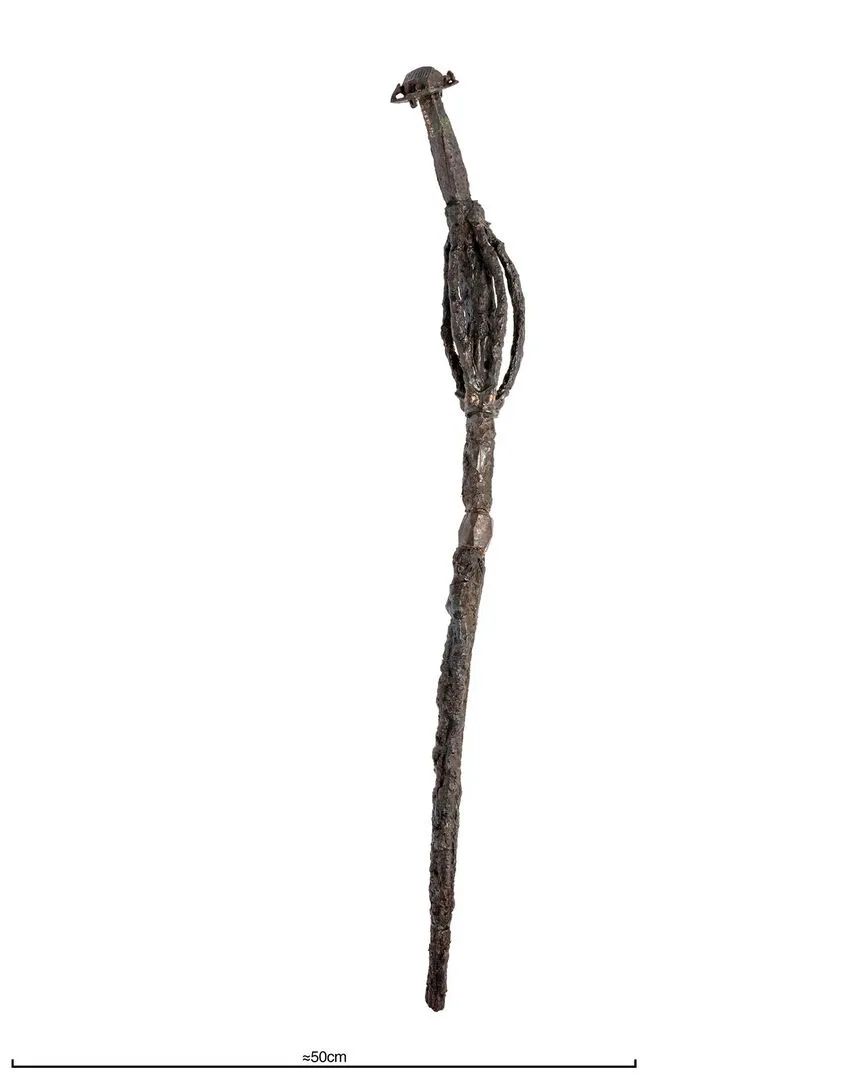 Viking Age iron staff with copper and bronze details, interpreted as a seeress’s staff. Swedish History Museum, CC BY 4.0.
One influential line of interpretation connects seiðr staffs with distaffs used in textile production. Some archaeological staffs have shapes that evoke tools for spinning, and Old Norse myth repeatedly links fate with textile imagery.
The Norns determine destinies. Valkyries are imagined in one poem weaving the outcome of battle from gruesome materials. Women’s textile work was deeply embedded in household economy and social identity. From this perspective, magical manipulation of fate could be conceptualized through spinning, twisting, binding, and weaving.
The Swedish History Museum presents this interpretation in discussing the Klinta staff, suggesting that its form may evoke a distaff and therefore the symbolic spinning of fate. Scholars such as Neil Price and Eldar Heide have explored related linguistic and material connections.
But the theory remains interpretive. Not every staff resembles a distaff closely, and textile symbolism should not be turned into a universal ritual mechanism. There is no surviving Viking manual instructing a völva to “spin the thread of fate” using a standardized wand technique.
What is secure is that textile metaphors were powerful in Norse cosmology. The possibility that ritual staffs drew on that symbolic field is plausible and helps explain why a feminized technology of destiny could become both respected and threatening.
Fyrkat: A Seeress at a Royal Fortress?
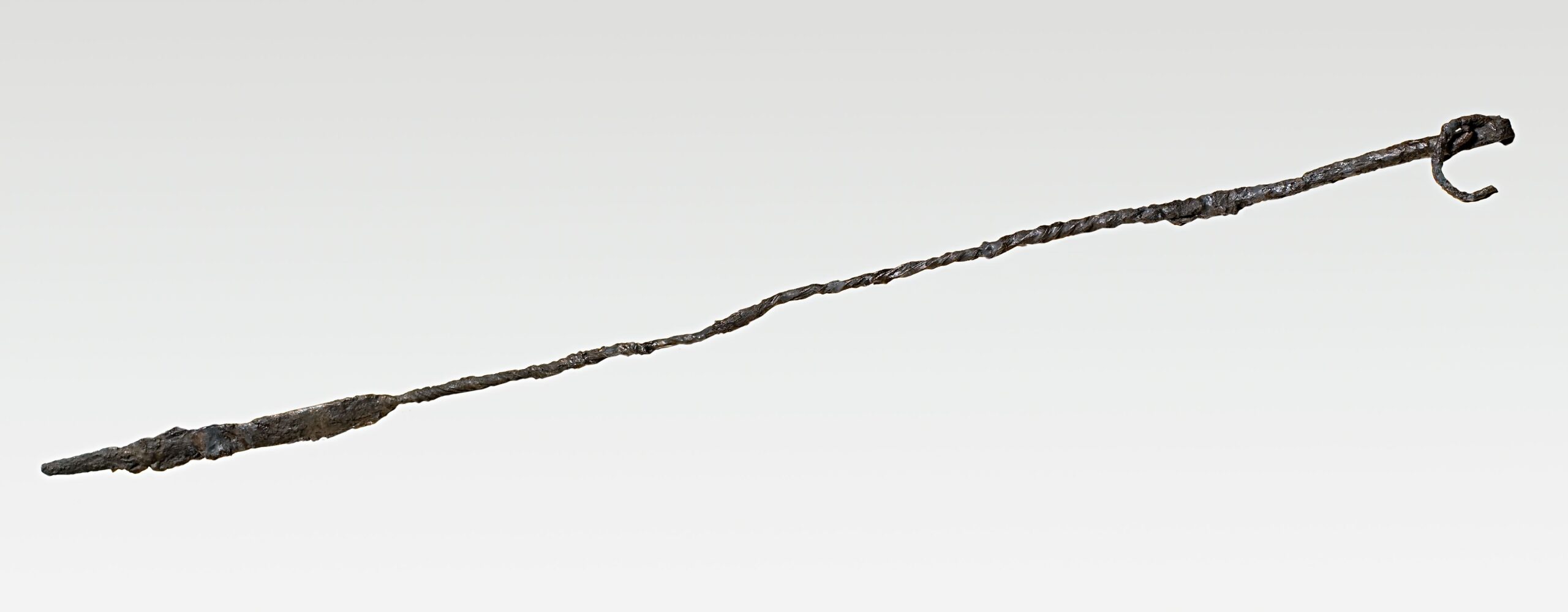 The iron rod from the unusual female burial at Fyrkat, Denmark. Image reproduced by Princeton’s Making the Viking Age project from National Museum documentation.
The Fyrkat grave is among the most discussed archaeological cases for a Viking ritual specialist. Fyrkat was a ring fortress associated with the reign of Harald Bluetooth in the tenth century. Among its burials was a wealthy woman whose grave goods were unusually cosmopolitan and strange.
The National Museum of Denmark describes fine blue and red clothing with gold thread, silver toe rings, imported bronze vessels, a metal staff, henbane seeds, animal remains, white lead, and a tiny silver chair amulet. The woman was buried in a wagon body, a high-status funerary practice.
The combination has led archaeologists to propose that she held a spiritual role, perhaps as a völva connected with the royal environment. The interpretation remains a hypothesis, but a serious one.
Henbane is especially tempting to sensationalize. It contains toxic tropane alkaloids and can produce severe physiological and psychoactive effects. The National Museum suggests possible ritual or medicinal use but cannot demonstrate exactly how the seeds were employed. Modern claims that Viking seeresses routinely smoked henbane to enter trance go beyond the evidence.
The best historical use of the grave is cumulative. A wealthy woman at an elite political center was buried with an unusual staff and a cluster of objects not typical of ordinary domestic assemblages. The possibility that ritual specialists could operate close to royal power becomes archaeologically credible.
Klinta and the High Status of the Völva
The Klinta burial on Öland reinforces the social-status question. The Swedish History Museum describes the woman buried there as aristocratic. Her grave included imported objects, animals, and the extraordinary iron staff topped by a miniature house and animal figures.
Such graves undermine a modern stereotype inherited partly from European witch persecutions: the magical woman as poor, marginalized, and socially powerless. Viking Age ritual specialists could instead be linked to wealth, travel, elite households, and political networks.
This does not mean all practitioners were aristocrats. Archaeology preserves elite burials disproportionately well, and saga literature tends to focus on elite households. Ordinary local specialists may have left far fewer identifiable traces.
Still, the evidence strongly suggests that supernatural expertise could be prestigious. Fear and respect are not opposites. A person believed capable of seeing the future or harming enemies could be socially valued precisely because she was dangerous.
Prophecy, Famine, and Practical Questions
The Erik the Red saga shows people consulting Thorbjorg because they want to know when scarcity will end. This practical context deserves emphasis. Prophecy was not only about Ragnarök or cosmic destiny. It could answer immediate questions about survival.
Preindustrial communities faced crop failure, livestock disease, storms, sea travel, childbirth, warfare, and epidemic illness with limited ability to predict outcomes. A specialist claiming access to hidden knowledge could become socially important during crisis.
The same logic appears globally in divinatory traditions. Mesopotamian scholars read omens for kings; Yoruba babalawo interpret Ifá; Chinese specialists used the Yijing; Roman Egyptians consulted lot oracles such as the Sortes Astrampsychi. These traditions are not historically connected in a simple way, but they reveal a recurring human problem: uncertainty becomes ritualized.
Seiðr belongs within that comparative history of uncertainty management. Its prophetic dimension was not entertainment. Decisions about winter, travel, household survival, or political action could depend on what a specialist said.
Cursing, Harm, and Political Power
Seiðr was not limited to benevolent prophecy. Literary sources associate it with harm, confusion, illness, death, and manipulation. Kings and rivals use sorcery against enemies. Practitioners are accused of causing misfortune. Mythic narratives treat supernatural attack as a real weapon within the story world.
Such accounts complicate modern attempts to classify seiðr as purely spiritual or healing. Like many historical magical traditions, it occupies a moral spectrum. Protective and destructive practices can use similar ideas about invisible causation.
The political implications are significant. If a ruler believes a rival can attack through magic, ritual specialists become security threats. Accusations of sorcery can justify violence or exile. Conversely, a king who controls powerful specialists gains symbolic authority.
This resembles the social logic of witchcraft accusations in many cultures without implying that Norse seiðr was identical to early modern European witchcraft. The specific legal categories, cosmology, and historical institutions were different.
Weather Magic and Control of the Environment
Norse literature contains repeated claims that magical practitioners could raise storms, calm winds, obscure visibility, or alter environmental conditions. Seiðr and related magical language appear in some of these contexts.
For seafaring societies, weather was power. A favorable wind could determine whether a voyage succeeded; fog could save or destroy an army; winter conditions could decide famine. It is therefore unsurprising that weather manipulation appears among supernatural claims.
Historical scholars cannot verify that rituals changed weather. They can document that people told stories in which weather responded to ritual actors. That belief itself could shape behavior, fear, and reputation.
Later Scandinavian folklore preserves many weather-magical motifs, but direct continuity from Viking Age seiðr should not be assumed without evidence. Similar problems can generate similar rituals independently across centuries.
Seiðr, Trance, and the “Shamanism” Debate
One of the most controversial modern interpretations describes seiðr as a form of shamanism. The comparison is attractive because the sources include altered states, spirit mediation, ritual song, prophecy, and possible soul journeys. Scandinavia also bordered Sámi cultures with documented shamanic traditions, making contact historically plausible.
Neil Price has explored circumpolar comparisons extensively, arguing that Norse seiðr should be understood partly in relation to neighboring Sámi religious worlds. Other scholars have been more cautious, warning that “shamanism” can become a universal label that erases specific cultural differences.
The methodological problem resembles the one encountered in Korean gut and mudang traditions. “Shamanism” is a comparative scholarly term, not a native universal religion. It can identify structural similarities while producing false equivalence.
The best approach is conditional. Some forms of seiðr may have involved practices comparable to circumpolar shamanism, and Norse-Sámi contact probably mattered. But seiðr should first be reconstructed from Norse evidence before being fitted into an external model.
The Sámi Question
Norse and Sámi communities interacted through trade, marriage, tribute, conflict, migration, and shared landscapes. Medieval Norse literature often attributes extraordinary magical power to Sámi figures. That literary stereotype itself shows that northern magic was imagined through ethnic difference.
Some scholars argue that seiðr borrowed techniques from Sámi ritual, perhaps including ecstatic practices. Others emphasize that similarities may reflect a wider circumpolar cultural environment rather than simple one-way borrowing.
The evidence does not support a clean origin story in which “the Norse copied Sámi shamanism.” Cultural exchange is usually messier. Practices can circulate through frontier communities, intermarriage, specialist exchange, and shared economic life.
Ethical caution is also important. Modern reconstructions of “Norse shamanism” sometimes appropriate Sámi symbols and practices while ignoring living Sámi communities. Historical comparison should not turn contemporary Indigenous religion into raw material for a generalized Viking spirituality.
Völuspá: The Seeress Who Knows the Fate of the Gods
The most famous völva in Norse literature may be the unnamed prophetic voice of Völuspá, “The Prophecy of the Seeress.” The poem opens the Poetic Edda and presents a cosmic narrative from creation through catastrophe and renewal.
Odin questions the seeress because she possesses knowledge he wants. This inversion is powerful: the god of wisdom must seek revelation from a female prophetic figure. Her authority extends beyond human fate to the destiny of gods.
The poem cannot be treated as a transcript of a real seiðr session. It is high mythic poetry transmitted through medieval manuscripts. Yet its central image confirms the cultural prestige of the völva as a figure of dangerous memory and future knowledge.
The seeress knows beginnings because prophecy in Norse tradition is not merely forecasting. To know the future, one may need to know the deep past. Cosmic memory and fate belong together.
Runes and Seiðr Are Not the Same Thing
Modern Norse occultism frequently merges runes and seiðr into one magical system. Historically, they overlap but should not be treated as synonyms.
Runes are a writing system used for mundane inscriptions as well as memorial, ownership, protective, curse, and magical texts. Some runic inscriptions clearly have ritual functions. Others simply name a person or record a commemorative statement.
Seiðr is a category of ritual or magic described in literature and possibly reflected in material culture. A seiðr practitioner could theoretically use runes, but the surviving sources do not define rune magic as the essence of seiðr.
This distinction matters because modern occult manuals often create synthetic systems that combine runes, völva prophecy, galdr, Odinism, and modern trance techniques. Such systems may be meaningful contemporary practices, but they are reconstructions.
Historical honesty does not forbid reconstruction. It simply labels it correctly.
Galdr: Incantation Beside Seiðr
Galdr is another important Old Norse magical term, generally associated with chanting, incantation, or magical song. Odin’s magical repertoire in Eddic poetry includes songs that heal, release fetters, stop weapons, calm seas, counter curses, communicate with the dead, and influence love or knowledge.
These poems show that magical speech was conceptually broad. A charm could be protective, coercive, healing, or revelatory. The boundary between prayer, poem, spell, and song was not necessarily the same as in modern categories.
Seiðr and galdr can overlap, but the literary evidence does not justify treating them as two levels of one systematic school. It is safer to see them as partially intersecting ritual vocabularies.
The importance of sound in the Thorbjorg episode makes the overlap particularly plausible. Seiðr may sometimes require sung performance even if the act is not reducible to galdr.
Henbane and the Search for Viking Entheogens
The discovery of henbane seeds in the Fyrkat grave has generated popular claims about Viking psychedelic rituals. Henbane can indeed be psychoactive and toxic. Historically it was used medicinally and in later European magical lore. But archaeological presence does not tell us dosage, route of administration, purpose, or frequency.
The seeds could have been medicinal, ritual, symbolic, or practical. They may have been burned, ingested, applied externally, stored as ingredients, or never used during trance at all. The National Museum of Denmark presents psychoactive use as a possibility, not a demonstrated fact.
This is a useful example of how modern fascination can outpace evidence. Once an archaeological grave is labeled “sorceress,” every unusual plant becomes a hallucinogen for ecstatic flight. Responsible interpretation keeps multiple hypotheses open.
The same caution applies to cannabis seeds reported from the Oseberg burial. Presence of a plant does not automatically reveal a psychoactive ritual.
The Oseberg Burial and the Limits of Identification
The Oseberg ship burial in Norway contained two women and an extraordinary assemblage of objects. Some scholars have proposed connections with ritual authority and seiðr, partly because of staffs and other unusual items.
Yet Oseberg demonstrates the difficulty of identifying profession from burial alone. Elite women could possess ritual objects because they led household cult, held political authority, or received symbolic goods without being full-time specialists.
The category “völva grave” should therefore be used as an interpretation rather than a forensic diagnosis. Archaeologists reconstruct social roles probabilistically.
This does not make the category useless. When distinctive staffs recur in wealthy female graves across Scandinavia, pattern becomes meaningful. But pattern is stronger than any single artifact.
Was the Völva Feared or Respected?
The answer is both. Literary texts depict prophetic women as powerful, uncanny, dangerous, and worthy of hospitality. Archaeology suggests that some women associated with ritual staffs received elaborate funerals.
Fear can generate respect. In societies where supernatural harm is considered real, insulting a sorcerer is risky. The same person may be welcomed in crisis and avoided in ordinary life.
Modern categories such as “marginalized witch” or “holy priestess” oversimplify this ambivalence. The völva may occupy a liminal social position: close enough to elites to advise them, strange enough to remain outside ordinary norms.
This liminality is part of her authority. A specialist who mediates between ordinary society and invisible forces cannot be entirely ordinary herself.
Christianization and the Rewriting of Pagan Magic
Most detailed literary descriptions of seiðr were written after Scandinavia had become Christian. This creates a major interpretive problem.
Christian authors inherited stories about pagan ancestors while living in a culture where magic could be condemned as illicit or demonic. They could preserve genuine ritual memories and simultaneously reshape them through Christian moral categories.
Some saga episodes present pagan prophecy accurately enough to be narratively respected. Others associate sorcery with villains, foreigners, or social disorder. The same literature can admire ancient power and condemn it.
This ambivalence means that negative descriptions of seiðr cannot automatically be projected back into the Viking Age. A practice stigmatized in thirteenth-century Christian Iceland may have held different status three centuries earlier.
Archaeology is crucial precisely because it provides an independent line of evidence. Rich graves with staffs complicate a purely hostile Christian portrait.
Seiðr and the Politics of Memory
The medieval Icelanders who recorded seiðr traditions were not neutral archivists. They were descendants of settlers constructing stories about origin, conversion, kingship, feud, and identity.
A völva in a saga can function as a narrative device that predicts later events and gives divine legitimacy to history. A sorcerer can embody the dangerous pagan past. Odin’s seiðr can explain why the god possesses knowledge unavailable to ordinary men.
Literary function does not make the evidence fictional in a useless sense. It means the historian must ask two questions at once: what might this passage preserve about earlier practice, and what work is the passage doing inside the medieval story?
This double reading is essential for all esoteric history. A grimoire, oracle, hagiography, or saga is both evidence and interpretation.
Modern Seiðr and Reconstruction
Contemporary Heathen and Pagan communities have revived seiðr in multiple forms. Some practitioners draw on saga descriptions, reconstructed songs, guided trance, ancestor work, spirit communication, staff symbolism, or high-seat ceremonies. Others combine Norse material with modern shamanic techniques.
These practices are living religions and should be described respectfully. They are also modern reconstructions, not untouched survivals from the Viking Age.
The distinction is not an insult. Christianity, Buddhism, Judaism, and many other religions also contain modern movements that creatively reconstruct older sources. Historical awareness can strengthen practice by clarifying what is documented and what is experimental.
Problems arise only when a recent method is marketed as a precise ancient technique without evidence.
Five Myths About Seiðr
“Seiðr was the Viking version of modern witchcraft.”
No. It belonged to a very different religious, legal, and social world. Some features overlap with what modern people call witchcraft, but the category is not interchangeable.
“Every völva used drugs to enter trance.”
No. Henbane in the Fyrkat grave makes psychoactive use possible, not universal. The literary sources do not describe a standard drug technique.
“Seiðr was only practised by women.”
No. Women are especially prominent, but male practitioners appear in the literature, including Odin. Male practice could carry stigma.
“The staffs prove exactly how the ritual worked.”
No. Staffs strongly support the existence of a staff-bearing ritual role, but their precise gestures and symbolism remain reconstructed.
“Seiðr is simply Sámi shamanism borrowed by the Norse.”
No. Norse-Sámi contact is historically important and may have influenced practice, but the relationship cannot be reduced to a simple one-way borrowing model.
What the Archaeology Really Adds
Archaeology gives the study of seiðr something literature alone cannot: bodies, objects, spatial context, and chronology.
A saga can describe a völva’s clothing. A grave can reveal actual textiles and imported metalwork. A saga can mention a staff. Archaeology can show repeated iron rods in wealthy female burials. Literature can speak of unusual ritual knowledge. Archaeology can show assemblages that differ radically from ordinary graves.
At the same time, archaeology cannot hear the songs. It cannot tell us what a practitioner thought while holding the staff. It cannot reliably identify every object as magical.
The strongest history emerges when neither source type is forced to do the work of the other. Literary texts preserve vocabulary and narrative memory; archaeology tests whether the social worlds they describe are materially plausible.
Seiðr as a Technology of Uncertainty
At its broadest, seiðr can be understood as a technology for acting on uncertainty. The future is unknown; the völva sees it. An enemy is dangerous; sorcery weakens him. Weather threatens; ritual attempts to alter it. Fate appears fixed; magical practice seeks leverage within it.
This is why seiðr touches prophecy, warfare, social status, and gender at once. Knowledge of hidden causes is power.
The same structural logic appears in other traditions without making them identical. Mesopotamian namburbi rituals attempted to avert the evil predicted by omens. Korean mudang negotiate with spirits when illness and family misfortune resist ordinary explanation. Ancient Egyptian heka joined speech, image, medicine, and divine authority.
Comparative study becomes useful when it identifies recurring human problems while preserving cultural difference.
Why Seiðr Still Fascinates
Seiðr sits at the intersection of several subjects that modern audiences find compelling: women’s authority, altered states, magic, prophecy, Norse mythology, sexuality, archaeology, and the possibility of lost ritual knowledge.
Its fragmentary nature intensifies the fascination. A complete handbook would answer questions; fragments invite reconstruction.
That reconstruction can be intellectually productive if uncertainty remains visible. The real Viking Age is more interesting than the fantasy precisely because it resists a clean system. We see elite women with staffs but do not know every gesture they made. We read of songs but cannot hear the melodies. We know male seiðr could be shamed but cannot map that stigma perfectly onto modern sexuality. We find psychoactive plants but cannot reconstruct dosage.
Historical humility is not a failure to understand. It is the most accurate form of understanding available.
Conclusion: The Völva Beyond the Viking Witch
The völva was not simply a Viking witch in the modern sense. She emerges from the evidence as something more specific and more socially significant: a prophetic and ritual specialist whose authority could reach elite households, whose staff became a visible sign of role, and whose knowledge placed her near the dangerous boundary between fate and human action.
Seiðr likewise cannot be reduced to one technique. It names a field of supernatural practices involving prophecy, harmful magic, mind and fate, ritual song, gendered power, and perhaps altered states. The surviving evidence is distributed unevenly across poetry, sagas, law, mythology, graves, plants, staffs, amulets, and later interpretation.
Freyja’s association with the art and Odin’s transgressive practice of it reveal how deeply gender mattered. The Fyrkat and Klinta graves reveal that women connected with such roles could be wealthy and socially prominent. The Greenland völva scene reveals a ritual embedded in hospitality, communal crisis, song, and formal consultation. The repeated staff motif bridges language and archaeology in a way unusually strong for a lost pre-Christian ritual tradition.
At the same time, almost every attractive reconstruction contains uncertainty. Staffs may symbolize more than one thing. Henbane does not prove psychedelic ritual. “Shamanism” illuminates some comparisons and distorts others. Christian-era sagas preserve older material through later literary lenses.
The most responsible conclusion is therefore not that seiðr has been decoded. It is that a recognizable ritual world can be reconstructed without pretending it was more standardized than the evidence allows.
That world was one in which prophecy could be a profession, magic could sit near political power, women could possess feared supernatural authority, men who crossed into the same ritual field risked social stigma, and the future itself could be imagined as something that specialized persons might perceive—or perhaps even alter.
Sources and References
- Swedish History Museum, “The Klinta Staff – a Viking Age magic wand”: Historiska museet.
- National Museum of Denmark, “The magic staffs of the seeresses?”: National Museum of Denmark.
- National Museum of Denmark, “A seeress from Fyrkat?”: National Museum of Denmark.
- Eiríks saga rauða, English translation in the Icelandic Saga Database: Icelandic Saga Database.
- Neil Price, The Viking Way: Magic and Mind in Late Iron Age Scandinavia, revised edition, Oxbow Books.
- Neil Price, “The Archaeology of Seiðr: Circumpolar Traditions in Viking Pre-Christian Religion.”
- Leszek Gardeła, “Into Viking Minds: Reinterpreting the Staffs of Sorcery and Unravelling Seiðr,” Viking and Medieval Scandinavia 4.
- Leszek Gardeła, (Magic) Staffs in the Viking Age, Studia Medievalia Septentrionalia 27.
- Catharina Raudvere, studies of Old Norse religion, magic, and seiðr terminology.
- Cambridge Archaeological Journal, “Agents of Death: Reassessing Social Agency and Gendered Narratives of Human Sacrifice in the Viking Age”: Cambridge University Press.
- Cambridge University Press, “The Vǫlva,” in Meeting the Other in Norse Myth and Legend: Cambridge Core.


