


 Hirasawa Byōzan’s 1875 painting of an Ainu iomante ceremony. Public-domain reproduction via Wikimedia Commons and National Museums Scotland.
Ainu spirituality is often reduced to two phrases: “nature worship” and “bear worship.” Both expressions point toward real features of Ainu religious life, yet both become misleading when treated as complete explanations. The Ainu did not simply worship “nature” as an abstract category, and the bear was not a god in the same way that a modern reader might imagine a deity living permanently inside an animal body. Ainu ritual life developed through a more relational understanding of humans, animals, objects, places, fire, water, ancestors, disease, hunting, and the many beings called kamuy.
For Ainu communities in Hokkaido, Sakhalin, the Kuril Islands, and neighboring northern regions, the world was inhabited by beings possessing ramat, life or spirit. The National Ainu Museum at Upopoy presents spirituality as a central dimension of Ainu culture and explicitly describes a world in which ramat exists all around human beings. Kamuy could appear through animals, fire, water, tools, disease, weather, or other forms, and relationships with them required hospitality, prayer, offerings, careful speech, and reciprocity.
This worldview is particularly visible in inau, carved wooden ritual offerings, and in iomante, ceremonies for sending the spirit of a bear back to the divine world. But these practices should not be isolated as exotic survivals. They belong to a larger system in which humans and kamuy exchange gifts, food, respect, stories, and power.
The Ainu case also forces historians to confront the politics of evidence. Many early written descriptions were produced by Japanese officials, missionaries, travelers, ethnologists, or colonial observers who often treated Ainu people as primitive, vanishing, or incapable of sophisticated religious thought. Isabella Bird’s nineteenth-century account, for example, could dismiss Ainu religious ideas while recording practices she did not fully understand. Modern scholarship and Ainu-led institutions increasingly correct that imbalance by foregrounding Ainu language, oral literature, community memory, and Indigenous interpretation.
This article therefore approaches Ainu ritual life not as a museum of “primitive magic” but as a living Indigenous religious tradition with its own categories, historical disruptions, and modern revival.
Who Are the Ainu?
The Ainu are an Indigenous people of northern Japan and adjacent regions, historically associated especially with Hokkaido, southern Sakhalin, and the Kuril Islands. Their language is not simply a dialect of Japanese, and Ainu cultural history developed through long interaction with neighboring peoples, trade networks, hunting and fishing economies, and changing political powers.
Modern Japanese expansion into Hokkaido intensified dramatically in the nineteenth century. Colonial settlement, land transformation, compulsory schooling, restrictions on subsistence practices, discrimination, and assimilation policies profoundly disrupted Ainu life. Religious practice was affected alongside language, dress, economy, and community organization.
The modern National Ainu Museum and Upopoy were created within a very different political environment, one that increasingly recognizes Ainu people as Indigenous and emphasizes cultural revitalization. Yet revival does not erase the historical damage created by state assimilation.
Any discussion of Ainu spirituality therefore has to be historical. Ritual traditions were not frozen outside modernity. They changed under pressure, suppression, tourism, anthropology, museum collection, revitalization, and new forms of public representation.
Kamuy: More Than “God”
The Ainu word kamuy is often translated as “god,” but the English word can mislead. The National Ainu Museum’s language archive gives examples including kimun kamuy, the mountain deity associated with the bear, kotankor kamuy, the deity or guardian of the village associated with the owl, and other kamuy linked with food, the sky, epidemics, and the sea.
Kamuy are not simply copies of Greek or Abrahamic gods. They are powerful beings whose relationships with humans are expressed through particular appearances, functions, and exchanges. An animal may be the form in which a kamuy visits the human world. Fire may be a divine presence within the household. A dangerous disease can also be conceptualized through a kamuy relationship.
The category is therefore broader than a pantheon of named personalities. The world is populated by agents of different ranks and temperaments.
This helps explain why the phrase “nature worship” is too vague. Ainu people did not indiscriminately worship every natural object. They recognized differentiated beings, obligations, dangers, gifts, and ritual protocols.
Ramat and the Living World
The National Ainu Museum uses the concept of ramat when explaining Ainu spirituality to the public. Ramat can be translated roughly as spirit, life, or vital presence, though no English word captures every context.
A world filled with ramat is not a world divided cleanly between dead matter and living subjects. Humans, animals, objects, and sacred beings can participate in relationships that modern secular language tends to separate.
This does not mean every object has the same degree of agency or sacredness. Ainu ritual distinctions remain specific. Certain beings are especially powerful, certain objects become ritually important, and certain forms of treatment are appropriate in one context but not another.
The concept is useful because it shifts attention away from belief as abstract doctrine and toward relationship. Ainu spirituality is enacted through what humans do with fire, animals, food, carved offerings, houses, ancestors, and words.
The Hearth and the Fire Deity
The hearth occupied a central place in Ainu domestic and ritual life. Fire was not merely a household technology for cooking and warmth. The fire deity was a powerful mediator between human beings and other kamuy.
Prayers could be addressed through the hearth because fire linked the domestic world with the divine. The household became a religious center rather than a secular space separated from ritual.
This is one reason outsider descriptions that looked only for temples or priesthoods could misunderstand Ainu religion. A tradition does not need monumental architecture to possess complex ritual practice. Sacred communication can be organized around a hearth, window, altar, and household sequence.
The Smithsonian’s collections include objects associated with the “god’s window,” a special opening through which divine beings could symbolically enter and leave the house during ceremonies. Domestic architecture itself could therefore embody ritual relationships.
Inau: Carved Wood as Offering and Messenger
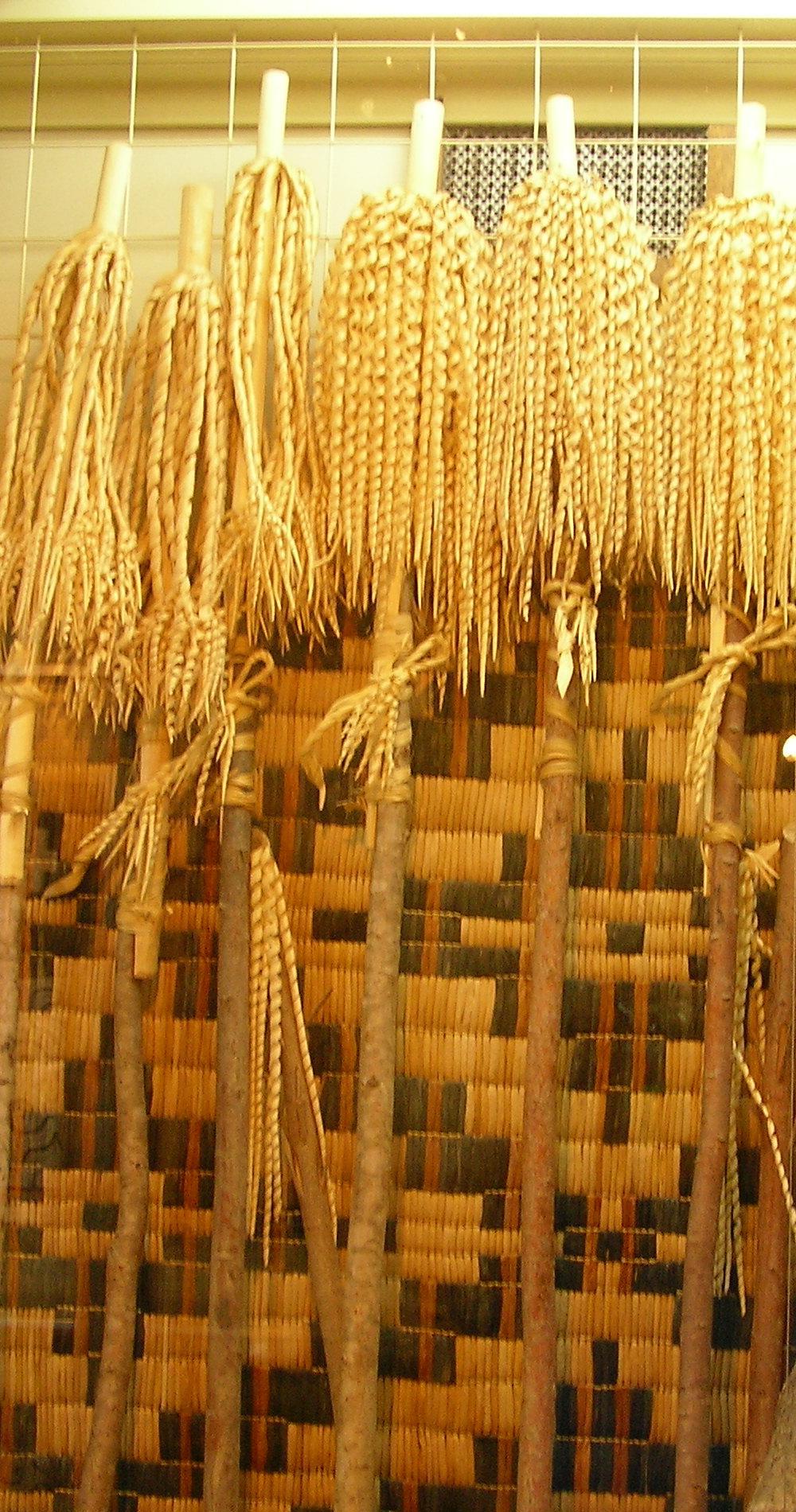 Ainu inau at the Kayano Shigeru Nibutani Ainu Museum in Hokkaido. Public-domain photograph via Wikimedia Commons.
Among the most recognizable Ainu ritual objects are inau: wooden sticks carefully shaved so that curls or tufts of wood remain attached. Different forms could be made for different ritual purposes and divine recipients.
Older European writers often compared inau to Japanese gohei or called them “fetishes,” but these comparisons easily distort their function. Inau are better understood within Ainu ritual exchange. They can operate as offerings, messengers, signs of respect, and material participants in communication with kamuy.
The act of making an inau matters. Wood is selected, carved, and transformed through skilled ritual work. The resulting object is not simply decorative. Its form, material, placement, and intended recipient belong to a religious grammar.
The Smithsonian preserves a related prayer stick called kike-ush-pasuy, described as a specially carved implement used in the bear-sending ceremony. Its markings could identify the sender to divine beings. Such details show that ritual objects carry social information as well as symbolic form.
Why Wood Shavings Matter
The long curled shavings of an inau are visually striking. Outsiders often assume that their meaning can be decoded as a simple symbol, but material symbolism does not always work like a codebook.
The production of fine shavings displays care, skill, and transformation. A simple piece of wood becomes something suitable for divine exchange. The object’s labor value is part of its religious value.
In many ritual traditions, offerings are significant because time and attention have been invested in them. A mass-produced object may not carry the same force as something made according to inherited practice.
Inau therefore remind us that ritual power can be artisanal. Knowledge resides in hands as much as in words.
Prayer Sticks and the Direction of Communication
Ainu ritual communication is structured. Prayers are not always addressed randomly to an undifferentiated spirit world. Certain kamuy mediate communication to others. The hearth deity, for example, occupies an especially important position in domestic ritual.
Prayer sticks and libation implements can help direct offerings and speech. The physical arrangement of ritual space—hearth, east window, altar, inau, food, drink—creates a geography of communication.
This is comparable, at a very general level, to ritual systems elsewhere in which sacred direction, altar placement, and properly prepared objects establish a channel between worlds. Yet the specific Ainu logic must be learned from Ainu categories rather than forced into foreign ceremonial models.
Iomante: The Bear-Sending Ceremony
No Ainu ritual has attracted more outside attention than iomante, the bear spirit-sending ceremony. Older books frequently called it “the bear festival” or “bear sacrifice.” Those phrases describe visible aspects but miss the religious logic emphasized by Ainu sources and modern museum interpretation.
The bear, kimun kamuy or mountain kamuy, could be understood as a powerful divine being visiting the human world in animal form. In the classic ceremony, a bear cub was raised within the community and later ceremonially killed. Its spirit was then sent back to the divine world with food, drink, inau, prayer, and celebration.
The Smithsonian’s account of an Ainu bear skull created for its 1999 exhibition explains that after the ceremony the bear’s spirit was understood to depart from the skull and return to the world of the gods. The skull could remain on the ritual altar as a reminder of the visit.
The ceremony therefore cannot be understood simply as animal killing. It is a theory of divine hospitality and return.
Why Kill a Being Regarded as Divine?
This is the question that most often confuses modern readers. If the bear is a kamuy, why would people kill it?
The answer lies in the relationship between visible animal form and divine identity. In many Ainu narratives, an animal body is a form or gift through which a kamuy enters the human world. Human beings receive meat, hide, and other useful materials. In return they must treat the visiting being correctly and send its spirit home with honor.
Death is therefore not interpreted simply as destruction. It can be a return.
This worldview does not eliminate the ethical difficulty modern people may feel about animal sacrifice. Historical explanation is not moral endorsement. It clarifies how participants understood the act.
The key idea is reciprocity: the kamuy gives a body and resources; humans give hospitality, praise, offerings, and ritual return.
Raising the Bear Cub
Historical accounts describe bear cubs being captured and raised by Ainu households before iomante. In some cases women cared for the cub closely, creating an emotionally complicated relationship between nurture and ritual death.
Outsider observers often sensationalized this practice because the contrast is dramatic: affection and killing exist in the same sequence.
Within the ritual logic, however, careful raising increased the quality of hospitality offered to the visiting kamuy. The animal was not simply livestock awaiting slaughter. It was a guest whose divine identity shaped its treatment.
This remains one of the most challenging aspects of the tradition for modern readers precisely because it resists simple categories such as pet, prey, god, or sacrifice.
Iomante as Feast
Iomante was also a communal feast. Food, alcohol, dancing, song, prayer, and social gathering transformed the ceremony into a major event.
The bear’s return to the divine world was imagined as something that should be accompanied by generosity. A kamuy sent home well treated would speak positively about the human community and could encourage other kamuy to visit.
This is a remarkable inversion of the modern image of sacrifice as grim loss. The ceremony is structured around abundance and hospitality.
The same logic appears in Ainu oral literature, where kamuy sometimes describe receiving human offerings and returning to their own world pleased by respectful treatment.
Chiri Yukie and the Voice of the Kamuy
One of the most important Ainu literary figures is Chiri Yukie, who died in 1922 at only nineteen years old. She recorded and translated Ainu kamuy yukar, songs narrated in the voices of divine beings.
Her Ainu Shin’yōshū, published posthumously in 1923, became one of the most important written records of Ainu oral literature. Recent Cambridge publication of her owl-god song highlights a ritual worldview in which an owl chooses to fall to a hunter’s arrow, receives inau and respectful treatment, and then returns blessing to the human household.
The narrative makes reciprocity explicit. Hunting is not represented as humans dominating passive animals. The kamuy has intention, dignity, and a continuing social relationship with humans.
Chiri’s work is also historically important because she preserved Ainu voices during an era of intense assimilation.
Kamuy Yukar: Songs Spoken by Gods
In kamuy yukar, a performer may narrate from the perspective of a deity or spirit being. This literary structure gives nonhuman beings voice.
An owl, bear, fox, wind deity, or other figure can speak about humans, gifts, danger, generosity, and foolishness. The result is not merely mythology in the sense of stories about gods. It is a moral and social imagination in which humans are seen from outside the human world.
This perspective is especially important for environmental interpretation. Ainu stories do not simply preach that “nature is sacred.” They dramatize reciprocal obligations between species and beings.
That is a richer and more demanding idea than generic ecological spirituality.
The Owl as Kotankor Kamuy
The owl is often associated with kotankor kamuy, a guardian or master of the village. The National Ainu Museum language materials preserve this association explicitly.
Owls hunt rodents and occupy a prominent place in northern ecosystems, but their ritual importance cannot be reduced to ecological function. In oral tradition the owl may appear as a powerful and high-ranking being concerned with human prosperity.
Chiri Yukie’s famous owl song demonstrates how a deity’s relationship with a household can be negotiated through hunting, offerings, and respectful behavior.
The owl therefore belongs to a moral landscape as much as a biological one.
Salmon, Orcas, and Other Divine Visitors
The bear dominates popular accounts, but Ainu ritual relationships extend to many other beings. Salmon are central to subsistence and appear in sacred narratives. Orcas are associated with powerful sea kamuy. Foxes, birds, trees, winds, and other entities can have divine roles.
This diversity is why “bear worship” is an inadequate summary. The bear is exceptionally important, but it belongs to a larger network.
Different environments also produce different emphases. Coastal, riverine, forest, Hokkaido, Sakhalin, and Kuril communities did not all practice identical rituals.
Ainu religion is therefore regional as well as relational.
The House as Ritual Cosmos
Ainu houses, chise, were organized according to more than practical convenience. The hearth, east-facing sacred window, storage, sleeping areas, and ritual objects created a social and religious geography.
The Smithsonian’s “god’s window” mat documents the special status of an opening through which gods were understood to enter or leave during ceremonies. Humans did not treat it like an ordinary window.
This is an important reminder that architecture can encode theology. Sacred space does not require a temple when the household itself has ritually differentiated zones.
Alcohol, Libation, and Sacred Exchange
Millet or other alcoholic drink played important roles in Ainu ceremony. Libations could be offered to kamuy, and drinking could accompany feasts and formal prayer.
A special carved prayer stick or libation implement helped direct drops toward the fire or other sacred recipients.
Alcohol in this setting is not simply recreation. It is part of hospitality. Humans share valued substances with divine guests.
The significance resembles ritual drinking in many cultures, but Ainu forms, implements, and prayers remain specific to their own tradition.
Prayer and Formal Speech
Ainu prayer could be highly formal. The speaker addresses kamuy with honor, explanation, request, gratitude, and careful language.
This matters because outsiders sometimes assumed oral religions lacked theology. In fact, theology can be performed through speech rather than written as doctrine.
Formal prayer tells us what kind of being a kamuy is, what humans owe, why misfortune has occurred, what gift is being offered, and what response is hoped for.
Speech is therefore one of the main archives of Ainu religious thought.
Eupotara and Ritual Protection
Historical ethnographic literature records protective and exorcistic rites often grouped under the term eupotara. Such practices addressed illness, harmful influences, fear, or unwanted spiritual conditions.
They belong to the part of Ainu religion most easily compared with “magic” in a cross-cultural sense. Ritual action aims at concrete change rather than only devotion.
Yet the term magic should not separate these acts from the broader religious system. Protection works through the same relationships with kamuy, prayer, offerings, household space, and inherited expertise that structure other ceremonies.
Comparatively, this resembles how Korean gut can address illness or spirit conflict without being reducible to a generic category of sorcery.
Illness and Spiritual Interpretation
Ainu traditions could interpret certain illnesses through relationships with kamuy or harmful spiritual forces. Historical prayers sometimes ask divine beings for recovery from severe illness.
Such beliefs should be described historically without turning them into medical advice. A religious explanation of suffering can coexist with biomedical care, and modern readers should not use historical ritual models as substitutes for evidence-based treatment.
Anthropologically, the important point is that illness is social and cosmological as well as physical. It can raise questions about neglected obligations, danger, impurity, or divine relationship.
Ancestors and the Dead
Ainu ritual life also includes remembrance of the dead and continuing relationships with ancestors. Historical ethnographies describe ceremonies of memorialization and the management of relationships between the living and departed.
Again, these practices are not identical to Japanese Buddhist ancestor rites, even though centuries of contact created areas of influence.
The dead belong to a moral community whose relationships must be handled correctly.
Tools Can Have Spirit
One of the most fascinating features of Ainu worldview is the extension of spiritual significance beyond animals. Useful objects can possess ramat or become associated with divine power.
A tool is not necessarily a disposable inert thing. It has a history of use, skill, and relationship.
This idea complicates modern assumptions about animism. “Everything is alive” is too simplistic. The better question is how particular things become participants in human life and what forms of respect follow from that participation.
Ritual Quivers and Sending the Bear
 Ainu ritual quiver at the National Ainu Museum and Park. Photograph by Hiart, CC0 via Wikimedia Commons.
Special ritual equipment associated with iomante demonstrates the ceremony’s technical complexity. The National Ainu Museum preserves objects such as ritual quivers, while museum records from other institutions document prayer sticks, skull displays, and ceremonial implements.
These objects show that ritual practice cannot be reconstructed from stories alone. Craft, hunting technology, woodwork, clothing, household space, and ceremony form one system.
Material culture is theology made visible.
Why Early Outsider Accounts Must Be Read Critically
Nineteenth- and early twentieth-century travelers left valuable descriptions of Ainu life, but many wrote within colonial and racial theories that ranked peoples as more or less civilized.
Isabella Bird’s account is a striking example. She recorded inau and libations while simultaneously claiming that Ainu religious ideas were vague and childish. The contradiction is instructive. An observer can describe ritual details accurately while misunderstanding their intellectual structure.
Modern readers should therefore separate evidence from interpretation. Old sources may preserve information unavailable elsewhere, but their assumptions require critique.
“Primitive Religion” and the Colonial Gaze
Early anthropology often used Ainu people as evidence in theories about stages of human religious evolution. Bear ritual, animism, and oral tradition were placed near the “primitive” beginning of religion.
This framework made complex contemporary people into living fossils. It also encouraged museums to collect objects as if Ainu culture were about to vanish.
Modern scholarship rejects this evolutionary ranking. Ainu religion is not an earlier stage of Japanese religion. It is its own historical tradition.
Assimilation and the Transformation of Ritual Life
Japanese state expansion into Hokkaido changed the material conditions that supported Ainu ritual. Hunting restrictions, land policies, schooling, language suppression, and economic transformation affected the ability to maintain ceremonies.
Iomante itself became controversial and was restricted or banned in parts of the modern period. Ritual continuity was therefore shaped by law, not merely by voluntary cultural change.
When later generations revived ceremonies or reconstructed techniques, they did so after institutional disruption.
Revival should not be mistaken for invention. Communities often rebuild from interrupted memory, surviving elders, museum objects, songs, photographs, and archival records.
Tourism, Display, and the Problem of Authenticity
Ainu dance, craft, ritual imagery, and bear symbolism were often presented to tourists in twentieth-century Hokkaido. This created income and visibility but also encouraged stereotypes.
Visitors wanted dramatic “traditional” scenes, which could pressure communities to perform a fixed version of identity.
Modern institutions such as Upopoy attempt a different approach by combining public education with Ainu-led cultural presentation, language revitalization, performance, research, and historical interpretation.
Yet debates continue over who controls representation and how state institutions frame Indigenous identity.
Upopoy and the National Ainu Museum
The National Ainu Museum opened as part of Upopoy in Shiraoi, Hokkaido, creating Japan’s first national museum dedicated to Ainu history and culture.
Its permanent exhibition is structured around Ainu-language concepts including language, universe, life, history, work, and interaction with other peoples. The “Our Universe” section places spirituality at the center rather than treating religion as an exotic side topic.
This curatorial choice matters. It allows Ainu categories such as ramat to organize interpretation instead of beginning only with outside anthropological labels.
Chiri Yukie and Cultural Survival
Chiri Yukie’s short life symbolizes both cultural loss and cultural preservation. Her decision to record oral songs in writing preserved voices that might otherwise have disappeared during rapid assimilation.
But writing also changes oral tradition. A performed song has rhythm, voice, audience, memory, and local variation. A printed text stabilizes one version.
The transformation is not a betrayal. It is a survival strategy.
SecretMagic readers who have explored textual transmission in the Hekhalot corpus or ritual manuscripts can recognize a very different but related problem: what happens when living performance becomes archive?
Kamuy and the Ethics of Hunting
Ainu hunting traditions are sometimes romanticized as evidence that Indigenous hunting was always ecologically perfect. That claim should be avoided.
The more defensible point is ethical: animals are treated as beings within reciprocal relationships rather than as meaningless resources.
Ritual does not prevent killing. It changes what killing means. The hunter owes gratitude, correct treatment, and return.
This is a difficult worldview for modern industrial societies, where animal death is often hidden far from consumers.
Reciprocity Rather Than Dominion
The deepest pattern running through Ainu ritual is reciprocity. Kamuy provide food, protection, materials, or other benefits. Humans provide offerings, prayer, hospitality, and respectful return.
Neither side is imagined as completely independent. The divine world and human world need exchange.
This is why an owl can choose to be hunted in a song, why a bear can be treated as a guest, and why an inau can function as a gift rather than mere symbol.
The universe is social.
Is Ainu Religion “Shamanism”?
Ainu religion is sometimes classified as shamanic because it includes spirit relationships, ritual specialists, healing, and altered states in some contexts. The comparison can be useful, but it should not erase local categories.
Unlike Korean mudang traditions, Ainu religion is not organized primarily around professional possession mediums conducting gut ceremonies. The institutional forms are different.
The label shamanism therefore describes selected similarities, not identity.
Is Ainu Religion “Magic”?
If magic is defined broadly as ritual action intended to influence unseen forces, protect people, heal, communicate with spirits, or secure practical benefit, then some Ainu practices can be studied comparatively as magic.
If magic is defined as something separate from religion, the category fails. Inau, prayer, household ritual, hunting, healing, and iomante belong to one sacred world.
The same interpretive caution applies to the Atharvaveda, where healing charms and sacred speech cannot be separated neatly into “religion” and “magic.”
What Ainu Spirituality Is Not
“Ainu people worship every object in nature.”
No. Spiritual presence is widespread, but ritual relationships are differentiated by being, place, rank, danger, and context.
“The bear is the single supreme Ainu god.”
No. The bear is a major mountain kamuy but belongs to a much larger divine world.
“Iomante was simply cruelty disguised as religion.”
That judgment ignores the historical worldview, though modern people may still ethically reject animal sacrifice. Explanation and endorsement are different.
“Ainu religion disappeared with modernization.”
No. It was severely disrupted, but knowledge survived and has been actively revitalized.
“Museum objects show exactly how every Ainu community practiced.”
No. Ainu traditions were regionally diverse, and collections often preserve only selected moments.
A Living Tradition, Not an Archaeological Fossil
The most important correction is temporal. Ainu people are not characters from nineteenth-century ethnography. They are contemporary communities engaged in language revival, cultural education, artistic production, political advocacy, ceremony, and reinterpretation.
Some people practice inherited rituals; others engage Ainu identity differently. No Indigenous population is religiously uniform.
Modern Ainu spirituality therefore cannot be reduced to reconstructing the past. It is also about deciding what should be carried forward and how.
Why Ainu Spirituality Matters for Comparative Esotericism
Ainu ritual life broadens the study of esotericism by showing that sacred knowledge does not require secret books, priestly hierarchies, or elaborate metaphysical diagrams.
Knowledge can be encoded in how wood is shaved, where a window is placed, how an animal is addressed, how a prayer is spoken, how food is shared, and how a spirit is sent home.
This is not “less sophisticated” than textual occultism. It is sophisticated in a different medium.
Comparative study becomes most useful when it expands our idea of what ritual intelligence looks like.
For comparison, the Daoist talismanic traditions of ritual writing also show how material forms can participate in a sacred order, but Ainu inau belong to a different ritual logic centered on reciprocal hospitality with kamuy rather than celestial bureaucracy.
Conclusion: The World as a Network of Guests
Ainu spirituality is best understood through relationship. Kamuy are not distant gods ruling from an abstract heaven. They visit, feed, protect, threaten, exchange, and return. Humans are not masters of a silent natural world. They are hosts, hunters, relatives, makers, speakers, and recipients of gifts.
Inau make those relationships material. Prayer makes them audible. The hearth makes them domestic. Kamuy yukar makes them narrative. Iomante makes them communal and dramatic.
The famous bear ceremony therefore belongs to a much larger worldview. The bear is important not because Ainu religion is “bear worship,” but because the bear reveals the structure of reciprocity with unusual clarity. A powerful being comes in a valuable animal body. Humans receive that gift, offer hospitality, and return the spirit with honor.
That worldview was damaged by colonial expansion, assimilation, and the outsider belief that Ainu culture was primitive and destined to vanish. Yet songs, objects, language, memories, museums, and living practitioners have carried important knowledge forward.
For the history of magic and religion, Ainu traditions offer a powerful reminder: ritual power does not always mean commanding supernatural forces. Sometimes power lies in maintaining relationships correctly—in knowing how to receive a guest, recognize a presence, make an offering, speak with respect, and send a being home.
Regional Diversity Across Ainu Communities
One of the easiest mistakes in writing about Ainu spirituality is to describe “the Ainu” as though every community practiced the same rites in the same way. Historical Ainu populations lived across a large northern zone, and ecological conditions differed significantly between inland Hokkaido, coastal areas, Sakhalin, and the Kuril Islands. Fishing, hunting, marine travel, forest use, trade, and contact with neighboring peoples shaped ritual priorities.
This regional diversity affected divine relationships. Coastal communities could emphasize sea beings and marine danger differently from inland hunting communities. Sakhalin traditions developed in contact with Nivkh and other northern peoples, while Hokkaido communities experienced intense interaction with Japanese merchants and administrators. Ritual vocabulary, material culture, and ceremonial sequences therefore varied.
Modern museum displays necessarily select representative examples, but no object should be treated as a universal template for all Ainu practice. A particular style of inau, house arrangement, clothing, or ceremony may reflect a local tradition. Good comparative history preserves this plurality instead of flattening it.
Gender, Ritual Labor, and Authority
Ainu ritual life also involved gendered forms of labor and authority. Men and women did not always perform the same ceremonial tasks, and older ethnographies sometimes described male formal prayer as though it represented the whole religious system. That bias can hide the religious importance of women’s work in child care, food preparation, textile production, household continuity, oral tradition, and the raising of animals involved in ceremony.
The emotionally difficult history of bear cub rearing is a clear example. Women could play central roles in feeding and caring for a cub that would later become the focus of iomante. To describe only the final public ritual and ignore months or years of care removes much of the relationship that gave the ceremony meaning.
Gender roles also changed under assimilation and modern labor patterns. As with other Indigenous traditions, contemporary Ainu cultural revitalization includes debates over who may teach, perform, reconstruct, or publicly represent particular practices.
Oral Tradition Is Not the Absence of Scholarship
Older observers frequently equated literacy with intellectual sophistication. Because much Ainu religious knowledge circulated orally, they concluded that Ainu religion lacked systematic thought. That conclusion reflects the observer’s assumptions more than the evidence.
Oral traditions can preserve highly structured knowledge through narrative formulas, specialized vocabulary, performance conventions, mnemonic repetition, genealogies, and ritual contexts. A skilled singer or elder may carry an archive that exists in memory rather than in a bound volume. The form is different, not inferior.
Chiri Yukie’s recordings demonstrate this vividly. Once kamuy yukar were written down, Japanese readers could suddenly see complexity that had always been present in oral performance. The appearance of sophistication on the page did not create the sophistication; writing merely made it legible to outsiders trained to respect books.
Language Revitalization and Religious Meaning
Ainu language revival is inseparable from the recovery of religious meaning. Terms such as kamuy, ramat, inau, and iomante lose nuance when reduced to one-word translations. “God,” “spirit,” “offering,” and “bear festival” are useful entry points, but they also import foreign assumptions.
The National Ainu Museum’s language archive is important because it allows researchers to see how words appear in compounds and local dictionaries. A term such as kamuy changes meaning according to context: village guardian, mountain bear deity, sea power, epidemic being, or an honorific expression of extraordinary status.
Language therefore functions as a map of relationships. Revitalizing it does more than preserve vocabulary. It restores distinctions through which the world was understood.
Modern Performance and the Question of Reconstruction
Some Ainu ceremonies performed today are revivals, commemorations, educational presentations, or reconstructed forms rather than uninterrupted repetitions of premodern practice. This fact should not be used to dismiss them as fake.
Religious traditions frequently survive through reconstruction after suppression. Jewish liturgies, Indigenous ceremonies, Buddhist lineages, and folk festivals around the world have been rebuilt from partial memory, texts, recordings, museum objects, and elder testimony. The key question is not whether a rite has changed but how communities understand the continuity.
Ainu cultural revival is especially sensitive because so much disruption resulted from external policy rather than voluntary abandonment. Reconstructing a ceremony can therefore be an act of cultural sovereignty.
What Museums Can and Cannot Preserve
Museums preserve inau, clothing, hunting tools, ritual quivers, carved implements, photographs, and paintings. These objects are indispensable historical evidence. Yet they cannot preserve the full event.
An inau behind glass is separated from the prayer that activated its role. A bear skull in storage is separated from the feast, song, grief, and social relations of iomante. A house model can show the sacred window but not reproduce the atmosphere of a family ceremony around the hearth.
This limitation is why collaboration with living communities matters. Objects become more intelligible when interpreted through language, oral memory, craft knowledge, and family histories rather than through typology alone.
Reciprocity as a Theory of Religious Power
Comparative esoteric studies often focus on control: commanding spirits, binding demons, manipulating correspondences, or gaining supernatural authority. Ainu ritual offers a different model. Power can emerge from correct reciprocity rather than domination.
The hunter succeeds because relationships with animal kamuy are maintained. The household flourishes because a divine guest is treated generously. Prayer works because communication follows an inherited etiquette. Ritual objects matter because they carry gifts and messages between parties.
This model complicates the stereotype that magic is fundamentally coercive. Across cultures, ritual efficacy may be contractual, hospitable, kinship-based, devotional, bureaucratic, sacrificial, or reciprocal. Ainu practices belong strongly to the reciprocal end of that spectrum.
Sources and References
- National Ainu Museum, “Permanent Exhibition Room,” especially the “Our Universe” section: National Ainu Museum / Upopoy.
- National Ainu Museum Ainu Language Archive, dictionary entries for kamuy and related terms: National Ainu Museum.
- Chiri Yukie and Kyoko Selden, “The Song the Owl God Himself Sang: ‘Silver Droplets Fall Fall All Around,’ An Ainu Tale,” Asia-Pacific Journal, Cambridge University Press, 2025: Cambridge Core.
- Kayano Shigeru and Kyoko Selden, “The Goddess of the Wind and Okikurmi,” Asia-Pacific Journal, Cambridge University Press, 2025: Cambridge Core.
- Neil Gordon Munro, Ainu Creed and Cult, Smithsonian Libraries and Archives record: Smithsonian Institution.
- Smithsonian National Museum of Natural History, “Bear Skull,” object record discussing iomante and the return of kimun-kamuy: Smithsonian Institution.
- Smithsonian National Museum of Natural History, “Prayer stick, kike-ush-pasuy,” object record: Smithsonian Institution.
- Smithsonian National Museum of Natural History, “God’s window mat, chitarpe,” object record: Smithsonian Institution.
- Smithsonian Institution, “Ainu: Spirit of a Northern People,” exhibition record: Smithsonian Institution.
- Wikimedia Commons, Hirasawa Byōzan, “Ainu iomante bear spirit-sending ceremony,” 1875, public-domain reproduction.
- Wikimedia Commons, “Inaw.jpg,” public-domain photograph of Ainu ceremonial implements.
- Wikimedia Commons, “Ainu ritual quiver, National Ainu Museum and Park,” CC0.


