


 Ancient papyrus fragment preserving part of the Sortes Astrampsychi. Public-domain reproduction via Wikimedia Commons.
Ancient divination is often imagined as spectacle: a priestess speaking in a sanctuary, a dream sent by a god, birds crossing the sky, or an animal sacrifice whose organs reveal a hidden future. The Sortes Astrampsychi belongs to a less theatrical but equally revealing world. It is a handbook built from numbered questions, numerical routing, and prepared answers. A client could ask about marriage, illness, money, travel, legal trouble, inheritance, employment, social advancement, pregnancy, or the fate of an absent person. The diviner did not need to compose a prophecy from nothing. The book itself transformed ordinary anxiety into a controlled encounter with chance.
That mechanism makes the Sortes Astrampsychi one of the most important surviving witnesses to practical divination in Roman Egypt and late antiquity. Its questions are strikingly human. They are not dominated by cosmic secrets or philosophical speculation. They ask whether a debt will be repaid, whether a business will prosper, whether someone will obtain an office, whether a sick person will recover, whether a journey will end safely, whether a spouse will remain faithful, or whether a person in danger will escape. Behind the numerical machinery stands a social history of uncertainty.
The work also challenges several modern assumptions about magic. It was not a private diary of visions, an elite philosophical treatise, or a simple random-answer game. Nor did it remain frozen in one religious form. Papyrus witnesses from Egypt preserve late antique stages of the tradition, while medieval manuscripts show that the system survived, changed, and in some versions became Christianized. The oracle could retain its computational architecture even when the sacred names around it changed.
Studying the Sortes Astrampsychi therefore means studying more than fortune-telling. It means studying how a book can function as ritual technology; how randomness can be interpreted as divine selection; how clients turn private problems into standardized questions; how pagan and Christian cultures can reuse the same divinatory infrastructure; and how a text attributed to an ancient sage could acquire authority through pseudonymous antiquity.
Who Was Astrampsychus?
The name Astrampsychus belongs to the history of attributed wisdom more securely than to recoverable biography. Ancient and later traditions present Astrampsychus as an eastern or Egyptian sage, sometimes placing him in a Persian setting before Alexander the Great and sometimes connecting him with a Ptolemaic ruler. The oracle book itself participates in this prestige-making process. Its introductory tradition associates the system with great names and remote authority, including Pythagoras and Alexander.
Modern scholarship does not treat these claims as straightforward authorship records. Gerald M. Browne, whose work established much of the modern textual study of the Sortes, regarded the attribution as pseudonymous. The surviving form belongs to the Roman imperial world rather than to the age of Alexander. The modern critical edition places the oracle book in roughly the first or second century CE, while surviving papyrus copies are later. The gap is normal for ancient literature: the date of a composition and the date of its oldest surviving physical witness are different questions.
Astrampsychus became a useful authorial container. Other works were also attributed to him, including texts concerned with dreams and other forms of divination. Such attribution did not require a historical Astrampsychus to have written them all. Ancient and medieval intellectual culture repeatedly gathered technical knowledge under prestigious names. Hermes Trismegistus, Solomon, Orpheus, Pythagoras, and other figures accumulated textual libraries far beyond anything that could be assigned to one historical author.
The important historical question is therefore not simply whether Astrampsychus was real. It is why this name authorized a divinatory technology. An exotic or ancient sage could guarantee that a numerical oracle was not merely a clever game. Pseudonymous antiquity gave the procedure pedigree.
A Book Designed to Answer Problems
The core attraction of the Sortes Astrampsychi is its architecture. The system organizes consultation into stages. A questioner selects a question from a numbered list. A number from one to ten is then introduced through the divinatory procedure. The question number and selected number are combined and routed through an index. That index leads to a numbered group of ten answers. The selected number finally identifies the response.
The procedure sounds complicated when described abstractly, but its complexity serves an important purpose. It separates the client from the answer. The diviner cannot simply choose whichever response seems profitable or persuasive without manipulating several visible steps. At the same time, the client does not merely open a book at random. The consultation is structured enough to feel governed by a system.
In surviving versions, divine names can appear within the routing apparatus. This religious framing matters. Chance is not necessarily understood as absence of causation. The number can be the point at which divine agency enters. A modern reader may say that a random number selects an answer; an ancient practitioner could say that a god guides the number that appears in the mind or hand. The physical or mental act of selection becomes a bridge between uncertainty and revelation.
This logic is common in lot divination. A lot is powerful precisely because the human consultant gives up direct control at a crucial moment. Dice, knucklebones, marked sticks, lots, randomly selected verses, and numbered tables can all create a controlled surrender of choice. The divine answer appears through a process that is simultaneously mechanical and sacred.
The Ninety-Two Questions and the Texture of Ordinary Life
The question list is among the richest features of the work. It preserves not just a divinatory system but a catalogue of anxieties. Modern readers often encounter ancient magic through exceptional texts about summoning gods, binding enemies, or acquiring supernatural knowledge. The Sortes brings us closer to the concerns of clients who wanted to know what would happen next week, next month, or next year.
Questions concern health: will an illness pass, will a patient recover, will danger end? Others concern family and reproduction: marriage, reconciliation, pregnancy, children, and sexual relationships. Money appears repeatedly through loans, debts, trade, property, inheritance, and employment. Travel is dangerous enough to require consultation. Legal accusation and public reputation matter. So do offices and advancement.
Some questions presuppose social positions unavailable to most inhabitants of the Roman Empire. Others are compatible with the concerns of slaves, freed people, merchants, artisans, and households. This mixture suggests that the oracle was flexible enough to serve a varied clientele. It also reminds us that popular divination does not mean used only by the poor. Uncertainty cuts across class boundaries even when the available questions reveal class distinctions.
Franziska Naether’s major study of the Sortes Astrampsychi treats the oracle as a source for strategies of problem solving in Roman Egypt. Her 2025 article introduces newly studied papyrus fragments and places the Sortes within a wider field of lot oracles, hemerologies, dice, and knucklebone divination. This approach is valuable because it shifts attention from whether divination was superstitious to what people were trying to accomplish by consulting it.
A client facing uncertainty has several problems at once. The future is unknown; available information is incomplete; emotional pressure can make decision-making difficult; and social consequences may be severe. An oracle converts this open-ended situation into a finite question. That conversion alone can be psychologically and socially significant. What will happen to me is unmanageable. Will I recover from this illness can be routed through a system.
Roman Egypt as a Divinatory Environment
The papyrus evidence anchors the Sortes in Egypt, where Greek, Egyptian, Roman, Jewish, and later Christian traditions interacted over centuries. Roman Egypt produced an extraordinary documentary archive because papyrus survived in dry conditions. Tax receipts, letters, contracts, school exercises, literary texts, magical handbooks, prayers, and divinatory manuals can sometimes be studied side by side.
This environment is essential for understanding the oracle. Greek was a major administrative and literary language, but it existed alongside Egyptian languages and religious traditions. Divination was not one uniform practice. Temple oracles, dreams, astrology, lots, omens, and technical handbooks could coexist. Practitioners could borrow procedures without adopting an entire foreign theology.
The history of Onmyōdō in Japan offers a useful comparative reminder: divination often becomes most intelligible when studied as a practical technology embedded in calendars, institutions, specialist knowledge, and everyday decisions rather than as a collection of isolated supernatural beliefs. The cultural content differs radically, but the methodological lesson is similar.
The Sortes Astrampsychi also belongs beside other evidence for textual ritual. The Ephesia Grammata and Greek protective formulae show how words could move between performance and inscription. The Sortes shows another form of textual ritualization: not a fixed charm but a decision tree.
Papyrus 2461 and the Archaeology of Reuse
One especially important witness is British Library Papyrus 2461 from Oxyrhynchus. The catalogue dates the object to the late third or early fourth century CE. Its recto contains a list of payments in wheat and barley by cultivators. The verso preserves material from the Sortes Astrampsychi, including portions of numbered questions.
This physical arrangement is historically suggestive. Papyrus was valuable. A sheet used for one documentary purpose could later be turned over and reused. The divinatory text therefore survives not as a pristine luxury manuscript but on material already involved in economic administration. Grain payments and oracle questions occupy opposite sides of the same object.
That fact should not be romanticized into a complete story about the owner. We do not know that the same person who recorded the grain accounts practiced divination. Reused papyri could circulate. But the artifact does demonstrate the material proximity of mundane administration and divinatory literature.
It also undermines the modern expectation that esoteric knowledge must be preserved in visually elaborate books. A practical oracle can live on reused papyrus. Ritual authority depends on the functioning system, not necessarily on luxurious presentation.
The Codex as a Divinatory Tool
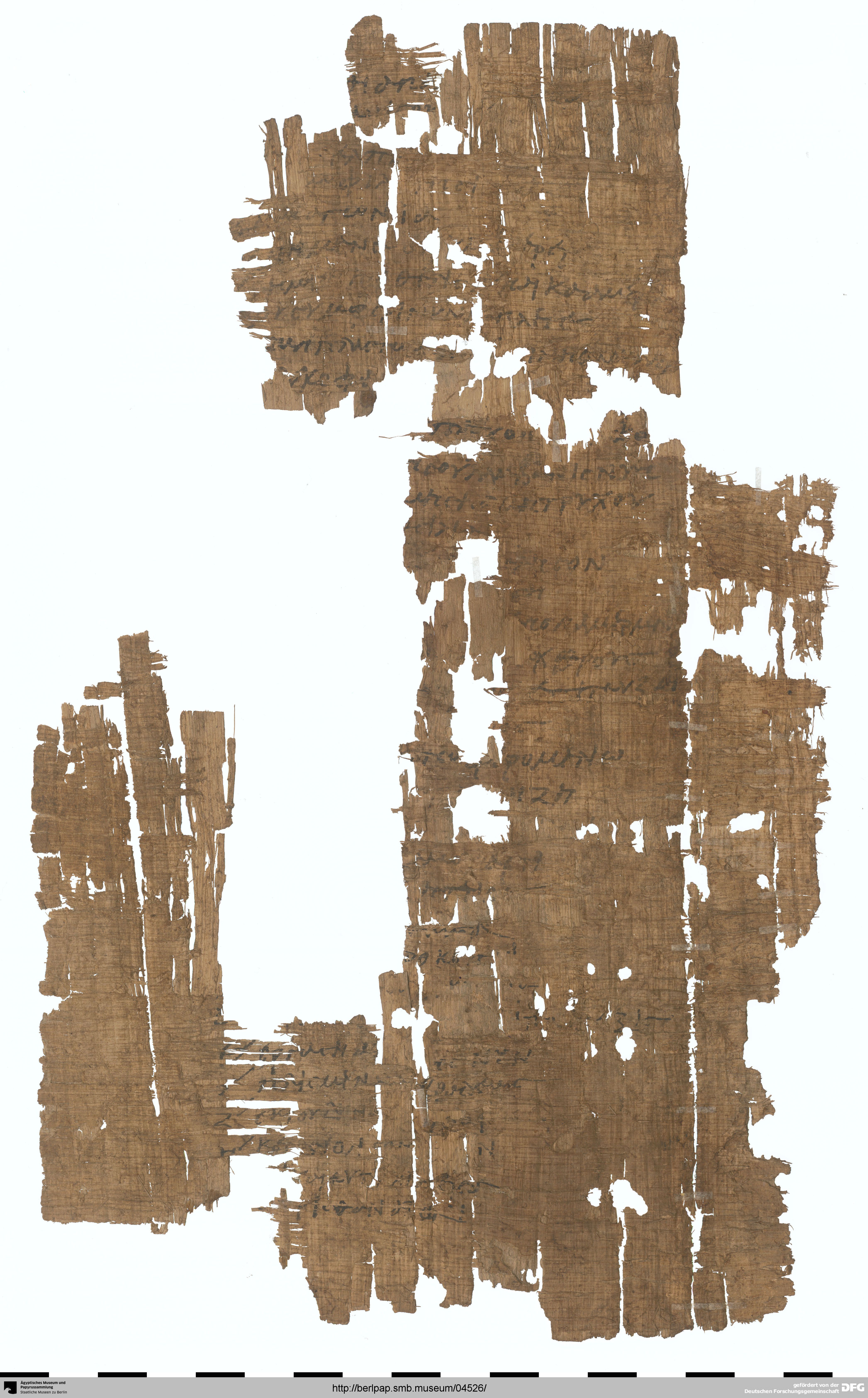 A third-century CE papyrus codex fragment of the Sortes Astrampsychi, P. 21341, preserved in the Berlin Papyrus Collection.
The Berlin Papyrus Database records P. 21341 as part of a third-century CE papyrus codex containing the Sortes Astrampsychi. The codex format is important. Unlike a roll, a codex permits rapid movement between sections. For a consultation system that requires jumping from a question list to an index and then to an answer group, the ability to navigate a book efficiently is practical rather than merely aesthetic.
We should be cautious about assuming that every surviving copy was laid out identically or that the codex was invented for divination. Yet the format suits a reference work. A ritual handbook is not necessarily read from beginning to end. It is operated.
This is one of the most useful ways to understand the Sortes: as an interface. The client supplies a problem; the system converts it into a number; the number moves through tables; the book returns a bounded response. The material book and the numerical rules form a single divinatory machine.
How Randomness Becomes Revelation
Modern probability theory encourages us to think of randomness as mathematically describable uncertainty. Ancient lot divination asks a different question: what if the unpredictable event is precisely where a god can act without human interference?
This idea does not require practitioners to deny ordinary causation. The sacred interpretation attaches to a controlled moment of indeterminacy. The consultant cannot know in advance which answer will be reached. That lack of knowledge creates room for divine selection.
The logic resembles drawing a marked lot from a vessel. The physical objects are human-made; the rules are human-made; the possible outcomes are human-written. Yet the specific outcome is treated as more than human choice. Divination often works by constructing such a boundary.
The Sortes makes the boundary unusually visible because its answer bank is prewritten. The god, if divine agency is assumed, does not dictate new prose. The god selects among existing sentences. Revelation is therefore constrained by editorial design.
This raises a profound question about divinatory authority. If humans wrote the answers, how can the result be divine? Ancient users did not necessarily see a contradiction. A temple oracle also uses human language. An astrologer uses human tables. A priest examining a liver relies on learned classifications. Divine communication frequently requires a human-made interpretive technology.
The Oracle as an Algorithm
It is tempting to call the Sortes Astrampsychi an ancient algorithm. The comparison is useful if handled carefully. An algorithm is a defined sequence of operations that transforms an input into an output. The Sortes does exactly that. A selected question and a number move through a routing system toward one answer.
But the analogy has limits. The oracle is not a secular calculating device. Its procedure is embedded in religious assumptions, textual authority, social performance, and perhaps the presence of a diviner. The same numerical sequence can be understood mechanically by a historian and providentially by a practitioner.
Still, algorithmic language helps explain why the book could survive religious change. The architecture is separable from some of its theological labels. Replace pagan divine names with biblical figures, alter some questions, and the routing mechanism can continue to operate. A successful information structure is reusable.
This adaptability may be one reason the tradition persisted into the Byzantine and medieval periods. It offered a tested framework for transforming chance into an answer.
Pagan Gods and Christian Revisions
The transmission history of the Sortes is especially valuable because it shows religious adaptation rather than simple replacement. Earlier papyrus witnesses preserve a world in which pagan divine names belong naturally to the procedure. Later manuscripts can introduce Christian elements and biblical figures.
This does not mean that one day a pagan oracle suddenly became Christian in a single editorial act. Textual traditions change unevenly. Different manuscripts preserve different layers. Questions can be altered while structures remain. Names can be replaced while numerical correspondences survive. A Christian scribe may copy material inherited from a non-Christian source because the practical technology still appears useful.
The process resembles other late antique transformations. Ritual forms, calendars, amulets, dream interpretation, and healing practices did not vanish simply because religious institutions changed. They were criticized, renamed, absorbed, reauthorized, or pushed into new social spaces.
For historians, this is more informative than a simple story of pagan survival. Survival suggests passive persistence. Adaptation involves choices. Someone decides that a procedure can be retained if its sacred framework is revised.
Why Christianity Did Not End Lot Divination
Christian authorities frequently criticized unauthorized divination, but Christianity also possessed its own traditions of providential lots, scriptural consultation, saintly revelation, and signs. The theological issue was not always whether hidden knowledge could be revealed; it was who authorized the revelation and by what means.
This distinction created a large gray zone. A numerical oracle associated with pagan gods could be condemned. A structurally similar procedure framed through biblical authority might appear more acceptable to some users, though clerical critics could still object.
The Sortes demonstrates how practices can cross confessional boundaries through re-description. The mechanism does not carry an immutable religious identity. Its identity is produced by names, prayers, interpretive claims, and communities of use.
This is one reason historians should resist treating magic and religion as substances that can be separated chemically. They are categories applied to practices in contested social contexts. A lot oracle can be sacred, illicit, foolish, providential, demonic, or traditional depending on who describes it.
What Did the Answers Sound Like?
The answer system is designed for practical ambiguity. Responses can promise success, warn of delay, predict failure, or qualify an apparently favorable outcome. Such answers need to be specific enough to feel relevant but broad enough to fit many circumstances.
This is not evidence of crude deception. Divinatory language everywhere faces the same structural problem: the future is open, but clients demand usable guidance. An oracle that always says yes is useless; one that gives extremely detailed predictions will fail visibly. A bank of varied, qualified responses creates interpretive space.
Interpretation likely continued after the answer was obtained. A client could ask what a warning meant, whether a delay required action, or whether a favorable response justified a risky choice. The diviner’s role may therefore have extended beyond operating the table.
Even when a text provides the answer, human mediation remains important. Books do not eliminate specialists; they can professionalize them.
Divination as Decision Support
It is easy to dismiss ancient fortune-telling as an attempt to know an unknowable future. A more productive approach asks how consultation affects decisions. An oracle can authorize action, delay action, distribute responsibility, reduce anxiety, or create a socially acceptable reason for choosing one option over another.
Suppose a merchant is uncertain about travel. The decision involves weather, piracy, disease, prices, credit, family obligations, and incomplete information. An oracle cannot calculate all those variables. But it can produce a decision point. A favorable answer may strengthen resolve; an unfavorable answer may justify postponement.
Similarly, a person uncertain about marriage or litigation may already have conflicting evidence. Divination does not necessarily replace observation. It can enter after ordinary reasoning reaches its limit.
This is why the mundane questions in the Sortes matter so much. They show divination operating not at the edge of society but inside ordinary planning.
The Social Role of the Diviner
The handbook implies expertise. Even if the client selects the question and participates in generating the number, someone must know how to navigate the tables correctly. A diviner who owns the book possesses both a tool and a service.
Such expertise could be relatively modest compared with temple priesthood or advanced astrology. That may have made the system economically accessible. The questions look suited to repeated consultation by people with practical concerns rather than only by rulers.
The diviner also controls the setting. He or she can explain the rules, frame the role of divine agency, read the answer, and perhaps interpret it. Literacy itself is part of the authority. In a society where not every client can comfortably navigate a Greek reference text, the book becomes professional capital.
At the same time, the standardized system limits arbitrary improvisation. The practitioner is not claiming to enter trance and speak whatever comes to mind. Authority is distributed among book, number, divine agency, and specialist.
Questions as a Map of Social Fear
The list of questions can be read as a map of vulnerability. Illness threatens the body. Debt threatens economic survival. Accusation threatens reputation and liberty. Travel threatens life. Marriage and childbirth threaten household stability. Employment and office determine status. An absent person’s fate creates emotional uncertainty.
These concerns are not uniquely ancient, but their framing reveals Roman social structures. Questions about slavery, public office, and legal exposure belong to a world of sharply unequal status. A modern horoscope column may ask about career and romance; the Sortes can ask about sale, freedom, or civic position.
This is why divinatory texts are valuable historical documents even for scholars uninterested in whether divination worked. They preserve what people feared enough to ask.
Oxyrhynchus and the Accident of Survival
 A Greek papyrus manuscript from Oxyrhynchus, illustrating the documentary environment in which fragments of the Sortes Astrampsychi survived. Public-domain reproduction via Wikimedia Commons.
The importance of Oxyrhynchus to this story is partly an accident of preservation. The ancient city, near the edge of the western desert in Middle Egypt, produced enormous quantities of written material. From the late nineteenth century onward, excavations led by Bernard Grenfell and Arthur Hunt recovered papyri from rubbish mounds whose dry conditions had preserved texts that would have disappeared in wetter environments. The resulting corpus contains literary works beside tax records, petitions, accounts, private letters, horoscopes, Christian writings, and technical material.
This archaeological context changes how we imagine ancient esotericism. The surviving fragment of a divinatory handbook does not come from a sealed occult library separated from ordinary life. It belongs to the same documentary landscape that preserves rents, grain, lawsuits, family correspondence, and administrative paperwork. That proximity is historically appropriate because the questions in the oracle are themselves about ordinary life.
It also warns us against equating survival with popularity too mechanically. Egypt preserves papyrus exceptionally well, while comparable books used in damper regions may have vanished completely. The concentration of witnesses in Egypt therefore reflects both genuine use and the unequal survival of ancient writing. Papyrological evidence is powerful precisely when its archaeological biases are kept in view.
At the same time, multiple witnesses and later manuscript transmission show that the Sortes was not an isolated curiosity. The tradition was copied often enough to develop recensions, variants, and religious adaptations. The accident of Egyptian preservation gives us access to a practice whose cultural life extended beyond any single surviving sheet.
Textual Transmission and Two Recensions
The surviving Sortes Astrampsychi is not one perfectly stable text. Scholars distinguish major recensional forms, conventionally called the ecdosis prior and ecdosis altera. Gerald Browne and Randall Stewart produced critical editions that made it possible to compare the complicated papyrus and manuscript evidence.
The differences matter because they show that users did not merely copy a fixed oracle unchanged. Structure and wording could diverge. A recension may preserve some older features while innovating elsewhere. Later Christianization does not map perfectly onto a simple two-stage sequence.
Textual criticism is therefore essential. If one medieval manuscript contains a Christian figure, that does not prove the earliest Roman form did. If one papyrus omits a question, that does not prove the question never belonged to another branch of the tradition.
The oracle’s history is a family tree with missing branches, not a single line of descent.
New Fragments and a Living Field of Research
The study of the Sortes is not finished. Naether’s 2025 article, “Fateful Fragments,” reports new papyrological evidence from fragments in the Leipzig University Papyrus Collection and situates them alongside related lot-oracle traditions in Egyptian, Greek, Latin, and Arabic contexts. This is an important reminder that ancient divination is still being reconstructed from incomplete physical remains.
Every new fragment can alter the map. A few lines may preserve a question otherwise known only from a medieval manuscript. A different arrangement can clarify how the routing table worked. Handwriting and material features can refine chronology. Provenance can reveal where a version circulated.
Papyrology is therefore not merely the background to the history of magic. It is one of the disciplines that makes that history possible.
Lots, Dice, and Knucklebones
The Sortes Astrampsychi should also be placed beside other ancient technologies of random selection. Dice and knucklebones could generate numbers. Inscribed lots could be drawn. Oracle tables could map numerical outcomes to verses or short predictions.
Naether’s recent comparative work emphasizes this wider ecosystem. Different media can implement the same conceptual move: constrain the possible outcomes, then allow a chance event to select among them.
The selection device is not trivial. Throwing dice produces a visibly external result. Mentally choosing a number produces an internal one. Drawing a lot combines bodily action and hidden arrangement. Each technique creates a different experience of agency.
What unites them is the ritual management of uncertainty. The practitioner designs a space in which human intention stops and another kind of selection begins.
Is the Sortes Astrampsychi Magic?
The answer depends on the definition. The work is clearly divinatory. It uses a structured procedure to obtain knowledge unavailable through ordinary means. Some ancient and modern classifications place such practices within magic. Others distinguish sanctioned divination from illicit magic.
For historical analysis, it is better to avoid forcing a universal boundary. The same practice can be classified differently by clients, priests, philosophers, lawmakers, and theologians. What matters is the technology, the claims made for it, and the social setting in which it is used.
The Sortes belongs comfortably within the comparative history of esoteric and ritual practices because it combines hidden knowledge, sacred authority, specialized textual technique, and divination. But calling it magic should not make us imagine ceremonial circles, spirit evocation, or a secret occult order. Its world is a desk, a book, a client, a question, a number, and an answer.
Why the Oracle Is Not a Modern Fortune-Telling Deck
Modern readers may compare the system with Tarot, oracle cards, or automated fortune-telling apps. The comparison can clarify some structural features, but historical differences are substantial.
Tarot reading typically depends on symbolic images and interpretive combinations. The Sortes relies on standardized questions and prepared verbal responses. A card reader may construct a narrative from several symbols; the Astrampsychus operator follows a routing procedure.
Modern apps can imitate the numerical architecture easily, but they remove the material and social context. An ancient consultation involved a manuscript, literacy, perhaps payment, a practitioner, religious assumptions, and the risks of life in Roman society. Recreating the algorithm is not recreating the experience.
The comparison is most useful when it reveals continuity in a human desire: to transform uncertainty into a bounded sign.
Pseudonymous Wisdom and the Authority of Antiquity
The attribution to Astrampsychus, Pythagoras, or royal patrons belongs to a broader strategy of authorization. Technical books often claim older origins than historians can verify. This is not unique to magic. Medical, alchemical, astrological, and religious texts also circulate under prestigious names.
Such claims solve a problem. Why should a client trust this table rather than another? Because it comes from an ancient sage, a philosopher, a king, or a divinely favored civilization. Antiquity functions as evidence of accumulated success.
The same pattern appears in later Western grimoires attributed to Solomon and in Hermetic texts attributed to Hermes Trismegistus. The historical scholar separates claimed authorship from manuscript evidence without dismissing the claim as irrelevant. The attribution tells us how the text wanted to be believed.
From Papyrus to Byzantine Manuscript
The long survival of the Sortes is remarkable. Papyrus fragments from late antique Egypt preserve early stages, while Byzantine manuscripts transmit more complete forms centuries later. The survival required copying, adaptation, and renewed interest.
A divinatory book is especially vulnerable to obsolescence because its questions can become socially outdated. Offices change. Legal institutions change. Religious vocabulary changes. Yet the system could be revised. Some questions were replaced or reworded. Pagan names could yield to Christian ones.
This adaptability is evidence of use. A purely antiquarian text can preserve obsolete details unchanged. A practical handbook invites modification because users need it to address current life.
The Sortes therefore survives not despite change but partly because of change.
What the Oracle Reveals About Books as Ritual Objects
Books in ritual traditions do more than store information. They can authorize, conceal, calculate, preserve, and perform. The Sortes Astrampsychi is a strong example because the book’s structure is inseparable from the divination.
A prayer can be memorized without its manuscript. A talisman can be copied from a model and then detached from the book. But the Sortes requires navigation among numbered components. The reference architecture is itself part of the rite.
This gives the manuscript a peculiar status. It is both text and instrument. To damage a routing table is not merely to lose sentences; it is to impair the mechanism.
Modern digital interfaces make this easy to understand. A database can contain all the right information but still become unusable if its indexing system breaks. The ancient oracle is similarly dependent on organization.
Chance, Fate, and Human Agency
Divination is sometimes portrayed as fatalistic, but consultation can actually increase agency. A person asks because a decision or danger matters. The answer may be interpreted as information that enables action.
A warning about travel can lead to delay. A favorable answer about a lawsuit can encourage persistence. A negative prediction about a relationship can prompt caution. Even when the future is imagined as knowable, the act of consulting belongs to decision-making.
The Sortes does not preserve a systematic philosophy of fate. Its practical form is more revealing. People seek answers because they still have choices, fears, and responsibilities.
Divination occupies the tension between destiny and action. If nothing could be changed, why ask? If everything were controllable, why need an oracle?
Reading the Sortes Historically
A responsible modern reading requires several cautions. First, the pseudonymous preface should not be treated as proof that the work was created by a historical Egyptian sage serving a Ptolemaic king. Second, later Christian manuscripts should not be projected backward unchanged into Roman pagan contexts. Third, papyrus fragments are incomplete and represent particular copies, not the entire tradition. Fourth, the word magic should not erase the more precise category of divination.
It is also important not to reconstruct detailed ceremonies that the evidence does not preserve. The numerical mechanism is relatively clear; the atmosphere of an actual consultation is much less so. We do not know what every practitioner said, charged, wore, or believed.
Historical restraint does not make the oracle less interesting. It makes the surviving evidence more vivid because we can distinguish what the papyri actually tell us from modern fantasy.
The Human Future in Ninety-Two Questions
The enduring power of the Sortes Astrampsychi lies in the mismatch between its mechanical form and emotional content. Numbers route the consultation, but the questions concern sickness, love, money, danger, status, and hope.
That contrast is not accidental. Formal procedure makes uncertainty manageable. A frightening future becomes a numbered entry. A difficult choice becomes an operation. The emotional burden is transferred, briefly, into a system.
This may explain why divination so often develops tables, calendars, diagrams, lots, charts, and other formal devices. Structure does not eliminate uncertainty; it domesticates it.
Conclusion: An Ancient Machine for Uncertainty
The Sortes Astrampsychi is one of the clearest surviving examples of a book designed to be operated rather than simply read. Its numbered questions and routed answers transformed the anxieties of Roman life into a controlled divinatory process. The client supplied a problem. Chance supplied a number. The book supplied an answer. Religious interpretation supplied the reason that this answer, rather than another, mattered.
Its history also demonstrates the adaptability of ritual technology. A system created in the Roman imperial world could survive in late antique papyri, move through Byzantine manuscripts, and absorb Christian revisions without losing its basic computational logic. Divine names could change. Questions could be updated. The architecture endured.
For the history of magic and esotericism, the lesson is broader than fortune-telling. Ritual power does not always depend on dramatic invocation or secret symbols. Sometimes it lies in classification, indexing, and controlled randomness. The Sortes Astrampsychi turned a book into an oracle by making uncertainty pass through numbers.
And behind those numbers are people. A traveler wondering whether someone will return. A debtor hoping for relief. A patient fearing death. A household uncertain about a child. A litigant waiting for judgment. A person asking whether tomorrow will be better than today. The papyrus fragments survive because scribes copied a system, but the system mattered because human beings needed answers.
Sources and References
- Gerald M. Browne, “The Origin and Date of the Sortes Astrampsychi,” Illinois Classical Studies 1 (1976), 53–58.
- Gerald M. Browne, The Papyri of the Sortes Astrampsychi, 1974.
- Randall Stewart, Sortes Astrampsychi II: Ecdosis altera, Bibliotheca Teubneriana, 2001.
- Franziska Naether, Die Sortes Astrampsychi: Problemlösungsstrategien durch Orakel im römischen Ägypten, Mohr Siebeck, 2010.
- Franziska Naether, “Fateful Fragments,” Early Christianity 16.2 (2025), 171–190.
- British Library Archives and Manuscripts Catalogue, Papyrus 2461, P.Oxy. XII 1477.
- Berliner Papyrusdatenbank, P. 21341.
- Willy Clarysse and Randall Stewart, “P.Gent. inv. 85: A New Fragment of the Sortes Astrampsychi,” Chronique d’Égypte 63 (1988), 309–314.


