


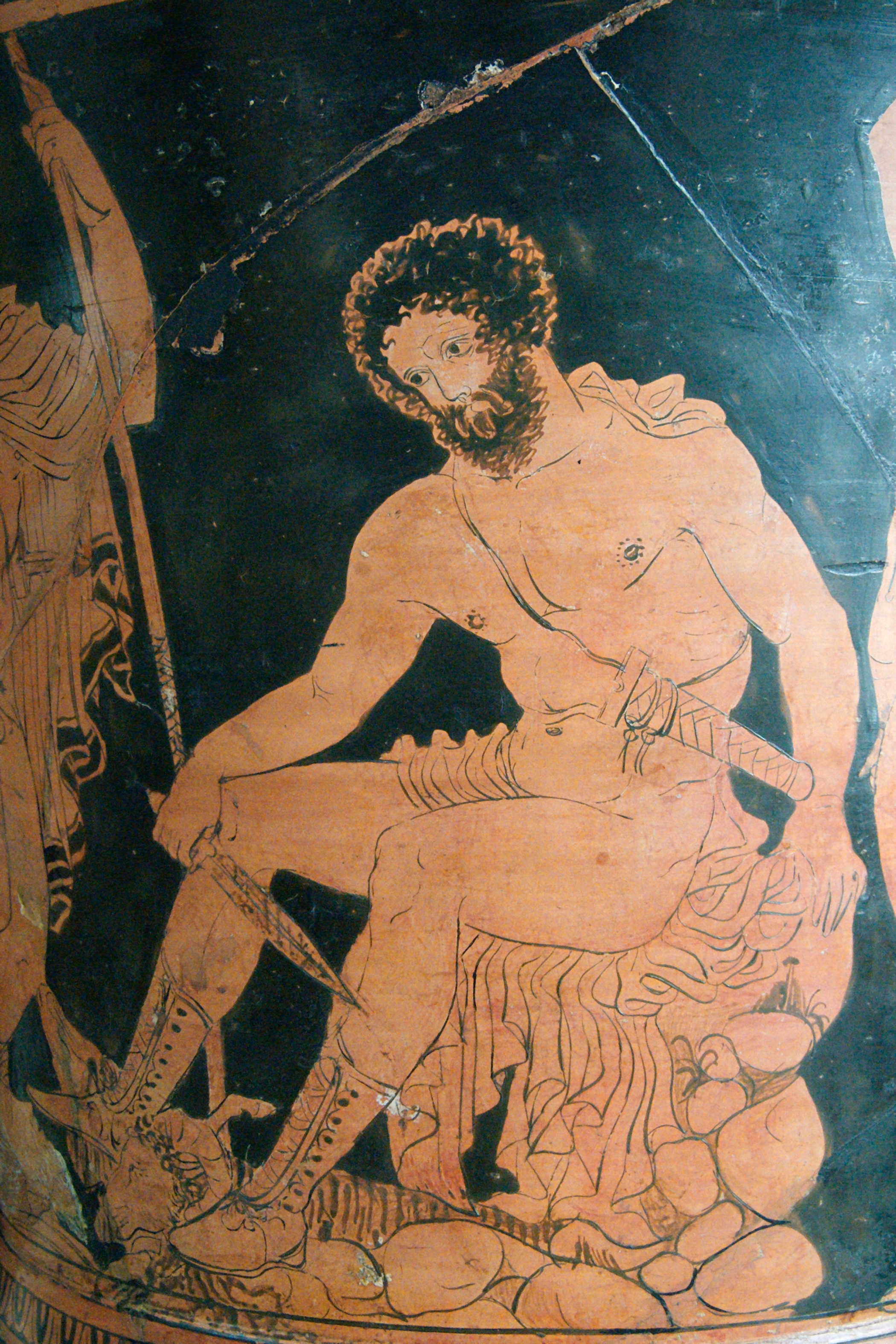
 Odysseus consulting the shade of Tiresias, ca. 390 BCE, on a Lucanian red-figure calyx-krater. Photograph by Marie-Lan Nguyen, CC BY 2.5, via Wikimedia Commons.
Ancient Greek necromancy is often imagined through a much later visual language: a magician in a circle, a book of conjurations, a skull, candles, secret names, and a spirit commanded to appear. That image owes far more to medieval and early modern ritual magic than to the Greek evidence. The Greeks certainly told stories about summoning the dead, consulting ghosts, compelling restless spirits, and visiting places believed to border the underworld. But their practices were embedded in funerary religion, divination, lament, sacrifice, heroic cult, local landscape, and specialist ritual knowledge rather than in a single standardized “necromancy system.”
The surviving evidence is unusually rich and unusually difficult. Homer’s Odyssey gives the most influential literary model: Odysseus digs a trench, pours offerings, sacrifices animals, lets their blood collect, and questions the dead seer Tiresias. Herodotus describes the Corinthian tyrant Periander sending messengers to an oracle of the dead on the Acheron to consult his deceased wife Melissa. Aeschylus dramatizes the ghost of the Persian king Darius rising after libations, lament, and invocation. Later authors speak of psychagōgoi, specialists who could “lead” or summon souls, and of famous necromantic locations at Acheron, Tainaron, Heracleia Pontica, and elsewhere.
Yet archaeology complicates every confident reconstruction. The famous building at Mesopotamos near the Acheron was excavated in the twentieth century and identified as the ancient Nekyomanteion, an oracle of the dead. Later archaeologists argued that the structure looked more like a fortified Hellenistic residence or agricultural complex and that catapult parts had been misread as ritual machinery. More recent work has reopened the debate again, defending at least some cultic interpretation. The result is a valuable lesson: ancient necromancy is real as a literary and religious category, but the material identification of a specific “necromancy temple” can remain contested.
To understand Greek necromancy historically, however, it is better to begin not with the later grimoire but with the ancient problem of the dead themselves. Who could return? Why would a ghost know the future? What offerings made the dead responsive? Why were rivers, caves, tombs, and remote promontories associated with access to Hades? And why did some specialists gain reputations for handling powers that ordinary people feared?
Necromancy Is a Modern Umbrella for Several Ancient Practices
The English word necromancy comes ultimately from Greek components meaning “dead” and “divination,” but modern usage has grown much broader. It can refer to spirit evocation, corpse magic, graveyard rites, communication with ghosts, or any magical practice involving the dead. Ancient Greek sources use several overlapping terms rather than one perfectly stable category.
A nekyomanteion or nekromanteion can mean an oracle of the dead or a place where the dead are consulted. A psychagōgos is literally a “leader of souls,” a specialist associated with drawing or guiding souls. Goēs and goēteia are terms later associated with sorcery, lament, and dealings with spirits. Nekuia can denote a ritual or literary scene involving the dead; Book 11 of the Odyssey became so famous that the word is often used for Odysseus’s consultation of the dead.
Sarah Iles Johnston’s influential study of the Greek dead emphasizes that these categories developed within a wider religious environment in which the living regularly honored, feared, appeased, and sometimes deliberately summoned the dead. The same society that poured offerings at graves and held festivals for ancestors could also imagine specialist practitioners who controlled unusually dangerous forms of contact.
That continuity is crucial. Necromancy did not emerge in a religious vacuum. It radicalized ordinary relationships between living and dead.
The Greek Dead Were Not Always Powerless Shadows
Homeric poetry often presents the dead as weak shades lacking the vitality of the living. But even Homer’s underworld is not completely uniform. Tiresias retains prophetic intelligence. Elpenor is deeply concerned about burial. Agamemnon, Achilles, and other heroes maintain memory, anger, and identity. Later Greek traditions increasingly imagine certain dead as capable of affecting the living.
Johnston describes several categories of especially dangerous ghosts. Those who died violently, prematurely, without proper burial, outside normal family structures, or before completing expected life transitions could be imagined as restless. Their deaths had not been socially resolved. Because their transition was incomplete, they were more likely to remain close to the world of the living.
This does not mean every prematurely dead person was believed to become a demon. Greek beliefs varied by period, region, and genre. But the pattern matters because it explains why magical practitioners would seek the dead at tombs or use the names of the untimely dead in curse rituals. The dead could become powerful precisely because they were not fully at rest.
SecretMagic’s article on ancient curse tablets examines one related tradition: inscribed lead tablets could be placed in graves and other chthonic locations so that the dead or underworld powers would carry out the requested binding. Necromancy and curse tablets are not identical, but both depend on a religious geography in which the dead remain available as dangerous intermediaries.
The Odyssey’s Nekuia: The Most Famous Ancient Necromantic Scene
Book 11 of Homer’s Odyssey became the foundational literary image of Greek contact with the dead. Odysseus is instructed by Circe to travel to the boundary of Ocean and perform a rite so that he can question Tiresias, the dead prophet whose knowledge is necessary for the voyage home.
The ritual is concrete. Odysseus digs a trench. He pours libations for the dead, including honeyed milk, wine, water, and barley. He promises further sacrifices after returning home. He kills sheep so that their blood flows into the trench. The dead gather toward the blood, but Odysseus uses his sword to keep them away until Tiresias arrives.
Perseus Digital Library’s text of the scene makes the logic explicit. Tiresias explains that whichever dead soul is permitted to approach the blood will speak truthfully, while those refused access will withdraw. Blood restores enough vitality for communication.
This is not resurrection. The dead do not permanently return to embodied life. Nor does Odysseus command a demon by a secret divine name. He temporarily creates conditions under which shades can speak.
The rite therefore combines sacrifice, boundary control, prophecy, and hospitality to the dead.
Why Blood Gives the Dead a Voice
The blood in the Odyssey is one of the most discussed features of ancient necromancy because it dramatizes the difference between living bodies and dead shades.
Blood is life. The shades lack embodied vitality. By drinking sacrificial blood, they temporarily regain recognition and speech. Odysseus’s own mother does not recognize him until she drinks.
The symbolism is powerful, but we should not assume that every historical necromantic rite used animal blood. Literary ritual can exaggerate or stylize practice. Later evidence shows libations, songs, prayers, offerings, and grave rituals that do not always reproduce Homer exactly.
What Homer establishes is a model: the dead require ritual mediation before communication becomes possible.
Odysseus Controls Access with a Sword
Another often overlooked feature is Odysseus’s use of the sword. The dead crowd toward the blood, but he prevents them from drinking until the desired prophet appears.
This is a technology of selection. Necromancy is dangerous not because one ghost is difficult to contact, but because opening a channel may attract many dead.
The sword creates a boundary. Odysseus stands between the offering and the shades, controlling access. He is both sacrificer and gatekeeper.
This detail anticipates a recurring problem in later ritual magic: how does a practitioner contact one entity without inviting every other being associated with the same realm? Later grimoires solve the problem with names, circles, seals, and hierarchical commands. Homer solves it with a sword and control of sacrificial blood.
Tiresias Knows What the Living Cannot
Why consult the dead at all? The answer is not that all dead people know everything.
Odysseus specifically needs Tiresias because Tiresias was a seer in life and retains exceptional knowledge after death. The scene implies that death changes access to information but does not automatically make every shade omniscient.
This distinction survives in later necromantic stories. Dead rulers, prophets, spouses, and heroes are consulted because they possess particular knowledge, authority, or personal connection.
The function is closer to specialized divination than indiscriminate ghost conversation.
Odyssey 11 Is Not a Field Manual
Modern occult reconstructions sometimes treat Homer’s scene as if it were a preserved ritual handbook. This is methodologically risky.
The Odyssey is epic poetry. The ritual serves narrative goals. It allows Odysseus to receive prophecy, encounter his mother, hear stories of the Trojan dead, and expand the poem’s geography into Hades.
Yet literary form does not make the ritual historically useless. Epic poets drew on recognizable religious practices: sacrifice, libation, burial, lament, chthonic deities, and prophecy. Later Greeks themselves used Homer as a religious reference point.
The correct approach is therefore neither “this is exactly what necromancers did” nor “this is pure fiction.” It is a culturally authoritative ritual imagination that later practice could imitate, reinterpret, or cite.
Aeschylus and the Ghost of Darius
In Aeschylus’s Persians, first performed in 472 BCE, the dead king Darius is summoned before the audience.
The queen brings libations including milk, honey, water, wine, olive fruit, and flowers. The chorus sings invocations to the powers below. Earth, Hermes, and the ruler of the dead are asked to send Darius upward. The ghost then appears and accepts the offerings.
The scene resembles necromancy but occurs within tragedy. It also differs from Homer. No blood trench is required. The dead king is summoned from his tomb through libation, lament, song, and chthonic prayer.
Perseus preserves Darius’s opening statement that the path out of the tomb is difficult because underworld powers are more willing to seize the dead than to release them. His appearance is temporary and regulated.
The scene demonstrates that fifth-century Athenian audiences could recognize a dramatic grammar of ghost evocation.
Was Darius a Ghost or a Heroic Power?
Scholars have noted that Darius is presented not merely as a weak shade but almost as a chthonic hero protecting the Persian land. His tomb anchors his presence. Libations please him. He possesses knowledge the living need.
This overlaps with Greek hero cult, where extraordinary dead people received sacrifices or offerings at tombs and could influence communities.
The boundary between “necromancy” and “hero cult” is therefore not absolute. Calling a dead king back to speak is extraordinary, but the underlying religious logic—that the powerful dead remain capable of action—was familiar.
Necromancy can be understood as an intensified form of a broader funerary relationship.
Herodotus and the Oracle of Melissa
Herodotus gives one of the most important non-mythic literary testimonies. He tells how Periander, tyrant of Corinth, sent messengers to an oracle of the dead on the Acheron in Thesprotia because he wanted to locate a deposit left by a friend.
The ghost of Periander’s wife Melissa appeared but initially refused to reveal the information. She complained that she was cold and naked because the clothes buried with her had not been burned and therefore were useless to her.
Periander then arranged a grotesque and tyrannical act: the women of Corinth were stripped of their fine clothes, which were burned in a pit as an offering to Melissa. After this, the ghost provided the information.
Herodotus’s story is politically charged. It illustrates tyranny and Periander’s cruelty. Yet the necromantic institution appears as an intelligible element of the narrative. Messengers can travel to an oracle of the dead. A named ghost can be consulted. The ghost can demand ritual compensation before giving information.
What Melissa’s Story Reveals About Offerings to the Dead
The story makes sense only if offerings burned for the dead are imagined to become useful in the underworld.
This idea has parallels in Greek funerary ritual. Objects, food, drink, and gifts accompany the deceased. Burning transforms offerings through fire and smoke, transferring them into another domain.
Melissa’s complaint is therefore religiously legible: improperly transferred goods do not reach the dead.
The ghost also behaves like a negotiating person rather than a passive information source. She refuses cooperation until a grievance is corrected.
This resembles many ancient religious relationships. The dead, gods, and heroes are not machines. They can demand reciprocity.
The Acheron as a Landscape of the Underworld
 The archaeological site at Mesopotamos near the Acheron, traditionally identified as the Nekromanteion of Ephyra. Photograph by Michael Nicht, CC BY-SA 4.0, via Wikimedia Commons.
Why Acheron?
In Greek myth, Acheron is one of the rivers associated with Hades. The real river in Epirus moves through a dramatic landscape of gorges, marshes, underground waters, springs, and dark terrain. Ancient geography and myth reinforce one another.
Places that looked like thresholds could become thresholds.
Caves, fissures, deep lakes, volcanic areas, remote capes, and subterranean waterways often acquired chthonic associations across the Mediterranean. Acheron’s environment offered a natural setting for stories about access to the dead.
Herodotus’s testimony shows that an oracle of the dead on the Acheron was known in the Classical period, even if the precise archaeological location remains debated.
The Famous “Nekromanteion” at Mesopotamos
In the twentieth century, archaeologist Sotirios Dakaris excavated a Hellenistic complex near Mesopotamos and identified it as the Nekyomanteion of the Acheron.
The site contains massive polygonal masonry, corridors, rooms, storage areas, and a subterranean vaulted chamber. Dakaris interpreted the architecture as a controlled ritual environment through which consultants gradually approached a central place of ghost revelation.
The identification became famous. Guidebooks described pilgrims undergoing purification, special diets, darkness, and theatrical spirit appearances. The building became one of the most visually compelling “temples of necromancy” in the modern imagination.
But archaeology did not stay settled.
The Fortified Farmhouse Challenge
In the late twentieth century, Dietwulf Baatz and other scholars challenged Dakaris’s interpretation. The building’s architecture could be compared with fortified Hellenistic residences. Iron mechanical parts interpreted in a ritual framework looked like pieces of catapults. Large storage jars and agricultural materials fit a domestic or military complex.
More recent research on Hellenistic rural architecture has gone further. A 2024 Sapienza University research program describes the Mesopotamos complex as an example long misidentified as the famous necromantic sanctuary and instead relates it to fortified countryside architecture.
Yet the case is not closed. Diego Chapinal-Heras’s 2023 review of the debate examines both sides rather than treating the old interpretation as simply dead. Other Greek scholars have defended the cultic identification on architectural, geological, and acoustic grounds.
The responsible conclusion is that the archaeological site is real, impressive, and culturally associated with the ancient Acheron tradition, but its exact function remains debated.
Why the Archaeological Debate Matters
The debate is more than a technical disagreement.
It demonstrates how easily literary expectations influence excavation. Archaeologists know from Herodotus and other sources that a necromantic oracle existed in the region. When they encounter an unusual Hellenistic building near Acheron, the temptation to identify it with the literary sanctuary is strong.
Later researchers then re-examine architecture without the same expectation and see storage, defense, and residence.
The process does not mean early archaeologists were foolish. Interpretation is always shaped by available comparisons. New evidence changes models.
For esoteric history, this is a valuable discipline: never use a famous archaeological label as proof if the label itself is disputed.
The Underground Chamber
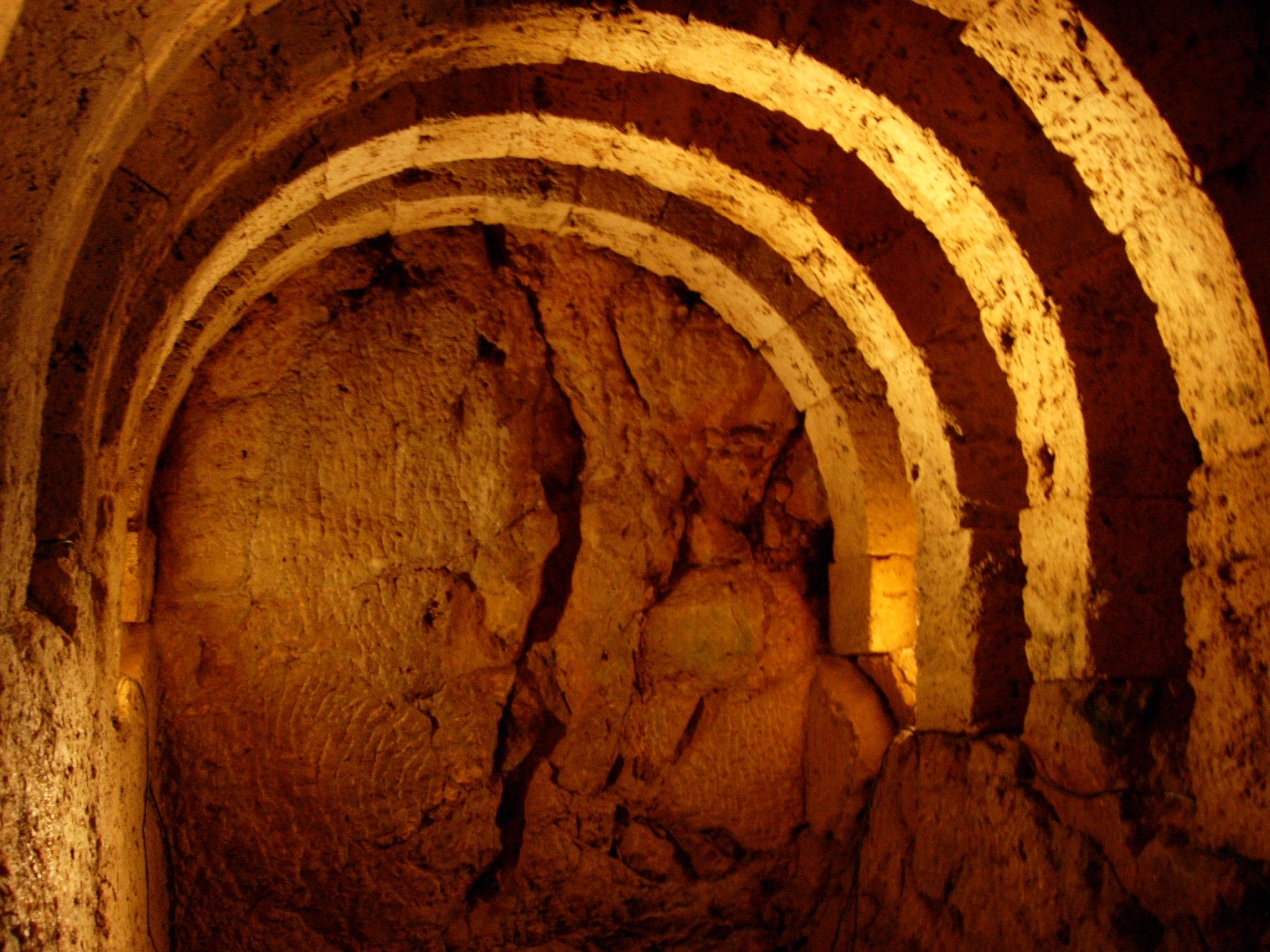 Vaulted underground chamber at the Mesopotamos site traditionally identified as the Nekromanteion. Photograph by Samuli Lintula, CC BY 2.5, via Wikimedia Commons.
The subterranean chamber at Mesopotamos is the strongest visual reason the necromancy interpretation remains attractive. It feels like an underworld space.
Stone arches create an enclosed chamber below the main structure. Modern visitors naturally associate darkness, echo, and descent with Hades.
But atmosphere is not archaeological proof. Basements serve practical functions too.
Recent defenders of the sanctuary interpretation have emphasized unusual acoustic properties and the symbolic force of the architecture. Critics argue that these features can be explained without necromancy.
The chamber therefore stands as a perfect example of how modern experience can reinforce ancient mythic expectation.
Other Oracles of the Dead
Ancient authors mention several other places associated with necromantic consultation.
Tainaron, at the southern end of the Peloponnese, was famous as an entrance to Hades. Heracles was said to have brought Cerberus up through a cave there. Later literary traditions associate the site with necromantic consultation.
Heracleia Pontica on the Black Sea also had a strong underworld mythology and traditions of an oracle of the dead. Other locations appear in scattered texts.
Daniel Ogden’s Greek and Roman Necromancy gathers the literary evidence for these institutions and emphasizes that necromancy could be localized around places understood as natural access points to the underworld.
The geography is religious. A place becomes suitable because myth, landscape, local cult, and memory converge.
Psychagōgoi: Specialists Who Led Souls
The term psychagōgos literally means “soul-leader.” Johnston discusses psychagōgoi as specialists connected with summoning or controlling ghosts.
The name suggests a role broader than merely “fortune teller.” A psychagōgos knows how to direct the dead: call them, move them, quiet them, or restore proper boundaries.
This is important because ancient Greek concern with ghosts was not limited to obtaining prophecy. A restless ghost could require removal or appeasement. A polluted household might need ritual cleansing. A dead person who had not received proper burial might require corrective rites.
The specialist’s expertise therefore includes both invitation and dismissal.
Goēs, Lament, and the Origins of Sorcery
Johnston’s study links the goēs with lament and the dead. The word later develops strong negative associations with sorcery and deception, but its ritual background may involve specialized mourning and spirit control.
This connection between lament and necromancy makes cultural sense. The lamenter addresses the dead. Funeral song creates a structured channel between bereaved community and deceased person. A specialist who knows how to manipulate such communication can move from mourning into controlled ghost contact.
Magic, in this model, grows partly from funerary expertise.
That is very different from the later image of the magician as a scholar working from a secret book.
Song Calls the Dead
Aeschylus dramatizes ghost summoning through choral song. The Odyssey foregrounds sacrifice. Other traditions emphasize lament, names, libations, and tomb ritual.
Voice is central because the dead must be addressed.
The idea that song itself has power is widespread in Greek culture. Poetry remembers the dead. Lament calls them emotionally into social presence. Magical incantation uses rhythm and repetition. Orpheus becomes the archetypal singer who crosses the underworld boundary.
The overlap between necromancy and Orphic tradition is therefore not accidental. SecretMagic’s article on the Orphic gold tablets shows another side of the same religious world: ritual poetry accompanies the dead and provides words for navigating Hades.
Ghosts Needed Proper Burial
One of the oldest themes in Greek literature is the danger of remaining unburied.
Elpenor in the Odyssey asks Odysseus to return and bury him properly. In tragedy, unburied corpses generate religious crisis. Burial gives the dead social location.
A person without proper rites remains between categories—no longer alive, not fully incorporated among the dead.
Necromancy operates near this unstable boundary. The same ghost who is dangerous because burial is incomplete may also be more accessible to ritual specialists.
This helps explain why graves, battlefields, execution sites, and violent deaths recur in later magical traditions involving spirits.
Restless Dead and Curse Magic
Greek curse tablets frequently exploit the dead as intermediaries. Tablets deposited in graves sometimes address the deceased directly or place the curse in proximity to chthonic powers.
Those who died prematurely or violently were especially attractive because they were imagined as active and unsettled.
This is not identical to asking a ghost for prophecy. But both practices treat dead persons as potential agents.
The social logic differs. Necromancy asks for knowledge. Curse magic asks for action. Yet the ritual ecology overlaps.
Hecate and the Expanding World of Ghosts
Hecate becomes increasingly important in Greek and Roman traditions involving ghosts, crossroads, liminality, night, and magical practice.
Johnston argues that Hecate’s role as mistress of ghosts developed from earlier functions involving boundaries and transitions, especially dangerous transitions around girls and women.
By late antiquity, Hecate can appear prominently in magical texts and theurgical cosmology. SecretMagic’s article on the Chaldean Oracles explores one much later transformation, where Hekate becomes a cosmic mediating power in Neoplatonic theurgy.
This long history should not be collapsed. Classical ghost ritual and late antique theurgy belong to different contexts. The continuity lies in Hecate’s capacity to inhabit thresholds.
Hermes as Guide of the Dead
Hermes also appears naturally in necromantic contexts because one of his roles is Psychopompos, conductor of souls.
In Aeschylus, Hermes is invoked with Earth and underworld powers when Darius is summoned. The god who leads dead souls downward can also mediate controlled movement in the opposite direction.
Hermes’s ambiguity suits the role. He crosses boundaries, carries messages, guides travelers, protects exchange, and moves between divine and human worlds.
Necromancy requires exactly this kind of boundary specialist.
Does a Ghost Know the Future Because It Is Dead?
Ancient sources do not provide one philosophical answer.
Some dead are consulted because they were seers in life, as with Tiresias. Others seem to gain postmortem access to hidden knowledge. Dead rulers may understand political fate. A murdered person may know the identity of a killer.
The underlying logic is spatial as much as intellectual. The dead inhabit a realm closer to underworld gods and cosmic knowledge unavailable to the living.
Death changes perspective.
This belief appears in many cultures, but its Greek forms are rooted in Greek ideas of Hades, fate, divination, and chthonic powers.
Was Necromancy Illegal?
There was no single Greek law code covering all cities and periods, so the question cannot be answered with a universal yes or no.
Necromancy could be regarded with suspicion because it involved dangerous powers, pollution, private ritual, or specialists outside civic cult. But Herodotus can mention an oracle of the dead without treating the institution itself as criminal.
Greek religion tolerated enormous diversity. Civic temples, household cult, hero worship, mystery initiation, private divination, itinerant specialists, curse tablets, and healing sanctuaries existed side by side.
Social judgment depended on purpose, status, place, and context.
Necromancy and Civic Religion
The modern phrase “black magic” creates a false expectation that consulting the dead necessarily belonged outside religion.
An oracle of the dead could function like other divinatory institutions: clients traveled, made offerings, consulted specialists, and received answers.
At the same time, necromancy involved beings and places more dangerous than ordinary Olympian sacrifice. Its chthonic character set it apart.
It therefore occupied an ambiguous position: religious enough to have recognized traditions, unsettling enough to attract stories of secrecy and pollution.
The Difference Between Katabasis and Necromancy
A katabasis is a descent into the underworld. Heracles, Orpheus, Theseus, and later literary heroes descend physically or mythically.
Necromancy does not necessarily require descent. Odysseus performs a rite at the edge of the world and brings the dead toward him. Aeschylus’s Darius rises from the tomb. Herodotus’s messengers visit an oracle where a ghost is consulted.
The distinction matters because later storytellers often merge the two. A cave entrance to Hades can become a necromantic shrine precisely because underworld geography and ghost consultation overlap.
But “going to Hades” and “calling a dead person” are not the same ritual act.
The Difference Between Ghost Consultation and Possession
Ancient Greek necromantic sources usually imagine the dead as external beings appearing, speaking, or being questioned.
This differs from traditions where a spirit speaks through the body of a living medium.
There are ancient Mediterranean examples of inspired or possessed speech, but the classic necromantic scenes emphasize apparition rather than mediumship.
This distinction is useful when comparing Greek necromancy with later Spiritualism or with possession-centered traditions such as Korean gut.
Did Ancient Necromancers Use Circles?
The evidence for the famous ceremonial magic circle belongs mainly to later ritual traditions.
Greek magical papyri contain drawn figures, protective spaces, ritual boundaries, and complex procedures, but the iconic medieval necromancer standing inside a written circle while commanding a spirit should not be projected backward onto Homeric or Classical necromancy.
Odysseus uses a trench and a sword. Tomb rituals use graves and libation channels. Place itself creates the boundary.
This difference shows how magical technologies change across time.
From Greek Necromancy to the Greek Magical Papyri
By the Roman imperial period, texts now collected as the Greek Magical Papyri preserve ritual procedures involving divine revelation, dream sending, spirit contact, skulls, tombs, and underworld powers.
These papyri belong to Egypt and reflect Greek, Egyptian, Jewish, and other religious influences. They are not simple descendants of Homeric necromancy.
Yet the old themes survive: the dead know hidden things; chthonic places are powerful; blood and offerings matter; ritual specialists manage dangerous contact; names and speech control access.
The historical line is continuity through transformation, not one unchanged tradition.
Roman Necromancy Became More Theatrical in Literature
Roman poets developed spectacular necromantic scenes. Lucan’s Pharsalia gives the witch Erictho a gruesome ritual involving a corpse. Horace, Virgil, and later authors use necromancy for literary horror, prophecy, and moral transgression.
These scenes influenced later European imagination enormously.
But they should not be used uncritically to reconstruct Classical Greek practice. Roman literary necromancy is already a reception of older traditions, shaped by new genres and anxieties.
The further we move from Homer and Herodotus, the more layers accumulate.
Why Caves and Water Matter
Ancient necromantic places are repeatedly associated with caves, springs, rivers, lakes, and deep fissures.
Water crosses boundaries. Rivers can separate worlds. Caves descend into earth. Darkness obscures ordinary vision. Echo changes sound. Remote landscapes remove the client from civic normality.
These physical properties create religious plausibility.
A cave does not prove necromancy, but a culture that imagines Hades beneath the earth will naturally locate underworld access in downward landscapes.
Why Darkness Can Produce Religious Experience
Modern discussions of the Mesopotamos site sometimes emphasize sensory manipulation: darkness, restricted movement, diet, echo, or expectation could have altered visitors’ perceptions.
Even if the building was not a necromantic sanctuary, the broader point is reasonable. Ritual environments shape experience.
Darkness heightens sound. Repetition intensifies expectation. Fasting changes the body. Underground spaces reduce orientation. A client who believes a ghost may appear enters the ritual already psychologically prepared.
Historical analysis can acknowledge these effects without reducing religion to hallucination.
Ritual experience is both cultural and bodily.
The Dead as Witnesses
Ghosts are valuable not only because they know the future. They can testify about the past.
Melissa knows the location of a missing deposit. Murdered or wronged dead may know what happened to them. Ancestors can validate claims.
This makes necromancy a form of information retrieval in a world without forensic institutions capable of solving every hidden problem.
The dead become witnesses beyond ordinary human access.
Why Necromancy Is Morally Ambiguous
To consult a dead prophet for guidance may seem religiously respectable. To compel a recently murdered person to harm an enemy seems darker. Ancient traditions contain both.
The moral category therefore depends on purpose and relationship.
Was the dead person honored or exploited? Was the consultation socially authorized? Was the goal justice, prophecy, private gain, or harm?
Ancient Greek sources rarely give us one universal theological answer.
Necromancy and Grief
Behind the magical history lies a simple human desire: the dead are gone, and the living want them to speak again.
Greek funerary lament already creates a one-sided conversation. The mourner addresses the dead as if they can hear. Necromancy changes the structure by imagining an answer.
This explains some of its emotional force.
Periander wants practical information, but he must confront Melissa’s grievance. Odysseus seeks Tiresias but encounters his mother. Darius is called for political guidance, yet his return is saturated with collective mourning.
Necromancy turns grief into dialogue.
The Professionalization of Ghost Contact
As beliefs about restless dead developed, specialists could offer expertise.
Johnston argues that the goēs emerged as someone skilled in controlling souls, with connections to lament and mystery initiation.
Professionalization makes sense socially. Most people do not want dangerous ghost contact to be ordinary. Specialists create distance.
The same pattern appears in many ritual traditions. When a practice is risky, polluting, technically demanding, or frightening, communities delegate it.
Orpheus as Necromantic Model
Orpheus belongs naturally near the history of necromancy because he is the mythical singer who entered Hades and returned.
He differs from Odysseus. Odysseus seeks information. Orpheus seeks a person.
Yet both myths create a privileged human figure capable of negotiating with the underworld.
Later Orphic ritual specialists could claim authority from someone who had crossed the boundary personally.
Necromancy and Mystery Initiation
Johnston draws attention to overlap between the goēs and ritual specialists involved in eschatological mysteries.
This connection is logical. If a specialist claims to know what happens after death, that knowledge can be used in two directions: preparing the living for death and controlling contact with those already dead.
The gold tablets show the first direction. Necromancy shows the second.
Both turn underworld knowledge into ritual expertise.
Five Modern Myths About Greek Necromancy
“Ancient Greek necromancers used medieval grimoires.”
No. The surviving Classical evidence centers sacrifice, libation, tombs, ritual song, specialists, and chthonic locations. The book-centered ceremonial magic model is much later.
“The Mesopotamos building is unquestionably the Nekromanteion.”
No. The identification is famous but debated. Some archaeologists favor a fortified residence or farmstead interpretation, while others continue to defend a cultic function.
“All ghosts knew the future.”
No. Tiresias is consulted because he is a prophet. Other dead provide personal or local knowledge.
“Necromancy was completely outside Greek religion.”
No. It overlaps with burial, hero cult, divination, chthonic worship, and recognized oracular traditions, even if it remained unusual and potentially suspect.
“Every literary necromancy scene records a real historical ritual exactly.”
No. Epic and tragedy are literary genres. They preserve culturally meaningful ritual patterns, not stenographic field reports.
What We Can Say with Confidence
- Ancient Greeks believed communication with the dead was possible under exceptional ritual conditions.
- Homeric poetry preserves an influential model involving offerings, animal sacrifice, blood, and selective questioning of shades.
- Classical authors knew traditions of specialized places called oracles of the dead.
- Herodotus explicitly locates one such oracle on the Acheron in Thesprotia.
- Specialists called psychagōgoi and goētes were associated with manipulating or communicating with souls.
- Ghost summoning overlapped with funerary ritual, lament, hero cult, divination, and magical practice.
- The identification of the archaeological complex at Mesopotamos as the historical Acheron Nekromanteion remains disputed.
- Later Greek and Roman magical traditions developed necromantic techniques far beyond the earlier literary models.
Why the Archaeological Uncertainty Is a Strength, Not a Weakness
Esoteric history is often marketed through certainty. “This is the exact temple.” “This is the precise ritual.” “This chamber was designed to make ghosts appear.” Such claims are attractive because mystery becomes concrete.
But uncertainty can teach more.
The Acheron debate reveals how myths shape archaeology, how archaeology corrects literary imagination, and how later scholars revise earlier reconstructions.
The ancient oracle described by Herodotus does not cease to exist historically merely because one building is disputed. The literary evidence remains. The regional underworld traditions remain. The landscape remains.
Separating those forms of evidence makes the history stronger.
Necromancy as a Technology of Boundary
The deepest pattern in Greek necromancy is boundary control.
Life and death are separated, but not absolutely. A trench opens a temporary channel. Blood permits speech. A tomb anchors a ghost. A song calls upward. A river or cave marks a landscape threshold. A psychagōgos controls access. A sword keeps unwanted shades away.
The ritual succeeds by opening the boundary without destroying it.
This distinguishes necromancy from resurrection. The dead return temporarily and conditionally.
Necromancy as Divination
The second major pattern is information.
Odysseus wants knowledge of his journey. Periander wants the location of a deposit. The Persians want explanation of catastrophe. Later clients seek answers about murder, fate, and hidden causes.
The dead are valuable because they stand outside ordinary human knowledge.
In this sense, necromancy belongs beside other forms of Greek divination. SecretMagic’s article on the Oracle of Delphi examines a very different institution, where Apollo speaks through the Pythia. Both systems address uncertainty, but they authorize answers differently. Delphi appeals to an Olympian god through civic sanctuary. Necromancy appeals to chthonic beings and the dead through liminal ritual.
Necromancy as Social Repair
The third pattern is unresolved relationship.
Melissa will not cooperate until her grievance is addressed. Unburied dead require burial. Violent ghosts demand attention. Ancestors can become dangerous if neglected.
Communication with the dead therefore does more than extract information. It can repair obligations.
That makes necromancy a social practice as much as an occult one.
The Ancient Greek Necromancer Before the Grimoire
If we strip away medieval imagery, what remains?
Not one uniform practitioner.
We see a spectrum: household mourners pouring libations, civic communities honoring heroes, itinerant goētes claiming special control over spirits, psychagōgoi dealing with ghosts, clients traveling to underworld-associated oracles, poets dramatizing spectral return, and later ritual specialists building increasingly elaborate magical technologies.
The “necromancer” is therefore a modern synthesis of several ancient roles.
Conclusion: Consulting the Dead in a World Where Hades Was Near
Ancient Greek necromancy was not the art of a solitary wizard reading from a black book. It grew from a religious world in which death remained socially active.
The dead needed burial. They accepted offerings. They could be angry, grateful, dangerous, prophetic, or protective. Heroes remained powerful at their tombs. Restless ghosts threatened the living. Underworld gods controlled boundaries. Rivers and caves could become entrances to Hades. Specialists learned how to manage relationships ordinary people preferred to keep stable.
The Odyssey gives the most memorable ritual image: a trench, libations, sacrificed animals, blood, a sword, and a dead prophet. Aeschylus shows another method: tomb, lament, song, and offerings that call a royal ghost upward. Herodotus shows necromancy functioning as practical divination at an oracle on the Acheron. Later traditions expand the repertoire further.
Archaeology refuses to give us a simple temple to contain all this evidence. The famous Mesopotamos complex may have been a sanctuary, a fortified residence, or a structure whose functions changed over time. The debate remains instructive because it prevents literary imagination from becoming architectural certainty.
What can be recovered with confidence is a ritual logic. Necromancy opened a temporary boundary. It created conditions for speech. It selected which dead could approach. It compensated, appeased, or questioned them. Then the boundary had to close again.
This is the form of ancient Greek necromancy before the later grimoire: not a standardized occult school, but a dangerous extension of funerary religion into divination.
Its most enduring idea is also its simplest. The dead are absent, but not necessarily unreachable.
Sources and References
- Homer, Odyssey, Book 11, Greek text and English translation, Perseus Digital Library: Perseus.
- Herodotus, Histories 5.92, Oracle of the Dead on the Acheron and Melissa: Perseus.
- Aeschylus, Persians, especially lines 609–699, Perseus Digital Library: Perseus.
- Sarah Iles Johnston, Restless Dead: Encounters between the Living and the Dead in Ancient Greece, University of California Press / Oxford Academic: Oxford Academic.
- Sarah Iles Johnston, “Magical Solutions to Deadly Problems: The Origin and Roles of the Goes,” in Restless Dead: Oxford Academic.
- Sarah Iles Johnston, “To Honor and Avert: Rituals Addressed to the Dead,” in Restless Dead: Oxford Academic.
- Daniel Ogden, Greek and Roman Necromancy, Princeton University Press, 2001.
- Diego Chapinal-Heras, “With the Dead amidst Darkness: The Nekyomanteion of the Acheron,” ARYS: Antigüedad, Religiones y Sociedades 21 (2023): ARYS.
- Marie-Pierre Donnadieu and Sylvie Vilatte, “Genèse de la nécromancie hellénique: de l’instant de la mort à la prédiction du futur,” Dialogues d’histoire ancienne 22.2 (1996): Persée.
- Julian Bogdani, “Living in the Town, Living in the Countryside: Typologies, Models and Transformations of Residential Architecture in Hellenistic and Roman Epirus,” Sapienza University of Rome, 2024: Sapienza.


