


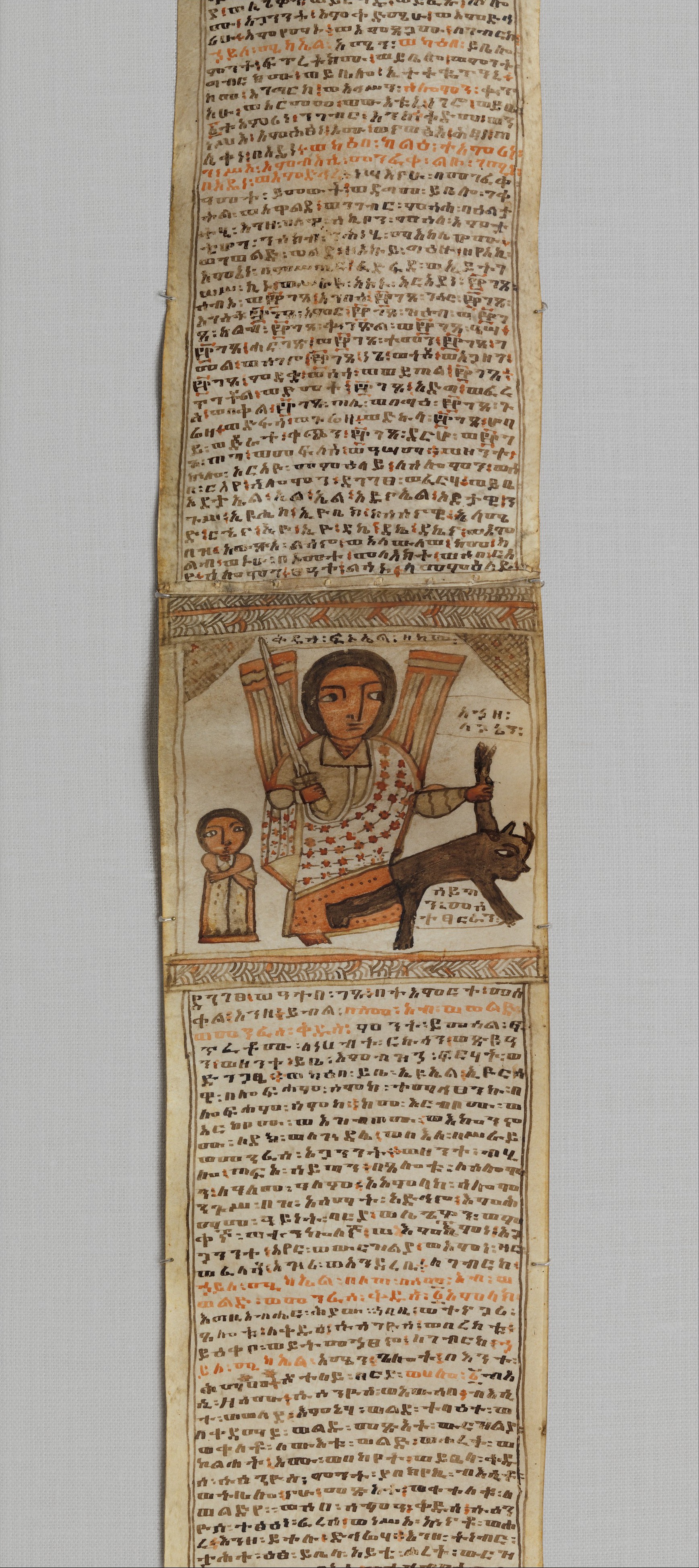
 Nineteenth-century Ethiopian healing scroll made by a Northern Highlands däbtära. The Metropolitan Museum of Art, Open Access, Public Domain.
Ethiopian healing scrolls are among the most visually arresting manuscripts in the history of Christian ritual. Long strips of parchment carry tightly written Geʿez prayers between radiant eyes, angelic faces, interlocking crosses, geometric seals, mounted saints, demons, and star-like diagrams. Some scrolls were made approximately as long as the person they were intended to protect. Others were hung in a house, carried in cases, or brought into a healing session. Many contain the name of an individual patron. Their words and images were not assembled as generalized decoration; they were made to intervene in a particular human life.
Outside Ethiopia, these objects are often introduced under the label “magic scrolls.” The term is convenient, but it can distort the tradition in two opposite ways. One version turns the scrolls into mysterious African grimoires detached from Christianity. Another treats them as embarrassing superstition attached to an otherwise orthodox religious culture. The evidence supports neither simplification. The surviving scrolls are deeply Christian in language and imagery while also belonging to healing, protective, astrological, exorcistic, and talismanic practices that do not fit comfortably inside modern Western boundaries between religion, medicine, and magic.
The specialists most closely associated with these scrolls are known as däbtära. A däbtära is a learned religious figure trained in liturgical language, chant, writing, and traditional knowledge, but not necessarily an ordained priest. Historical däbtäras could serve churches as singers or scribes while also working beyond formal liturgy as healers, astrologers, diviners, exorcists, teachers, and makers of protective texts. The scroll therefore emerges from a world in which scriptural literacy and practical ritual expertise overlap.
Modern collections preserve hundreds of these objects. Princeton University Library holds more than five hundred magic or protective scrolls among its Ethiopic manuscripts. The Wellcome Collection preserves important nineteenth-century examples, including material with a documented history connected to Maqdala. The Metropolitan Museum of Art has several major scrolls and has published one of the clearest museum introductions to their ritual use. These collections make it possible to study the tradition materially rather than through rumor.
This article examines Ethiopian healing scrolls as personalized technologies of protective Christianity. It asks who made them, why Geʿez mattered, how words and images worked together, what the famous eyes and eight-pointed designs may signify, why saints such as Susenyos appear in texts for women, how demons and illness were connected, why the scroll was measured to the client, and what happens when a living ritual object becomes a museum manuscript.
Why “Magic Scroll” Is a Useful but Incomplete Label
European catalogues have long used terms such as “magic scroll,” “magico-medical scroll,” “talismanic scroll,” “healing scroll,” and “protective scroll.” Each highlights a real feature. The problem begins when one label is treated as the complete native category.
The Met uses the Ethiopian terms tälsäm and yä bərana kətab for protective or healing scrolls. Museum and manuscript catalogues also contain variant spellings because Ethiopic words are transliterated into Latin letters in more than one way. Modern English writers may write däbtära, dabtara, or debtera. The scriptural language may appear as Geʿez, Gəʿəz, or Ethiopic. These differences are usually transliteration issues rather than evidence for different traditions.
Calling the scrolls “magic” makes sense if magic refers broadly to ritual action involving protective words, sacred names, talismanic images, astrology, exorcism, and extraordinary causation. But the label becomes misleading if it implies a non-Christian religion opposed to church life. Many scrolls invoke the Trinity, Christ, Mary, angels, apostles, saints, biblical narratives, and the sign of the cross. Their creators drew on Christian liturgical learning.
The more historically accurate question is therefore not “Are the scrolls really Christian or really magical?” It is “How did Ethiopian Christians organize healing and protection in a world where prayer, demonology, sacred names, manuscript writing, astrology, and medicine could belong to one practical system?”
Christian Ethiopia and the Long Life of Geʿez
Christianity became established in the Aksumite kingdom in late antiquity, traditionally associated with the fourth-century conversion of King Ezana. Over the following centuries, Ethiopia developed distinctive Christian institutions, monastic networks, biblical translations, liturgical traditions, saints’ literature, theological writings, and manuscript arts.
Geʿez was once a spoken language of the Aksumite world. It later ceased to function as an everyday vernacular while remaining the classical and liturgical language of Ethiopian and Eritrean Orthodox Christianity. This transformation is comparable, in a limited sense, to the continuing religious roles of Latin, Church Slavonic, Sanskrit, or Classical Arabic in communities where everyday speech has changed.
The sacred prestige of Geʿez is crucial to the scroll tradition. Many clients could not necessarily read every line written for them. The efficacy of a text did not depend only on ordinary silent reading. A prayer could be copied, recited, carried, displayed, or placed near the body. The written form itself participated in religious action.
This makes the scrolls part of the larger history of sacred writing explored elsewhere on SecretMagic. The Coptic magical papyri likewise show Christians using inherited ritual languages, saints, angels, divine names, drawings, and protective texts without obeying a modern boundary between religion and magic. The Ethiopian material is historically distinct, but comparison reveals a shared problem: writing can be prayer, image, medicine, and object at the same time.
Who Was the Däbtära?
The däbtära is one of the most important figures in the history of Ethiopian manuscript culture. Modern museum labels often call him an “unordained cleric,” but that phrase alone can understate the breadth of the role.
Däbtäras traditionally received training in ecclesiastical schools, where students learned reading, liturgical chant, sacred poetry, and the complex oral and written repertoires required for church service. Some became expert scribes. Others specialized in traditional healing, astrology, calendrical calculation, divination, exorcistic prayer, or protective writing. The exact balance varied by person and period.
This combination of skills challenges modern professional categories. A person could be at once singer, manuscript maker, teacher, ritual specialist, and healer. Religious literacy was practical expertise.
Princeton’s Ethiopic manuscript collection reflects this learned environment. Its more than five hundred protective scrolls are not anonymous evidence of a vague folk belief but the products of literate specialists working from reusable textual and visual repertoires. Patron names, prayers, saints, diagrams, and manuscript conventions reveal a craft with rules even where individual variation is considerable.
The däbtära should therefore not be imagined as a village sorcerer operating entirely outside Christianity. Nor should he be reduced to a formal church employee. His historical position could be liminal, respected for learning and feared for abilities that extended beyond public liturgy.
A Scroll Was Made for Someone
One of the defining features of Ethiopian healing scrolls is personalization. These were not generic books intended for a mass audience. They were commissioned for individuals.
The owner’s name may be inserted into prayers. The choice of texts and images could respond to a specific concern: illness, infertility, miscarriage, childbirth danger, demonic attack, the evil eye, nightmares, colic, headache, fear, possession, or a broader need for protection. Some manuscript catalogues record prayers against named classes of spirits or specific bodily complaints.
This personalization makes each scroll part of a biography. A museum object that now appears anonymous may once have been intimately connected to a client’s illness, fear, household, or pregnancy.
Princeton’s museum record for a healing scroll made for a woman named Asädä Maryam illustrates the point. The scroll combines Christian holy figures with prayers aimed at demons, diseases, and pains affecting a specific owner. The patron’s identity is not secondary metadata. It is part of the ritual logic.
The difference from a printed prayer book is substantial. A prayer book can serve many readers. A healing scroll is prepared as a tailored protective body of text.
The Scroll as a Second Body
Several museum and manuscript descriptions note that protective scrolls could be cut to approximately the height of the person for whom they were made. Wellcome MS Ethiopian 14, for example, is catalogued with the explanation that such a scroll was designed in relation to the owner’s bodily length so that protection could encompass the whole person.
This practice turns parchment into a kind of ritual double.
The scroll is not a portrait in the ordinary sense, but its dimensions establish correspondence with the client’s body. It can wrap, accompany, or stand in for the person. The patron’s name further individualizes it. The object becomes protection made bodily.
Similar ideas appear in many traditions of amuletic practice. An object worn on the neck touches the body; an inscribed metal leaf placed in a grave travels with the dead; a written charm placed over a wound localizes sacred language. The Ethiopian scroll intensifies this principle by extending protection from head to foot.
Again, this is why text is an insufficient category. The manuscript has a physical relationship with the person for whom it was made.
Parchment Was Not Neutral Material
Most surviving healing scrolls were written on parchment made from animal skin. The material connects the tradition with the wider Ethiopian manuscript culture in which sacred books were copied on parchment long after paper became common elsewhere.
Some accounts describe a ritualized relationship between the animal used for the skin and the person being treated. Museum descriptions emphasize that the preparation of the scroll itself could form part of the healing process. The Met’s nineteenth-century example, object 2011.377, was made from four pieces of parchment associated with a ritually sacrificed animal.
We should be cautious about assuming that one recorded procedure applied identically to every region and century. Yet the evidence is strong that material preparation mattered. The parchment was not simply whatever writing surface happened to be available.
This distinguishes healing scrolls from modern printed reproductions. A scan can preserve the visual design but not the ritual history of the animal skin, sewing, measurement, ink, patron name, handling, and activation.
Black Ink, Red Ink, and Visual Hierarchy
Ethiopic manuscripts traditionally use black and red ink in structured ways. Healing scrolls participate in this broader scribal convention.
Black ink carries much of the main text. Red can mark headings, sacred names, emphatic words, the patron’s name, or visual details. The exact usage varies, but color creates hierarchy.
Red is therefore not merely decorative. It guides the eye toward words or names requiring special attention. In a ritual context, visual emphasis can become theological emphasis.
The coexistence of text and painted imagery also means that reading is not purely linear. A viewer moves between written prayer, face, eye, cross, star, saint, demon, and geometric field.
The scroll is a visual environment.
Healing Scroll, nineteenth century, Amhara or Tigrinya peoples. The Metropolitan Museum of Art, Open Access, Public Domain.
Why Eyes Appear Everywhere
Eyes are among the most characteristic motifs in Ethiopian talismanic art. Some appear inside faces; others multiply within geometric designs. An eight-pointed figure may contain a human face or repeated ocular forms.
The Met emphasizes the ocular power of these images. Vision itself becomes protective. Malevolent forces are confronted by beings that see them.
This makes sense in a world where illness or spiritual danger may be hidden. The healer needs more than ordinary perception. An angel sees the invisible cause. A talisman looks back at the evil eye. A geometric face transforms vision into pattern.
Eyes can also be connected with divine light. A protective image does not have to depict a full narrative scene in order to act. A staring face may be sufficient to establish vigilant presence.
Western viewers sometimes describe the patterns as abstract. Within ritual practice, abstraction and figuration can overlap. A seal may simultaneously resemble a face, a star, a net, a cross, and a field of eyes.
There Is No Single Dictionary for Every Talismanic Shape
One of the most responsible statements in the Met’s scholarship is that there is no fixed interpretation for every talismanic design.
This is important because modern occult culture often wants symbol dictionaries: eight-pointed star equals X; circle equals Y; crossed lines always mean Z. Ethiopian scrolls resist that simplification.
A design can accumulate meanings through textual context, local interpretation, practitioner knowledge, visual resemblance, and the prayer placed beside it. The same basic geometry may be named or interpreted differently in different manuscripts.
The Met notes that an eight-pointed motif may be understood as the Sea of Solomon, the face of a person, or an eight-winged angel. Such variation does not mean the image is meaningless. It means meaning is relational rather than fixed.
Historians should therefore avoid pretending that every diagram has been decoded.
The Net or Sea of Solomon
Solomon occupies an enormous place in the history of Jewish, Christian, Islamic, and magical literature. Ancient and medieval traditions repeatedly transformed the biblical king renowned for wisdom into a master over demons, spirits, names, seals, and hidden knowledge.
Ethiopian protective scrolls participate in this wider Solomonic world. Geometric designs can be connected with the Sea or Net of Solomon, and prayers may invoke Solomonic authority against demons.
The relationship is not identical to European ceremonial texts such as the Key of Solomon. Ethiopian Christianity developed its own manuscript traditions, saints, demonologies, and protective prayers. Shared use of Solomon does not prove direct descent from a single lost grimoire.
Comparison with SecretMagic’s studies of Hekhalot and Merkabah literature and Arabic traditions such as Shams al-Maʿārif shows how widely sacred names, angels, seals, and Solomonic authority could circulate across different religious worlds. Similarity does not erase local history.
Saint Susenyos and Protective Christianity for Women
One of the most distinctive figures in Ethiopian protective literature is Saint Susenyos. Prayers connected with Susenyos often appear in scrolls made for women and are associated with protection from a female demon linked to pregnancy, childbirth, infants, or reproductive danger.
The narrative structure is familiar within Christian apotropaic tradition: a holy figure confronts a dangerous supernatural being, compels disclosure, defeats the threat, and transforms the story of victory into reusable protection for later readers.
The Met’s object 95.66 includes a prayer to Saint Susenyos and explicitly notes the saint’s use in scrolls intended for women.
This material must be read historically. Premodern pregnancy and childbirth carried substantial risk. Ritual protection responded to conditions where biomedical options were limited and maternal or infant death could be sudden. Demonological language gave fear a recognizable antagonist.
Calling such prayers superstition without acknowledging the realities of reproductive danger misses their emotional and social context.
Archangels as Fighters and Healers
Angels in Ethiopian scrolls are not delicate decorative beings. They often carry swords, confront demons, or stand in commanding poses.
The Met’s object 2011.377 contains a frontal archangel, probably Michael, wielding a sword. The museum explains the image through Ethiopian Christian beliefs about Michael’s power to force demons away from human hosts. Another major scroll, object 95.66, includes a central winged figure interpreted as the archangel Phanuel confronting or controlling a horned demonic being.
Such imagery makes theology visible. Healing is a conflict between ordered sacred power and hostile intrusion.
Weapons are therefore not evidence that the manuscript is dark magic. The sword belongs to protective angelology.
Demons and Disease
The scroll tradition often treats illness through a cosmology in which demons, hostile spirits, the evil eye, sorcery, or other invisible forces can cause bodily suffering.
Modern medicine describes disease through pathogens, genetics, physiology, psychology, environment, and other empirically investigated mechanisms. Historical Ethiopian healing could include herbal treatment, prayer, holy water, church ritual, exorcism, astrology, and protective manuscripts within a different explanatory system.
These systems should not be collapsed. A modern reader should not infer that a serious illness should be treated as demon possession. At the same time, historians should not erase the religious meanings through which past communities understood suffering.
Ritual healing often addresses questions that biomedical explanation alone does not answer: Why did this happen to me? Why now? Who or what is against me? How can my household feel safe again? The scroll provides an answer in the form of personalized sacred order.
Healing as Exorcistic Reordering
Some healing scrolls are best understood as exorcistic technologies. Prayer names and confronts a harmful force. An angel threatens it. A saint defeats it. A geometric net traps it. A sacred name overrides it.
The patient is thereby relocated within a hierarchy of power. The demon is not ultimate. God, Christ, angels, saints, and sacred names outrank it.
This hierarchy is psychologically and religiously important. Fear becomes manageable when it can be placed inside a cosmic chain of authority.
The scroll makes that chain visible on parchment.
Asmat: Sacred Names and the Problem of Translation
Ethiopian magical and protective literature often emphasizes asmat, sacred or secret names. Names of God, angels, and powerful beings can function as more than labels.
Across late antique and medieval religious traditions, sacred names were often treated as carriers of presence or authority. The exact sound or written form could matter. Translation might therefore be considered inadequate.
This principle has close parallels in other traditions without implying direct identity. Iamblichus defended the preservation of inherited divine names in theurgical ritual. Jewish amulets use divine and angelic names. Arabic occult manuscripts employ names, letter combinations, and numerical correspondences. The Daoist talismanic world likewise treats writing as authorization rather than ordinary prose.
In Ethiopian scrolls, sacred names operate inside a specifically Christian and Geʿez textual environment.
Astrology and Personalization
Museum records note that the contents of some scrolls were astrologically determined according to the patron’s zodiacal correspondences.
This should not surprise us. Ethiopian intellectual culture developed in conversation with broader Mediterranean, Near Eastern, and Christian traditions in which calendars, stars, saints’ days, auspicious timing, and astrological knowledge could overlap.
A däbtära might use calendrical or astrological reasoning when choosing material for a client. The scroll therefore becomes personalized not only by name and illness but by cosmic timing.
Again, there was no need for historical practitioners to separate religion and astrology into the modern categories often used today.
Text and Image Do Different Work
A scroll’s prayers and paintings are related, but they are not redundant.
Text can name a demon, invoke a saint, recount a biblical victory, command a harmful force, or identify the client. Image can confront the viewer, establish divine presence, embody vigilance, or create a geometric trap without explaining itself in sentences.
Some imagery is figurative: mounted saints, angels, demons. Other imagery is talismanic: intersecting lines, stars, faces within patterns, repeated eyes.
The Met distinguishes these visual modes while emphasizing that both contribute to healing. A manuscript can therefore be read with the eyes even by someone unable to parse every Geʿez sentence.
Image becomes a form of ritual speech.
 Ethiopian protective scroll from the Wellcome Collection. Wellcome image L0025427, CC BY 4.0 via Wikimedia Commons.
The Scroll Could Be Read, Worn, Hung, and Seen
Modern books are usually understood through reading. Healing scrolls could function through several modes at once.
A scroll might be carried in a case. It might hang in a house. It might be unrolled during treatment. A specialist could read prayers aloud. The owner could keep it close to the body. A long domestic scroll could face a doorway so that protective angelic images confronted threatening spirits attempting to enter.
The Met’s object 95.66 is nearly six and a half feet long and was interpreted as a household scroll intended to hang opposite a door. The physical scale changes the function. This is not a pocket amulet.
The manuscript therefore exists between architecture and body.
Doorways, Thresholds, and Domestic Protection
Doorways are symbolically powerful in many cultures because they are boundaries between inside and outside. A household may be safe while the world beyond contains danger.
Placing an angelic or talismanic scroll near a doorway turns architecture into religious defense. The scroll watches the threshold.
This does not require us to claim a universal anthropology of doors. The specific Ethiopian practice is documented directly by museum research. But the broader principle helps explain why protective images often cluster at boundaries.
Protection is strongest where categories meet: inside and outside, health and illness, human and spirit, sacred and dangerous.
Why the Evil Eye Fits a Manuscript of Eyes
The evil eye is a widespread belief complex found across the Mediterranean, Middle East, Northeast Africa, and many other regions. It concerns harmful influence communicated through envy, gaze, or socially dangerous attention.
Ethiopian protective literature includes prayers against forms of the evil eye. The prominence of eyes in talismanic imagery therefore creates a striking visual reversal: hostile sight is confronted by sacred sight.
We should avoid assuming that every painted eye is specifically an evil-eye symbol. Museum specialists explicitly caution against fixed dictionaries.
But within a wider protective context, the eye as vigilant divine power is clearly important.
Why Solomon Appears Beside Christian Saints
Modern religious categories can make the mixture look strange. Why would a Christian scroll invoke Solomon, angels, saints, demons, astrology, and geometric seals at the same time?
For historical practitioners, these were not necessarily contradictory authorities. Solomon belonged to the biblical world. Angels belonged to Christianity. Saints demonstrated divine victory. Astrology could describe cosmic order. Geometric seals could materialize sacred protection.
The tradition is therefore syncretic only if the word is used carefully. It is not a random collage. It is a coherent local system built from materials that Ethiopian Christians had inherited, translated, and reinterpreted over centuries.
The Scroll Is Not a Grimoire
Because the objects are magical and written, modern readers sometimes call them grimoires. The comparison is misleading.
A grimoire usually refers to a handbook containing multiple operations, instructions, conjurations, diagrams, or recipes for a practitioner. A healing scroll is typically customized for a client and intended to perform a protective or curative role in relation to that person.
Practitioner handbooks did exist in Ethiopian manuscript culture, and they deserve separate study. But the finished scroll given to a patron is closer to an amulet, prescription, liturgical object, and personalized sacred document than to a manual.
The distinction resembles the difference between a recipe book and the medicine prepared from one recipe.
Personalized Manuscripts and the History of Medicine
Wellcome catalogues describe these objects as magico-medical scrolls and place them within the history of ethnomedicine. This is useful because it directs attention toward healing practice rather than occult curiosity alone.
A patient’s world could include plant remedies, fasting, prayer, diagnosis, exorcism, holy water, church attendance, and protective writing. Different treatments addressed different dimensions of the problem.
The scroll may have been one intervention among several rather than an exclusive alternative to physical medicine.
Historical medicine was rarely divided cleanly into scientific and magical practices in the way modern readers expect. The categories themselves are products of later institutions.
Women’s Health in the Scroll Tradition
Many surviving prayers address concerns closely associated with women’s health: fertility, pregnancy, childbirth, miscarriage, infant survival, menstrual problems, and threatening female spirits.
This concentration has several possible explanations. Reproductive danger was substantial. Women may have commissioned protective manuscripts at high rates. Certain textual traditions, especially the Susenyos prayers, became strongly associated with reproductive protection. Collecting history may also shape what survives.
Whatever the exact statistical balance, the manuscripts preserve a valuable record of women as religious patrons.
A woman whose voice is absent from royal chronicles may still survive by name inside a protective scroll commissioned for her body.
Patron Names Turn Manuscripts into Microhistory
Every personal name in a healing scroll is a fragment of social history.
Libraries often catalogue a manuscript by shelfmark. The ritual itself was organized around a person.
Wellcome MS Ethiopian 14 preserves the name Yemam. Princeton’s records preserve names such as Asädä Maryam. The Met’s object 95.66 names Hayla-Mikáel in its scholarly interpretation.
These names remind us that the manuscripts were once part of ordinary fear and hope rather than anonymous African art.
Museums Preserve the Scroll but Change Its Function
When a healing scroll enters a museum, it becomes something new.
It is flattened behind glass, photographed, catalogued, conserved, digitized, and studied as art or manuscript. The patron may be dead. The ritual specialist is absent. The prayers are no longer recited as part of treatment. The object is separated from the body or doorway it once protected.
Museum preservation is enormously valuable. Without it, many manuscripts would disappear. Yet preservation also freezes an object whose original meaning depended on use.
The viewer should therefore distinguish between the scroll’s present museum life and its earlier ritual life.
Maqdala and the Colonial History of Collections
Some Ethiopian manuscripts in British collections have histories connected with the 1868 British expedition to Maqdala, the mountain stronghold of Emperor Tewodros II.
Wellcome MS Ethiopian 14 has a particularly explicit provenance note. The collection record states that it had been part of Tewodros II’s library at Maqdala and was taken during the British Expedition to Abyssinia in April 1868. It later entered the Wellcome collection through the art and manuscript market.
This history matters. A museum object is not only evidence for Ethiopian religion; it is also evidence for imperial violence, dispersal, collecting, and the movement of sacred property.
Modern research increasingly treats provenance as part of interpretation rather than an administrative footnote.
Why Digital Images Are Both Useful and Misleading
Digitization has revolutionized access. A reader anywhere can now inspect Ethiopian scrolls held in New York, London, Princeton, or other collections.
High-resolution images reveal brushwork, ink, sewing, faces, text blocks, and damage that older printed catalogues could not show clearly.
But screens alter scale. A six-foot scroll may appear the same size as a postcard. Parchment texture becomes pixels. The relation to a human body disappears.
A responsible digital viewer should always check dimensions.
The Scroll as a Technology of Proximity
Many ritual traditions place power in contact. An amulet works because it touches the wearer. A relic protects because the faithful approach it. A sacred inscription guards a doorway because it occupies the threshold.
Ethiopian scrolls intensify proximity. They are measured to the person, carry the person’s name, may be worn or hung near the body, and contain images whose eyes confront danger.
The scroll does not merely represent protection from a distance. It stays close.
Protective Writing Across Religious Traditions
Ethiopian healing scrolls become clearer when placed in comparative context without collapsing them into other systems.
Coptic Christians in Egypt wrote healing and exorcistic texts on papyrus, parchment, ostraca, and other media. Jewish communities produced amulets containing divine names, angels, biblical passages, and protective formulas. Islamic traditions developed Qurʾanic amulets, letter magic, magic squares, and invocations. Buddhist communities printed dhāraṇī texts for protection and merit. Daoist specialists created talismans as forms of celestial authorization.
These practices differ profoundly in theology and history. Their comparison reveals one recurring insight: writing can act.
Modern literacy often treats written words as containers of information. Ritual literacy can treat written words as presence, authority, protection, identity, and medicine.
Do the Scrolls Contain Secret Knowledge?
Some do contain specialized names, diagrams, prayers, and formulas inaccessible to ordinary readers. Däbtära training gave specialists forms of knowledge unavailable to most clients.
But secret should not automatically mean hidden conspiracy or forbidden doctrine.
Technical knowledge can be restricted because it requires education. Geʿez literacy itself creates an access barrier. Ritual expertise can be passed through teacher-student relationships. Certain prayers may be known widely even if their manuscript combinations are specialized.
The secrecy of the scroll tradition is therefore practical and social as much as sensational.
Can We Reconstruct Exactly How a Scroll Was Activated?
Not universally.
Ethnographic accounts, museum research, manuscript notes, and oral traditions preserve descriptions of reading, hanging, wearing, measuring, sacrifice, washing, fumigation, or other practices. But the surviving corpus spans regions and centuries.
One procedure should not be turned into a standardized initiation manual.
The strongest historical approach describes documented practices while leaving local variation visible.
Why the Scrolls Were Not Simply Folk Christianity
Folk religion can be useful for practices outside formal ecclesiastical structures, but it may also create an artificial hierarchy in which literate theology belongs to elites while ordinary people possess only superstition.
Healing scrolls complicate that hierarchy because they depend on learned Geʿez literacy, biblical material, saints’ literature, angelology, scribal practice, and specialist training.
They are simultaneously learned and popular, textual and oral, Christian and apotropaic.
The categories cross.
The Church and the Däbtära Were Not Always in Perfect Agreement
Däbtäras could occupy an ambiguous position in relation to ecclesiastical authority. Their liturgical learning connected them to the church, while some practices—especially divination, astrology, coercive ritual, or aggressive magic—could be criticized or treated as improper.
This ambiguity resembles many religious traditions where specialists operate near the edge of formal institutions.
Medieval European clerics copied condemned magical texts. Muslim scholars debated talismans and letter sciences. Jewish authorities distinguished accepted amulets from suspect practices. Christian Ethiopian communities likewise negotiated boundaries rather than applying one timeless rule.
It is therefore inaccurate to say either that the Church approved all magic scrolls or that the scrolls were completely outside Christianity.
Healing Scrolls and the Problem of Authenticity
Modern collectors value old scrolls as art objects, creating a market that can separate them from ritual context or encourage production for sale.
A scroll made for the market is not necessarily worthless as art, but it is historically different from one commissioned for a named patient.
Provenance, patron names, wear, folding, cases, textual content, and collection history help scholars distinguish ritual use from later production.
This is another reason museum catalogues matter. Good object records preserve more than images.
Why the Face Inside the Geometry Matters
One of the most unforgettable Ethiopian motifs is a frontal face embedded inside an eight-pointed or interlocking design.
The image refuses a modern distinction between portrait and diagram.
It is simultaneously someone and something: face, seal, eye-network, angelic presence, geometric defense.
That visual ambiguity may be part of its force. The supernatural is not represented naturalistically. It appears as an organized field of vision.
The Scroll Does Not Need to Be Decoded to Be Understood
Popular occult writing often approaches talismanic manuscripts as ciphers. If we can identify every symbol, secret name, and geometric line, the system will supposedly unlock.
Historical understanding works differently.
We can know that a scroll was protective, personalized, Christian, written in Geʿez, created by a däbtära, associated with specific prayers, and used near a body or doorway even when one talismanic design has no single agreed translation.
Uncertainty is not failure.
Five Modern Misreadings to Avoid
Ethiopian healing scrolls are non-Christian black magic.
No. Many are explicitly Christian, invoking the Trinity, Christ, Mary, angels, saints, biblical figures, and prayer. Their protective practices complicate modern religious categories but do not erase their Christian setting.
Every symbol has one secret meaning.
No. Museum scholarship explicitly cautions that talismanic designs can support multiple interpretations.
The däbtära is simply a priest.
No. The role is more complex. Däbtäras are learned religious specialists associated with chant, writing, teaching, healing, and other forms of expertise, but they are not equivalent to ordained priests.
A scroll was mainly meant to be read like a book.
No. Scrolls could be read aloud, worn, carried, hung, displayed, and physically related to the client’s body.
Museum scrolls are neutral survivals.
No. Some entered collections through colonial violence, market dispersal, or decontextualization. Their provenance is part of their history.
Why the Tradition Matters for the History of Magic
Ethiopian healing scrolls matter because they expose the limitations of a European-centered history of magic.
They show a Christian manuscript tradition in Africa where sacred language, angelology, demonology, astrology, healing, image-making, and personalized protection interact over centuries.
They also challenge the idea that magic is necessarily opposed to literacy or institutional religion. The maker is not an illiterate outsider. The scroll depends on learned script, church language, biblical tradition, manuscript craft, and specialist knowledge.
The history of magic looks different when Ethiopia stands at the center rather than the margin.
Words, Images, and the Human Need for Protection
The deepest continuity across the scroll tradition is not one symbol or one demon. It is the attempt to turn fear into form.
Illness is invisible; the scroll gives it an antagonist. Pregnancy is dangerous; a saint is recruited as protector. The house feels vulnerable; an angel watches the door. The patient feels exposed; a manuscript matching the person’s height creates a second protective body. Uncertainty becomes prayer, parchment, red ink, eyes, names, and geometry.
The scroll therefore does more than claim supernatural efficacy. It organizes experience.
That social and psychological function does not require the historian to decide whether demons objectively exist. It explains why such objects could remain meaningful to the people who commissioned them.
Conclusion: A Manuscript Made to Guard a Life
Ethiopian healing scrolls are not miniature grimoires accidentally surviving from an exotic magical culture. They are personalized Christian ritual objects created within a sophisticated manuscript world.
The däbtära brings together skills that modern institutions tend to separate: sacred literacy, chant, writing, astrology, healing, exorcism, and the interpretation of invisible danger. Geʿez gives the scroll the authority of liturgical tradition. Parchment connects the text to animal, craft, body, and durability. Red and black ink create sacred hierarchy. Saints and angels make protection visible. Demons give suffering a form that can be confronted. Talismanic eyes watch what humans cannot see. Geometric seals materialize divine order without requiring one fixed symbolic dictionary.
The objects are intimate. Many were made for named patrons. Some corresponded to the owner’s height. Some were carried. Others were hung at thresholds. They belonged to illness, childbirth, fear, domestic security, and the hope that sacred power could be brought close enough to touch ordinary life.
The museum has changed their status, but not erased their history. A scroll behind glass is still evidence of a person who once needed protection and of a specialist who responded by turning prayer into an object.
For the history of esotericism, that transformation is the central lesson. Magic is not always a secret book teaching someone how to command spirits. Sometimes it is a sacred manuscript made for one vulnerable human being—a text whose purpose is not to reveal the hidden universe in the abstract, but to stand between a body and whatever that body fears.
Sources and References
- Kristen Windmuller-Luna, “Ethiopian Healing Scrolls,” Heilbrunn Timeline of Art History, The Metropolitan Museum of Art: The Met.
- The Metropolitan Museum of Art, Tälsäm or yä bərana kətab (healing scroll), object 95.66: The Met.
- The Metropolitan Museum of Art, Healing Scroll, object 2011.377: The Met.
- The Metropolitan Museum of Art, Tälsäm or yä bərana kətab (healing scroll), object 2012.5: The Met.
- Princeton University Library, “Ethiopic Manuscripts in the Princeton University Library,” describing a collection including more than 500 protective scrolls: Princeton University Library.
- Princeton University Art Museum, Healing scroll (ma’ero qumät, tälsäm, or yä branna ketab): Princeton University Art Museum.
- Wellcome Collection, MS Ethiopian 14, nineteenth-century Geʿez protective prayers, Public Domain Mark: Wellcome Collection.
- Stefan Strelcyn, “Catalogue of Ethiopian Manuscripts of the Wellcome Institute of the History of Medicine in London,” Bulletin of the School of Oriental and African Studies: Cambridge University Press.
- M. Vadrucci et al., “The Ethiopian Magic Scrolls: A Combined Approach for the Study of Their Conservation and Materiality,” Heritage 6 (2023): Heritage.
- Jacques Mercier, Ethiopian Magic Scrolls, George Braziller, 1979; bibliographic record: Wellcome Collection.


