


 Yamabushi on the Omine Okugakemichi near Yoshino, photographed in 2014 by Wolfgang Michel and released under CC0 via Wikimedia Commons.
Shugendo is often introduced with a dramatic image: white-robed ascetics sounding conch shells on a mountain ridge, standing beneath waterfalls, crossing fire, climbing steep chains, or disappearing into cedar forests for days of fasting and prayer. These images are real, but they can encourage a misleading idea that Shugendo is simply a Japanese form of “extreme meditation” or an ancient survival of nature worship preserved unchanged since prehistoric times. The historical tradition is more complicated and more interesting.
Shugendo developed through the religious culture of sacred mountains in Japan, especially from the early medieval period onward. It brought together mountain asceticism, esoteric Buddhism, local kami cults, pilgrimage, divination, healing, ritual fire, sacred geography, and practices associated with powerful religious specialists known as shugenja or yamabushi. The tradition never belonged neatly inside the modern categories “Buddhist” and “Shinto.” For much of Japanese history those categories themselves were intertwined. Mountains could be understood simultaneously as domains of kami, manifestations of Buddhist divinities, landscapes of death and rebirth, and training grounds where the ascetic body was transformed.
That religious mixture later became politically dangerous. In the early Meiji period, state policies sought to separate kami worship from Buddhism. Because Shugendo embodied precisely the kind of kami-Buddha combination that the new government wished to dismantle, it was banned in 1872. Scholar Masataka Suzuki notes that large numbers of practitioners were forced to become laypeople, Buddhist clergy, or Shinto priests. Yet Shugendo survived, reorganized, and was formally revived in modern religious institutions after the restrictions ended.
Today Shugendo remains a living practice associated with places such as Yoshino and Omine in the Kii Mountains, Haguro and the Dewa Sanzan in northern Japan, Mount Ontake, Mount Fuji, Kumano, and many local centers. UNESCO recognizes the sacred sites and pilgrimage routes of the Kii Mountain Range as a cultural landscape shaped by more than 1,200 years of interaction among mountain worship, Buddhism, kami traditions, and Shugendo. Modern yamabushi still enter mountains, conduct goma fire rites, perform waterfall austerities, use conch shells, guide pilgrims, and interpret mountain practice as a path of transformation.
To understand Shugendo historically, however, we need to move beyond the popular image of the “mystic mountain monk.” The tradition is not merely about endurance. The mountain is a ritual world, and entering it can mean entering a sacred geography populated by buddhas, bodhisattvas, kami, protectors, ancestors, dangerous forces, and places where ordinary identity is temporarily suspended.
What Does Shugendo Mean?
The Japanese term Shugendo is commonly translated as “the way of cultivating and testing power,” “the way of practice and verification,” or “the path of ascetic practice.” No single English phrase captures every nuance. The word combines the idea of disciplined practice with the realization or acquisition of spiritual efficacy.
Practitioners are frequently called shugenja, people of Shugendo, or yamabushi, a term conventionally associated with those who “lie down” or practice in the mountains. Modern tourism literature sometimes calls yamabushi “mountain monks,” but this can be inaccurate if it implies that every practitioner is a fully ordained Buddhist monk. Historically, Shugendo included ordained clergy, married religious specialists, village practitioners, itinerant ascetics, temple-affiliated leaders, lay confraternity members, and many local forms of mountain practice.
This diversity is one reason Gaynor Sekimori’s scholarly review of the field emphasizes the difficulty of defining Shugendo too narrowly. The tradition crosses boundaries that modern academic departments often separate: Buddhism, kami worship, folk religion, pilgrimage, magic, ritual healing, local cult, monastic history, mountain geography, and political organization.
Rather than imagining one fixed doctrine, it is more accurate to begin with a recurring pattern. Shugendo treats sacred mountains as places where disciplined bodily practice can transform the practitioner and open access to extraordinary religious power.
The Mountain Is Not Merely a Beautiful Setting
Modern wellness culture often interprets mountain spirituality psychologically: nature is peaceful, forests reduce stress, hiking produces clarity, and physical challenge builds confidence. Shugendo can certainly produce such experiences, but the mountain is historically more than a therapeutic environment.
Mountains in Japanese religion could be understood as other worlds. They were associated with kami, ancestors, the dead, dangerous beings, Buddhist paradises, ascetic saints, hidden temples, and routes toward awakening. To enter a mountain was therefore not simply to leave the city. It could mean crossing a religious boundary.
The UNESCO World Heritage description of the Kii Mountains is especially useful because it avoids reducing the landscape to one religion. Yoshino and Omine, Kumano Sanzan, and Koyasan form a cultural landscape shaped through long interaction among native sacred-mountain traditions and Buddhism. The pilgrimage routes themselves are part of the sacred system.
Shugendo developed inside this environment. A waterfall could be a site of purification. A cliff could become an ordeal. A summit could embody a Buddha or kami. A route could represent stages of spiritual transformation. The practitioner did not merely think about religious ideas while hiking. The landscape organized the ritual.
En no Gyoja: Founder, Saint, and Legendary Ancestor
Shugendo traditions commonly revere En no Gyoja, also known as En no Ozunu or En no Ubasoku, as a founding figure. He is traditionally placed in the seventh century and is associated especially with the mountains of Katsuragi and Omine.
The historical evidence for his life is limited. Early chronicles portray him as a mountain ascetic with extraordinary powers who was exiled after accusations connected with magical activity. Later legends expanded dramatically. En no Gyoja was said to command spirits, discover sacred mountains, encounter deities, subdue dangerous beings, and establish routes later used by yamabushi.
This distinction between early evidence and later sacred biography matters. Shugendo did not suddenly appear as a fully formed institution because one seventh-century founder created a complete system. Historians generally understand its organized forms as developing over centuries through multiple mountain cults and Buddhist institutions.
Yet En no Gyoja’s legendary role is historically important even if every miracle cannot be verified. Founder legends create sacred geography. If a cave is believed to be where En no Gyoja practiced, the cave becomes part of a lineage. If a route is attributed to him, walking it becomes imitation of an ancestral master.
Later medieval texts helped reshape his image as Shugendo itself became more organized. Scholarship on texts such as the Mino’odera engi shows how religious communities used narratives of En no Gyoja to reorganize regional sacred space and connect local mountains with a wider history of Buddhist transmission.
Shugendo Before the Modern Separation of “Shinto” and “Buddhism”
One of the biggest obstacles to understanding Shugendo is the assumption that Japanese religion always consisted of separate Shinto and Buddhist systems.
For centuries, kami and buddhas were commonly interpreted through combined religious frameworks. Buddhist temples could manage kami shrines. Kami could be understood as local manifestations of buddhas or bodhisattvas through theories of honji suijaku. Mountain deities could be worshipped using Buddhist liturgy. Pilgrims moved through landscapes where shrine and temple institutions were interdependent.
Shugendo flourished in this mixed world. Its practitioners used Buddhist mantras, mudras, sutras, mandalas, ritual fire, and esoteric doctrines while also working with local mountain kami, sacred waterfalls, pilgrimage sites, and indigenous cult traditions.
This historical background provides a useful comparison with the Japanese divinatory culture discussed in SecretMagic’s article on Onmyodo and Abe no Seimei. Onmyodo developed through court institutions, calendrical science, yin-yang theory, astronomy, divination, and ritual administration. Shugendo developed through mountain practice and pilgrimage. Both traditions, however, show how premodern Japanese religion crossed categories that modern audiences often treat as separate.
Esoteric Buddhism and the Ritual Logic of the Mountain
Shingon and Tendai forms of esoteric Buddhism were especially important in Shugendo history. Esoteric Buddhism provided ritual languages capable of turning landscape, body, sound, gesture, and image into one system of practice.
Mantras were not merely statements about divinity. They were sacred sound. Mudras were not decorative hand signs. They embodied ritual relationships. Mandalas did not merely illustrate cosmology. They organized divine worlds spatially. Goma fire rituals transformed offerings through flame and mantra. Initiation established authorized access to ritual knowledge.
Shugendo adapted such principles to mountain environments. A mountain range could be interpreted as a living mandala. Peaks and valleys could correspond to stages of realization. The practitioner’s journey through difficult terrain could embody a Buddhist path rather than symbolize it from a distance.
The relation between sacred speech and material practice resembles themes explored in SecretMagic’s article on Buddhist dharani and protective sacred speech. In both contexts, words are not simply informational. Recitation, transmission, bodily discipline, and material setting contribute to efficacy.
Mountain Entry as Ritual Death
One of the most influential interpretations of Shugendo initiation understands mountain entry as a symbolic death and rebirth.
The practitioner leaves ordinary social space, adopts special clothing, follows a ritual leader, enters dangerous terrain, endures fasting or exhaustion, encounters sacred sites, and eventually returns transformed. Classical scholarship by Carmen Blacker compared Shugendo initiation with a passage through stages of existence, while later researchers examined local versions in greater detail.
This pattern is especially visible in Dewa Sanzan traditions. Modern official descriptions present Mount Haguro as associated with the present, Mount Gassan with the past and the realm of the dead, and Mount Yudono with the future and rebirth. Pilgrimage through the three mountains can therefore become a ritual life cycle.
We should avoid assuming that every Shugendo center uses exactly the same death-rebirth scheme. Regional systems vary. Yet the broader principle is widespread: ascetic practice temporarily removes the person from ordinary identity and returns them with renewed status.
The mountain acts almost like a womb and a tomb at once.
Why Yamabushi Wear White
 Historical 1928 illustration of yamabushi clothing and equipment with romanized labels, by Soyo Nakajima. Public domain via Wikimedia Commons.
White clothing is among the most recognizable features of yamabushi appearance. Its meaning can vary, but white in Japanese ritual can signal purity, death, pilgrimage, and separation from ordinary social identity.
Contemporary descriptions of Dewa Sanzan practice explicitly connect white robes with symbolic death. The novice dresses as someone who has left the ordinary world and enters the mountain under conditions of radical acceptance.
Other garments and implements carry practical and symbolic meaning. The small headpiece known as tokin, the chest tassels and cords, leggings, staff, prayer beads, and animal-skin or fur elements vary according to lineage and period. The conch shell, or horagai, is especially distinctive.
Modern illustrations often present the costume as if every item had one ancient universal meaning. Historical caution is necessary. Clothing systems changed, and different branches interpreted objects differently. Still, dress clearly marks the practitioner as someone entering a specialized ritual role.
The Horagai: Sounding the Mountain
The conch-shell trumpet is not merely a picturesque accessory. Yamabushi use the horagai to signal movement, coordinate groups, mark ritual moments, and produce a sound deeply associated with mountain practice.
Conch shells also belong to Buddhist ritual culture more broadly. Their sound can evoke proclamation of the Dharma, ritual assembly, and sacred communication.
In mountain terrain, the practical and symbolic roles merge. A horn call carries across valleys where ordinary speech does not. The landscape itself becomes part of the acoustic ritual.
The sound announces that the group is moving through sacred space.
The Guide Matters: Sendachi and Ritual Authority
Shugendo is not historically a do-it-yourself spirituality. Mountain practice depends on experienced leaders who know routes, rituals, sacred sites, chants, taboos, dangers, and lineage rules.
A senior guide may be called sendachi. The term indicates someone who has gone before. This is both practical and religious. A mountain route can be physically dangerous, but it is also ritually structured. Knowing where to bow, chant, sound the shell, purify, or perform an ordeal is part of the path.
Modern guided Shugendo programs in the Omine region continue to emphasize this principle. Participants do not simply hike and invent personal meanings. They move under direction.
This hierarchical transmission resembles many esoteric traditions in which experience is authorized through teachers rather than text alone.
Takigyo: Waterfall Austerity
Standing beneath cold mountain water is one of the most iconic Shugendo practices. It is commonly called takigyo, waterfall training.
The act combines bodily hardship with purification. Water strikes the head and shoulders with intense force. Cold changes breathing and attention. The practitioner may chant mantras or invocations while remaining beneath the fall.
Modern observers sometimes explain the practice only through physiological effects such as adrenaline or cold exposure. Those effects are real, but religious meaning cannot be reduced to them. The waterfall is not merely a natural shower. It may be a sacred place connected with a deity, temple, lineage, or mountain route.
Purification prepares the body to enter another ritual condition.
Goma: Fire as Transformation
The goma fire ritual derives from Indian Buddhist homa traditions transmitted through esoteric Buddhism to East Asia. In Japan it became central to Shingon, Tendai, and Shugendo ritual life.
During goma, wooden sticks and other offerings are burned while mantras, mudras, invocations, and liturgical actions transform the fire into a ritual medium. The rite may seek purification, protection, fulfillment of vows, removal of obstacles, or benefit for individuals and communities.
Outdoor Shugendo fire rites can be especially dramatic because they combine Buddhist liturgy with mountain space. Smoke, flame, drums, conch shells, and rows of yamabushi make the ritual visually powerful, but the spectacle should not obscure its disciplined liturgical structure.
Fire does not merely symbolize purification. The offering is physically transformed before the participants’ eyes.
Saito Goma and the Public Face of Shugendo
Large outdoor fire ceremonies known as saito goma are among the most public forms of Shugendo. Temporary ritual structures are built, offerings prepared, boundaries established, and prayers performed before the fire is lit.
These ceremonies can draw large audiences and may be associated with festivals, temples, or seasonal events. Public visibility does not make them less religious. Japanese ritual traditions often combine devotion, spectacle, pilgrimage, community gathering, and cultural performance.
At the same time, public fire rites are only one part of Shugendo. A visitor who sees a festival ceremony is not necessarily seeing the restricted practices of mountain initiation.
Ascetic Hardship Is Not the Same as Self-Punishment
Shugendo practices can involve fasting, sleep deprivation, cold, long-distance walking, steep climbs, smoke, silence, or uncomfortable postures. Popular descriptions often call these forms of self-punishment.
That interpretation is incomplete. The body is being trained, not merely injured. Hardship exposes dependence, fear, pride, exhaustion, and habitual reactions. The practitioner learns to continue under instruction.
In some modern Dewa Sanzan training, participants respond to instructions with the phrase uketamo, “I accept.” The practice emphasizes receiving what the mountain and teacher present rather than controlling every condition.
This is close to the meaning of asceticism in many traditions: disciplined reduction of ordinary choices so that another mode of attention becomes possible.
Cliffs, Chains, and Ritual Danger
Some Omine practices involve steep rock faces, chains, narrow passages, and dramatic ordeals near cliffs. Modern journalism sometimes focuses on these moments because they appear extreme.
The danger has religious meaning only inside a guided ritual context. Confrontation with fear can mark a boundary between ordinary and transformed identity. The participant becomes aware that mountain power is not sentimental. Nature can kill.
This is an important correction to romantic ideas of “nature spirituality.” Sacred mountains are not sacred because they are always gentle. Their danger is part of their religious force.
Historical yamabushi lived in a world where mountain travel genuinely exposed practitioners to injury, storms, cold, hunger, and isolation.
The Omine Okugakemichi
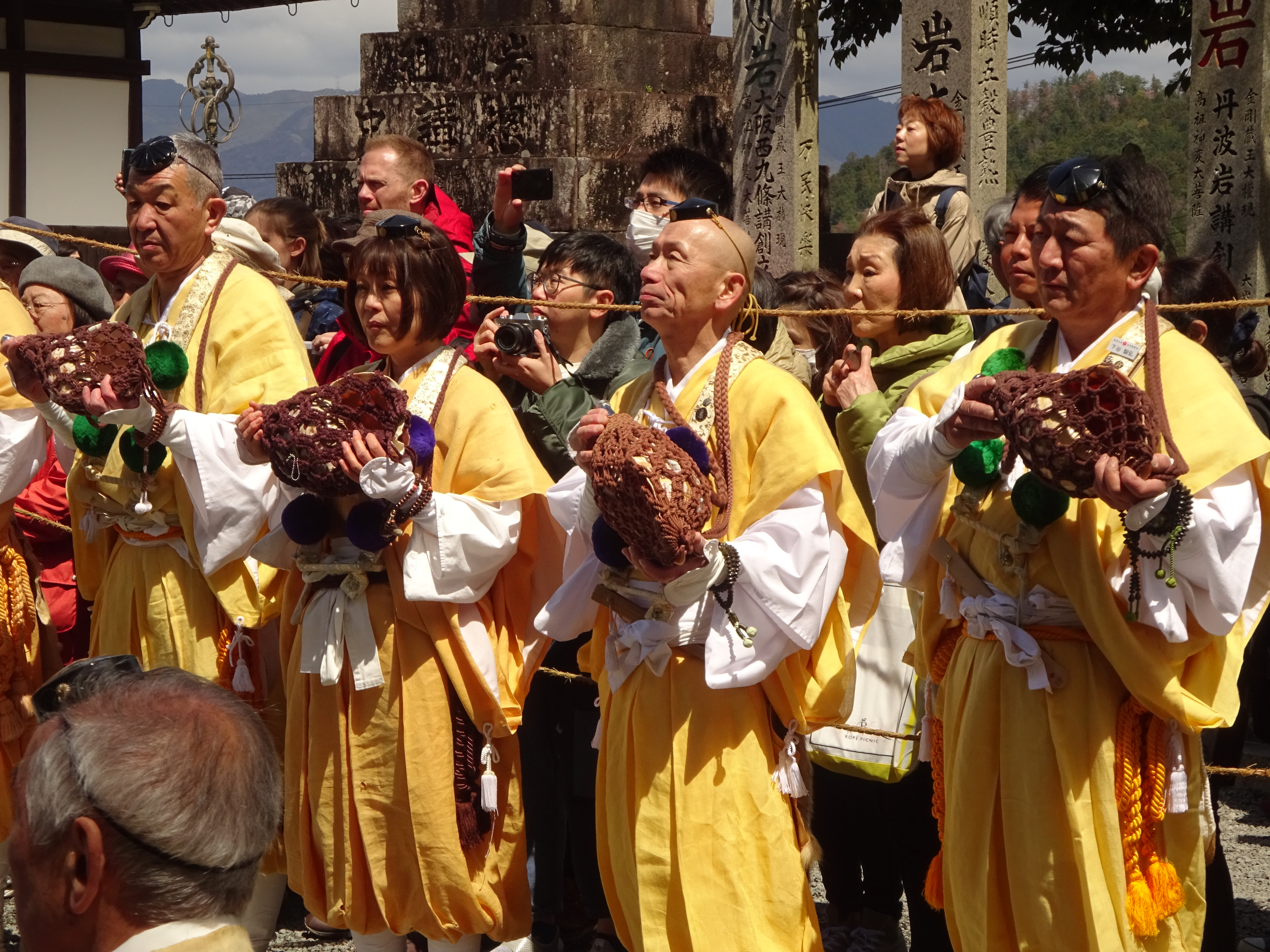 Yamabushi at Kinpusenji in Yoshino, photographed in 2019 by Havlicej. CC BY-SA 4.0 via Wikimedia Commons.
The Omine Okugakemichi is one of the most important Shugendo pilgrimage routes. It crosses rugged sections of the Kii Mountains between Yoshino and Kumano and links a series of sacred sites.
UNESCO includes the route within the Sacred Sites and Pilgrimage Routes in the Kii Mountain Range World Heritage property. The route is not merely a trail connecting temples. Its places are ritually charged stations within a sacred landscape.
Walking the path can become an act of reconstituting religious geography through the body. The practitioner does not study a map from afar. Distance is measured through fatigue, ascent, descent, weather, breath, prayer, and repeated encounters with specific peaks.
This embodied mapping is one of Shugendo’s most distinctive contributions to the history of ritual.
Yoshino, Kinpusenji, and Zao Gongen
Kinpusenji in Yoshino is a major Shugendo center and part of the UNESCO landscape. Its religious identity is strongly connected with Zao Gongen, a powerful syncretic deity associated with the mountain tradition.
Zao Gongen illustrates the problem of modern categories particularly well. The deity does not fit neatly into a simple pre-Buddhist kami versus Buddhist Buddha distinction. Gongen theology emerged from the world of kami-Buddha combination in which local sacred powers could manifest Buddhist realities.
Traditional imagery presents Zao Gongen as ferocious: a raised leg, fierce expression, dynamic posture, and wrathful energy. The form communicates active power capable of subduing obstacles and protecting practitioners.
Shugendo’s central deities often belong to precisely this kind of religious synthesis.
Kumano and the Geography of Death
Kumano in the Kii Peninsula developed as one of Japan’s most important pilgrimage regions. Emperors, aristocrats, monks, ascetics, and ordinary pilgrims traveled there over centuries.
The region’s mountains, waterfalls, and shrines became associated with purification, rebirth, the dead, and access to otherworldly realms. Shugendo practitioners incorporated Kumano routes into wider mountain networks.
This helps explain why mountain pilgrimage could function as a journey through death and return. The idea was not merely metaphorical invention. Certain landscapes were culturally imagined as thresholds to other worlds.
A pilgrim who returned from Kumano had completed more than exercise.
Dewa Sanzan: Present, Past, and Future
In northern Honshu, the Three Mountains of Dewa—Haguro, Gassan, and Yudono—preserve a distinctive Shugendo-related tradition.
Modern official descriptions interpret Haguro as the present world, Gassan as the past and realm of the dead, and Yudono as the future and rebirth. Pilgrimage through the mountains becomes a symbolic passage through death toward renewed life.
The system reflects regional history and should not be projected as the universal original meaning of every Shugendo mountain. Yet it offers a powerful example of how geography becomes ritual cosmology.
A route can function as a doctrine that must be walked.
Mount Yudono and Sacred Secrecy
Mount Yudono is famous for restrictions on photography and for traditions discouraging detailed description of the innermost sacred area.
Secrecy protects religious difference. A sacred place loses something when converted entirely into images for tourists. The rule also creates a boundary between those who have physically entered and those who know only through representation.
This does not mean every Shugendo practice is secret. Many rituals are public. But restricted knowledge remains important in lineages, mountain routes, initiations, and sacred sites.
The mountain must sometimes be encountered rather than explained.
Haguro Shugendo and the Akinomine
The autumn mountain-entry practice known as Akinomine is one of the best-known Dewa Sanzan ascetic programs.
Participants undergo several days of disciplined movement, ritual tasks, limited speech, mountain walking, purification, and other practices under experienced leaders. Some details are deliberately not publicized.
Modern heritage and tourism programs have made aspects of yamabushi training accessible to visitors, but this should not be confused with full ritual transmission. Participatory experiences exist on a spectrum from cultural introduction to serious religious training.
The persistence of Akinomine demonstrates that Shugendo is not only a museum tradition.
Mount Fuji and Shugendo
Mount Fuji became one of Japan’s most important sacred mountains and attracted practitioners from multiple religious backgrounds, including Shugendo-associated ascetics.
H. Byron Earhart’s study of Mount Fuji and Shugendo shows how mountain cults develop through changing institutions rather than one timeless belief. Fuji became connected with ascetics, confraternities, local deities, Buddhist interpretations, and mass pilgrimage.
By the early modern period, organized pilgrim associations allowed large numbers of ordinary people to participate in sacred-mountain travel.
This reminds us that mountain religion can expand from specialist asceticism into popular devotional networks.
Village Yamabushi and Everyday Religion
Not every yamabushi spent life wandering remote peaks. During the medieval and early modern periods, Shugendo practitioners were embedded in villages and regional religious economies.
They could perform healing, prayers, exorcistic rites, divination, calendrical services, funerary functions, pilgrimage leadership, and protective rituals. They connected remote mountain centers with ordinary households.
This role is essential for understanding why Shugendo became influential. Mountain austerity generated prestige, but practitioners brought that prestige back into society.
The ascetic leaves the village to gain efficacy and returns to use it.
Healing and Exorcistic Practice
Historical Shugendo included ritual responses to illness and affliction. Mantras, prayers, goma, amulets, divination, sacred water, and exorcistic techniques could all play roles.
Modern scholarship should describe these practices without presenting them as substitutes for medical treatment. Historical communities did not possess the same boundaries between medicine, religion, and magic that modern institutions use.
Illness could be interpreted simultaneously as physical, karmic, social, spiritual, and environmental.
The yamabushi’s authority came partly from operating across those categories.
Kuji and Ritual Protection
Popular culture frequently associates yamabushi with the nine-syllable formula known through forms of kuji practice. Modern martial arts and video games often present kuji-kiri as a ninja hand-sign system.
The historical picture is more complicated. Nine-syllable protective formulae have roots in Chinese religious and Daoist traditions and were transmitted through Japanese esoteric religious environments. Different lineages developed hand gestures, spoken formulae, and symbolic cutting or sealing practices.
Shugendo practitioners used protective ritual technologies within wider Buddhist frameworks. They were not simply casting fantasy spells.
This is another example of Japanese esotericism absorbing imported techniques and transforming them locally.
Shugendo and Daoist Influence
Older popular accounts often describe Shugendo as an equal mixture of Shinto, Buddhism, Daoism, and shamanism. This formula is too tidy.
Chinese religious ideas certainly influenced Japan. Yin-yang cosmology, immortality traditions, mountain practices, talismanic methods, calendrical systems, and protective formulae circulated through the broader East Asian world. Yet direct historical pathways vary.
Rather than treating Shugendo as a recipe with fixed percentages, historians trace specific practices and institutions.
The result is more accurate: Shugendo was profoundly syncretic, but syncretism developed historically rather than by combining four already separate religions at one moment.
Shugendo and Ainu Religion Are Not the Same Mountain Spirituality
Japan contains multiple indigenous and local traditions of sacred landscape. Modern comparisons sometimes merge them into one idea of “Japanese nature worship.”
This is especially misleading when discussing Ainu religion. Ainu concepts of kamuy, inau offerings, hunting ritual, and the iomante belong to a different cultural and linguistic history. SecretMagic’s article on Ainu kamuy, inau, and iomante shows how those traditions developed in northern Indigenous communities rather than in Buddhist mountain institutions.
Both traditions treat landscapes and nonhuman powers seriously, but similarity does not erase difference.
“Nature spirituality” is too broad to explain either one.
Women and the Mountain Boundary
Gender has been a major issue in the history of Japanese sacred mountains. Some mountains maintained restrictions excluding women from particular sacred zones. The most famous contemporary example is the traditional prohibition associated with part of Mount Omine.
Such restrictions emerged from complex ideas about purity, monastic discipline, sacred space, and gender. They should not be romanticized as timeless natural law.
Women also participated in mountain pilgrimage, local religion, confraternities, and other Shugendo-related practices. Scholarship increasingly examines female religious activity that older histories centered on male yamabushi overlooked.
Modern debates about access demonstrate that living traditions continue to negotiate historical boundaries.
The Meiji State Tried to Destroy Shugendo as a Mixed Religion
The most dramatic institutional rupture came after the Meiji Restoration.
Beginning in 1868, government policies promoted the separation of kami and buddhas, commonly known as shinbutsu bunri. These policies contributed to anti-Buddhist violence and the restructuring of religious institutions.
Shugendo was especially vulnerable because it embodied kami-Buddha combination. Masataka Suzuki’s 2018 study states that Shugendo was banned in 1872 and notes estimates that approximately 170,000 shugen practitioners were laicized or absorbed into Buddhist and Shinto institutions.
This event demonstrates why describing Shugendo as a timeless “Japanese religion” can be misleading. The modern category of religion itself was being restructured by the state.
Survival Through Reclassification
The ban did not erase local practice. Practitioners reorganized.
Some affiliated with Buddhist sects. Others became Shinto priests. Some returned to lay life while preserving pilgrimage customs, confraternities, family traditions, or local ritual knowledge.
After the Second World War and the restructuring of religion under a new legal framework, independent Shugendo institutions reemerged more openly.
Modern lineages therefore contain both continuity and reconstruction.
Why Modern Shugendo Is Not a Fake Revival
Whenever a tradition experiences suppression, historians face a difficult question: if institutions are later rebuilt, is the revived religion “authentic”?
The question assumes authenticity requires uninterrupted institutional form. Historical religions rarely work that way. Temples burn and are rebuilt. lineages split. Political regimes suppress practices. Communities reinterpret old rites.
UNESCO’s recognition of the Kii Mountains explicitly treats continuing ritual activity as part of the landscape’s authenticity while acknowledging long histories of reconstruction.
Continuity can survive through changed forms.
Yamabushi in Modern Japan
Contemporary yamabushi include temple clergy, lineage holders, lay practitioners, mountain guides, cultural educators, and people who participate periodically while maintaining ordinary professions.
Some centers offer introductory experiences to the public. Others maintain restricted training. Social media has made the white robes and conch shell globally recognizable.
This visibility creates opportunities and problems. Public programs can support rural communities and preserve practice, but commercialization can reduce complex religion to “samurai mindfulness” or endurance tourism.
Living practitioners negotiate that tension constantly.
Tourism and Ritual Are Not Automatically Opposites
It is tempting to assume that once tourists attend a ritual, authenticity disappears. Historically, pilgrimage sites have always had economies.
Pilgrims need food, lodging, guides, ritual goods, transport, and donations. Mountain towns developed around religious travel long before modern tourism.
The important question is not whether money is present but how the ritual is framed, who controls it, and whether religious communities retain authority over practice.
A guided experience can be educational without becoming initiation.
Why Shugendo Is Sometimes Called Shamanic
Comparative scholars have sometimes used the language of shamanism to describe aspects of Japanese mountain religion, spirit mediation, trance, possession, and ascetic power.
The comparison can illuminate certain patterns but is risky if treated as identity. “Shamanism” is a modern comparative category derived from specific northern Eurasian traditions. Shugendo has its own Buddhist institutions, textual lineages, deities, liturgies, and political history.
Calling every mountain ascetic a shaman erases those differences.
Comparison should begin after historical reconstruction, not replace it.
Does Shugendo Promise Supernatural Powers?
Traditional narratives frequently attribute extraordinary abilities to accomplished ascetics: prophecy, healing, control over spirits, resistance to danger, magical protection, rain-making, and other powers.
Buddhist traditions more broadly also contain accounts of siddhi-like powers arising from practice. Yet mature religious systems often warn that fascination with powers can distract from liberation or ethical cultivation.
Modern Shugendo teachers vary in how literally they interpret such claims. Some emphasize spiritual power, others psychological transformation, lineage, service, or embodied discipline.
Historical writing should record supernatural claims without presenting them as scientifically verified facts.
The Mountain as Mandala
One of the most powerful Shugendo ideas is that sacred geography can function like a mandala.
A painted mandala organizes divine figures in sacred space. A mountain mandala turns actual terrain into that structure. Peaks, caves, waterfalls, ridges, shrines, and temples correspond to religious stages and powers.
The practitioner enters the diagram physically.
This is perhaps the clearest example of how Shugendo transforms doctrine into movement. The body becomes the instrument with which cosmology is read.
Walking as Religious Knowledge
Modern scholarship often privileges texts because texts are easier to archive. Shugendo reminds us that knowledge can be muscular.
A sendachi knows how long a ridge takes in rain, where the dangerous descent begins, how the conch call changes by location, where prayers are offered, and when a novice is reaching exhaustion.
This knowledge is not fully contained in a book.
The mountain teaches through repetition, weather, fatigue, and guided memory.
Silence and Restricted Speech
Some Shugendo trainings restrict ordinary conversation. Silence reduces social performance and forces attention toward instruction, breath, sound, and environment.
When speech is restricted, ritual words become more powerful by contrast. A mantra, conch blast, prayer, or command occupies an acoustic space cleared of casual talk.
Restricted speech also strengthens group discipline. Participants do not negotiate every instruction.
The practice transforms language by limiting it.
Food, Fasting, and Mountain Plants
Ascetic traditions often regulate food because eating links body, environment, desire, and social life.
Yamabushi traditions include fasting as well as distinctive mountain cuisines using wild plants and vegetarian preparations. Dewa Sanzan food culture preserves strong connections between ascetic practice and edible mountain plants.
Fasting can prepare for ritual, reduce ordinary comfort, and create altered bodily awareness. Eating mountain foods after austerity can become part of reintegration.
As with other practices, there is no one universal Shugendo diet across all regions and centuries.
Fire, Water, Stone, and Forest as Ritual Media
Shugendo makes the elements of landscape ritually active.
Water purifies. Fire transforms offerings. Stone resists the body and marks sacred boundaries. Forest conceals and shelters. Height creates distance from ordinary settlement. Darkness alters perception. Weather imposes conditions no practitioner controls.
These meanings are religious because communities repeatedly ritualize them.
Nature becomes sacred through practice, narrative, deity, lineage, and memory—not simply because every natural object is automatically worshipped.
Why “Nature Worship” Is Too Simple
Popular descriptions often call Shugendo “nature worship.” The phrase captures the centrality of mountains but obscures the intellectual and ritual complexity of the tradition.
A yamabushi may chant Sanskrit-derived mantras, invoke Buddhist deities, perform esoteric mudras, honor local kami, walk a route associated with En no Gyoja, and interpret the landscape through mandala theory.
Calling all of this “nature worship” strips away history.
The mountain is sacred, but the ways in which it is sacred are learned.
Five Myths About Shugendo
“Shugendo is Japan’s unchanged prehistoric religion.”
No. It grew through historical interaction among mountain cults, Buddhism, kami traditions, pilgrimage institutions, and regional practice, especially during the medieval period.
“Every yamabushi is a Buddhist monk.”
No. Some are ordained clergy, but Shugendo has also included lay practitioners, married specialists, guides, and local religious professionals.
“Shugendo is just extreme hiking with meditation.”
No. Physical endurance is embedded in deity cult, liturgy, pilgrimage, sacred geography, initiation, and lineage.
“Shugendo simply combines Shinto, Buddhism, Taoism, and shamanism in equal parts.”
No. The tradition is highly syncretic, but specific influences entered through different historical pathways. The neat four-part formula is a modern simplification.
“The Meiji ban destroyed Shugendo completely.”
No. The ban shattered institutions and forced reclassification, but practices and lineages survived and were later reorganized.
What Makes Shugendo Esoteric?
Shugendo is esoteric not because everything is hidden, but because knowledge is layered.
Some rituals are public. Some teachings require initiation. Some routes are widely known but gain meaning only through guided practice. Some sacred sites restrict photography or description. Some liturgical knowledge belongs to formal lineages.
Esotericism here is embodied access.
The mountain reveals different things depending on who has been trained to read it.
Why Shugendo Matters for the Comparative History of Magic
Shugendo challenges modern divisions among religion, magic, medicine, pilgrimage, and physical training.
A goma ritual can be Buddhist liturgy and a technology of protection. Waterfall austerity can be purification and bodily ordeal. A mountain route can be pilgrimage and mandala. An ascetic can be healer, guide, priest, diviner, and community specialist.
This overlap resembles patterns found across the traditions studied on SecretMagic, but the Japanese historical structure remains distinctive.
The comparison is useful precisely because it shows that “magic” is often what modern observers call practices that older societies integrated into broader religious institutions.
The Future of a Mountain Tradition
Shugendo now faces challenges different from those of the nineteenth century. Rural depopulation, aging religious communities, environmental change, tourism pressure, and the commercialization of spiritual experience all affect sacred mountains.
At the same time, global interest has created new audiences. People seek mountain training for religious reasons, cultural education, personal transformation, historical interest, or environmental connection.
The tradition’s future will therefore involve negotiation: how to remain open without becoming generic wellness culture, how to preserve restricted knowledge without becoming invisible, and how to maintain dangerous mountain routes in societies increasingly concerned with liability and access.
Shugendo has survived previous transformations precisely because it is capable of reorganizing without losing the mountain as its center.
Conclusion: The Mountain as Teacher, Tomb, and Mandala
Shugendo is best understood neither as exotic self-punishment nor as timeless nature mysticism. It is a historical Japanese tradition that made sacred mountains into laboratories of religious transformation.
Its practitioners inherited Buddhist mantras, mudras, goma fire rites, mandala cosmology, kami cults, local mountain legends, pilgrimage routes, founder myths, healing practices, and disciplined forms of bodily training. The yamabushi entered the mountain not merely to escape society but to return to it with another kind of authority.
En no Gyoja became the legendary ancestor of this world. Yoshino and Omine became its central geography. Dewa Sanzan developed its own powerful journey of present, death, and rebirth. Kinpusenji and Shogoin preserved institutional lineages. Village practitioners carried mountain efficacy back into homes and communities.
The Meiji government tried to dismantle Shugendo because it represented the very religious mixture the new state wanted to separate. The ban demonstrated how artificial modern categories could be when imposed on older practice. Yet the tradition survived the attempt to classify it out of existence.
Today the conch still sounds in the mountains. Pilgrims still walk routes older than modern nation-state religion. Water still falls on ascetic bodies. Fire still consumes offerings. Mountains still organize religious time.
The deepest principle of Shugendo may be that knowledge is not always acquired by standing outside the world and describing it. Some knowledge must be walked. Some must be endured. Some appears only when the body has crossed a boundary and returned.
In that sense, the sacred mountain is more than a location. It is teacher, tomb, womb, mandala, and test.
Sources and References
- Miyake Hitoshi, “Religious Rituals in Shugendo: A Summary,” Japanese Journal of Religious Studies 16.2–3, Nanzan Institute for Religion and Culture: Nanzan Institute.
- Gorai Shigeru, “Shugendo Lore,” Japanese Journal of Religious Studies 16.2–3, Nanzan Institute for Religion and Culture.
- Gaynor Sekimori, “Shugendo: Japanese Mountain Religion – State of the Field and Bibliographic Review,” Religion Compass 3.1 (2009): Wiley.
- Masataka Suzuki, “The Meiji Restoration and Shugendo,” Journal of Religious Studies 92.2 (2018): J-STAGE.
- UNESCO World Heritage Centre, “Sacred Sites and Pilgrimage Routes in the Kii Mountain Range”: UNESCO.
- UNESCO Man and the Biosphere Programme, “Mount Odaigahara, Mount Omine and Osugidani”: UNESCO.
- Kinpusenji Temple, official English site: Kinpusenji.
- Shogoin Monzeki, head temple of Honzan Shugenshu: Shogoin.
- Japan National Tourism Organization, “Sacred Sites and Pilgrimage Routes in the Kii Mountain Range”: JNTO.
- Japan National Tourism Organization, “Spiritual Journeys in Japan’s National Parks,” section on Dewa Sanzan: JNTO.
- H. Byron Earhart, “Mount Fuji and Shugendo,” Japanese Journal of Religious Studies 16.2–3.
- Kawasaki Tsuyoshi, “The Invention and Reception of the Mino’odera engi,” Japanese Journal of Religious Studies 42.1 (2015).


